
|
시장보고서
상품코드
2062172
EMC 차폐 및 시험 장비 시장 : 점유율 분석, 업계 동향과 통계, 성장 예측(2026-2031년)EMC Shielding And Test Equipment - Market Share Analysis, Industry Trends & Statistics, Growth Forecasts (2026 - 2031) |
||||||
 Mordor Intelligence
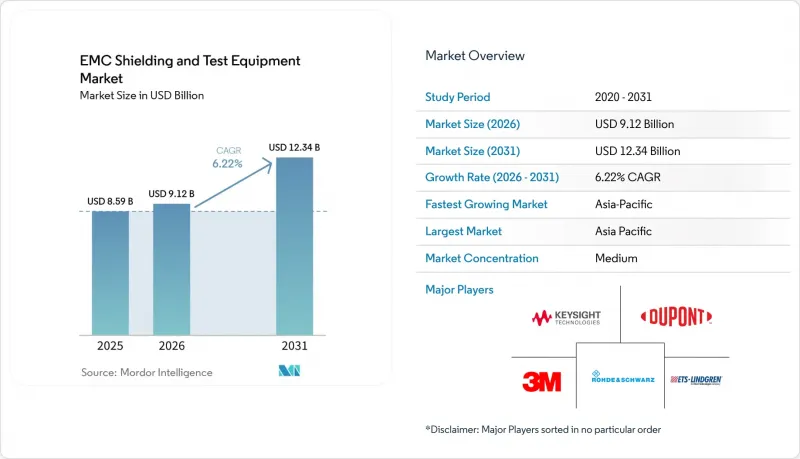
Mordor Intelligence에 의하면, EMC 차폐 및 시험 장비 시장은 2025년에 85억 9,000만 달러로 평가되었고 2026년 91억 2,000만 달러에서 2031년까지 123억 4,000만 달러에 이를 것으로 예측되며, 2026년부터 2031년까지 CAGR 6.22%로 성장할 전망입니다.
본 보고서는 제품 유형(차폐재 및 EMC 시험 장비), 차폐재의 유형(전도성 코팅 및 도료, 전도성 개스킷 및 O-링 등), 시험 장비의 유형(EMI 수신기 및 스펙트럼 분석기 등), 최종 사용자 산업(소비자용 전자기기, 자동차 등) 및 지역별로 분류되어 있습니다. 시장 전망은 금액(달러) 기준으로 제시되어 있습니다.
전 세계 EMC 차폐 및 시험 장비 시장 동향과 인사이트
EV 및 ADAS의 전동화로 인해 플랫폼당 EMC 관련 부품이 증가
전기 구동 시스템은 EMC 차폐 및 시험 장비 시장을 더욱 복잡한 차폐 아키텍처로 이끌고 있습니다. 이는 10 kHz 이상이고 최대 800 V인 트랙션 인버터가 배터리 케이블, 섀시 접지 및 ADAS 하네스를 통해 전도성 및 방사성 간섭을 발생시키기 때문입니다. TE Connectivity는 EV 플랫폼에서 하우징, 모듈, PCB 수준이라는 3개의 독립적인 차폐 계층을 구분하고 있으며, 각 계층에는 고유한 감쇠 목표와 검증 요건이 있습니다. 『Energies』지의 2025년 연구에 따르면, 표준 LISN으로는 트랙션 드라이브의 차동 모드 전도성 EMI를 완전히 포착할 수 없는 것으로 밝혀졌습니다. 이는 EV 프로그램에서 더 많은 맞춤형 측정 설정과 더 긴 시험 주기가 필요함을 의미합니다. 또한 소재 설계도 변화하고 있으며, Neklar사는 EMC 차폐와 난연성을 하나의 구조에 결합한 전기차 배터리 케이스용 듀얼 기능 차폐재를 도입했습니다. 또한, UNECE 규정 제10호 개정 제7판에서는 2025년 6월부터 전자 하위 어셈블리의 방사 방출 상한 주파수가 2,000 MHz에서 6,000 MHz로 상향 조정됨에 따라, UNECE 인증을 목표로 하는 모든 자동차 시험소에서 안테나 및 수신기에 대한 요건이 강화되었습니다.
5G 및 고주파 무선 기술의 확산
EMC 차폐 및 시험 장비 시장도 5G 확산의 혜택을 누리고 있습니다. 통신 사업자와 기기 제조업체들은 24GHz에서 44GHz에 이르는 전체 대역에서 효과를 발휘하는 새로운 무선 시험 시스템과 차폐 소재가 필요하기 때문입니다. ETSI EN 301 489-50 V2.4.1은 2025년 9월, 휴대전화 기지국, 중계기 및 관련 장비를 위한 업데이트된 EMC 조건을 공식적으로 규정하고 있으며, 이에 따라 개정된 OTA 시험 구성에 대한 새로운 수요가 뒷받침되고 있습니다. 『Journal of Computational Electronics』지에 게재된 연구에 따르면, 26GHz 5G n258 대역에서 0°에서 80°의 입사각에 걸쳐 안정적인 억제 효과를 보이는 컨포멀 주파수 선택성 표면(FSS)의 설계가 입증되었으며, 양산 규모에서 재료 성능의 정확성이 요구된다는 점이 강조되었습니다. 이러한 변화는 정밀 가공을 촉진하는 요인이기도 합니다. 왜냐하면 밀리파의 성능은 단순히 벌크 전도도나 충전재의 함유량뿐만 아니라, 형상, 적합성, 일관성에 크게 좌우되기 때문입니다. 유럽연합(EU) 회원국에서의 ETSI EN 301 489 -50 V2.4.1의 전국적인 도입은 2026년 6월까지 예정되어 있으며, 상충되는 규격은 2027년 6월까지 폐지될 예정이므로, EMC 차폐 및 시험 장비 시장 전반에서 규격 준수를 위한 전환이 활발히 진행되고 있습니다.
챔버 및 RF 계측 장비의 높은 자본 집약성
EMC 차폐 및 시험 장비 시장은 규격에 완벽하게 부합하는 챔버나 RF 계측 장비에 막대한 초기 투자가 필요하기 때문에 여전히 도입에 있어 큰 장벽에 직면해 있습니다. 신규 완전 무향실의 비용은 50만-200만 달러, 재생 시스템은 8만-40만 달러, 흡음재 교체에는 4만-20만 달러, 연례 교정에는 3,000-15,000달러가 소요됩니다. UNECE R10 개정 제7판에서는 일부 자동차 시험에 잔향실 요건이 추가되었기 때문에 완전한 준수를 목표로 하는 시험소에서는 단일 무향실 시설이 아닌 여러 유형의 시험실이 필요할 수 있습니다. 이러한 비용 부담으로 인해 많은 중소 제조업체들은 제3자 시험소를 이용해야 하는 상황에 몰리고 있으며, 그 결과 EMC 차폐 및 시험 장비 시장 전반에 걸쳐 시험 역량이 집중되면서 제품 출시 시기에 일정상의 압박이 발생하고 있습니다. 이에 대해 ATEC과 NTD Shielding은 2025년 6월, 공유 챔버 대여 풀을 출범시켰습니다. 이는 설비를 완전히 소유하기 어려운 상황에서 ‘서비스형 설비(Equipment-as-a-Service)’ 모델이 현실적인 해결책으로 자리 잡고 있음을 보여줍니다.
부문별 분석
2025년, EMC 차폐 및 시험 장비 시장에서 차폐 재료는 62.41%를 차지했습니다. 이는 소비자용 기기에서 항공기용 아비오닉스에 이르기까지, 거의 모든 전자기기 제조 분야에서 차폐 재료가 사용되고 있음을 반영합니다. EMC 차폐 및 시험 장비 시장의 이 분야에는 전도성 코팅, 개스킷, 적층판, 테이프, 호일, 금속 케이스 등이 포함되며, 많은 제품에서 동일한 어셈블리 내에 이러한 층을 여러 개 사용하고 있습니다. 연평균 성장률(CAGR) 6.35%를 기록하는 EMC 시험 장비는 2031년까지 가장 빠르게 성장하는 제품 유형이 될 것입니다. 이는 개정되는 규격에 따라 인증 시험소나 OEM 설계 팀이 측정해야 할 요건이 끊임없이 변화하고 있기 때문입니다.
EMC 차폐 및 시험 장비 업계 전반에서 이 두 제품군의 경계가 점차 모호해지고 있습니다. 이는 프리컴플라이언스 벤치가 설계 팀을 위한 표준 차폐 어셈블리 및 용도 가이드와 함께 판매되는 경우가 늘고 있기 때문입니다. 자동차 부품 공급업체 역시 UNECE R10 개정 7호에서 요구하는 과도 내성 프로파일을 재현한 프리컴플라이언스 벤치를 도입하여, 이를 통해 초기 설계 단계에서 외부 시험소에 대한 의존도를 낮추고 있습니다. Nolato는 2025년 엔지니어드 솔루션 부문 매출이 41억 100만 스웨덴 크로나(4억 2,400만 달러, 약 3억 8,700만 달러)였습니다고 보고했으며, 동사의 소재 하위 부문은 데이터센터 및 통신 분야 수요에 힘입어 2025년 4분기에 조정 후 성장률 기준 10%에 가까운 수치를 기록했습니다. 이러한 구성의 변화는 공정 내 전도성 코팅을 통해 재료층의 일부를 쉽게 전환할 수 있게 되었음에도 불구하고, EMC 차폐 및 시험 장비 업계가 새로운 컴퓨팅 및 통신 용도에 대응할 수 있는 공급업체를 평가하고 있음을 시사합니다.
라미네이트, 테이프 및 포일은 차폐 소재 중 가장 빠르게 성장하는 하위 부문이며, 이 범주의 EMC 차폐 및 시험 장비 시장은 2026년부터 2031년까지 연평균 성장률(CAGR) 6.42%로 확대될 것으로 전망됩니다. 이러한 재료의 장점은 유연성에 있습니다. 곡면이 있는 전기차용 배터리 하우징, ADAS 모듈 내의 리본 케이블, 폴더블 디스플레이 어셈블리의 경우, 공간이나 무게를 희생하지 않고 강성이 높은 차폐 구조를 채택하기 어려운 경우가 많기 때문입니다. 한편, 금속 인클로저나 캐비닛은 특히 산업용 전력 전자기기, 서버, 랙 시스템과 같이 질량보다 차폐 부피가 더 중요하게 여겨지는 분야에서 여전히 중요한 역할을 하고 있습니다.
전도성 코팅은 효과적인 차폐 성능과 경량성, 생산 유연성, 비용 효율성을 모두 갖추고 있어 EMC 차폐 및 시험 장비 시장에서 31.63%의 점유율을 차지하고 있습니다. 스마트폰, 태블릿, 노트북, 웨어러블 기기, IoT 제품 및 5G 기술의 활용이 확대됨에 따라, 전자 부품을 신호 간섭으로부터 보호하는 EMI 차폐 솔루션에 대한 수요가 크게 증가하고 있습니다. 이러한 코팅 및 도료는 소형 기기 본체나 인쇄 회로 기판에 쉽게 도포할 수 있어 널리 사용되고 있습니다. 기존의 금속 차폐와 달리, 전도성 코팅은 무게나 부피를 크게 늘리지 않으면서도 신뢰성 높은 전자기 보호 기능을 제공하므로, 소형 휴대용 전자 기기에 매우 적합합니다.
지역별 분석
아시아태평양은 2025년에 47.84%의 점유율을 차지해, 해당 지역의 EMC 차폐 및 시험 장비 시장은 2031년까지 연평균 성장률(CAGR) 6.51%로 성장할 것으로 전망됩니다. 중국은 전기차 생산, 5G 구축, 그리고 국내 반도체 투자 등 모든 분야에서 대규모 EMC 규정 준수 투자가 필수적이기 때문에 계속해서 주도적인 중심 역할을 수행하고 있습니다. 2025년 2월에 공표된 GB/T 18655-2025는 자동차 EMC 시험 대상 주파수를 5,925 MHz까지 확대하고, 전기차 전용 시험 설정 및 V2X 보호 요건을 추가했습니다. 2025년 12월에 공표된 GB/T 46894-2025는 IC 수준의 자동차 EMC 시험을 도입했으며, 화웨이(Huawei)와 체리 자동차(Chery Automobile)가 초안 작성 기관에 포함되어 있어, 중국 자동차 EMC 규격의 보다 자립적인 발전 방향을 시사하고 있습니다. 일본과 한국에서는 디스플레이, 파워 반도체, 가전제품 분야 수요가 견조한 추세를 보이고 있는 반면, 인도는 제조 거점으로 부상하고 있으며, Nolato는 현지 전자기기 생산을 지원하기 위해 벵갈루루에 EMC 대응 시설을 개설했습니다.
북미는 EMC 차폐 및 시험 장비의 지역 시장 규모에서 2위를 차지하고 있으며, 성숙한 상용 시험 역량과 항공우주 및 방위 분야의 고부가가치 수요에 힘입어 성장하고 있습니다. 2025년부터 2026년까지 FCC가 취한 조치(인증 시험소의 인증 취소, 상호 인정되지 않는 국가에서의 시험 단계적 폐지안, 2026년 6월 15일에 발효되는 ‘Trusted Test Lab’ 절차 등)에 따라, 미국 내 인증 수익의 배분 구조가 재편되고 있습니다. 또한, 미국과 캐나다는 AI 데이터센터 건설의 상당 부분을 주도하고 있으며, 이로 인해 800G 하드웨어와 관련된 차폐 인클로저, 개스킷 및 고주파 검증 도구에 대한 새로운 수요가 발생하고 있습니다. 멕시코는 특히 전기차 배터리 팩 제조 거점에서의 근해 자동차 조립의 혜택을 누리고 있으며, 이에 따라 사전 규격 준수 능력과 차체 통합에 대한 현지 수요가 증가하고 있습니다.
유럽은 EMC 차폐 및 시험 장비 분야에서 여전히 정책 주도형 시장이며, EN 61000-6-4: 2026, ETSI EN 301 489-50 V2.4.1 및 UNECE R10 Revision 7이 모두 적극적으로 채택되거나 시행되고 있습니다. 독일은 Rohde and Schwarz를 통해 계측 장비 분야의 거점으로서의 입지를 유지하고 있는 반면, 프랑스에 본사를 둔 Emitech는 2026년 1월부로 ExoTest 3E의 자산을 인수하여 자동차용 EMC 서비스 분야의 입지를 강화했습니다. 남미는 규모는 작지만, ANATEL 관련 규정 준수 수요와 현지 자동차 조립 산업을 원동력으로 꾸준히 성장하고 있는 반면, 중동에서는 아랍에미리트와 사우디아라비아가 주도하는 5G 인프라 확충 및 데이터센터 투자를 통해 미래 수요가 조성되고 있습니다. 아프리카에서는 인증 취득에 있어 여전히 유럽 인증 시험소에 주로 의존하고 있어, 이로 인해 현지 시험 인프라는 제한적이지만, 통신 기기 및 산업용 기기 수입에 따른 자재 수요를 충당할 여지는 남아 있습니다.
기타 혜택:
- 엑셀 형식 시장 예측(ME) 시트
- 3개월간의 애널리스트 지원
자주 묻는 질문
목차
제1장 서론
제2장 조사 방법
제3장 주요 요약
제4장 시장 구도
제5장 시장 규모와 성장 예측
제6장 경쟁 구도
제7장 시장 기회와 향후 전망
JHS 26.06.19According to Mordor Intelligence, the eMC shielding and test equipment market was valued at USD 8.59 billion in 2025 and is estimated to grow from USD 9.12 billion in 2026 to reach USD 12.34 billion by 2031, growing at a CAGR of 6.22% from 2026 to 2031.
This report is Segmented by Product Type (Shielding Materials, and EMC Test Equipment), Shielding Material Type (Conductive Coatings and Paints, Conductive Gaskets and O-Rings, and More), Test Equipment Type (EMI Receivers and Spectrum Analyzers, and More), End-User Industry (Consumer Electronics, Automotive, and More), and Geography. The Market Forecasts are Provided in Terms of Value (USD).
Global EMC Shielding And Test Equipment Market Trends and Insights
EV And ADAS Electrification Raising EMC Content Per Platform
Electric drivetrains are pushing the EMC shielding and test equipment market toward more complex shielding architectures because traction inverters above 10 kHz and up to 800 V create conducted and radiated interference across battery cables, chassis grounds, and ADAS harnesses. TE Connectivity identified 3 separate shielding layers for EV platforms: enclosure, module, and PCB level, and each layer has its own attenuation target and validation requirements. A 2025 study in Energies found that standard LISNs do not fully capture differential-mode conducted EMI in traction drives, which means more custom measurement setups and longer test cycles for EV programs. Material design is also shifting, as Neklar introduced dual-function shielding for EV battery enclosures that combines EMC containment with flame resistance in one structure. UNECE Regulation No. 10, Revision 7, also extended the upper radiated emissions frequency for electronic sub-assemblies from 2,000 MHz to 6,000 MHz in June 2025, raising the antenna and receiver requirements for every automotive laboratory seeking UNECE accreditation.
5G And High-Frequency Wireless Expansion
The EMC shielding and test equipment market is also benefiting from the 5G rollout, as operators and device makers need new over-the-air test systems and shielding materials that remain effective across the 24 GHz to 44 GHz range. ETSI EN 301 489-50 V2.4.1 formalized updated EMC conditions for cellular base stations, repeaters, and related equipment in September 2025, which supports fresh demand for revised OTA test configurations. Research in the Journal of Computational Electronics demonstrated a conformal frequency-selective surface design with stable suppression from 0° to 80° incidence at the 26 GHz 5G n258 band, underscoring the need for precise material performance at the production scale. The same shift favors precision fabrication, because mmWave performance depends heavily on geometry, fit, and consistency rather than only on bulk conductivity or filler loading. National adoption of ETSI EN 301 489-50 V2.4.1 across European Union member states is due by June 2026, and conflicting standards are scheduled for withdrawal by June 2027, which keeps the compliance transition active across the EMC shielding and test equipment market.
High Capital Intensity Of Chambers And RF Instrumentation
The EMC shielding and test equipment market still faces a significant adoption barrier because full-compliance chambers and RF instrumentation require substantial upfront spending. New fully anechoic chambers cost USD 500,000 to USD 2 million; refurbished systems cost USD 80,000 to USD 400,000; absorber replacement runs USD 40,000 to USD 200,000; and annual calibration adds USD 3,000 to USD 15,000. UNECE R10 Revision 7 adds reverberation chamber requirements for some automotive tests, so labs seeking full compliance may need more than one chamber type instead of a single anechoic setup. That cost burden pushes many small and mid-sized manufacturers toward third-party labs, which concentrate test capacity and create scheduling pressure during launch periods across the EMC shielding and test equipment market. ATEC and NTD Shielding responded with a shared-chamber rental pool in June 2025, demonstrating that equipment-as-a-service models are becoming a practical answer when outright ownership is difficult.
Other drivers and restraints analyzed in the detailed report include:
- Stricter EMC Regulations And Certification Mandates
- AI Server And 800G Infrastructure EMI Hot Spots
- EMC Engineering Talent Shortage And Test Complexity
For complete list of drivers and restraints, kindly check the Table Of Contents.
Segment Analysis
Shielding materials accounted for 62.41% of the EMC shielding and test equipment market in 2025, reflecting their use across nearly every electronics manufacturing category, from consumer devices to aircraft avionics. This side of the EMC shielding and test equipment market covers conductive coatings, gaskets, laminates, tapes, foils, and metal enclosures, and many products use more than one of these layers in the same assembly. That broad distribution across enclosures, modules, and PCB structures explains why materials revenue outpaced test equipment revenue in 2025. At the same time, EMC test equipment with 6.35% CAGR is the faster-growing product type through 2031 because revised standards keep changing what qualified laboratories and OEM design teams need to measure.
The line between the 2 product groups is narrowing across the EMC shielding and test equipment industry, because pre-compliance benches are increasingly sold with reference shielding assemblies and application guidance for design teams. Automotive suppliers are also buying pre-compliance benches that mirror the transient immunity profiles required under UNECE R10 Revision 7, thereby reducing dependence on external labs during early design work. Nolato reported FY2025 Engineered Solutions revenue of SEK 4,101 million (USD 424 million), which was approximately USD 387 million, and its materials sub-segment posted adjusted growth of nearly 10% in Q4 2025, led by data center and telecom demand. That mix shift suggests the EMC shielding and test equipment industry is rewarding suppliers that can serve newer compute and communications programs, even as in-process conductive coatings make switching easier in parts of the materials tier.
Laminates, tapes, and foils are the fastest-growing subsegment of shielding materials, with the EMC shielding and test equipment market for this category forecast to expand at a 6.42% CAGR from 2026 to 2031. Their advantage lies in flexibility, as curved EV battery housings, ribbon cables in ADAS modules, and foldable display assemblies often cannot use rigid shielding structures without incurring space or weight penalties. Metal enclosures and cabinets remain important where bulk shielding matters more than mass, especially in industrial power electronics, servers, and rack systems.
Conductive coatings accounted for 31.63% share of the EMC shielding and test equipment market due to their ability to combine effective shielding performance with lightweight characteristics, production flexibility, and cost efficiency. The growing use of smartphones, tablets, laptops, wearable devices, IoT products, and 5G technologies has significantly increased the demand for EMI shielding solutions that protect electronic components from signal interference. These coatings and paints are extensively adopted because they can be easily applied to compact device enclosures and printed circuit boards. Unlike conventional metal shielding, conductive coatings provide reliable electromagnetic protection without adding substantial weight or bulk, making them highly suitable for compact, portable electronic devices.
Geography Analysis
Asia-Pacific held a 47.84% share in 2025, and the regional EMC shielding and test equipment market is forecast to grow at a 6.51% CAGR through 2031. China remains the center of that lead because EV production, 5G deployment, and domestic semiconductor investment all carry mandatory EMC compliance spending at scale. GB/T 18655-2025 extended vehicle EMC test coverage to 5,925 MHz and added EV-specific setups and V2X protection requirements in February 2025. GB/T 46894-2025, published in December 2025, introduced IC-level vehicle EMC testing and included Huawei and Chery Automobile among the drafters, which points to a more independent automotive EMC standards path in China. Japan and South Korea add strong demand from displays, power semiconductors, and consumer appliances, while India is emerging as a manufacturing base, with Nolato opening an EMC-capable facility in Bangalore to support local electronics production.
North America is the second-largest regional market for EMC shielding and test equipment, supported by mature commercial test capacity and high-value demand from the aerospace and defense sector. FCC actions across 2025 and 2026, including revoked lab recognitions, the proposed phase-out of non-reciprocal country testing, and the Trusted Test Lab process effective June 15, 2026, are reshaping where certification revenue goes within the United States. The United States and Canada also anchor much of the AI data center build-out, which is adding a fresh demand stream for shielded enclosures, gaskets, and high-frequency validation tools tied to 800G hardware. Mexico is benefiting from nearshored automotive assembly, especially in EV battery pack manufacturing corridors, which is raising local demand for pre-compliance capability and shielding integration.
Europe remains a policy-led market for EMC shielding and test equipment, as EN 61000-6-4:2026, ETSI EN 301 489-50 V2.4.1, and UNECE R10 Revision 7 are all in active adoption or implementation. Germany remains the instrumentation hub through Rohde and Schwarz, while France-based Emitech strengthened its automotive EMC service position by acquiring ExoTest 3E assets effective January 2026. South America is smaller but growing steadily, driven by ANATEL-related compliance demand and local automotive assembly, while the Middle East is building future demand through 5G densification and data center investment led by the United Arab Emirates and Saudi Arabia. Africa still relies mainly on European-accredited laboratories for certification, which limits local testing infrastructure but leaves room to shield material demand in telecom and industrial equipment imports.
- Rohde & Schwarz GmbH & Co. KG
- Keysight Technologies, Inc.
- ETS-Lindgren Inc.
- 3M Company
- Parker-Hannifin Corporation
- DuPont de Nemours, Inc. (Laird Performance Materials)
- Henkel AG & Co. KGaA
- PPG Industries, Inc.
- TE Connectivity Ltd.
- Amphenol Corporation
- Nolato AB
- Methode Electronics, Inc.
- Leader Tech Inc.
- Boyd Corporation
- Teseq AG
- Intertek Group plc
- SGS SA
- Bureau Veritas SA
- Yokogawa Electric Corporation
- Anritsu Corporation
- Kitagawa Industries Co., Ltd.
- EM Test (GmbH)
- LISUN Group
- TDK Corporation
Additional Benefits:
- The market estimate (ME) sheet in Excel format
- 3 months of analyst support
TABLE OF CONTENTS
1 INTRODUCTION
- 1.1 Study Assumptions and Market Definition
- 1.2 Scope of the Study
2 RESEARCH METHODOLOGY
3 EXECUTIVE SUMMARY
4 MARKET LANDSCAPE
- 4.1 Market Overview
- 4.2 Market Drivers
- 4.2.1 5G and High-Frequency Wireless Expansion
- 4.2.2 EV and ADAS Electrification Raising EMC Content Per Platform
- 4.2.3 Stricter EMC Regulations and Certification Mandates
- 4.2.4 Device Miniaturization and Higher Electronics Density
- 4.2.5 Expanded Automotive EMC Test Scope Under UNECE and GB/T Updates
- 4.2.6 AI Server and 800G Infrastructure EMI Hot Spots
- 4.3 Market Restraints
- 4.3.1 High Capital Intensity of Chambers and RF Instrumentation
- 4.3.2 EMC Engineering Talent Shortage and Test Complexity
- 4.3.3 mmWave and Above-40 GHz Calibration Uncertainty
- 4.3.4 Thermal-Airflow and EMI Redesign Tradeoffs in Advanced Electronics
- 4.4 Industry Value-Chain Analysis
- 4.5 Regulatory Landscape
- 4.6 Technological Outlook
- 4.7 Impact of Macroeconomic Factors on the Market
- 4.8 Porter's Five Forces Analysis
- 4.8.1 Threat of New Entrants
- 4.8.2 Bargaining Power of Suppliers
- 4.8.3 Bargaining Power of Buyers
- 4.8.4 Threat of Substitutes
- 4.8.5 Competitive Rivalry
5 MARKET SIZE AND GROWTH FORECASTS (VALUE)
- 5.1 By Product Type
- 5.1.1 Shielding Materials
- 5.1.2 EMC Test Equipment
- 5.2 By Shielding Material Type
- 5.2.1 Conductive Coatings and Paints
- 5.2.2 Conductive Gaskets and O-rings
- 5.2.3 Laminates / Tapes and Foils
- 5.2.4 Metal Enclosures and Cabinets
- 5.3 By Test Equipment Type
- 5.3.1 EMI Receivers and Spectrum Analyzers
- 5.3.2 RF Power Amplifiers
- 5.3.3 Antennas and Probes
- 5.3.4 Transient / ESD Generators
- 5.3.5 EMC Test Software
- 5.4 By End-user Industry
- 5.4.1 Consumer Electronics
- 5.4.2 Automotive
- 5.4.3 Telecom and IT Infrastructure
- 5.4.4 Aerospace and Defense
- 5.4.5 Medical Devices
- 5.4.6 Industrial and Energy
- 5.5 By Geography
- 5.5.1 North America
- 5.5.1.1 United States
- 5.5.1.2 Canada
- 5.5.1.3 Mexico
- 5.5.2 South America
- 5.5.2.1 Brazil
- 5.5.2.2 Argentina
- 5.5.2.3 Rest of South America
- 5.5.3 Europe
- 5.5.3.1 United Kingdom
- 5.5.3.2 Germany
- 5.5.3.3 France
- 5.5.3.4 Italy
- 5.5.3.5 Rest of Europe
- 5.5.4 Asia-Pacific
- 5.5.4.1 China
- 5.5.4.2 Japan
- 5.5.4.3 India
- 5.5.4.4 South Korea
- 5.5.4.5 Rest of Asia-Pacific
- 5.5.5 Middle East
- 5.5.5.1 United Arab Emirates
- 5.5.5.2 Saudi Arabia
- 5.5.5.3 Turkey
- 5.5.5.4 Israel
- 5.5.5.5 Rest of Middle East
- 5.5.6 Africa
- 5.5.6.1 South Africa
- 5.5.6.2 Egypt
- 5.5.6.3 Rest of Africa
- 5.5.1 North America
6 COMPETITIVE LANDSCAPE
- 6.1 Market Concentration
- 6.2 Strategic Moves
- 6.3 Market Share Analysis
- 6.4 Company Profiles (includes Global Level Overview, Market Level Overview, Core Segments, Financials as available, Strategic Information, Market Rank/Share, Products and Services, Recent Developments)
- 6.4.1 Rohde & Schwarz GmbH & Co. KG
- 6.4.2 Keysight Technologies, Inc.
- 6.4.3 ETS-Lindgren Inc.
- 6.4.4 3M Company
- 6.4.5 Parker-Hannifin Corporation
- 6.4.6 DuPont de Nemours, Inc. (Laird Performance Materials)
- 6.4.7 Henkel AG & Co. KGaA
- 6.4.8 PPG Industries, Inc.
- 6.4.9 TE Connectivity Ltd.
- 6.4.10 Amphenol Corporation
- 6.4.11 Nolato AB
- 6.4.12 Methode Electronics, Inc.
- 6.4.13 Leader Tech Inc.
- 6.4.14 Boyd Corporation
- 6.4.15 Teseq AG
- 6.4.16 Intertek Group plc
- 6.4.17 SGS SA
- 6.4.18 Bureau Veritas SA
- 6.4.19 Yokogawa Electric Corporation
- 6.4.20 Anritsu Corporation
- 6.4.21 Kitagawa Industries Co., Ltd.
- 6.4.22 EM Test (GmbH)
- 6.4.23 LISUN Group
- 6.4.24 TDK Corporation
7 MARKET OPPORTUNITIES AND FUTURE OUTLOOK
- 7.1 White-Space and Unmet-Need Assessment