

|
시장보고서
상품코드
2062175
경량 소재 : 시장 점유율 분석, 산업 동향 및 통계 데이터, 성장 예측(2026-2031년)Lightweight Materials - Market Share Analysis, Industry Trends & Statistics, Growth Forecasts (2026 - 2031) |
||||||
 Mordor Intelligence
Mordor Intelligence에 의하면, 경량 소재 시장 규모는 2025년에 1억 9,992만 달러로 평가되었습니다. 2026년 2억 1,975만 달러에서 2031년까지 3억 5,263만 달러에 이를 것으로 예상되며, 예측 기간(2026-2031년) CAGR은 9.92%를 나타낼 전망입니다.
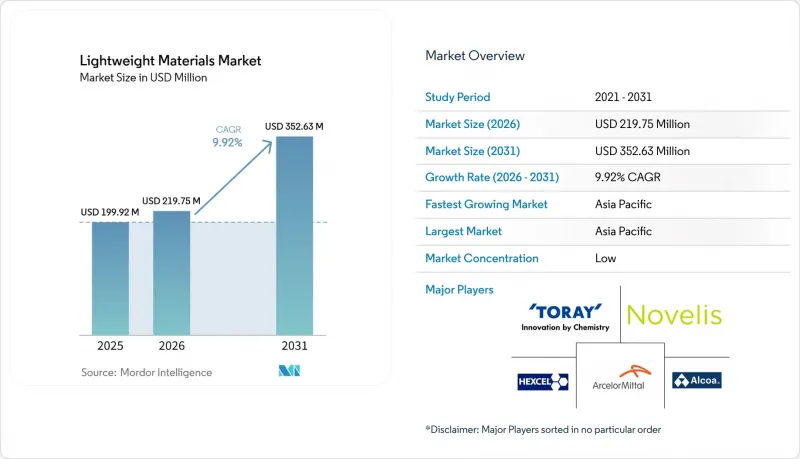
본 보고서는 제품 유형(폴리머, 복합재료, 금속), 제조 공정(압출·압연, 적층 가공 등), 최종 사용자 산업(자동차, 항공우주 및 방위 등) 및 지역(아시아태평양, 북미, 유럽, 남미, 중동 및 아프리카)별로 분류되어 있습니다. 시장 전망은 금액(달러) 기준으로 제시되어 있습니다.
세계의 경량 소재 시장 동향 및 인사이트
전 세계적인 CO2 배출 규제 및 연비 규제의 강화
유럽연합(EU), 중국 및 미국이 설정한 차량군 평균 CO2 배출량 상한선으로 인해, 자동차 제조업체들은 신규 플랫폼마다 100-150kg의 경량화를 추진해야 하는 상황에 놓여 있습니다. EU에서는 차량 1대당 CO2 배출량이 기준을 초과할 경우, 1그램당 95유로의 벌금이 부과됩니다. 그 결과, 경량화된 차체 패널, 서브프레임 및 시트 구조는 규제 준수를 위한 필수적인 조치가 되었습니다. 중국이 개정된 듀얼 크레딧 제도에 따르면, 100킬로미터(km)당 11kW시(kWh) 미만의 소비량을 달성하는 신에너지차(NEV)에 보너스 크레딧이 부여되는데, 이 목표를 달성하기 위해서는 알루미늄 차체(Body-in-White)와 마그네슘제 내장 주조 부품이 필수적입니다. 미국 환경보호청(EPA)이 2024년에 발표한, 2027-2032년 모델 연식을 대상으로 한 지침에 따르면, 2026년 수준 대비 모든 차종의 CO2 배출량을 56% 감축하는 것을 목표로 하고 있습니다. 이러한 규제로 인해 자동차 제조업체(OEM)는 배터리의 무게를 상쇄하기 위해 고강도 알루미늄이나 탄소섬유 강화 플라스틱(CFRP)을 도입해야 하는 상황에 놓여 있습니다. 그 결과, 경량 소재 시장은 차량 설계와 규제 준수가 교차하는 지점에 위치하게 되었습니다.
수소 저장 및 공급에 대한 중량 제한
미국 에너지부(DOE)는 소형 연료전지 차량에 대해 700바의 압력에서 수소를 중량비 5.5%(wt%)로 저장하도록 의무화하고 있습니다. 이러한 성능은 수소 적재량이 5kg인 경우, 중량이 90-110kg인 유형 IV CFRP 탱크를 사용할 때에만 달성할 수 있습니다. 대형 트럭도 마찬가지로 같은 요건에 직면해 있습니다. 니콜라사의 8탱크 모듈은 70kg의 수소를 저장하면서도 전체 어셈블리의 질량을 500kg 미만으로 유지하여, 미국의 차축 중량 제한을 준수하고 있습니다. 일본은 2025년에 수소 충전소를 위해 2억 5,000만 달러의 보조금을 편성했으며, 각 충전소에는 15-20개의 저장 모듈이 필요합니다. 이러한 노력을 통해 국내 탄소섬유 수요는 연간 8,000톤 증가할 것으로 예측됩니다. CFRP 탱크에 대한 구조적 수요는 항공우주 산업이나 자동차 산업의 변동과 무관하게 경량 소재 시장에 안정적인 기반을 제공합니다.
에너지 집약적인 채굴 및 가공
1차 알루미늄 제련은 1톤당 15-16MWh를 소비하며, 전력 비용 변동의 영향을 받습니다. 이는 2023년, 유럽의 전력 가격 상승으로 인해 80만 톤의 생산 능력이 중단되면서 입증되었습니다. 탄소섬유 제조에는 전구체의 산화 및 탄화 공정에서 1톤당 80-110MWh가 필요합니다. 티타늄 생산에 사용되는 크롤 공정에서는 1톤당 60-80MWh의 전력이 필요하며, 염화마그네슘 폐기물이 발생합니다. 높은 전력 수요는 비용과 스코프 1 탄소 배출량을 증가시키며, 비활성 양극 알루미늄(ELYSIS)이나 전기화 티타늄 공정과 같은 기술이 대규모 상용화에 성공하지 않는 한, 경량 소재 시장에 영향을 미칠 가능성이 있습니다.
부문별 분석
2025년에는 풍력 발전용 블레이드의 연간 수요가 120만 톤에 달했고, 보잉 787 및 에어버스 A350의 생산 대수가 팬데믹 이전 수준으로 거의 회복됨에 따라, 탄소섬유 강화 및 유리섬유 강화 폴리머가 매출의 64.42%를 차지했습니다. 비용 효율을 중시하는 건설 분야에서는 유리 섬유가 여전히 주류를 이루고 있지만, 폴리에테르에테르케톤(PEEK)이나 폴리에테르이미드(PEI)와 같은 내열성 폴리머는 특히 연기와 연기·독성에 관한 규제로 인해 금속 사용이 배제되는 배터리 하우징이나 전기 모터의 절연체 분야에서 채택이 확대되고 있습니다. 자동차 리프트게이트에 적합한 3-4분의 사이클 타임을 실현하는 열가소성 테이프의 인기에 힘입어, 복합 경량 소재 시장은 더욱 성장할 것으로 예측됩니다.
금속 시장은 알루미늄의 기가 주조, 중국의 마그네슘 사용 의무화, 그리고 티타늄 적층 가공 기술의 발전에 힘입어 2031년까지 연평균 성장률(CAGR) 9.28%를 나타낼 것으로 전망됩니다. 재활용률 90%, 이산화탄소(CO2) 배출량이 2.3톤/톤인 폐쇄형 순환 알루미늄은 탄소국경조정메커니즘(CBAM)의 기준을 충족하므로, OEM(원청 브랜드 제조업체)이 제품을 ‘탄소중립에 가까운’ 제품으로 표시할 수 있게 합니다. 내식성 플라즈마 전해 산화 코팅의 비용 효율성이 향상되고, 1kg당 8달러 미만으로 떨어질 가능성이 높아짐에 따라, 경량 소재 시장에서 마그네슘 시장 점유율은 확대될 것으로 예측됩니다. 티타늄은 여전히 특수한 용도로만 사용되고 있지만, Norsk Titanium사의 급속 플라즈마 증착 기술을 통해 구매에서 비행까지의 비율(Buy-to-Fly Ratio)이 10-20%에서 2% 미만으로 낮아져, 항공우주용 합금의 비용을 30-40% 절감합니다.
지역별 분석
2025년 기준으로, 아시아태평양은 경량 소재 시장의 41.12%를 차지했습니다. 예측에 따르면, 이 시장 점유율은 2031년까지 연평균 성장률(CAGR) 9.77%를 나타낼 전망입니다. 중국의 8개 부처가 공동으로 추진하는 마그네슘 촉진 정책에 따라, 국내 자동차 수요는 5.3배로 증가하여 2028년까지 8만 톤에 달할 것으로 예측됩니다. 일본에서는 수소 충전소에 대한 보조금 지원으로 인해 탄소섬유 전구체의 생산 능력이 연간 8,000톤 증가할 것으로 예측됩니다. 한국에서는 도레이와 SK가 4,500억 원(2억 9,000만 달러) 규모의 합작 사업을 통해 항공우주 및 연료전지차용 탄소섬유를 연간 3,000톤 생산할 예정입니다.
유럽은 세계 수요에 크게 기여하고 있습니다. 2025년, 독일의 자동차 제조업체(OEM)는 20만 톤에 가까운 알루미늄 시트를 소비했습니다. 앞으로 아르셀로미탈의 덩케르크에 위치한 수소 구동 직접환원철(DRI) 생산라인은 2026년부터 유럽의 전기차(EV)용 배터리 케이스 제작에 사용될 150만 톤의 저탄소강을 공급할 전망입니다. 그러나 브렉시트로 인한 통관상의 마찰로 인해, 영국의 복합재 주익 생산의 15%가 유럽 대륙의 공장으로 이전되면서, 정책 변화에 대한 업계의 민감성이 여실히 드러나고 있습니다.
북미에서는 켄튀르키예주에 위치한 노벨리스사의 60만 톤 규모 재활용 사업 확대와 테슬라사가 몬테레이 및 오스틴 시설에 기가캐스팅을 도입함에 따라 꾸준한 성장이 나타나고 있습니다. 캐나다의 복합재 동체 부문은 비즈니스 제트기 생산 대수 감소로 인해 어려움을 겪고 있지만, 그 감소분은 주로 미국의 로켓 발사체에 대한 수요로 상쇄되고 있습니다. 멕시코는 배터리 공급망에서 미국·멕시코·캐나다 협정(USMCA)의 원산지 규정 요건에 부합하는 1차 공급업체의 이전으로 인한 혜택을 누리고 있으며, 경량 소재 시장에서 해당 지역의 점유율을 확대되고 있습니다.
기타 혜택 :
- 엑셀 형식 시장 예측(ME) 시트
- 3개월간의 애널리스트 지원
자주 묻는 질문
목차
제1장 서론
제2장 분석 방법
제3장 주요 요약
제4장 시장 구도
제5장 시장 규모 및 성장률 예측
제6장 경쟁 구도
제7장 시장 기회 및 향후 전망
KTH 26.06.24According to Mordor Intelligence, the lightweight materials market size was valued at USD 199.92 million in 2025 and is estimated to grow from USD 219.75 million in 2026 to reach USD 352.63 million by 2031, at a CAGR of 9.92% during the forecast period (2026-2031).
This report is Segmented by Product Type (Polymers and Composites and Metals), Manufacturing Process (Extrusion and Rolling, Additive Manufacturing, and More), End-User Industry (Automotive, Aerospace and Defense, and More), and Geography (Asia-Pacific, North America, Europe, South America, and Middle East and Africa). The Market Forecasts are Provided in Terms of Value (USD).
Global Lightweight Materials Market Trends and Insights
Stricter Global CO2 and Fuel-Economy Regulations
Fleet-average carbon ceilings set by the European Union (EU), China, and the United States (U.S.) are prompting automakers to reduce 100-150 kilograms (kg) from every new platform. The EU imposes penalties of EUR 95 for each gram of excess CO2 per car. As a result, lightweight closures, subframes, and seat structures have become essential compliance measures. China's updated dual-credit scheme provides bonus credits for New Energy Vehicles (NEVs) consuming below 11 kilowatt-hours (kWh)/100 kilometers (km), a target that is challenging to meet without aluminum body-in-white and magnesium interior castings. The U.S. Environmental Protection Agency's (EPA) 2024 directive for model years 2027-2032 targets a 56% reduction in fleet-wide CO2 emissions from 2026 levels. This regulation is driving Original Equipment Manufacturers (OEMs) to adopt high-strength aluminum and Carbon Fiber Reinforced Polymer (CFRP) to offset battery mass. Consequently, the lightweight materials market is positioned at the intersection of vehicle design and regulatory compliance.
Hydrogen Storage and Distribution Weight Limits
The Department of Energy (DOE) mandates that light-duty fuel-cell vehicles must store 5.5 weight percent (wt%) hydrogen at 700 bar. This performance is achievable only with Type IV CFRP vessels, which weigh between 90 and 110 kg for a 5 kg hydrogen payload. Heavy-duty trucks face similar requirements: Nikola's eight-tank module carries 70 kg of hydrogen while keeping the total assembly mass under 500 kg, ensuring compliance with U.S. axle-weight limits. Japan has allocated USD 250 million in 2025 subsidies for hydrogen stations, each requiring 15-20 storage modules. This initiative is expected to increase domestic carbon-fiber demand by 8,000 tons annually. The structural demand for CFRP tanks provides a stable foundation for the lightweight materials market, independent of fluctuations in the aerospace or automotive industries.
Energy-Intensive Extraction and Processing
Primary aluminum smelting consumes 15-16 MWh per ton and is subject to electricity cost fluctuations. This was demonstrated in 2023 when European power price increases led to 800 kilotons of capacity being taken offline. Producing carbon fiber requires 80-110 MWh per ton during precursor oxidation and carbonization. The Kroll process for titanium production demands 60-80 MWh per ton and generates magnesium-chloride waste. High power requirements increase costs and scope-1 carbon emissions, potentially impacting the lightweight materials market unless technologies like inert-anode aluminum (ELYSIS) and electrified titanium processes achieve large-scale commercialization.
Other drivers and restraints analyzed in the detailed report include:
- Rapid Aerospace and Reusable-Launch Adoption
- AI-Driven Generative-Design Mass Optimization
- Mixed-Material End-of-Life Separation Hurdles
For complete list of drivers and restraints, kindly check the Table Of Contents.
Segment Analysis
In 2025, carbon-fiber-reinforced and glass-fiber-reinforced polymers accounted for 64.42% of the revenue, supported by a 1.2 million tons annual demand for wind blades and a near-recovery of Boeing 787 and Airbus A350 production rates to pre-pandemic levels. Glass fiber remains prevalent in cost-sensitive construction, while high-temperature polymers like polyether ether ketone (PEEK) and polyetherimide (PEI) are gaining traction in battery housings and electric motor insulators, particularly where flame-smoke toxicity regulations exclude metals. The market for composite lightweight materials is expected to grow further, driven by thermoplastic tapes enabling 3-4 minute cycle times suitable for automotive lift gates.
Metals are projected to grow at a 9.28% compound annual growth rate (CAGR) through 2031, driven by aluminum giga-casting, China's magnesium mandate, and advancements in titanium additive manufacturing. Closed-loop aluminum, with 90% recycled content and a carbon dioxide (CO2) footprint of 2.3 tons CO2/ton, complies with Carbon Border Adjustment Mechanism (CBAM) thresholds, enabling original equipment manufacturers (OEMs) to label products as near-carbon-neutral. The market share for magnesium in lightweight materials is expected to increase as corrosion-resistant plasma-electrolytic-oxidation coatings become more cost-effective, potentially dropping below USD 8/kg. Titanium remains specialized, but Norsk Titanium's rapid-plasma-deposition technology reduces buy-to-fly ratios from 10-20% to under 2%, lowering aerospace alloy costs by 30-40%.
Geography Analysis
In 2025, the Asia-Pacific region accounted for 41.12% of the lightweight materials market. Projections indicate this share will grow at a 9.77% compound annual growth rate (CAGR), extending to 2031. China's eight-ministry magnesium initiative is expected to increase domestic automotive demand by 5.3 times, reaching 80,000 tons by 2028. In Japan, subsidies for hydrogen refueling stations are anticipated to raise carbon-fiber precursor capacity by 8,000 tons annually. South Korea's KRW 450 billion (USD 0.29 billion) joint venture between Toray and SK is set to produce 3,000 tons of carbon fiber, catering to aerospace and fuel-cell vehicles.
Europe contributes significantly to global demand. In 2025, German original equipment manufacturers (OEMs) consumed nearly 200 kilotons of aluminum sheets. Looking ahead, ArcelorMittal's hydrogen-driven direct reduced iron (DRI) line in Dunkirk is projected to supply 1.5 million tons of low-carbon steel for European electric vehicle (EV) battery enclosures starting in 2026. However, Brexit-induced customs frictions have shifted 15% of the United Kingdom's (UK) composite wing production to continental plants, highlighting the industry's sensitivity to policy changes.
North America is experiencing steady growth, supported by Novelis's 600 kiloton recycling expansion in Kentucky and Tesla's adoption of giga-casting at its Monterrey and Austin facilities. While Canada's composite fuselage sector is facing challenges due to declining business-jet volumes, the decrease is largely offset by demand for United States (U.S.) launch vehicles. Mexico is benefiting from Tier-1 relocations aligning with the United States-Mexico-Canada Agreement (USMCA) rules-of-origin requirements for battery supply chains, enhancing the region's share in the lightweight materials market.
- Alcoa Corporation
- ArcelorMittal
- Covestro
- CRS Holdings, LLC
- ExxonMobil
- Gestamp
- Hexcel Corporation
- Norsk Titanium US Inc.
- Novelis Inc.
- SABIC
- SGL Carbon
- Solvay
- Toray Industries Inc.
- US Magnesium LLC
Additional Benefits:
- The market estimate (ME) sheet in Excel format
- 3 months of analyst support
TABLE OF CONTENTS
1 Introduction
- 1.1 Study Assumptions and Market Definition
- 1.2 Scope of the Study
2 Research Methodology
3 Executive Summary
4 Market Landscape
- 4.1 Market Overview
- 4.2 Market Drivers
- 4.2.1 Growing Demand for Fuel-Efficient and High-Performance Vehicles
- 4.2.2 Expansion of EV And Battery-Electric Platforms
- 4.2.3 Stringent Global Emission and Fuel-Economy Regulations
- 4.2.4 Rapid Adoption in Commercial Aerospace and Space Launch
- 4.2.5 Lightweighting Needs in Hydrogen Storage and Distribution
- 4.3 Market Restraints
- 4.3.1 High and Volatile Prices of Critical Raw Materials
- 4.3.2 Energy-Intensive Extraction and Processing Routes
- 4.3.3 Recycling and End-of-Life Separation Challenges
- 4.4 Value Chain Analysis
- 4.5 Porter's Five Forces Analysis
- 4.5.1 Bargaining Power of Suppliers
- 4.5.2 Bargaining Power of Buyers
- 4.5.3 Threat of New Entrants
- 4.5.4 Threat of Substitutes
- 4.5.5 Degree of Competition
5 Market Size and Growth Forecasts (Value)
- 5.1 By Product Type
- 5.1.1 Polymers and Composites
- 5.1.1.1 CFRP
- 5.1.1.2 GFRP
- 5.1.1.3 Thermoplastic Composites
- 5.1.1.4 High-performance Polymers (PEEK, PEI)
- 5.1.2 Metals
- 5.1.2.1 Aluminium
- 5.1.2.2 Magnesium
- 5.1.2.3 Titanium
- 5.1.2.4 High-strength Steel
- 5.1.1 Polymers and Composites
- 5.2 By Manufacturing Process
- 5.2.1 Extrusion / Rolling
- 5.2.2 Additive Manufacturing
- 5.2.3 Resin Transfer Molding
- 5.2.4 Hot Stamping and Hydroforming
- 5.3 By End-user Industry
- 5.3.1 Automotive
- 5.3.2 Aerospace and Defense
- 5.3.3 Construction
- 5.3.4 Energy (Wind, Hydrogen)
- 5.3.5 Marine
- 5.3.6 Other Industries (Sports, Rail, Packaging)
- 5.4 By Geography
- 5.4.1 Asia-Pacific
- 5.4.1.1 China
- 5.4.1.2 India
- 5.4.1.3 Japan
- 5.4.1.4 South Korea
- 5.4.1.5 ASEAN Countries
- 5.4.1.6 Rest of Asia-Pacific
- 5.4.2 North America
- 5.4.2.1 United States
- 5.4.2.2 Canada
- 5.4.2.3 Mexico
- 5.4.3 Europe
- 5.4.3.1 Germany
- 5.4.3.2 United Kingdom
- 5.4.3.3 France
- 5.4.3.4 Italy
- 5.4.3.5 Spain
- 5.4.3.6 Rest of Europe
- 5.4.4 South America
- 5.4.4.1 Brazil
- 5.4.4.2 Mexico
- 5.4.4.3 Rest of South America
- 5.4.5 Middle East and Africa
- 5.4.5.1 Saudi Arabia
- 5.4.5.2 United Arab Emirates
- 5.4.5.3 South Africa
- 5.4.5.4 Rest of Middle East and Africa
- 5.4.1 Asia-Pacific
6 Competitive Landscape
- 6.1 Market Concentration
- 6.2 Strategic Moves
- 6.3 Market Share (%)/Ranking Analysis
- 6.4 Company Profiles {(includes Global level Overview, Market level overview, Core Segments, Financials as available, Strategic Information, Market Rank/Share for key companies, Products and Services, and Recent Developments)}
- 6.4.1 Alcoa Corporation
- 6.4.2 ArcelorMittal
- 6.4.3 Covestro
- 6.4.4 CRS Holdings, LLC
- 6.4.5 ExxonMobil
- 6.4.6 Gestamp
- 6.4.7 Hexcel Corporation
- 6.4.8 Norsk Titanium US Inc.
- 6.4.9 Novelis Inc.
- 6.4.10 SABIC
- 6.4.11 SGL Carbon
- 6.4.12 Solvay
- 6.4.13 Toray Industries Inc.
- 6.4.14 US Magnesium LLC
7 Market Opportunities and Future Outlook
- 7.1 White-space and Unmet-Need Assessment
- 7.2 Circular Economy and Recycling Innovation
- 7.3 Lightweight Materials for Hydrogen Economy


