|
시장보고서
상품코드
2062180
방음 커튼 : 시장 점유율 분석, 업계 동향 및 통계, 성장 예측(2026-2031년)Soundproof Curtains - Market Share Analysis, Industry Trends & Statistics, Growth Forecasts (2026 - 2031) |
||||||
 Mordor Intelligence
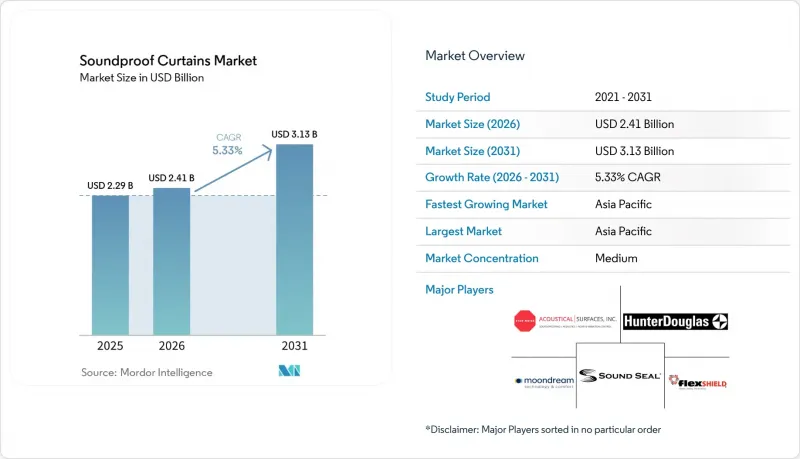
Mordor Intelligence에 의하면, 방음 커튼 시장 규모는 2025년에 22억 9,000만 달러로 평가되었습니다. 2026년 24억 1,000만 달러에서 2031년까지 31억 3,000만 달러에 이를 것으로 예상되며, 예측 기간(2026-2031년) CAGR은 5.33%를 나타낼 전망입니다.
본 보고서는 유형별(차음, 소음 저감, 방음), 재료별(유리솜, 암면, 플라스틱 폼, 천연섬유, 기타), 최종 사용자별(주택, 상업, 산업, 의료·교육 시설), 지역별(아시아태평양, 북미, 유럽, 남미, 중동 및 아프리카)로 분류되어 있습니다. 시장 전망은 금액(달러) 기준으로 제시되어 있습니다.
세계의 방음 커튼 시장 동향과 인사이트
산업 소음 노출 한계치가 강화됨
OSHA(미국 산업안전보건청) 및 유럽연합(EU) 규제 당국이 공장 및 창고의 소음 수준에 대한 감시를 강화하고 있는 만큼, 사업자들은 현재 8시간 근무 교대 중 데시벨 수치가 기준치를 초과할 경우 항상 공학적 대책에 투자하고 있습니다. 자동차, 전자상거래, 식품 가공 공장에서 도입이 증가하고 있는 이동식 방음벽은 고정식 인클로저보다 비용 대비 효과가 높을 뿐만 아니라, 레이아웃 변경 시 이동할 수 있다는 추가적인 장점도 언급하고 있습니다. 2025년부터 독일, 프랑스, 이탈리아에서 분기별 소음 모니터링 의무화가 도입됨에 따라, 뛰어난 방음 성능으로 알려진 두꺼운 비닐 라미네이트 커튼의 미처리 주문량이 급증하고 있습니다. 급속히 확대되고 있는 아시아태평양 시장에서는 다국적 기업들이 근로자 안전에 관한 보고 기준을 엄격한 유럽연합(EU) 기준에 맞추고 있기 때문에 현지 규제가 아직 정비 중인 지역이라 하더라도 인증을 받은 방음 커튼에 대한 수요가 높아지고 있습니다.
음향 쾌적성을 평가하는 그린빌딩 인증
LEED v4.1이 실내 음향 품질에 대해 크레딧을 부여하고, WELL v2가 배경 소음의 기준치를 설정한 데 따라, 개발사들은 천장 패널 및 소음 마스킹을 보완하는 커튼형 흡음 시스템에 주목하고 있습니다. LEED 인증을 획득한 사무실은 주요 도시에서 높은 임대료를 기대할 수 있기 때문에 이러한 음향 관련 크레딧은 부동산 소유주들 사이에서 수요가 높으며, 커튼에 대한 투자와 수익 증대 사이에 직접적인 연관성이 입증되었습니다. 인증 기관은 현재 제조 과정에서의 탄소 배출량에 초점을 맞춘 환경 제품 선언(EPD)을 중시하고 있으며, 재활용성 문제로 인해 PVC 라미네이트 제품은 기피되고 있습니다. Knauf Insulation과 같은 공급업체는 유리솜 코어에 바이오 결합제를 적용하여 VOC 및 포름알데히드 기준을 준수하는 것은 물론, 자사의 음향 제품이 친환경 건축 기준을 충족하도록 하고 있습니다.
습도가 높은 기후 조건에서의 성능 저하
상대 습도가 70%를 넘으면 폴리에스터 섬유로 만든 커튼의 흡음 성능이 떨어집니다. 검사 결과에 따르면, 섬유가 팽윤함에 따라 내부의 다공성이 저하되는 것으로 나타났습니다. 인도네시아, 베트남, 필리핀 등의 연안 지역에서는 일년중 대부분 기간 동안 습도가 80% 이상의 경우가 흔합니다. 이러한 차이로 인해 실험실에서의 STC 평가값과 실제 환경에서의 성능 사이에 차이가 발생합니다. 곰팡이나 흰곰팡이가 발생하기 쉬운 미처리 유기 섬유 원단은 의료 위생 기준을 위반하는 악취를 풍기므로 조기에 교체해야 합니다. 현재, 사양 결정권자들은 통일된 내습성 라벨이 없어 경험에 의존하고 있기 때문에 입찰 주기가 길어지고 있습니다. 전용 ISO 규격이 없기 때문에 습기와 관련된 문제는 여전히 남아 있어, 급성장하고 있는 열대 지역 시장에서의 도입을 저해하고 있습니다.
부문별 분석
방음 커튼 시장은 2026년부터 2031년까지의 예측 기간 동안 연평균 성장률(CAGR) 5.72%를 나타낼 것으로 예측되며, 2025년 소음 저감 제품이 차지했던 매출 점유율 46.68%를 점차 축소시킬 것으로 전망됩니다. 이러한 추세는 1데시벨의 차이도 중요한 화상 통화에서 최종 사용자가 완벽한 소음 차단을 원하고 있음을 보여줍니다. 그 결과, 방음 커튼 시장, 특히 차음형 시장 규모는 전반적인 수요보다 빠른 속도로 확대되고 있습니다. 이러한 성장은 기업의 조달 기준에 부합하는 사양에 힘입은 것입니다. 복합 용도 건물에서는 소유주가 인접한 소매·오락 시설에서 영업 시간 외에 발생하는 소음을 주거 공간에서 효과적으로 차단하기 위해, 칸막이 벽에 방음 커튼을 설치하는 사례가 늘고 있습니다.
방음 효과는 물론, 차광성과 단열성을 겸비한 방음 커튼은 에너지 절약 효과 덕분에 높은 비용을 정당화할 수 있는 한랭 지역에서 인기가 높아지고 있습니다. Moondream의 특허를 취득한 디자인은 중주파 소음을 반사하는 금속화 층과 실내의 반향음을 흡수하는 면 펠트 안감을 특징으로 하며, 다양한 성능 특성을 겸비하고 있습니다. 기존에는 산업용 구매자들이 소음 저감 기준을 충족하기 위해 두꺼운 비닐 라미네이트 제품을 선호했으나, 현재는 더 가벼운 주택용 방음 커튼도 동등한 성능 수준을 달성함에 따라 사용자층 간의 차이는 점차 좁혀지고 있습니다.
지역별 분석
2025년, 아시아태평양은 전 세계 매출의 41.78%를 차지했으며, 중국의 수출 주도형 공장 및 인도의 도시화 확대에 힘입어 2026-2031년의 예측 기간 동안 연평균 성장률(CAGR) 6.05%를 나타낼 것으로 전망됩니다. 2024년 매출을 늘린 칭다오 캐티란은 주로 북미와 유럽으로 수출하며, 표준화된 커튼 공급 분야에서 해당 지역의 선도적 입지를 공고히 하고 있습니다. 광둥 창야(Guangdong Chuangya)는 규모의 경제와 경쟁적인 노동력을 활용하여 생산량의 대부분을 해외로 수출하고 있으며, 제품 가격은 유럽 및 미국의 경쟁사들보다 훨씬 낮게 책정되어 있습니다. 일본과 한국은 소비자들의 환경 문제에 대한 우려에 부응하는 차원에서 수익성이 높은 천연섬유 및 재생 PET 제품으로 사업 방향을 전환하고 있습니다. 아세안 연안 도시에서는 습도와 관련된 문제가 폴리에스터 제품의 판매를 저해하고 있어, 내습성 혼합 소재에 대한 연구 개발이 활발해지고 있습니다.
북미에서는 시장 상황이 양극화되는 양상을 보이고 있습니다. 뉴욕, 시애틀, 토론토 등 해안 도시에서는 명확한 환경 제품 선언서(EPD)를 갖춘 LEED 인증 커튼이 우선적으로 채택되고 있는 반면, 내륙 주에서는 초기 비용을 중시하여 캐나다나 멕시코의 집하 센터를 경유해 아시아태평양의 제품을 조달하고 있습니다. 미국은 1인당 지출액이 가장 높지만, 이는 재택근무 시 소음 방지 대책 비용을 직원들에게 지원하는 기업 방침이 뒷받침하고 있기 때문입니다. 한편, 캐나다에서는 2025년 7월부터 시행되는 확대 생산자 책임(EPR) 규정에 따라 유틸리티에서 재활용 자재 사용률을 높여야 할 의무가 부과되고 있습니다.
유럽은 환경 규정 준수에 관한 최고 기준을 확립하고 있습니다. 2000년 이후 EU는 PVC 재활용 분야에서 눈부신 진전을 이루었으며, 새로운 ‘그린 딜’을 통해 2030년까지 섬유 폐기물 회수량을 두 배로 늘리는 것을 목표로 하고 있습니다. 사용 후 커튼 회수 제도가 없는 제품은 구매자로부터 불이익을 받을 수 있기 때문에 PET 펠트나 울의 사용이 증가하고 있습니다. EN 13501-1의 방화 규정은 엄격하게 시행되고 있으며, 인증을 받지 않은 수입품은 공공 입찰에서 사실상 배제되고 있습니다. 또한, 에너지 가격 변동으로 인해 독일과 이탈리아의 시설 소유주들은 겨울철 난방비를 대폭 절약할 수 있는 다층 커튼을 선호하는 추세입니다.
남미, 중동 및 아프리카 등의 지역은 개발의 호기를 맞이하고 있습니다. 브라질에서는 상파울루와 리우데자네이루의 고층 빌딩 시장에서 엄격한 방화 기준을 준수하면서도 방음성과 사생활 보호가 중요시됨에 따라, 비용 효율이 뛰어난 폴리우레탄 제품이 주류를 이루고 있습니다. 걸프협력회의(GCC) 지역에서는 사우디아라비아의 네옴과 같은 메가 프로젝트가 프리미엄 공급업체를 유치하고 있지만, 신속한 납기를 요구하기 때문에 현지에 재고를 보유한 공급업체가 유리합니다. 한편, 남아프리카에서는 환율 변동으로 인해 수입량이 감소하고 있지만, 전자상거래가 부상하면서 소형 커튼을 소비자에게 직접 배송하고 있습니다. 그러나 이러한 지역 전반에 걸쳐 표준화된 기준이 부재하기 때문에 평균 판매 가격이 하락하고, 인증 취득에 대한 투자 회수 기간이 길어지고 있습니다.
기타 혜택
- 엑셀 형식 시장 예측(ME) 시트
- 3개월간의 애널리스트 지원
자주 묻는 질문
목차
제1장 서론
제2장 조사 방법
제3장 주요 요약
제4장 시장 구도
제5장 시장 규모 및 성장 예측
제6장 경쟁 구도
제7장 시장 기회 및 향후 전망
KTH 26.06.22According to Mordor Intelligence, the soundproof curtains market size was valued at USD 2.29 billion in 2025 and is estimated to grow from USD 2.41 billion in 2026 to reach USD 3.13 billion by 2031, at a CAGR of 5.33% during the forecast period (2026-2031).
This report is Segmented by Type (Sound-Insulating, Noise-Reducing, Sound-Blocking), Material (Glass Wool, Rock Wool, Plastic Foams, Natural Fibers, and More), End-User (Residential, Commercial, Industrial, Healthcare and Educational Facilities), and Geography (Asia-Pacific, North America, Europe, South America, Middle-East and Africa). The Market Forecasts are Provided in Terms of Value (USD).
Global Soundproof Curtains Market Trends and Insights
Industrial Noise-Exposure Limits Becoming Stricter
With OSHA and European Union (EU) regulators ramping up audits on sound levels in factories and warehouses, operators are now investing in engineering controls whenever decibel readings exceed the threshold over an 8-hour shift. Movable barriers, increasingly adopted by automotive, e-commerce, and food-processing plants, are not only more cost-effective than rigid enclosures but also offer the added advantage of being relocated during layout changes. Quarterly noise-monitoring mandates, introduced in 2025 across Germany, France, and Italy, have resulted in a spike in order backlogs for heavy vinyl-laminate curtains known for their high attenuation. In the rapidly expanding Asia-Pacific markets, multinationals are aligning their worker-safety reporting with stringent European Union (EU) standards, leading to a heightened demand for certified acoustic drapes, even in areas where local regulations are still evolving.
Green-Building Credits Rewarding Acoustic Comfort
Developers are turning to curtain-based absorption systems, which complement ceiling panels and sound masking, as LEED v4.1 awards credits for indoor acoustic quality and WELL v2 sets background limits. These acoustic credits are in high demand among landlords, as LEED-certified offices can command premium rents in major cities, establishing a direct link between curtain investments and revenue boosts. Certification bodies are now emphasizing Environmental Product Declarations that spotlight embodied carbon, sidelining PVC-laminate products due to their recyclability issues. Suppliers like Knauf Insulation are integrating bio-based binders into their glass-wool cores, ensuring compliance with VOC and formaldehyde standards, and aligning their acoustic products with green-building criteria.
Performance Degradation in Humid Climates
When relative humidity exceeds 70%, polyester-fiber curtains experience a drop in attenuation. Test observations indicate that swollen fibers reduce internal porosity. In coastal regions such as Indonesia, Vietnam, and the Philippines, humidity levels often exceed 80% for most of the year. This discrepancy leads to a gap between laboratory STC ratings and real-world performance. Untreated organic fabrics, which are susceptible to mold and mildew, emit odors that violate healthcare hygiene standards, necessitating premature replacement. Currently, specifiers lack a unified humidity-resilience label and rely on anecdotal evidence, which extends tender cycles. Without a dedicated ISO standard, humidity challenges have persisted, hindering adoption in tropical growth markets.
Other drivers and restraints analyzed in the detailed report include:
- IoT-Enabled Acoustic Monitoring Spurring Retrofit Demand
- Circular-Economy Mandates Favoring Recyclable Drapes
- Fire-Safety Certification Gaps in Emerging Markets
For complete list of drivers and restraints, kindly check the Table Of Contents.
Segment Analysis
Sound-blocking curtains are projected to grow at a 5.72% CAGR during the forecast period of 2026-2031, gradually reducing the 46.68% revenue share held by noise-reducing products in 2025. This trend highlights the demand among end-users for complete acoustic isolation during video calls, where every decibel is critical. As a result, the market for soundproof curtains, particularly sound-blocking variants, is expanding at a faster rate than overall demand. This growth is supported by specifications that align with enterprise procurement criteria. In mixed-use buildings, owners are increasingly selecting sound-blocking curtains for party walls to effectively shield apartments from the after-hours noise of adjacent retail entertainment.
Sound-insulating curtains, which combine noise reduction with blackout and thermal benefits, are gaining popularity in colder regions, where energy savings justify the higher costs. Moondream's patented design features a metalized layer that reflects mid-frequency noise and a cotton-felt backing that absorbs internal echoes, showcasing a blend of diverse performance attributes. While industrial buyers have traditionally preferred heavy vinyl laminate to meet noise reduction standards, lighter residential-grade blocking curtains are now achieving comparable performance levels, narrowing the distinctions between user categories.
Geography Analysis
In 2025, the Asia-Pacific region accounted for 41.78% of global revenue and is projected to grow at a 6.05% CAGR through the forecast period of 2026-2031, fueled by China's export-driven factories and India's urban expansion. Qingdao Catilan, having boosted its 2024 revenue, predominantly exports to North America and Europe, reinforcing the region's leadership in standardized curtain supplies. Guangdong Chuangya, leveraging scale and competitive labor, exports most of its production overseas, pricing its products significantly lower than Western counterparts. Japan and South Korea are pivoting towards high-margin natural fibers and recycled PET variants, resonating with consumer environmental concerns. In coastal ASEAN cities, humidity-related challenges are curbing polyester sales, prompting intensified research and development into moisture-resistant blends.
North America showcases a split landscape. Coastal hubs such as New York, Seattle, and Toronto prioritize LEED-compliant drapes with explicit Environmental Product Declarations (EPDs), while inland states focus on upfront costs, sourcing Asia-Pacific products via consolidation centers in Canada and Mexico. The United States tops per-capita spending, aided by corporate policies reimbursing employees for home-office acoustic enhancements. At the same time, Canada's Extended Producer Responsibility (EPR) regulations, effective July 2025, are mandating heightened recycled content in public initiatives.
Europe sets the gold standard for environmental compliance. Since 2000, the bloc has made significant strides in PVC recycling, and with the new Green Deal, aims to double textile-waste recovery by 2030. Curtains lacking end-of-life take-back schemes face buyer penalties, leading to a rise in PET felt and wool usage. Fire regulations in EN 13501-1 are rigorously enforced, effectively excluding non-certified imports from public tenders. Additionally, energy price fluctuations are prompting facility owners in Germany and Italy to favor multi-layer curtains, which offer substantial winter heating savings.
Regions such as South America, the Middle-East and Africa are ripe for exploration. In Brazil, high-rise markets in Sao Paulo and Rio emphasize acoustic privacy, sidestepping stringent fire ratings, allowing cost-effective polyurethane products to dominate. In the Gulf Cooperation Council, mega-projects such as Saudi Arabia's Neom are receptive to premium suppliers but demand rapid turnarounds, benefiting vendors with local storage. While currency shifts in South Africa curtail import volumes, e-commerce is stepping in, delivering small-format curtains to consumers. However, a lack of standardized benchmarks across these regions depresses average selling prices and elongates the payback period for certification investments.
- Acoustical Surfaces Inc.
- Amcraft Manufacturing
- Enviro
- Flexshield Group Pty Ltd
- Guangzhou Dajulong Acoustic Material
- Haining Juncheng Textile Co.,Ltd
- Hofa-Akustik
- Hunter Douglas
- Impact Acoustic AG
- Kinetics Noise Control Inc.
- LANTAL
- MMT Acoustix
- Moondream
- Quiet Curtains
- Quietco
- Rose Brand
- Shanghai Zaiqiang Acoustic
- Sound Seal
Additional Benefits:
- The market estimate (ME) sheet in Excel format
- 3 months of analyst support
TABLE OF CONTENTS
1 Introduction
- 1.1 Study Assumptions and Market Definition
- 1.2 Scope of the Study
2 Research Methodology
3 Executive Summary
4 Market Landscape
- 4.1 Market Overview
- 4.2 Market Drivers
- 4.2.1 Surge in remote-working and home-studio culture
- 4.2.2 Industrial noise-exposure limits becoming stricter
- 4.2.3 Green-building credits rewarding acoustic comfort
- 4.2.4 IoT-enabled acoustic monitoring spurring retrofit demand
- 4.2.5 Circular-economy mandates favouring recyclable drapes
- 4.3 Market Restraints
- 4.3.1 Performance degradation in humid climates
- 4.3.2 Fire-safety certification gaps in emerging markets
- 4.3.3 Limited recyclability of multi-layer PVC composites
- 4.4 Value Chain Analysis
- 4.5 Porter's Five Forces
- 4.5.1 Threat of New Entrants
- 4.5.2 Bargaining Power of Suppliers
- 4.5.3 Bargaining Power of Buyers
- 4.5.4 Threat of Substitutes
- 4.5.5 Competitive Rivalry
5 Market Size and Growth Forecasts (Value)
- 5.1 By Type
- 5.1.1 Sound-insulating
- 5.1.2 Noise-reducing
- 5.1.3 Sound-blocking
- 5.2 By Material
- 5.2.1 Glass Wool
- 5.2.2 Rock Wool
- 5.2.3 Plastic Foams
- 5.2.4 Natural Fibers
- 5.2.5 High-density Vinyl Laminate
- 5.2.6 Recycled PET Felt
- 5.3 By End-user
- 5.3.1 Residential
- 5.3.2 Commercial
- 5.3.3 Industrial
- 5.3.4 Healthcare and Educational Facilities
- 5.4 By Geography
- 5.4.1 Asia-Pacific
- 5.4.1.1 China
- 5.4.1.2 India
- 5.4.1.3 Japan
- 5.4.1.4 South Korea
- 5.4.1.5 ASEAN Countries
- 5.4.1.6 Rest of Asia-Pacific
- 5.4.2 North America
- 5.4.2.1 United States
- 5.4.2.2 Canada
- 5.4.2.3 Mexico
- 5.4.3 Europe
- 5.4.3.1 Germany
- 5.4.3.2 United Kingdom
- 5.4.3.3 France
- 5.4.3.4 Italy
- 5.4.3.5 Spain
- 5.4.3.6 Russia
- 5.4.3.7 Rest of Europe
- 5.4.4 South America
- 5.4.4.1 Brazil
- 5.4.4.2 Argentina
- 5.4.4.3 Rest of South America
- 5.4.5 Middle-East and Africa
- 5.4.5.1 Saudi Arabia
- 5.4.5.2 South Africa
- 5.4.5.3 Rest of Middle-East and Africa
- 5.4.1 Asia-Pacific
6 Competitive Landscape
- 6.1 Market Concentration
- 6.2 Strategic Moves
- 6.3 Market Share(%)/Ranking Analysis
- 6.4 Company Profiles (includes Global Overview, Market Overview, Core Segments, Financials, Strategic Information, Products and Services, and Recent Developments)
- 6.4.1 Acoustical Surfaces Inc.
- 6.4.2 Amcraft Manufacturing
- 6.4.3 Enviro
- 6.4.4 Flexshield Group Pty Ltd
- 6.4.5 Guangzhou Dajulong Acoustic Material
- 6.4.6 Haining Juncheng Textile Co.,Ltd
- 6.4.7 Hofa-Akustik
- 6.4.8 Hunter Douglas
- 6.4.9 Impact Acoustic AG
- 6.4.10 Kinetics Noise Control Inc.
- 6.4.11 LANTAL
- 6.4.12 MMT Acoustix
- 6.4.13 Moondream
- 6.4.14 Quiet Curtains
- 6.4.15 Quietco
- 6.4.16 Rose Brand
- 6.4.17 Shanghai Zaiqiang Acoustic
- 6.4.18 Sound Seal
7 Market Opportunities and Future Outlook
- 7.1 White-space and Unmet-need Assessment