|
시장보고서
상품코드
2062183
부식 방지 폴리머 코팅 : 시장 점유율 분석, 산업 동향 및 통계 데이터, 성장 예측(2026-2031년)Corrosion Protection Polymer Coating - Market Share Analysis, Industry Trends & Statistics, Growth Forecasts (2026 - 2031) |
||||||
 Mordor Intelligence
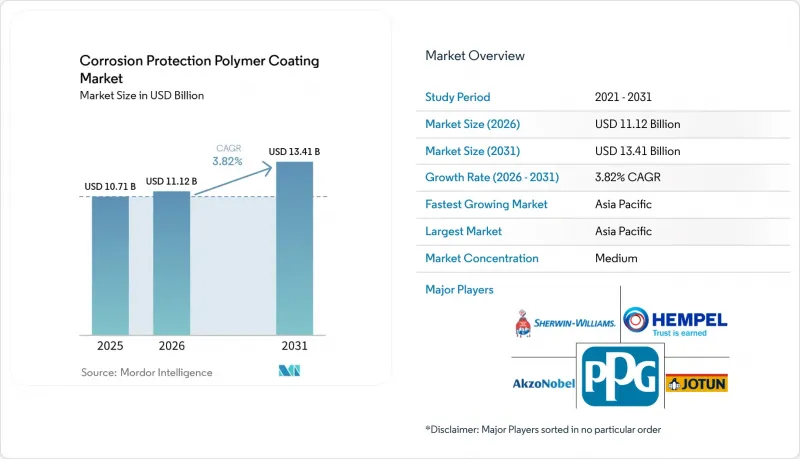
Mordor Intelligence에 의하면, 부식 방지 폴리머 코팅 시장 규모는 2025년 107억 1,000만 달러로 평가되었습니다. 2026년에는 111억 2,000만 달러로 확대되어 2026-2031년 CAGR은 3.82%를 나타내, 2031년에는 134억 1,000만 달러에 이를 것으로 예측됩니다.
본 보고서는 폴리머의 유형(에폭시, 폴리우레탄 등), 제형(용제형, 수성 등), 기술(열경화성 코팅, 열가소성 코팅), 최종 사용자 산업(석유 및 가스, 건설 및 인프라 등), 지역(아시아태평양, 북미, 유럽 등)별로 분류되어 있습니다. 시장 전망은 금액(달러) 기준으로 제시되어 있습니다.
세계의 부식 방지 폴리머 코팅 시장 동향 및 인사이트
신흥국의 인프라 붐
2026년, 중국은 공항, 해협 횡단 페리, 초고압(UHV) 송전망, 수력 발전 등을 아우르는 프로젝트를 승인했으나, 이 모든 분야에서 장기적인 부식 방지 대책이 필수적입니다. 한편, 인도의 국가 인프라 계획에서는 에너지 및 도로 분야에 막대한 예산이 배정되어 있어, ISO 12944 C5-M 규격에 부합하는 에폭시 및 폴리우레탄계 코팅 시스템에 대한 수요를 촉진하고 있습니다. 다자간 융자를 통해 신흥 시장의 민간 인프라 투자가 증가하고 있습니다. 라틴아메리카와 사하라 이남 아프리카에서는 미뤄진 유지보수 작업이 자산 가치의 상당 부분을 초과하는 경우가 많아, 소유주들은 교체 시기를 늦추기 위해 두꺼운 코팅을 적용하고 있습니다. 인프라에 대한 신규 직접투자(FDI) 증가는 지역 사양 수립 과정에서 민간 자본의 영향력이 커지고 있음을 여실히 보여주고 있으며, 이러한 사양은 대개 공공 예산과 부합하는 경우가 많습니다. 국제 표준으로의 전환은 인증 시험소를 보유한 전 세계 공급업체에게는 유리하게 작용하는 반면, 제3자 기관의 데이터를 보유하지 않은 현지 기업에게는 불리한 상황이 되고 있습니다.
자산 수명 연장 및 수명 주기 비용 절감으로의 전환
샤윈 윌리엄스사는 장기적인 시스템에 대한 초기 투자 비용이 다소 높아지더라도, 특히 인건비와 가동 중단 시간을 고려할 때 총 소유 비용 측면에서 상당한 절감 효과를 가져온다는 사실을 입증했습니다. 바이오본드사는 예방적 유지보수가 사후 대응형 수리나 긴급 교체에 비해 비용을 대폭 절감할 수 있다고 강조하며, 장수명 코팅의 중요성을 입증했습니다. SwitcH2사의 ‘아틀란티코’와 같은 해상 수소·암모니아 프로젝트에서는 저품질 에폭시 수지를 사용하지 않고, 대신 PVDF나 PTFE 탑코트가 채택되는 추세입니다. 발티라의 부유식 암모니아 크래커는 내식성 합금과 극저온의 암모니아 및 해수 모두에 견딜 수 있도록 설계된 폴리머 라이닝을 결합하고 있습니다. 현재의 조달 동향에서는 ‘자산 수명 전반에 걸친 최적의 가치’가 우선시되고 있으며, 공급업체는 막 두께 지표에만 의존하지 말고 전기화학 임피던스 데이터를 제공해야 합니다.
엄격한 VOC/HAP 배출 규제
2025년 1월, 미국 환경보호청(EPA)은 에어로졸 도료 내 VOC(휘발성 유기화합물)에 대한 상한선을 설정하고, 준수 기한을 2027년 1월까지 연장했습니다. 이 조치로 인해 업계에서는 신속한 배합 변경이 요구되었습니다. 한편, 2026년 2월에는 EU가 친환경 라벨 규정을 강화하여, 수성 및 분체 제품을 우대하는 수명 주기 탄소 발자국 기준치를 도입했습니다. 노스캐롤라이나주의 사례는 주 규제가 연방 규제를 초과할 가능성이 있으며, 관할 구역별로 여러 SKU 변형이 필요함을 보여줍니다. 배합 변경에 따른 재정적 부담이 막대하며, 장기간에 걸친 시험 기간까지 더해져 특히 중소규모 사업자들에게는 큰 과제가 되고 있습니다. 그 결과, 콜타르 에나멜과 고용제형 에폭시 매스틱은 배출 기준과 성능 기준을 모두 충족하는 고고형분 폴리우레탄 및 분체 시스템에 시장 점유율을 빼앗기고 있습니다.
부문별 분석
2025년, 에폭시계 시스템은 파이프라인 및 밸러스트 탱크 분야에서 다년간 쌓아온 실적을 바탕으로 부식 방지 폴리머 코팅 시장 매출의 40.78%를 차지하며 시장을 독점했습니다. 불소수지의 취급량은 여전히 소규모이지만, 2026년부터 2031년까지의 예측 기간 동안 연평균 성장률(CAGR) 4.57%를 달성할 것으로 전망됩니다. 이러한 성장은 염화물 분무에 대한 내성과 공정의 순도가 극히 중요하게 여겨지는 해상 수소·암모니아 플랫폼에서의 PVDF 및 PTFE 수요에 힘입어 이루어지고 있습니다. 2026년부터 2031년 사이에, 불소수지는 높은 가격대와 엄격한 기준에 대한 적합성을 바탕으로 부식 방지 시장에서 다른 폴리머 군을 앞지를 것으로 전망됩니다. 자외선 저항성이 뛰어난 폴리우레탄은 파사드용 금속 및 자동차용 탑코트에 선호되는 선택지입니다. 그러나 습한 환경에서 수분에 대한 민감도가 높기 때문에 선박 용도로의 사용은 제한되어 있습니다. 한편, 폴리에스터는 가전제품 및 HVAC 시스템 분야에서 주도적인 위치를 차지하고 있으며, 바이오 수지는 제품에 내재된 탄소 배출량을 대폭 줄이는 데 있어 매우 중요한 역할을 하고 있습니다.
현장 데이터는 열가소성 라이너에 대한 관심이 높아지고 있음을 뒷받침하고 있습니다. United Pipeline Systems사는 HDPE 재질의 ‘Tite Liner’를 장거리에 걸쳐 도입했습니다. 이를 통해 융착 에폭시에서 흔히 발생하는 용접부 결함을 방지하고 있습니다. PU/PTFE/셀룰로오스 나노섬유 복합재에 대한 조사 결과, 기존의 다층 구조에서 벗어나 단층 코팅 솔루션으로의 추세가 나타나고 있습니다. 이러한 발전은 현장 작업을 최소화하고자 하는 소유주의 목표와 부합합니다. 오늘날 공급망의 초점은 초기 접착 시험에 그치지 않고, 수명 주기 데이터로 옮겨가고 있습니다. 그 결과, 공급업체는 EIS 센서를 사용하여 시공된 코팅 상태를 모니터링하고, 입찰을 위해 제3자 기관이 실시한 염수 분무 시험의 성능 데이터를 제출해야 합니다.
2025년, 부식 방지 폴리머 코팅 시장에서 용제계 시스템은 매출의 44.68%를 차지했습니다. 이는 두꺼운 막의 단층 도포가 가능하며, 현장에서의 보수 작업이 용이하다는 점이 높이 평가되었기 때문입니다. 그러나 미국 환경보호청(EPA)과 EU의 규제 강화로 인해 그 확산이 저지되면서, 구매자들은 고고형분 도료나 면제 용제 혼합 제품으로 전환하고 있습니다. 분체 도료 시장은 2026년부터 2031년까지의 예측 기간 동안 연평균 성장률(CAGR) 4.68%를 나타낼 것으로 전망되며, 경화 공정을 줄여주는 ‘더스트 온 더스트(Dust-on-Dust)’ 기술과 친환경 건축물 인증 포인트로 주목받고 있는 바이오 유래 폴리에스테르 등의 혜택을 받고 있습니다. 특히, 저취성이나 오버스프레이 회수 등의 특성이 강력히 요구되는 가전 및 건설 분야에서 분체 도료의 채택이 점점 더 확대되고 있습니다.
수성 에폭시 도료는 음용수 용도나 저취성이 요구되는 실내 마감 용도에서 선호되는 선택지입니다. 그러나 추운 조선소에서는 경화 시간이 길어지기 때문에 문제가 되고 있습니다. 고고형분 노보락 도료는 성능과 규제 준수 간의 균형이 뛰어나지만, 가열식 플래너 펌프와 숙련된 작업자가 필요하다는 점에 유의해야 합니다. 2026년에 발표된 연구에서는 PDMS 마이크로캡슐이 함유된 자가복구형 분체 도료가 소개되었습니다. 이 도료는 내구 연한을 2배로 늘릴 가능성이 있어, 기존에는 용제형 에폭시 도료의 영역이었던 인프라 시장으로의 진출이 기대되고 있습니다. 또한, 공장의 자동화 시스템은 현재 경화 온도 및 도막 두께를 정확하게 추적하고 있으며, 폐기물 및 에너지 사용량을 현저히 줄였음을 입증하는 데이터를 생성하여 ESG 감사에 활용되고 있습니다.
지역별 분석
2025년, 아시아태평양은 부식 방지 폴리머 코팅 시장을 주도하며 매출의 44.78%를 차지했으며, 2026년부터 2031년까지의 예측 기간 동안 연평균 성장률(CAGR) 4.55%를 나타낼 것으로 전망됩니다. 해당 지역에서 VOC 규제가 강화되는 상황에서도 중국의 유틸리티과 인도의 인프라 구축 계획이 에폭시 및 폴리우레탄 수요를 끌어올리고 있습니다. 가전제품 및 이륜차 분야 수요 증가에 대응하기 위해, Berger Paints나 Kansai Nerolac과 같은 현지 대기업들은 공장 가동을 확대되고 있습니다. 기업들이 공급망을 다각화하는 가운데, 아세안(ASEAN) 거점이 공장 투자의 주요 입지로 부상하고 있습니다. 대표적인 사례로 PPG가 베트남의 산업용도료 거점을 확장한 것을 들 수 있으며, 이는 이 지역에 대한 해당 기업의 확신을 여실히 보여주고 있습니다.
북미에서는 교량, 수자원 프로젝트, 대서양 연안의 해상 풍력 발전 사업에 대한 연방 정부의 자금 지원이 활용되고 있습니다. EPA의 VOC 배출 상한선이 배합 제조업체들에게 과제로 대두되고 있는 반면, PPG가 노스캐롤라이나주의 항공우주 거점과 오하이오주의 자동차 사업 확장에 막대한 투자를 하고 있다는 사실은 이 회사가 이 지역의 잠재력을 신뢰하고 있음을 보여줍니다. 캐나다의 오일샌드 파이프라인 사업에서는 융착 에폭시 수지가 선호되고 있으나, 인가 절차의 난관에 직면해 있어 유지보수를 위한 재도장에 주력할 필요가 대두되고 있습니다. 동시에, 멕시코의 자동차 산업 거점에서는 니어쇼어링 추세를 주요 요인으로 하여 분체 도장 및 전착 도장에 대한 수요가 증가하고 있습니다.
유럽의 친환경 라벨 규제가 강화됨에 따라, 용제계 도료 제품은 특수 용도로 점차 전환되고 있습니다. 북해 및 발트해 지역의 해상 풍력 발전 프로젝트 확대는 특히 ISO 24656 규격의 의무화에 따라 두꺼운 도막의 에폭시 도료 및 열가소성 분체 도료 수요를 끌어올리고 있습니다. 악소노벨과 악살타의 합병 가능성은 시장 역학을 바꿀 우려가 있지만, 특히 저탄소 배합 분야에서 연구개발 자원을 통합할 기회도 제공합니다. 동유럽에서는 거시경제적 문제로 인해 성장세가 둔화되고 있지만, 국방비 증가로 인해 폴란드와 노르웨이에서는 선박용 도료 수요가 촉진되고 있습니다. 중동에서는 NEOM과 같은 야심 찬 프로젝트로 인해 사막의 자외선과 열 충격에 견딜 수 있는 시스템이 요구되고 있습니다. 한편, 아프리카의 항만 및 광업 부문에서는 세계적 동향과 밀접한 관련을 맺으며 수요 변동이 나타나고 있습니다.
기타 혜택 :
- 엑셀 형식 시장 예측(ME) 시트
- 3개월간의 애널리스트 지원
자주 묻는 질문
목차
제1장 서론
제2장 분석 방법
제3장 주요 요약
제4장 시장 구도
제5장 시장 규모 및 성장률 예측
제6장 경쟁 구도
제7장 시장 기회 및 향후 전망
KTH 26.06.24According to Mordor Intelligence, the corrosion protection polymer coating market size is expected to grow from USD 10.71 billion in 2025 to USD 11.12 billion in 2026 and is forecast to reach USD 13.41 billion by 2031 at 3.82% CAGR over 2026-2031.
This report is Segmented by Polymer Type (Epoxy, Polyurethane, and More), Formulation (Solvent-Borne, Water-Borne, and More), Technology (Thermosetting Coatings and Thermoplastic Coatings), End-User Industry (Oil and Gas, Construction and Infrastructure, and More), and Geography (Asia-Pacific, North America, Europe, and More). The Market Forecasts are Provided in Terms of Value (USD).
Global Corrosion Protection Polymer Coating Market Trends and Insights
Infrastructure Boom in Emerging Economies
In 2026, China approved projects encompassing airports, cross-sea ferries, UHV grids, and hydropower, all of which necessitate long-term corrosion protection. Meanwhile, India's National Infrastructure Pipeline has allocated a substantial budget for energy and roads, bolstering the demand for epoxy and polyurethane systems that comply with ISO 12944 C5-M standards. Multilateral lending has increased private infrastructure investments in emerging markets. In Latin America and Sub-Saharan Africa, deferred-maintenance backlogs often exceed significant portions of asset values, prompting owners to adopt high-build coatings to delay replacements. Growth in greenfield FDI into infrastructure highlights the rising influence of private capital in shaping regional specifications, often aligning with public budgets. The shift towards international standards benefits global suppliers with certified laboratories, while disadvantaging local players lacking third-party data.
Shift Toward Asset-Life Extension and Lifecycle-Cost Reduction
Sherwin-Williams demonstrated that a slightly higher upfront cost for a long-term system can result in substantial savings in total ownership costs, particularly when labor and downtime are considered. BioBond emphasized that preventive maintenance can lead to significant savings compared to reactive repairs and emergency replacements, reinforcing the importance of long-life coatings. Offshore hydrogen and ammonia projects, such as SwitcH2's Atlantico, have moved away from lower-grade epoxies, opting instead for PVDF and PTFE topcoats. Wartsila's floating ammonia cracker integrates corrosion-resistant alloys with polymer linings designed to withstand both cryogenic ammonia and seawater. Procurement trends now prioritize "best value over asset life," encouraging suppliers to provide electrochemical impedance data rather than relying solely on film-thickness metrics.
Stringent VOC/HAP Emission Regulations
In January 2025, the U.S. EPA capped VOCs in aerosol coatings, granting an extension for compliance until January 2027. This move required swift reformulations in the industry. Meanwhile, in February 2026, the EU tightened Ecolabel rules, introducing a lifecycle carbon footprint threshold that favors water-borne and powder products. North Carolina demonstrates how state regulations can exceed federal limits, leading to the need for multiple SKU variants across jurisdictions. The financial burden of reformulation is significant, accompanied by a lengthy testing period, which poses challenges, particularly for smaller players. As a result, coal-tar enamels and high-solvent epoxy mastics are losing market share to high-solids polyurethanes and powder systems, which meet both emissions and performance standards.
Other drivers and restraints analyzed in the detailed report include:
- Offshore Renewable H2/NH3 Projects in Corrosive Sites
- Digital-Twin-Driven Predictive Maintenance Uptake
- Global Shortage of Certified Applicators
For complete list of drivers and restraints, kindly check the Table Of Contents.
Segment Analysis
In 2025, epoxy systems dominated the corrosion protection polymer coating market, capturing 40.78% of sales, thanks to their long-proven track record in pipelines and ballast tanks. While fluoropolymer volumes remain modest, they are projected to achieve a 4.57% CAGR during the forecast period of 2026-2031. This growth is driven by the demand for PVDF and PTFE in offshore hydrogen and ammonia platforms, where tolerance to chloride spray and process purity is paramount. Between 2026 and 2031, fluoropolymers are set to surpass other polymer groups in the corrosion protection market, bolstered by their premium pricing and compliance with stringent standards. Polyurethanes, prized for their UV resilience, are the preferred choice for facade metals and automotive topcoats. However, their sensitivity to moisture in humid conditions limits their use in marine applications. On the other hand, polyester leads in household appliances and HVAC systems, with bio-attributed resins playing a pivotal role in significantly reducing embodied carbon.
Field data underscores a rising interest in thermoplastic liners. United Pipeline Systems has rolled out extensive miles of HDPE Tite Liner, a move that avoids the weld-zone holidays common with fusion-bonded epoxy. Research into PU/PTFE/cellulose nanofiber composites indicates a trend toward single-coat solutions, departing from the conventional multi-layer stacks. This evolution aligns with the owner's goals of minimizing field operations. Today's supply chain focus has shifted to lifecycle data, moving beyond just initial adhesion tests. As a result, suppliers are now tasked with monitoring installed coatings via EIS sensors and supplying third-party salt-spray performance data for tender bids.
In 2025, solvent-borne systems commanded a 44.68% share of the revenue in the corrosion protection polymer coating market, valued for their thick single-coat application and ease of field repairs. However, tightening regulations from the EPA and EU have stymied their expansion, steering buyers toward high-solids and exempt-solvent blends. Powder coatings, enjoying a 4.68% CAGR during the forecast period of 2026-2031, benefit from dust-on-dust technology that reduces curing steps and bio-attributed polyesters, which are gaining traction due to green building credits. Significantly, powder coatings are increasingly favored in the appliance and construction sectors, where attributes such as low odor and overspray reclamation are in high demand.
Water-borne epoxies are the preferred choice for potable water applications and interiors requiring low odor. However, their slow curing times in chilly marine yards present challenges. High-solids novolacs strike a commendable balance between performance and regulatory compliance, but they come with the caveat of requiring heated plural pumps and a proficient workforce. A 2026 study unveils self-healing powders laced with PDMS microcapsules, boasting the potential to double service life and penetrate infrastructure markets, traditionally the realm of solvent-based epoxies. Furthermore, factory automation systems are now adeptly tracking cure temperatures and film builds, generating data for ESG audits that highlight commendable reductions in waste and energy use.
Geography Analysis
In 2025, the Asia-Pacific dominated the corrosion protection polymer coating market, accounting for 44.78% of the revenue and projecting a 4.55% CAGR during the forecast period of 2026-2031. China's public works and India's infrastructure initiatives are driving up the demand for epoxy and polyurethane, even as the region tightens its VOC regulations. To cater to the growing demand in appliances and two-wheelers, local giants like Berger Paints and Kansai Nerolac are broadening their plant operations. As companies diversify their supply chains, ASEAN hubs are emerging as prime locations for factory investments. A notable example is PPG's expansion of its industrial coatings site in Vietnam, highlighting its confidence in the region.
North America is capitalizing on federal funding for bridges, water projects, and Atlantic offshore wind initiatives. While the EPA's VOC caps challenge formulators, PPG's major investments in a Carolina aerospace site and an Ohio automotive expansion signal their trust in the region's potential. Canada's oil-sands pipelines, favoring fusion-bonded epoxy, face approval hurdles, prompting a shift in focus towards maintenance recoats. Simultaneously, Mexican automotive hubs are seeing a rise in powder and e-coat volumes, largely due to near-shoring trends.
Europe's tightening Ecolabel is pushing solvent lines towards specialized applications. The North Sea and Baltic regions' expanding offshore wind projects are boosting the demand for thick-build epoxies and thermoplastic powders, especially with the ISO 24656 mandate. The potential merger of AkzoNobel and Axalta could alter market dynamics, but it also offers a chance to pool research and development resources, especially for low-carbon formulations. Eastern Europe's macroeconomic challenges are slowing growth, yet increased defense spending is spurring demand for naval coatings in Poland and Norway. In the Middle-East, ambitious projects like NEOM are necessitating systems resilient to the desert's UV rays and thermal shocks. Meanwhile, Africa's port and mining sectors are experiencing demand fluctuations, closely linked to global commodity trends.
- 3M
- Akzo Nobel N.V.
- Allnex GmbH
- Arkema
- Asian Paints Limited, LLC
- Axalta Coating Systems
- BASF
- Berger Paints India
- Hempel A/S
- Jotun
- Kansai Paint Co., Ltd.
- Nippon Paint Holdings Co., Ltd.
- PPG Industries, Inc.
- RPM International Inc.
- Sika AG
- Teknos Group
- The Sherwin-Williams Company
- Tnemec
Additional Benefits:
- The market estimate (ME) sheet in Excel format
- 3 months of analyst support
TABLE OF CONTENTS
1 Introduction
- 1.1 Study Assumptions and Market Definition
- 1.2 Scope of the Study
2 Research Methodology
3 Executive Summary
4 Market Landscape
- 4.1 Market Overview
- 4.2 Market Drivers
- 4.2.1 Infrastructure boom in emerging economies
- 4.2.2 Shift toward asset-life extension and lifecycle-cost reduction
- 4.2.3 Offshore renewable H2/NH3 projects in corrosive sites
- 4.2.4 Digital-twin-driven predictive maintenance uptake
- 4.2.5 Naval modernisation need for low-magnetic coatings
- 4.3 Market Restraints
- 4.3.1 Stringent VOC/HAP emission regulations
- 4.3.2 Global shortage of certified applicators
- 4.3.3 Lengthy qualification cycles for novel systems
- 4.4 Value Chain Analysis
- 4.5 Porter's Five Forces
- 4.5.1 Threat of New Entrants
- 4.5.2 Bargaining Power of Buyers
- 4.5.3 Bargaining Power of Suppliers
- 4.5.4 Threat of Substitutes
- 4.5.5 Competitive Rivalry
5 Market Size and Growth Forecasts (Value)
- 5.1 By Polymer Type
- 5.1.1 Epoxy
- 5.1.2 Polyurethane
- 5.1.3 Polyester
- 5.1.4 Fluoropolymer
- 5.1.5 Acrylic
- 5.1.6 Other Polymers (Nylon, PVDF, etc.)
- 5.2 By Formulation
- 5.2.1 Solvent-borne
- 5.2.2 Water-borne
- 5.2.3 Powder Coating
- 5.2.4 High-solids Coating
- 5.3 By Technology
- 5.3.1 Thermosetting Coatings
- 5.3.2 Thermoplastic Coatings
- 5.4 By End-user Industry
- 5.4.1 Oil and Gas
- 5.4.2 Marine
- 5.4.3 Construction and Infrastructure
- 5.4.4 Automotive and Transportation
- 5.4.5 Energy and Power (Wind, Solar, Hydro)
- 5.4.6 Water and Wastewater Treatment
- 5.4.7 Other End-user Industries Industries (Mining, Chemical Processing, etc.)
- 5.5 By Geography
- 5.5.1 Asia-Pacific
- 5.5.1.1 China
- 5.5.1.2 Japan
- 5.5.1.3 India
- 5.5.1.4 South Korea
- 5.5.1.5 ASEAN Countries
- 5.5.1.6 Rest of Asia-Pacific
- 5.5.2 North America
- 5.5.2.1 United States
- 5.5.2.2 Canada
- 5.5.2.3 Mexico
- 5.5.3 Europe
- 5.5.3.1 Germany
- 5.5.3.2 United Kingdom
- 5.5.3.3 France
- 5.5.3.4 Italy
- 5.5.3.5 Spain
- 5.5.3.6 Russia
- 5.5.3.7 Rest of Europe
- 5.5.4 South America
- 5.5.4.1 Brazil
- 5.5.4.2 Argentina
- 5.5.4.3 Rest of South America
- 5.5.5 Middle-East and Africa
- 5.5.5.1 South Africa
- 5.5.5.2 Saudi Arabia
- 5.5.5.3 Rest of Middle-East and Africa
- 5.5.1 Asia-Pacific
6 Competitive Landscape
- 6.1 Market Concentration
- 6.2 Strategic Moves
- 6.3 Market Share(%)/Ranking Analysis
- 6.4 Company Profiles (includes Global Overview, Market Overview, Core Segments, Financials, Strategic Information, Products and Services, and Recent Developments)
- 6.4.1 3M
- 6.4.2 Akzo Nobel N.V.
- 6.4.3 Allnex GmbH
- 6.4.4 Arkema
- 6.4.5 Asian Paints Limited, LLC
- 6.4.6 Axalta Coating Systems
- 6.4.7 BASF
- 6.4.8 Berger Paints India
- 6.4.9 Hempel A/S
- 6.4.10 Jotun
- 6.4.11 Kansai Paint Co., Ltd.
- 6.4.12 Nippon Paint Holdings Co., Ltd.
- 6.4.13 PPG Industries, Inc.
- 6.4.14 RPM International Inc.
- 6.4.15 Sika AG
- 6.4.16 Teknos Group
- 6.4.17 The Sherwin-Williams Company
- 6.4.18 Tnemec
7 Market Opportunities and Future Outlook
- 7.1 White-space and Unmet-need Assessment