

|
시장보고서
상품코드
2062185
덱스트로스 일수화물 : 시장 점유율 분석, 업계 동향 및 통계, 성장 예측(2026-2031년)Dextrose Monohydrate - Market Share Analysis, Industry Trends & Statistics, Growth Forecasts (2026 - 2031) |
||||||
 Mordor Intelligence
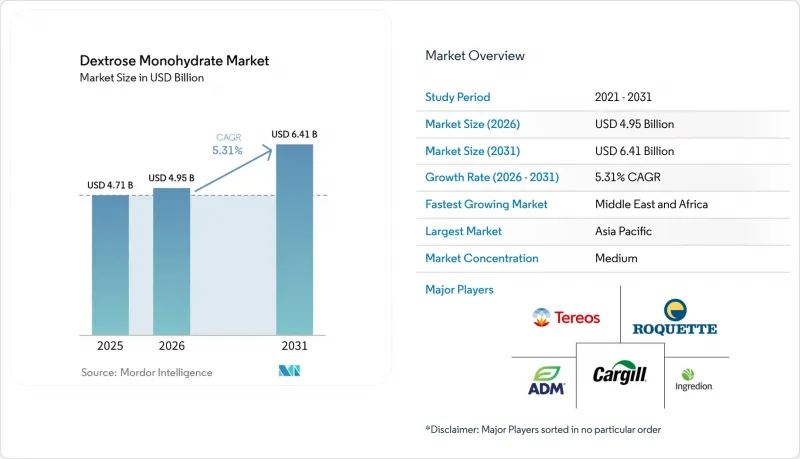
Mordor Intelligence에 의하면, 덱스트로스 일수화물 시장은 2025년까지 47억 1,000만 달러로 평가되었습니다. 2026년까지 49억 5,000만 달러, 2031년까지 64억 1,000만 달러에 이를 것으로 예측되며, 2026-2031년 CAGR은 5.31%를 나타낼 전망입니다.
본 보고서는 등급(식품용, 의약품용, 산업용), 원료(옥수수 유래, 밀 유래, 기타 전분 원료), 용도(식품 및 음료, 의약품, 기타), 지역(아시아·태평양, 북미, 유럽, 남미, 중동 및 아프리카)별로 분류되어 있습니다. 시장 전망은 금액(달러) 기준으로 제시되어 있습니다.
세계의 덱스트로스 일수화물 시장 동향 및 인사이트
식품 및 음료 제조업체 수요 증가(클린 라벨 감미료)
유기 인증과 비유전자변형(비GMO) 인증을 획득한 제품은 원료 표시가 명확하기 때문에 소매업체들이 점점 더 우선적으로 취급하고 있습니다. 이러한 제품들은 인증을 받은 재배 면적이 제한되어 있고, 여러 시즌에 걸쳐 공급을 확보하기 위한 장기 특수 곡물 계약에 힘입어 20%에서 50%에 달하는 프리미엄 가격을 유지하고 있습니다. 용해도가 100mL당 약 100그램(g/100 mL)이며, 단맛은 자당의 약 70% 수준이므로, 이러한 제품을 사용하면 제법 개발자가 식감을 해치지 않으면서 자당을 부분적으로 대체할 수 있어 유기농 베이커리 제품, 분말 음료, 스포츠 젤에 사용할 수 있습니다. 추적성 및 인증과 관련된 조달의 복잡성은 장벽 역할을 하여, 범용 대체품과의 경쟁 속에서 프리미엄 지위를 지켜주고 있습니다. 덱스트로스 일수화물 시장의 중기적 성장은 인증된 원료공급 확대와 주요 브랜드의 제품 재조성에 달려 있으며, 이를 통해 시장의 지속적인 성장이 보장될 것입니다.
비경구 영양 및 주사용 바이오의약품의 급속한 보급
미국 약전(USP), 유럽 약전(EP), 영국 약전(BP), 일본 약전(JP)의 규정에 따른 규격 통합으로 인해, 국경 간 조달 프로세스가 효율화되었습니다. 프레제니우스 카비(Fresenius Kabi)는 63그램에서 165그램의 덱스트로스 일수화물을 함유한 비경구 영양 백을 공급하고 있으며, 이는 고순도 제품에 대한 안정적인 수요를 보여주고 있습니다. 이 첨가제는 동결건조 생물제제의 안정화 및 세포 배양 발효조의 유지 관리에서도 중요한 역할을 하고 있습니다. 북미, 유럽, 동아시아의 고령화 추세가 수액 사용량 증가를 주도하고 있으며, 이는 시장에서 의약품 등급의 덱스트로스 일수화물의 장기적인 성장 가능성에 기여하고 있습니다.
과도한 당분 섭취에 대한 건강상의 우려와 비만 대책
미국 농무부(USDA)의 ‘2025-2030년 식이 지침’에서는 첨가당의 권장 상한선을 총 칼로리 섭취량의 6% 이하로 설정하고 있는 반면, 세계보건기구(WHO)는 유리당 섭취량을 5% 이하로 유지할 것을 권장하고 있습니다. 유럽의 설탕세 및 포장 전면 표시 의무화는 칼로리가 포함된 감미료의 사용을 줄이는 것을 목적으로 하고 있습니다. 이러한 정책들은 과자나 탄산음료 등 기호품 부문에 영향을 미칠 것으로 예상되며, 이에 따라 덱스트로스 일수화물 시장의 단기 수요에도 영향을 줄 것으로 보입니다.
부문별 분석
의약품 등급 부문은 병원 내 비경구 영양 프로그램의 확대와 바이오의약품 파이프라인 개발에 힘입어 연평균 성장률(CAGR) 6.21%를 기록하며, 덱스트로스 일수화물 시장 전체를 상회할 것으로 전망됩니다. 식품 등급의 덱스트로스 일수화물은 2025년까지 시장 점유율의 92.50%를 차지했지만, 당분 절감 추세가 강화되면서 과제에 직면해 있습니다. 산업용 등급 수요는 특히 규제 요건이 엄격하지 않은 지역에서 발효 및 섬유 산업에서의 비용 면에서의 우위를 바탕으로 안정적으로 유지되고 있습니다. 이집트 내 Cairo 3A의 Pharma Copia 인증 생산 라인 도입은 증가하는 수액 수요를 충족시키기 위한 지역 허브의 부상을 여실히 보여주고 있습니다.
의약품 등급 제품의 구매자들은 로트 간 균일성과 여러 약전 기준에 대한 준수를 우선시하고 있으며, 이는 상품 시장의 변동에 대한 가격 안정화에 기여하고 있습니다. 반면, 식품 등급 제품 구매자들은 클린 라벨 제품에 대한 프리미엄과 천연 고감미도 감미료로부터의 경쟁 압력 사이에서 균형을 맞추어야 합니다. 이러한 추세는 덱스트로스 일수화물 시장 전체에서 나타나는 양극화된 성장 양상을 반영하고 있습니다.
지역별 분석
아시아태평양은 중국, 인도, 아세안(동남아시아 국가 연합) 회원국들의 전분 생산에 대한 대규모 투자의 견인 효과로 인해, 2025년 덱스트로스 일수화물 시장 규모의 41.40%를 차지했습니다. 그 예로 TH 그룹의 6조 VND(2억 2,000만 달러) 규모의 복합 시설과 선스타의 일일 2,100톤 규모의 옥수수 가공 공장을 들 수 있으며, 이는 현지 감미료 공급을 확보하기 위한 수직 통합 전략을 여실히 보여주고 있습니다. 또한, 지역 종합적 경제 동반자 협정(RCEP)에 힘입어 촉진되는 국경 간 무역이 원자재 흐름을 활성화시키고 있는 한편, 도시 지역의 식생활 변화가 가공식품 수요를 뒷받침하고 있습니다.
인도의 덱스트로스 일수화물 시장에서는 리디 시디가 카길의 연간 30만 톤 규모의 습식 제분 시설을 25억 루피(2,681만 달러)에 인수함에 따라 시장 움직임이 활발해지고 있습니다. 이러한 움직임으로 인해 리디 시디는 그동안 로켓사가 지배해 온 시장에 다시 진출하게 되며, 경쟁이 격화되는 동시에 남아시아 시장 상황에 새로운 생산 능력이 추가될 것입니다.
북미와 유럽은 클린 라벨 및 의약품 등급의 덱스트로스 일수화물에 있어 여전히 주요 시장으로 자리 잡고 있습니다. 잉그레디언이 인디애나폴리스에서 진행한 1억 달러 규모의 사업 확장과 루마니아에서 아그라나와 맺은 합작 투자는 밀 및 특수 전분 고객과의 근접성을 확보하기 위한 것입니다. 그러나 에너지 비용 상승과 설탕세 정책으로 인해 기존 방식의 당분을 함유한 음료에 대한 수요가 감소하고 있으며, 이에 따라 제제 개발자들은 혼합 감미료 시스템에 대한 검토를 진행하고 있습니다.
중동 및 아프리카는 덱스트로스 일수화물 시장에서 가장 빠른 성장세를 보일 것으로 예상되며, 예측 연평균 성장률(CAGR)은 6.18%입니다. 이집트 카이로 3A가 보유한 Pharma Copia 인증을 획득한 생산 라인과 ISO 22000 준수를 통해 현지 생산 품질이 향상되었으며, 수입 의존도가 낮아지고 있습니다.
브라질의 카사바 재배에 주력하는 것을 필두로 한 남미는 세계 데크스트로스 일수화물 시장의 원료 다각화에 기여하고 있습니다. 이러한 다양화는 단일 작물에 대한 의존으로 인한 위험을 줄이고, 시장의 안정성을 높이는 데 기여하고 있습니다.
기타 혜택
- 엑셀 형식 시장 예측(ME) 시트
- 3개월간의 애널리스트 지원
자주 묻는 질문
목차
제1장 서론
제2장 조사 방법
제3장 주요 요약
제4장 시장 구도
제5장 시장 규모 및 성장 예측
제6장 경쟁 구도
제7장 시장 기회 및 향후 전망
KTH 26.06.22According to Mordor Intelligence, the dextrose monohydrate market is projected to reach USD 4.71 billion by 2025, USD 4.95 billion by 2026, and USD 6.41 billion by 2031, with a CAGR of 5.31% from 2026 to 2031.
This report is Segmented by Grade (Food Grade, Pharmaceutical Grade, Industrial Grade), Source (Corn-Based, Wheat-Based, Other Starch Sources), Application (Food and Beverage, Pharmaceuticals, and More), and Geography (Asia-Pacific, North America, Europe, South America, and Middle East and Africa). The Market Forecasts are Provided in Terms of Value (USD).
Global Dextrose Monohydrate Market Trends and Insights
Growing Demand from Food and Beverage Manufacturers (Clean-Label Sweetening)
Organic and non-genetically modified organism (non-GMO) certified variants are increasingly prioritized by retailers due to their clear ingredient panels. These variants maintain premiums of 20%-50%, driven by limited certified acreage and long-term specialty grain contracts that secure supply for several seasons. With solubility near 100 grams per 100 milliliters (g/100 mL) and approximately 70% sucrose sweetness, these products enable formulators to partially replace sucrose without compromising texture, supporting their use in organic bakery products, powdered beverages, and sports gels. The complexity of procurement related to traceability and certification acts as a barrier, protecting premium positions from competition with commodity alternatives. Medium-term growth in the dextrose monohydrate market will rely on scaling certified feedstock and reformulations by mainstream brands, ensuring sustained market expansion.
Rapid Uptake in Parenteral Nutrition and Injectable Biologics
Compendial alignment under United States Pharmacopeia (USP), European Pharmacopeia (EP), British Pharmacopeia (BP), and Japanese Pharmacopeia (JP) regulations has streamlined cross-border sourcing processes. Fresenius Kabi offers parenteral bags containing 63 grams to 165 grams of dextrose monohydrate, indicating consistent demand for high-purity products. This excipient also plays a key role in stabilizing lyophilized biologics and supporting cell-culture fermenters. The aging populations in North America, Europe, and East Asia are driving increased infusion volumes, contributing to the long-term growth potential for pharmaceutical-grade dextrose monohydrate in the market.
Health Concerns Over Excessive Sugar Intake and Obesity Regulations
The United States Department of Agriculture's (USDA) 2025-2030 Dietary Guidelines set the recommended limit for added sugars to below 6% of total calorie intake, while the World Health Organization (WHO) recommends a free-sugar intake of less than 5%. European sugar taxes and mandatory front-of-pack labeling are designed to reduce the use of caloric sweeteners. These policies are expected to impact discretionary categories, such as confectionery and sodas, thereby influencing short-term demand in the dextrose monohydrate market.
Other drivers and restraints analyzed in the detailed report include:
- Expansion of Processed-Food Capacity in Emerging Economies
- Cost-Effective Bulking and Browning Alternative to Sucrose
- Proliferation of High-Intensity/Rare Sugars
For complete list of drivers and restraints, kindly check the Table Of Contents.
Segment Analysis
The pharmaceutical-grade segment is projected to grow at a Compound Annual Growth Rate (CAGR) of 6.21%, exceeding the overall dextrose monohydrate market, driven by the expansion of parenteral nutrition programs in hospitals and the development of biologic pipelines. Food-grade dextrose monohydrate is expected to account for 92.50% of the market share by 2025 but faces challenges due to increasing sugar-reduction trends. Industrial-grade demand remains stable, supported by its cost advantages in fermentation and textiles, particularly in regions with less stringent regulatory requirements. The introduction of Cairo 3A's Pharma Copia-certified production lines in Egypt highlights the emergence of regional hubs aiming to meet growing infusion demand.
Pharmaceutical-grade buyers prioritize batch-to-batch consistency and compliance with multiple compendial standards, which helps stabilize prices against commodity market fluctuations. In contrast, food-grade buyers must balance the premium for clean-label products with the competitive pressure from natural high-intensity sweeteners. This dynamic reflects a two-speed growth pattern within the broader dextrose monohydrate market.
Geography Analysis
Asia-Pacific is projected to account for 41.40% of the 2025 dextrose monohydrate market size, driven by significant investments in starch production across China, India, and ASEAN (Association of Southeast Asian Nations) countries. Examples include TH Group's VND 6,000 billion (USD 0.22 billion) complex and Sanstar's 2,100 tons per day maize plant, which highlight vertical integration strategies to secure local sweetener supply. Additionally, cross-border trade facilitated by the Regional Comprehensive Economic Partnership (RCEP) enhances ingredient flow, while urban dietary shifts favor packaged foods.
India's dextrose monohydrate market has seen increased activity following Riddhi Siddhi's acquisition of Cargill's 300,000 tons per year wet-milling asset for INR 2,500 million (USD 26.81 million). This move reintroduces Riddhi Siddhi into a market historically dominated by Roquette, intensifying competition and adding new production capacity to South Asia's market landscape.
North America and Europe continue to serve as key markets for clean-label and pharmaceutical-grade dextrose monohydrate. Ingredion's USD 100 million expansion in Indianapolis and its joint venture with Agrana in Romania ensure proximity to wheat and specialty starch customers. However, rising energy costs and sugar tax policies are reducing demand for traditional sugary beverages, prompting formulators to explore blended sweetener systems.
The Middle East and Africa are expected to achieve the fastest growth in the dextrose monohydrate market, with a forecasted CAGR of 6.18%. Cairo 3A's Pharma Copia-certified production lines in Egypt, along with ISO 22000 compliance, are improving local production quality and reducing reliance on imports.
South America, led by Brazil's focus on cassava, is contributing to feedstock diversification in the global dextrose monohydrate market. This diversification helps mitigate risks associated with dependence on single-crop sources, providing greater stability to the market.
- ADM
- AVEBE
- Cargill
- Dong Xiao Biotechnology Co., Ltd.
- Global Sweeteners Holdings Ltd. - Added
- Green Plains
- Gulshan Polyols Ltd.
- Ingredion
- Lihua Starch Industry Co., Ltd. - Added
- Matco Foods Limited
- Matsutani Chemical Industry Co., Ltd.
- Qingyuan Food Co., Ltd. - Added
- Roquette Freres
- Shandong Fuyang Biotechnology Co., Ltd.
- Tate & Lyle
- Tereos
- Universal Starch-Chem Allied Ltd.
- XIWANG Group Co. Ltd.
- Zhucheng Xingmao Corn Developing Co., Ltd.
Additional Benefits:
- The market estimate (ME) sheet in Excel format
- 3 months of analyst support
TABLE OF CONTENTS
1 Introduction
- 1.1 Study Assumptions and Market Definition
- 1.2 Scope of the Study
2 Research Methodology
3 Executive Summary
4 Market Landscape
- 4.1 Market Overview
- 4.2 Market Drivers
- 4.2.1 Growing demand from food and beverage manufacturers (clean-label sweetening)
- 4.2.2 Rapid uptake in parenteral nutrition and injectable biologics
- 4.2.3 Expansion of processed-food capacity in emerging economies
- 4.2.4 Cost-effective bulking and browning alternative to sucrose
- 4.2.5 Formulation uptake in plant-based meat analogues
- 4.3 Market Restraints
- 4.3.1 Health concerns over excessive sugar intake and obesity regulations
- 4.3.2 Proliferation of high-intensity/rare sugars (stevia, allulose, monk-fruit)
- 4.3.3 Volatility in corn and wheat starch feedstock prices
- 4.4 Value Chain Analysis
- 4.5 Porter's Five Forces
- 4.5.1 Threat of New Entrants
- 4.5.2 Bargaining Power of Buyers
- 4.5.3 Bargaining Power of Suppliers
- 4.5.4 Threat of Substitutes
- 4.5.5 Competitive Rivalry
5 Market Size and Growth Forecasts (Value)
- 5.1 By Grade
- 5.1.1 Food Grade
- 5.1.2 Pharmaceutical Grade
- 5.1.3 Industrial Grade
- 5.2 By Source
- 5.2.1 Corn-based
- 5.2.2 Wheat-based
- 5.2.3 Other Starch Sources (cassava, tapioca, potato)
- 5.3 By Application
- 5.3.1 Food and Beverage
- 5.3.2 Pharmaceuticals
- 5.3.3 Nutraceuticals and Dietary Supplements
- 5.3.4 Personal Care and Cosmetics
- 5.3.5 Chemical and Industrial
- 5.4 By Geography
- 5.4.1 Asia-Pacific
- 5.4.1.1 China
- 5.4.1.2 Japan
- 5.4.1.3 India
- 5.4.1.4 South Korea
- 5.4.1.5 ASEAN Countries
- 5.4.1.6 Rest of Asia-Pacific
- 5.4.2 North America
- 5.4.2.1 United States
- 5.4.2.2 Canada
- 5.4.2.3 Mexico
- 5.4.3 Europe
- 5.4.3.1 Germany
- 5.4.3.2 United Kingdom
- 5.4.3.3 France
- 5.4.3.4 Italy
- 5.4.3.5 Spain
- 5.4.3.6 Russia
- 5.4.3.7 NORDIC Countries
- 5.4.3.8 Rest of Europe
- 5.4.4 South America
- 5.4.4.1 Brazil
- 5.4.4.2 Argentina
- 5.4.4.3 Rest of South America
- 5.4.5 Middle-East and Africa
- 5.4.5.1 Saudi Arabia
- 5.4.5.2 South Africa
- 5.4.5.3 Rest of Middle-East and Africa
- 5.4.1 Asia-Pacific
6 Competitive Landscape
- 6.1 Market Concentration
- 6.2 Strategic Moves
- 6.3 Market Share(%)/Ranking Analysis
- 6.4 Company Profiles (includes Global-level Overview, Market-level Overview, Core Segments, Financials as available, Strategic Information, Products and Services, and Recent Developments)
- 6.4.1 ADM
- 6.4.2 AVEBE
- 6.4.3 Cargill
- 6.4.4 Dong Xiao Biotechnology Co., Ltd.
- 6.4.5 Global Sweeteners Holdings Ltd. - Added
- 6.4.6 Green Plains
- 6.4.7 Gulshan Polyols Ltd.
- 6.4.8 Ingredion
- 6.4.9 Lihua Starch Industry Co., Ltd. - Added
- 6.4.10 Matco Foods Limited
- 6.4.11 Matsutani Chemical Industry Co., Ltd.
- 6.4.12 Qingyuan Food Co., Ltd. - Added
- 6.4.13 Roquette Freres
- 6.4.14 Shandong Fuyang Biotechnology Co., Ltd.
- 6.4.15 Tate & Lyle
- 6.4.16 Tereos
- 6.4.17 Universal Starch-Chem Allied Ltd.
- 6.4.18 XIWANG Group Co. Ltd.
- 6.4.19 Zhucheng Xingmao Corn Developing Co., Ltd.
7 Market Opportunities and Future Outlook
- 7.1 White-space and Unmet-need Assessment
- 7.2 Growth in clean-label and non-GMO dextrose
- 7.3 Rising demand from functional foods and emerging markets

(주말 및 공휴일 제외)


