|
시장보고서
상품코드
2062249
의료기기용 접착제 시장 : 시장 점유율 분석, 산업 동향 및 통계 데이터, 성장 예측(2026-2031년)Medical Device Adhesive - Market Share Analysis, Industry Trends & Statistics, Growth Forecasts (2026 - 2031) |
||||||
 Mordor Intelligence
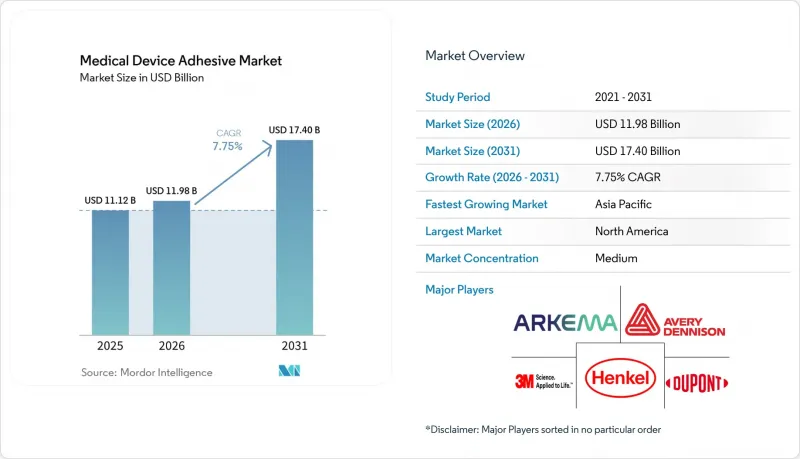
Mordor Intelligence에 의하면, 의료기기용 접착제 시장 규모는 2025년 111억 2,000만 달러로 평가되었습니다. 2026년에는 119억 8,000만 달러로 확대되어 2026-2031년 CAGR은 7.75%를 나타내, 2031년까지 174억 달러에 이를 것으로 예측됩니다.
본 보고서는 수지(아크릴 등), 기술(수성 등), 접착제 유형(감압 필름·테이프, 구조용/반구조용 액체 등), 용도(의료기기·장치 등), 지역(아시아태평양, 북미, 유럽, 남미, 중동 및 아프리카)별로 분류되어 있습니다. 시장 전망은 금액(달러) 기준으로 제시되어 있습니다.
세계의 의료기기용 접착제 시장 동향 및 분석
원격 모니터링 및 웨어러블 치료 기기의 급증
현재 웨어러블 기기에는 피부에 자극을 일으키지 않으면서 7-14일간 피부에 밀착될 수 있는 것이 요구되고 있습니다. 메드트로닉사의 2025년 시험 결과, 단백질 흡착을 억제하는 약 20 다인/cm의 실리콘 표면 에너지 덕분에 실리콘-아크릴레이트 하이브리드 소재가 표준 아크릴레이트 소재에 비해 홍반 점수를 35% 감소시킨 것으로 나타났습니다. FDA는 2025년에 14종의 새로운 접착식 인슐린 전달 시스템을 승인했습니다. 이 제품들은 모두 ISO 10993-10 및 -23 프로토콜을 충족합니다. 설계 단계에서의 테이프 공동 개발이 사후 적용 방식을 대체함으로써, 400-600 g/인치의 박리 강도와 800 g/m²/24시간을 초과하는 수증기 투과율을 최적화하고 있습니다.
일회용 및 저침습 카테터 플랫폼의 확대
EU MDR 2017/745에 따라 2024년에 재사용에 관한 규제가 강화되면서 일회용 카테터의 급속한 성장이 촉진되었습니다. 보스턴 사이언티피크사는 경화 시간이 5초인 UV 경화형 풍선 본딩 기술을 도입한 결과, 일회용 요관경의 매출이 28% 증가했다고 보고했습니다. 스트라이커사는 신경혈관 기기 표면의 100µm 미만의 틈새에도 침투하는 저점도 시아노아크릴레이트 수지를 채택하고 있으며, ISO 10993-18의 추출물 허용 한계치인 0.1 ppm 미만을 충족합니다. 이러한 신속 경화 특성 덕분에 재공품 재고를 40% 줄일 수 있었습니다.
복잡한 ISO 10993 생체적합성 및 추출물 시험의 부담
ISO 10993-1 : 2018에서는 생물학적 시험에 앞서 화학적 특성 평가가 의무화되어 있어, 새로운 배합마다 18-24개월의 기간과 20만-50만 달러의 추가 비용이 발생하고 있습니다. 2025년에는 위탁 검사 기관의 미처리 주문량이 16주 분량에 달하고, 제품 출시가 지연되었습니다. 2024년 6월에 발효되는 REACH 부속서 XVII의 프탈레이트류 금지 조치로 인해, 유럽 전역에서 기존 테이프의 재인증이 불가피하게 되었습니다.
부문별 분석
아크릴계 제품은 1kg당 4.50-6달러의 원가와 분당 200m의 코팅 속도를 바탕으로, 2025년 의료기기용 접착제 시장에서 29.05%의 점유율을 차지했습니다. 실리콘 수지는 2026년부터 2031년까지 연평균 성장률(CAGR) 8.11%를 나타낼 것으로 전망됩니다. 이는 의료기기 제조업체들이 25kGy의 감마선 조사 주기를 거친 후에도 400g/in 이상의 박리 강도를 유지하는 접착제를 선호하기 때문입니다. 그러나 실리콘의 ISO 10993-5 기준 세포독성 점수가 1 미만이기 때문에 장기간 착용형 CGM(연속 혈당 모니터링)이나 인슐린 펌프 플랫폼에서는 실리콘이 점차 채택되고 있습니다. 에시콘(Eschicon)사의 ‘Dermabond Prineo 2.0’과 같은 틈새 시장용 시아노아크릴레이트계 접착제는 450명의 환자를 대상으로 한 임상시험에서 상처 봉합 시간을 30% 단축시켰습니다.
폴리우레탄계 화학 물질은 2,500 psi 이상의 랩 전단 강도가 필요한 이식형 펄스 발생기의 구조적 접착을 뒷받침하고 있지만, 카테터 선단의 조립에는 에폭시계가 주로 사용됩니다. 2025년에 6종의 시아노아크릴레이트계 외과용 실란트가 FDA의 승인을 받은 사실은 포름알데히드 방출량이 2 ppm 미만으로 억제된 경우 규제 당국이 이를 용인하고 있음을 뒷받침합니다.
수성 화학물질은 EU의 엄격한 VOC 규제 하에서도 2025년 의료기기용 접착제 시장 규모에서 34.82%의 점유율을 유지했으나, 건조 시간이 15-30분 소요되기 때문에 생산성이 제한되고 있습니다. Dymax사의 405nm LED 제품군은 3초 만에 쇼어 D 경도 75까지 경화되며, 수은 램프에 비해 에너지 소비량을 85% 절감합니다. UV/방사선 경화형 접착제는 VOC가 전혀 발생하지 않는 가공 공정과 사출 성형의 타크트 타임에 부합하는 5초 미만의 경화 시간 덕분에, 2031년까지 연평균 성장률(CAGR) 8.35%를 나타낼 것으로 전망됩니다.
용제계 시스템은 틈새 채우기나 긴 개방 시간이 필요한 상황에서 여전히 활용되고 있으며, 핫멜트는 120-140°C의 융점을 가지고 있어 수술용 드레이프 고정 용도로 수요가 확대되고 있습니다. 표면을 광중합시키고, 숨겨진 접합부를 24시간에 걸쳐 암소 중합시키는 하이브리드형 듀얼 큐어 에폭시는 복잡한 형상에서 기포 발생을 방지합니다.
지역별 분석
북미는 2025년에 전 세계 매출의 38.11%를 차지했으며, 이는 120일 이내에 완료되는 FDA 510(k) 승인 및 CGM과 인슐린 펌프 생산의 임계량에 힘입은 결과입니다. 애보트, 데크콤, 메드트로닉은 2025년에 820만 개의 센서를 출하했는데, 이 센서들은 모두 14일간 착용이 가능한 ISO 10993-10 인증을 받은 실리콘-아크릴레이트 하이브리드 수지를 사용하고 있습니다. 솔벤탐의 분사(spin-off)를 통해 새로운 ISO 10993 시험소를 위해 1억 8,000만 달러가 확보된 반면, 헨켈은 니어쇼어링 수요에 대응하기 위해 멕시코에 8,000톤 규모의 UV 경화형 수지 생산 능력을 추가했습니다.
아시아태평양은 2026년부터 2031년에 걸쳐 연평균 성장률(CAGR) 8.46%를 기록하며 가장 빠르게 성장할 지역입니다. 중국 국가의약품감독관리국(NMPA)은 ISO 10993을 준수하여, 2025년에는 의료기기 시장이 12% 성장했습니다. 또한, Mindray와 United Imaging은 새로운 영상 진단 장비에 구조용 접착제를 적용했습니다. 일본에서는 2025년에 18유형의 접착제가 함유된 의료기기가 승인되었으며, 다우 케미칼은 인도의 PLI 제도에 따라 푸네에 3,500톤 규모의 실리콘 공장을 설립했습니다. 한국 식품의약품안전처(MFDS)의 삼성 ‘갤럭시 워치 6 메디컬 에디션’ 승인 과정에서 손목을 20% 구부린 상태에서도 0.8Ω/제곱mm의 시트 저항을 구현하는 전도성 폴리우레탄 접착제가 채택되었습니다.
유럽에서는 MDR(의료기기 규정)의 시행에 따라 증거 요건이 강화되었습니다. 독일의 Lohmann사는 카탈로그에 수록된 제품의 68%를 바이오 아크릴레이트 계열 제품으로 전환하여 CO₂ 배출량을 22% 감축했습니다. 영국에서는 FDA 승인을 받은 접착제에 대한 신속 승인 절차가 도입되었으며, 프랑스에서는 당뇨병성 상처 치료에 대한 보험 급여가 우선적으로 적용되었습니다. 또한, Urgo사의 하이드로콜로이드 실버 드레싱은 치유 기간을 25% 단축시켰습니다. 러시아의 수입 대체 정책에 따라, 국내에서 시아노아크릴레이트 제품이 30-35%의 가격 경쟁력을 갖추고 출시되었습니다.
기타 혜택 :
- 엑셀 형식 시장 예측(ME) 시트
- 3개월간의 애널리스트 지원
자주 묻는 질문
목차
제1장 서론
제2장 분석 방법
제3장 주요 요약
제4장 시장 구도
제5장 시장 규모 및 성장률 예측
제6장 경쟁 구도
제7장 시장 기회 및 향후 전망
KTH 26.06.24According to Mordor Intelligence, the medical device adhesive market size is expected to grow from USD 11.12 billion in 2025 to USD 11.98 billion in 2026 and is forecast to reach USD 17.40 billion by 2031 at 7.75% CAGR over 2026-2031.
This report is Segmented by Resin (Acrylic, and More), Technology (Water-Based, and More), Adhesive Form (Pressure-Sensitive Films and Tapes, Structural/Semi-Structural Liquids, and More), Application (Medical Devices and Equipment, and More), and Geography (Asia-Pacific, North America, Europe, South America, and the Middle East and Africa). The Market Forecasts are Provided in Terms of Value (USD).
Global Medical Device Adhesive Market Trends and Insights
Surge in Remote-Monitoring and Wearable Therapeutic Devices
Wearable devices now demand skin adhesion for 7-14 days without sensitization. Medtronic showed silicone-acrylate hybrids cut erythema scores 35% versus standard acrylics in 2025 trials, thanks to silicone surface energies near 20 dynes/cm that limit protein adsorption. The FDA cleared 14 new adhesive-backed insulin-delivery systems during 2025, each passing ISO 10993-10 and -23 protocols. Co-development of tapes at the design stage has replaced retrofit approaches, optimizing peel strengths of 400-600 g/inch and moisture-vapor transmission above 800 g/m2/24 h.
Expansion of Single-Use and Minimally-Invasive Catheter Platforms
EU MDR 2017/745 tightened re-use rules in 2024, prompting rapid growth of disposable catheters. Boston Scientific reported 28% sales growth in single-use ureteroscopes aided by UV-curable balloon bonds with 5-second cure times. Stryker applies low-viscosity cyanoacrylates that wick into less than100-µm gaps on neurovascular devices, meeting ISO 10993-18 extractables thresholds under 0.1 ppm. The quick cure slashes work-in-process inventories by 40%.
Complex ISO-10993 Biocompatibility and Extractables Testing Burden
ISO 10993-1:2018 now mandates chemical characterization before biological tests, adding 18-24 months and USD 200,000-500,000 per new formulation. Contract-lab backlogs stretched to 16 weeks in 2025, delaying launches. REACH Annex XVII phthalate bans, effective June 2024, forced re-qualification of legacy tapes throughout Europe.
Other drivers and restraints analyzed in the detailed report include:
- Growth in Home-Infusion Pumps Requiring Long-Wear PSAs
- Wider Adoption of Hydrogel and Bio-Resorbable Adhesive Chemistries
- Cost Volatility of Medical-Grade Silicone and Specialty Acrylates
For complete list of drivers and restraints, kindly check the Table Of Contents.
Segment Analysis
Acrylics held 29.05% of the medical device adhesive market share in 2025 because of their USD 4.50-6.00/kg cost and 200-m/min coating speeds. Silicone resins are on track for an 8.11% CAGR between 2026 and 2031 as device makers favor adhesives that maintain greater than or equal to 400 g/in peel after 25-kGy gamma cycles. Yet ISO 10993-5 cytotoxicity scores below 1 for silicones are steering long-wear CGM and insulin-pump platforms their way. Niche cyanoacrylates, as seen in Ethicon's Dermabond Prineo 2.0, cut closure time 30% in a 450-patient trial.
Polyurethane chemistries underpin structural bonds in implantable pulse generators that require greater than or equal to 2,500 psi lap-shear, while epoxies dominate catheter-tip assembly. FDA clearance of six cyanoacrylate surgical sealants during 2025 confirms regulatory comfort when formaldehyde release stays under 2 ppm.
Water-based chemistries retained 34.82% share of the medical device adhesive market size in 2025 under tight EU VOC caps, yet their 15-30 minute dry times limit throughput. Dymax's 405-nm LED line cures to 75 Shore D in 3s, trimming energy use 85% versus mercury lamps. UV/radiation-curable adhesives will post an 8.35% CAGR through 2031, propelled by zero-VOC processing and sub-5-second cures that align with injection-molding tact times.
Solvent-based systems endure where gap filling or long open times are needed, and hot-melts are growing in surgical-drape attachment with 120-140°C melt points. Hybrid dual-cure epoxies that photopolymerize surfaces and dark-cure hidden joints over 24 h eliminate voids in complex geometries.
Geography Analysis
North America held 38.11% of global revenue in 2025, sustained by FDA 510(k) clearances that can close in 120 days and a critical mass of CGM and insulin-pump production. Abbott, Dexcom, and Medtronic shipped 8.2 million sensors in 2025, all using silicone-acrylate hybrids qualified to ISO 10993-10 for 14-day wear. Solventum's spin-off unlocked USD 180 million for new ISO-10993 labs, while Henkel added 8,000 tons of UV-curable capacity in Mexico to meet near-shoring demand.
Asia-Pacific is the fastest-growing region at an 8.46% CAGR from 2026 to 2031. China's NMPA aligned with ISO 10993 and saw a 12% device-market jump in 2025; Mindray and United Imaging integrated structural adhesives in new imaging gear. Japan okayed 18 adhesive-containing devices during 2025, and Dow opened a 3,500-ton silicone plant in Pune under India's PLI scheme. South Korea's MFDS approval of Samsung's Galaxy Watch 6 Medical Edition showcased conductive polyurethane adhesives delivering 0.8 Ω/square sheet resistance during 20% wrist flex.
In Europe, MDR enforcement tightened evidence demands. Germany's Lohmann converted 68% of its catalog to bio-based acrylates, lowering CO2 footprints 22%. The U.K. introduced a fast-track path for FDA-cleared adhesives, France prioritized diabetic wound-care reimbursement, and Urgo's hydrocolloid-silver dressing cut healing times 25%. Russia's import-substitution policy spurred domestic cyanoacrylate launches at a 30-35% price edge.
- 3M
- Arkema (Bostik)
- Avery Dennison Corporation
- Beacon Adhesives, Inc.
- CHEMENCE
- Dow
- DuPont (Liveo)
- Dymax Corporation
- EpoxySet, Inc.
- Franklin International
- H.B. Fuller Company
- Henkel AG & Co. KGaA
- Hoenle AG
- Lohmann GmbH & Co. KG
- Master Bond Inc.
- Nitto Denko Corporation
- Permabond LLC
- Scapa
- Wacker Chemie AG
Additional Benefits:
- The market estimate (ME) sheet in Excel format
- 3 months of analyst support
TABLE OF CONTENTS
1 Introduction
- 1.1 Study Assumptions and Market Definition
- 1.2 Scope of the Study
2 Research Methodology
3 Executive Summary
4 Market Landscape
- 4.1 Market Overview
- 4.2 Market Drivers
- 4.2.1 Surge in remote-monitoring and wearable therapeutic devices
- 4.2.2 Expansion of single-use and minimally-invasive catheter platforms
- 4.2.3 Growth in home-infusion pumps requiring long-wear PSAs
- 4.2.4 Wider adoption of hydrogel and bio-resorbable adhesive chemistries
- 4.2.5 Emergence of printed self-powered biosensor patches needing stretchable conductive adhesives
- 4.2.6 AI-driven inline optical-curing QA boosting assembly line throughput
- 4.3 Market Restraints
- 4.3.1 Complex ISO-10993 biocompatibility and extractables testing burden
- 4.3.2 Cost volatility of medical-grade silicone and specialty acrylates
- 4.3.3 Sterilization-induced crosslink-density drift reducing shelf-life of advanced PSAs
- 4.3.4 Supply risk of pharma-grade tackifier resins due to SE-US pine-blight
- 4.4 Value Chain Analysis
- 4.5 Porter's Five Forces
- 4.5.1 Bargaining Power of Suppliers
- 4.5.2 Bargaining Power of Buyers
- 4.5.3 Threat of New Entrants
- 4.5.4 Threat of Substitutes
- 4.5.5 Competitive Rivalry
5 Market Size and Growth Forecasts (Value)
- 5.1 By Resin
- 5.1.1 Acrylic
- 5.1.2 Cyanoacrylate
- 5.1.3 Silicone
- 5.1.4 Polyurethane
- 5.1.5 Epoxy
- 5.1.6 Other Resins
- 5.2 By Technology
- 5.2.1 Water-based
- 5.2.2 Solvent-based
- 5.2.3 Hot-melt
- 5.2.4 UV/Radiation-curable
- 5.3 By Adhesive Form
- 5.3.1 Pressure-Sensitive Films and Tapes
- 5.3.2 Structural/Semi-Structural Liquids
- 5.3.3 Gels and Hydrocolloid Patches
- 5.3.4 Sprayable/Foam Adhesives
- 5.4 By Application
- 5.4.1 Medical Devices and Equipment
- 5.4.2 External Medical Application
- 5.4.3 Dental
- 5.4.4 Internal Medical Applications
- 5.4.5 Others
- 5.5 By Geography
- 5.5.1 Asia-Pacific
- 5.5.1.1 China
- 5.5.1.2 Japan
- 5.5.1.3 India
- 5.5.1.4 South Korea
- 5.5.1.5 ASEAN Countries
- 5.5.1.6 Rest of Asia-Pacific
- 5.5.2 North America
- 5.5.2.1 United States
- 5.5.2.2 Canada
- 5.5.2.3 Mexico
- 5.5.3 Europe
- 5.5.3.1 Germany
- 5.5.3.2 United Kingdom
- 5.5.3.3 France
- 5.5.3.4 Italy
- 5.5.3.5 Spain
- 5.5.3.6 Russia
- 5.5.3.7 Rest of Europe
- 5.5.4 South America
- 5.5.4.1 Brazil
- 5.5.4.2 Argentina
- 5.5.4.3 Rest of South America
- 5.5.5 Middle East and Africa
- 5.5.5.1 Saudi Arabia
- 5.5.5.2 South Africa
- 5.5.5.3 Rest of Middle East and Africa
- 5.5.1 Asia-Pacific
6 Competitive Landscape
- 6.1 Market Concentration
- 6.2 Strategic Moves
- 6.3 Market Share (%)/Ranking Analysis
- 6.4 Company Profiles (includes Global level Overview, Market level overview, Core Segments, Financials as available, Strategic Information, Products and Services, and Recent Developments)
- 6.4.1 3M
- 6.4.2 Arkema (Bostik)
- 6.4.3 Avery Dennison Corporation
- 6.4.4 Beacon Adhesives, Inc.
- 6.4.5 CHEMENCE
- 6.4.6 Dow
- 6.4.7 DuPont (Liveo)
- 6.4.8 Dymax Corporation
- 6.4.9 EpoxySet, Inc.
- 6.4.10 Franklin International
- 6.4.11 H.B. Fuller Company
- 6.4.12 Henkel AG & Co. KGaA
- 6.4.13 Hoenle AG
- 6.4.14 Lohmann GmbH & Co. KG
- 6.4.15 Master Bond Inc.
- 6.4.16 Nitto Denko Corporation
- 6.4.17 Permabond LLC
- 6.4.18 Scapa
- 6.4.19 Wacker Chemie AG
7 Market Opportunities and Future Outlook
- 7.1 White-space and Unmet-Need Assessment