

|
시장보고서
상품코드
2062276
베니어 시트 시장 : 점유율 분석, 업계 동향과 통계, 성장 예측(2026-2031년)Veneer Sheets - Market Share Analysis, Industry Trends & Statistics, Growth Forecasts (2026 - 2031) |
||||||
 Mordor Intelligence
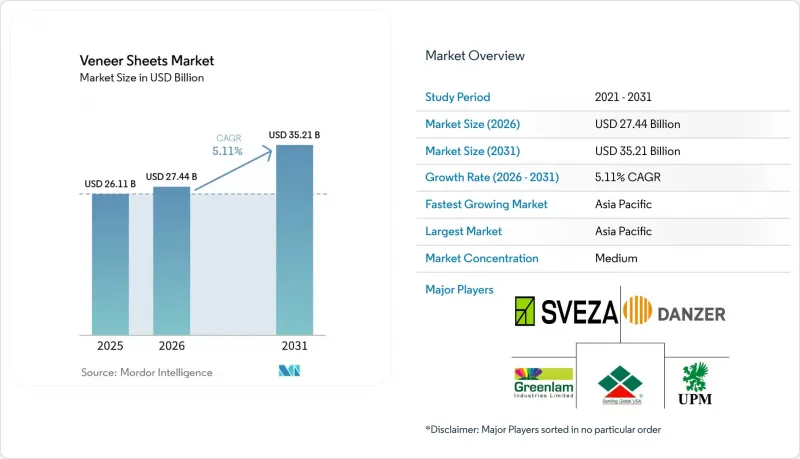
Mordor Intelligence에 의하면, 베니아시트 시장 규모는 2025년 261억 1,000만 달러에서 2026년에는 274억 4,000만 달러로 확대되어 2031년까지 352억 1,000만 달러에 이를 것으로 예상되고 있어 2026년부터 2031년까지 CAGR 5.11%로 성장할 전망입니다.
본 보고서는 제품 유형(천연 슬라이스 베니어 시트, 로터리 컷 베니어 시트 등), 수종(오크, 티크 등), 용도(가구 제조, 건축용 목공·문짝 등), 최종 사용자 산업(주택, 상업시설 등), 지역(아시아태평양, 북미, 유럽 등)별로 분류되어 있습니다. 시장 전망은 금액(달러) 기준으로 제시되어 있습니다.
세계 베니어 시트 시장 동향 및 분석
주택 및 상업시설의 리모델링 활동 확대
미국의 주택 소유자들은 2025년까지 6년 동안 리모델링 수요가 증가하는 추세를 유지하고 있으며, 현재는 주방이나 욕실 리모델링 시 재판매 가치라는 장점 때문에 라미네이트 소재보다 천연 베니어가 항상 선택되고 있습니다. 로비를 리뉴얼하는 호텔 체인은 북매치 마감 처리된 월넛과 훈연 오크를 사용하여, 객실 점유율이 70% 이상 시장에서 객실 단가 상승으로 이어지는 바이오필릭한 공간을 조성하고 있습니다. 미국의 주요 도시(Tier-1)에 위치한 오피스 빌딩 소유주들은 LEED 및 WELL 인증 점수를 획득하기 위해 베니어 벽 시스템을 채택하고 있으며, 기존에는 도장된 석고보드에 사용되던 상업용 목공 예산의 일부를 이쪽으로 전환하고 있습니다. 의료시설에서는 2025년부터 시행될 더욱 엄격한 소음 지침을 충족하는 흡음 베니어 패널이 채택되면서, 최종 시장에서의 입지가 확대되고 있습니다. 이러한 동향들이 맞물리면서, 베니어 시트 시장과 직결되는 안정적인 리모델링 프로젝트의 흐름이 강화되고 있습니다.
친환경 라벨이 부착된 목재 및 저VOC 자재로 전환
2025년, 유럽 공공 부문의 인테리어 공사 입찰에 참여하는 업체에 대해 FSC 및 PEFC 인증이 의무화됨에 따라, 인도네시아와 말레이시아의 비인증 수출업체들은 시장에서 배제되었습니다. 캘리포니아주는 복합 패널의 포름알데히드 함유량 기준을 강화함에 따라, 미국의 마감 업체들은 VOC가 전혀 포함되지 않은 합판 제품과 잘 어울리는 수성 UV 래커로 전환할 수밖에 없게 되었습니다. 지중해의 요트 제조업체들은 전세 선주에게 정보를 공개해야 하는 규정을 충족하기 위해 FSC 인증 티크 목재를 채택했으며, 이러한 추세는 2026년 초까지 중형 레저 보트 분야로도 확산되었습니다. 국제열대목재기구(ITTO)는 미얀마산 천연 티크 목재 수출이 12% 감소했다고 지적하며, 이로 인해 조림목 조달이 확대되었다고 밝혔습니다. 인증 획득으로 인해 입고 비용이 8-12% 증가하게 되었으나, 공급업체는 비인증 자재를 거부하는 스칸디나비아 및 독일의 OEM 제조업체에 접근할 수 있게 되었으며, 이로 인해 베니어 시트 업계에서 수익을 프리미엄 지역으로 재분배하게 되었습니다.
LVT, 멜라민 라미네이트, PVC 시트와의 경쟁
2025년에 출시된 디지털 프린트 고급 비닐 타일은 실제 합판 시공 비용의 절반 가격으로 오크나 월넛의 질감을 제공하여, 비용 효율성을 중시하는 공동주택 프로젝트에서 큰 호응을 얻고 있습니다. 동기 엠보싱 가공된 멜라민 입자는 질감과 인쇄 패턴을 일치시켜, 기존 베니어에 비해 열세였던 촉감의 차이를 줄여줍니다. 중국의 PVC 필름 공급업체는 가장자리 밀봉 공정을 생략하고, 내습성 면에서 합판을 능가하는 3D 라미네이트 프로파일의 생산을 확대했습니다. 인도나 동남아시아에서는 멜라민 재질을 채택함으로써 주방 캐비닛 가격이 1미터당 150달러 미만으로 떨어지게 되어, 베니어 시트 업계의 중위권 업체들이 베니어 재질에 대한 어려움을 겪고 있습니다. 한편, 고급 호텔, 요트, 맞춤형 주택에서는 여전히 실제 나무의 결과 질감이 프리미엄 가격을 유지하며, 합판 시장의 상위권을 굳건히 지키고 있습니다.
부문별 분석
천연 슬라이스 베니어 시트는 진짜 쿼터컷 오크와 리프트 소닝 월넛이 프리미엄 가격을 정당화하는 고급 캐비닛 시장을 기반으로, 2025년 매출의 48.22%를 차지하며 시장을 독점했습니다. 한편, 플렉서블 백이 적용된 베니어 시트는 곡면 적용이 요구되는 모듈식 건축의 확산에 힘입어 2031년까지 연평균 성장률(CAGR) 5.48%로 성장할 전망입니다. 로터리 커팅 시트는 비용 안정성을 중시하는 플랫팩 가구 OEM 제조업체에서 사용되며, 재구성 베니어는 염색된 포플러 심재를 사용하여 희귀한 이국적인 목재를 재현하고 있습니다. 2025년에는 PUR계 접착제를 사용한 내수성 접착이 주방에 가장 적합하다는 점 때문에 에지 밴딩 스트립 수요가 증가했습니다.
자동화의 추세가 이러한 변화를 가속화하고 있습니다. 2026년 초에 출시된 칸티사사의 PVC 코팅 합판 엣지 밴딩은 표준 설비로 가공이 가능하며, 플라스틱의 유연성과 천연 목재의 미관을 조화롭게 결합하고 있습니다. ±0.05mm 미만의 엔지니어드 베니어 두께 공차는 로봇을 이용한 취급에 적합하며, 베니어 시트 시장을 대량 생산을 통한 높은 처리량으로 이끌고 있습니다.
오크 목재는 구하기 쉬운 점과 쿼터 컷 가공으로 인한 안정성 덕분에 2025년 베니어 시트 시장 점유율의 30.24%를 차지했습니다. 월넛 목재는 벤틀리사가 2025년에 FSC 인증 오픈 포어 패널로 전환한 것을 계기로, 2031년까지 연평균 성장률(CAGR) 5.61%를 기록하며 가장 빠르게 성장할 것으로 전망됩니다. 티크 목재의 경우 미얀마에서공급이 제한적이기 때문에 요트 제조업체들은 조림 목재로 대체하는 작업을 추진하고 있습니다. 메이플은 조립식 캐비닛의 주력 소재로 자리매김하고 있는 반면, 애쉬와 체리는 틈새 주택 디자인 시장을 지탱하고 있습니다.
CITES(워싱턴 협약)에 따른 규제 강화로 인해 마호가니의 가격은 상승하고 있으며, 그 수요 기반은 축소되고 있습니다. 인증받은 조림 목재의 수종 다양화는 구매자의 지속가능성 노력과 부합하며, 베니어 시트 시장에서 프리미엄 위치를 공고히 하고 있습니다.
지역별 분석
아시아태평양은 2025년에 베니어 시트 시장 규모의 40.11%를 차지할 것으로 예상되며, 2031년까지 연평균 성장률(CAGR) 6.29%로 성장할 전망입니다. 중국 푸젠성과 저장성의 생산 거점에서는 자동화된 슬라이싱 기술과 열대 원목 수입 거점과의 근접성을 결합하여, 생산물을 북미 및 유럽에 공급하고 있습니다. 인도에서는 푸네, 아메다바드, 코임바토르에서 수요가 급증하고 있으며, 중산층 주택 소유자들이 오크나 월넛으로 만든 주방을 선호하고 있습니다. 일본은 미니멀한 나뭇결 미학에 초점을 맞춘 고급 수입품의 틈새 시장을 유지하고 있습니다.
북미에서는 2025년 콜롬비아 포레스트 프로덕츠가 노바 우드 라미네이션을 인수한 것이 호재가 되었습니다. 이를 통해 캐나다공급망이 강화되었으며, 중서부 가구 OEM 제조업체의 리드 타임이 단축되었습니다. 주택 리모델링이 기본적인 수요를 지탱하는 한편, LEED 인증 획득을 목표로 하는 사무실 리모델링이 때때로 수요를 끌어올리고 있습니다.
유럽 수요는 독일, 영국, 스칸디나비아 지역에 집중되어 있으며, 엄격한 FSC 기준 덕분에 단저(Danzer)와 같은 통합형 기업의 시장 점유율이 높아지고 있습니다. UPM이 2026년에 실시한 합판 사업 부문 재검토는 생산 능력 재편을 시사하고 있으며, 이로 인해 신규 시장 진출기업이 유입될 가능성이 있습니다.
중동 및 아프리카에서는 지역에 따라 성장 정도에 차이가 있습니다. 두바이와 리야드의 호스피탈리티 프로젝트에서는 북매치 마감 처리된 월넛이 지정되어 있지만, 사하라 이남 아프리카에서는 기후로 인한 내구성 문제로 인해 도입이 지연되고 있습니다. 남미는 여전히 수출 중심이며, 브라질은 로터리 컷 유칼립투스를 수출하고 있지만, 불법 벌목으로 인해 마호가니 공급은 위축되고 있습니다. 베니어 시트 시장의 기회 양상은 여전히 지리적 분산에 의해 규정되고 있습니다.
기타 혜택:
- 엑셀 형식 시장 예측(ME) 시트
- 3개월간의 애널리스트 지원
자주 묻는 질문
목차
제1장 서론
제2장 조사 방법
제3장 주요 요약
제4장 시장 구도
제5장 시장 규모와 성장 예측
제6장 경쟁 구도
제7장 시장 기회와 향후 전망
JHS 26.06.19According to Mordor Intelligence, the veneer sheets market size is expected to increase from USD 26.11 billion in 2025 to USD 27.44 billion in 2026 and reach USD 35.21 billion by 2031, growing at a CAGR of 5.11% over 2026-2031.
This report is Segmented by Product Type (Natural Sliced Veneer Sheets, Rotary-Cut Veneer Sheets, and More), Wood Species (Oak, Teak, and More), Application (Furniture Manufacturing, Architectural Millwork and Joinery, and More), End-User Industry (Residential, Commercial, and More), and Geography (Asia-Pacific, North America, Europe, and More). The Market Forecasts are Provided in Terms of Value (USD).
Global Veneer Sheets Market Trends and Insights
Growth in Residential and Commercial Remodeling Activity
Homeowners in the United States sustained a six-year remodeling uptrend through 2025, and kitchen or bath upgrades now consistently choose real veneer over laminates for resale value advantages. Hotel chains refreshing lobbies adopted book-matched walnut and fumed oak to create biophilic spaces that yield higher room rates in markets with occupancy above 70%. Office landlords in Tier-1 U.S. cities specify veneer wall systems to earn LEED and WELL credits, redirecting a share of commercial millwork budgets historically spent on painted gypsum. Healthcare facilities incorporated acoustic veneer panels that meet tougher 2025 noise guidelines, broadening end-market exposure. Collectively, these dynamics reinforce a stable renovation pipeline that feeds directly into the veneer sheets market.
Shift Toward Eco-Labeled Wood and Low-VOC Materials
FSC and PEFC certifications became mandatory for vendors bidding on European public-sector interiors in 2025, sidelining non-certified exporters from Indonesia and Malaysia. California tightened composite-panel formaldehyde limits, prompting U.S. finishers to switch to waterborne UV lacquers that pair well with Zero-VOC veneer offerings. Mediterranean yacht builders adopted FSC-certified teak to satisfy charterer disclosure rules, and the trend cascaded into mid-size recreational boats by early 2026. The International Tropical Timber Organization noted a 12% slide in wild teak exports from Myanmar, accelerating plantation sourcing. Although certification adds 8-12% to landed cost, suppliers gain access to Scandinavian and German OEMs that refuse uncertified lumber, realigning revenue toward premium geographies within the Veneer sheets industry.
Competition from LVT, Melamine Laminates, and PVC Sheets
Digitally printed luxury vinyl tile launched in 2025 offers oak and walnut visuals at half the installed price of real veneer, winning cost-sensitive multifamily projects. Synchronized-embossed melamine particles align texture with print, narrowing the tactile gap historically favoring veneer. Chinese PVC film suppliers scaled 3D-laminated profiles that eliminate edge-sealing and outperform veneer in terms of moisture. Kitchen cabinetry in India and Southeast Asia now hits sub-USD 150 per linear meter by opting for melamine, challenging veneer in the middle tier of the Veneer sheets industry. Authentic grain and patina still command premiums in luxury hotels, yachts, and bespoke residences, insulating the upper end of the veneer sheets market.
Other drivers and restraints analyzed in the detailed report include:
- Adoption of Bio-Based Adhesives Cutting Formaldehyde
- AI-Driven Veneer Grain-Matching and Waste Minimization
- Moisture/Termite Susceptibility Without Nano-Coatings
For complete list of drivers and restraints, kindly check the Table Of Contents.
Segment Analysis
Natural sliced veneer sheets dominated with 48.22% of 2025 revenue, anchored in high-end cabinetry where authentic quarter-cut oak and rift-sawn walnut justify premium pricing. Flexible backed veneer sheets, however, are set to expand at a 5.48% CAGR through 2031, propelled by modular construction that requires conformable surfaces. Rotary-cut sheets serve flat-pack furniture OEMs prioritizing cost stability, while reconstituted veneers replicate scarce exotics through dyed poplar cores. Edge-banding strips climbed in 2025 as PUR adhesive lines delivered water-resistant bonds ideal for kitchens.
Automation trends accelerate the shift. Cantisa's PVC-backed veneer edgeband, released in early 2026, runs on standard equipment and merges plastic flexibility with real-wood aesthetics. Engineered veneer thickness tolerances below +-0.05 millimeters satisfy robotic handling, positioning the veneer sheets market for higher throughput in mass production.
Oak captured 30.24% of the veneer sheets market share in 2025 because of availability and quarter-sawn stability. Walnut, aided by Bentley's 2025 shift to FSC-certified open-pore panels, will grow fastest at a 5.61% CAGR through 2031. Teak faces limited supply from Myanmar, steering yacht builders toward plantation alternatives. Maple remains a workhorse for ready-to-assemble cabinetry, while ash and cherry feed niche residential design.
Regulatory scrutiny under CITES inflates costs for mahogany and narrows its addressable base. Species diversification into certified plantation stock aligns with buyers' sustainability pledges, reinforcing premium positioning in the veneer sheets market.
Geography Analysis
Asia-Pacific retained a 40.11% veneer sheets market size in 2025 and will compound at a 6.29% CAGR through 2031. China's Fujian and Zhejiang clusters blend automated slicing with proximity to tropical log imports, funneling output to North America and Europe. Indian demand surged in Pune, Ahmedabad, and Coimbatore, where middle-class homeowners specify oak and walnut kitchens. Japan maintains a premium import niche focused on minimalist grain aesthetics.
North America benefited from Columbia Forest Products' 2025 acquisition of Nova Wood Lamination, which tightened Canadian supply chains and trimmed lead times for Midwest furniture OEMs. Residential remodels stabilize baseline demand, while LEED-driven office retrofits generate episodic lifts.
Europe's appetite centers on Germany, the United Kingdom, and Scandinavia, where strict FSC rules elevate the share of integrated players such as Danzer. UPM's 2026 review of its plywood unit hints at capacity realignment that could invite new entrants.
The Middle-East and Africa present selective growth. Dubai and Riyadh hospitality projects specify book-matched walnut, but Sub-Saharan adoption lags due to climate durability concerns. South America remains export-oriented; Brazil ships rotary-cut eucalyptus, though illegal logging curbs mahogany flows. Geographic diversification continues to define opportunity contours across the veneer sheets market.
- CEDAN INDUSTRIES
- Austin Hardwoods & Hardware
- Columbia Forest Products
- DANZER
- Durian Industries Ltd.
- Duroply Industries Limited
- F/List
- Flexible Materials
- FormWood Industries
- Greenlam Industries Ltd.
- Herzog Veneers
- Oakwood Veneer Company
- Samling Timber Malaysia
- Sunrise Plywood
- Sveza Group
- Turakhia Overseas
- UPM
- Veneer Technologies
- Woodline Veneer
Additional Benefits:
- The market estimate (ME) sheet in Excel format
- 3 months of analyst support
TABLE OF CONTENTS
1 Introduction
- 1.1 Study Assumptions and Market Definition
- 1.2 Scope of the Study
2 Research Methodology
3 Executive Summary
4 Market Landscape
- 4.1 Market Overview
- 4.2 Market Drivers
- 4.2.1 Growth in residential and commercial remodeling activity
- 4.2.2 Shift toward eco-labeled wood and low-VOC materials
- 4.2.3 Adoption of bio-based adhesives cutting formaldehyde
- 4.2.4 AI-driven veneer grain-matching and waste minimization
- 4.2.5 Modular off-site wall-panel systems using peel-and-stick veneers
- 4.3 Market Restraints
- 4.3.1 Competition from LVT, melamine laminates and PVC sheets
- 4.3.2 Moisture/termite susceptibility without nano-coatings
- 4.3.3 Prolonged global freight-capacity constraints lengthening lead-times
- 4.4 Value Chain Analysis
- 4.5 Porter's Five Forces
- 4.5.1 Threat of New Entrants
- 4.5.2 Bargaining Power of Buyers
- 4.5.3 Bargaining Power of Suppliers
- 4.5.4 Threat of Substitutes
- 4.5.5 Competitive Rivalry
5 Market Size and Growth Forecasts (Value)
- 5.1 By Product Type
- 5.1.1 Natural Sliced Veneer Sheets
- 5.1.2 Rotary-Cut Veneer Sheets
- 5.1.3 Reconstituted/Engineered Veneer Sheets
- 5.1.4 Flexible Backed Veneer Sheets
- 5.1.5 Edge-banding Veneer Strips
- 5.2 By Wood Species
- 5.2.1 Oak
- 5.2.2 Teak
- 5.2.3 Maple
- 5.2.4 Walnut
- 5.2.5 Birch
- 5.2.6 Cherry
- 5.2.7 Poplar
- 5.2.8 Other Wood Species (Ash, Mahogany, Exotic)
- 5.3 By Application
- 5.3.1 Furniture Manufacturing
- 5.3.2 Architectural Millwork and Joinery
- 5.3.3 Wall Paneling and Ceilings
- 5.3.4 Flooring Inlays
- 5.3.5 Doors and Windows
- 5.3.6 Automotive and Yacht Interiors
- 5.4 By End-user Industry
- 5.4.1 Residential
- 5.4.2 Commercial (Hospitality, Offices, Retail)
- 5.4.3 Institutional (Healthcare, Education)
- 5.4.4 Industrial and Transportation
- 5.5 By Geography
- 5.5.1 Asia-Pacific
- 5.5.1.1 China
- 5.5.1.2 Japan
- 5.5.1.3 India
- 5.5.1.4 South Korea
- 5.5.1.5 ASEAN Countries
- 5.5.1.6 Rest of Asia-Pacific
- 5.5.2 North America
- 5.5.2.1 United States
- 5.5.2.2 Canada
- 5.5.2.3 Mexico
- 5.5.3 Europe
- 5.5.3.1 Germany
- 5.5.3.2 United Kingdom
- 5.5.3.3 France
- 5.5.3.4 Italy
- 5.5.3.5 Spain
- 5.5.3.6 Russia
- 5.5.3.7 NORDIC Countries
- 5.5.3.8 Rest of Europe
- 5.5.4 South America
- 5.5.4.1 Brazil
- 5.5.4.2 Argentina
- 5.5.4.3 Rest of South America
- 5.5.5 Middle-East and Africa
- 5.5.5.1 Saudi Arabia
- 5.5.5.2 South Africa
- 5.5.5.3 Rest of Middle-East and Africa
- 5.5.1 Asia-Pacific
6 Competitive Landscape
- 6.1 Market Concentration
- 6.2 Strategic Moves
- 6.3 Market Share(%)/Ranking Analysis
- 6.4 Company Profiles (includes Global Overview, Market Overview, Core Segments, Financials, Strategic Information, Products and Services, and Recent Developments)
- 6.4.1 CEDAN INDUSTRIES
- 6.4.2 Austin Hardwoods & Hardware
- 6.4.3 Columbia Forest Products
- 6.4.4 DANZER
- 6.4.5 Durian Industries Ltd.
- 6.4.6 Duroply Industries Limited
- 6.4.7 F/List
- 6.4.8 Flexible Materials
- 6.4.9 FormWood Industries
- 6.4.10 Greenlam Industries Ltd.
- 6.4.11 Herzog Veneers
- 6.4.12 Oakwood Veneer Company
- 6.4.13 Samling Timber Malaysia
- 6.4.14 Sunrise Plywood
- 6.4.15 Sveza Group
- 6.4.16 Turakhia Overseas
- 6.4.17 UPM
- 6.4.18 Veneer Technologies
- 6.4.19 Woodline Veneer
7 Market Opportunities and Future Outlook
- 7.1 White-space and Unmet-need Assessment


