

|
시장보고서
상품코드
2062280
알루미늄 황산칼륨 시장 : 점유율 분석, 업계 동향과 통계, 성장 예측(2026-2031년)Aluminium Potash Sulphate - Market Share Analysis, Industry Trends & Statistics, Growth Forecasts (2026 - 2031) |
||||||
 Mordor Intelligence
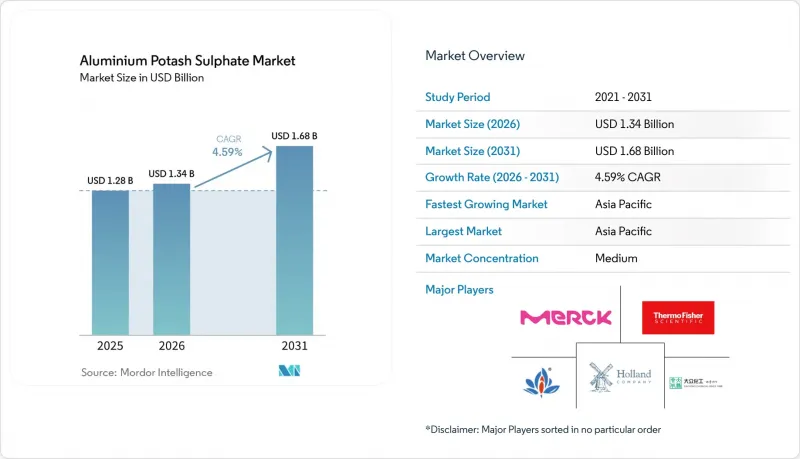
Mordor Intelligence에 의하면, 알루미늄 황산칼륨 시장 규모는 2025년에 12억 8,000만 달러, 2026년에 13억 4,000만 달러가 되어, 2031년까지 16억 8,000만 달러에 이를 것으로 예측되며, 2026년부터 2031년까지 CAGR 4.59%로 성장할 전망입니다.
본 보고서는 형태(고체, 액체 및 용액), 등급(산업용 등급, 식품용 등급 등), 용도(상하수도 처리, 섬유·가죽 가공 등), 최종 사용자(지자체, 산업, 상업, 가정) 및 지역(아시아태평양, 북미, 유럽, 남미, 중동 및 아프리카)별로 분류되어 있습니다. 시장 전망은 금액(달러) 기준으로 제시되어 있습니다.
세계 알루미늄 황산칼륨 시장 동향 및 분석
천연 데오드란트 및 퍼스널케어용 수렴제에서의 사용 증가
2024년 4월, 규제 당국은 특정 농도의 명반의 안전성을 승인했습니다. 이러한 인기에 힘입어 대중 시장과 프리미엄 시장 모두에서 천연 데오드란트 제품의 출시가 증가했습니다. 임상 연구에 따르면, 2-5%의 농도로 사용하면 자극을 최소화하면서 2주 이내에 겨드랑이 냄새를 줄일 수 있는 것으로 나타났습니다. 이를 통해 브랜드는 땀샘을 막지 않으면서도 식물 유래 제품임을 강조할 수 있게 되었습니다. 롤온이나 젤 형태의 제품, 특히 하이드로겔 캐리어를 사용한 제품이 소비자들의 관심을 끌고 있습니다. 또한, 투명성이 높은 성분 표기는 클린 뷰티를 추구하는 소비자들의 취향과 부합합니다. 미국과 독일의 자체 브랜드 소매업체들은 합성 발한 억제제 옆에 명반 결정체를 진열하기 시작했는데, 이는 시장에서 이에 대한 수용이 확대되고 있음을 반영합니다. 스프레이 제품용으로 입자 직경이 10 마이크로미터(µm) 미만임을 인증받은 공급업체의 판매량이 증가하고 있습니다.
아시아태평양의 섬유 및 가죽 가공 산업 확대
의류 및 신발 생산이 중국에서 인도, 베트남, 방글라데시로 이동하는 가운데, 해당 지역의 가공업체들은 매염 및 무두질 능력을 강화하고 있습니다. 중국이 알루미늄 제품에 최대 30%의 수출 관세를 부과함에 따라 전 세계 명반 공급이 부족해지고 있으며, 하류 구매자들은 수년까지 공급 계약을 확보하기 위해 서두르고 있습니다. 크롬 배출을 제한하는 유럽연합(EU)의 규제로 인해, 독성이 낮은 알루미늄계 무두질제로의 전환이 가속화되고 있습니다. 또한, 인도의 섬유 산업을 위한 생산 연계형 인센티브 제도가 명반의 소비를 촉진하고 있습니다. 다국적 가죽 브랜드들은 저탄소 명반을 사용하는 공급업체를 우선적으로 선정하는 구매 평가 시스템을 도입했으며, 이를 통해 제혁 공장들이 폐알루미늄을 효과적으로 재활용하는 방안을 채택하도록 장려하고 있습니다.
식품 및 화장품에 대한 알루미늄 사용에 대한 더 엄격한 제한
유럽 소비자안전과학위원회(SCCS)의 의견서에 명시된 알루미늄의 최대 허용치와 소비자 감시의 강화로 인해, 제품 개발자들은 알루미늄 함량을 줄이거나 분석을 통한 검증에 투자해야 할 필요가 있습니다. 독일의 규정에 따르면, 코팅되지 않은 알루미늄이 산성 식품과 접촉하는 것이 금지되어 있어 코팅 개선이 필요하게 되었고, 이에 따라 벌크 알루미늄 수요가 감소하고 있습니다. 또한, 나노 형태 제거와 관련된 시험으로 인해 추가 검사 비용이 발생하고 있습니다. 이러한 규제는 소비자의 안전을 높이는 한편, 특히 스프레이형 데오도란트나 산성 피클 등의 분야에서 성장에 부정적인 영향을 미치고 있습니다.
부문별 분석
2025년, 고체 분말 및 결정 형태는 고밀도 보관, 확립된 투여 장치, 비용 효율성 등의 장점에 힘입어 알루미늄 황산칼륨 시장에서 63.24%의 점유율을 차지했습니다. 액체 용액 시장은 2031년까지 연평균 성장률(CAGR) 5.51%로 성장할 것으로 전망됩니다. 이러한 성장은 디지털 채널을 통해 중소기업(SME)이 현장의 용해 탱크 사용을 피할 수 있게 되어 설비 투자를 절감할 수 있게 된 것이 원동력이 되고 있습니다. 프랑스에서 실시된 현장 시험 결과, 응집 효율에 영향을 주지 않으면서 구입하는 액체 알루미늄의 50%를 일렉트로펜턴 슬러지로 대체할 수 있음이 입증되었습니다. 지방자치단체의 유틸리티자는 대량 보관 시의 안정성 때문에 여전히 건조 형태를 선호하고 있지만, 크래프트 화장품 제조업체는 분진 노출을 최소화하기 위해 미리 용해된 제품을 선택하고 있습니다. 또한, 자동 디스펜서용으로 설계된 하이브리드 농축 파우치는 기존 형태를 결합하여, 공급업체가 두 가지 모두를 판매할 수 있게 되었습니다.
북미에서는 노동안전보건청(OSHA)의 분진 노출 기준에 따라 액체 투여가 권장되고 있어, 액체 용액이 눈에 띄는 성장을 보이고 있습니다. 한편, 아시아태평양의 섬유 공장에서는 인건비가 저렴하고 확립된 공급망이 있다는 점을 이유로 분말 공급 시스템을 유지하고 있습니다. 컨테이너 운송의 효율화가 진행됨에 따라 액체 화물의 경제성이 향상되고, 기존에 수분 함량에 따른 문제가 점차 해소되고 있습니다. 경쟁 구도는 수용액에서의 보관 기간 동안 안정성을 확보하고 미생물의 증식을 방지하는 공급업체의 역량에 달려 있습니다.
2025년, 산업용 등급은 수처리 및 섬유 염색용 매염제로서 수요가 주도하여 알루미늄 황산칼륨 시장의 60.56%를 차지했습니다. 의약품 및 화장품용 등급은 에어로졸 입자 크기에 관한 유럽연합(EU)의 규제로 인해 사실상 미국약전(USP) 수준의 순도가 요구되므로, 2031년까지 연평균 성장률(CAGR) 5.83%로 성장할 것으로 전망됩니다. 30-50%의 가격 프리미엄 덕분에 생산자들은 재결정화 및 유도 결합 플라즈마 질량 분석법(ICP-MS)에 대한 투자를 확대되고 있습니다. 식품 등급의 명반은 제빵 및 급성장하는 식물성 단백질 시장에 대응하는 중간적인 위치를 차지하고 있으며, 이러한 시장에서는 ‘일반적으로 안전하다고 인정되는(GRAS)’ 기준을 준수해야 하지만, 완전한 약전 기준까지는 요구되지 않습니다.
폐루프 세척 및 고효율 미립자 공기(HEPA) 필터를 도입한 제조업체는 중금속 함량을 10ppm(parts per million) 미만으로 유지하여 북유럽의 친환경 라벨 기준을 충족하고 있습니다. 아시아태평양의 산업용 구매자들은 여전히 비용을 중시하고 있지만, 한국의 화장품 수출업체들은 EU의 수입 기준을 충족하기 위해 유럽약전(EP) 및 USP 인증을 점점 더 많이 요구하고 있습니다. 이러한 시장 세분화를 통해 알루미늄 황산칼륨 시장은 수량 중심의 산업용 채널과 가치 중심의 특수 용도 부문으로 구분되며, 이로 인해 이중 라인 생산 전략이 촉진되고 있습니다.
지역별 분석
2025년, 아시아태평양은 알루미늄 황산칼륨 시장 점유율의 46.88%를 차지하고, 2031년까지 연평균 성장률(CAGR) 5.81%를 달성할 것으로 전망됩니다. 중국의 7억 1,100만 톤에 달하는 보크사이트 매장량과 수출 관세 제도로 인해 명반의 원료 공급이 부족해지고 있습니다. 이에 따라 인도와 베트남의 가공업체들은 대체 공급망을 모색하고, 스크랩을 원료로 하는 알루미늄 생산에 대한 투자를 확대되고 있습니다. 일본과 한국에서는 반도체 등급의 수처리 시스템에 고순도 알루미늄이 사용되고 있는 반면, 아세안(ASEAN) 국가들에서는 유리한 무역 협정 하에 섬유·가죽 산업이 확대되고 있습니다. 이 지역의 성장은 도시화, 배수 기준의 강화, 그리고 순환형 경제를 촉진하는 정책에 힘입어 이루어지고 있습니다.
북미에서는 지방자치단체 수요가 안정적이며, 가정용 및 화장품 분야에서 뚜렷한 성장이 나타나고 있습니다. 미국 환경보호청(EPA)의 영양염 기준에 따라 인 제거를 위한 알루미늄 첨가가 지속적으로 추진되고 있으며, 이에 따른 기초 소비량이 유지되고 있습니다. 서스캐처원주의 칼리 광산과 인접한 입지 덕분에 신뢰할 수 있는 원료 공급이 확보된 반면, 멕시코의 마키라도라 산업에서는 고순도 수처리 솔루션의 도입이 확대되고 있습니다.
유럽에서는 엄격한 화학물질 등록·평가·허가·제한(REACH) 규정 및 소비자안전과학위원회(SCCS)의 규제 하에, 입자 크기가 정밀하게 관리된 의약품 등급의 명반에 대한 수요가 증가하고 있습니다. 칼륨 공급과 관련된 지정학적 혼란으로 인해 비용은 상승하고 있지만, 순환형 경제로의 전환을 장려하는 정책 덕분에 알루미늄 스크랩의 활용이 촉진되고 있습니다. 독일과 프랑스는 화장품 분야의 주요 시장인 반면, 북유럽의 유틸리티자들은 저탄소 조달 요건을 충족하기 위해 재생에너지를 활용한 결정화 공정을 도입하고 있습니다.
남미, 중동 및 아프리카는 이 분야의 신흥 시장입니다. 브라질의 위생 프로그램과 사우디아라비아의 해수 담수화 전처리 이니셔티브가 기초적인 성장을 주도하고 있습니다. 그러나 물류상의 과제와 분석 능력의 부족이 단기적인 확장을 제약하고 있습니다. 향후 10년 동안 다자간 인프라 자금 지원으로 시장 침투가 촉진될 것으로 예측됩니다.
기타 혜택:
- 엑셀 형식 시장 예측(ME) 시트
- 3개월간의 애널리스트 지원
자주 묻는 질문
목차
제1장 서론
제2장 조사 방법
제3장 주요 요약
제4장 시장 구도
제5장 시장 규모와 성장 예측
제6장 경쟁 구도
제7장 시장 기회와 향후 전망
JHS 26.06.19According to Mordor Intelligence, the aluminium potash sulphate market size is projected to be USD 1.28 billion in 2025, USD 1.34 billion in 2026, and reach USD 1.68 billion by 2031, growing at a CAGR of 4.59% from 2026 to 2031.
This report is Segmented by Form (Solid, Liquid Solutions), Grade (Industrial Grade, Food Grade, and More), Application (Water and Wastewater Treatment, Textile and Leather Processing, and More), End-User (Municipal, Industrial, Commercial, Household), and Geography (Asia-Pacific, North America, Europe, South America, Middle East and Africa). The Market Forecasts are Provided in Terms of Value (USD).
Global Aluminium Potash Sulphate Market Trends and Insights
Increased Use in Natural Deodorants and Personal-Care Astringents
In April 2024, regulators endorsed potassium alum's safety at specific concentrations. This approval led to an increase in natural deodorant launches across both mass and premium markets. Clinical studies indicate that 2-5% formulations reduce underarm odor in less than two weeks with minimal irritation. This enables brands to promote a plant-based narrative without blocking sweat ducts. Formats such as roll-ons and gels, particularly those using hydrogel carriers, are attracting consumers. Additionally, transparent ingredient labels are aligning with the preferences of clean-beauty consumers. Private-label retailers in the United States and Germany are now placing alum crystals alongside synthetic antiperspirants, reflecting broader market acceptance. Suppliers certifying particle sizes under 10 micrometers (µm) for sprays are experiencing increased sales volumes.
Expansion of Textile and Leather Processing in Asia-Pacific
As apparel and footwear production shifts from China to India, Vietnam, and Bangladesh, regional processors are increasing their mordanting and tanning capacities. China's export duties of up to 30% on aluminum products are tightening global alum feedstocks, prompting downstream buyers to secure multi-year supply contracts. European Union (EU) regulations limiting chromium effluent are accelerating the transition to aluminum-based tanning agents, which are less toxic. Furthermore, India's Production Linked Incentive scheme for textiles is driving alum consumption. Multinational leather brands are implementing purchasing scorecards that prioritize suppliers using lower-carbon alum, encouraging mills to adopt waste-aluminum valorization methods.
Stricter Limits on Aluminium in Foods and Cosmetics
Formulators are required to either reduce aluminum levels or invest in analytical verifications due to maximum aluminum thresholds set by the European Scientific Committee on Consumer Safety (SCCS) opinion and increasing consumer scrutiny. Germany's regulations prohibit uncoated aluminum from coming into contact with acidic foods, necessitating retrofits for coatings and reducing the demand for bulk aluminum. Additionally, testing for nanoform exclusions introduces additional laboratory costs. These regulations enhance consumer safety but also impact growth, particularly in sectors like spray deodorants and acidic pickling.
Other drivers and restraints analyzed in the detailed report include:
- Up-Cycling of Aluminium Waste into High-Purity Potassium Alum
- Adoption in Plant-Based Meat Processing as Clean-Label Firming Agent
- Geopolitical Potash-Supply Volatility
For complete list of drivers and restraints, kindly check the Table Of Contents.
Segment Analysis
In 2025, solid powder and crystal formats held a 63.24% share of the aluminium potash sulphate market, supported by advantages such as dense storage, established dosing equipment, and cost-efficiency. Liquid solutions are projected to grow at a 5.51% compound annual growth rate (CAGR) through 2031. This growth is driven by digital channels enabling small and medium enterprises (SMEs) to avoid on-site dissolution tanks, reducing capital expenditures. Field trials in France demonstrated that electro-Fenton sludge can replace 50% of purchased liquid alum without affecting coagulation efficiency. Municipal utilities continue to prefer dry forms for their bulk storage stability, while craft cosmetic producers opt for pre-dissolved grades to minimize dust exposure. Additionally, hybrid concentrate pouches designed for automated dispensers are merging traditional formats, allowing suppliers to market both.
North America is experiencing significant growth in liquid solutions due to the Occupational Safety and Health Administration (OSHA) dust-exposure limits encouraging liquid dosing. Conversely, textile mills in the Asia-Pacific region maintain powder-feed systems due to lower labor costs and established supply chains. As containerized shipping becomes more efficient, the economics of liquid freight improve, addressing previous challenges associated with water weight. The competitive landscape will depend on suppliers' ability to ensure shelf-life stability and prevent microbial growth in aqueous solutions.
In 2025, industrial grades accounted for 60.56% of the aluminium potash sulphate market, driven by applications in water treatment and textile mordanting. Pharmaceutical and cosmetic grades are forecast to grow at a 5.83% CAGR through 2031, supported by European Union (EU) regulations on particle sizes for aerosols, which effectively require near-United States Pharmacopeia (USP) purity. Price premiums of 30-50% are encouraging producers to invest in recrystallization and inductively coupled plasma mass spectrometry (ICP-MS) analytics. Food-grade alum occupies a middle ground, catering to baking and the growing plant-protein market, which demands Generally Recognized as Safe (GRAS) compliance but not full pharmacopeial standards.
Producers implementing closed-loop rinsing and high-efficiency particulate air (HEPA) filtration are achieving heavy-metal baselines below 10 parts per million (ppm), meeting Nordic eco-label standards. While industrial buyers in Asia-Pacific remain cost-focused, cosmetics exporters in South Korea are increasingly requiring European Pharmacopeia (EP)/USP certification to meet EU import standards. This segmentation divides the aluminium potash sulphate market into volume-driven industrial channels and value-driven specialty segments, encouraging dual-line manufacturing strategies.
Geography Analysis
In 2025, the Asia-Pacific region accounted for 46.88% of the aluminium potash sulphate market share and is projected to achieve a 5.81% compound annual growth rate (CAGR) through 2031. China's 711 million-ton bauxite reserves, along with its export-duty regime, are tightening the supply of alum feedstock. This has led processors in India and Vietnam to explore alternative supply chains and invest in scrap-based alum production. Japan and South Korea are utilizing high-purity alum in semiconductor-grade water systems, while ASEAN nations are expanding their textile and leather industries under favorable trade agreements. Regional growth is supported by urbanization, stricter wastewater standards, and policies promoting a circular economy.
North America demonstrates stable municipal demand, with notable growth in household and cosmetics applications. The United States Environmental Protection Agency's (EPA) nutrient criteria continue to drive alum dosing for phosphorus removal, maintaining baseline consumption. Proximity to Saskatchewan potash ensures a reliable feedstock supply, while Mexico's maquiladora industries are increasingly adopting high-purity water treatment solutions.
Europe, operating under stringent Registration, Evaluation, Authorization, and Restriction of Chemicals (REACH) and Scientific Committee on Consumer Safety (SCCS) regulations, is experiencing increased demand for pharmaceutical-grade alum with precise particle-size control. Geopolitical disruptions in potash supply have raised costs, but circular economy incentives are encouraging aluminum-scrap utilization. Germany and France are key markets for cosmetics applications, while Nordic utilities are implementing renewable-powered crystallisation to meet low-carbon procurement requirements.
South America and the Middle East & Africa are emerging markets in this sector. Brazil's sanitation programs and Saudi Arabia's desalination pre-treatment initiatives are driving baseline growth. However, logistical challenges and limited analytical capacity are constraining short-term expansion. Multilateral infrastructure funding is expected to enhance market penetration over the next decade.
- Alpha Chemika
- Amar Narain Industries
- American Elements
- Arch Industries
- Avantor, Inc.
- GEO Specialty Chemicals
- GFS Chemicals, Inc.
- Hengyang Jianheng Industry Development Co., Ltd.
- HOLLAND COMPANY
- K+S Aktiengesellschaft
- Merck KGaA
- NATIONAL CHEMICAL INDUSTRIES
- Otto Chemie Pvt. Ltd.
- Thermo Fisher Scientific Inc.
- Zibo Dazhong Edible Chemical Co., LTD.
Additional Benefits:
- The market estimate (ME) sheet in Excel format
- 3 months of analyst support
TABLE OF CONTENTS
1 Introduction
- 1.1 Study Assumptions and Market Definition
- 1.2 Scope of the Study
2 Research Methodology
3 Executive Summary
4 Market Landscape
- 4.1 Market Overview
- 4.2 Market Drivers
- 4.2.1 Increased use in natural deodorants and personal-care astringents
- 4.2.2 Expansion of textile and leather processing in Asia-Pacific
- 4.2.3 Up-cycling of aluminium waste into high-purity potassium alum
- 4.2.4 Adoption in plant-based meat processing as clean-label firming agent
- 4.2.5 Digital-direct B2B distribution unlocking SME demand
- 4.3 Market Restraints
- 4.3.1 Stricter limits on aluminium in foods and cosmetics
- 4.3.2 Geopolitical potash-supply volatility (sanctions, export bans)
- 4.3.3 High energy intensity of alum crystallisation limiting green credentials
- 4.4 Value Chain Analysis
- 4.5 Porter's Five Forces
- 4.5.1 Threat of New Entrants
- 4.5.2 Bargaining Power of Buyers
- 4.5.3 Bargaining Power of Suppliers
- 4.5.4 Threat of Substitutes
- 4.5.5 Competitive Rivalry
5 Market Size and Growth Forecasts (Value)
- 5.1 By Form
- 5.1.1 Solid (Powder, Crystals)
- 5.1.2 Liquid Solutions
- 5.2 By Grade
- 5.2.1 Industrial Grade
- 5.2.2 Food Grade
- 5.2.3 Pharmaceutical/Cosmetic Grade
- 5.3 By Application
- 5.3.1 Water and Wastewater Treatment
- 5.3.2 Textile and Leather Processing
- 5.3.3 Cosmetics and Personal Care
- 5.3.4 Food and Beverage Additives
- 5.3.5 Pharmaceuticals and Medical
- 5.3.6 Paper and Pulp Industry
- 5.3.7 Other (Photography, Fireproofing, Agriculture)
- 5.4 By End-User Industry
- 5.4.1 Municipal
- 5.4.2 Industrial
- 5.4.3 Commercial
- 5.4.4 Household
- 5.5 By Geography
- 5.5.1 Asia-Pacific
- 5.5.1.1 China
- 5.5.1.2 Japan
- 5.5.1.3 India
- 5.5.1.4 South Korea
- 5.5.1.5 ASEAN Countries
- 5.5.1.6 Rest of Asia-Pacific
- 5.5.2 North America
- 5.5.2.1 United States
- 5.5.2.2 Canada
- 5.5.2.3 Mexico
- 5.5.3 Europe
- 5.5.3.1 Germany
- 5.5.3.2 United Kingdom
- 5.5.3.3 France
- 5.5.3.4 Italy
- 5.5.3.5 Spain
- 5.5.3.6 Russia
- 5.5.3.7 NORDIC Countries
- 5.5.3.8 Rest of Europe
- 5.5.4 South America
- 5.5.4.1 Brazil
- 5.5.4.2 Argentina
- 5.5.4.3 Rest of South America
- 5.5.5 Middle-East and Africa
- 5.5.5.1 Saudi Arabia
- 5.5.5.2 South Africa
- 5.5.5.3 Rest of Middle-East and Africa
- 5.5.1 Asia-Pacific
6 Competitive Landscape
- 6.1 Market Concentration
- 6.2 Strategic Moves
- 6.3 Market Share(%)/Ranking Analysis
- 6.4 Company Profiles (includes Global Overview, Market Overview, Core Segments, Financials, Strategic Information, Products and Services, and Recent Developments)
- 6.4.1 Alpha Chemika
- 6.4.2 Amar Narain Industries
- 6.4.3 American Elements
- 6.4.4 Arch Industries
- 6.4.5 Avantor, Inc.
- 6.4.6 GEO Specialty Chemicals
- 6.4.7 GFS Chemicals, Inc.
- 6.4.8 Hengyang Jianheng Industry Development Co., Ltd.
- 6.4.9 HOLLAND COMPANY
- 6.4.10 K+S Aktiengesellschaft
- 6.4.11 Merck KGaA
- 6.4.12 NATIONAL CHEMICAL INDUSTRIES
- 6.4.13 Otto Chemie Pvt. Ltd.
- 6.4.14 Thermo Fisher Scientific Inc.
- 6.4.15 Zibo Dazhong Edible Chemical Co., LTD.
7 Market Opportunities and Future Outlook
- 7.1 White-space and Unmet-need Assessment


