

|
시장보고서
상품코드
2062308
마이크로 세분화 시장 : 점유율 분석, 업계 동향과 통계, 성장 예측(2026-2031년)Microsegmentation - Market Share Analysis, Industry Trends & Statistics, Growth Forecasts (2026 - 2031) |
||||||
 Mordor Intelligence
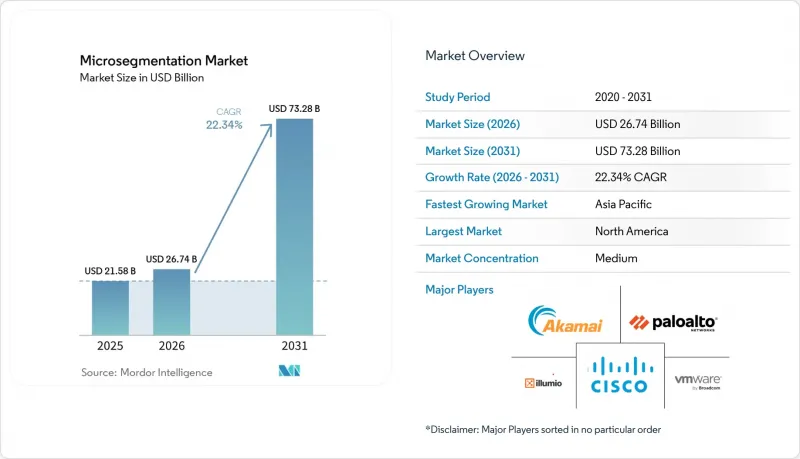
Mordor Intelligence에 의하면, 마이크로 세분화 시장 규모는 2025년에 215억 8,000만 달러, 2026년에 267억 4,000만 달러가 되어, 2031년까지 732억 8,000만 달러에 이를 것으로 예측됩니다.
2026년부터 2031년까지 연평균 성장률(CAGR) 22.34%로 성장할 것으로 전망됩니다.
본 보고서는 구성 요소(소프트웨어, 서비스), 도입 형태(On-Premise, 클라우드), 조직 규모(중소기업, 대기업), 최종 사용자 산업(은행, 금융서비스 및 보험(BFSI), 헬스케어 및 생명과학, 기타), 보안 유형(네트워크 중심, 용도 중심, 워크로드 중심, 엔드포인트 중심) 및 지역별로 분류되어 있습니다. 시장 전망은 금액(달러) 기준으로 제시되어 있습니다.
세계 마이크로 세분화 시장 동향 및 인사이트
제로 트러스트 보안 아키텍처의 도입 확대
제로 트러스트 프로그램은 암묵적인 신뢰를 지속적인 검증으로 대체하며, 기업이 모든 워크로드, 디바이스 및 세션을 격리할 것을 요구합니다. 미국 행정관리예산국(OMB)은 연방 기관에 2027년까지 제로 트러스트 레벨 3의 성숙도를 달성할 것을 요구하고 있으며, 이는 모든 네트워크에 대한 마이크로 세분화를 명시적으로 요구하는 것으로, 규제가 엄격한 민간 부문에서도 유사한 움직임을 촉진하고 있습니다. 금융기관의 보고에 따르면, 세분화 시행 후 공격자의 잠복 기간이 21일에서 48시간 미만으로 단축되었으며, 이는 해당 대책이 침해로 인한 경제적 손실에 직접적인 영향을 미칩니다는 사실을 입증하고 있습니다. 각 벤더사는 이에 맞추어 로드맵을 조정하고, 신원, 네트워크, 워크로드 정책을 통합한 단일 엔진을 구축하여 제로 트러스트 원칙에 따라 운영할 수 있도록 하고 있습니다.
랜섬웨어 및 측면 이동 공격의 급증
공격자가 공격을 실행하기 전에 내부 토폴로지를 파악하는 데 더 많은 시간을 할애함에 따라, 2025년 기업을 대상으로 한 평균 몸값 요구액은 530만 달러에 달하고, 전년 대비 74% 증가했습니다. 성공한 침해 사고의 약 68%에서 부문 간 수평 이동이 확인되었으나, 마이크로 세분화는 사용되지 않는 경로를 차단함으로써 이러한 패턴을 차단합니다. 사전에 세분화 작업을 수행한 조직의 경우, 동종 업계 타사에 비해 복구 비용이 89% 감소했으며, 사이버 보안은 더 이상 회수 불가능한 비용이 아니라 보험 수리학적 헤지 수단으로 전환되고 있습니다.
도입의 복잡성과 높은 비용
세분화을 도입하는 데는 보통 6개월에서 18개월이 소요됩니다. 이는 용도의 종속성을 면밀히 조사하고 광범위한 시범 테스트를 수행해야 하기 때문입니다. 중견 기업들은 미션 크리티컬 자산만을 대상으로 하는 1단계에 50만 달러에서 500만 달러를 투자하고 있으며, 이는 다른 현대화 프로그램에서 확보한 제한된 자금을 전용하는 것을 의미합니다. 범위 설정에 대한 단 하나의 잘못된 정책만으로도 실제 워크플로우가 중단되고, 이해관계자의 신뢰를 잃으며, 이후 단계가 지연될 수 있으므로, 재작업의 위험이 매우 큽니다.
부문별 분석
서비스 시장의 성장률은 마이크로 세분화 시장 전체의 성장률을 상회하고 있으며, 이는 추상적인 보안 의도를 적용 가능한 규칙으로 변환할 수 있는 아키텍트에 대한 절실한 수요를 반영하고 있습니다. 2025년에도 소프트웨어가 여전히 수익의 대부분을 차지하고 있었지만, 조직들은 라이선싱만으로는 네트워크를 보호할 수 없습니다는 사실을 깨달았습니다. 전문 팀은 트래픽 흐름 매핑, 허용 목록 작성, 레거시 워크로드에 대한 정책의 영향 검증에 수개월을 할애하고 있습니다. 이러한 노력이 성숙해짐에 따라 성과 기반 계약이 점차 확산되고 있으며, 공급업체에 대한 지급은 공격 표면의 측정 가능한 축소나 감사 결과와 연계되도록 되어 있습니다. 관리형 서비스 제공업체는 마이크로 세분화를 지속적인 정책 조정, 변경 관리, 사고 대응을 포함한 보다 광범위한 서비스에 통합하고 있습니다. 이는 전담 세분화 담당자를 배치할 수 없는 조직에 있어 필수적인 요소입니다.
또 다른 동향으로는 일반적인 엔터프라이즈 용도를 위한 모범 사례 템플릿을 통합한 로우코드 정책 생성 도구의 등장을 들 수 있습니다. 이러한 도구는 서비스의 가치를 반복적인 규칙 수립에서 수익성이 높은 자문 업무로 높여줍니다. 이러한 융합 덕분에 소프트웨어 단가가 상품화되고 있음에도 불구하고, 평균 프로젝트 규모는 높은 수준을 유지하고 있으며, 안정적인 컨설팅 수주 파이프라인이 유지되고 있습니다.
2025년 수익의 58.43%를 클라우드 도입이 차지했습니다. 이는 신규 프로젝트에서 유연하게 확장할 수 있고, 몇 분 만에 정책을 검증할 수 있는 SaaS형 컨트롤 플레인이 선호되었기 때문입니다. 클라우드 기반 서비스를 통해 랙 공간, 배선, 하드웨어 교체 주기가 필요 없어지며, 분산형 기업의 가치 실현까지 걸리는 시간이 단축됩니다. 멀티 클라우드 사용자의 경우, 통합된 SaaS 콘솔을 통해 Amazon Web Services, Microsoft Azure, Google Cloud의 각 환경 간에 정책 구문 불일치가 발생하는 것을 방지할 수 있습니다.
그러나 데이터 주권 관련 규제가 있는 업계나 에어갭(air gap) 방식으로 분리된 운영 기술(OT) 네트워크를 보유한 업계에서는 On-Premise 구축이 여전히 주류를 이루고 있습니다. 이러한 환경에서는 어플라이언스나 자체 호스팅형 가상 머신이 여전히 안정적인 성능과 오프라인 운영을 제공합니다. 하이브리드 방식도 일반적이며, 조직은 클라우드를 통해 제공되는 정책 엔진을 운영하고, 이를 통해 On-Premise 엔포서(enforcer)에 규칙을 푸시함으로써, 기밀 데이터를 이동시키지 않고도 단일 관리 화면을 구현하고 있습니다.
지역별 분석
아시아태평양의 높은 성장세는 수십억 달러 규모의 공장 현대화 프로그램, 핀테크의 확산, 그리고 각국의 사이버 보안 전략에 힘입어 유지되고 있습니다. 중국은 중요 정보 인프라의 현지 보호를 의무화하고 있으며, 에너지, 금융, 통신 등의 업계에 대해 세밀한 통제 체계의 도입을 장려하고 있습니다. 일본에서는 인더스트리 4.0으로의 전환에 따라 프로그래머블 로직 컨트롤러(PLC)가 더욱 광범위한 네트워크에 연결됨에 따라, 공정 중단을 방지하기 위해 워크로드를 분리할 필요가 대두되고 있습니다.
북미는 성숙한 사이버 보안 예산과 정교한 위협 활동 덕분에 수요 측면에서 주도권을 유지하고 있습니다. 미국 연방 정부의 제로 트러스트 관련 주요 단계와 주 정부의 개인정보 보호법은 세분화을 기업의 로드맵에 명확히 자리매김하게 하는 다양한 규제의 모자이크를 형성하고 있습니다. 캐나다가 핵심 인프라의 회복탄력성을 중시함에 따라 수요가 서서히 증가하고 있는 반면, 멕시코의 니어쇼어링 이니셔티브는 제조업 집적 지역에 새로운 수요를 창출하고 있습니다.
유럽에서는 NIS2(네트워크 및 정보 보안 지침 2) 미준수에 대한 처벌 조치가 경영진 차원의 주요 관심사로 부상함에 따라, 주요 산업 전반에서 도입이 동시에 진행되고 있습니다. 중동에서는 석유 수입을 기술 다각화에 투자하고 있으며, 대규모 스마트 시티 및 에너지 프로젝트에서 설계 단계부터 세분화가 반영되고 있습니다. 남미에서의 도입은 브라질과 아르헨티나가 중심이며, 금융 규제 당국이 정보 유출 보고 규정을 강화하고 있습니다. 한편, 아프리카는 여전히 개발도상국 단계에 머물러 있어 보안 아키텍트 부족으로 인한 제약을 받고 있지만, 통신 인프라의 현대화에 힘입어 성장하고 있습니다.
기타 혜택:
- 엑셀 형식 시장 예측(ME) 시트
- 3개월간의 애널리스트 지원
자주 묻는 질문
목차
제1장 서론
제2장 조사 방법
제3장 주요 요약
제4장 시장 구도
제5장 시장 규모와 성장 예측
제6장 경쟁 구도
제7장 시장 기회와 향후 전망
JHS 26.06.19According to Mordor Intelligence, the microsegmentation market size is projected to be USD 21.58 billion in 2025, USD 26.74 billion in 2026, and reach USD 73.28 billion by 2031, growing at a CAGR of 22.34% from 2026 to 2031.
This report is Segmented by Component (Software, Services), Deployment Mode (On-Premises, Cloud), Organization Size (Small and Medium Enterprises, Large Enterprises), End-User Industry (BFSI, Healthcare and Life Sciences, and More), Security Type (Network-Centric, Application-Centric, Workload-Centric, Endpoint-Centric), and Geography. The Market Forecasts are Provided in Terms of Value (USD).
Global Microsegmentation Market Trends and Insights
Rising Adoption Of Zero-Trust Security Architectures
Zero-trust programs replace implicit trust with continuous verification, forcing enterprises to isolate every workload, device, and session. The U.S. Office of Management and Budget requires federal agencies to attain zero-trust Level 3 maturity by fiscal 2027, which explicitly calls for microsegmentation on all networks, driving similar moves in highly regulated private sectors.Financial institutions report that dwell time dropped from 21 days to under 48 hours after segmentation, confirming the control's direct impact on breach economics. Vendors align roadmaps accordingly, integrating identity, network, and workload policies into a unified engine that executes in line with zero-trust principles.
Surge In Ransomware And Lateral-Movement Attacks
Average enterprise ransom demands climbed to USD 5.3 million in 2025, a 74% rise from the prior year, as attackers spent longer mapping internal topologies before detonation. Nearly 68% of successful incidents involved cross-segment traversal, a pattern microsegmentation disrupts by sealing off unused pathways. Organizations with pre-existing segmentation reported 89% lower recovery outlays than peers, converting cybersecurity into an actuarial hedge rather than a sunk cost.
High Implementation Complexity And Cost
Segmentation rollouts typically require six to eighteen months, driven by painstaking discovery of application dependencies and extensive pilot testing. Mid-sized enterprises invest between USD 500,000 and USD 5 million for a first phase that covers only mission-critical assets, diverting scarce capital from other modernization programs. Rework risk looms large, as one mis-scoped policy can interrupt production workflows, eroding stakeholder confidence and delaying further phases.
Other drivers and restraints analyzed in the detailed report include:
- Regulatory Mandates For East-West Traffic Control
- Proliferation Of Cloud-Native Workloads And Microservices
- Legacy Infrastructure Compatibility Challenges
For complete list of drivers and restraints, kindly check the Table Of Contents.
Segment Analysis
Services growth outpaces the overall microsegmentation market, reflecting an acute need for architects who translate abstract security intent into enforceable rules. In 2025, software still generated most revenue, yet organizations discovered that licensing alone does not secure networks. Professional teams spend months mapping traffic flows, drafting allowlists, and validating policy impact on legacy workloads. As these engagements mature, outcome-based contracts gain traction, tying vendor payments to measurable reductions in attack surface or audit findings. Managed service providers bundle microsegmentation into broader offerings that include continuous policy tuning, change management, and incident response, crucial for organizations unable to field full-time segmentation staff.
A secondary dynamic is the emergence of low-code policy generators that embed best practice templates for common enterprise applications. These tools elevate the value of services from repetitive rule writing toward higher-margin advisory roles. The convergence keeps average project scopes high and sustains robust consulting pipelines, even as software per-unit prices are being commoditized.
Cloud deployments held 58.43% of 2025 revenue as greenfield projects favored SaaS control planes that scale elastically and validate policies in minutes. Cloud delivery removes the need for rack space, cabling, and hardware refresh cycles, reducing time-to-value for distributed enterprises. For multi-cloud users, a unified SaaS console prevents policy syntax drift across Amazon Web Services, Microsoft Azure, and Google Cloud environments.
On-premises deployments, however, remain a fixture in sectors with data sovereignty rules or air-gapped operational technology networks. In those contexts, appliances or self-hosted virtual machines still offer deterministic performance and offline operation. Hybrid patterns are common, with organizations running cloud-delivered policy engines that push rules to on-premises enforcers, yielding a single pane of glass without relocating sensitive data.
Geography Analysis
Asia-Pacific's high-growth trajectory is fueled by multi-billion-dollar factory modernization programs, fintech proliferation, and national cybersecurity strategies. China mandates localized protection of critical information infrastructure, encouraging sectors such as energy, finance, and telecom to adopt granular controls. In Japan, Industry 4.0 retrofits expose programmable logic controllers to broader networks, necessitating workload isolation that avoids process interruptions.
North America retains demand leadership by virtue of mature cyber budgets and advanced threat activity. U.S. federal zero-trust milestones and state privacy laws create a mosaic of mandates that place segmentation squarely on enterprise roadmaps. Canada's emphasis on critical infrastructure resilience adds incremental volume, while Mexican nearshoring initiatives inject new demand in manufacturing corridors.
Europe experiences synchronized adoption across critical sectors as penalties for NIS2 non-conformance become a board-level concern. The Middle East channels oil revenue into technology diversification, with large-scale smart city and energy projects embedding segmentation at design time. South American uptake centers on Brazil and Argentina, where financial regulators tighten breach reporting rules, while Africa remains emergent, constrained by shortage of security architects but buoyed by telecom modernization.
- Illumio, Inc.
- VMware, Inc.
- Cisco Systems, Inc.
- Akamai Technologies, Inc.
- Palo Alto Networks, Inc.
- Fortinet, Inc.
- Check Point Software Technologies Ltd.
- Juniper Networks, Inc.
- Unisys Corporation
- Forcepoint LLC
- Sophos Group plc
- F5, Inc.
- Nutanix, Inc.
- ColorTokens Inc.
- CloudPassage, Inc.
- Tufin Software Technologies Ltd.
- Zscaler, Inc.
- Armo Security Ltd.
- Guardicore Ltd.
- McAfee LLC
Additional Benefits:
- The market estimate (ME) sheet in Excel format
- 3 months of analyst support
TABLE OF CONTENTS
1 INTRODUCTION
- 1.1 Study Assumptions and Market Definition
- 1.2 Scope of the Study
2 RESEARCH METHODOLOGY
3 EXECUTIVE SUMMARY
4 MARKET LANDSCAPE
- 4.1 Market Overview
- 4.2 Market Drivers
- 4.2.1 Rising Adoption of Zero-Trust Security Architectures
- 4.2.2 Surge in Ransomware and Lateral-Movement Attacks
- 4.2.3 Regulatory Mandates for East-West Traffic Control
- 4.2.4 Proliferation of Cloud-Native Workloads and Micro-services
- 4.2.5 Convergence with Secure Access Service Edge (SASE) Platforms
- 4.2.6 Cyber-Insurance Pre-qualification Requirements for Microsegmentation
- 4.3 Market Restraints
- 4.3.1 High Implementation Complexity and Cost
- 4.3.2 Legacy Infrastructure Compatibility Challenges
- 4.3.3 Scarcity of Certified Microsegmentation Architects
- 4.3.4 Latency Overheads in Operational Technology (OT) Networks
- 4.4 Industry Value-Chain Analysis
- 4.5 Regulatory Landscape
- 4.6 Technological Outlook
- 4.7 Impact of Macroeconomic Factors on the Market
- 4.8 Porter's Five Forces Analysis
- 4.8.1 Threat of New Entrants
- 4.8.2 Threat of Substitutes
- 4.8.3 Bargaining Power of Suppliers
- 4.8.4 Bargaining Power of Buyers
- 4.8.5 Intensity of Competitive Rivalry
5 MARKET SIZE AND GROWTH FORECASTS (VALUE)
- 5.1 By Component
- 5.1.1 Software
- 5.1.2 Services
- 5.2 By Deployment Mode
- 5.2.1 On-Premises
- 5.2.2 Cloud
- 5.3 By Organization Size
- 5.3.1 Small and Medium Enterprises
- 5.3.2 Large Enterprises
- 5.4 By End-User Industry
- 5.4.1 Banking, Financial Services and Insurance (BFSI)
- 5.4.2 Healthcare and Life Sciences
- 5.4.3 Government and Defense
- 5.4.4 IT and Telecommunication
- 5.4.5 Retail and E-Commerce
- 5.4.6 Energy and Utilities
- 5.4.7 Rest of End-User Industry
- 5.5 By Security Type
- 5.5.1 Network-Centric
- 5.5.2 Application-Centric
- 5.5.3 Workload-Centric
- 5.5.4 Endpoint-Centric
- 5.6 By Geography
- 5.6.1 North America
- 5.6.1.1 United States
- 5.6.1.2 Canada
- 5.6.1.3 Mexico
- 5.6.2 Europe
- 5.6.2.1 Germany
- 5.6.2.2 United Kingdom
- 5.6.2.3 France
- 5.6.2.4 Russia
- 5.6.2.5 Rest of Europe
- 5.6.3 Asia-Pacific
- 5.6.3.1 China
- 5.6.3.2 Japan
- 5.6.3.3 India
- 5.6.3.4 South Korea
- 5.6.3.5 Australia
- 5.6.3.6 Rest of Asia-Pacific
- 5.6.4 Middle East
- 5.6.4.1 Saudi Arabia
- 5.6.4.2 United Arab Emirates
- 5.6.4.3 Rest of Middle East
- 5.6.5 Africa
- 5.6.5.1 South Africa
- 5.6.5.2 Egypt
- 5.6.5.3 Rest of Africa
- 5.6.6 South America
- 5.6.6.1 Brazil
- 5.6.6.2 Argentina
- 5.6.6.3 Rest of South America
- 5.6.1 North America
6 COMPETITIVE LANDSCAPE
- 6.1 Market Concentration
- 6.2 Strategic Moves
- 6.3 Market Share Analysis
- 6.4 Company Profiles (includes Global Level Overview, Market Level Overview, Core Segments, Financials as available, Strategic Information, Market Rank/Share, Products and Services, Recent Developments)
- 6.4.1 Illumio, Inc.
- 6.4.2 VMware, Inc.
- 6.4.3 Cisco Systems, Inc.
- 6.4.4 Akamai Technologies, Inc.
- 6.4.5 Palo Alto Networks, Inc.
- 6.4.6 Fortinet, Inc.
- 6.4.7 Check Point Software Technologies Ltd.
- 6.4.8 Juniper Networks, Inc.
- 6.4.9 Unisys Corporation
- 6.4.10 Forcepoint LLC
- 6.4.11 Sophos Group plc
- 6.4.12 F5, Inc.
- 6.4.13 Nutanix, Inc.
- 6.4.14 ColorTokens Inc.
- 6.4.15 CloudPassage, Inc.
- 6.4.16 Tufin Software Technologies Ltd.
- 6.4.17 Zscaler, Inc.
- 6.4.18 Armo Security Ltd.
- 6.4.19 Guardicore Ltd.
- 6.4.20 McAfee LLC
7 MARKET OPPORTUNITIES AND FUTURE OUTLOOK
- 7.1 White-space and Unmet-Need Assessment


