|
시장보고서
상품코드
2062352
금속 비활성화제 시장 : 시장 점유율 분석, 업계 동향 및 통계, 성장 예측(2026-2031년)Metal Deactivator - Market Share Analysis, Industry Trends & Statistics, Growth Forecasts (2026 - 2031) |
||||||
 Mordor Intelligence
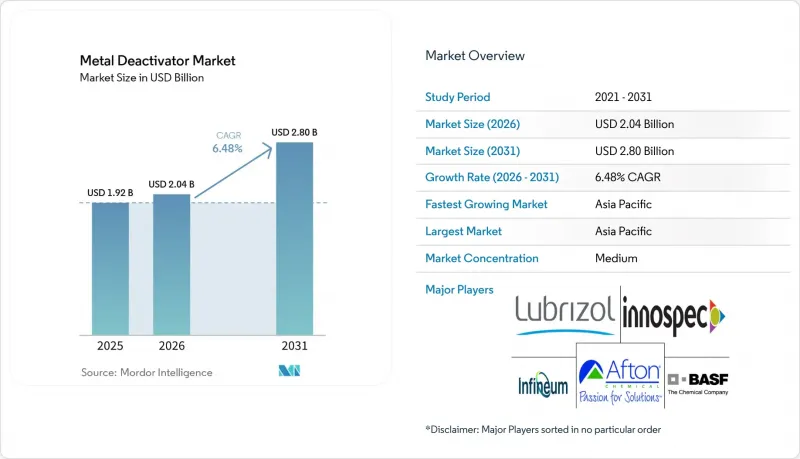
Mordor Intelligence에 의하면, 금속 비활성화제 시장 규모는 2025년 19억 2,000만 달러로 평가되었고, 2026년에는 20억 4,000만 달러로 추정되고, 2031년까지 28억 달러에 이를 것으로 예상되며, 2026-2031년 CAGR 6.48%로 성장할 전망입니다.
본 보고서는 유형별(연료 첨가제, 윤활유 첨가제 등), 화학적 성질별(질소계 킬레이트제, 황계 화합물 등), 용도별(가솔린, 디젤 등), 최종 사용자 산업별(자동차 및 운송, 석유 및 가스, 정제 등), 지역별(아시아태평양, 북미, 유럽 등)로 분류되어 있습니다. 시장 전망은 금액(달러) 기준으로 제시되어 있습니다.
세계의 금속 비활성화제 시장 동향 및 인사이트
연료 및 윤활유의 장기적 안정성에 대한 수요 증가
승용차용 및 산업용 오일의 교환 주기 연장에 따라, 오일 제조업체는 슬러지 및 바니시 형성을 유발하는 구리 촉매에 의한 산화를 방지하기 위해 금속 비활성화제를 고성능 산화 방지제와 혼합해야 합니다. 합성 에스테르와 폴리알파올레핀은 광유 기반 오일에 비해 전이금속에 의한 열화가 쉽게 발생하기 때문에 10,000마일 이상의 교환 주기를 인증하는 ACEA C5 및 API SP 규격을 충족하기 위해서는 비활성화 처리가 필수적입니다. 2025년에 224억 달러 규모로 평가되는 전 세계 윤활유 첨가제 시장은 산화 및 부식을 제어하기 위해 금속 비활성화제를 함유한 다기능 패키지에 대한 구조적인 수요를 뒷받침하고 있습니다. 바이오디젤 혼합유는 원료 처리 과정에서 구리를 함유합니다. 실험실 시험에 따르면, 300-500 ppm의 살리실리덴계 킬레이트제가 과산화물의 생성을 억제하고 보존 기간을 연장하는 것으로 나타났습니다. EU 친환경 라벨 기준에 힘입어 바이오 및 재정제 기유의 성장이 가속화되면서, 극성 에스테르와 호환되는 질소 킬레이트제의 사용이 확대되고 있습니다. 볼보 VDS-5 등의 OEM 승인에서는 금속 촉매에 의한 산화가 명시적으로 평가되며, 비활성화제는 차세대 오일의 인증 과정과 밀접한 관련이 있습니다.
유체 시스템에서 비철금속 사용 증가
해군 함정의 구리-니켈 합금 열교환기, 전기자동차의 알루미늄 라디에이터, 그리고 유압 회로의 황동 피팅은 유체를 촉매 작용을 하는 표면에 노출시킵니다. 이러한 요인들은 부동태화 처리가 이루어지지 않는 한 열화를 가속화시킵니다. 미 해군 자료에 따르면, 항공모함에 탑재된 JP-5 연료의 구리 오염 수준은 최대 1,000 ppb에 달하며, 이로 인해 엔진 정비 비용이 연간 10억 달러 증가하고 있습니다. 400V 이상에서 작동하는 전기차(EV)의 급속 충전 냉각 루프에서는 절연성 냉각액으로의 구리 갈바닉 침출이 발생하며, 킬레이트 처리를 하지 않을 경우 전도도 변동이나 단락의 위험이 발생합니다. 심사 과정을 거친 연구에 따르면, 전이 금속이 250°C 이상에서 제트 연료의 산화를 촉매한다는 사실이 확인되었으며, N,N'-디살리실릴-1,2-프로판디아민을 미량 첨가함으로써 침전물의 질량을 80% 줄일 수 있음이 밝혀졌습니다. IEC 60296 규격에 부합하는 변압기유에서는 절연 내력을 저하시킬 가능성이 있는 황화물의 생성으로부터 구리 권선을 보호하기 위해 벤조트리아졸 유도체가 사용되고 있습니다. 재생에너지용 기어박스 및 태양열 저장 시스템에서 구리 사용량이 증가함에 따라, 금속 비활성화제 시장은 자동차 및 항공 분야를 넘어 확대되고 있습니다.
첨가제 화학물질에 대한 엄격한 환경 규제
유럽화학물질청(ECHA)은 2025년에 벤조트리아졸을 PBT 감시 목록에 추가하고, 내분비 교란 작용에 관한 연구를 시작하는 한편, 향후 농도 제한 가능성이 있음을 시사했습니다. 같은 해, REACH 부속서 XVII의 개정에 따라 디페닐(2,4,6-트리메틸벤조일)포스핀옥사이드를 포함한 16종의 CMR 물질이 규제됨에 따라, 인계 비활성화제의 배합 선택지가 좁아졌습니다. ECHA의 승인 목록 초안에는 멜라민 및 포스핀 옥사이드 화합물이 포함되어 있으며, 해당 일몰 기간이 최단 36개월로 짧기 때문에 신속한 배합 변경이 필요합니다. EU의 규제 로드맵에서는 타이어용 산화방지제인 6PPD가 수생 독성 우려 사항으로 지적되고 있으며, 이는 규제 당국이 첨가물을 광범위한 금지 대상으로 일괄 관리하는 경향을 반영하고 있습니다. 시험 및 표시와 관련된 규정 준수 비용의 상승은 소규모 블렌딩 업체들에게 장벽이 되고 있으며, 전담 규제 대응 팀을 보유한 전 세계 첨가제 제조업체들 사이에서 시장 지배력이 집중되는 요인이 되고 있습니다.
부문별 분석
2025년 기준으로, 연료 첨가제는 금속 비활성화제 시장 규모의 46.71%를 차지했으며, 2031년까지 연평균 성장률(CAGR) 6.84%를 기록하며 그 우위를 유지할 것으로 예측됩니다. 이러한 우위는 초저유황 디젤 연료의 요구 사항, 제트 연료의 열안정성 한계, 그리고 침전물 억제 배합에 금속 패시베이션을 도입한 TOP TIER+ 가솔린 프로토콜 등의 요인에 기인합니다. 윤활유 첨가제는 합성유 사용이 확대되고, 효과적인 구리 부식 억제가 필요한 수소 엔진의 등장으로 인해 수혜를 보고 있습니다. 폴리머 안정제는 틈새 시장 분야이긴 하지만, 구리 접점의 열화를 방지하기 위해 전선 및 케이블의 절연체에는 필수적입니다. 그 밖의 소규모 부문에는 금속 가공유가 포함됩니다. 이 분야에서는 OEM의 부식 기준을 충족하기 위해 수성 냉각제에 구리 및 알루미늄 보호 기능이 필요합니다.
OEM 각사는 TOP TIER+Revision G 및 MIL-PRF-25017 등의 인증 요건을 충족하기 위해, 금속 비활성화제, 세정제, 산화 방지제를 조합한 다기능 화학 패키지를 점점 더 우선적으로 채택하고 있습니다. 그 예로 BASF의 ‘Keropur’ 가솔린 시리즈나 Afton의 ‘HiTEC 65522’를 들 수 있습니다. 이 제품들은 질소 킬레이트제와 침전물 억제제를 결합하여 GDI 엔진의 인젝터 오염 및 우발적 예연소를 방지합니다. 제트 연료에 대한 초기 2.0 mg/L, 누적 5.7 mg/L와 같은 규제상의 첨가량 제한으로 인해, 더 낮은 첨가율에서도 효과를 발휘하는 고친화성 질소 킬레이트제에 대한 혁신이 촉진되면서, 금속 비활성화제 업계의 발전이 지속되고 있습니다.
질소계 킬레이트제는 2025년에 금속 비활성화제 시장 점유율의 35.27%를 차지한 것으로 평가되었으며, 2031년까지 연평균 성장률(CAGR) 7.22%로 성장할 것으로 전망됩니다. N,N'-지살리실라이덴-1,2-프로판디아민 등의 화합물은 2-5 ppm이라는 낮은 농도에서도 ASTM D1655-22a 제트 연료 규격을 충족하는 반면, 벤조트리아졸 유도체는 변압기유의 부동태화 과정에서 주류를 이루고 있습니다. 바이오 에스테르 및 환경 친화적 윤활유(EAL)와의 호환성이 수요를 뒷받침하고 있으며, 특히 EU 항만에서 OSPAR 지침이 시행됨에 따라 이러한 경향은 더욱 두드러지고 있습니다. 유황계 화합물은 극압 성능이 요구되는 대형 디젤 엔진 분야에서 여전히 중요하지만, Euro 7 및 Bharat Stage VI 규정에 따른 유황 규제 강화로 인해 그 장기적인 전망은 제한적입니다. 린계 첨가제는 CMR 분류에 근거한 특정 포스핀 옥사이드에 대한 EU의 규제로 인해 큰 과제에 직면해 있습니다.
벤조트리아졸과 붕소계 분산제를 결합한 하이브리드 시스템에 대한 연구가 진행 중이며, 이는 금속의 부동태화와 산화 방지를 동시에 달성하는 이중의 이점을 제공하면서 수생 독성을 저감하고 있습니다. 2026년 연구에서는 질소 도핑 나노세륨 산화물이 주목받고 있는데, 이는 라디칼 포집 능력을 40배까지 높여, 향후 킬레이트화의 필요성을 뛰어넘는 산화 제어가 가능해질 가능성을 시사하고 있습니다. EV 구동계에서 OEM이 에스테르계 유체를 선호하는 경향에 힘입어, 질소계 금속 비활성화제 시장은 더욱 확대될 것으로 예측됩니다.
지역별 분석
아시아태평양은 2025년 매출의 44.67%를 차지한 것으로 평가되었으며, 2031년까지 연평균 성장률(CAGR) 7.22%라는 가장 높은 성장률을 유지할 것으로 전망됩니다. 중국의 연간 9억 3,600만 톤에 달하는 정제 능력과 아세안(ASEAN) 국가들의 두 자릿수 항공 수요 증가가 맞물리면서, 해당 지역의 금속 비활성화제 시장 규모는 계속해서 급속히 확대되고 있습니다. 인도의 ‘Bharat Stage VI’ 디젤 황 함량 규제(10ppm)로 인해 천연 산화 방지제가 배제됨에 따라, 정유사들은 저장 및 유통 공정에서 금속 비활성화 기술을 도입해야 하는 상황에 직면해 있습니다. 한국에서는 밀집된 급속 충전 네트워크에서 전기차 냉각 루프의 구리 용출이 문제로 대두되면서, 킬레이트제를 함유한 절연성 냉각제에 대한 수요가 급증하고 있습니다. ‘Make-in-India’나 중국의 현지화 프로그램에 따른 현지 첨가제 생산은 공급 구조에 변화를 가져오고 있으며, 지역 제조업체에게는 이익 마진의 여지가 생기는 반면, 세계 대기업들은 OEM 승인을 유지하기 위해 노력하고 있습니다.
북미 시장은 처리율을 높여야 하는 엄격한 EPA Tier 3 휘발유 기준과, JP-5 연료의 구리 오염 문제에 대한 미국 국방부의 집중적인 대응에 힘입어 성장하고 있습니다. 항공모함 함대가 배관 개보수 및 첨가제 여과 시스템을 도입하여 유지보수 비용을 절감함에 따라, 항공 연료용 금속 비활성화제 시장 점유율이 상승하고 있습니다. 전기차(EV) OEM 각사는 전도율 변동을 방지하기 위해 배터리용 열전도액 내 구리의 부동태화를 지정하고 있으며, 이것이 수요 증가 요인이 되고 있습니다. 규제 체계가 성숙해졌습니다는 점과 캐나다에서 Euro 7 기준을 따르는 단기적인 제안으로 인해, 예측 가능하기는 하지만 규정 준수 비용은 높은 수준을 유지하고 있습니다.
유럽은 가장 엄격한 규제 압박에 직면해 있습니다. 벤조트리아졸에 대한 REACH 심사 및 부속서 XVII에 새로운 CMR 물질이 추가됨에 따라, 배합에 대한 자유도가 낮아지면서 사용자들은 대체 가능한 질소계 화학 물질로 전환하고 있습니다. 독일과 프랑스에서 진행 중인 변압기 재충전 프로젝트는 벤조트리아졸 수요를 안정적으로 유지하고 있지만, PBT 지정 가능성이 장기적인 판매량에 위협이 되고 있습니다. 네덜란드의 벤조트리아졸 담수 환경 기준치(EQS) 97µg/L는 폐쇄형 순환 시스템 및 물질 대체를 촉진할 가능성이 있는 방류 허가의 선례가 될 것입니다. 전반적으로, 규정 준수 요건이 강화되는 상황 속에서도 첨단 자동차 및 항공우주 분야 수요 덕분에 유럽 수요는 안정적인 양상을 보이고 있습니다.
기타 지역은 틈새 시장이지만 전략적 가치를 제공합니다. 중동에서는 두바이, 도하, 리야드에서 제트 연료 취급량이 증가하고 있어, 고온 저장 환경에서 패시베이터에 대한 수요가 높아지고 있습니다. 남미에서는 바이오디젤 의무화 및 금속 비활성화제로 처리된 시추액을 채택하는 해양 플랫폼이 호재로 작용하고 있습니다. 아프리카에서의 보급 속도는 여전히 완만하지만, 남아프리카의 광업용 유압 장비와 노후화된 변압기들을 중심으로 수요가 나타나고 있습니다.
기타 혜택 :
- 엑셀 형식 시장 예측(ME) 시트
- 3개월간의 애널리스트 지원
자주 묻는 질문
목차
제1장 서론
제2장 조사 방법
제3장 주요 요약
제4장 시장 구도
제5장 시장 규모 및 성장 예측
제6장 경쟁 구도
제7장 시장 기회 및 향후 전망
AJY 26.06.26According to Mordor Intelligence, the metal deactivator market size is expected to increase from USD 1.92 billion in 2025 to USD 2.04 billion in 2026 and reach USD 2.80 billion by 2031, growing at a CAGR of 6.48% over 2026-2031.
This report is Segmented by Type (Fuel Additives, Lubricant Additives, and More), Chemistry (Nitrogen-Based Chelating Agents, Sulfur-Based Compounds, and More), Application (Gasoline, Diesel, and More), End-User Industry (Automotive and Transportation, Oil and Gas and Refining, and More) and Geography (Asia-Pacific, North America, Europe, and More). The Market Forecasts are Provided in Terms of Value (USD).
Global Metal Deactivator Market Trends and Insights
Growing Demand for Long-term Fuel and Lubricant Stability
Extended drain intervals in passenger-car and industrial oils require formulators to blend metal deactivators with high-performance antioxidants to prevent copper-catalyzed oxidation, which leads to sludge and varnish formation. Synthetic esters and polyalphaolefins are more vulnerable to transition-metal degradation than mineral bases, making passivation essential for meeting ACEA C5 and API SP standards that certify drain intervals of 10,000 miles or more. The global lubricant additives market, valued at USD 22.4 billion in 2025, supports structural demand for multifunctional packages incorporating metal deactivators to manage oxidation and corrosion. Biodiesel blends retain copper from feedstock processing; laboratory tests show that 300-500 ppm of salicylidene chelators suppress peroxide growth and extend storage life. The growth of bio-based and re-refined base oils, driven by EU Ecolabel criteria, supports the use of nitrogen chelators compatible with polar esters. OEM approvals such as Volvo VDS-5 explicitly assess metal-catalyzed oxidation, linking deactivators to the qualification process for next-generation oils.
Increase in Non-ferrous Metal Usage in Fluid Systems
Copper-nickel heat exchangers in naval vessels, aluminum radiators in electric vehicles, and brass fittings in hydraulic circuits expose fluids to catalytic surfaces that accelerate degradation unless passivated. U.S. Navy data shows copper contamination levels as high as 1,000 ppb in JP-5 fuel aboard aircraft carriers, increasing engine overhaul costs to USD 1 billion annually. Fast-charging EV cooling loops operating above 400 V experience galvanic leaching of copper into dielectric coolants, risking conductivity drift and short circuits without chelation. Peer-reviewed studies confirm that transition metals catalyze jet-fuel oxidation above 250°C, with N, N'-disalicylidene-1,2-propanediamine reducing deposit mass by 80% at trace treatment levels. Transformer oils meeting IEC 60296 standards use benzotriazole derivatives to protect copper windings from sulfide formation, which can erode dielectric strength. The increasing use of copper in renewable-energy gearboxes and solar-thermal storage systems is expanding the metal deactivator market beyond automotive and aviation applications.
Stringent Environmental Limits on Additive Chemistries
The European Chemicals Agency added benzotriazole to its PBT watchlist in 2025, initiating endocrine-disruption studies and signaling potential future concentration limits. REACH Annex XVII amendments in the same year restricted 16 CMR substances, including diphenyl(2,4,6-trimethylbenzoyl)phosphine oxide, reducing formulation options for phosphorus-based deactivators. ECHA's draft Authorization List includes melamine and phosphine-oxide compounds with sunset periods as short as 36 months, necessitating rapid reformulations. The EU Restrictions Roadmap flagged tire antioxidant 6PPD for aquatic toxicity, reflecting regulators' inclination to group additives under broad bans. Rising compliance costs for testing and labeling discourage smaller blenders, consolidating market power among global additive manufacturers with dedicated regulatory teams.
Other drivers and restraints analyzed in the detailed report include:
- Stricter Oxidation-stability Regulations
- Rising Adoption of Aviation and Marine Fuels
- Volatile Raw-material Prices
For complete list of drivers and restraints, kindly check the Table Of Contents.
Segment Analysis
Fuel additives accounted for 46.71% of the metal deactivator market size in 2025 and are expected to maintain their dominance with a 6.84% CAGR through 2031. This dominance is attributed to factors such as ultra-low-sulfur diesel requirements, jet-fuel thermal stability limits, and the TOP TIER+ gasoline protocol, which incorporates metal passivation into deposit-control formulations. Lubricant additives benefit from the growing adoption of synthetic oils and the launch of hydrogen engines, which require effective copper inhibition. Polymer stabilizers, though niche, are essential for wire-and-cable insulation to address copper-contact degradation. Other smaller segments include metalworking fluids, where water-borne coolants require copper and aluminum protection to meet OEM corrosion standards.
OEMs are increasingly prioritizing multifunctional chemical packages that combine metal deactivators with detergents and antioxidants to meet certifications such as TOP TIER+ Revision G or MIL-PRF-25017. Examples include BASF's Keropur gasoline series and Afton's HiTEC 65522, which integrate nitrogen chelators with deposit inhibitors to address injector fouling and stochastic pre-ignition in GDI engines. Regulatory dosage limits, such as 2.0 mg/L initial and 5.7 mg/L cumulative in jet fuel, are driving innovation toward high-affinity nitrogen chelators that deliver efficacy at lower treat rates, sustaining advancements in the metal deactivator industry.
Nitrogen-based chelating agents held 35.27% of the metal deactivator market share in 2025 and are projected to grow at a 7.22% CAGR through 2031. Compounds like N, N'-disalicylidene-1,2-propanediamine meet ASTM D1655-22a jet-fuel standards at low concentrations of 2-5 ppm, while benzotriazole derivatives dominate transformer-oil passivation. Their compatibility with bio-esters and Environmentally Acceptable Lubricants supports demand, particularly as EU ports enforce OSPAR guidelines. Sulfur-based compounds remain relevant in heavy-duty diesel applications requiring extreme-pressure performance, but their long-term potential is limited by tightening sulfur regulations under Euro 7 and Bharat Stage VI standards. Phosphorus-based agents face significant challenges due to EU restrictions on certain phosphine oxides under CMR classifications.
Research is advancing hybrid systems that combine benzotriazole with borated dispersants, offering dual benefits of metal passivation and antioxidancy while reducing aquatoxicity. Studies from 2026 highlight nitrogen-doped nano-cerium oxide, which provides a 40-fold increase in radical-scavenging capacity, suggesting a potential future pathway where oxidation control surpasses chelation needs. The market for nitrogen-based metal deactivators is expected to expand further, supported by OEM preferences for ester-based fluids in EV drivetrains.
Geography Analysis
Asia-Pacific accounted for 44.67% of 2025 revenue and is forecast to maintain the fastest 7.22% CAGR through 2031. China's 936-million-ton-per-annum refining capacity, coupled with ASEAN's double-digit aviation growth, keeps the metal deactivator market size in the region expanding briskly. India's Bharat Stage VI diesel sulfur cap at 10 ppm strips natural antioxidants, pushing refiners to adopt metal passivation in storage and distribution. South Korea's dense fast-charging network faces copper leaching in EV cooling loops, accelerating demand for dielectric coolants with chelators. Local additive production under Make-in-India and Chinese localization programs shifts supply dynamics, giving regional formulators margin room while global majors protect OEM approvals.
North America is anchored by stringent EPA Tier 3 gasoline standards that elevate treat rates and by the Department of Defense's focus on copper contamination in JP-5 fuels. The metal deactivator market share in aviation fuels climbs as carrier groups retrofit piping and implement additive filtration to cut maintenance costs. Electric-vehicle OEMs specify copper passivation in battery thermal fluids to avert conductivity drift, adding incremental demand. Mature regulatory pathways and near-term Euro-7-type proposals in Canada create predictable but elevated compliance costs.
Europe faces the tightest regulatory squeeze. REACH scrutiny of benzotriazole and new Annex XVII CMR listings lower formulation latitude, nudging users toward alternative nitrogen chemistries. Transformer retro-fill projects in Germany and France maintain steady benzotriazole pull, but potential PBT designation threatens long-run volumes. The Netherlands' freshwater EQS of 97 µg/L for benzotriazole foreshadows wastewater-discharge permits that may spur closed-loop systems or substance substitution. Overall, European demand steadies on advanced automotive and aerospace applications even as compliance barriers rise.
Other regions contribute niche but strategic value. The Middle-East scales jet-fuel throughput in Dubai, Doha, and Riyadh, elevating passivator demand in hot-storage conditions. South America benefits from biodiesel mandates and offshore platforms employing metal-deactivator-treated drilling fluids. Africa's uptake remains moderate, centered on South African mining hydraulics and aging transformer fleets.
- ADEKA CORPORATION
- Afton Chemical
- BASF
- Bodo Moller Chemie GmbH
- Chevron Oronite Company LLC.
- Clariant
- Croda International Plc
- Dorf Ketal Chemicals
- DOVER CHEMICAL CORPORATION
- Evonik Industries AG
- Infineum International Limited
- Innospec
- King Industries, Inc.
- LANXESS
- Lubrizol
- Mayzo, Inc.
- Nouryon
- R.T. Vanderbilt Holding Company, Inc.
- SI Group, Inc.
- SONGWON
- Valvoline Global Operations
- Yasho Industries Limited
Additional Benefits:
- The market estimate (ME) sheet in Excel format
- 3 months of analyst support
TABLE OF CONTENTS
1 Introduction
- 1.1 Study Assumptions and Market Definition
- 1.2 Scope of the Study
2 Research Methodology
3 Executive Summary
4 Market Landscape
- 4.1 Market Overview
- 4.2 Market Drivers
- 4.2.1 Growing demand for long-term fuel and lubricant stability
- 4.2.2 Increase in non-ferrous metal usage in fluid systems
- 4.2.3 Stricter oxidation-stability regulations
- 4.2.4 Rising adoption of aviation and marine fuels
- 4.2.5 Surge in copper-leaching in fast-charging EV cooling loops
- 4.2.6 High-voltage transformer retro-fill programs
- 4.3 Market Restraints
- 4.3.1 Stringent environmental limits on additive chemistries
- 4.3.2 Volatile raw-material prices
- 4.3.3 Nano-cerium oxide antioxidants as substitutes
- 4.3.4 Shift to solid-state batteries curbing dielectric-fluid demand
- 4.4 Value Chain Analysis
- 4.5 Porter's Five Forces
- 4.5.1 Threat of New Entrants
- 4.5.2 Bargaining Power of Buyers
- 4.5.3 Bargaining Power of Suppliers
- 4.5.4 Threat of Substitutes
- 4.5.5 Competitive Rivalry
5 Market Size and Growth Forecasts (Value)
- 5.1 By Type
- 5.1.1 Fuel Additives
- 5.1.2 Lubricant Additives
- 5.1.3 Polymer Stabilizers
- 5.1.4 Other Types (Coatings, Metalworking Fluids)
- 5.2 By Chemistry
- 5.2.1 Nitrogen-based Chelating Agents
- 5.2.2 Sulfur-based Compounds
- 5.2.3 Phosphorus-based Compounds
- 5.2.4 Amine Derivatives
- 5.2.5 Other Metal Passivating Agents
- 5.3 By Application
- 5.3.1 Gasoline
- 5.3.2 Diesel
- 5.3.3 Jet Fuel
- 5.3.4 Turbine and Compressor Oils
- 5.3.5 Transformer and Insulating Oils
- 5.3.6 Polymer and Plastic Stabilizers
- 5.3.7 Other Applications (Coolants, Greases, Coatings)
- 5.4 By End-user Industry
- 5.4.1 Automotive and Transportation
- 5.4.2 Oil and Gas and Refining
- 5.4.3 Industrial Equipment and Manufacturing
- 5.4.4 Aerospace and Defense
- 5.4.5 Energy and Utilities
- 5.4.6 Marine
- 5.4.7 Other End-user Industries (Electronics, Plastics, Power)
- 5.5 By Geography
- 5.5.1 Asia-Pacific
- 5.5.1.1 China
- 5.5.1.2 India
- 5.5.1.3 Japan
- 5.5.1.4 South Korea
- 5.5.1.5 ASEAN Countries
- 5.5.1.6 Rest of Asia-Pacific
- 5.5.2 North America
- 5.5.2.1 United States
- 5.5.2.2 Canada
- 5.5.2.3 Mexico
- 5.5.3 Europe
- 5.5.3.1 Germany
- 5.5.3.2 United Kingdom
- 5.5.3.3 France
- 5.5.3.4 Italy
- 5.5.3.5 Spain
- 5.5.3.6 Russia
- 5.5.3.7 NORDIC Countries
- 5.5.3.8 Rest of Europe
- 5.5.4 South America
- 5.5.4.1 Brazil
- 5.5.4.2 Argentina
- 5.5.4.3 Rest of South America
- 5.5.5 Middle-East and Africa
- 5.5.5.1 Saudi Arabia
- 5.5.5.2 South Africa
- 5.5.5.3 Rest of Middle-East and Africa
- 5.5.1 Asia-Pacific
6 Competitive Landscape
- 6.1 Market Concentration
- 6.2 Strategic Moves
- 6.3 Market Share (%)/Ranking Analysis
- 6.4 Company Profiles (includes Global level Overview, Market level overview, Core Segments, Financials as available, Strategic Information, Products and Services, and Recent Developments)
- 6.4.1 ADEKA CORPORATION
- 6.4.2 Afton Chemical
- 6.4.3 BASF
- 6.4.4 Bodo Moller Chemie GmbH
- 6.4.5 Chevron Oronite Company LLC.
- 6.4.6 Clariant
- 6.4.7 Croda International Plc
- 6.4.8 Dorf Ketal Chemicals
- 6.4.9 DOVER CHEMICAL CORPORATION
- 6.4.10 Evonik Industries AG
- 6.4.11 Infineum International Limited
- 6.4.12 Innospec
- 6.4.13 King Industries, Inc.
- 6.4.14 LANXESS
- 6.4.15 Lubrizol
- 6.4.16 Mayzo, Inc.
- 6.4.17 Nouryon
- 6.4.18 R.T. Vanderbilt Holding Company, Inc.
- 6.4.19 SI Group, Inc.
- 6.4.20 SONGWON
- 6.4.21 Valvoline Global Operations
- 6.4.22 Yasho Industries Limited
7 Market Opportunities and Future Outlook
- 7.1 White-space and Unmet-need Assessment