

|
시장보고서
상품코드
2062369
군용 안테나 시장 : 시장 점유율 분석, 업계 동향 및 통계, 성장 예측(2026-2031년)Military Antenna - Market Share Analysis, Industry Trends & Statistics, Growth Forecasts (2026 - 2031) |
||||||
 Mordor Intelligence
Mordor Intelligence에 의하면, 군용 안테나 시장 규모는 2025년 47억 8,000만 달러로 평가되었고, 2026년 51억 1,000만 달러로 추정되고, 2031년까지 66억 5,000만 달러로 확대될 전망이며, 2026-2031년 연평균 복합 성장률(CAGR)은 5.41%를 나타낼 것으로 예측됩니다.
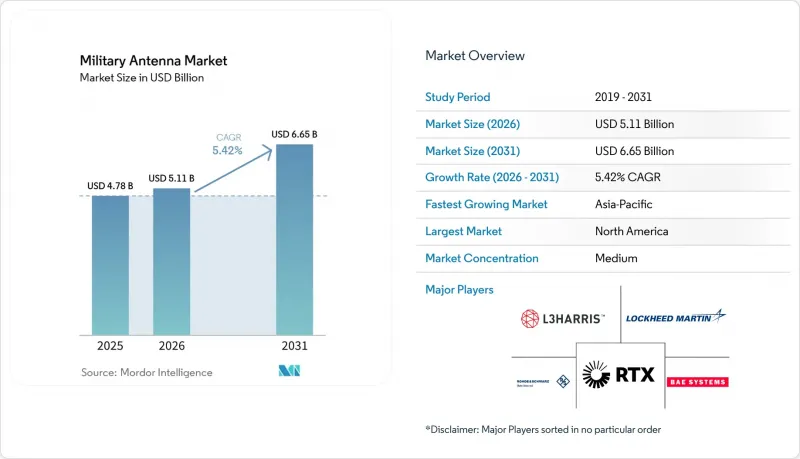
본 보고서는 플랫폼별(항공기, 지상, 해군, 우주), 주파수 대역별(HF, VHF, UHF, SHF, EHF), 기술별(와이어, 어퍼처, 어레이, 리플렉터 등), 용도별(통신, 항법 등), 구성 부품별(방사 소자 등), 지역별(북미, 유럽 등)로 분류되어 있습니다. 시장 전망은 금액(달러) 기준으로 제시되어 있습니다.
세계의 군용 안테나 시장 동향 및 분석
위상 배열 및 전자식 빔 제어 안테나로의 업그레이드
미 육군은 2025년 초, 캘리포니아주 포트 어윈에 위치한 국립훈련센터(NTC)에서 진행된 순환 훈련 기간 동안 제1보병사단과 함께 ‘기동 중장갑 부대 네트워크(AFN-OTM)’의 2단계 시범 운영을 실시했습니다. AFN-OTM 차량에는 C2(지휘통제) 작전을 지원하기 위해 LEO 위성 통신, 킥아웃식 위성 통신 단말기, LOS 무전기, 셀룰러 통신, 대역폭 다이버시티 도구 및 높이 조절이 가능한 안테나 드론이 탑재되어 있었습니다. 시장에서도 마찬가지로, 보다 고도화된 무인 임무로의 전환이 진행되고 있으며, 2026년 5월에는 AeroVironment가 초음속 원격 측정용 SkyRange 플랫폼에 자사의 PANTHER 위상 배열 안테나를 통합하는 계약을 4,300만 달러에 수주했습니다. 2026년에 발표된 조사에 따르면, 무인항공기(UAV)용 날개 일체형 위상 배열 안테나 시제품은 방위각 ±65°의 스캔, 24.8%의 상대 대역폭, 그리고 주파수 대역에서 3dB 미만의 이득 변동을 달성했습니다. 이러한 연구 결과는 무인항공기(UAV) 레이더 용도에서 일체형 위상 배열의 기술적 실현 가능성을 뒷받침하고 있습니다. 2025년 5월, 중국의 CETC는 제11회 세계 레이더 박람회에서 S-밴드 디지털 어레이 감시 레이더, S-밴드 능동 위상 배열 시스템, UHF-밴드 완전 디지털 위상 배열 대스텔스 레이더, 그리고 C-밴드 완전 디지털 능동 위상 배열 기상 레이더를 포함한 레이더 제품군을 전시하며, 레이더의 역할이나 주파수 대역에 관계없이 전자 가변 개구 기술의 활용이 확대되고 있음을 강조했습니다.
LEO, MEO, GEO 네트워크에서의 전술 위성통신(SATCOM) 확대
저궤도(LEO), 중궤도(MEO), 정지궤도(GEO)에 걸친 전술 위성 통신의 확대가 군용 안테나에 영향을 미치고 있습니다. 이는 운영자가 단일 경로에 국한되지 않고, 여러 네트워크 간에 트래픽을 전송할 수 있는 모바일 단말기에 대한 수요가 점점 더 증가하고 있기 때문입니다. 일본의 2026년도 국방 예산에는 차세대 국방 통신 위성에 882억 엔(5억 6,301만 달러), PATS 멀티밴드 위성 통신 시스템에 87억 엔(5,550만 달러)이 계상되어 있으며, 이는 첨단 안테나 페이로드 및 멀티밴드 지상 단말기에 대한 지속적인 수요를 뒷받침하기 위한 것입니다. 미국 해군의 2025년도 PMW/A 170 문서에서는 위성 통신의 내결함성, 여러 궤도 간의 연결성, 그리고 주파수 대역 및 공급업체의 다양성이 강조되었습니다. STNG 및 CBSP 이니셔티브는 해군 플랫폼에서 GEO 및 NGSO 위성군에 대한 접근성을 강화함으로써, 다중 대역 단말기, 인증된 개구부 및 다중 빔 어레이 기술에 대한 수요를 주도하고 있습니다. 그러나 해군 소식통은 안테나 조달이 함대 현대화의 주요 요건이라고 명시적으로 밝히지는 않았습니다. 2026년 2월, L3Harris는 General Dynamics Electric Boat로부터 2033년까지 버지니아급 및 컬럼비아급 잠수함을 위해 26세트의 잠수함용 통신 장비를 납품하는 양산 계약을 수주했습니다. 안테나 조달에 대해서는 명시적으로 언급되지 않았지만, 이 계약은 신뢰성이 높은 해군용 통신 시스템에 대한 수요를 여실히 보여주고 있습니다. 2026년 3월, Kymeta는 ‘KuKa 8 시리즈’를 발표했습니다. 이는 소형 전자식 스티어링 평판 안테나 내에서 Ku 대역과 Ka 대역을 동시에 운용할 수 있게 해주는 것으로, 군용 안테나 시장이 더욱 소형화되고 다중 대역을 지원하며 쉽게 통합 가능한 위성통신(SATCOM) 단말기로 전환되고 있음을 반영합니다.
ITAR 및 주권 조달에 따른 수출의 병목 현상
군용 안테나 시장에서는 수출 관리 규정에 따라 여전히 지연이 빈번하게 발생하고 있으며, 특히 고성능 개구부가 기밀성이 높은 플랫폼 전자 장비나 군용 통신 기능과 연계되어 있는 경우에 그 현상이 두드러집니다. 미국 국무부는 2025년 1월에 잠정 최종 규정을 공표한 데 이어, 2025년 8월에 최종 규정을 공표하고 2025년 9월에 발효했습니다. 이 규정에 따라 위치·항법·시간(PNT)용 특정 제어 수신 패턴 안테나가 미국 군수품 목록에서 제외되어 수출관리규정(EAR)의 적용 대상이 되었습니다. 이러한 규제 변경으로 인해, PNT 전용 방해 대책 안테나와 관련된 ITAR 수출상의 과제가 완화되었습니다. 그러나 수출업체는 여전히 EAR에 따른 분류 및 라이선스 요건을 평가해야 합니다. 이 조치로 인해 일부 GNSS 관련 제품의 상황은 개선되었으나, 고성능 군용 안테나 시스템, 특히 기밀성이 높은 임계치를 초과하는 능동 위상 배열에 대한 광범위한 라이선스 발급 압력은 해소되지 않았습니다. 따라서 군용 안테나 시장은 해외 프로그램에서 여전히 승인까지 오랜 기간이 소요되는 상황에 직면해 있습니다. 이는 구매자가 라이선싱, 기술 제공 조건 및 플랫폼의 다른 부분과의 하류 통합이 미치는 영향을 고려해야 하기 때문입니다. 또한, 이러한 상황은 동맹국 정부와 현지 방위 기업들로 하여금 자국이 주도하는 대안안에 투자하도록 유도하게 되며, 그 결과 군용 안테나 시장에서 수출에 의존하는 공급업체들의 향후 사업 기회가 줄어들게 되고 있습니다.
부문별 분석
2025년, 지상 플랫폼은 군용 안테나 시장 규모의 37.55%를 차지했으며, 금액 기준으로 여전히 가장 큰 플랫폼 부문으로 자리매김했습니다. 이는 이동통신용으로 업그레이드된 장갑차, 전술용 바퀴 달린 플랫폼 및 휴대용 시스템의 도입 현황을 반영한 것입니다. 2025년 1월, 미 육군은 ‘핸드헬드, 맨팩 및 스몰 폼 핏(HF3SF) 프로그램’의 일환으로 L3Harris에 맨팩 및 리더 무전기 양산 계약으로 약 3억 달러를 발주하며 전술 통신 수요를 뒷받침했습니다. 이로 인해, 안테나의 호환성, 파형 성능 및 SATCOM/LOS 연결성이 작전상 효과성에 있어 여전히 매우 중요하다는 점이, 안전하고 상호 운용 가능하며 즉시 투입 가능한 통신 시스템에 대한 지속적인 수요를 뒷받침하고 있습니다. 따라서 군용 안테나 산업은 여전히 대규모 지상군의 현대화 주기에 크게 의존하고 있으며, 그 생산량은 많은 해군 및 우주 프로그램보다 훨씬 더 많은 수준을 유지하고 있습니다.
시장에서는 우주 플랫폼 분야가 급속한 성장을 거듭하고 있으며, 위성 페이로드 및 중계 아키텍처에 대한 투자 증가에 힘입어 2031년까지 연평균 성장률(CAGR) 8.90%로 확대될 것으로 전망됩니다. 예를 들어, 일본의 2026년도 예산에서는 차세대 방위 통신 위성에 882억 엔(5억 6,300만 달러), PATS 멀티밴드 SATCOM 시스템에 87억 엔(5,550만 달러)이 배정되어 있습니다. 콘스텔레이션 확충, 중계 네트워크 및 궤도상 처리를 통해 기존의 정지궤도(GEO) 아키텍처를 뛰어넘는 군용 어퍼처의 배치가 증가함에 따라, 페이로드 수준에서 수요가 확대될 것으로 전망됩니다. 또한, 항공기 플랫폼은 2위 시장을 차지하고 있으며, 이는 전투기 레이더의 업그레이드, ISR(정보·감시·정찰) 항공기의 교체 주기, 그리고 전술 항공기 부대에서 생존성이 높은 통신에 대한 수요에 힘입은 결과입니다. 잠수함이나 수상 전투함은 특히 지상 통신의 대체 수단이 제한된 환경에서 멀티밴드 및 멀티궤도 연결성이 필요하기 때문에 해군 수요는 계속해서 견조한 추세를 보이고 있습니다.
초단파(UHF)는 2025년에 34.10%를 차지했으며, 군용 안테나 시장에서 가장 큰 주파수 대역 부문으로서의 위상을 유지했습니다. 전술 통신, 협대역 SATCOM, 함정 통신 링크 및 수많은 분산형 현장 작전이 여전히 UHF를 신뢰할 수 있는 중추 인프라로 의존하고 있기 때문에 그 위상은 흔들림이 없습니다. 미국 해군의 PMW/A 170 문서에서는 멀티오빗 위성통신(SATCOM)의 내결함성이 함대 통신에서 최우선 과제임을 강조하고 있습니다. CBSP 및 STtNG는 주파수 대역과 공급업체의 다양화, 그리고 멀티밴드 페일오버를 실현하기 위해 GEO 및 NGSO 위성군 전체에 걸친 접근성을 강화합니다. UHF는 DMR, MUOS, BFTN 및 기존 시스템을 통해 해군용 통신에 계속해서 필수적인 역할을 수행하며, 첨단 다중 궤도 단말기 및 UHF 지원 안테나 시스템에 대한 수요를 뒷받침하고 있습니다. 또한, 장거리 또는 지평선 너머의 통신이 여전히 운용상 가치를 제공하는 상황, 특히 가혹한 환경이나 혼합 플랫폼 함대에서는 HF 및 VHF도 여전히 중요한 역할을 수행하고 있습니다.
초단파(SHF)는 가장 빠르게 성장하고 있는 주파수 대역으로, Ka 대역 및 Ku 대역의 위성 통신 용량으로의 전환을 반영하여 2031년까지 연평균 성장률(CAGR) 9.01%로 확대될 것으로 전망됩니다. 군용 안테나 시장에서는 더욱 소형화된 이동 단말기, 더욱 빠른 빔 전환, 그리고 더욱 콤팩트한 멀티밴드 피드 어셈블리에 대한 수요를 통해 이러한 변화를 확인할 수 있습니다. 일본의 2026년도 통신위성 및 PATS(방위통신위성) 배분에서는 차세대 방위통신위성 및 PATS 대응 장비에 대한 자금 지원을 바탕으로, 보호되고 방해에 강한 위성 링크가 우선시되고 있습니다. 2026년 3월, Kymeta는 단일 전자식 가동형 평면 패널 어퍼처 내에서 Ku 대역과 Ka 대역의 동시 운용이 가능한 ‘KuKa 8 시리즈’를 출시했습니다. 이번 개발은 소형이며 다중 대역, 다중 궤도를 지원하는 SHF/Ku-Ka 대역 위성통신 단말기에 대한 수요가 증가하고 있음을 보여줍니다. EHF 대역 시장 규모는 작지만, 전략적, 해군, 항공 및 지상 임무에서 생존성이 높고, 보호되며, 방해에 강한 통신을 제공하는 데 있어 여전히 중요한 역할을 하고 있습니다.
지역별 분석
2025년, 북미는 군용 안테나 시장 점유율의 47.35%를 차지했으며, 지역별 최대 기여 지역으로서의 위상을 유지했습니다. 이동통신, 잠수함 연결성, 전술 네트워크 현대화 분야 모두에서 활발한 조달 절차가 진행되고 있어, 미국은 계속해서 이 지역 수요 중심지 역할을 하고 있습니다. 2025년 1월, 미 육군은 포트 브리스에서 진행된 ‘Network-on-the-Move’ 시범 사업을 통해 군용 안테나 시장을 주도했습니다. 이 사업을 통해 장갑 부대에서 전자식 지향형 차량 탑재 안테나의 유효성이 입증되었습니다. 또한 북미 시장은 L3Harris가 2026년 2월에 수주한 버지니아급 및 콜롬비아급 잠수함용 통신 시스템의 양산 계약으로부터도 혜택을 받았습니다. 이 계약은 2033년까지 26척 분량의 시스템을 포함하는 것입니다.
유럽은 NATO 주도의 상호운용성 요구와 동맹국 군 전체에 걸친 광범위한 통신 현대화에 힘입어, 군용 안테나 시장에서 여전히 2위 지역 블록으로서의 지위를 유지했습니다. 2025년 12월 나토(NATO)가 2026년도 공동 자금 예산을 승인한 것은 더욱 견고한 집단 방위, 공유된 군사 인프라, 그리고 상호 운용 가능한 통신 네트워크의 필요성을 한층 더 확고히 했습니다. 2025년 4월 로데 앤 슈바르츠(Rohde & Schwarz)가 소형·경량이며 신속하게 배치 가능한 군용 스펙트럼 감시 시스템을 발표한 것에서도 알 수 있듯이, 이 지역공급업체 기반은 활발한 활동을 이어가고 있습니다. 이러한 시스템은 전파 관리, 발신원 감지 및 위치 파악, EMCON(전파 은폐) 감시, 그리고 전자파 간섭이 심한 운용 환경에서 신뢰성 높은 무선 통신을 확보하는 데 있어 군을 지원하는 것을 목적으로 하고 있습니다. 따라서, 군용 안테나 시장에서 유럽의 위상은 조달 수요와 안전한 통신 및 주파수 운용에 중점을 둔 현지 산업 기반에 의해 뒷받침되고 있습니다.
아시아태평양은 군용 안테나 시장에서 가장 빠르게 성장하고 있는 지역으로, 2031년까지 연평균 성장률(CAGR) 6.90%를 기록하며 확대될 것으로 전망됩니다. 이 지역의 성장은 예산 확대, 국내 생산 목표, 그리고 해상 및 항공 감시 네트워크 강화에 대한 필요성에 힘입어 이루어지고 있습니다. 일본의 2026년도 예산에는 지휘·통제·정보(C3) 기능, 무인 시스템, 차세대 방위 통신 위성, 그리고 PATS 멀티밴드 위성통신(SATCOM) 프로그램에 대한 자금 지원을 통해 명확한 지원 조치가 추가되었습니다. 또한, 중국의 CETC는 2025년 5월, 해당 지역의 방위산업 기반에서 다중 대역에 걸친 능동 위상 배열의 생산 체제가 이미 확립되어 있음을 밝혔습니다. 중동 및 아프리카 및 남미는 군용 안테나 시장의 나머지 점유율을 차지하고 있으며, 이들 지역에서의 활동은 MTI Wireless Edge가 2025년 1월 이스라엘의 시스템 하우스로부터 수주한 군용 안테나 개발·제조 계약 등, 선택적인 플랫폼 업그레이드 및 하위 시스템의 외부 위탁에 여전히 의존하고 있습니다.
기타 혜택 :
- 엑셀 형식 시장 예측(ME) 시트
- 3개월간의 애널리스트 지원
자주 묻는 질문
목차
제1장 서론
제2장 조사 방법
제3장 주요 요약
제4장 시장 구도
제5장 시장 규모 및 성장 예측
제6장 경쟁 구도
제7장 시장 기회 및 향후 전망
AJY 26.06.26According to Mordor Intelligence, the military antenna market size is projected to expand from USD 4.78 billion in 2025 and USD 5.11 billion in 2026 to USD 6.65 billion by 2031, registering a CAGR of 5.41% between 2026 and 2031.
This report is Segmented by Platform (Airborne, Ground, Naval, and Space), Frequency Band (HF, VHF, UHF, SHF, and EHF), Technology (Wire, Aperture, Array, Reflector, and More), Application (Communications, Navigation, and More), Component (Radiating Elements, and More), and Geography (North America, Europe, and More). The Market Forecasts are Provided in Terms of Value (USD).
Global Military Antenna Market Trends and Insights
Phased-Array and Electronically Steered Antenna Upgrades
The market is gradually shifting toward phased-array and electronically steered systems due to user demand for increased mobility, faster beam control, and reduced reliance on moving parts in exposed platforms. The US Army conducted the second-phase Armored Formation Network On-The-Move (AFN-OTM) pilot in early 2025 with the 1st Infantry Division during National Training Center rotations at Fort Irwin, California. AFN-OTM vehicles featured LEO SATCOM, kick-out SATCOM terminals, LOS radios, cellular transport, bandwidth-diversity tools, and Variable Height Antenna drones to support C2 operations. The market is seeing the same shift toward higher-end unmanned missions, as AeroVironment received a USD 43 million contract in May 2026 to integrate its PANTHER phased-array antenna onto SkyRange platforms for hypersonic telemetry. Research published in 2026 demonstrated that a wing-conformal phased-array antenna prototype for UAV applications achieved +-65° azimuth scanning, a 24.8% relative bandwidth, and less than 3 dB of gain fluctuation at key frequencies. These findings confirm the technical feasibility of conformal phased arrays for UAV radar applications. In May 2025, China's CETC showcased a radar portfolio at the 11th World Radar Expo, including S-band digital-array surveillance radar, S-band active phased-array systems, UHF-band fully digital phased-array anti-stealth radar, and C-band all-digital active phased-array weather radar, highlighting the expanding use of electronically agile aperture technologies across radar roles and frequency bands.
Tactical SATCOM Expansion Across LEO, MEO, and GEO Networks
The military antenna is being influenced by the expansion of tactical SATCOM across low, medium, and geostationary orbits, as operators increasingly require mobile terminals capable of transferring traffic across multiple networks rather than being restricted to a single orbit. Japan's FY2026 defense budget included JPY 88.2 billion (USD 563.01 million) for a next-generation defense communications satellite and JPY 8.7 billion (USD 55.50 million) for the PATS multi-band satellite communications system, which supports continued demand for advanced antenna payloads and multi-band ground terminals. The US Navy's PMW/A 170 documentation for 2025 emphasized SATCOM resiliency, multi-orbit connectivity, and band/vendor diversity. STNG and CBSP initiatives enhance access across GEO and NGSO constellations for naval platforms, driving demand for multi-band terminals, certified apertures, and multi-beam array technologies. However, Navy sources do not explicitly state that antenna procurement is the primary requirement for fleet upgrades. In February 2026, L3Harris secured a full-rate production contract from General Dynamics Electric Boat to deliver 26 submarine communications shipsets for Virginia- and Columbia-class submarines by 2033. While antenna procurement was not explicitly mentioned, the contract highlights demand for reliable naval communication systems. In March 2026, Kymeta introduced the KuKa 8-Series, enabling simultaneous Ku- and Ka-band operation within a compact, electronically steered flat-panel antenna, reflecting the military antenna market's shift toward smaller, multi-band, and easily integrable SATCOM terminals.
ITAR and Sovereign Procurement Export Bottlenecks
The military antenna market still faces persistent delays due to export-control rules, especially when high-performance apertures are tied to sensitive platform electronics and military communications functions. The US Department of State issued an interim final rule in January 2025, followed by a final rule in August 2025, which became effective in September 2025. This rule removed certain Controlled Reception Pattern Antennas for Position, Navigation, and Timing (PNT) from the US Munitions List and placed them under the Export Administration Regulations (EAR). This regulatory change reduces ITAR-related export challenges for PNT-focused anti-jam antennas. However, exporters must still evaluate EAR classification and licensing requirements. That step improved conditions for some GNSS-related products, but it did not remove broader licensing pressure on higher-performance military antenna systems, especially active phased arrays above sensitive thresholds. The military antenna market, therefore, continues to face long approval cycles on foreign programs because buyers must account for licensing, technology release conditions, and downstream integration effects on the rest of the platform, also encouraging allied governments and local defense firms to invest in sovereign alternatives, thereby redirecting future business away from export-dependent suppliers in the military antenna market.
Other drivers and restraints analyzed in the detailed report include:
- C4ISR and Multi-Domain Secure Communications Modernization
- Unmanned and Attritable Platform Proliferation
- GaN and Advanced RF Component Supply Concentration
For complete list of drivers and restraints, kindly check the Table Of Contents.
Segment Analysis
Ground platforms accounted for 37.55% of the military antenna market size in 2025, remaining the largest platform segment by value. This reflects the installed base of armored vehicles, tactical wheeled platforms, and man-portable systems being upgraded for mobile communications. The US Army reinforced tactical communications demand in January 2025 when it awarded L3Harris nearly USD 300 million in full-rate production orders for Manpack and Leader radios under the handheld, manpack, and small form fit program, supporting continued demand for secure, interoperable, and field-ready communications systems where antenna compatibility, waveform performance, and SATCOM/LOS connectivity remain critical to operational effectiveness. The military antenna industry, therefore, continues to depend heavily on large ground fleet modernization cycles, where unit volumes remain much higher than in many naval and space programs.
The market is experiencing rapid growth in the space platform segment, which is projected to expand at a CAGR of 8.90% through 2031, driven by increasing investments in satellite payloads and relay architectures. For instance, Japan's FY2026 budget allocates JPY 88.2 billion (USD 563 million) for a next-generation defense communications satellite and JPY 8.7 billion (USD 55.50 million) for the PATS multi-band SATCOM system. The market is expected to witness higher demand at the payload level as proliferated constellations, relay networks, and on-orbit processing increase the deployment of military apertures beyond traditional GEO architectures. Additionally, airborne platforms represent the second-largest segment, supported by upgrades to fighter radars, refresh cycles for ISR aircraft, and the need for survivable communications in tactical aviation fleets. Naval demand remains robust as submarines and surface combatants require multi-band and multi-orbit connectivity, particularly in environments where terrestrial communication alternatives are limited.
Ultra High Frequency (UHF) accounted for 34.10% in 2025, maintaining its position as the largest frequency band segment in the military antenna market. Its position remains durable because tactical communications, narrowband SATCOM, shipboard links, and many dispersed field operations still rely on UHF as a dependable backbone. The US Navy's PMW/A 170 documentation emphasizes that multi-orbit SATCOM resiliency is a key fleet communications priority. CBSP and STtNG enhance access across GEO and NGSO constellations for band and vendor diversity, as well as multi-band failover. UHF remains integral to the Navy's communications through DMR, MUOS, BFTN, and legacy systems, sustaining demand for advanced multi-orbit terminals and UHF-compatible antenna systems. HF and VHF also remain relevant where long-range or over-the-horizon links still offer operational value, especially in austere settings and across mixed platform fleets.
Super High Frequency (SHF) is the fastest-growing band and is projected to expand at a 9.01% CAGR through 2031, reflecting the move toward Ka- and Ku-band SATCOM capacity. The military antenna market is seeing this change through demand for smaller mobile terminals, faster beam switching, and more compact multi-band feed assemblies. Japan's FY2026 communications satellite and PATS allocations prioritize protected, anti-jam satellite links, supported by funding for next-generation defense communications satellites and PATS-compatible equipment. In March 2026, Kymeta launched the KuKa 8-Series, which features simultaneous Ku- and Ka-band operation within a single electronically steered flat-panel aperture. This development underscores the increasing demand for compact, multi-band, multi-orbit SHF/Ku-Ka SATCOM terminals. While the EHF segment is smaller, it continues to play a critical role in providing survivable, protected, and jam-resistant communications for strategic, naval, air, and ground missions.
Geography Analysis
North America held 47.35% of the military antenna market share in 2025, maintaining its position as the largest regional contributor. The US remains the anchor of regional demand because mobile communications, submarine connectivity, and tactical network modernization are all moving through active procurement pipelines. In January 2025, the US Army advanced the military antenna market through its Fort Bliss network-on-the-move pilot, which validated electronically steered vehicle-mounted antennas in armored formations. North America also gained from L3Harris' February 2026 full-rate production contract for Virginia-class and Columbia-class submarine communication systems covering 26 shipsets through 2033.
Europe remained the second-largest regional block in the military antenna market, supported by NATO-led interoperability needs and wider communications modernization across allied militaries. NATO's December 2025 approval of its 2026 common-funded budgets reinforced the need for stronger collective defense, shared military infrastructure, and interoperable communications networks. The regional supplier base remains active, as evidenced by Rohde & Schwarz's launch in April 2025 of compact, lightweight, and rapidly deployable military spectrum-monitoring systems. These systems aim to assist armed forces in spectrum management, emitter detection and geolocation, EMCON monitoring, and ensuring reliable radio communications in contested electromagnetic operating environments. Europe's position in the military antenna market is therefore supported by both procurement demand and a local industrial base focused on secure communications and spectrum operations.
Asia-Pacific is the fastest-growing region in the military antenna market and is projected to expand at a 6.90% CAGR through 2031. Regional growth is being shaped by budget expansion, domestic production goals, and the need to strengthen maritime and air surveillance networks. Japan's FY2026 budget added visible support through funding for command, control, and intelligence functions, unmanned systems, next-generation defense communications satellites, and the PATS multi-band SATCOM program. China's CETC also showed in May 2025 that active phased-array production across multiple bands is already well established in the region's defense industrial base. Middle East and Africa, along with South America, account for the remaining share of the military antenna market, and activity in these regions remains tied to selective platform upgrades and subsystem outsourcing, including MTI Wireless Edge's January 2025 military antenna development and manufacturing contracts from an Israeli system house.
- L3Harris Technologies, Inc.
- Rohde & Schwarz GmbH & Co. KG
- RTX Corporation
- Lockheed Martin Corporation
- Saab AB
- BAE Systems plc
- Thales Group
- Leonardo S.p.A.
- Honeywell International Inc.
- Comrod Communication AS
- TCI International Inc. (SPX Technologies, Inc.)
- Antcom Corporation (Hexagon AB)
- Hascall-Denke
- Southwest Antennas, Inc.
- Terma A/S
- General Dynamics Mission Systems (General Dynamics Corporation)
- ViaSat, Inc.
- MTI Wireless Edge Ltd, (MTI Group)
- Radiall SA
- Molex (Koch, Inc.)
Additional Benefits:
- The market estimate (ME) sheet in Excel format
- 3 months of analyst support
TABLE OF CONTENTS
1 INTRODUCTION
- 1.1 Study Assumptions and Market Definition
- 1.2 Scope of the Study
2 RESEARCH METHODOLOGY
3 EXECUTIVE SUMMARY
4 MARKET LANDSCAPE
- 4.1 Market Overview
- 4.2 Market Drivers
- 4.2.1 Phased-array and electronically steered antenna upgrades
- 4.2.2 Tactical SATCOM expansion across LEO, MEO, and GEO networks
- 4.2.3 C4ISR and multi-domain secure communications modernization
- 4.2.4 Unmanned and attritable platform proliferation
- 4.2.5 Shared-aperture multifunction antenna adoption
- 4.2.6 Protected multi-orbit connectivity for polar and contested theaters
- 4.3 Market Restraints
- 4.3.1 ITAR and sovereign procurement export bottlenecks
- 4.3.2 Electromagnetic congestion and platform-level EMC complexity
- 4.3.3 GaN and advanced RF component supply concentration
- 4.3.4 Long defense budget cycles delaying next-wave upgrades
- 4.4 Value Chain Analysis
- 4.5 Regulatory Landscape
- 4.6 Technological Outlook
- 4.7 Porter's Five Forces Analysis
- 4.7.1 Threat of New Entrants
- 4.7.2 Threat of Substitutes
- 4.7.3 Bargaining Power of Suppliers
- 4.7.4 Bargaining Power of Buyers
- 4.7.5 Intensity of Competitive Rivalry
5 MARKET SIZE AND GROWTH FORECASTS (VALUE)
- 5.1 By Platform
- 5.1.1 Airborne
- 5.1.2 Ground
- 5.1.3 Naval
- 5.1.4 Space
- 5.2 By Frequency Band
- 5.2.1 High Frequency (HF)
- 5.2.2 Very High Frequency (VHF)
- 5.2.3 Ultra High Frequency (UHF)
- 5.2.4 Super High Frequency (SHF)
- 5.2.5 Extremely High Frequency (EHF)
- 5.3 By Technology
- 5.3.1 Wire Antennas
- 5.3.2 Aperture Antennas
- 5.3.3 Array Antennas
- 5.3.4 Reflector Antennas
- 5.3.5 Lens Antennas
- 5.3.6 Microstrip Antennas
- 5.4 By Application
- 5.4.1 Communications
- 5.4.2 Navigation
- 5.4.3 Surveillance
- 5.4.4 Electronic Warfare (EW)
- 5.4.5 Telemetry
- 5.5 By Component
- 5.5.1 Radiating Elements
- 5.5.2 Feed Networks and Coax Assemblies
- 5.5.3 RF/Microwave Switches and Phase Shifters
- 5.5.4 Radomes
- 5.5.5 Other Components
- 5.6 By Geography
- 5.6.1 North America
- 5.6.1.1 United States
- 5.6.1.2 Canada
- 5.6.1.3 Mexico
- 5.6.2 Europe
- 5.6.2.1 United Kingdom
- 5.6.2.2 France
- 5.6.2.3 Germany
- 5.6.2.4 Italy
- 5.6.2.5 Russia
- 5.6.2.6 Rest of Europe
- 5.6.3 Asia-Pacific
- 5.6.3.1 China
- 5.6.3.2 India
- 5.6.3.3 Japan
- 5.6.3.4 South Korea
- 5.6.3.5 Australia
- 5.6.3.6 Rest of Asia-Pacific
- 5.6.4 South America
- 5.6.4.1 Brazil
- 5.6.4.2 Rest of South America
- 5.6.5 Middle East and Africa
- 5.6.5.1 Middle East
- 5.6.5.1.1 Saudi Arabia
- 5.6.5.1.2 Israel
- 5.6.5.1.3 Turkey
- 5.6.5.1.4 Rest of Middle East
- 5.6.5.2 Africa
- 5.6.5.2.1 Egypt
- 5.6.5.2.2 South Africa
- 5.6.5.2.3 Rest of Africa
- 5.6.5.1 Middle East
- 5.6.1 North America
6 COMPETITIVE LANDSCAPE
- 6.1 Market Concentration
- 6.2 Strategic Moves
- 6.3 Market Share Analysis
- 6.4 Company Profiles (includes Global level Overview, Market level overview, Core Segments, Financials as available, Strategic Information, Market Rank/Share for key companies, Products and Services, and Recent Developments)
- 6.4.1 L3Harris Technologies, Inc.
- 6.4.2 Rohde & Schwarz GmbH & Co. KG
- 6.4.3 RTX Corporation
- 6.4.4 Lockheed Martin Corporation
- 6.4.5 Saab AB
- 6.4.6 BAE Systems plc
- 6.4.7 Thales Group
- 6.4.8 Leonardo S.p.A.
- 6.4.9 Honeywell International Inc.
- 6.4.10 Comrod Communication AS
- 6.4.11 TCI International Inc. (SPX Technologies, Inc.)
- 6.4.12 Antcom Corporation (Hexagon AB)
- 6.4.13 Hascall-Denke
- 6.4.14 Southwest Antennas, Inc.
- 6.4.15 Terma A/S
- 6.4.16 General Dynamics Mission Systems (General Dynamics Corporation)
- 6.4.17 ViaSat, Inc.
- 6.4.18 MTI Wireless Edge Ltd, (MTI Group)
- 6.4.19 Radiall SA
- 6.4.20 Molex (Koch, Inc.)
7 MARKET OPPORTUNITIES AND FUTURE OUTLOOK
- 7.1 White-Space and Unmet-Need Assessment


