

|
시장보고서
상품코드
2062379
디젤 미립자 필터 시장 : 점유율 분석, 업계 동향과 통계, 성장 예측(2026-2031년)Diesel Particulate Filter - Market Share Analysis, Industry Trends & Statistics, Growth Forecasts (2026 - 2031) |
||||||
 Mordor Intelligence
Mordor Intelligence에 의하면, 디젤 미립자 필터(DPF) 시장 규모는 2025년 232억 4,000만 달러, 2026년 241억 5,000만 달러에서 2031년까지 292억 5,000만 달러로 확대되어 2026년부터 2031년까지 연평균 복합 성장률(CAGR)은 3.91%를 나타낼 것으로 예측됩니다.
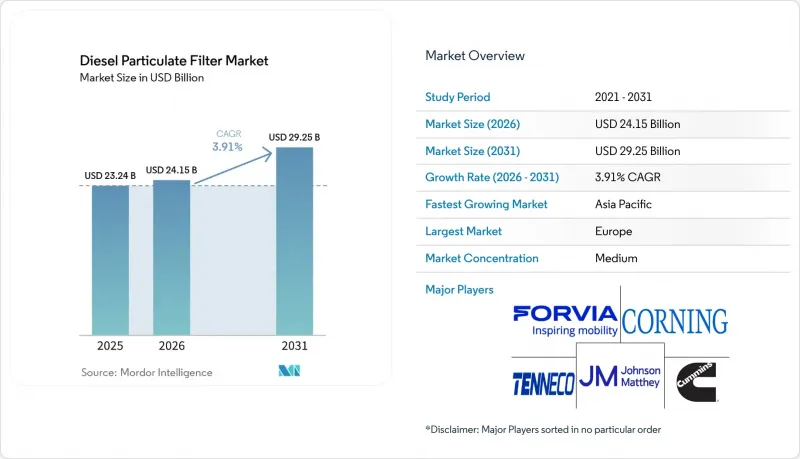
본 보고서는 기판 유형(실리콘 카바이드, 세라믹 파이버 등), 재생 공정(패시브, 액티브 등), 차종(승용차 등), 판매 채널(OEM 및 애프터마켓), 지역(아시아태평양, 북미, 유럽, 남미, 중동 및 아프리카)별로 분류되어 있습니다. 시장 전망은 금액(달러) 기준으로 제시되어 있습니다.
세계 디젤 미립자 필터 시장 동향 및 분석
인도, 아세안, 아프리카의 디젤 차량 대수가 급격히 증가하고 있습니다.
2026년 1월 인도의 상용차 판매 대수는 전년 동월 대비 15% 증가한 10만 7,486대를 기록했으며, 디젤 차량이 81.97%의 점유율을 유지했습니다. 2025년도의 차량 평균 사용 연수는 10년이며, 바라트 스테이지 VI 2단계 규정에 따라 월플로우식 필터 사용이 의무화됨에 따라 차량 교체 작업이 진행되고 있습니다. 아세안 상용차 시장은 2030년까지 835억 1,000만 달러에 달할 것으로 예상되며, 연평균 성장률(CAGR)은 6.97%에 이를 것으로 전망됩니다. 태국과 인도네시아에서는 인프라 구축에 앞서 유럽 기준에 상응하는 규제가 시행되고 있습니다. 아프리카의 항만에서는 저배출 구역이 도입됨에 따라 수입 중고 트럭의 개조(레트로핏) 기회가 생겨나고 있습니다. 이 지역들의 이러한 움직임이 디젤 미립자 필터 시장에 대한 지속적인 수요를 뒷받침하고 있습니다.
선박 및 비도로용 디젤 장비에 대한 사후 규제
네덜란드에서는 2025년 1월부터 모든 건설기계 및 농기계에 가동 중인 필터 장착을 의무화하고, 미세먼지 배출을 90% 이상 줄이는 설비에 대해 보조금을 지급하고 있습니다. 캘리포니아주의 ‘상업용 항만 선박 규정’은 약 3,159척을 대상으로 하며, 제품 검증이 완료되는 대로 레벨 3 시스템을 단계적으로 도입할 예정입니다. 2026년 2월에 발표된 CARB(캘리포니아 대기자원국)의 Tier 5 비도로용 차량 규제안에서는 Tier 4 규제 하에서 그동안 면제되었던 엔진에 대한 필터 장착이 의무화됩니다. 2026년 3월에 발효되는 국제해사기구(IMO)의 배출 규제 해역은 SCR과 DPF를 결합한 솔루션에 대한 수요를 더욱 확대시킬 것입니다. 이러한 정책들의 시너지 효과로 인해 디젤 미립자 필터 시장의 중기적인 성장 전망이 밝아지고 있습니다.
도시 지역의 버스 및 승용차에서 BEV와 연료전지차의 급속한 보급
인도의 상용차 부문에서 전기차 보급률은 2026년 1월 기준 1.92%였으나, 2030년까지 버스의 최대 30%를 나타낼 것으로 예측되며, 그 대부분은 대도시권의 노선에 도입될 전망입니다. 미국의 수소 트럭 보유 대수는 2024년 5,000대에서 2030년까지 7만 5,000대로 증가할 가능성이 있으며, 이에 따라 해당 차량의 필터 정비는 더 이상 필요하지 않게 됩니다. 유럽의 저공해 구역에서는 무공해 버스가 장려되고 있어 소형 디젤 차량의 판매 대수는 감소 추세에 있지만, 장거리 운송 및 비도로 부문에서는 여전히 디젤에 대한 의존도가 높은 상황입니다. 이러한 도시와 지방 간의 격차가 디젤 미립자 필터 시장 전체의 성장을 저해하는 요인이 되고 있습니다.
부문별 분석
코디에라이트는 비용 면에서의 우위 덕분에 2025년 기준 47.71%의 시장 점유율을 유지했으나, 1,400°C라는 내열 온도의 한계에 직면해 있습니다. 반면, 실리콘 카바이드는 2,000°C 이상의 고온을 견디며 재생 속도를 높여 99%가 넘는 여과 효율을 달성합니다. 실리콘 카바이드 부품은 디젤 미립자 필터 시장 점유율을 확대하고 있으며, 유로 7 및 CARB Tier 5에 따른 입자 수(PN) 기준의 강화에 따라, 예측 기간(2026-2031년) 동안 연평균 성장률(CAGR) 4.32%로 성장할 것으로 전망됩니다.
NGK, 코닝, 이비덴 등 각 OEM 업체들은 회분 유지 능력을 저해하지 않으면서 배압을 낮추는 다공질 구조의 제품을 출시하고 있습니다. 포시아 서비스는 6단계 공정을 통해 실리콘 카바이드 필터를 재생산하고 있으며, 이를 통해 비용을 30% 절감하고 수명을 연장함으로써 애프터마켓에서의 채택을 촉진하고 있습니다. 승용차의 경우 가격 민감도가 높아 보급이 제한되고 있지만, 대형차 및 하이브리드차 분야에서는 2031년까지 실리콘 카바이드로의 전환이 계속될 전망입니다.
2025년에는 패시브 재생 방식이 50.33%의 점유율을 차지하며 주류를 이루었으나, 라스트 마일 운송 차량의 경우 정지 및 재출발이 반복되는 주행 패턴이 주를 이루기 때문에 예측 기간(2026-2031년) 동안 패시브-액티브 복합 방식은 연평균 성장률(CAGR) 4.58%로 증가할 것으로 전망됩니다. 커민스사는 48V 발전기로 구동되는 5kW 히터 2대를 갖춘 ‘트윈 모듈’ 시스템을 도입하여, 디젤 연료를 분사하지 않고도 그을음을 신속하게 연소시킬 수 있게 했습니다.
SAE의 연구에 따르면, 고압 분사 및 열 관리 전략을 통해 재생 효율이 최대 20% 향상되고, HC 및 CO를 95% 저감할 수 있는 것으로 나타났습니다. 액티브 이벤트는 불필요한 연료를 소모하지만, 예측 스케줄링을 통해 발생 빈도를 줄임으로써 비용과 규제 준수 간의 균형을 맞출 수 있습니다. 신규 출시된 플라즈마 히터와 전기 전용 히터는 고정식 및 선박용 세트를 대상으로 시험 중이며, 디젤 미립자 필터 시장에서 혁신의 여지가 있음을 보여주고 있습니다.
지역별 분석
유럽은 유로 6 규제의 확산과 견고한 리매뉴팩처링 네트워크를 바탕으로 2025년 매출의 42.23%를 차지했습니다. 유로 7 도입이 연기됨에 따라 2025-2026년 수요는 둔화될 전망이지만, 향후 PN10 규제와 20만 킬로미터의 내구성 요건으로 인해 특히 독일, 프랑스, 영국에서는 차량 함대가 실리콘 카바이드 기판 및 첨단 코팅 기술로 전환될 것으로 보입니다. 1차 정제에 비해 CO₂ 배출량을 97% 줄이면서 백금족 금속을 재활용하는 BASF의 순환 경제 노력은 다가오는 지속가능성 지침과 부합합니다.
아시아태평양은 예측 기간(2026-2031년) 동안 5.12%라는 가장 높은 연평균 성장률(CAGR)을 보일 것으로 전망됩니다. 이는 상용차 부문에서 인도의 디젤차 점유율 81.97%, 아세안(ASEAN) 국가들의 차량 구매 지출 증가, 그리고 중국의 ‘Bharat 7’ 규제 시행 일정에 힘입은 결과입니다. 해당 지역의 디젤 미립자 필터(DPF) 시장 규모는 구형 트럭의 폐차와 Bharat Stage VII 및 중국 7단계 기준을 충족하는 신형 엔진에 고효율 소재가 채택됨에 따라 확대될 전망입니다. 일본과 한국에서 하이브리드 차량의 조기 보급은 300°C 미만에서도 재생 가능한 촉매 코팅 필터에 대한 수요를 이끌고 있습니다.
북미는 여전히 거대한 시장이며, EPA Tier 4 Final 규정에 따라 비도로용 장비에 필터 장착이 의무화되어 있습니다. 2031년부터 2036년까지 도입이 제안된 CARB Tier 5 규정에 따라, 그동안 적용 대상에서 제외되었던 엔진에 대한 도입이 확대되는 한편, 수소 트럭의 실증 실험으로 인해 도시 지역 수요는 감소할 것으로 전망됩니다. 캘리포니아주의 R99 또는 R100 재생 가능 디젤 의무화 조치는 미세먼지(PM)를 줄여주지만, 여과 필요성을 없애는 것은 아니며, 장기간의 정비 주기를 견딜 수 있는 실리콘 카바이드 유닛에 대한 애프터마켓 수요를 유지하게 될 것입니다.
기타 혜택:
- 엑셀 형식 시장 예측(ME) 시트
- 3개월간의 애널리스트 지원
자주 묻는 질문
목차
제1장 서론
제2장 조사 방법
제3장 주요 요약
제4장 시장 구도
제5장 시장 규모와 성장 예측
제6장 경쟁 구도
제7장 시장 기회와 향후 전망
JHS 26.06.19According to Mordor Intelligence, the diesel particulate filter market size is projected to expand from USD 23.24 billion in 2025 and USD 24.15 billion in 2026 to USD 29.25 billion by 2031, registering a CAGR of 3.91% between 2026 and 2031.
This report is Segmented by Substrate Type (Silicon Carbide, Ceramic Fibre, and More), Regeneration Process (Passive, Active, and More), Vehicle Type (Passenger Cars, and More), Sales Channel (Original Equipment Manufacturer and Aftermarket), and Geography (Asia-Pacific, North America, Europe, South America, and Middle-East and Africa). The Market Forecasts are Provided in Terms of Value (USD).
Global Diesel Particulate Filter Market Trends and Insights
Rapid Diesel Fleet Growth in India, ASEAN and Africa
Commercial-vehicle sales in India rose 15% year-on-year to 107,486 units in January 2026, and diesel retained an 81.97% share. Fleet age averaged 10 years in fiscal 2025, driving replacements as Bharat Stage VI Stage 2 rules require wall-flow filters. ASEAN's commercial-vehicle market is forecast to reach USD 83.51 billion by 2030, a 6.97% CAGR, with Thailand and Indonesia enforcing Euro-equivalent norms ahead of infrastructure rollouts. African ports are adopting low-emission zones that open retrofit opportunities for imported used trucks. The momentum across these regions underpins sustained demand for the Diesel particulate filter market.
Retrofit Mandates for Marine and Off-Road Diesel Equipment
The Netherlands required operational filters on all construction and agricultural machinery from January 2025, subsidizing installs that cut particulate mass by more than 90%. California's Commercial Harbor Craft rule covers about 3,159 vessels and phases in level-3 systems once product verification is achieved. CARB's draft Tier 5 off-road proposal, issued in February 2026, will mandate filters on engines previously exempt under Tier 4. International Maritime Organization emission-control areas coming into force in March 2026 further expand demand for combined SCR-DPF solutions. These converging policies lift medium-term growth prospects for the Diesel particulate filter market.
Fast BEV and Fuel-Cell Uptake in Urban Buses and Cars
Electric penetration in Indian commercial segments was 1.92% in January 2026 but is projected to reach up to 30% of buses by 2030, mostly in metropolitan corridors. The United States hydrogen truck fleet could rise from 5,000 units in 2024 to 75,000 by 2030, eliminating filter servicing on those vehicles. European low-emission zones incentivize zero-emission buses, eroding light-duty diesel volumes, yet long-haul and off-highway sectors remain diesel-reliant. This urban-rural split tempers overall Diesel particulate filter market expansion.
Other drivers and restraints analyzed in the detailed report include:
- E-Commerce Last-Mile Boom Lifting LCV Mileage
- Low-Temperature, Catalyst-Coated Filters for Hybrid Powertrains
- Post-COVID Delays to Euro 7 Weaken 2025-26 Demand
For complete list of drivers and restraints, kindly check the Table Of Contents.
Segment Analysis
Cordierite retained 47.71% market share in 2025 on cost advantages but faces thermal limits at 1,400°C, whereas silicon carbide tolerates more than 2,000°C, accelerates regeneration, and achieves filtration efficiency above 99%. Silicon-carbide components accounted for a rising slice of the Diesel particulate filter market size and are set to grow at a 4.32% CAGR during the forecast period (2026-2031) as Euro 7 and CARB Tier 5 tighten PN thresholds.
OEMs such as NGK, Corning, and IBIDEN have released porous structures that cut backpressure without sacrificing ash capacity. Faurecia Service remanufactures silicon-carbide filters via a six-step process that lowers costs by 30% and extends service life, reinforcing aftermarket uptake. Higher price sensitivity in passenger cars constrains penetration, yet heavy-duty and hybrid applications will continue shifting volumes toward silicon carbide through 2031.
Passive regeneration dominated installations with 50.33% share in 2025, but combined passive-active architectures are projected to rise at 4.58% CAGR during the forecast period (2026-2031) as stop-and-go duty cycles prevail in last-mile fleets. Cummins introduced the Twin Module system with twin 5 kW heaters powered by a 48-V alternator, enabling rapid soot burn-off without diesel dosing.
SAE studies demonstrate that high-pressure dosing and thermal-management strategies improve regeneration efficiency by up to 20% and lower HC and CO by 95%. While active events consume extra fuel, predictive scheduling reduces occurrences, balancing cost and compliance. Emerging plasma and electric-only heaters are under trial for stationary and marine sets, indicating an innovation runway in the Diesel particulate filter market.
Geography Analysis
Europe generated 42.23% of 2025 revenue on the strength of Euro 6 saturation and robust remanufacturing networks. The Euro 7 delay moderates 2025-26 demand, yet future PN10 limits and 200,000-kilometer durability will pivot fleets to silicon-carbide substrates and advanced coatings, especially in Germany, France, and the United Kingdom. Circular-economy moves by BASF, which recycles platinum-group metals with 97% lower CO2 than primary refining, align with looming sustainability guidelines.
Asia-Pacific is set to post the fastest 5.12% CAGR during the forecast period (2026-2031), anchored by India's 81.97% diesel share in commercial vehicles, ASEAN's growth in fleet spending, and China's 7 implementation timelines. The Diesel particulate filter market size across the region will accelerate as older trucks are scrapped and new Bharat Stage VII and China 7 engines adopt high-efficiency substrates. Early hybrid uptake in Japan and South Korea drives demand for catalyst-coated filters that regenerate below 300°C.
North America remains a sizable market where EPA Tier 4 Final keeps off-road equipment filtered. CARB Tier 5, proposed for 2031-36, will widen adoption to engines previously exempt, while hydrogen truck pilots reduce urban demand. California's R99 or R100 renewable-diesel mandate cuts PM but does not eliminate filtration needs, preserving aftermarket volumes for silicon-carbide units that withstand extended service intervals.
- Afton Chemical
- BASF
- BorgWarner
- BOSAL
- Corning Incorporated
- Cummins Inc.
- DENSO CORPORATION
- Donaldson Company Inc.
- Eberspacher
- Eminox
- FORVIA
- Haldor Topsoe
- Johnson Matthey
- MANN+HUMMEL
- NGK INSULATORS, LTD.
- PHINIA Inc.
- Tenneco Inc.
- Umicore
Additional Benefits:
- The market estimate (ME) sheet in Excel format
- 3 months of analyst support
TABLE OF CONTENTS
1 Introduction
- 1.1 Study Assumptions and Market Definition
- 1.2 Scope of the Study
2 Research Methodology
3 Executive Summary
4 Market Landscape
- 4.1 Market Overview
- 4.2 Market Drivers
- 4.2.1 Rapid diesel fleet growth in India, ASEAN and Africa
- 4.2.2 Retrofit mandates for marine and off-road diesel equipment
- 4.2.3 E-commerce last-mile boom lifting LCV mileage
- 4.2.4 Low-temperature, catalyst-coated filters for hybrid powertrains
- 4.2.5 AI-enabled predictive DPF maintenance unlocking fleet ROI
- 4.3 Market Restraints
- 4.3.1 Fast BEV and fuel-cell uptake in urban buses and cars
- 4.3.2 Post-COVID delays to Euro-7 weaken 2025-26 demand
- 4.3.3 HVO/Synthetic-diesel adoption lowers PM and filter demand
- 4.4 Value Chain Analysis
- 4.5 Porter's Five Forces
- 4.5.1 Bargaining Power of Suppliers
- 4.5.2 Bargaining Power of Buyers
- 4.5.3 Threat of New Entrants
- 4.5.4 Threat of Substitutes
- 4.5.5 Competitive Rivalry
5 Market Size and Growth Forecasts (Value)
- 5.1 By Substrate Type
- 5.1.1 Cordierite
- 5.1.2 Silicon Carbide (SiC)
- 5.1.3 Ceramic Fiber
- 5.1.4 Metallic and Other Advanced Substrates
- 5.2 By Regeneration Process
- 5.2.1 Passive
- 5.2.2 Active (In-cylinder/In-exhaust)
- 5.2.3 Combined Passive-Active
- 5.3 By Vehicle Type
- 5.3.1 Passenger Cars
- 5.3.2 Light Commercial Vehicles (LCV)
- 5.3.3 Heavy Commercial Vehicles (HCV)
- 5.3.4 Off-Highway (Construction, Agri, and Mining)
- 5.4 By Sales Channel
- 5.4.1 Original Equipment Manufacturer (OEM)
- 5.4.2 Aftermarket (Retrofit and Replacement)
- 5.5 By Geography
- 5.5.1 Asia-Pacific
- 5.5.1.1 China
- 5.5.1.2 India
- 5.5.1.3 Japan
- 5.5.1.4 South Korea
- 5.5.1.5 ASEAN Countries
- 5.5.1.6 Rest of Asia-Pacific
- 5.5.2 North America
- 5.5.2.1 United States
- 5.5.2.2 Canada
- 5.5.2.3 Mexico
- 5.5.3 Europe
- 5.5.3.1 Germany
- 5.5.3.2 United Kingdom
- 5.5.3.3 France
- 5.5.3.4 Italy
- 5.5.3.5 Spain
- 5.5.3.6 Russia
- 5.5.3.7 Rest of Europe
- 5.5.4 South America
- 5.5.4.1 Brazil
- 5.5.4.2 Argentina
- 5.5.4.3 Rest of South America
- 5.5.5 Middle-East and Africa
- 5.5.5.1 Saudi Arabia
- 5.5.5.2 South Africa
- 5.5.5.3 Rest of Middle-East and Africa
- 5.5.1 Asia-Pacific
6 Competitive Landscape
- 6.1 Market Concentration
- 6.2 Strategic Moves
- 6.3 Market Share(%)/Ranking Analysis
- 6.4 Company Profiles (includes Global Overview, Market Overview, Core Segments, Financials, Strategic Information, Products and Services, and Recent Developments)
- 6.4.1 Afton Chemical
- 6.4.2 BASF
- 6.4.3 BorgWarner
- 6.4.4 BOSAL
- 6.4.5 Corning Incorporated
- 6.4.6 Cummins Inc.
- 6.4.7 DENSO CORPORATION
- 6.4.8 Donaldson Company Inc.
- 6.4.9 Eberspacher
- 6.4.10 Eminox
- 6.4.11 FORVIA
- 6.4.12 Haldor Topsoe
- 6.4.13 Johnson Matthey
- 6.4.14 MANN+HUMMEL
- 6.4.15 NGK INSULATORS, LTD.
- 6.4.16 PHINIA Inc.
- 6.4.17 Tenneco Inc.
- 6.4.18 Umicore
7 Market Opportunities and Future Outlook
- 7.1 White-space and Unmet-need Assessment


