|
시장보고서
상품코드
2062383
폴리프로필렌 흡수성 위생용품 시장 : 점유율 분석, 업계 동향과 통계, 성장 예측(2026-2031년)Polypropylene Absorbent Hygiene - Market Share Analysis, Industry Trends & Statistics, Growth Forecasts (2026 - 2031) |
||||||
 Mordor Intelligence
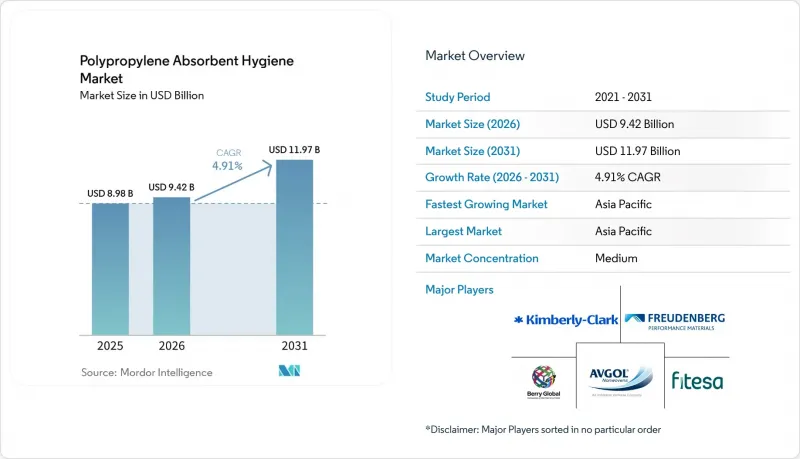
Mordor Intelligence에 의하면, 폴리프로필렌 흡수성 위생용품 시장 규모는 2025년 89억 8,000만 달러에서 2026년에는 94억 2,000만 달러로 확대되어 2026년부터 2031년까지 CAGR 4.91%로 성장을 지속하여, 2031년까지 119억 7,000만 달러에 이를 것으로 예측됩니다.
본 보고서는 제품 유형(스펀본드 부직포 폴리프로필렌, 멜트블로운 부직포 폴리프로필렌 등), 용도(아기 기저귀, 여성 위생용품, 성인용 요실금 용품 등), 지역(아시아태평양, 북미, 유럽, 남미, 중동 및 아프리카)별로 분류되어 있습니다. 시장 전망은 금액(달러) 기준으로 제시되어 있습니다.
전 세계 폴리프로필렌 흡수성 위생용품 시장 동향 및 분석
신흥 아시아 및 아프리카의 출산율 상승이 기저귀 보급을 촉진하고 있습니다.
아시아와 아프리카의 인구 증가는 인도의 농촌 지역이나 서아프리카 일부 등 기저귀 보급률이 여전히 10% 미만인 지역에서도 유아용품에 대한 높은 수요를 지속적으로 뒷받침하고 있습니다. 다국적 기업들은 이러한 시장에 대응하기 위해 생산 능력을 확대되고 있습니다. 예를 들어, 유니참은 2025년 2월, 가격에 민감한 지역의 리드타임과 물류 비용을 절감하기 위해 인도 내 세 번째 공장의 가동을 재개했습니다. 현지 생산을 통해 기업들은 각 가정의 자금 운용 주기에 맞춘 포장 규격을 제공할 수 있게 되었으며, 이는 도시 외곽 지역으로의 보급 확대에 필수적입니다. 그 결과, 해당 지역에서는 폴리프로필렌 흡수성 위생용품 시장이 프리미엄화보다는 판매량 증가의 혜택을 보고 있습니다. 각 지역에 분산된 프로필렌 조달망과 첨단 저중량 스펀본드 기술을 보유한 공급업체는 시장 점유율을 확대하기에 유리한 위치에 있습니다.
매우 부드럽고 저자극성 톱시트로의 프리미엄화 추세
미국, 서유럽, 그리고 중국의 부유한 도시 지역 등 시장에서는 피부과 테스트를 거친 무향의 초미세 데니어 톱시트를 선택하는 부모들이 늘고 있습니다. 2025년에 출시된 프로이덴베르크의 초극세 필라멘트 스펀본드 제품 라인은 부드러움과 높은 인열 강도를 겸비한 2.5-3데니어의 폴리프로필렌 섬유를 생산합니다. 이러한 특성 덕분에 쾌적성을 저해하지 않으면서 코어 두께를 얇게 할 수 있으며, 단위당 폴리머 사용량을 안정적으로 유지할 수 있습니다. 이 전자상거래 플랫폼은 저자극성을 주요 특징으로 내세워, 디지털에 익숙한 부모 세대의 구매 의욕을 높이고 있습니다. 그 결과, 폴리프로필렌의 흡수성 위생용품 시장은 판매량 증가뿐만 아니라, 더 가늘고 강인한 섬유를 생산할 수 있는 수지 등급을 활용함으로써 부가가치를 창출하고 있습니다. 피부 접촉의 안전성을 문서로 입증하고 제3자 기관의 인증을 획득한 변환기는 온라인·오프라인을 불문하고 경쟁 우위를 확보하고 있습니다.
프로필렌(C3) 및 에틸렌(C2) 원료 가격 변동
폴리머 등급 프로필렌 가격은 2023년 중반 이후, 겨울 폭풍과 정유시설의 정기 점검으로 인한 공급 제약의 영향을 받아 파운드당 0.30-0.60달러 범위에서 움직였습니다. 이러한 공급 차질로 인해, 소매업체와의 엄격한 계약 조건 하에서 운영되는 가공업체들은 수지 원가 급등에 대응할 수밖에 없게 되었습니다. 라이온델바셀의 휴스턴 공장 등 미국 내 정유시설 폐쇄로 인해 시장에서 약 20만 톤(kt)의 정제 등급 프로필렌이 사라졌으며, 이는 난방 수요가 증가하는 시기의 가격 상승 요인 중 하나가 되었습니다. 에틸렌 가격 또한 나프타 및 원유 가격의 변동에 따라 큰 폭의 등락을 보이고 있으며, 이로 인해 기저귀의 뒷면 시트에 사용되는 바이컴포넌트 섬유의 원가가 상승하고 있습니다. 이러한 가격 변동은 매출 총이익률에 영향을 미치며, 신규 스펀본드 생산 라인의 투자 회수 기간을 연장시키고 있습니다. 선물 헤지나 재생 가능 원료에 연동된 인증된 서큘러 등급으로의 다각화는 가격 변동을 억제하는 데 도움이 되지만, 소규모 변환업체의 경우 이러한 수단을 효과적으로 활용하기에는 규모가 부족한 경우가 많습니다.
부문별 분석
스펀본드 폴리프로필렌은 주로 탑시트 및 백시트 용도로 사용되어, 2025년 예상 매출의 42.24%를 차지할 것으로 전망됩니다. 복합 부직포 시장은 연평균 성장률(CAGR) 5.71%를 달성할 것으로 예측됩니다. 컨버터가 액체 처리 성능을 최적화하고 중량 밀도를 줄이기 위해 멜트블로운 웹과 스펀본드 층을 라미네이트하는 추세가 확산됨에 따라, 복합 웹용 폴리프로필렌 흡수성 위생용품 시장 규모는 꾸준히 확대될 것으로 전망됩니다. 코폼 기술의 발전으로 고흡수성 입자를 멜트블로운 섬유에 직접 내장할 수 있게 되어, 접착제 사용량을 줄이고 코어 층의 얇은 두께 구현을 실현하고 있습니다. 복합 구조를 채택함에 따라, 고급 기저귀의 1제곱미터당 폴리프로필렌 사용량은 증가하는 반면, 총 중량(평량)은 감소하므로, 평량을 정밀하게 제어할 수 있는 공급업체에게 유리합니다.
한편, 멜트블로운 폴리프로필렌은 여과를 주된 목적으로 하는 위생용 필름용 틈새 소재에 그치고 있습니다. 또한, 에어레이드 및 니들펀치 부직포는 인장 강도보다 부피감이 더 중요한 특수 라이너에 사용됩니다. 프로이덴베르크사의 제곱미터당 불과 17그램(gsm)에 불과한 초경량 스펀본드 웹 등, 초미세 섬유 기술의 혁신을 통해 기계적 성능 요건이 충족되고 있습니다. 예측 기간 동안, 복합 구조는 유럽의 순환형 경제 규정을 준수하는 단일 소재 기저귀 설계를 가능하게 함으로써 폴리프로필렌 흡수성 위생용품 시장 점유율을 확대할 것으로 예측됩니다.
지역별 분석
아시아태평양은 2025년 매출의 40.15%를 차지해, 2031년까지 연평균 성장률(CAGR) 5.84%로 성장할 것으로 전망됩니다. 인도, 베트남, 인도네시아에서는 기저귀 보급률 향상과 수입 관세를 피하기 위한 국내 생산 공장 설립으로 인해 판매량 증가가 주도될 것으로 전망됩니다. 반면 중국에서는 브랜드 신뢰도 문제와 소비자들의 저가 선호 경향으로 인해 2025년 기저귀 판매량이 감소했습니다. 그러나 유니참과 킴벌리 클라크의 경영진은 2026년까지 현지 통화 기준으로 한 자릿수 중반대의 회복을 예상하고 있습니다. 일본 수요는 안정적이며 프리미엄 제품이 선호되고 있어, 고밀도 탑시트 사용을 통해 수익률을 유지하고 있습니다.
북미는 시장 점유율은 작지만, 더 건전한 이익률의 혜택을 누리고 있습니다. 소매업체와의 브랜드 제휴를 통해 온텍스는 유아용품 출하량에서 두 자릿수 성장을 달성했습니다. 또한, 아브골사가 노스캐롤라이나주에 신설한 생산 라인을 통해, 이 회사는 주요 기저귀 공장에서 트럭으로 1일 이내 거리에 고품질 복합 소재를 공급할 수 있는 체제를 구축했습니다. 소매업체의 자발적인 재생 소재 함유율 목표와 관련된 요건에 힘입어, 인증받은 순환형 폴리프로필렌이 점차 보급되고 있습니다.
유럽에서는 사상 최저 수준의 출산율로 인해 유아용품 판매량이 감소했습니다. 그러나 이는 프리미엄 성인용 요실금 패드의 성장과 지속가능성에 중점을 둔 입찰로 인해 일부 상쇄되었습니다. 2027년에 도입될 예정인 확대 생산자 책임(EPR) 제도는 이미 단일 소재 기저귀에 대한 시범 프로젝트 개발을 촉진하고 있습니다. 이러한 노력은 폴리에틸렌 테레프탈레이트(PET) 필름에 대한 의존도를 낮추는 동시에 폴리프로필렌 수요를 증가시킬 가능성이 있습니다.
라틴아메리카와 중동 및 아프리카는 여전히 시장 침투율이 낮은 편이지만, 큰 성장 기회를 내포하고 있습니다. 에시티(Essity)는 퍼스널케어 제품 매출의 상당 부분을 라틴아메리카에서 올리고 있으며, 환율 리스크가 있음에도 불구하고 이 지역의 중요성이 부각되고 있습니다. 아프리카에서는 각국 정부가 수입 비용 절감을 목적으로 현지 생산을 우선시하고 있으며, 이는 지역 내 스펀본드 생산 능력에 대한 투자로 이어지고 있습니다. 이를 통해 국내 폴리프로필렌 소비가 뒷받침되고 있습니다.
기타 혜택:
- 엑셀 형식 시장 예측(ME) 시트
- 3개월간의 애널리스트 지원
자주 묻는 질문
목차
제1장 서론
제2장 조사 방법
제3장 주요 요약
제4장 시장 구도
제5장 시장 규모와 성장 예측
제6장 경쟁 구도
제7장 시장 기회와 향후 전망
JHS 26.06.19According to Mordor Intelligence, the polypropylene absorbent hygiene market size is expected to grow from USD 8.98 billion in 2025 to USD 9.42 billion in 2026 and is forecast to reach USD 11.97 billion by 2031 at 4.91% CAGR over 2026-2031.
This report is Segmented by Product Type (Spunbond Non-Woven Polypropylene, Melt-Blown Non-Woven Polypropylene, and More), Application (Baby Diapers, Feminine Hygiene Products, Adult Incontinence Products, and More), & Geography (Asia-Pacific, North America, Europe, South America, and Middle-East and Africa). The Market Forecasts are Provided in Terms of Value (USD).
Global Polypropylene Absorbent Hygiene Market Trends and Insights
Rising Birth Rates in Emerging Asia and Africa Fuelling Diaper Uptake
Demographic growth in Asia and Africa continues to sustain high demand for baby-care products, even in regions where diaper penetration remains below 10%, such as rural India and parts of West Africa. Multinational companies are increasing production capacity to address these markets. For instance, Unicharm resumed operations at its third Indian plant in February 2025 to reduce lead times and logistics costs in price-sensitive areas. Local manufacturing also enables companies to offer pack sizes aligned with household cash-flow cycles, which is essential for expanding penetration beyond urban centers. Consequently, the polypropylene absorbent hygiene market benefits from volume growth rather than premiumization in these regions. Suppliers with regionally diversified propylene sourcing and advanced low-basis-weight spun-bond capabilities are positioned to gain market share.
Premiumization Trend Toward Ultra-Soft/Hypoallergenic Topsheets
In markets such as the United States, Western Europe, and affluent urban areas in China, parents are increasingly opting for fine-denier topsheets that are dermatologically tested and fragrance-free. Freudenberg's fine-filament spun-bond line, launched in 2025, produces 2.5-3-denier polypropylene fibers that combine softness with high tear strength. These properties enable reductions in core thickness without compromising comfort, maintaining stable polymer usage per unit. E-commerce platforms prominently highlight hypoallergenic claims, encouraging higher spending among digitally active parents. As a result, the polypropylene absorbent hygiene market captures value not only through increased volumes but also by utilizing resin grades capable of producing finer, stronger fibers. Converters that provide documented skin-contact safety and secure third-party certifications gain a competitive edge both online and offline.
Propylene (C3) and Ethylene (C2) Feedstock Price Volatility
Polymer-grade propylene prices ranged between USD 0.30 and 0.60 per pound since mid-2023, influenced by supply constraints caused by winter storms and refinery turnarounds. These disruptions required converters operating under narrow retailer contracts to manage sudden increases in resin costs. U.S. refinery closures, such as LyondellBasell's Houston facility, have removed nearly 200 kilotons (kt) of refinery-grade propylene from the market, contributing to price increases during periods of high heating demand. Ethylene prices have also shown significant volatility, driven by fluctuations in naphtha and crude oil prices, which have raised costs for bicomponent fibers used in diaper backsheets. This price variability affects gross margins and extends the payback period for new spun-bond production lines. While forward hedging and diversification into certified circular grades indexed to renewable feedstocks can help manage volatility, smaller converters often lack the scale to utilize these tools effectively.
Other drivers and restraints analyzed in the detailed report include:
- E-Commerce-Led Private-Label Diaper Scale-Up
- High-Loft Spun-Bond PP Replacing Cotton and Viscose Webs
- Brand-Owner Pivot Toward Bio-Based PLA/PHA Non-Wovens
For complete list of drivers and restraints, kindly check the Table Of Contents.
Segment Analysis
Spunbond polypropylene accounted for 42.24% of the projected 2025 revenue, primarily due to its application in topsheets and backsheets. Composite non-wovens are expected to achieve a 5.71% compound annual growth rate (CAGR). The polypropylene absorbent hygiene market size for composite webs is anticipated to grow steadily as converters laminate melt-blown webs and spunbond layers to optimize fluid handling and reduce basis weight. Advances in co-form technology enable the embedding of super-absorbent particles directly into melt-blown fibers, reducing adhesive usage and allowing for thinner cores. Composite designs increase polypropylene usage per square meter in premium diapers while lowering overall grammage, benefiting suppliers with precise basis-weight control capabilities.
In comparison, melt-blown polypropylene remains a niche material for filtration-focused hygiene films, while air-laid and needle-punched fabrics are used in specialty liners where loft is prioritized over tensile strength. Innovations in fine-filament technology, such as Freudenberg's spunbond webs with weights as low as 17 grams per square meter (gsm), meet mechanical performance requirements. Over the forecast period, composite structures are expected to enhance the polypropylene absorbent hygiene market share by enabling mono-material diaper designs that comply with circular-economy regulations in Europe.
Geography Analysis
Asia-Pacific accounted for 40.15% of the 2025 revenue and is projected to grow at a Compound Annual Growth Rate (CAGR) of 5.84% through 2031. India, Vietnam, and Indonesia are expected to drive volume growth due to increasing diaper penetration and the establishment of domestic manufacturing plants, which help avoid import duties. In contrast, China experienced a decline in diaper volumes in 2025 due to brand-trust issues and consumer trading-down. However, management teams at Unicharm and Kimberly-Clark anticipate a mid-single-digit recovery in local currency by 2026. Japanese demand remains stable, with a preference for premium products, supporting margins through the use of fine-denier topsheets.
North America holds a smaller market share but benefits from healthier margins. Retailer-brand partnerships enabled Ontex to achieve double-digit growth in baby-care volumes. Additionally, Avgol's new production line in North Carolina positions the company to supply high-quality composites within a single-day truck radius of major diaper plants. Certified circular polypropylene is gaining traction, driven by retailer mandates linked to voluntary recycled-content goals.
Europe experienced a decline in baby-care volumes due to record-low birth rates. However, this was partially offset by growth in premium adult incontinence pads and sustainability-focused tenders. The introduction of extended producer responsibility fees, set to begin in 2027, is already encouraging the development of mono-material diaper pilots. These initiatives could increase polypropylene demand while reducing reliance on polyethylene terephthalate (PET) films.
Latin America and the Middle East & Africa remain under-penetrated but present significant growth opportunities. Essity derives a substantial portion of its personal-care sales from Latin America, highlighting the region's importance despite currency risks. In Africa, governments are prioritizing local manufacturing to reduce import bills, leading to investments in regional spun-bond capacity, which supports domestic polypropylene consumption.
- Ahlstrom
- Asahi Kasei Corporation
- Avgol Industries 1953 Ltd
- Berry Global
- Dow
- Essity Aktiebolag (publ)
- Fibertex Personal Care A/S
- First Quality Enterprises, Inc.
- Fitesa S.A.
- Freudenberg Performance Materials
- KCWW
- KNH Enterprise Co., Ltd
- Mitsui Chemicals, Inc.
- Ontex BV
- PFNonwovens Holding s.r.o.
- Unicharm Corporation
- Welspun India
Additional Benefits:
- The market estimate (ME) sheet in Excel format
- 3 months of analyst support
TABLE OF CONTENTS
1 Introduction
- 1.1 Study Assumptions and Market Definition
- 1.2 Scope of the Study
2 Research Methodology
3 Executive Summary
4 Market Landscape
- 4.1 Market Overview
- 4.2 Market Drivers
- 4.2.1 Rising birth rates in emerging Asia and Africa fuelling diaper uptake
- 4.2.2 Premiumisation trend toward ultra-soft/hypoallergenic topsheets
- 4.2.3 E-commerce-led private-label diaper scale-up
- 4.2.4 High-loft spun-bond PP replacing cotton and viscose webs
- 4.2.5 Closed-loop recycling credits for mono-material PP diaper designs
- 4.3 Market Restraints
- 4.3.1 Propylene (C3) and ethylene (C2) feedstock price volatility
- 4.3.2 Brand-owner pivot toward bio-based PLA/PHA non-wovens
- 4.3.3 Cellulose-foam cores eliminating PP acquisition layers
- 4.4 Value Chain Analysis
- 4.5 Porter's Five Forces
- 4.5.1 Threat of New Entrants
- 4.5.2 Bargaining Power of Buyers
- 4.5.3 Bargaining Power of Suppliers
- 4.5.4 Threat of Substitutes
- 4.5.5 Competitive Rivalry
5 Market Size and Growth Forecasts (Value)
- 5.1 By Product Type
- 5.1.1 Spunbond Non-woven Polypropylene
- 5.1.2 Melt-blown Non-woven Polypropylene
- 5.1.3 Composite Non-woven
- 5.1.4 Air-laid Polypropylene
- 5.1.5 Other Product Types (Needle-punched, Thermal-bonded)
- 5.2 By Application
- 5.2.1 Baby Diapers
- 5.2.2 Feminine Hygiene Products
- 5.2.3 Adult Incontinence Products
- 5.2.4 Panty Liners
- 5.2.5 Wipes
- 5.2.6 Medical Hygiene (Surgical Drapes, Gowns, Pads)
- 5.2.7 Other Hygiene Products
- 5.3 By Geography
- 5.3.1 Asia-Pacific
- 5.3.1.1 China
- 5.3.1.2 India
- 5.3.1.3 Japan
- 5.3.1.4 South Korea
- 5.3.1.5 ASEAN Countries
- 5.3.1.6 Rest of Asia-Pacific
- 5.3.2 North America
- 5.3.2.1 United States
- 5.3.2.2 Canada
- 5.3.2.3 Mexico
- 5.3.3 Europe
- 5.3.3.1 Germany
- 5.3.3.2 United Kingdom
- 5.3.3.3 France
- 5.3.3.4 Italy
- 5.3.3.5 Spain
- 5.3.3.6 Russia
- 5.3.3.7 Nordic Countries
- 5.3.3.8 Rest of Europe
- 5.3.4 South America
- 5.3.4.1 Brazil
- 5.3.4.2 Argentina
- 5.3.4.3 Rest of South America
- 5.3.5 Middle-East and Africa
- 5.3.5.1 Saudi Arabia
- 5.3.5.2 South Africa
- 5.3.5.3 Rest of Middle-East and Africa
- 5.3.1 Asia-Pacific
6 Competitive Landscape
- 6.1 Market Concentration
- 6.2 Strategic Moves
- 6.3 Market Share(%)/Ranking Analysis
- 6.4 Company Profiles (includes Global Overview, Market Overview, Core Segments, Financials, Strategic Information, Products and Services, and Recent Developments)
- 6.4.1 Ahlstrom
- 6.4.2 Asahi Kasei Corporation
- 6.4.3 Avgol Industries 1953 Ltd
- 6.4.4 Berry Global
- 6.4.5 Dow
- 6.4.6 Essity Aktiebolag (publ)
- 6.4.7 Fibertex Personal Care A/S
- 6.4.8 First Quality Enterprises, Inc.
- 6.4.9 Fitesa S.A.
- 6.4.10 Freudenberg Performance Materials
- 6.4.11 KCWW
- 6.4.12 KNH Enterprise Co., Ltd
- 6.4.13 Mitsui Chemicals, Inc.
- 6.4.14 Ontex BV
- 6.4.15 PFNonwovens Holding s.r.o.
- 6.4.16 Unicharm Corporation
- 6.4.17 Welspun India
7 Market Opportunities and Future Outlook
- 7.1 White-space and Unmet-need Assessment