
|
시장보고서
상품코드
2062428
마이크로 스위치 시장 : 시장 점유율 분석, 업계 동향 및 통계, 성장 예측(2026-2031년)Micro Switch - Market Share Analysis, Industry Trends & Statistics, Growth Forecasts (2026 - 2031) |
||||||
 Mordor Intelligence
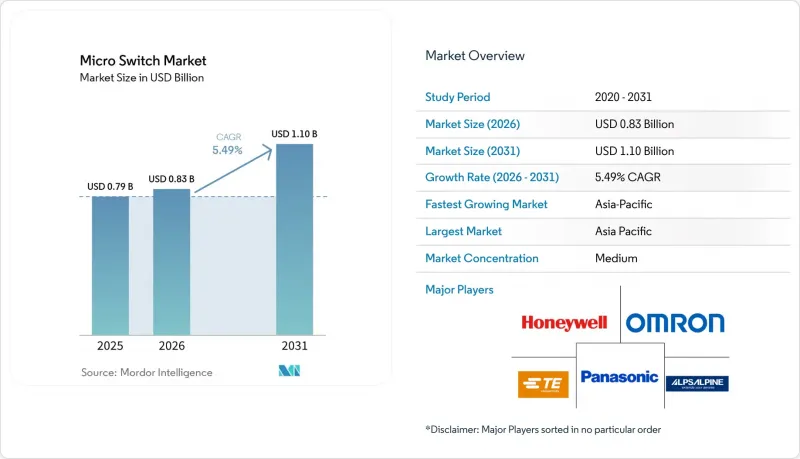
Mordor Intelligence에 의하면, 마이크로 스위치 시장 규모는 2025년 7억 9,000만 달러로 평가되었고, 2026년 8억 3,000만 달러로 추정되고, 2031년까지 11억 달러로 확대될 전망이며, 2026-2031년 연평균 복합 성장률(CAGR)은 5.49%를 나타낼 것으로 예측됩니다.
본 보고서는 스위치 유형별(표준 스냅 액션, 서브미니처 등), 액추에이터 유형별(플런저, 레버, 롤러 레버, 푸시 버튼, 토글, 커스텀), 정격 전류별(5A 이하, 6-10A, 11-16A 및 16A 초과), 최종 사용자 산업별(가전, 자동차, 기타) 및 지역별(북미, 유럽, 아시아태평양, 기타)로 분류되어 있습니다. 시장 전망은 금액(달러) 기준으로 제시되어 있습니다.
세계의 마이크로 스위치 시장 동향 및 인사이트
자동차 안전성 및 ADAS 분야의 센서 중복성 요구 사항 급증
세계 자동차 제조업체들이 개발하는 레벨 3 이상의 자율주행 시스템은 ISO 26262 ASIL-D의 진단 커버리지 요건을 충족해야 하며, 이에 따라 1차 공급업체들은 독립적인 중복성 계층으로서 홀 센서와 스냅 액션 방식의 마이크로 스위치를 결합해야 하는 상황에 직면해 있습니다. 기계식 접점에는 용착이나 산화 등의 고장 모드가 발생하지만, 이러한 현상은 자기 센서의 드리프트와 통계적으로 상관관계가 없기 때문에 안전 설계자는 모든 구성 요소의 사양을 상향 조정하지 않고도 분해 규정을 충족할 수 있습니다. 롤러 레버식 액추에이터는 포지티브 오픈 구조 덕분에 정의된 힘 임계값에서 접점이 확실하게 분리되므로, IEC 61058-1에 따른 인증 획득이 용이하다는 점에서 선호되고 있습니다. 따라서 -40-125°C의 작동 온도를 지원하는 초소형 디바이스에 대한 수요는 전기차 생산 확대에 따라 증가하고 있습니다. IATF 16949 인증을 획득하고 100만 사이클의 내구성을 입증한 공급업체는 장기적인 자동차 플랫폼 프로그램에서 확고한 우위를 점할 수 있습니다.
IoT 지원 스마트 홈 가전에서의 마이크로 스위치 통합 확대
Matter 인증을 획득한 냉장고, 오븐, 세탁기에는 무선 통신이 끊긴 경우에도 하드웨어 수준의 안전성을 유지하기 위해 마이크로 스위치를 이용한 인터록 기능이 내장되어 있습니다. 가전제품 설계자들은 0.15달러짜리 스위치와 2.50달러짜리 시스템 온 칩을 결합함으로써, 케이스를 재설계하지 않고도 UL 60335 표준을 준수하는 듀얼 모드 작동을 구현하고 있습니다. 북미의 스마트 홈 보급률이 40%를 넘어서는 가운데, 각 OEM 업체들은 추적 가능한 품질을 확보하고 공급 차질에 대한 리스크를 분산하기 위해 수년에 걸친 스위치 공급 계약을 체결하고 있습니다. ISO 9001 인증을 획득한 공장을 보유하고 현지 현장 용도 엔지니어를 보유한 공급업체가, 현물 시장의 신규 진입업체보다 우선적으로 선택되고 있습니다. 그 결과, 안정적인 대량 수요가 발생하여 정격 전류 제품의 상품화가 진행되는 부문에서 가격 압박에 직면하고 있음에도 불구하고, 이익률을 지탱하고 있습니다.
상품화와 중국의 저비용 생산자들이 가하는 가격 압박
현재 심천의 수탁 제조업체는 5암페어 스냅 액션 스위치를 1만 개 단위로 0.08달러에 견적하고 있으며, 이는 일본 및 유럽 브랜드보다 최대 50%나 저렴한 가격입니다. 이익률 하락을 우려하는 유럽과 미국의 기존 제조업체들은 일반 상품(commodity) 분야에서 철수하고, 연구 개발(R&D) 자원을 항공우주 및 의료와 같은 틈새 시장으로 재분배하고 있습니다. 그러나 이러한 철수로 인해 가전 및 저전류 시장 점유율을 아시아 제조업체들에게 내주게 되었습니다. 대량 생산을 수행하는 중국의 제조 거점은 IATF 16949 인증과 자동 검사를 활용하여 자동차 업계의 2차 공급업체를 유치하고 있으며, 이는 가격 경쟁의 하향 평준화를 가속화하고 있습니다. 비용 리더십이 수요 곡선을 재편하는 가운데, 자동화 시스템, 자체 도금 설비 및 은 가격 헤지 계약을 갖춘 공급업체만이 수익성을 지킬 수 있습니다. 소규모 지역 제조업체들은 통합과 철수 중 하나를 선택해야 하는 상황에 직면해 있습니다.
부문별 분석
재생에너지 및 실외 장비 구매자들이 장기간 현장 운용을 위해 IP67 규격을 요구함에 따라, 밀폐형 및 방수형 디바이스에 사용되는 마이크로 스위치 시장 규모는 표준형보다 빠르게 확대되고 있습니다. 표준 스냅 액션 모델은 가전제품 및 소형 기계에서의 확고한 사용으로 인해 2025년 기준 37.2%의 시장 점유율을 유지했으나, 휴대용 전자기기에서의 홀 센서 채택과 아시아태평양 OEM 업체들의 수직 통합으로 인해 그 성장세는 둔화되고 있습니다.
밀폐형 스위치는 가격이 20-30% 더 비싸지만, 외딴 지역의 풍력 발전소나 태양광 발전소 전체에 대한 출장 유지보수 비용을 절감해 줍니다. 특히 초소형 밀폐형 포맷은 환경 밀폐성과 소형화가 요구되는 의료용 펌프나 휴대용 진단 기기에 적합합니다. 리미트 스위치의 폼 팩터는 분산형 I/O 구조로 전환되는 산업용 자동화 패널에서 꾸준히 채택되고 있습니다. 기밀 씰, 자가 세척 접점 및 가속 수명 시험 결과를 종합한 공급업체는 2031년까지 6.9%의 성장세를 활용하는 데 유리한 입장에 있습니다.
레버 작동식 장치는 2025년 수요의 41.5%를 차지했으며, 가전제품의 덮개, 안전 게이트 및 후드 래치 센서에 필요한 범용성을 제공합니다. 연평균 성장률(CAGR) 6.7%로 성장을 지속할 전망이며, 있는 롤러 레버 제품은 IEC 61058-1 규격 준수를 간소화하는 포지티브 오픈 구조 덕분에 공장 현대화에 따라 부피가 큰 캠식 리미트 스위치를 대체하고 있습니다.
플런저 방식은 직선적인 동작이 주를 이루는 엘리베이터 호출 버튼이나 푸시 버튼 패널에서 여전히 대표적인 방식입니다. 토글식 및 맞춤형 액추에이터는 촉각을 통한 확인이 필수적인 항공기 조종실이나 수술 기구에서 널리 사용되고 있습니다. 협동 로봇의 보급에 따라 설계자들은 작동력을 최대 40%까지 줄일 수 있는 롤러 레버를 선호하여, 이를 통해 자율 주행 카트나 핸드헬드 컨트롤러의 배터리 수명을 연장하고 있습니다. 이러한 설비 갱신에 힘입어 롤러 레버의 성장률은 마이크로 스위치 시장 평균을 크게 상회하며 유지되고 있습니다.
지역별 분석
아시아태평양은 2025년 매출의 42.7%를 차지한 것으로 평가되었고, 중국의 가전제품 생산 및 확대되는 지역 내 자동차 전자기기 라인에 힘입어 2031년까지 연평균 성장률(CAGR) 6.1%를 나타낼 것으로 전망됩니다. Dongnan Electronics의 연간 3억 개 생산 능력은 저전류 모델의 수입 실현 가능성을 낮출 수 있는 규모의 경제를 구현하고 있습니다. 베트남과 인도는 관세 혜택을 확보하고 생산 연계형 인센티브 요건을 충족하기 위해 현지 스위치 공급을 요구하는 신흥 조립 거점으로 주목받고 있지만, 품질 관리의 편차가 여전히 걸림돌로 작용하고 있습니다. 일본과 한국은 높은 신뢰성이 요구되는 항공우주 및 자동차 분야의 틈새 시장에 주력하는 한편, 민수용 제품의 대량 생산을 점차 동남아시아로 이전하고 있습니다.
유럽에서는 풍력 발전소 개보수 및 인더스트리 4.0에 대한 투자가 국내 가전제품 생산 감소분을 상쇄하여 시장이 안정세를 보이고 있습니다. 독일과 스위스의 전문 기업들은 현지 엔지니어링 지원과 짧은 리드 타임을 바탕으로, SIL-3 안전 규격에 대응하는 용도 및 재생 에너지 설비를 위한 제품을 제공합니다. 영국의 브렉시트 이후 발생한 통관 마찰은 독일, 프랑스, 체코 공화국의 자동차 공장에 적시 납품이 가능한 지역의 유통업체들에게는 약간의 호재가 되고 있습니다. 중동의 건설 붐이 HVAC용 스위치 수요를 끌어올리고 있지만, 이 지역은 여전히 부품의 대부분을 수입에 의존하고 있습니다. 남아프리카, 이집트, 모로코에 형성된 아프리카의 새로운 가전 클러스터는 유통망 구축과 기술 교육 준비가 완료된 공급업체들에게 새로운 사업 기회를 제공합니다.
북미에서는 자동차의 ADAS 도입, FDA 규제 대상인 의료기기, 그리고 UL 인증 부품을 우선시하는 외식 산업의 위생 기준 향상으로 인해 시장 점유율을 유지하고 있습니다. 미국의 공장에서는 전기차 배터리 팩이나 레스토랑의 컨베이어 오븐용으로 IP67 규격의 밀폐형 스위치가 요구되고 있으며, 이것이 프리미엄 가격 책정을 뒷받침하고 있습니다. 캐나다의 자동차 부품 공장에서는 배터리 절단 장치에 고주파수 대응 초소형 장치가 탑재되어 있는 반면, 멕시코의 가전제품 생산 라인에서는 물류 효율화를 위해 공급업체 관리 재고(VMI) 프로그램에 의존하고 있습니다. 남미에서는 거시경제적 역풍으로 인해 신규 건설 규모가 제한되고 있어, 시장은 여전히 교체 수요에 의해 주도되는 양상을 보이고 있습니다. 이러한 동향을 종합해 보면, 양극화된 시장 구조가 뚜렷이 드러납니다. 즉, 아시아태평양이 판매량을 견인하는 한편, 북미와 유럽은 규제 및 품질 관리의 복잡성을 통해 이익률을 뒷받침하고 있는 것입니다.
기타 혜택 :
- 엑셀 형식 시장 예측(ME) 시트
- 3개월간의 애널리스트 지원
자주 묻는 질문
목차
제1장 서론
제2장 조사 방법
제3장 주요 요약
제4장 시장 구도
제5장 시장 규모 및 성장 예측
제6장 경쟁 구도
제7장 시장 기회 및 향후 전망
AJY 26.06.22According to Mordor Intelligence, the micro switch market size is projected to expand from USD 0.79 billion in 2025 and USD 0.83 billion in 2026 to USD 1.10 billion by 2031, registering a CAGR of 5.49% between 2026 to 2031.
This report is Segmented by Switch Type (Standard Snap-Action, Subminiature, and More), Actuator Type (Plunger, Lever, Roller-Lever, Push-Button, Toggle, and Custom), Current Rating (Up To 5 A, 6-10 A, 11-16 A, and Above 16 A), End-User Industry (Home Appliances, Automotive, and More), and Geography (North America, Europe, Asia-Pacific, and More). The Market Forecasts are Provided in Terms of Value (USD).
Global Micro Switch Market Trends and Insights
Surge in Automotive Safety and ADAS Sensor-Redundancy Requirements
Global automakers' engineering Level-3 automation and above must meet ISO 26262 ASIL-D diagnostic coverage, which pushes tier-one suppliers to pair Hall sensors with snap-action microswitches as independent redundancy layers. Mechanical contacts introduce failure modes, such as weld or oxidation, that are statistically uncorrelated with magnetic-sensor drift, allowing safety architects to satisfy decomposition rules without up-specifying every component. Roller-lever actuators are favored because their positive-opening geometry guarantees contact separation at defined force thresholds, easing certification under IEC 61058-1. Demand for subminiature-footprint devices rated to -40 to 125 °C is therefore rising alongside electric-vehicle production. Suppliers that certify to IATF 16949 and document 1-million-cycle endurance gain a defensible edge in long-platform automotive programs.
Increasing Integration of Microswitches in IoT-Enabled Smart-Home Appliances
Matter-certified refrigerators, ovens, and washers embed microswitch interlocks to maintain hardware-level safety when wireless links fail. Appliance designers combine a USD 0.15 switch with a USD 2.50 system-on-chip, achieving dual-mode operation that meets UL 60335 without redesigning sheet-metal enclosures. As smart-home penetration in North America exceeds 40%, OEMs lock-in multiyear switch contracts to secure traceable quality and hedge against supply disruptions. Suppliers with ISO 9001 plants and local field-application engineers win preference over spot-market entrants. The result is stable, volume-driven demand that cushions margins even as commoditized current-rating segments face price pressure.
Price Pressure from Commoditization and Chinese Low-Cost Producers
Shenzhen contractors now quote 5-ampere snap-action switches at USD 0.08 in 10,000-piece lots, undercutting Japanese and European brands by up to 50%. Western incumbents watching margin erosion are exiting commodity categories and reallocating R&D toward aerospace and medical niches, but the retreat cedes appliance and low-current market share to Asia-based producers. High-volume Chinese facilities leverage IATF 16949 certification and automated inspection to court automotive tier-twos, accelerating the race to the bottom on price. As cost leadership reshapes the demand curve, only suppliers with automation, in-house plating, and hedged silver contracts can defend profitability. Short-run regional manufacturers face consolidation or exit.
Other drivers and restraints analyzed in the detailed report include:
- Industrial Automation Retrofits Demanding Compact Limit-Switch Alternatives
- Rising Adoption of Sealed IP67 Microswitches in Outdoor Renewable Installations
- Substitution Risk from Solid-State Hall-Effect Sensors in Compact Devices
For complete list of drivers and restraints, kindly check the Table Of Contents.
Segment Analysis
The micro switch market size attributed to sealed and waterproof devices is growing faster than their standard counterparts, as renewable-energy and outdoor-equipment buyers specify IP67 ratings for long-life field service. Standard snap-action models retained 37.2% share in 2025 owing to entrenched use in appliances and light machinery, yet their outlook is tempered by Hall-sensor adoption in portable electronics and by Asia-Pacific OEM vertical integration.
Sealed switches command a 20-30% price premium but cut truck-roll maintenance costs across remote wind farms and solar arrays. Subminiature sealed formats, in particular, address medical pumps and handheld diagnostics where environmental sealing and miniature size intersect. Limit-switch form factors see steady uptake in industrial automation panels migrating to distributed I/O structures. Vendors combining hermetic sealing, self-cleaning contacts, and accelerated life-test results are well-positioned to leverage the 6.9% growth runway through 2031.
Lever-actuated devices held 41.5% of 2025 demand, providing the versatility needed for appliance lids, safety gates, and hood-latch sensors. Roller-lever products, enjoying a 6.7% CAGR, replace bulky cam-operated limit switches during factory modernization, thanks to positive-opening mechanics that simplify IEC 61058-1 compliance.
Plunger styles remain staples in elevator call stations and push-button panels where linear travel dominates. Toggle and custom actuators thrive in aircraft cockpits and surgical instruments that mandate tactile confirmation. As collaborative robots proliferate, designers prefer roller levers offering up to 40% lower actuation force, preserving battery life in autonomous carts and handheld controllers. This retooling momentum sustains roller-lever growth well above the micro switch market average.
Geography Analysis
Asia-Pacific, with 42.7% of 2025 revenue, is projected to post a 6.1% CAGR through 2031, powered by Chinese appliance production and expanding regional auto-electronics lines. Dongnan Electronics' 300-million-unit annual capacity exemplifies scale economics that blunt import feasibility for lower-current models. Vietnam and India showcase emerging assembly hubs seeking local switch supply to secure tariff advantages and meet production-linked incentives, though inconsistent quality enforcement remains a hurdle. Japan and South Korea focus on high-reliability aerospace and automotive niches while gradually offshoring consumer volume to Southeast Asia.
Europe stabilizes as wind-farm retrofits and Industry 4.0 investments counterbalance declines in domestic appliance output. German and Swiss specialists cater to SIL-3 safety applications and renewable installations, leveraging local engineering support and short lead times. The United Kingdom's post-Brexit customs friction adds a slight tailwind for regional distributors able to deliver just-in-time to auto plants in Germany, France, and the Czech Republic. Middle Eastern construction booms lift HVAC switch demand, but the region still imports the majority of components. Africa's nascent appliance clusters in South Africa, Egypt, and Morocco open green-field opportunities for suppliers ready to establish distribution and technical training.
North America maintains share through automotive ADAS rollouts, FDA-regulated medical devices, and food-service hygiene upgrades that prefer UL-recognized parts. U.S. factories demand IP67 sealed switches for electric-vehicle battery packs and restaurant conveyor ovens, supporting premium pricing. Canadian auto parts plants integrate high-cycle subminiature devices into battery disconnects, while Mexican appliance lines rely on vendor-managed inventory programs to streamline logistics. South America stays replacement-driven due to macroeconomic headwinds, limiting new-build volumes. Collectively, these dynamics reveal a bifurcated landscape: Asia-Pacific drives volume, whereas North America and Europe underpin margins via regulatory and quality complexity.
- Omron Corporation
- Honeywell International Inc.
- Alps Alpine Co., Ltd.
- C&K Components LLC
- TE Connectivity Ltd.
- Panasonic Holdings Corporation
- Zing Ear Group Company Limited
- Defond Electric Industrial Co., Ltd.
- E-Switch Inc.
- ZF Friedrichshafen AG (Cherry Switches)
- Johnson Electric Holdings Limited
- Dongnan Electronics Co., Ltd.
- Salecom Electronics Co., Ltd.
- Microprecision Electronics SA
- Baumer Electric AG
- Wurth Elektronik GmbH & Co. KG
- Nidec Copal Electronics Corporation
- TTC Group (Trantek Corporation)
- Uniwell Corporation
- Kaihua Electronics Co., Ltd.
Additional Benefits:
- The market estimate (ME) sheet in Excel format
- 3 months of analyst support
TABLE OF CONTENTS
1 INTRODUCTION
- 1.1 Study Assumptions and Market Definition
- 1.2 Scope of the Study
2 RESEARCH METHODOLOGY
3 EXECUTIVE SUMMARY
4 MARKET LANDSCAPE
- 4.1 Market Overview
- 4.2 Market Drivers
- 4.2.1 Increasing Integration of Microswitches in IoT-Enabled Smart Home Appliances
- 4.2.2 Surge in Automotive Safety and ADAS Sensor-Redundancy Requirements
- 4.2.3 Industrial Automation Retrofits Demanding Compact Limit-Switch Alternatives
- 4.2.4 Rapid Expansion of Chinese Appliance OEMs with In-House Switch Sourcing
- 4.2.5 Rising Adoption of Sealed IP67 Microswitches in Outdoor Renewable Installations
- 4.2.6 Commercial Food-Service Equipment Compliance with Stricter Hygiene-Switch Standards
- 4.3 Market Restraints
- 4.3.1 Price Pressure from Commoditisation and Chinese Low-Cost Producers
- 4.3.2 Substitution Risk from Solid-State Hall-Effect Sensors in Compact Devices
- 4.3.3 Supply-Chain Volatility of Ag-Alloy Contacts Driving Cost Swings
- 4.3.4 Compliance Burden with Evolving RoHS / REACH Halogen-Free Mandates
- 4.4 Industry Value / Supply-Chain Analysis
- 4.5 Regulatory Landscape
- 4.6 Technological Outlook
- 4.7 Impact of Macroeconomic Factors on the Market
- 4.8 Porter's Five Forces Analysis
- 4.8.1 Threat of New Entrants
- 4.8.2 Bargaining Power of Suppliers
- 4.8.3 Bargaining Power of Buyers
- 4.8.4 Threat of Substitutes
- 4.8.5 Competitive Rivalry
5 MARKET SIZE AND GROWTH FORECASTS (VALUE)
- 5.1 By Switch Type
- 5.1.1 Standard (Snap-Action) Microswitches
- 5.1.2 Subminiature Microswitches
- 5.1.3 Ultraminiature Microswitches
- 5.1.4 Limit-Switch Form-Factor Microswitches
- 5.1.5 Sealed / Water-proof Microswitches
- 5.2 By Actuator Type
- 5.2.1 Plunger-Actuated
- 5.2.2 Lever-Actuated (Hinge, Simulated Roller)
- 5.2.3 Roller-Lever
- 5.2.4 Push-Button
- 5.2.5 Toggle and Custom Actuators
- 5.3 By Current Rating
- 5.3.1 Up to 5 A
- 5.3.2 6 - 10 A
- 5.3.3 11 - 16 A
- 5.3.4 Above 16 A
- 5.4 By End-User Industry
- 5.4.1 Home Appliances
- 5.4.2 Automotive and Transportation
- 5.4.3 Industrial Automation and Machinery
- 5.4.4 Medical Devices and Instrumentation
- 5.4.5 Consumer Electronics
- 5.4.6 Other End-User Industries
- 5.5 By Geography
- 5.5.1 North America
- 5.5.1.1 United States
- 5.5.1.2 Canada
- 5.5.1.3 Mexico
- 5.5.2 Europe
- 5.5.2.1 Germany
- 5.5.2.2 United Kingdom
- 5.5.2.3 France
- 5.5.2.4 Russia
- 5.5.2.5 Rest of Europe
- 5.5.3 Asia-Pacific
- 5.5.3.1 China
- 5.5.3.2 Japan
- 5.5.3.3 India
- 5.5.3.4 South Korea
- 5.5.3.5 Australia
- 5.5.3.6 Rest of Asia-Pacific
- 5.5.4 Middle East and Africa
- 5.5.4.1 Middle East
- 5.5.4.1.1 Saudi Arabia
- 5.5.4.1.2 United Arab Emirates
- 5.5.4.1.3 Rest of Middle East
- 5.5.4.2 Africa
- 5.5.4.2.1 South Africa
- 5.5.4.2.2 Egypt
- 5.5.4.2.3 Rest of Africa
- 5.5.4.1 Middle East
- 5.5.5 South America
- 5.5.5.1 Brazil
- 5.5.5.2 Argentina
- 5.5.5.3 Rest of South America
- 5.5.1 North America
6 COMPETITIVE LANDSCAPE
- 6.1 Market Concentration
- 6.2 Strategic Moves and Developments
- 6.3 Market Share Analysis
- 6.4 Company Profiles (includes Global Level Overview, Market Level Overview, Core Segments, Financials as available, Strategic Information, Market Rank/Share, Products and Services, Recent Developments)
- 6.4.1 Omron Corporation
- 6.4.2 Honeywell International Inc.
- 6.4.3 Alps Alpine Co., Ltd.
- 6.4.4 C&K Components LLC
- 6.4.5 TE Connectivity Ltd.
- 6.4.6 Panasonic Holdings Corporation
- 6.4.7 Zing Ear Group Company Limited
- 6.4.8 Defond Electric Industrial Co., Ltd.
- 6.4.9 E-Switch Inc.
- 6.4.10 ZF Friedrichshafen AG (Cherry Switches)
- 6.4.11 Johnson Electric Holdings Limited
- 6.4.12 Dongnan Electronics Co., Ltd.
- 6.4.13 Salecom Electronics Co., Ltd.
- 6.4.14 Microprecision Electronics SA
- 6.4.15 Baumer Electric AG
- 6.4.16 Wurth Elektronik GmbH & Co. KG
- 6.4.17 Nidec Copal Electronics Corporation
- 6.4.18 TTC Group (Trantek Corporation)
- 6.4.19 Uniwell Corporation
- 6.4.20 Kaihua Electronics Co., Ltd.
7 MARKET OPPORTUNITIES AND FUTURE OUTLOOK
- 7.1 White-Space and Unmet-Need Assessment