

|
시장보고서
상품코드
2062432
클라우드 기반 영어 학습 시장 : 시장 점유율 분석, 업계 동향 및 통계, 성장 예측(2026-2031년)Cloud-Based English Language Learning - Market Share Analysis, Industry Trends & Statistics, Growth Forecasts (2026 - 2031) |
||||||
 Mordor Intelligence
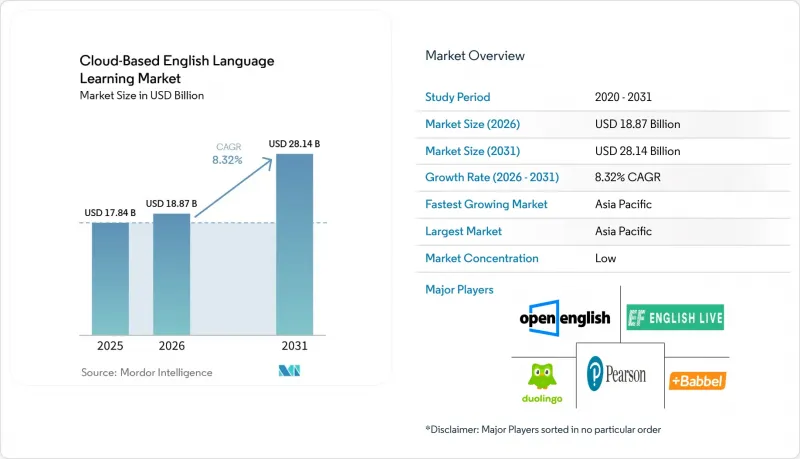
Mordor Intelligence에 의하면, 클라우드 기반 영어 학습 시장 규모는 2025년 178억 4,000만 달러로 평가되었고, 2026년에는 188억 7,000만 달러로 추정되고, 2026-2031년 CAGR 8.32%로 성장을 지속할 전망이며, 2031년까지 281억 4,000만 달러에 이를 것으로 예측됩니다.
본 보고서는 최종 사용자별(개인 학습자, 교육 기관, 기업), 학습 방식별(앱 기반 자율 학습 과정, 실시간 온라인 수업 등), 플랫폼별(모바일 앱, 웹 포털, 가상현실), 연령대별(K-12, 고등 교육, 성인) 및 지역별로 분류되어 있습니다. 시장 전망은 금액(달러) 기준으로 제시되어 있습니다.
세계의 클라우드 기반 영어 학습 시장 동향 및 인사이트
비자 관련 PTE/IELTS 대비 과정의 디지털화 : 이민 정책의 변화에도 불구하고 응시자 수는 안정적
피어슨(Pearson)의 보고서에 따르면, 특정 여행지에 대한 정책 강화가 비자 관련 수요에 영향을 미치면서 2025년 PTE Academic 응시자 수는 5% 감소했으나, 가격 조정 및 갱신으로 인해 매출은 견조한 추세를 보였으며, 처리량은 감소했음에도 수익성은 더욱 탄탄해졌음을 보여줍니다. PTE 인증은 캐나다 대학의 97%, 전문대학의 95%, 호주, 뉴질랜드, 아일랜드의 모든 대학, 그리고 영국 대학의 99%를 포괄하며, 주요 경로를 통한 학업 및 이민을 위한 '디지털 퍼스트' 준비의 기반이 되고 있습니다. 피어슨은 PTE Core로 제품 라인업을 확충하고, 미국 유학을 목표로 하는 학습자를 대상으로 한 PTE Express를 출시하며, 시험 설계를 목적지별 정책 기준에 맞추는 방식으로 대응 범위를 확대했습니다. Duolingo English Test는 합리적인 가격대로 수십만 명의 응시자 결과를 72시간 이내에 처리하며 전 세계 채용 시장을 확대했습니다. 이로 인해 기존 시험 제공 업체들은 시험의 신뢰성을 유지하면서도, 동등한 수준의 신속한 결과 제공과 투명성을 확보해야 한다는 경쟁 압박이 커지고 있습니다. ETS는 2026년 1월부터 적응형 섹션, 더 신속한 성적 보고, AI 기반 학습 기능을 도입하여 TOEFL iBT를 개편함으로써, 시험 제공 기관이 시험 당일 이전 단계에서 가치를 창출하기 위해 어떻게 지도를 통합하고 있는지를 여실히 보여주었습니다. 시험 실시 및 감독이 클라우드로 전환됨에 따라, 각 서비스 제공업체들은 대규모 신원 확인 및 보안 관리를 위한 보증 체계를 재검토하고 있으며, 교육 기관 및 이민 관련 기준을 충족하는 동시에 보다 유연한 재택 학습 환경을 제공함으로써 클라우드 기반 영어 학습 시장을 뒷받침하고 있습니다.
기업 내 영어 능력 향상 의무화 : 성숙도가 높은 프로그램은 순이익을 2배, AI 도입률을 10배로 증가시킵니다.
EF의 '2026년 성숙도 보고서'에 따르면, 언어 프로그램의 성숙도가 높은 조직은 성숙도가 낮은 동종 업계 경쟁사에 비해 2배의 순이익을 달성하고 있으며, AI 도입률은 10배에 달하고, 언어 학습을 단순한 선택적 경비 항목에서 업무 효율의 구조적 원동력으로 전환시키고 있습니다. 해당 비즈니스 케이스의 핵심은 인재 확보와 시장 진출에 있습니다. 인정받은 영어 능력은 국경을 초월한 업무의 원활한 수행, 신규 시장 진출 성공률 향상, 그리고 보다 확실한 해외 근무 배정과 밀접한 관련이 있습니다. EF의 숙련도 분석 결과, 점수가 높은 국가들에서도 말하기와 듣기 능력 사이에 여전히 큰 격차가 있는 것으로 나타났습니다. 이를 통해 예산은 광범위하고 일반적인 내용이 아닌, 업무 과제에 맞춘 목표 지향적인 말하기 연습이나 역할 기반 커리큘럼에 배정되고 있습니다. 2020년대 후반에 걸쳐 예상되는 비즈니스 영어 분야 추가 지출은 경영진이 CEFR에 부합하는 컨텐츠를 제공하고, 검증 가능한 자격증을 발급하며, 교육 투자와 성과 간의 연관성을 분석해 주는 코호트 분석 기능을 갖춘 플랫폼을 선호하는 경향을 반영하고 있습니다. 피어슨의 'Communications Coach'는 Microsoft 365와 연동되어 있어, 직원들은 익숙한 도구 내에서 피드백을 받을 수 있으며, 업무상 '의도'와 '행동' 사이의 괴리를 줄여 도입률을 높입니다. 이러한 기업 중심 접근 방식은 규정 준수 대응에 대한 평가, HRIS(인사 정보 시스템)와의 통합, 그리고 조달 및 감사 심사를 견딜 수 있는 명확한 ROI(투자 수익률) 보고서에 대한 수요를 강화함으로써 클라우드 기반 영어 학습 시장에 이익을 가져다줍니다.
자기 주도형 과정의 낮은 수료율 : MOOC의 중앙 지속률이 평생 가치를 압박하는 가운데, 코호트 모델은 70% 이상의 수료율로 이에 대응하고 있습니다.
자기 주도형 학습 과정의 수료율은 여전히 낮은 편이며, 플랫폼은 활발한 학습자 기반을 유지하기 위해 사용자 유치 비용을 늘릴 수밖에 없어 수익화가 지연되고 있습니다. 예정된 코호트 학습, 커뮤니티 토론, 실시간 상호작용을 결합한 교육 제공업체들은 더 높은 수료율을 보고하고 있으며, 성과 검증이 중요한 기업 교육 분야에서 블렌디드 학습 모델이 더욱 주목받고 있습니다. Duolingo나 기타 대규모 앱들은 마이크로 레슨과 게임화 루프를 통해 매일의 참여도를 높이고 있지만, 많은 학습자들은 연습을 CEFR(유럽 언어 공통 참조 프레임워크) 기준의 빠른 실력 향상으로 이어가기 위해 여전히 체계적인 코칭이 필요합니다. 마켓플레이스형 튜터 모델은 단기간 내 실력 향상이 입증되었으며, 세션 간의 예습 및 복습을 지원하는 AI 도구와 결합함으로써 고가이자 성과 연동형 서비스 제공의 비즈니스 타당성을 입증하고 있습니다. 매월 수많은 가상 세션을 포함하는 라이브 수업 생태계는 특히 말하기와 쓰기 분야에서 자기 주도형 컨텐츠만으로는 제공하기 어려운 '학습의 지속성'을 가져다줍니다. 이러한 시너지 효과로 인해, 클라우드 기반 영어 학습 시장은 디지털 배포의 규모의 경제를 유지하면서 수료율과 학습 성과에 대한 신뢰성을 높이는 하이브리드형 아키텍처로 전환되고 있습니다.
부문별 분석
2025년에는 개인 학습자가 55%의 점유율을 차지했으나, 기업 부문은 2031년까지 연평균 성장률(CAGR) 17%로 성장할 것으로 전망됩니다. 이는 클라우드 기반 영어 학습 시장에서 책임 소재가 명확하고 검증 가능한 성과를 위한 예산 배분의 변화를 반영한 것입니다. EF의 2026년 조사 결과에 따르면, 성숙도가 높은 어학 프로그램은 더 높은 수익성과 AI의 신속한 도입과 상관관계가 있는 것으로 나타났으며, 이는 CEFR 수준이나 업무 성과와 연계된 대규모 교육에 대한 경영진의 지원을 뒷받침하고 있습니다. 고용주는 타겟을 명확히 한 영어 능력 향상을 통해, 보다 확실한 해외 파견의 유연성과 국경을 초월한 역할 수행 시의 리스크 감소 등 측정 가능한 이점을 확보하고 있습니다. 피어슨의 'Communications Coach'는 Microsoft 365와 같은 일상적인 도구에 학습 프롬프트를 통합함으로써 이용률이 향상되고, 인사 및 감사 팀의 규정 준수 입증 절차가 간소화된다는 점을 보여줍니다. Preply의 기업용 서비스는 대시보드 및 CEFR 추적 기능을 L&D(학습 및 개발) 보고 요구 사항에 맞추어, 교육 시간을 성과 관리 및 조달 기준과 연계하고 있습니다. 기업 계약과 관련된 클라우드 기반 영어 학습 시장 규모는 수요를 집약하는 다중 사용자 계약의 혜택을 받고 있습니다. 한편, 소매 분야의 수익화는 여전히 프리미엄 모델로의 전환이나 앱 스토어의 동향에 좌우되고 있습니다.
교육 기관은 여전히 대규모 법인 고객층이며, 대학 진학이나 해외 유학의 필수 요건으로 영어 실력이 요구됨에 따라 그 규모는 계속해서 확대되고 있습니다. 소비자용 플랫폼은 여전히 가장 많은 학습자 수를 보유하고 있지만, 비즈니스 계정에 비해 사용자 1인당 평균 수익이 낮기 때문에 코호트 기반 경험 및 부가 서비스에 대한 전략적 중요성이 더욱 커지고 있습니다. 기업 구매 담당자들은 AI를 활용한 학습과 강사의 지도, 그리고 검증 가능한 평가를 결합한 솔루션에 매력을 느끼고 있으며, 이러한 조합은 조달이 중요한 분야에서의 클라우드 기반 영어 학습 업계의 입지를 공고히 하고 있습니다. 장기적으로는 최종 사용자의 구성이 벤더가 성과 보고서를 승진 기준이나 인사 이동 체계와 어느 정도 적절하게 연계시키느냐에 따라 좌우될 것입니다. 이를 통해 CFO가 예측 가능한 수익을 확인할 수 있게 된다면, 클라우드 기반 영어 학습 시장에서 해당 기업의 시장 점유율이 확대될 가능성이 있습니다.
2025년에는 자율 학습형 앱 기반 과정이 60%의 점유율을 차지한 것으로 평가되었으며, 유연한 마이크로러닝 형식이 클라우드 기반 영어 학습 시장 전체의 일일 학습 빈도를 뒷받침하고 있는 것으로 확인되었습니다. 동시에, 기업들이 실생활에서의 말하기 및 쓰기 능력을 검증하기 위해 실시간으로 접근하기 쉬운 지도를 선호함에 따라, 라이브 온라인 수업은 연평균 성장률(CAGR) 17.8%로 성장할 것으로 전망됩니다. Duolingo의 방대한 활성 사용자 수는 매일의 습관을 정착시키는 '한 입 크기 컨텐츠 루프'의 위력을 보여줍니다. 반면, 기업 대상 과정에서는 여전히 정해진 마일스톤에 따른 인증된 진행 상황이나 강사의 승인이 요구되고 있습니다. Babbel Live는 매달 수많은 가상 수업을 진행하며, 승진이나 전보와 같은 목표를 향해 학습자들이 꾸준히 진전을 이룰 수 있도록 돕고, 엄선된 그룹 수업 및 지도형 세션에 대한 수요를 충족시키고 있습니다. MOOC(대규모 공개 온라인 강좌)는 수료율이 낮아 시장 점유율이 여전히 낮은 임베디드니다. 이는 지식에서 실력으로의 전환을 입증하기를 요구하는 고용주에게 있어, 그 매력을 떨어뜨리는 요인이 되고 있습니다. 블렌디드 학습 방식은 AI를 활용한 사전 학습 및 복습과, 예정된 강사의 지도 및 커뮤니티를 통한 상호 지원을 결합함으로써, 순수한 자율 학습에 비해 수료율을 높이고, 감사 과정에서 프로그램의 신뢰성을 제고하고 있습니다.
교육 기관이나 기업에게 블렌디드 교육 제공 방식은 CEFR 및 사내 직무 프레임워크에 부합하는 데이터 수집과 보고를 지원하며, 비용 대비 효과의 정당화를 뒷받침하고 계약 갱신을 용이하게 합니다. 라이브 및 혼합형 모드와 관련된 클라우드 기반 영어 학습 시장 규모는 입증된 성과와 규정 준수 요건에 따른 프리미엄 가격 책정을 반영하고 있습니다. 반면, 자기 주도형 앱은 규모의 경제성과 학습자의 참여도를 중시합니다. 각 교육 제공업체는 라이브 세션 사이의 공백을 메우기 위해 자동 생성된 수업 요약이나 복습 연습과 같은 워크플로 기능을 도입하고 있으며, 이를 통해 학습 내용의 숙달도와 고객이 느끼는 가치를 높이고 있습니다. 이러한 모델들이 융합되는 가운데, 클라우드 기반 영어 학습 업계는 입증된 효과, 강사의 질, 그리고 조직 시스템과의 통합 수준 면에서 계속해서 차별화를 꾀하고 있습니다.
지역별 분석
아시아태평양은 2025년에 43%의 점유율을 차지한 것으로 평가되었으며, 2031년까지 연평균 성장률(CAGR) 22%로 성장을 주도할 것으로 전망됩니다. 이는 모바일 우선 학습 패턴, 정부의 인력 양성 의무화, 그리고 고등교육 및 세계 인재 이동의 통로로 유입되는 대규모 학생층을 반영한 것입니다. 이러한 상황으로 인해 아시아태평양은 클라우드 기반 영어 학습 시장의 주요 성장 동력으로서의 입지를 확고히 하고 있으며, 민관 협력 및 교육 기관과의 계약을 통해 프로그램의 보급 범위가 확대되고 있습니다. 피어슨은 최근 실적 발표에서 라틴아메리카 및 중동 전역에서 교육 기관을 대상으로 한 사업이 호조를 보이고 있다고 보고했습니다. 또한 특정 지역의 정책 변경에 따른 단기적인 PTE 응시자 수 감소에 대해서도 언급하며, 비자 관련 카테고리가 지정학적 변화에 민감하다는 점을 강조했습니다. 학술적 자격, 재택 시험 실시, 기업 대상 서비스 간의 균형을 잘 맞추고 있는 제공업체는 이민 정책의 영향을 쉽게 받는 하위 부문의 정책 리스크를 관리하면서도 아시아태평양(APAC) 지역의 다중 채널 성장을 포착하기에 가장 유리한 위치에 있습니다.
북미에서의 확산은 기업의 교육 예산과 구독 서비스의 높은 유연성에 힘입어 가속화되고 있으며, 생산성 제품군에 통합되는 엔터프라이즈 솔루션은 원활한 사용자 경험 덕분에 많은 지지를 얻고 있습니다. Duolingo의 2025년 실적 목표와 전망은 지속적인 사용자 참여와 제품 포트폴리오 확장을 뒷받침하는 '규모 우선' 전략을 여실히 보여주고 있으며, 이러한 전략이 소비자 가격대의 기준을 결정짓는 경우가 점점 더 많아지고 있습니다. 유럽에서는 CEFR(유럽 언어 공통 참조 프레임워크)의 표준화와 규제 명확화가 긍정적인 요인으로 작용하고 있으며, 이는 규정 준수 및 개인정보 보호 관련 인프라가 성숙한 제공업체의 강점으로 작용하여 국경을 초월한 조달 기준에 영향을 미칠 가능성이 있습니다. 영국 및 기타 유럽 국가에서의 대학 진학이나 비자 취득을 위한 경로는 PTE나 TOEFL 대비에 대한 꾸준한 수요를 뒷받침하고 있습니다. 동시에, 교육 기관들은 수강생 그룹을 관리하기 위해 클라우드 네이티브 관리 기능과 신속한 성적 보고를 요구하고 있습니다.
중동 및 아프리카 및 라틴아메리카와 같은 신흥 지역의 클라우드 기반 영어 학습 시장은 모바일 우선 전략의 확산과 젊은 층의 인구 증가로 인해 학습자층이 확대됨에 따라 소규모 기반에서 성장해 나갈 전망입니다. 정부 부처, 대학, 대기업과 제휴하는 벤더는 접근성 확대를 가속화하는 동시에, 지역 특유의 규정 준수, 신원 확인, 평가에 대한 요구 사항에 대응할 수 있습니다. 지역에 관계없이 모바일, 웹, VR 모드에서 플랫폼을 이용할 수 있으므로, 제공업체는 인프라 현황에 맞추어 제공 방식을 조정할 수 있습니다. 동시에, 평가의 신뢰성과 데이터 거버넌스 원칙은 대규모 도입의 공통된 기반이 됩니다.
기타 혜택 :
- 엑셀 형식 시장 예측(ME) 시트
- 3개월간의 애널리스트 지원
자주 묻는 질문
목차
제1장 서론
제2장 조사 방법
제3장 주요 요약
제4장 시장 구도
제5장 시장 규모 및 성장 예측
제6장 경쟁 구도
제7장 시장 기회 및 향후 전망
AJY 26.06.22According to Mordor Intelligence, the cloud-Based english language learning market size is expected to grow from USD 17.84 billion in 2025 to USD 18.87 billion in 2026 and is forecast to reach USD 28.14 billion by 2031 at 8.32% CAGR over 2026-2031.
This report is Segmented by End User (Individual Learners, Academic Institutions, and Corporate/Enterprise), Learning Mode (Self-Paced App-Based Courses, Live Online Classes, and More), Platform (Mobile Apps, Web-Based Portals, and Virtual-Reality), Age Group (K-12, Higher-Education, Adults), and Geography. The Market Forecasts are Provided in Terms of Value (USD).
Global Cloud-Based English Language Learning Market Trends and Insights
Visa-Linked PTE/IELTS Prep Digitization: Test-Taker Volumes Stabilize Despite Migration Policy Flux
Pearson reported that PTE Academic volumes declined 5% in 2025 as policy tightening in certain destinations affected visa-linked demand, while sales held steady through price adjustments and renewals, indicating more resilient monetization even with lower throughput. PTE acceptance covers 97% of Canadian universities and 95% of colleges, all Australian, New Zealand, and Irish universities, and 99% of United Kingdom universities, which anchors digital-first preparation for academic and migration pathways in major corridors. Pearson extended the product set with PTE Core and launched PTE Express targeted at United States-bound learners, aligning test design with destination-specific policy criteria to deepen addressability. The Duolingo English Test processed results within 72 hours for hundreds of thousands of candidates at accessible price points and expanded its global acceptance base, increasing competitive pressure on incumbents to match its turnaround speed and transparency while preserving integrity. ETS modernized TOEFL iBT for January 2026 with adaptive sections, faster score reporting, and embedded AI-driven preparation, underscoring how test providers now integrate instruction to capture value upstream of exam day. As test delivery and proctoring shift to the cloud, providers are reworking assurance controls to manage identity verification and security at scale, supporting the Cloud-based English language learning market with more flexible, at-home journeys that still meet institutional and immigration standards.
Corporate English Upskilling Mandates: High-Maturity Programs Yield 2X Net Profit, 10X AI Deployment
EF's 2026 Maturity Report found that organizations with highly mature language programs achieved twice the net profit and deployed AI at ten times the rate of less mature peers, converting language learning from a discretionary line item to a structural driver of operational effectiveness. The business case centers on workforce readiness and market access, where certified English proficiency correlates with smoother cross-border execution, a higher rate of successful new-market entry, and more reliable assignment mobility. EF's proficiency mapping identified persistent gaps in speaking and listening, even in high-scoring countries, which steers budgets toward targeted speaking practice and role-based curriculum aligned with work tasks rather than broad, generic coverage. The projected incremental spend in Business English through the late 2020s reflects executives' preference for platforms that align content with the CEFR, issue verifiable credentials, and provide cohort analytics that link training inputs to performance outcomes. Pearson's Communications Coach integrates with Microsoft 365, so employees receive feedback within familiar tools, improving adoption by reducing the friction between intent and action at work. This enterprise orientation benefits the Cloud-based English language learning market by reinforcing demand for compliance-ready assessments, HRIS integration, and clear ROI reporting that withstands procurement and audit scrutiny.
Low Self-Paced Course Completion: Median MOOC Retention Compresses Lifetime Value, Cohort Models Counter With 70%+ Rates
Completion rates in self-paced formats remain low, forcing platforms to spend more on acquisition to maintain active learner bases and delaying monetization. Providers that combine scheduled cohorts, community discussion, and live touchpoints report higher completion rates, making blended models more attractive for enterprise training where verification matters. Duolingo and other high-scale apps improve daily engagement through micro-lessons and gamification loops, but many learners still need structured coaching to translate practice into rapid CEFR advancement. Marketplace tutoring models document faster level gains within short windows, which supports business cases for higher-priced, outcome-tied offers when paired with AI tools that prepare and reinforce between sessions. Live class ecosystems, including large volumes of virtual sessions each month, offer accountability that self-paced content alone struggles to deliver, especially for speaking and writing. The net effect pushes the Cloud-based English language learning market toward hybrid architectures that raise completion and outcome credibility while preserving the scale benefits of digital delivery.
Other drivers and restraints analyzed in the detailed report include:
- GenAI Tutors Enable Scalable Speaking Practice: Duolingo's "Video Call" Migration Prioritizes Growth Over Yield
- CEFR Micro-Credentials Embedded in Hiring: B2 Baselines and Verifiable Certificates Shape HR Workflows
- Data Privacy and Consent Regimes: Transparency Obligations Raise Compliance Costs and Favor Mature Operators
For complete list of drivers and restraints, kindly check the Table Of Contents.
Segment Analysis
Individual learners held a 55% share in 2025, while the enterprise segment is projected to grow at a 17% CAGR through 2031, reflecting budget shifts toward accountable, verifiable outcomes in the Cloud-based English language learning market. EF's 2026 findings that high-maturity language programs correlate with stronger profit and faster AI deployment support executive sponsorship of scaled training tied to CEFR levels and job performance. Employers secure measurable benefits from targeted English upskilling, including more reliable international assignment mobility and fewer execution risks in cross-border roles. Pearson's Communications Coach shows how embedding learning prompts into everyday tools like Microsoft 365 raises usage and simplifies compliance proof points for HR and audit teams. Preply's enterprise offering aligns dashboards and CEFR tracking with L&D reporting needs, linking training hours to performance management and procurement standards. The Cloud-based English language learning market size associated with enterprise contracts benefits from multi-seat agreements that aggregate demand. At the same time, retail monetization still depends on freemium conversion and app-store dynamics.
Academic institutions remain a sizable institutional buyer cohort and continue to expand as English proficiency becomes a career prerequisite for university placement and international study tracks. Consumer platforms continue to serve the largest volume of learners but face lower average revenue per user than business accounts, which deepens strategic emphasis on cohort-based experiences and add-on services. Enterprise buyers gravitate to solutions that blend AI practice with instructor interventions and auditable assessment, a combination that strengthens the Cloud-based English language learning industry's positioning in procurement-heavy categories. Over time, end-user mix will depend on how well vendors align outcome reporting with promotion criteria and mobility frameworks, which could broaden the enterprise slice of the Cloud-based English language learning market as CFOs see predictable returns.
Self-paced app-based courses held 60% share in 2025, confirming that flexible, micro-learning formats anchor daily practice frequency across the Cloud-based English language learning market. At the same time, live online classes are projected to grow at 17.8% CAGR as companies favor synchronous, accessible instruction to verify real-world speaking and writing performance. Duolingo's large active user base illustrates the power of bite-sized content loops that create daily habits. At the same time, enterprise cohorts still require certified progress and instructor sign-off at defined milestones. Babbel Live conducts a large volume of virtual classes each month, meeting demand for curated groups and guided sessions that keep learners on track toward promotion or migration goals. MOOCs remain a smaller slice due to lower completion rates, which reduces their attractiveness for employers requiring proof of transfer from knowledge to performance. Blended formats combine AI-driven preparation and recap with scheduled human interventions and community reinforcement, lifting completion compared with pure self-study and strengthening program credibility in audits.
For institutions and corporations, blended delivery supports data collection and reporting aligned with CEFR or in-house role frameworks, making it easier to justify spend and renewals. The Cloud-based English language learning market size linked to live and blended modes reflects premium pricing that attaches to verified outcomes and compliance needs. At the same time, self-paced apps prioritize scale economics and engagement. Providers are introducing workflow features such as automated lesson summaries and reinforcement exercises to bridge gaps between live sessions, thereby improving skill retention and perceived value. As these models converge, the Cloud-based English language learning industry continues to differentiate on verified impact, teacher quality, and integration depth with institutional systems.
Geography Analysis
Asia-Pacific held 43% share in 2025 and is projected to lead growth at a 22% CAGR through 2031, reflecting mobile-first study patterns, government workforce mandates, and large student cohorts entering higher education and global mobility pipelines. This profile positions APAC as the primary engine of the cloud-based English-language learning market, with public-private partnerships and institutional contracts expanding program reach. Pearson reported strong institutional momentum across Latin America and the Middle East in recent results, and noted short-term PTE volume softness tied to policy changes in specific corridors, underscoring the sensitivity of visa-linked categories to geopolitical shifts. Providers that balance academic credentials, at-home test delivery, and enterprise offerings are best placed to capture APAC's multi-channel growth while managing policy risk in migration-exposed subsegments.
North America's adoption is reinforced by corporate training budgets and strong subscription elasticity, with enterprise solutions that integrate into productivity suites gaining preference for their low-friction user experience. Duolingo's 2025 performance milestones and guidance highlighted a scale-first posture that supports ongoing engagement and broadening of the product portfolio, which often sets pricing references for consumer tiers. Europe benefits from CEFR standardization and regulatory clarity, which plays to the strengths of providers with mature compliance and privacy infrastructure and may influence procurement criteria across borders. University and visa pathways in the United Kingdom and other European destinations continue to underpin steady demand for PTE and TOEFL preparation. At the same time, institutions seek cloud-native administration and faster score reporting to manage cohorts.
The cloud-based English-language learning market in emerging regions of the Middle East and Africa, as well as Latin America, is set to grow from a smaller base as mobile-first adoption and youth demographics expand the learner pool. Vendors partnering with ministries, universities, and large employers can accelerate access and address localized compliance, identity, and assessment needs. Across regions, platform availability in mobile, web, and VR modes allows providers to tailor delivery to infrastructure realities. At the same time, assessment credibility and data governance principles act as common denominators in large-scale deployments.
- Duolingo
- Pearson (Mondly by Pearson
- PTE
- Versant)
- Open English
- EF English Live
- Babbel
- Busuu (Chegg)
- Cambly
- Preply
- italki
- Voxy
- goFLUENT
- Speexx
- Learnship
- Hult EF Corporate Education
- Berlitz Virtual Classroom
- EnglishCentral
- Wall Street English (Online)
- Rosetta Stone
- Memrise
- Lingoda
- ELSA Speak
- Speak (AI Tutor)
Additional Benefits:
- The market estimate (ME) sheet in Excel format
- 3 months of analyst support
TABLE OF CONTENTS
1 Introduction
- 1.1 Study Assumptions & Market Definition
- 1.2 Scope of the Study
2 Research Methodology
3 Executive Summary
4 Market Landscape
- 4.1 Market Overview
- 4.2 Market Drivers
- 4.2.1 Visa-linked PTE/IELTS prep digitization
- 4.2.2 Corporate English upskilling mandates
- 4.2.3 GenAI tutors enable scalable speaking practice
- 4.2.4 Telco/device bundling boosts subscriptions
- 4.2.5 Mobile-first uptake in emerging markets
- 4.2.6 CEFR micro-credentials embedded in hiring
- 4.3 Market Restraints
- 4.3.1 Low self-paced course completion
- 4.3.2 Data privacy and consent regimes
- 4.3.3 App-store commissions reduce ARPU
- 4.3.4 AI hallucinations undermine trust
- 4.4 Value / Supply-Chain Analysis
- 4.5 Regulatory Landscape
- 4.6 Technological Outlook
- 4.7 Porter's Five Forces
- 4.7.1 Threat of New Entrants
- 4.7.2 Bargaining Power of Suppliers
- 4.7.3 Bargaining Power of Buyers
- 4.7.4 Threat of Substitutes
- 4.7.5 Industry Rivalry
- 4.8 Insights on Test-prep partnerships (IELTS, PTE, TOEFL)
5 Market Size & Growth Forecasts (Value, USD)
- 5.1 By End User
- 5.1.1 Individual Learners
- 5.1.2 Academic Institutions
- 5.1.3 Corporate / Enterprise
- 5.2 By Learning Mode
- 5.2.1 Self-paced App-based Courses
- 5.2.2 Live Online Classes
- 5.2.3 Massive Open Online Courses (MOOCs)
- 5.2.4 Blended/Hybrid Programs
- 5.3 By Platform
- 5.3.1 Mobile Apps
- 5.3.2 Web-based Portals
- 5.3.3 Virtual-Reality/Metaverse Classrooms
- 5.4 By Age Group
- 5.4.1 K-12
- 5.4.2 Higher-Education (18-24)
- 5.4.3 Adults (25+)
- 5.5 By Geography
- 5.5.1 North America
- 5.5.1.1 Canada
- 5.5.1.2 United States
- 5.5.1.3 Mexico
- 5.5.2 South America
- 5.5.2.1 Brazil
- 5.5.2.2 Peru
- 5.5.2.3 Chile
- 5.5.2.4 Argentina
- 5.5.2.5 Rest of South America
- 5.5.3 Europe
- 5.5.3.1 United Kingdom
- 5.5.3.2 Germany
- 5.5.3.3 France
- 5.5.3.4 Spain
- 5.5.3.5 Italy
- 5.5.3.6 BENELUX (Belgium, Netherlands, Luxembourg)
- 5.5.3.7 NORDICS (Denmark, Finland, Iceland, Norway, Sweden)
- 5.5.3.8 Rest of Europe
- 5.5.4 Asia-Pacific
- 5.5.4.1 India
- 5.5.4.2 China
- 5.5.4.3 Japan
- 5.5.4.4 Australia
- 5.5.4.5 South Korea
- 5.5.4.6 South-East Asia (Singapore, Malaysia, Thailand, Indonesia, Vietnam, Philippines)
- 5.5.4.7 Rest of Asia-Pacific
- 5.5.5 Middle East and Africa
- 5.5.5.1 United Arab Emirates
- 5.5.5.2 Saudi Arabia
- 5.5.5.3 South Africa
- 5.5.5.4 Nigeria
- 5.5.5.5 Rest of Middle East and Africa
- 5.5.1 North America
6 Competitive Landscape
- 6.1 Market Concentration
- 6.2 Strategic Moves
- 6.3 Market Share Analysis
- 6.4 Company Profiles {(includes Global level Overview, Market level overview, Core Segments, Financials as available, Strategic Information, Market Rank/Share for key companies, Products & Services, and Recent Developments)}
- 6.4.1 Duolingo
- 6.4.2 Pearson (Mondly by Pearson; PTE; Versant)
- 6.4.3 Open English
- 6.4.4 EF English Live
- 6.4.5 Babbel
- 6.4.6 Busuu (Chegg)
- 6.4.7 Cambly
- 6.4.8 Preply
- 6.4.9 italki
- 6.4.10 Voxy
- 6.4.11 goFLUENT
- 6.4.12 Speexx
- 6.4.13 Learnship
- 6.4.14 Hult EF Corporate Education
- 6.4.15 Berlitz Virtual Classroom
- 6.4.16 EnglishCentral
- 6.4.17 Wall Street English (Online)
- 6.4.18 Rosetta Stone
- 6.4.19 Memrise
- 6.4.20 Lingoda
- 6.4.21 ELSA Speak
- 6.4.22 Speak (AI Tutor)
7 Market Opportunities & Future Outlook
- 7.1 White-space & unmet-need assessment


