

|
시장보고서
상품코드
2062443
항공우주 시험 시장 : 시장 점유율 분석, 업계 동향 및 통계, 성장 예측(2026-2031년)Aerospace Testing - Market Share Analysis, Industry Trends & Statistics, Growth Forecasts (2026 - 2031) |
||||||
 Mordor Intelligence
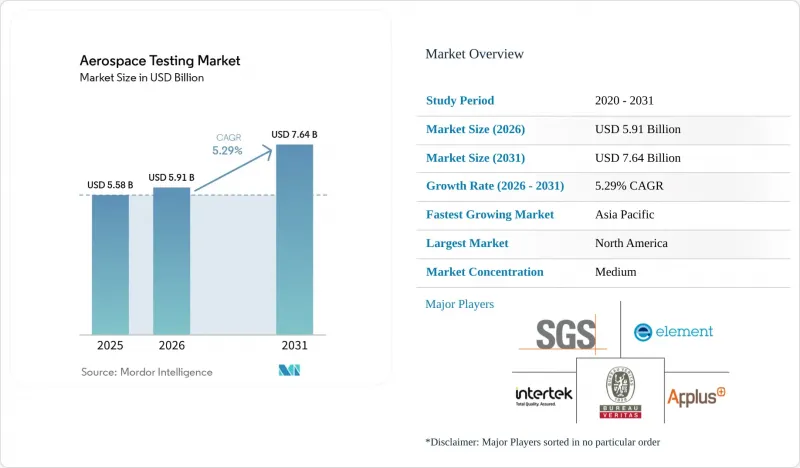
Mordor Intelligence에 의하면, 항공우주 시험 시장 규모는 2025년 55억 8,000만 달러로 평가되었고, 2026년에는 59억 1,000만 달러로 추정되고, 2026-2031년 CAGR 5.29%로 성장을 지속할 전망이며, 2031년까지 76억 4,000만 달러에 이를 것으로 예측됩니다.
본 보고서는 서비스 유형별(비파괴 검사, 환경 및 기후 시험, 구조 및 하중 시험 등), 구성 요소별(기체, 항공전자 및 전기 시스템, 추진 시스템 등), 시험 방법별(물리 시험, 가상 및 디지털 트윈 시험), 최종 사용자별(OEM, MRO 등), 지역별로 분류되어 있습니다. 시장 전망은 금액(달러) 기준으로 제시되어 있습니다.
세계의 항공우주 시험 시장 동향 및 인사이트
복합재료의 도입 가속화가 비파괴 검사(NDT) 수요를 끌어올리고 있습니다.
현재 787이나 A350과 같은 기종에서 복합재 구조의 비중은 공차 중량의 50%를 초과하고 있습니다. 또한, 적층재의 함유율이 높아짐에 따라 육안 검사로는 감지할 수 없는 새로운 파손 양상이 나타나고 있습니다. 자동 위상 배열 초음파 검사는 단일 소자 프로브에 비해 최대 27배 빠른 속도로 샌드위치 패널을 검사할 수 있으며, 적응형 평면파 이미징 기술을 통해 진폭 변동을 23.18dB에서 1.86dB로 줄임으로써 곡면 스파의 결함 감지 정확도가 향상되었습니다. 따라서 Tier 1 공급업체에게 복합재 비파괴 검사(NDT)의 Nadcap 인증은 필수적이지만, 레벨 3 검사원공급은 여전히 부족하여 리드타임이 길어지고 가격도 강세를 보이고 있습니다. OEM 업체들이 적층 및 경화 모니터링을 자동화하더라도, 복합재의 채택이 확대됨에 따라 인증 실험실의 높은 요금 수준은 유지될 것으로 예측됩니다. 이러한 추세가 맞물려, 중기적으로는 항공우주 시험 시장에서 첨단 비파괴 검사(NDT) 기술에 대한 수요가 지속될 것으로 보입니다.
위성 메가 콘스텔레이션의 급속한 확대
스타링크는 2025년까지 7,000기 이상의 위성을 운용했으며, 2030년까지 12,000기를 목표로 하고 있습니다. 한편, 프로젝트 카이퍼와 원웹은 합쳐서 4,000기 이상의 우주선을 추가로 계획하고 있습니다. 모든 위성은 ITU 및 FCC Part 25의 주파수 대역 규정을 준수해야 하므로, -150°C에서 +150°C에 이르는 열진공 시험과 EMI 스크리닝을 거쳐야 합니다. 시험실 대기 시간이 길어짐에 따라 주요 계약업체들은 자사 전용 시험 구역을 건설하고 있으며, Element와 같은 독립 기업들도 병목 현상을 해소하기 위해 연간 1만 5,000개의 시료를 처리할 수 있는 텍사스주 복합재료 센터를 신설했습니다. 또한, 버추얼 트윈도 점차 보급되면서 엔지니어들은 귀중한 하드웨어를 점유하지 않고도 안테나 패턴이나 열 경로의 반복 설계를 수행할 수 있게 되었습니다. 이러한 콘스텔레이션 붐은 우주 관련 환경 및 진동 서비스 분야에서 두 자릿수 성장을 견인할 것으로 전망됩니다.
환경 시험실 및 무반향실의 고액 설비 투자
3미터급 EMC 챔버의 가격은 15만-40만 달러이지만, 실물 크기의 온습도 및 진동 시험 장비는 100만 달러를 초과하기 때문에 신규 진입을 가로막고, 설비 확충 속도를 늦추고 있습니다. TUV SUD가 1,500만 유로(1,750만 달러)를 투자한 볼피아노 복합 시설은 Nadcap 인증 사이트에 필요한 투자 규모를 여실히 보여주고 있습니다. 시험실 조달에 12-18개월이 소요되는 리드타임은 단기적인 공급 부족을 초래하여 가격 상승으로 이어질 수 있습니다. 신흥 시장의 시험소들은 저비용 자금 조달 기회가 제한적이고 고객 기반이 집중되어 있어 가장 큰 어려움을 겪고 있습니다. 그 때문에 수요가 증가하고 있음에도 불구하고, 막대한 설비 투자가 성장을 저해하고 있습니다.
부문별 분석
항공우주 시험 시장에서 서비스 유형별로는 비파괴 검사(NDT)가 62.52%를 차지했습니다. 그러나 소프트웨어 및 시뮬레이션 서비스 시장은 연평균 5.93%의 성장률을 보이고 있으며, 이는 OEM 업체들이 프로토타입 제작에 착수하기 전에 설계를 가상으로 검증하려는 전략을 반영한 것입니다. Nadcap 및 규제 당국이 여전히 증명 하중 시험, 파괴 역학 시험편, 실제 환경 노출 시험을 요구하고 있기 때문에 물리적 비파괴 검사는 여전히 기본이 되고 있습니다. 그러나 현재 디지털 트윈에는 많은 초기 단계의 반복 과정이 포함되어 있어, 이를 통해 검사 기관은 범용 시험편 시험이 아닌 고부가가치 상관성 프로젝트를 통해 수익을 창출할 수 있게 되었습니다. GPU 클러스터와 진동 시험기를 모두 보유한 하이브리드 서비스 제공업체는 장기적이고 안정적인 계약을 확보하고 있습니다.
시뮬레이션 분야의 성장은 진입 장벽을 낮춤으로써 중소 공급업체의 진입 기회도 확대되고 있습니다. 클라우드 네이티브 플랫폼을 통해 2차 금속 성형 제조업체는 자본 집약적인 솔버 도입을 피할 수 있는 동시에, 1차 제조업체에는 표준화된 데이터 형식을 제공할 수 있습니다. 현재 주요 OEM의 40% 이상이 라이프사이클 트윈을 활용해 유지보수 요구 사항을 예측하고 있으며, 이는 예측 유지보수 및 상태 모니터링 테스트 서비스에 대한 수요 증가를 이끌고 있습니다. 그 결과, 인증 목적상 파괴 시험이 여전히 필수적임에도 불구하고, 서비스 구성은 구조적으로 가상 검증으로 전환되고 있습니다. 이러한 하이브리드 방식이 항공우주 시험 서비스의 미래를 만들어가고 있습니다.
2025년, 기체 구조 부문은 총매출의 37.19%를 차지했습니다. 그러나 수소 엔진, 하이브리드 전기 엔진, 초음속 엔진의 발전이 주목을 받는 가운데, 추진 시스템 시험 시장은 연평균 성장률(CAGR) 5.78%를 나타낼 것으로 예측되며, 가장 높은 성장률로 시장을 주도할 전망입니다. 정밀도가 요구되는 추진 시스템 프로그램에서는 영하 253℃의 극저온 환경에서의 취급, 고고도 연소기 시험 장치, 마하 5를 넘는 풍동 등이 활용되고 있으며, 이 모든 것에는 막대한 비용이 소요됩니다. 이러한 고도의 시험 요건은 차세대 추진 시스템의 신뢰성과 성능을 확보하는 데 필수적입니다. 동시에, 재료연구소에서는 세라믹 매트릭스 복합재와 적층 가공 티타늄 시험편에 주력하며, 고온 코어 부품의 인증 획득과 안정적인 기준치 유지를 위해 노력하고 있습니다. 이러한 노력은 현대 항공우주 분야의 극한 환경을 견딜 수 있는 소재에 대한 수요 증가에 대응하기 위해 필수적입니다.
플라이 바이 와이어(Fly-by-Wire) 시스템의 개량 및 엄격한 사이버 보안 요건에 따라 항공전자 장비 시험이 증가하고 있습니다. 플라이 바이 와이어 시스템의 도입 확대는 항공기의 성능과 안전성을 향상시키는 한편, 사이버 보안 대책은 디지털 항공전자 시스템에 수반되는 증가하는 위험에 대처하기 위한 것입니다. 동시에, 복합재료의 인증 역시 여전히 매우 중요합니다. 새로운 수지나 섬유 유형이 도입될 때마다 열적 특성, 가연성, 피로 특성에 대한 철저한 검증이 필요합니다. 이러한 엄격한 인증 절차는 안전 기준 준수를 보장할 뿐만 아니라, 더 가볍고 효율적인 항공기 개발을 뒷받침하고 있습니다. 전반적으로, 추진 시스템의 복잡한 특성과 규제 당국의 강화된 감독이 엔진 시험 설비에 대한 투자를 촉진하고 있으며, 이는 항공우주 시험 시장을 다음 성장 단계로 이끌고 있습니다. 이러한 투자는 혁신을 촉진하고 항공우주 산업의 변화하는 요구를 뒷받침할 것으로 기대됩니다.
지역별 분석
북미는 OEM 본사의 견고한 네트워크, NASA 시설, 그리고 200개가 넘는 Nadcap 인증 실험소의 지원을 바탕으로 2025년 매출의 46.47%를 차지했습니다. 앨라배마주에 건설된 록히드 마틴의 1,710만 달러 규모 '초음속 시스템 통합 연구소'와 같은 투자는 기밀 처리된 일정에 따른 위험을 줄이는 동시에, 제3자 시험을 위한 상업적 기회를 개척하는 것을 목표로 하고 있습니다. 이 분야는 성숙기에 접어들었으며, 메가 콘스텔레이션의 페이로드와 수소 엔진이 한정된 진공 및 극저온 시험 베이를 놓고 경쟁하는 가운데 수요가 증가하고 있습니다. 이러한 경쟁으로 인해 실험실 대기 시간이 길어지고 있으며, 높아지는 요구 사항을 충족하기 위해 용량을 확대해야 할 필요성이 부각되고 있습니다. 북미는 선진적인 시험 인프라와 혁신의 중요한 거점으로 자리매김하고 있습니다.
아시아태평양은 가장 빠르게 성장하고 있는 지역으로, 2031년까지 연평균 성장률(CAGR)이 5.84%를 나타낼 것으로 전망됩니다. 이는 중국의 C919 기종 인증 비행과 인도의 2031년까지 AMCA 시제기 5대 개발과 같은 노력에 힘입은 것입니다. 이 지역의 각국 정부는 공급망 효율화를 도모하고 현지 전문 인력을 양성하기 위해, 싱가포르의 엔진 MRO(정비·수리·오버홀) 시설 확장이나 한국의 사천 복합 시설 등 시험 거점에 대한 공동 투자를 적극적으로 추진하고 있습니다. 롤스로이스의 '펄 10X' 프로그램에 부품을 공급하는 바라트 포지(Barat Forge)의 링 압연 공장에서 볼 수 있듯이, 2차 공급업체들은 밸류체인의 업스트림로 진출하고 있습니다. 이러한 움직임은 세계 시험 시장에서 해당 지역의 주요 주자로서의 입지를 확고히 하고 있습니다. 아시아태평양의 성장은 외부 시장에 대한 의존도를 낮추는 데 주력하고 있다는 점도 또 다른 원동력이 되고 있습니다.
유럽은 EASA의 규제 체계 하에서 운영되는 에어버스, 롤스로이스, 사프란의 확고한 생태계를 통해 여전히 막강한 영향력을 유지하고 있습니다. 6,400만 유로(7,451만 달러) 규모의 'UltraFan 30' 보조금은 친환경 추진 시스템 테스트베드에 대한 강력한 제도적 지원을 보여주는 반면, TUV SUD가 1,500만 유로(1,746만 달러)를 투자한 볼피아노 연구소는 독립 기업이 OEM의 투자와 협력하고 있음을 반영하고 있습니다. 남미, 중동 및 아프리카의 신흥 클러스터도 성장세를 보이고 있으며, 자유무역지대의 MRO 파크와 현지화된 비파괴 검사(NDT) 서비스에 주력하고 있습니다. 이러한 지역은 규제 장벽이 낮고 비용 면에서 우위를 점하고 있어, 가격에 민감한 프로젝트를 유치하고 시험 역량의 성장을 가속하고 있습니다. 그린 테크놀러지 및 혁신 분야에서 유럽의 리더십은 여전히 세계 시장에서 중요한 차별화 요소로 작용하고 있습니다.
기타 혜택 :
- 엑셀 형식 시장 예측(ME) 시트
- 3개월간의 애널리스트 지원
자주 묻는 질문
목차
제1장 서론
제2장 조사 방법
제3장 주요 요약
제4장 시장 구도
제5장 시장 규모 및 성장 예측
제6장 경쟁 구도
제7장 시장 기회 및 향후 전망
AJY 26.06.22According to Mordor Intelligence, the aerospace testing market size is expected to grow from USD 5.58 billion in 2025 to USD 5.91 billion in 2026 and is forecast to reach USD 7.64 billion by 2031 at a 5.29% CAGR over 2026-2031.
This report is Segmented by Service Type (Non-Destructive Testing, Environmental and Climatic Testing, Structural and Load Testing, and More), Component (Airframe, Avionics and Electrical Systems, Propulsion Systems, and More), Testing Method (Physical Testing, and Virtual, Digital-Twin Testing), End-User (OEMs, Mros, and More), and Geography. The Market Forecasts are Provided in Terms of Value (USD).
Global Aerospace Testing Market Trends and Insights
Accelerating Composites Adoption Elevates NDT Demand
Composite structures now exceed 50% of the empty weight on platforms such as the 787 and A350, and higher laminate content introduces failure modes that visual inspection cannot catch.Automated phased-array ultrasonics screen sandwich panels up to 27 times faster than single-element probes, while adaptive plane-wave imaging cuts amplitude variation from 23.18 dB to 1.86 dB, improving defect detection in curved spars. Nadcap accreditation for composite NDT has therefore become mandatory for Tier-1 suppliers, but the pipeline for Level 3 inspectors remains tight, extending lead times and keeping prices firm. Rising composite penetration is expected to uphold premium rates for accredited labs even as OEMs automate lay-up and cure monitoring. These dynamics jointly sustain the aerospace testing market's appetite for advanced NDT capacity through the medium term.
Rapid Ramp-Up of Satellite Megaconstellations
Starlink operated more than 7,000 satellites by 2025 and targets 12,000 before 2030, while Project Kuiper and OneWeb together plan another 4,000-plus spacecraft. Every satellite requires thermal-vacuum testing from -150 °C to +150 °C and EMI screening to comply with ITU and FCC Part 25 spectrum rules. Chamber queues are lengthening; consequently, prime contractors are building captive test bays, and independents such as Element have added a Texas composites center designed to handle 15,000 samples a year to relieve bottlenecks. Virtual twins are also gaining traction, allowing engineers to iterate on antenna patterns or thermal paths without tying up scarce hardware. This constellation boom is set to anchor double-digit growth for space-related environmental and vibration services.
High Capex for Environmental and Anechoic Chambers
A 3-meter EMC chamber costs USD 150,000-400,000, while full-scale temperature-humidity-vibration rigs exceed USD 1 million, deterring new entrants and slowing capacity expansion. TUV SUD's EUR 15 million (USD 17.5 million) Volpiano complex underscores the investment needed for Nadcap-ready sites. Lead times of 12-18 months to source chambers can create short-term supply squeezes, leading to higher pricing. Emerging-market labs struggle most due to limited access to low-cost capital and concentrated customer bases. High capex thus tempers growth even as demand climbs.
Other drivers and restraints analyzed in the detailed report include:
- Stricter ICAO and FAA Sustainability, NOx Rules
- Digital-Twin Validation Cuts Physical Test Cycles
- Shortage of AS9100-Certified Testing Talent
For complete list of drivers and restraints, kindly check the Table Of Contents.
Segment Analysis
The aerospace testing market service type, non-destructive testing (NDT), accounted for 62.52%. However, software and simulation services are advancing 5.93% annually, reflecting OEM strategies to validate designs virtually before committing to prototypes. Physical NDT remains fundamental because Nadcap and regulators still demand proof loads, fracture mechanics coupons, and real-environment exposure. Yet digital twins now incorporate many early iterations, allowing labs to monetize high-value correlation projects rather than commodity coupon runs. Hybrid providers that host both GPU clusters and vibration shakers are capturing sticky, multi-year contracts.
Growth in simulation is also widening access for smaller suppliers by reducing barriers to entry. Cloud-native platforms enable Tier-2 metal formers to avoid capital-intensive solvers while providing primes with standardized data formats. Over 40% of major OEMs now use lifecycle twins to forecast maintenance requirements, driving increased demand for prognostics and health management test services. Consequently, the service-type mix is shifting structurally toward virtual validation, even as destructive testing remains essential for certification purposes. This hybrid approach is shaping the future of aerospace testing services.
In 2025, airframe structures accounted for 37.19% of total revenue. However, as advancements in hydrogen, hybrid-electric, and hypersonic engines take center stage, propulsion testing is poised to lead with the fastest growth rate, projected at 5.78% CAGR. Propulsion programs, demanding precision, utilize cryogenic handling at a frigid -253 °C, high-altitude combustor rigs, and wind tunnels exceeding Mach 5, all commanding premium prices. These advanced testing requirements are critical for ensuring the reliability and performance of next-generation propulsion systems. Concurrently, materials labs are focused on ceramic matrix composites and additive titanium coupons, working to qualify higher-temperature cores and maintain a steady baseline. These efforts are essential to meet the increasing demand for materials capable of withstanding extreme conditions in modern aerospace applications.
Avionics testing is on the rise, driven by fly-by-wire retrofits and stringent cybersecurity mandates. The growing adoption of fly-by-wire systems enhances aircraft performance and safety, while cybersecurity measures address the increasing risks associated with digital avionics systems. At the same time, qualifying composite materials remains crucial; every new resin or fiber variant necessitates thorough evidence of thermal, flammability, and fatigue properties. This rigorous qualification process ensures compliance with safety standards and supports the development of lighter, more efficient aircraft. Collectively, the intricate nature of propulsion and its heightened regulatory scrutiny are steering capital investments towards engine test cells, propelling the aerospace testing market into its next growth phase. These investments are expected to drive innovation and support the evolving needs of the aerospace industry.
Geography Analysis
North America contributed 46.47% of 2025 revenue, driven by a robust network of OEM headquarters, NASA facilities, and over 200 Nadcap-accredited labs. Investments like Lockheed Martin's USD 17.1 million Hypersonic System Integration Lab in Alabama aim to mitigate risks in classified schedules while opening up commercial slots for third-party testing. Despite its maturity, the region faces increasing demand as megaconstellation payloads and hydrogen engines compete for limited vacuum and cryogenic testing bays. This competition has led to longer chamber queues, highlighting the need for expanded capacity to meet growing requirements. North America remains a critical hub for advanced testing infrastructure and innovation.
Asia-Pacific is the fastest-growing region, with a projected CAGR of 5.84% through 2031, supported by initiatives such as China's C919 certification flights and India's development of five AMCA prototypes by 2031. Governments in the region are actively co-funding test hubs, including Singapore's engine MRO expansions and South Korea's Sacheon complex, to enhance supply chain efficiency and develop local expertise. Tier-2 suppliers are moving up the value chain, as seen with Bharat Forge's ring-rolling plant, which will supply components for Rolls-Royce's Pearl 10X programs. These developments are solidifying the region's position as a key player in the global testing market. Asia-Pacific's growth is further fueled by its focus on reducing dependency on external markets.
Europe continues to hold significant influence through its established Airbus, Rolls-Royce, and Safran ecosystems, operating under EASA's regulatory framework. The EUR 64 million (USD 74.51 million) UltraFan 30 grant demonstrates strong institutional support for green propulsion testbeds, while TUV SUD's EUR 15 million (USD 17.46 million) Volpiano lab reflects independent players aligning with OEM investments. Emerging clusters in South America, the Middle East, and Africa are also gaining traction, focusing on free-zone MRO parks and localized NDT services. These regions benefit from lower regulatory barriers and cost advantages, attracting price-sensitive projects and fostering growth in their testing capabilities. Europe's leadership in green technology and innovation remains a key differentiator in the global market.
- SGS SA
- Bureau Veritas SA
- Intertek Group plc
- Element Materials Technology
- Applus+ Laboratories
- TUV SUD AG
- National Technical Systems Inc.
- Mistras Group Inc.
- Dayton T. Brown Inc.
- IABG mbH
- DNV AS
- TUV Rheinland AG
- Eurofins Scientific SE
- L3Harris Environmental Test Labs
- Lockheed Martin Test Labs
- Boeing Test & Evaluation
- Airbus Defence & Space Structural Test Centre
- Northrop Grumman Structural Testing Services
- Rolls-Royce Testing & Development
- Safran Engineering Services
Additional Benefits:
- The market estimate (ME) sheet in Excel format
- 3 months of analyst support
TABLE OF CONTENTS
1 INTRODUCTION
- 1.1 Study Assumptions and Market Definition
- 1.2 Scope of the Study
2 RESEARCH METHODOLOGY
3 EXECUTIVE SUMMARY
4 MARKET LANDSCAPE
- 4.1 Market Overview
- 4.2 Market Drivers
- 4.2.1 Accelerating Composites Adoption Elevates NDT Demand
- 4.2.2 Rapid Ramp-Up of Satellite Megaconstellations
- 4.2.3 Stricter ICAO and FAA Sustainability, NOx Rules
- 4.2.4 Digital-Twin Validation Cuts Physical Test Cycles
- 4.2.5 Hypersonic Flight Programs Across Major Powers
- 4.2.6 AI-Driven Conformity Analytics Reduces Retest Rates
- 4.3 Market Restraints
- 4.3.1 High Capex for Environmental and Anechoic Chambers
- 4.3.2 Shortage of AS9100-Certified Testing Talent
- 4.3.3 Data-Ownership Conflicts in OEM-Lab Partnerships
- 4.3.4 Cryogenic Hydrogen Safety Protocol Complexity
- 4.4 Industry Value-Chain Analysis
- 4.5 Regulatory Landscape
- 4.6 Technological Outlook
- 4.7 Impact of Macroeconomic Factors on the Market
- 4.8 Porter's Five Forces Analysis
- 4.8.1 Threat of New Entrants
- 4.8.2 Bargaining Power of Suppliers
- 4.8.3 Bargaining Power of Buyers
- 4.8.4 Threat of Substitutes
- 4.8.5 Competitive Rivalry
5 MARKET SIZE AND GROWTH FORECASTS (VALUE)
- 5.1 By Service Type
- 5.1.1 Non-Destructive Testing
- 5.1.2 Environmental and Climatic Testing
- 5.1.3 Structural and Load Testing
- 5.1.4 Vibration and Acoustic Testing
- 5.1.5 EMI / EMC Testing
- 5.1.6 Software and Simulation-Based Testing
- 5.2 By Component Tested
- 5.2.1 Airframe
- 5.2.2 Avionics and Electrical Systems
- 5.2.3 Propulsion Systems
- 5.2.4 Materials and Composites
- 5.3 By Testing Method
- 5.3.1 Physical Testing
- 5.3.2 Virtual, Digital-Twin Testing
- 5.4 By End-User
- 5.4.1 OEMs
- 5.4.2 MROs
- 5.4.3 Independent Test Labs and Certification Bodies
- 5.5 By Geography
- 5.5.1 North America
- 5.5.1.1 United States
- 5.5.1.2 Canada
- 5.5.1.3 Mexico
- 5.5.2 South America
- 5.5.2.1 Brazil
- 5.5.2.2 Argentina
- 5.5.2.3 Rest of South America
- 5.5.3 Europe
- 5.5.3.1 Germany
- 5.5.3.2 France
- 5.5.3.3 United Kingdom
- 5.5.3.4 Rest of Europe
- 5.5.4 Asia-Pacific
- 5.5.4.1 China
- 5.5.4.2 Japan
- 5.5.4.3 India
- 5.5.4.4 Rest of Asia-Pacific
- 5.5.5 Middle East
- 5.5.5.1 Saudi Arabia
- 5.5.5.2 United Arab Emirates
- 5.5.5.3 Turkey
- 5.5.5.4 Rest of Middle East
- 5.5.6 Africa
- 5.5.6.1 South Africa
- 5.5.6.2 Egypt
- 5.5.6.3 Rest of Africa
- 5.5.1 North America
6 COMPETITIVE LANDSCAPE
- 6.1 Market Concentration
- 6.2 Strategic Moves
- 6.3 Market Share Analysis
- 6.4 Company Profiles (includes Global Level Overview, Market Level Overview, Core Segments, Financials as available, Strategic Information, Market Rank/Share, Products and Services, Recent Developments)
- 6.4.1 SGS SA
- 6.4.2 Bureau Veritas SA
- 6.4.3 Intertek Group plc
- 6.4.4 Element Materials Technology
- 6.4.5 Applus+ Laboratories
- 6.4.6 TUV SUD AG
- 6.4.7 National Technical Systems Inc.
- 6.4.8 Mistras Group Inc.
- 6.4.9 Dayton T. Brown Inc.
- 6.4.10 IABG mbH
- 6.4.11 DNV AS
- 6.4.12 TUV Rheinland AG
- 6.4.13 Eurofins Scientific SE
- 6.4.14 L3Harris Environmental Test Labs
- 6.4.15 Lockheed Martin Test Labs
- 6.4.16 Boeing Test & Evaluation
- 6.4.17 Airbus Defence & Space Structural Test Centre
- 6.4.18 Northrop Grumman Structural Testing Services
- 6.4.19 Rolls-Royce Testing & Development
- 6.4.20 Safran Engineering Services
7 MARKET OPPORTUNITIES AND FUTURE OUTLOOK
- 7.1 White-Space and Unmet-Need Assessment


