
|
시장보고서
상품코드
2062449
가격 최적화 소프트웨어 시장 : 시장 점유율 분석, 업계 동향 및 통계, 성장 예측(2026-2031년)Price Optimization Software - Market Share Analysis, Industry Trends & Statistics, Growth Forecasts (2026 - 2031) |
||||||
 Mordor Intelligence
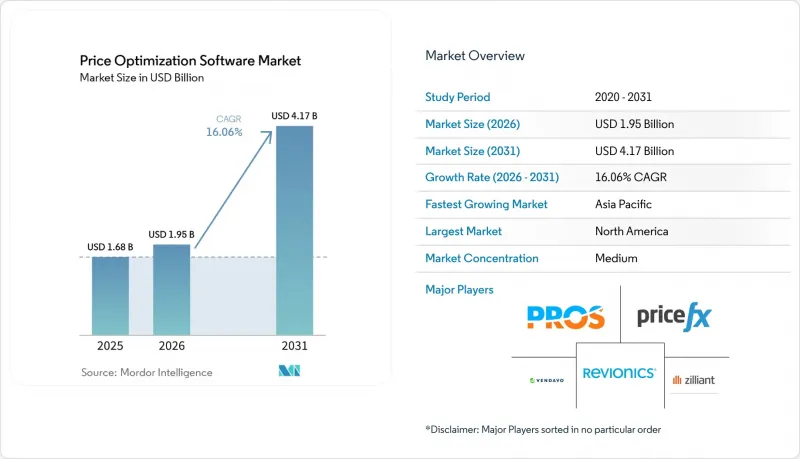
Mordor Intelligence에 의하면, 가격 최적화 소프트웨어 시장 규모는 2025년 16억 8,000만 달러로 평가되었고, 2026년 19억 5,000만 달러로 추정되고, 2031년까지 41억 7,000만 달러로 확대될 전망이며, 2026-2031년 연평균 복합 성장률(CAGR)은 16.06%를 나타낼 것으로 예측됩니다.
본 보고서는 도입 모델별(클라우드, 온프레미스, 하이브리드), 최종 이용 산업별(소매 및 전자상거래, 제조업 등), 가격 전략 유형별(AI 기반 동적 가격 책정 등), 조직 규모별(대기업, 중소기업) 및 지역별(북미, 유럽, 아시아태평양 등)로 분류되어 있습니다. 시장 전망은 금액(달러) 기준으로 제시되어 있습니다.
세계의 가격 최적화 소프트웨어 시장 동향 및 인사이트
AI를 활용한 실시간 동적 가격 책정이 옴니채널 소매의 성장을 가속화합니다.
소매업체들은 현재 경쟁사의 가격, 재고 수준, 일기 예보 및 마이크로 행동 신호를 반영하는 머신러닝 모델을 활용해 하루에도 여러 번 가격을 조정하고 있습니다. 월마트는 2026년 3월, 매장 가격과 온라인 가격을 동시에 변경하는 신경망 시스템에 관한 특허를 출원했습니다. 한편, 크로거는 기존 매장 매출이 정체된 상황임에도 불구하고, AI를 활용한 가격 책정이 매출 총이익률을 끌어올렸다고 밝혔습니다. Feedvisor의 보고서에 따르면, 아마존과 월마트의 마켓플레이스에서는 연간 4,600만 건 이상의 가격 업데이트가 이루어지고 있으며, 지속적인 최적화가 주 단위의 규칙 기반 변경보다 더 우수한 성과를 내고 있음이 입증되었습니다. 강화 학습 엔진은 현재, 기기별 장바구니 포기 경향 등 스프레드시트로는 파악할 수 없는 비선형 가격 탄력성을 밝혀내고 있습니다. 전자 가격표와 마켓플레이스의 상품 목록을 동기화함으로써, 쇼루밍을 통한 차익 거래를 방지하고, 채널 전반에 걸쳐 브랜드 일관성을 유지할 수 있습니다.
클라우드 네이티브 SaaS 모델이 총 소유 비용을 절감하고 도입을 가속화합니다.
구독형 서비스 제공으로 인해 설비 투자나 전용 인프라가 필요 없어졌으며, 포춘 500대 기업 이외의 기업들도 가격 최적화 소프트웨어 시장에 진입하기가 쉬워졌습니다. 2026년 1월에 출시된 Pricefx Copilot은 사전 구축된 API를 통해 SAP, Salesforce, Microsoft Dynamics와 통합되어, 도입 기간을 8-12주로 단축하고 온프레미스 구축 대비 총 소유 비용을 약 40% 절감합니다. Zilliant가 2025년 11월에 발표한 'Pricing Plus'는 가격 최적화, 거래 지침, CPQ를 단일 라이선스로 통합하여 중견 제조업체가 전문 분석가를 고용할 필요가 없도록 합니다. Vendavo가 2026년 4월에 출시한 'AI Pricing Assistant'는 SAP Business Technology Platform을 기반으로 하며, SAP를 핵심 시스템으로 사용하는 기업에게 업그레이드 시 안전한 연결성을 보장합니다. 각 벤더사는 고급 AI 기능을 SaaS 플랜으로 한정해 제공하고 있으며, 이로 인해 클라우드로의 전환이 더욱 가속화되고 있습니다.
마스터 데이터의 낮은 품질과 사일로화된 시스템이 ROI를 저해하고 있습니다.
가격 책정 모델은 상세한 비용, 경쟁사 및 고객 데이터에 의존하지만, 많은 기업에서는 제품, 고객, 할인 정보를 호환되지 않는 ERP나 CRM 시스템이라는 고립된 데이터 저장소에 분산하여 보관하고 있습니다. 연방거래위원회(FTC)가 2025년 1월에 실시한 가격 모니터링 조사에 따르면, 중개업체들은 불완전한 피드를 수동으로 조정해야 하는 경우가 많아 자동화가 가져다주는 속도상의 이점이 상실되고 있는 것으로 나타났습니다. Model N의 조사에 따르면, 경영진의 85%가 가치 실현의 가장 큰 장애물로 데이터 품질을 꼽았습니다. SKU별 원가, 리베이트 조정 후의 수익성 또는 지역별 경쟁사 가격 정보가 누락된 경우, 도입 기간이 최대 6개월까지 연장될 수 있으며, 조직 내에서 종종 부족한 부서 간 거버넌스가 필요하게 됩니다.
부문별 분석
2025년 기준으로 가격 최적화 소프트웨어 시장의 63.7%를 클라우드 도입이 차지하고 있으며, 이 부문은 2031년까지 연평균 성장률(CAGR) 17.1%를 나타낼 것으로 예측됩니다. 가격 최적화 소프트웨어 시장 규모 면에서 우위를 점하고 있는 것은 구독 경제, 자동 업그레이드, 그리고 온프레미스 하드웨어 없이도 생성형 AI 모듈을 배포할 수 있는 능력 덕분입니다. 벤더는 SaaS 라이선스를 통해 최첨단 기능을 단계적으로 제공하고 있으며, 온프레미스 환경에서 동등한 기능을 구현하려면 비용이 너무 많이 듭니다.
하이브리드 아키텍처에서는 기밀 데이터를 사내 서버에 보관하면서 클라우드에서 머신러닝 훈련을 수행할 수 있으며, Vendavo는 SAP Business Technology Platform을 통해 이러한 방식을 지원합니다. 방위 분야나 규제가 엄격한 금융 분야에서는 온프레미스 도입이 지속될 전망이지만, 유럽 및 아시아태평양의 소버린 클라우드 확대로 인해 데이터 소재지에 대한 우려는 점차 완화되고 있습니다. 이러한 추세가 맞물려 가격 최적화 소프트웨어 시장에서 클라우드의 점유율 확대를 뒷받침하고 있습니다.
AI 기반 동적 엔진은 2025년 시장 규모의 47.4%를 차지했으며, 이는 소매업체와 마켓플레이스에서 강화 학습 접근 방식의 도입을 반영한 것입니다. 그러나 이익률의 하한선이나 규제로 인한 상한선이 존재하는 분야에서는 알고리즘이 가격 탄력성을 모색하는 과정에서 규정 준수를 보장하기 위해 규칙 기반의 안전장치가 여전히 필수적입니다. 사용량 기반 및 구독-하이브리드형 접근 방식은 연평균 성장률(CAGR) 17.9%로 가장 빠른 성장세를 보일 것으로 예상되며, 이는 공급업체들이 수익을 실제 사용 현황에 연동시키는 구조적 변화를 보여줍니다.
사용량 기반 과금과 연계된 가격 최적화 소프트웨어 시장 규모는 SaaS 및 API 사업자들이 정액제 라이선스에서 사용량 기반 모델로 전환함에 따라 확대될 것입니다. 월마트의 특허는 신경망 기반 예측과 엄격한 제약 조건을 결합하고 있으며, 이는 모범 사례 아키텍처가 AI의 민첩성과 비즈니스 규칙을 조화시키고 있음을 보여줍니다. 하이브리드 거버넌스 프레임워크를 통해 B2B 제조업체는 협상된 계약 조건을 준수하면서도 예측 지침을 활용할 수 있어, 신뢰를 유지하면서 실현 이익률을 높일 수 있습니다.
지역별 분석
북미는 2025년 매출의 36.6%를 차지했으며, 조기 도입과 주요 공급업체의 존재에 힘입어 성장하고 있습니다. PROS는 2025년 3분기에 7,600만 달러의 구독 수익을 기록했으며, 이는 해당 지역이 SaaS에 집중하고 있음을 보여줍니다. 연방거래위원회(FTC)와 법무부의 알고리즘을 활용한 임대료 조정 및 가격 감시 관련 조사가 규정 준수 비용을 증가시키고 있어, 공급업체들은 설명 가능성과 감사 추적을 시스템에 반영해야 하는 상황에 직면해 있습니다. 규제상의 마찰이 있음에도 불구하고, AI 및 클라우드 인프라에 대한 지속적인 투자를 통해 미국은 가격 최적화 소프트웨어 시장의 혁신 중심지로서의 위치를 유지하고 있습니다.
유럽에서는 활발한 수요와 엄격한 거버넌스가 공존하고 있습니다. 유럽연합 집행위원회는 2025년 7월, 여러 카르텔 조사 건이 알고리즘 가격 책정과 관련이 있음을 확인했으며, 영국 경쟁시장청(CMA)은 디지털 분야의 담합을 감시하기 위해 새로운 수석 기술관을 임명했습니다. 동시에, EU의 탄소국경조정메커니즘(CBAM)은 탄소 비용을 포함한 도착 비용을 산출하는 공급업체들에게 새로운 활용 사례를 창출하고 있습니다. 탄소 조정 기능을 갖춘 투명성이 높고 감사 가능한 모델을 제공하는 업체들은 EU 내에서 경쟁 우위를 확보하고 있습니다. 소버린 클라우드 도입과 데이터 현지화 프레임워크 덕분에 SaaS 도입에 대한 우려가 완화되면서, 점차 퍼블릭 클라우드 도입이 주류로 자리 잡고 있습니다.
아시아태평양은 가장 빠르게 성장하고 있으며, 2031년까지 연평균 성장률(CAGR) 16.9%로 확대될 것으로 전망됩니다. 중국과 인도의 전자상거래 플랫폼들은 치열한 마켓플레이스 경쟁에 대응하기 위해 1시간에 수차례 가격을 갱신하고 있으며, 이것이 강화 학습 엔진에 대한 수요를 견인하고 있습니다. 일본, 한국 및 아세안(ASEAN)의 제조업체들은 전 세계 판매 채널과 급변하는 원자재 비용을 관리하기 위해 가격 최적화 전략을 도입하고 있습니다. 중국의 '개인정보보호법' 등 데이터 보호 제도에 따라 투명성 확보 의무가 발생하고 있지만, 유럽의 기준만큼 규제가 엄격하지는 않아 공급업체에게는 급속한 사업 확장의 여지가 남아 있습니다. 동남아시아의 신흥 경제국들과 국경을 초월한 시장 확대가 맞물리면서, 이 지역은 가격 최적화 소프트웨어 시장에서 가장 큰 성장 동력으로서의 입지를 확고히 하고 있습니다.
기타 혜택 :
- 엑셀 형식 시장 예측(ME) 시트
- 3개월간의 애널리스트 지원
자주 묻는 질문
목차
제1장 서론
제2장 조사 방법
제3장 주요 요약
제4장 시장 구도
제5장 시장 규모 및 성장 예측
제6장 경쟁 구도
제7장 시장 기회 및 향후 전망
AJY 26.06.22According to Mordor Intelligence, the price optimization software market size is projected to expand from USD 1.68 billion in 2025 and USD 1.95 billion in 2026 to USD 4.17 billion by 2031, registering a CAGR of 16.06% between 2026 and 2031.
This report is Segmented by Deployment Model (Cloud, On-Premise, Hybrid), End-Use Industry (Retail and ECommerce, Manufacturing, and More), Pricing Strategy Type (AI-Driven Dynamic Pricing, and More), Organization Size (Large Enterprises, Small and Medium Enterprises), and Geography (North America, Europe, Asia-Pacific, and More). The Market Forecasts are Provided in Terms of Value (USD).
Global Price Optimization Software Market Trends and Insights
AI-Powered Real-Time Dynamic Pricing Accelerates Omnichannel Retail Growth
Retailers now run machine-learning models that ingest competitor prices, inventory levels, weather forecasts, and micro-behavioral signals to adjust prices many times per day. Walmart filed a March 2026 patent describing neural-network systems that change shelf and online prices simultaneously, while Kroger disclosed that AI pricing lifted gross margin even though same-store sales were flat. Feedvisor reports more than 46 million price updates annually on Amazon and Walmart marketplaces, proving that continuous optimization outperforms weekly rule-based changes. Reinforcement-learning engines now surface non-linear elasticities, such as device-specific cart-abandonment tendencies, that spreadsheets cannot detect. Synchronizing electronic shelf labels with marketplace listings prevents showrooming arbitrage and protects brand integrity across channels.
Cloud-Native SaaS Models Slash Total Cost of Ownership and Speed Implementations
Subscription delivery eliminates capital expenditure and dedicated infrastructure, making the price optimization software market accessible to firms beyond the Fortune 500. Pricefx Copilot, launched in January 2026, integrates with SAP, Salesforce, and Microsoft Dynamics via pre-built APIs, cutting deployment time to 8-12 weeks and reducing lifetime ownership costs by around 40% compared with on-premise builds. Zilliant's November 2025 Pricing Plus bundles optimization, deal guidance, and CPQ into a single license, letting mid-market manufacturers avoid hiring specialist analysts. Vendavo's AI Pricing Assistant, released April 2026, rides SAP Business Technology Platform, ensuring upgrade-safe connectivity for SAP-centric enterprises. Vendors reserve advanced AI only for SaaS tiers, further tipping adoption toward cloud.
Poor Master-Data Quality and Siloed Systems Hinder ROI
Pricing models rely on granular cost, competitor, and customer data, yet many firms store products, customers, and discounts in incompatible ERP and CRM silos. The Federal Trade Commission's January 2025 surveillance-pricing study found that intermediaries must often reconcile incomplete feeds manually, eroding the speed advantage of automation. Model N surveys show 85% of executives cite data quality as the top barrier to value realization. Missing SKU-level costs, rebate-adjusted profitability, or localized competitor prices can extend implementation timelines by up to six months and require cross-functional governance that organizations frequently lack.
Other drivers and restraints analyzed in the detailed report include:
- Inflationary Margin Pressure Makes Algorithmic Pricing a Board Priority
- End-to-End CPQ and eCommerce Integration Unlocks Revenue Synergies
- Cultural Resistance to Algorithmic Price Changes Slows Deployment
For complete list of drivers and restraints, kindly check the Table Of Contents.
Segment Analysis
Cloud deployments held 63.7% of the price optimization software market share in 2025, and the segment is expected to grow at a 17.1% CAGR through 2031. The price optimization software market size advantage originates from subscription economics, automatic upgrades, and the ability to roll out generative AI modules without on-premise hardware. Vendors increasingly gate-cutting-edge functions behind SaaS licenses, making parity in on-premise environments cost-prohibitive.
Hybrid architectures preserve sensitive data on private servers while running machine-learning training in the cloud, a pattern Vendavo supports via SAP Business Technology Platform. On-premise installations will persist in defense and highly regulated finance, but sovereign-cloud expansions in Europe and Asia-Pacific are softening data-residency objections. Collectively, these trends fortify the cloud's pathway to an even larger share of the price optimization software market.
AI-driven dynamic engines commanded 47.4% of the 2025 value, reflecting retailer and marketplace adoption of reinforcement-learning approaches. However, rule-based guardrails remain essential in sectors with margin floors or regulatory ceilings, ensuring compliance while algorithms explore elasticities. Usage-based and subscription-hybrid approaches are projected to post the fastest expansion at 17.9% CAGR, signaling a structural shift as vendors align revenue with actual utilization.
The price optimization software market size tied to usage billing will grow as more SaaS and API businesses migrate from flat-fee licenses to consumption-based models. Walmart's patent blends neural forecasts with hard constraints, highlighting that best-practice architectures merge AI agility with business rules. Hybrid governance frameworks allow B2B manufacturers to leverage predictive guidance while respecting negotiated contract limits, maintaining trust while boosting realized margins.
Geography Analysis
North America contributed 36.6% of 2025 revenue, sustained by early adoption and the presence of leading vendors. PROS reported USD 76 million in subscription revenue during Q3 2025, underscoring the region's tilt to SaaS pros.com. Federal Trade Commission and Department of Justice investigations into algorithmic rent coordination and surveillance pricing are increasing compliance costs, forcing vendors to embed explainability and audit trails. Despite regulatory friction, continuous investment in AI and cloud infrastructure keeps the United States an innovation nucleus for the price optimization software market.
Europe combines strong demand with stringent governance. The European Commission confirmed in July 2025 that multiple cartel probes involve algorithmic pricing, and the UK Competition and Markets Authority has added a chief technologist to police digital coordination. Simultaneously, the EU Carbon Border Adjustment Mechanism creates fresh use cases for suppliers calculating carbon-inclusive landed costs. Vendors offering transparent, auditable models with carbon adjustments gain a competitive foothold across the bloc. Sovereign-cloud rollouts and data-localization frameworks are tempering objections to SaaS adoption, gradually tipping more deals toward public-cloud deployment.
Asia-Pacific is the fastest growing, forecast to expand at a 16.9% CAGR through 2031. E-commerce platforms in China and India update prices several times per hour to manage intense marketplace competition, driving demand for reinforcement-learning engines. Japan, South Korea, and ASEAN manufacturers deploy price optimization to manage global channels and volatile input costs. While data-protection regimes such as China's Personal Information Protection Law introduce transparency obligations, they remain less restrictive than European standards, giving vendors latitude to scale rapidly. Emerging economies in Southeast Asia, coupled with cross-border marketplace expansion, position the territory as the foremost growth engine for the price optimization software market.
- PROS Holdings, Inc.
- Pricefx AG
- Vendavo, Inc.
- Zilliant, Inc.
- Revionics LLC
- Competera Limited
- Vistaar Technologies, Inc.
- Omnia Retail B.V.
- Quicklizard Ltd.
- Feedvisor Ltd.
- Open Pricer SAS
- Perfect Price Inc.
- Periscope by McKinsey & Company, Inc.
- Model N, Inc.
- Aptos LLC (Revionics Division)
- IBM Corporation (Watson Dynamic Pricing)
- SAP SE (Price Management Module)
- SPOSEA B.V.
- Navetti AB (part of Vendavo)
- Yieldigo a.s.
Additional Benefits:
- The market estimate (ME) sheet in Excel format
- 3 months of analyst support
TABLE OF CONTENTS
1 INTRODUCTION
- 1.1 Study Assumptions and Market Definition
- 1.2 Scope of the Study
2 RESEARCH METHODOLOGY
3 EXECUTIVE SUMMARY
4 MARKET LANDSCAPE
- 4.1 Market Overview
- 4.2 Market Drivers
- 4.2.1 AI-Powered Real-Time Dynamic Pricing Accelerates Omnichannel Retail Growth
- 4.2.2 Cloud-Native SaaS Models Slash Total Cost of Ownership and Speed Implementations
- 4.2.3 Inflationary Margin Pressure Makes Algorithmic Pricing a Board Priority
- 4.2.4 End-to-End CPQ and eCommerce Integration Unlocks Revenue Synergies
- 4.2.5 GenAI-Enabled Price Narratives Enhance Sales Adoption and Negotiation Outcomes
- 4.2.6 Carbon-Adjusted Pricing Algorithms Gain Traction in ESG-Sensitive Sectors
- 4.3 Market Restraints
- 4.3.1 Poor Master-Data Quality and Siloed Systems Hinder ROI
- 4.3.2 Cultural Resistance to Algorithmic Price Changes Slows Deployment
- 4.3.3 Algorithmic Collusion Concerns Trigger Antitrust Scrutiny and Self-Regulation
- 4.3.4 Edge-Case Model Failures in Volatile Demand Windows Erode Executive Trust
- 4.4 Impact of Macroeconomic Factors on the Market
- 4.5 Industry Value and Supply-Chain Analysis
- 4.6 Regulatory Landscape
- 4.7 Technological Outlook
- 4.8 Porter's Five Forces Analysis
- 4.8.1 Threat of New Entrants
- 4.8.2 Bargaining Power of Buyers
- 4.8.3 Bargaining Power of Suppliers
- 4.8.4 Threat of Substitutes
- 4.8.5 Competitive Rivalry
5 MARKET SIZE AND GROWTH FORECASTS (VALUE)
- 5.1 By Deployment Model
- 5.1.1 Cloud
- 5.1.2 On-Premise
- 5.1.3 Hybrid
- 5.2 By End-Use Industry
- 5.2.1 Retail and eCommerce
- 5.2.2 Manufacturing
- 5.2.3 Transportation and Logistics
- 5.2.4 Financial Services
- 5.2.5 Other End-Use Industries
- 5.3 By Pricing Strategy Type
- 5.3.1 AI-Driven Dynamic Pricing
- 5.3.2 Rule-Based Dynamic Pricing
- 5.3.3 Markdown Optimization
- 5.3.4 Promotion Optimization
- 5.4 By Organization Size
- 5.4.1 Large Enterprises
- 5.4.2 Small and Medium Enterprises (SMEs)
- 5.5 By Geography
- 5.5.1 North America
- 5.5.1.1 United States
- 5.5.1.2 Canada
- 5.5.1.3 Mexico
- 5.5.2 Europe
- 5.5.2.1 Germany
- 5.5.2.2 United Kingdom
- 5.5.2.3 France
- 5.5.2.4 Italy
- 5.5.2.5 Rest of Europe
- 5.5.3 Asia-Pacific
- 5.5.3.1 China
- 5.5.3.2 Japan
- 5.5.3.3 India
- 5.5.3.4 South Korea
- 5.5.3.5 Australia
- 5.5.3.6 Rest of Asia-Pacific
- 5.5.4 Middle East and Africa
- 5.5.4.1 Middle East
- 5.5.4.1.1 Saudi Arabia
- 5.5.4.1.2 United Arab Emirates
- 5.5.4.1.3 Rest of Middle East
- 5.5.4.2 Africa
- 5.5.4.2.1 South Africa
- 5.5.4.2.2 Egypt
- 5.5.4.2.3 Rest of Africa
- 5.5.4.1 Middle East
- 5.5.5 South America
- 5.5.5.1 Brazil
- 5.5.5.2 Argentina
- 5.5.5.3 Rest of South America
- 5.5.1 North America
6 COMPETITIVE LANDSCAPE
- 6.1 Market Concentration
- 6.2 Strategic Moves
- 6.3 Market Share Analysis
- 6.4 Company Profiles (includes Global Level Overview, Market Level Overview, Core Segments, Financials as available, Strategic Information, Market Rank/Share, Products and Services, Recent Developments)
- 6.4.1 PROS Holdings, Inc.
- 6.4.2 Pricefx AG
- 6.4.3 Vendavo, Inc.
- 6.4.4 Zilliant, Inc.
- 6.4.5 Revionics LLC
- 6.4.6 Competera Limited
- 6.4.7 Vistaar Technologies, Inc.
- 6.4.8 Omnia Retail B.V.
- 6.4.9 Quicklizard Ltd.
- 6.4.10 Feedvisor Ltd.
- 6.4.11 Open Pricer SAS
- 6.4.12 Perfect Price Inc.
- 6.4.13 Periscope by McKinsey & Company, Inc.
- 6.4.14 Model N, Inc.
- 6.4.15 Aptos LLC (Revionics Division)
- 6.4.16 IBM Corporation (Watson Dynamic Pricing)
- 6.4.17 SAP SE (Price Management Module)
- 6.4.18 SPOSEA B.V.
- 6.4.19 Navetti AB (part of Vendavo)
- 6.4.20 Yieldigo a.s.
7 MARKET OPPORTUNITIES AND FUTURE OUTLOOK
- 7.1 White-space and Unmet-Need Assessment