|
시장보고서
상품코드
2062450
다중 공간 주차 미터기 : 시장 점유율 분석, 업계 동향 및 통계, 성장 예측(2025-2031년)Multispace Parking Meter - Market Share Analysis, Industry Trends & Statistics, Growth Forecasts (2025 - 2031) |
||||||
 Mordor Intelligence
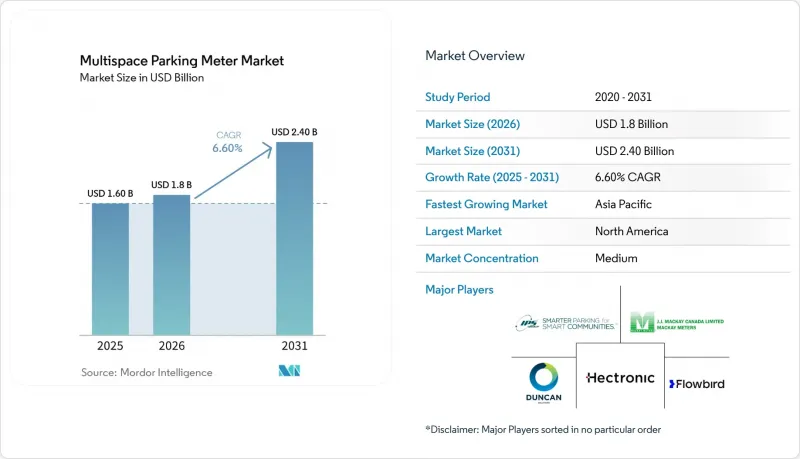
Mordor Intelligence에 의하면, 다중 공간 주차 미터기 시장 규모는 2025년 16억 달러로 평가되었습니다. 2026년 18억 달러에서 2031년까지 24억 달러로 확대되고 2026-2031년 CAGR은 6.6%를 나타낼 것으로 예측됩니다.
본 보고서는 결제 방식(페이 앤 디스플레이, 번호판 결제, 주차 공간 번호 결제, 탭 투 페이), 동력원(태양광 발전, AC 전원, 하이브리드(태양광·AC)), 설치 장소(노상, 노외), 최종 사용자(지자체·시 당국, 주차장 운영 사업자, 교통 기관, 대학·병원), 지역별로 분류되어 있습니다. 시장 전망은 금액(달러) 기준으로 제시되어 있습니다.
세계의 다중 공간 주차 미터기 시장 동향 및 인사이트
스마트시티 프로그램이 계량기 도입을 가속화하고 있습니다.
연방, 주 및 시의 스마트시티 보조금 제도는 다중 공간 요금 징수기 프로젝트에 직접 자금을 지원하고 있으며, 이를 통해 조달 기간이 단축되고 하드웨어, 소프트웨어, 데이터 분석을 일괄적으로 제공하는 턴키 계약이 촉진되고 있습니다. 미국의 SMART 프로그램은 미니애폴리스, 시애틀, 듀벡에 자금을 지원하여 통합 센서 네트워크 구축을 가능하게 했을 뿐만 아니라, 혼잡통행료 제도의 시범 사업으로 가는 길을 열었습니다. 영국에서는 레딩 보로 의회가 현금 수거 비용 절감을 이유로 시내 전역에 무현금 결제 단말기 도입을 의무화했습니다. 한편, 온타리오주 티민스는 기후 목표에 부합하기 위해 태양광 발전식 키오스크를 도입했습니다. 이러한 노력은 번들형 솔루션을 제공하는 공급업체의 사업 타당성을 강화하고, 지자체의 투자 회수 기간을 단축합니다.
무현금 및 비접촉식 결제로의 전환
2025년에는 전 세계 비접촉 결제 보급률이 86%에 달하면서, 각 도시는 미터기에 근거리 무선 통신(NFC), 전자기장 및 QR 코드 리더기를 사후에 설치할 수밖에 없게 되었습니다. IPS 그룹의 ‘MSX Multi-Space Kiosk’는 결제 카드의 규정 준수 요건을 충족하기 위해 NFC와 QR 코드를 모두 탑재하고 있어, 거래 시간을 단축하고 동전 막힘으로 인한 유지보수 작업을 줄여줍니다. 도쿄도는 도심 각 구에 무현금 결제가 가능한 자판기를 설치했으며, 부에노스아이레스는 모바일 지갑을 통해 8만 대 이상의 주차 공간을 관리하는 완전 디지털화된 주차 시스템으로 전환했습니다. 이로 인해 주차 공간의 회전율이 향상되었고, 파손 행위도 줄었습니다. 무현금 결제로의 지속적인 전환은 하드웨어의 업데이트 주기를 뒷받침하고, 실시간 데이터 생태계의 도입을 가속화하고 있습니다.
지자체에 있어 막대한 초기 투자 비용
다기능 키오스크의 단가는 8,000달러에서 1만 5,000달러에 달하고, 지자체의 자본 예산에 부담을 주고 있습니다. 뉴플리머스 지역 의회는 지불액을 7년에 걸쳐 분할하는 리스 계약을 채택함으로써 대차대조표에 미치는 즉각적인 영향을 완화하는 한편, 초기 비용을 120만 뉴질랜드 달러(72만 달러) 절감했습니다. 영국에서는 웨이버리 보로의 31만 7,400파운드(40만 2,000달러) 규모 계약 체결에 18개월에 걸친 위원회의 승인이 필요했습니다. 이러한 사례들은 자금 조달 모델, 수익 분배형 컨세션 또는 리스 구조가 고액의 초기 비용으로 인한 충격을 완화할 수 있는 반면, 조달 주기를 장기화시킬 수도 있음을 보여줍니다.
부문별 분석
차량 번호판 결제 기술은 2025년 매출의 46%를 차지했으며, 도시들이 종이 영수증 폐지와 단속 자동화를 추진함에 따라 다중 주차 공간 미터기 시장에서 가장 큰 점유율을 확보했습니다. 입스위치 시의회는 자동 번호판 인식 시스템과 위반 딱지 처리 백오피스 플랫폼을 연동하는 90대의 장비에 대해 251만 호주 달러(167만 달러) 규모의 계약을 체결했습니다. 이는 현장 방문 횟수 감소와 부정 행위 감소라는 이점을 입증하는 것입니다. 타이중시가 2025년 9월에 시작한 도입 계획에서는 2030년까지 2만 7,000구획의 종이 없는화를 목표로 하고 있으며, 이는 번호판 인식 아키텍처의 확장성을 입증하고 있습니다.
이러한 기세가 지속될지는 특히 아시아태평양의 비약적인 성장을 보이는 시장에서 타사 제조업체의 번호판 인식 시스템과의 상호 운용성 및 정체 요금 제도와의 통합 여부에 달려 있습니다. 한편, 탭 결제 및 모바일 지갑 기능은 전 세계 소비자의 86%가 비접촉식 결제를 선호한다는 점과 자동차 제조업체가 주도하는 차량 내 상거래의 확산을 배경으로, 연간 13.8%의 성장세가 예상됩니다. BMW의 유럽 내 차량 내 결제 서비스는 OEM 플랫폼이 어떻게 거래를 키오스크에서 대시보드로 전환하고, 물리적 계기판이 규제 및 정보 허브 역할을 수행하는 동시에 디지털 지갑이 결제 흐름을 포착하는 이중 채널 환경을 구축할 수 있는지를 보여줍니다.
2025년 매출의 61%를 태양광 발전식 유닛이 차지했으며, 도시들이 탄소 중립을 추구하고 매설 공사 비용을 절감하려는 가운데, 다중 공간 주차 미터기 시장에서 이 제품의 우위가 두드러지고 있습니다. 리스본 1,200대, 브뤼셀 9,000대라는 설치 대수(모두 Hectronic 사의 단결정 패널)는 태양광 발전 설계를 통한 운영 비용 절감과 내구성을 입증하고 있습니다. 미시간주 로열오크 등 북미의 지자체들은 완전한 Off-grid 충전소를 선택한 주된 이유로 에너지 비용 절감을 꼽고 있습니다.
하이브리드형(태양광·교류) 키오스크 시장은 연평균 성장률(CAGR) 11.2%로 확대되고 있으며, 겨울철 일사량이 충전 기준치를 밑도는 고위도 지역이나 그늘이 많은 지역 수요 공백을 메우고 있습니다. 헥트로닉사가 셰일베이크에서 진행한 개보수 공사에서는 새로운 하이브리드 발전소와 기존 설비에 태양광 설비를 추가하는 방식을 결합함으로써, 전력망에 지나치게 의존하지 않으면서도 이중화 기능을 구현했습니다. 리튬 탄산염 시장의 가격 변동(현물 가격이 2025년 1월 톤당 1만 798달러에서 같은 해 12월에는 1만 6,882달러로 상승)에 따라, 조달 담당자는 소형 배터리 팩을 활용하고, 이용 가능한 상용 전원 배선을 통해 보조 충전을 수행하는 하이브리드 방식으로의 전환을 검토할 가능성이 있습니다.
지역별 분석
북미는 연방도로청(FHWA)의 SMART 기금, 전자기장(EMF) 3-Domain Secure 2 준수 일정, 그리고 EasyPark의 Flowbird 인수와 같은 채널 역량을 강화하는 합병을 통해 2025년 매출의 37%를 차지했습니다. 미니애폴리스, 시애틀, 듀뷰크의 지자체는 조기 도입자로서의 입지를 확고히 한 반면, 대학 및 공항 프로젝트는 도심 도로변 이외 수요를 다각화하고 있습니다. 유럽은 리스본, 뮌헨, 브뤼셀에서 태양광 발전을 중심으로 한 도입을 통해 31%를 차지했습니다. 북부 도시에서는 낙서 방지 코팅, 4세대 셀룰러 모뎀, 하이브리드 전원 공급 장치가 기후 위험 및 파괴 행위의 위험을 완화하고, 공급업체의 요구 사항 목록을 강화하고 있습니다.
아시아태평양은 말레이시아, 한국, 대만, 베트남이 차량 번호판 인식 및 모바일 지갑을 도입함으로써 코인·카드식 플랫폼을 비약적으로 추월할 것으로 예상에 따라, 2031년까지 연평균 9.6%의 성장률을 기록하며 성장을 주도할 것으로 전망됩니다. 홍천군의 2026년 스마트 주차 제어 시스템 도입과 시부시의 2025년 무현금 결제 시스템은 정체 요금 제도, 디지털 결제 의무화, 국가 차원의 전자정부 프로그램이 도입 과정을 가속화하고 있음을 보여주었습니다.
중동 및 아프리카는 Parkin사가 체결한 19만 5,000대 규모의 주차 공간에 관한 양해각서와, 사우디아라비아 투자 회사인 Merak Capital이 Arsann사에 2,670만 달러를 출자한 사례 등 사우디아라비아의 민관 파트너십에 힘입어 2025년 시장 규모의 18%를 차지했습니다. 두바이 도로교통청(RTA)은 2024년에 3,000만 건에 가까운 디지털 티켓을 발행했으며, 확대되는 모바일 채널에 대응하기 위해 태양광 키오스크를 도입했습니다. 남미는 14%를 차지하며, 연평균 성장률(CAGR) 8.9%로 성장하고 있습니다. 이는 부에노스아이레스시 전역에 도입된 디지털 주차 시스템과 인근 니테로이에서 거둔 초기 성공을 반영한 리우데자네이루의 ‘디지털 블루존 법’에 힘입은 결과입니다.
기타 혜택 :
- 엑셀 형식 시장 예측(ME) 시트
- 3개월간의 애널리스트 지원
자주 묻는 질문
목차
제1장 서론
제2장 조사 방법
제3장 주요 요약
제4장 시장 구도
제5장 시장 규모 및 성장 예측
제6장 경쟁 구도
제7장 시장 기회 및 향후 전망
KTH 26.06.22According to Mordor Intelligence, the multispace parking meters market size is projected to expand from USD 1.6 billion in 2025 and USD 1.8 billion in 2026 to USD 2.4 billion by 2031, registering a CAGR of 6.6% between 2026 and 2031.
This report is Segmented by Payment Mode (Pay and Display, Pay-By-Plate, Pay-By-Space, and Tap-To-Pay), Power Source (Solar-Powered, AC-Mains, and Hybrid Solar-AC), Installation Site (On-Street, and Off-Street), End-User (Municipal and City Authorities, Parking Operators, Transit Agencies, and Universities and Hospitals), and Geography. The Market Forecasts are Provided in Terms of Value (USD).
Global Multispace Parking Meter Market Trends and Insights
Smart-City Programmes Accelerating Meter Roll-Outs
Federal, provincial, and city smart-city grant schemes channel capital directly into multispace pay-station projects, compressing procurement timelines and encouraging turnkey contracts that bundle hardware, software, and data analytics. The United States SMART program funded Minneapolis, Seattle, and Dubuque, enabling the deployment of integrated sensor networks and paving the way for congestion-pricing pilots. In the United Kingdom, Reading Borough Council mandated cashless pay stations across the town center, citing savings on cash collection, while Timmins, Ontario, selected solar kiosks to align with climate targets. Such initiatives strengthen the business case for suppliers offering bundled solutions and reduce the payback period for municipalities.
Shift Toward Cashless and Contactless Payments
Global contactless penetration hit 86% in 2025, compelling cities to retrofit meters with near-field communication, electromagnetic-field, and quick-response code readers. IPS Group's MSX Multi-Space Kiosk embeds both NFC and QR codes to meet payment card compliance requirements, shortening transaction time and reducing coin-jam maintenance. Tokyo installed cashless vending units across central wards, and Buenos Aires switched to a fully digital parking system that manages more than 80,000 bays via a mobile wallet, resulting in faster turnover and reduced vandalism. The sustained shift to cashless channels underpins hardware refresh cycles and accelerates the adoption of real-time data ecosystems.
High Upfront Capital Cost for Municipalities
Unit prices for feature-rich kiosks range from USD 8,000 to USD 15,000, straining city capital budgets. New Plymouth District Council adopted a lease arrangement that spread payments over 7 years, reducing the immediate impact on the balance sheet and saving NZD 1.2 million (USD 720,000) in initial outlays. In the United Kingdom, Waverley Borough's GBP 317,400 (USD 402,000) award required 18 months of committee approvals. These examples show how financing models, revenue-share concessions, or leasing structures can mitigate sticker shock, but they also lengthen procurement cycles.
Other drivers and restraints analyzed in the detailed report include:
- Municipal Drive for Higher Parking-Fee Revenue
- Preference for Solar-Powered, Low-OPEX Hardware
- Modal Shift to Ride-Hailing and Micro-Mobility
For complete list of drivers and restraints, kindly check the Table Of Contents.
Segment Analysis
Pay-by-plate technology accounted for 46% of 2025 revenue, securing the largest share of the multispace parking meters market as cities seek to eliminate paper receipts and automate enforcement. Ipswich City Council awarded a AUD 2.51 million (USD 1.67 million) contract for 90 units that link automatic number plate recognition with citation back-office platforms, demonstrating the appeal of fewer site visits and reduced fraud. Taichung City's September 2025 rollout aims for 27,000 paperless bays by 2030, affirming the scalability of license-plate architectures.
Continued momentum rests on interoperability with third-party license-plate recognition and integration into congestion-pricing schemes, especially in Asia-Pacific leapfrog markets. Tap-to-pay and mobile-wallet functions, however, are projected to grow 13.8% a year, driven by 86% of global consumers preferring contactless payments and automaker-led in-car commerce launches. BMW's European in-car payment service exemplifies how original-equipment-manufacturer platforms can shift transactions from kiosks to dashboards, creating a dual-channel environment in which physical meters serve as enforcement and information nodes while digital wallets capture payment flows.
Solar-powered units accounted for 61% of 2025 revenue, underscoring their dominance in the multispace parking meters market as cities pursue carbon neutrality and avoid trenching costs. Lisbon's 1,200-unit portfolio and Brussels' 9,000-unit fleet, both Monocrystalline panel installations from Hectronic, showcase the operational savings and durability of solar designs. North American municipalities such as Royal Oak, Michigan, cited utility bill elimination as a core driver of their decision to choose fully off-grid pay stations.
Hybrid solar-alternating current kiosks are expanding at an 11.2% CAGR, filling gaps in high-latitude or shaded corridors where winter irradiance dips below recharge thresholds. Hectronic's Schaerbeek retrofit blended new hybrid stations with solar add-ons on legacy units, achieving redundancy without grid over-reliance. Volatility in lithium carbonate markets, where spot prices climbed from USD 10,798 per ton in January 2025 to USD 16,882 in December 2025, may nudge procurement officers toward hybrids that leverage smaller battery packs and harness available mains wiring for top-up charging.
Geography Analysis
North America retained 37% of 2025 revenue due to Federal Highway Administration SMART funding, electromagnetic-field 3-Domain Secure 2 compliance timelines, and mergers such as EasyPark's Flowbird acquisition that consolidate channel power. Municipalities in Minneapolis, Seattle, and Dubuque anchor early adopter status, while university and airport projects diversify demand beyond city curbs. Europe accounted for 31% thanks to solar-centric deployments in Lisbon, Munich, and Brussels. Anti-graffiti coatings, fourth-generation cellular modems, and hybrid power in northern cities mitigate climate and vandalism risks, reinforcing vendor requirement lists.
Asia-Pacific is projected to lead growth at 9.6% through 2031, as Malaysia, South Korea, Taiwan, and Vietnam leapfrog coin-and-card platforms by embracing license-plate recognition and mobile wallets. Hongcheon County's 2026 Smart Parking Control roll-out and Sibu's 2025 cashless system show how congestion pricing, digital-payment mandates, and national e-government programs compress adoption curves.
Middle East and Africa commanded 18% of the 2025 value, propelled by Saudi public-private partnerships such as Parkin's 195,000-space memorandum and Saudi investment firm Merak Capital's USD 26.7 million infusion into Arsann. Dubai's Roads and Transport Authority recorded nearly 30 million digital tickets in 2024 and added solar kiosks to support a growing mobile channel. South America held 14% and is rising at an 8.9% CAGR, buoyed by Buenos Aires' citywide digital parking and Rio de Janeiro's Digital Blue Zone law that mirrors neighboring Niteroi's early success.
- Flowbird Group SA
- IPS Group Inc.
- Duncan Solutions Pty Ltd
- MacKay Meters Inc.
- Hectronic GmbH
- IEM SA
- CAME Parkare S.L.
- Ventek International
- Global Parking Solutions Ltd
- Metric Group Ltd
- Pacific Parking Systems Inc.
- Amano McGann Inc.
- CivicSmart Inc.
- Precise ParkLink Inc.
- Parking BOXX Corp.
- Scheidt & Bachmann GmbH
- T2 Systems Inc.
- Guangzhou Coma Electronics Co., Ltd.
- Swarco AG
- Meypar S.A.
Additional Benefits:
- The market estimate (ME) sheet in Excel format
- 3 months of analyst support
TABLE OF CONTENTS
1 INTRODUCTION
- 1.1 Study Assumptions and Market Definition
- 1.2 Scope of the Study
2 RESEARCH METHODOLOGY
3 EXECUTIVE SUMMARY
4 MARKET LANDSCAPE
- 4.1 Market Overview
- 4.2 Market Drivers
- 4.2.1 Mainstream - Smart-city programmes accelerating meter roll-outs
- 4.2.2 Mainstream - Shift toward cashless and contactless payments
- 4.2.3 Mainstream - Municipal drive for higher parking-fee revenue
- 4.2.4 Mainstream - Preference for solar-powered, low-OPEX hardware
- 4.2.5 Under-the-radar - Integration of pay-by-plate data into congestion-pricing schemes
- 4.2.6 Under-the-radar - In-car commerce APIs enabling automatic meter payments
- 4.3 Market Restraints
- 4.3.1 Mainstream - High upfront capital cost for municipalities
- 4.3.2 Mainstream - Modal shift to ride-hailing and micro-mobility
- 4.3.3 Under-the-radar - EMV 3-DS2 compliance delaying hardware refresh
- 4.3.4 Under-the-radar - Lithium battery supply constraints for meter power modules
- 4.4 Industry Value Chain Analysis
- 4.5 Regulatory Landscape
- 4.6 Technological Outlook
- 4.7 Porter's Five Forces Analysis
- 4.7.1 Threat of New Entrants
- 4.7.2 Bargaining Power of Suppliers
- 4.7.3 Bargaining Power of Buyers
- 4.7.4 Threat of Substitutes
- 4.7.5 Competitive Rivalry
5 MARKET SIZE AND GROWTH FORECASTS (VALUE)
- 5.1 By Payment Mode
- 5.1.1 Pay and Display
- 5.1.2 Pay-by-Plate
- 5.1.3 Pay-by-Space
- 5.1.4 Tap-to-Pay / Mobile Wallet
- 5.2 By Power Source
- 5.2.1 Solar-Powered
- 5.2.2 AC-Mains
- 5.2.3 Hybrid Solar-AC
- 5.3 By Installation Site
- 5.3.1 On-Street
- 5.3.2 Off-Street (Lots and Garages)
- 5.4 By End-User
- 5.4.1 Municipal and City Authorities
- 5.4.2 Parking Operators and Concessionaires
- 5.4.3 Transit Agencies and Airports
- 5.4.4 Universities and Hospitals
- 5.5 By Geography
- 5.5.1 North America
- 5.5.1.1 United States
- 5.5.1.2 Canada
- 5.5.1.3 Mexico
- 5.5.2 Europe
- 5.5.2.1 Germany
- 5.5.2.2 United Kingdom
- 5.5.2.3 France
- 5.5.2.4 Italy
- 5.5.2.5 Rest of Europe
- 5.5.3 Asia-Pacific
- 5.5.3.1 China
- 5.5.3.2 Japan
- 5.5.3.3 India
- 5.5.3.4 South Korea
- 5.5.3.5 Rest of Asia-Pacific
- 5.5.4 Middle East and Africa
- 5.5.5 South America
- 5.5.1 North America
6 COMPETITIVE LANDSCAPE
- 6.1 Market Concentration
- 6.2 Strategic Moves
- 6.3 Market Share Analysis
- 6.4 Company Profiles (includes Global level Overview, Market level overview, Core Segments, Financials as available, Strategic Information, Market Rank/Share for key companies, Products and Services, and Recent Developments)
- 6.4.1 Flowbird Group SA
- 6.4.2 IPS Group Inc.
- 6.4.3 Duncan Solutions Pty Ltd
- 6.4.4 MacKay Meters Inc.
- 6.4.5 Hectronic GmbH
- 6.4.6 IEM SA
- 6.4.7 CAME Parkare S.L.
- 6.4.8 Ventek International
- 6.4.9 Global Parking Solutions Ltd
- 6.4.10 Metric Group Ltd
- 6.4.11 Pacific Parking Systems Inc.
- 6.4.12 Amano McGann Inc.
- 6.4.13 CivicSmart Inc.
- 6.4.14 Precise ParkLink Inc.
- 6.4.15 Parking BOXX Corp.
- 6.4.16 Scheidt & Bachmann GmbH
- 6.4.17 T2 Systems Inc.
- 6.4.18 Guangzhou Coma Electronics Co., Ltd.
- 6.4.19 Swarco AG
- 6.4.20 Meypar S.A.
7 MARKET OPPORTUNITIES AND FUTURE OUTLOOK
- 7.1 White-Space and Unmet-Need Assessment