
|
시장보고서
상품코드
2062458
금속 산화물 배리스터(MOV) : 시장 점유율 분석, 업계 동향 및 통계, 성장 예측(2026-2031년)Metal Oxide Varistors - Market Share Analysis, Industry Trends & Statistics, Growth Forecasts (2026 - 2031) |
||||||
 Mordor Intelligence
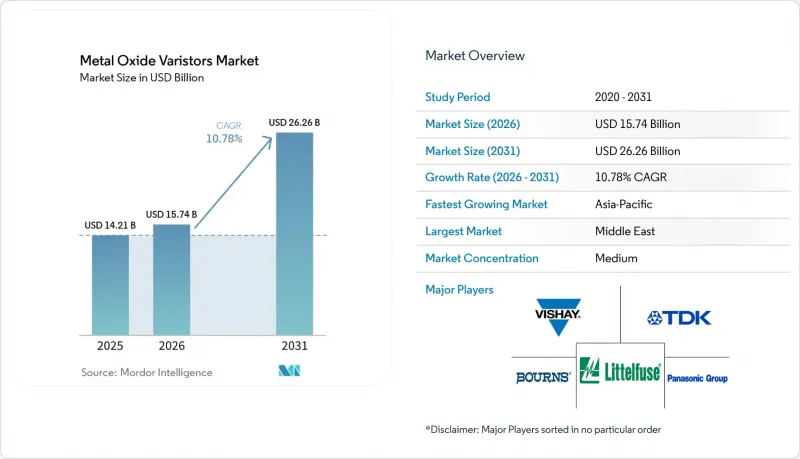
Mordor Intelligence에 의하면, 금속 산화물 배리스터(MOV) 시장 규모는 2025년 142억 1,000만 달러로 평가되었습니다. 2026년 157억 4,000만 달러에서 2031년까지 262억 6,000만 달러로 확대되고 2026년부터 2031년까지 연평균 복합 성장률(CAGR)은 10.78%를 나타낼 것으로 예측됩니다.
본 보고서는 제품 유형(디스크형 MOV, 표면 실장형 MOV, 스트랩/블록형 MOV 등), 정격 전압(저전압 <=230 V, 중전압 230-1000 V, 기타), 최종 사용자 산업(소비자용 전자기기, 산업용 기기, 기타), 용도(서지 보호 장치, 선전압 보호, 자동차용 전자기기, 기타), 지역별로 분류되어 있습니다. 시장 전망은 금액(달러) 기준으로 제시되어 있습니다.
세계의 금속 산화물 배리스터(MOV) 시장 동향 및 인사이트
전기차(EV) 충전 인프라의 급속한 보급
2024년, 전 세계 공공 전기차 충전기는 500만 대를 넘어섰으며, IEC 61851-23 : 2023 표준에 따라 2.5 kV의 보호 수준을 갖춘 DC 측 서지 보호 장치의 설치가 의무화되었습니다. 이러한 규정에 따라, AC 입력 측에 MOV와 가스 방전관을 조합하고, 출력 측에 전용 MOV 기반 DC 아레스터를 조합한 유형 1 및 유형 2의 협업 아키텍처가 권장되고 있습니다. 또한, IEEE Std C62.230-2022는 최대 1,500 V DC까지의 보호를 규정하고 있으며, 반도체만 사용하는 옵션보다 고에너지 MOV 흡수를 권장하고 있습니다. 현장에서의 신뢰성은 매우 중요하며, 급속 충전 사용자 중 46%가 전기적 고장으로 인한 가동 중단 시간을 주요 문제로 꼽고 있으며, 충전기 고장으로 인해 수리비와 수익 손실을 합쳐 4만 달러 이상의 비용이 발생할 수 있습니다. 이에 대해 부품 제조업체들은 대응 조치를 추진하고 있습니다. Raycap사의 ‘2025 ProTec T2DCGU 3Y’는 100 kA 정격의 1,000 V 및 1,500 V 대응 플러그인 모듈을 제공하며, 고전압이면서 유지보수가 가능한 MOV 플랫폼으로의 전환을 보여줍니다.
스마트 홈용 서지 보호 장치의 보급 확대
현재 가정에는 약 30대의 연결 기기가 설치되어 있으며, NEC 2023 제230.67조에서는 미국의 모든 주택용 서비스 입구에 서지 보호 장치의 설치를 의무화하고 있습니다. 주택 전체를 대상으로 하는 MOV 기반 장치는 낙뢰 및 전력망의 변동을 완화합니다. 이 수치는 지난 10년 동안 각각 18%와 17% 증가했습니다. Mersen 등 제조업체들은 2025년, 열 차단 MOV 코어, 원격 상태 표시 LED, 연결 기기 보증을 묶어 제공한 75kA 주택용 유닛으로 프리미엄 라인을 확대하며 평균 판매 가격을 끌어올렸습니다. 공급 부족 현상은 계속되고 있지만, AEC-Q200 규격의 MOV 칩의 경우 특정 정격에 대해 리드타임이 9개월로 늘어남에 따라, 건설업체와 설치업체는 사전에 재고를 확보할 수밖에 없는 상황입니다. Weidmuller사의 ‘VARITECTOR PU IoT AC’와 같은 IoT 지원 SPD는 과전압 현상을 클라우드 대시보드로 실시간 전송하는 기능을 갖추고 있어, 주택 소유자는 고장이 발생하기 전에 교체 일정을 세울 수 있게 되었습니다.
산화아연 원료 가격의 변동
산화아연은 MOV의 기능성 세라믹 기판으로, 원자재 비용의 급등은 분기 이익률을 무너뜨릴 가능성이 있습니다. 2025년 하반기 현물 가격은 1kg당 3.11-3.46달러 사이에서 형성되었으며, 이는 팬데믹 이전 수준보다 약 25% 높은 수치입니다. 재정 기반이 취약한 아시아의 소규모 공급업체들은 헤지 전략 수립에 어려움을 겪고 있으며, 일부 업체는 납품량 제한이나 할증료 부과에 나서고 있습니다. 한편, 대형 공급업체들의 수직 통합은 가격 변동을 부분적으로 상쇄하고 있으며, 여러 기업이 광석에 대한 다년 계약을 체결하거나 소성 스크랩의 폐쇄형 순환 재활용에 투자하고 있습니다.
부문별 분석
2025년, 디스크형 장치는 금속 산화물 배리스터(MOV) 시장 점유율에서 39.43%로 가장 높은 비중을 차지했으며, 서비스 입구 및 가전제품용 서지 보호 장치에서 뛰어난 내에너지 성능을 바탕으로 그 입지를 확고히 다졌습니다. 그러나 자동차 및 통신용 기판이 리플로우 납땜이 가능한 부품으로 전환됨에 따라, 표면 실장형은 2031년까지 연평균 성장률(CAGR) 11.58%라는 가장 높은 성장률을 보이고 있습니다. 이러한 변화는 라디얼 리드형에 비해 실장 시간을 절반으로 줄여주는 AEC-Q200 인증 다층 제품에서 두드러지게 나타납니다. 스트랩 앤 블록 방식은 펄스당 수십 킬로암페어의 전류를 처리하며, 일반적인 전력용 변압기나 철도용 구동 장치의 보호 기능을 계속해서 담당하고 있지만, 시장 전체의 가치 측면에서는 틈새 시장으로 남아 있습니다. 링형 MOV 등 기타 형태는 특수한 케이블 감김 용도로 사용되며, 시장 구조를 바꾸지 않으면서도 적정한 수요를 유지하고 있습니다.
예측 기간 동안, 각 OEM 업체들이 기판 수준의 보호 기능을 통합하고 ISO 7637 및 IEC 61000-4-5를 준수하기 위해 파워 컨트롤러 옆에 소형화된 MOV를 탑재함에 따라, 표면 실장형 금속 산화물 배리스터(MOV) 시장 규모는 확대될 것입니다. 다층 세라믹의 층 수가 증가함에 따라 줄 용량이 약 30% 향상되었으며, 서브나노초 수준의 응답 속도를 유지하면서 14mm 디스크와의 격차를 좁히고 있습니다. 디스크형 장치는 여전히 가격에 민감한 백색 가전 및 UPS 설계 분야에서 주류를 이루고 있으며, 이 분야에서는 스루홀 실장이 여전히 일반적입니다. 이 공급업체는 디스크형 부품에 폴리머 재질의 열퓨즈와 컨포멀 코팅을 추가하여 차별화를 꾀하고, 습도가 높은 환경에서 사이클 수명을 연장하고 있습니다. 두 가지 형식이 공존함으로써, 제조업체는 직경이나 적층 높이에 따라 세라믹 소성로를 유연하게 활용할 수 있어 균형 잡힌 제품 포트폴리오를 확보할 수 있습니다.
230V에서 1,000V 범위의 중전압 소자는 2025년 금속 산화물 배리스터(MOV) 시장 점유율의 44.59%를 차지했으며, 이는 주거용 단상 및 상업용 3상 전원과의 호환성을 반영한 것입니다. 1,000 V를 초과하는 고전압 부품은 800 V 트랙션 배터리 및 1,500 V 태양광 발전 스트링에 힘입어 11.38%라는 업계 최고 수준의 연평균 성장률(CAGR)을 기록하고 있습니다. 저전압 MOV는 여전히 소비자용 기판이나 데이터 포트에서 필수적이지만, 실리콘 TVS 다이오드와 직접적인 경쟁에 직면해 있습니다. 현재의 제품 로드맵에서는 정격 강하 없이 DC 급속 충전기의 출력단에 통합할 수 있는 1,500V 연속 작동 모듈이 중점적으로 다루어지고 있습니다. 현장에서 교체 가능한 카트리지를 통해 사업자는 유지보수 중 캐비닛 전체의 가동을 중단하지 않아도 됩니다.
재생에너지 용량이 확대됨에 따라, 전력 회사들은 IEC 61643-41의 일시적 과전압 시험 요건을 충족하기 위해 고전압 MOV-GDT 하이브리드 제품을 지정하고 있으며, 이에 따라 수요는 곡선의 상단부로 향하고 있습니다. 따라서 고전압 정격과 관련된 금속 산화물 배리스터(MOV) 시장 규모는 절대 출하량이 중전압 제품군보다 적음에도 불구하고, 시장 전체의 평균보다 빠른 속도로 성장하고 있습니다. 각 제조업체는 180°C 미만에서 작동하는 열 차단 장치를 개선하여, 장시간 고장 발생 시 치명적인 파열을 방지하고 있습니다. 한편, 중전압 제품에는 단계적인 개량이 이루어져, 레이저 마킹을 통한 추적성 코드와 스마트 패널 생태계에 통합하기 위한 IoT 연결 지점이 탑재되어 있습니다. 저전압 MOV는 단일 2kA 펄스를 설계 목표로 하는 LED 드라이버나 노트북용 어댑터에 계속해서 사용되고 있지만, 판매량 증가세는 여전히 완만한 수준에 그치고 있습니다.
지역별 분석
아시아태평양은 금속 산화물 배리스터(MOV) 시장을 주도하고 있으며, 2025년에는 매출의 38.48%를 차지하고 연평균 성장률(CAGR)은 11.69%를 나타냈습니다. 중국이 제시한 주요 부품의 국내 조달률 70%라는 정책 목표가 합작 사업을 뒷받침하는 한편, 4,000억 루피(48억 달러)로 확대된 인도의 ‘전자 부품 제조 계획’은 139억 달러가 넘는 투자 약속을 이끌어내고 있습니다. 현지 생산 능력은 물류 위험을 줄여주지만, 위조품의 위험도 대두시키고 있습니다. 실제로, 생산 거점을 이전한 공장의 43%가 이전 후 6개월 이내에 의심스러운 부품을 보고했습니다.
북미는 미국의 법규 및 전기차(EV) 산업의 급속한 확장에 힘입어 여전히 중요한 시장으로 자리 잡고 있습니다. 520억 달러 규모의 인센티브를 배정하는 ‘CHIPS법’은 수동 부품의 국내 생산을 촉진하고 수입 의존도를 낮추는 데 있어 매우 중요한 역할을 하고 있습니다. 또한, 제301조 관세의 시행은 중국에서 수입되는 금속 산화물 배리스터(MOV)의 원가에 큰 영향을 미쳐, 2025년 이후 그 가격은 실질적으로 두 배로 상승하게 될 것입니다. 이에 따라 유통업체들은 위험을 줄이고 비용을 효과적으로 관리하기 위해 공급망 다각화를 추진하고 있습니다. 한편, 캐나다와 멕시코에서는 특히 풍력 발전소와 데이터센터를 중심으로 제1종 서지 보호 장치(SPD)의 설치가 증가하고 있습니다. 이러한 설비는 낙뢰가 잦은 대초원 지대에 집중되어 있으며, 해당 지역의 인프라 신뢰성과 안전성을 확보하기 위해서는 견고한 서지 보호가 필수적입니다.
유럽에서는 EN 61643에 기반한 엄격한 EMC 규제와 재생에너지에 대한 추진이 호재로 작용하고 있습니다. 독일과 프랑스에서는 1,500V 태양광 발전 어레이의 DC 버스 보호 조치가 가속화되고 있는 반면, 영국에서는 공식적인 위험 면제 신청이 이루어지지 않는 한 전기차 충전기 회로에 SPD를 설치해야 합니다. 배전선의 지하화를 위한 지역 차원의 노력은 낙뢰 노출을 줄여주는 한편, 자산 건전성 감사를 지원하기 위한 네트워크형 서지 로깅에 대한 수요를 높이고 있습니다. 남미에서는 브라질의 태양광 발전 설비 확대와 AEC-Q200 규격을 준수하는 MOV를 조달하는 멕시코의 자동차 조립 클러스터가 주도적인 역할을 하며 시장이 꾸준히 확대되고 있습니다. 중동 및 아프리카에서는 전력 회사와 석유 관련 시설에 서지 보호 장치가 도입되고 있으며, 아랍에미리트에서는 SPD에 IoT 상태 비콘을 통합한 스마트 그리드 시범 사업을 추진하고 있습니다.
기타 혜택 :
- 엑셀 형식 시장 예측(ME) 시트
- 3개월간의 애널리스트 지원
자주 묻는 질문
목차
제1장 서론
제2장 조사 방법
제3장 주요 요약
제4장 시장 구도
제5장 시장 규모 및 성장 예측
제6장 경쟁 구도
제7장 시장 기회 및 향후 전망
KTH 26.06.22According to Mordor Intelligence, the metal oxide varistors market size is projected to expand from USD 14.21 billion in 2025 and USD 15.74 billion in 2026 to USD 26.26 billion by 2031, registering a CAGR of 10.78% between 2026 to 2031.
This report is Segmented by Product Type (Disc MOV, Surface-Mount MOV, Strap/Block MOV, and More), Voltage Rating (Low <=230 V, Medium 230-1000 V, and More), End-User Industry (Consumer Electronics, Industrial Equipment, and More), Application (Surge-Protective Devices, Line-Voltage Protection, Automotive Electronics, and More), and Geography. The Market Forecasts are Provided in Terms of Value (USD).
Global Metal Oxide Varistors Market Trends and Insights
Rapid Proliferation Of Electric Vehicle Charging Infrastructure
Global public EV chargers exceeded 5 million units in 2024, and IEC 61851-23:2023 now mandates DC-side surge-protective devices with a 2.5 kV protection level. These rules push coordinated Type 1 and Type 2 architectures that pair MOVs with gas-discharge tubes at AC inputs and dedicated MOV-based DC arresters at outputs. IEEE Std C62.230-2022 further codifies protection up to 1,500 V DC, favoring high-energy MOV absorption over semiconductor-only options. Field reliability matters, 46% of fast-charge users cite downtime linked to electrical faults, and a failed charger can cost more than USD 40,000 in repair and lost revenue. Component makers responded; Raycap's 2025 ProTec T2 DCGU 3Y provides pluggable 1,000 V and 1,500 V modules rated to 100 kA, illustrating the shift to high-voltage, serviceable MOV platforms.
Heightened Adoption of Smart Home Surge Protection
Homes now host roughly 30 connected devices, and NEC 2023 Article 230.67 requires surge protection on all U.S. dwelling service entrances. Whole-house MOV-based devices mitigate lightning strikes and grid fluctuations, which increased by 18% and 17%, respectively, over the past decade. Makers such as Mersen expanded premium lines in 2025 with 75 kA residential units that bundle thermal-disconnect MOV cores, remote status LEDs, and connected-equipment warranties, pushing average selling prices higher. Supply tension persists; however, lead times for AEC-Q200-grade MOV chips lengthened to nine months for select values, forcing builders and installers to pre-stock. IoT-enabled SPDs, such as Weidmuller's VARITECTOR PU IoT AC, now stream overvoltage events to cloud dashboards, allowing homeowners to schedule replacements before failure.
Volatility In Zinc Oxide Raw-Material Prices
Zinc oxide is the functional ceramic base of an MOV, and feedstock cost spikes can wipe out quarterly margins. Spot prices ranged between USD 3.11 kg and USD 3.46 kg during late 2025, roughly 25% above pre-pandemic norms. Smaller Asian suppliers with thin balance sheets struggle to hedge, prompting some to ration deliveries or impose surcharges. Vertical integration by top-tier vendors partially offsets volatility; several negotiated multi-year ore contracts and invested in closed-loop recycling of kiln scrap.
Other drivers and restraints analyzed in the detailed report include:
- 5G Network Roll-Outs Requiring Robust Surge Suppression
- Industrial IoT Expansion In Harsh-Power Environments
- Miniaturization Limits On Peak Energy Handling
For complete list of drivers and restraints, kindly check the Table Of Contents.
Segment Analysis
Disc devices retained the largest 39.43% slice of the metal oxide varistors market share in 2025, a position secured by their high-energy handling in service-entrance and appliance surge protectors. Surface-mount variants, however, deliver the fastest 11.58% CAGR through 2031 as automotive and telecom boards migrate to reflow-solderable components. This shift is evident in AEC-Q200-qualified multilayer offerings that halve placement time compared to radial leads. Strap-and-block formats continue to shield utility transformers and rail drives, where tens of kiloamperes per impulse are common, but they represent a niche in overall value terms. Other geometries such as ring MOVs occupy specialty cable-wrap roles, sustaining moderate demand without altering the hierarchy.
Over the forecast horizon, the metal oxide varistors market size for surface-mount parts expands as OEMs consolidate protection at the board level, embedding miniaturized MOVs next to power controllers to meet ISO 7637 and IEC 61000-4-5. Higher layer counts in multilayer ceramics increase joule capacity by roughly 30%, closing the gap with 14 mm discs while preserving sub-nanosecond response. Disc devices still dominate price-sensitive white goods and UPS designs, where through-hole assembly remains prevalent. Suppliers differentiate by adding polymer thermal fuses and conformal coatings to disc parts, extending cycle life in damp environments. The coexistence of both formats ensures a balanced portfolio for manufacturers that can flex ceramic kilns across diameters and stack heights.
Medium-voltage devices between 230 V and 1,000 V captured 44.59% of the 2025 metal oxide varistors market share, reflecting their fit with residential split-phase and three-phase commercial mains. High-voltage parts above 1,000 V post the leading 11.38% CAGR, fueled by 800 V traction batteries and 1,500 V photovoltaic strings. Low-voltage MOVs remain essential on consumer boards and data ports yet face direct competition from silicon TVS diodes. Product roadmaps now emphasize 1,500 V continuous-operation modules that slot into DC fast-charger output stages without derating. Field-replaceable cartridges help operators avoid full-cabinet shutdowns during maintenance.
As renewable-energy capacity scales, utilities specify high-voltage MOV-GDT hybrids to satisfy IEC 61643-41 temporary-overvoltage tests, pulling demand toward the top end of the curve. The metal oxide varistor market size, linked to high-voltage ratings, therefore grows faster than the overall average, even though absolute unit volumes remain lower than on medium-voltage lines. Manufacturers are improving thermal disconnect mechanisms that trip below 180 °C, preventing catastrophic rupture under sustained faults. Meanwhile, medium-voltage products receive incremental updates, laser-marked traceability codes, and IoT contact points that lock them into smart-panel ecosystems. Low-voltage MOVs will persist in LED drivers and laptop adapters where a single 2 kA pulse is the design target, but volume uplift remains modest.
Geography Analysis
Asia-Pacific leads the metal oxide varistors market, accounting for 38.48% of revenue in 2025 and an 11.69% CAGR outlook. China's policy goal of 70% domestic content in core components fuels joint ventures, while India's Electronics Components Manufacturing Scheme, expanded to INR 400 billion (USD 4.8 billion), has attracted pledged investments topping USD 13.9 billion. Local capacity reduces logistics risk but surfaces counterfeit exposure, as 43% of relocated plants reported suspect parts within six months of moving production.
North America follows as a significant market, driven by U.S. code mandates and the rapid expansion of the electric vehicle (EV) industry. The CHIPS Act, which allocates USD 52 billion in incentives, is playing a crucial role in encouraging domestic fabrication of passive components and reducing reliance on imports. Additionally, the implementation of Section 301 tariffs has significantly impacted the cost of Metal Oxide Varistors (MOVs) imported from China, effectively doubling their prices starting in 2025. This has prompted distributors to diversify their supply chains to mitigate risks and manage costs effectively. Meanwhile, Canada and Mexico are witnessing increased installations of Type 1 Surge Protective Devices (SPDs), particularly on wind farms and data centers. These installations are concentrated in lightning-prone prairie corridors, where the need for robust surge protection is critical to ensure the reliability and safety of infrastructure in these regions.
Europe benefits from stringent EMC rules under EN 61643 and the push toward renewable energy. Germany and France accelerate DC bus protection in 1,500 V solar arrays, while the United Kingdom requires SPDs on EV charger circuits unless a formal risk exemption is filed. Regional initiatives to underground distribution lines dampen lightning exposure but heighten demand for networked surge logging to support asset-health audits. South America expands steadily, led by Brazil's solar build-out and Mexico's automotive assembly clusters that source AEC-Q200 MOVs.The Middle East and Africa are adopting surge protection in utility and oil installations; the United Arab Emirates is promoting smart-grid pilots that instrument SPDs with IoT status beacons.
- TDK Corporation
- Vishay Intertechnology Inc.
- Panasonic Holdings Corporation
- Littelfuse Inc.
- Eaton Corporation plc
- Bourns Inc.
- Murata Manufacturing Co. Ltd.
- KOA Corporation
- KEMET (Yageo Corporation)
- Schneider Electric SE
- TE Connectivity Ltd.
- Honeywell International Inc.
- Amotech Co. Ltd.
- Dean Technology Inc.
- Epcos India Pvt. Ltd.
- Shenzhen MOV Electronics Co. Ltd.
- Nippon Chemi-Con Corporation
- Metrosil (M&I Materials Ltd.)
- General Electric Company
- ON Semiconductor Corporation
Additional Benefits:
- The market estimate (ME) sheet in Excel format
- 3 months of analyst support
TABLE OF CONTENTS
1 INTRODUCTION
- 1.1 Study Assumptions and Market Definition
- 1.2 Scope of the Study
2 RESEARCH METHODOLOGY
3 EXECUTIVE SUMMARY
4 MARKET LANDSCAPE
- 4.1 Market Overview
- 4.2 Market Drivers
- 4.2.1 Rapid Proliferation of Electric Vehicle Charging Infrastructure
- 4.2.2 Heightened Adoption of Smart Home Surge Protection
- 4.2.3 5G Network Roll-outs Requiring Robust Surge Suppression
- 4.2.4 Industrial IoT Expansion in Harsh-Power Environments
- 4.2.5 Grid-Edge Power Quality Initiatives in Developing Economies
- 4.2.6 Insurance-Driven Mandates for Lightning Protection in Commercial Buildings
- 4.3 Market Restraints
- 4.3.1 Volatility in Zinc Oxide Raw-Material Prices
- 4.3.2 Miniaturization Limits on Peak Energy Handling
- 4.3.3 Substitution Threat from Transient Voltage Suppressors (TVS Diodes)
- 4.3.4 Counterfeit Components in Gray-Market Supply Chains
- 4.4 Impact of Macroeconomic Factors on the Market
- 4.5 Industry Value Chain Analysis
- 4.6 Regulatory Landscape
- 4.7 Technological Outlook
- 4.8 Porter's Five Forces Analysis
- 4.8.1 Bargaining Power of Suppliers
- 4.8.2 Bargaining Power of Buyers
- 4.8.3 Threat of New Entrants
- 4.8.4 Threat of Substitutes
- 4.8.5 Intensity of Competitive Rivalry
5 MARKET SIZE AND GROWTH FORECASTS (VALUE)
- 5.1 By Product Type
- 5.1.1 Disc MOV
- 5.1.2 Surface-Mount (SMD/Chip) MOV
- 5.1.3 Strap / Block MOV
- 5.1.4 Other Product Types
- 5.2 By Voltage Rating
- 5.2.1 Low (<=230 V)
- 5.2.2 Medium (230 - 1,000 V)
- 5.2.3 High (Above 1,000 V)
- 5.3 By End-User Industry
- 5.3.1 Consumer Electronics
- 5.3.2 Industrial Equipment
- 5.3.3 Automotive
- 5.3.4 Energy and Power
- 5.3.5 Telecommunications
- 5.3.6 Other End-User Industries
- 5.4 By Application
- 5.4.1 Surge-Protective Devices (SPDs)
- 5.4.2 Line-Voltage Protection
- 5.4.3 Automotive Electronics
- 5.4.4 Industrial Power Electronics
- 5.4.5 Other Applications
- 5.5 By Geography
- 5.5.1 North America
- 5.5.1.1 United States
- 5.5.1.2 Canada
- 5.5.1.3 Mexico
- 5.5.2 South America
- 5.5.2.1 Brazil
- 5.5.2.2 Argentina
- 5.5.2.3 Rest of South America
- 5.5.3 Europe
- 5.5.3.1 United Kingdom
- 5.5.3.2 Germany
- 5.5.3.3 France
- 5.5.3.4 Italy
- 5.5.3.5 Spain
- 5.5.3.6 Rest of Europe
- 5.5.4 Asia-Pacific
- 5.5.4.1 China
- 5.5.4.2 Japan
- 5.5.4.3 India
- 5.5.4.4 South Korea
- 5.5.4.5 Rest of Asia-Pacific
- 5.5.5 Middle East and Africa
- 5.5.5.1 Middle East
- 5.5.5.1.1 United Arab Emirates
- 5.5.5.1.2 Saudi Arabia
- 5.5.5.1.3 Rest of Middle East
- 5.5.5.2 Africa
- 5.5.5.2.1 South Africa
- 5.5.5.2.2 Egypt
- 5.5.5.2.3 Rest of Africa
- 5.5.5.1 Middle East
- 5.5.1 North America
6 COMPETITIVE LANDSCAPE
- 6.1 Market Concentration
- 6.2 Strategic Moves
- 6.3 Market Share Analysis
- 6.4 Company Profiles (includes Global Level Overview, Market Level Overview, Core Segments, Financials as available, Strategic Information, Market Rank/Share, Products and Services, Recent Developments)
- 6.4.1 TDK Corporation
- 6.4.2 Vishay Intertechnology Inc.
- 6.4.3 Panasonic Holdings Corporation
- 6.4.4 Littelfuse Inc.
- 6.4.5 Eaton Corporation plc
- 6.4.6 Bourns Inc.
- 6.4.7 Murata Manufacturing Co. Ltd.
- 6.4.8 KOA Corporation
- 6.4.9 KEMET (Yageo Corporation)
- 6.4.10 Schneider Electric SE
- 6.4.11 TE Connectivity Ltd.
- 6.4.12 Honeywell International Inc.
- 6.4.13 Amotech Co. Ltd.
- 6.4.14 Dean Technology Inc.
- 6.4.15 Epcos India Pvt. Ltd.
- 6.4.16 Shenzhen MOV Electronics Co. Ltd.
- 6.4.17 Nippon Chemi-Con Corporation
- 6.4.18 Metrosil (M&I Materials Ltd.)
- 6.4.19 General Electric Company
- 6.4.20 ON Semiconductor Corporation
7 MARKET OPPORTUNITIES AND FUTURE OUTLOOK
- 7.1 White-Space and Unmet-Need Assessment