

|
시장보고서
상품코드
2062461
출하전 검사 시장 : 시장 점유율 분석, 업계 동향 및 통계, 성장 예측(2026-2031년)Pre-Shipment Inspection - Market Share Analysis, Industry Trends & Statistics, Growth Forecasts (2026 - 2031) |
||||||
 Mordor Intelligence
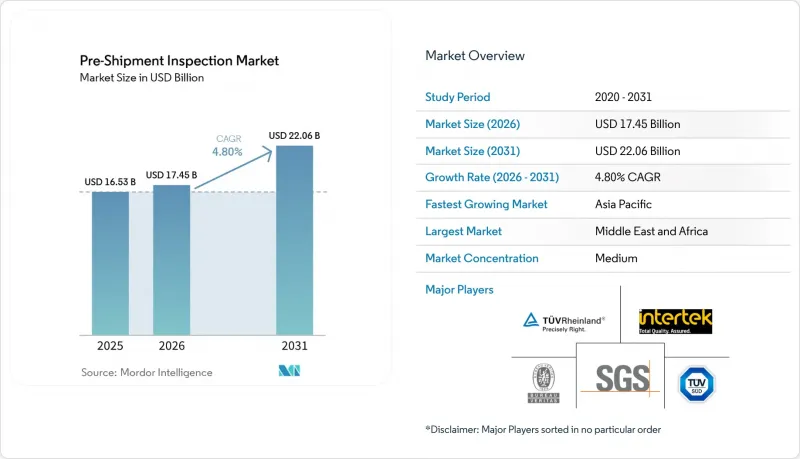
Mordor Intelligence에 의하면, 출하전 검사 시장 규모는 2025년 165억 3,000만 달러로 평가되었고, 2026년 174억 5,000만 달러로 추정되고, 2031년까지 220억 6,000만 달러로 확대될 전망이며, 2026-2031년 연평균 복합 성장률(CAGR)은 4.8%를 나타낼 것으로 예측됩니다.
본 보고서는 조달 형태별(사내 수행, 외부 위탁), 서비스 유형별(제품 적합성 검사, 서류 검증 및 규정 준수 심사 등), 산업 분야별(소비재 및 소매, 산업 및 제조 등), 운송 수단별(해상, 항공, 육상, 철도) 및 지역별(북미, 아시아태평양 등)로 분류되어 있습니다. 시장 전망은 금액(달러) 기준으로 제시되어 있습니다.
세계의 출하전 검사 시장 동향 및 분석
세계 제품 품질 및 안전 규제의 강화
각국 정부는 안전 기준을 낮추지 않으면서 통관 절차를 신속하게 처리하기 위해 국경 관리 업무를 인증 기관에 위탁하고 있습니다. 미국 식품의약국(FDA)은 현재 고위험 농산물에 대해 로트 단위의 추적성을 의무화하고 있으며, 이에 따라 출하 전 증명서 취득이 법적 요건이 되었습니다. 인도는 2026년 초에 수입 검사 규정을 확대했으며, 케냐는 새로운 프로그램의 감시를 9개 국제 기업에 위탁하고 대상 거래량을 확대했습니다. 모로코의 제품 적합성 평가 플랫폼은 디지털 워크플로를 통해 인증서 발급 시간을 40% 단축했습니다. 이러한 움직임은 종합적으로 볼 때, 제조업체가 규정 준수를 유지하기 위해 제3자 검사 기관을 고용하도록 유도하고 있습니다.
아시아태평양의 수출 호황이 적합성 인증서 수요를 견인하고 있습니다.
중국, 베트남, 인도에서 수출되는 전자기기, 섬유 제품, 기계류는 수입국 시장에서 더욱 엄격한 적합성 규정을 적용받고 있으며, 많은 구매자가 출하 전 제3자 검사를 의무화하고 있습니다. 칠레와 미국 간의 신선 과일 관련 양자 프로그램에서는 2025-2026년 시즌에 85만 톤 이상이 처리되었으며, 수출 전 증명서가 통관 절차를 얼마나 신속하게 처리하는지 보여주었습니다. 사우디아라비아의 SABER나 스페인의 새로운 재활용 소재 함유 마크 역시 독립적인 검증이 필요하기 때문에 아시아태평양의 검사 기관으로 사업을 유도하고 있습니다.
중소기업에게 있어 제3자 검사의 높은 비용
검사 1회당 300-1,500달러에 달하는 검사 비용은 중소기업의 미미한 수출 이익을 압박하고 있습니다. 많은 기업이 현물 환율로 결제하고, 은행 대출을 받기 전에 검사 증명서 비용을 선불로 지불해야 하기 때문에 현금 흐름의 악화가 더욱 심화되고 있습니다. 아르헨티나의 제477/1997호 행정명령은 정액 요금을 부과하고 있어, 저가 화물의 단가를 상승시키고, 소규모 수출업체들을 고액의 가교 자금 조달을 구해야 하는 상황으로 내몰고 있습니다. 아프리카와 남미에서 무역 금융에 대한 접근성이 제한적이라는 점이 이러한 부담을 더욱 가중시키고 있습니다.
부문별 분석
2025년, 출하 전 검사(PSI) 시장의 72.74%를 아웃소싱 프로그램이 차지했습니다. 이 모델은 전자기기, 의류, 산업용 부품 제조업체에 특히 유리하며, 검사실 설비 투자를 줄일 수 있습니다. 아웃소싱을 통해 기업은 전문 업체의 전문 지식을 활용하면서 자사의 핵심 역량에 집중할 수 있습니다. 2025년 공급망 변동은 수주량에 따라 조정되어 유연성과 비용 효율성을 제공하는 변동비 계약의 장점을 더욱 부각시켰습니다. 그러나 특히 지적 재산권상의 우려로 인해 외부 접근이 제한되고 기밀 정보의 보호가 요구되는 특정 사례에서는 사내 부서의 중요성이 여전히 유지되었습니다.
2026년, 뷰로베리타스는 검사 데이터를 무역 금융 플랫폼에 통합함으로써, 틈새 시장 제공업체라 하더라도 광범위한 고객층을 대상으로 막대한 소프트웨어 투자의 정당성을 입증할 수 있음을 보여주었습니다. 이러한 움직임은 출하 전 검사 프로세스에서 업무 효율성과 투명성을 높일 수 있는 기술의 잠재력을 여실히 보여주었습니다. 아시아태평양의 수출업체들은 업무의 유연성을 유지하고 변동이 심한 수요에 대응하기 위해 아웃소싱 파트너에 크게 의존하고 있습니다. 이러한 상호 의존 관계는 해당 부문의 연평균 성장률(CAGR)을 5.28%로 끌어올릴 뿐만 아니라, 출하전 검사 시장 전체에서 그 기반이 되는 역할을 확고히 하고 있습니다. 해당 지역에서 외부 위탁 솔루션의 도입 확대는 국제 무역 업무에서 비용 최적화와 민첩성을 추구하는 광범위한 추세를 반영하고 있습니다.
제품 적합성 검사는 2025년 매출의 38.19%를 차지했으나, 블록체인을 활용한 인증서가 연평균 성장률(CAGR) 5.55%를 기록하며 주목받고 있습니다. 동시에, 블록체인을 활용한 인증서도 입지를 넓혀 연평균 성장률(CAGR) 5.55%를 달성했습니다. 치수, 표시, 기능성을 검증하여 적합성을 확보하는 기존의 검사는 여전히 필수적입니다. 게다가, 특히 관세가 높은 지역에서는 통관 절차 시 서류 심사가 여전히 필수적입니다. 비용 효율성에 대한 관심이 높아짐에 따라, 2025년에는 화주들이 컨테이너 적재 감독을 더욱 적극적으로 도입하여 운임 최적화와 물류 비효율성 감소를 도모했습니다.
제조 공정 중의 감사는 특히 고부가가치 제품이나 안전성이 극히 중요한 제품의 경우, 제조 공정의 초기 단계에서 결함을 파악하기 위해 필수적입니다. 이러한 감사는 위험을 줄이고 출하 전 제품 품질을 확보하는 데 도움이 됩니다. 국제항공운송협회(IATA)의 보고서에 따르면, 2025년에는 562곳의 CEIV Pharma 인증 시설이 운영될 예정이며, 이들 모든 시설에서 의약품 기준을 준수하기 위해 엄격한 온도 관리가 요구됩니다. 2026년 초, 모로코는 5만 건이 넘는 암호화 서명이 포함된 증명서를 발급하며 무역 절차에서 블록체인 기술 도입이 확대되고 있음을 보여주었습니다. 또한, 뷰로베리타스와 은행 간의 원장 연동에 관한 협력 관계는 디지털 증명에 대한 신뢰가 높아지고 있음을 반영하며, 이러한 추세는 출하전 검사(PSI) 시장에서 서비스 제공 방식을 재편할 것으로 예측됩니다.
지역별 분석
아시아태평양은 중국의 기계, 인도의 의약품, 그리고 베트남의 급성장하는 가구 부문에 힘입어 2025년 전 세계 매출의 41.68%를 차지했습니다. 이 지역의 수출 지향형 제조업체들은 검사를 임의적인 지출이 아니라 시장 진입을 위한 비용으로 간주하고 있습니다. 디지털 스케줄링 플랫폼과 검사원의 높은 밀집도를 바탕으로 당일 파견이 가능해져, 출하 전 검사 시장에서 해당 지역의 경쟁력을 강화하고 있습니다.
중동 및 아프리카는 2031년까지 연평균 성장률(CAGR) 5.16%를 기록할 전망이며, 가장 빠른 성장세를 보이고 있습니다. 모로코의 PortNet은 수입업체 주도의 적합성 검사를 의무화한 결과, 발급 시간을 40% 단축했습니다. 케냐의 2026년 입찰에서는 새로운 규정을 시행하기 위해 9개의 인증 기업이 추가되었습니다. 동아프리카의 검사 기관에 대한 투자를 통해 평균 인증 소요 기간이 2023년 21일에서 2025년 14일로 단축됨에 따라, 비관세 장벽이 완화되고 아프리카 대륙 자유무역지대(AfCFTA) 내 무역 흐름이 촉진되고 있습니다.
북미와 유럽은 성숙한 시장이며, FDA의 추적성 규정이나 유럽의 재활용 소재 함유율에 관한 지침 등의 규제 개정이 성장의 원동력이 되고 있습니다. SGS는 Applied Technical Services를 13억 2,500만 달러에 인수하여 미국 내 사업 기반을 강화했습니다. 이는 표면상의 성장률은 둔화되고 있지만, 해당 기업이 자신감을 가지고 있음을 보여줍니다. 남미는 아르헨티나의 출하전 검사 의무와 칠레의 장기적인 과일 검사 프로그램 덕분에 안정적인 상태를 유지하고 있지만, 환율 변동으로 인해 수출업체들의 지출은 억제되고 있습니다.
기타 혜택 :
- 엑셀 형식 시장 예측(ME) 시트
- 3개월간의 애널리스트 지원
자주 묻는 질문
목차
제1장 서론
제2장 조사 방법
제3장 주요 요약
제4장 시장 구도
제5장 시장 규모 및 성장 예측
제6장 경쟁 구도
제7장 시장 기회 및 향후 전망
AJY 26.06.22According to Mordor Intelligence, the pre-Shipment inspection market size is projected to expand from USD 16.53 billion in 2025 and USD 17.45 billion in 2026 to USD 22.06 billion by 2031, registering a CAGR of 4.8% between 2026 to 2031.
This report is Segmented by Sourcing Type (In-House, Outsourced), Service Type (Product Conformity Inspection, Document Verification and Compliance Review, and More), Industry (Consumer Goods and Retail, Industrial and Manufacturing, and More), Shipment Mode (Sea, Air, Road, and Rail), and Geography (North America, Asia-Pacific, and More). The Market Forecasts are Provided in Terms of Value (USD).
Global Pre-Shipment Inspection Market Trends and Insights
Stringent Global Product-Quality and Safety Regulations
Governments outsource border-control tasks to accredited bodies to accelerate clearance without lowering safety thresholds. The United States Food and Drug Administration now requires lot-level traceability for high-risk produce, making pre-shipment certificates a legal requirement. India broadened its import inspection rules in early 2026, and Kenya contracted nine international firms to police new programs, expanding the addressable volume. Morocco's Product Conformity Assessment platform cut certificate issuance time by 40% through digital workflows. These moves collectively push manufacturers to hire third-party inspectors to stay compliant.
Asia-Pacific Export Boom Driving Compliance Certificates
Electronics, textiles, and machinery that leave China, Vietnam, and India face stricter conformity rules in destination markets; many buyers stipulate third-party inspection before shipment. Bilateral fresh-fruit programs between Chile and the United States processed more than 850 000 tonnes in the 2025-2026 season, showing how pre-export certificates speed customs clearance. Saudi Arabia's SABER and Spain's new recycled-content marks also need independent validation, channeling business toward inspection providers across Asia-Pacific.
High Cost of Third-Party Inspections for SMEs
Inspection fees ranging from USD 300 to USD 1 500 per visit erode thin export margins for small firms. Many pay spot rates and must pre-fund certificates before receiving bank credit, widening a cash-flow gap. Argentina's Decreto 477/1997 imposes flat fees that raise per-unit costs for low-value consignments, pushing micro-exporters to seek expensive bridge loans. Limited trade-finance access in Africa and South America magnifies the burden.
Other drivers and restraints analyzed in the detailed report include:
- Rising Product Recalls and E-Commerce Counterfeiting
- Blockchain-Secured Digital Inspection Certificates
- Non-Uniform Global Inspection and Certification Regimes
For complete list of drivers and restraints, kindly check the Table Of Contents.
Segment Analysis
Outsourced programs controlled 72.74% of the Pre-Shipment Inspection market share in 2025. This model is particularly advantageous for manufacturers of electronics, apparel, and industrial components, allowing them to sidestep capital expenditures on laboratories. By outsourcing, companies can focus on their core competencies while leveraging the expertise of specialized providers. The supply-chain volatility of 2025 further underscored the benefits of variable-cost contracts, which adjust according to order volume, offering flexibility and cost efficiency. However, in-house units retained their relevance in specific cases, particularly where intellectual property concerns restricted external access, ensuring sensitive information remained protected.
In 2026, Bureau Veritas integrated inspection data into a trade-finance platform, demonstrating that niche providers can validate hefty software investments for a vast clientele. This move highlighted the potential for technology to enhance operational efficiency and transparency in the Pre-Shipment Inspection process. Exporters in the Asia-Pacific region heavily rely on outsourced partners, considering them vital for maintaining operational flexibility and meeting fluctuating demand. This reliance not only propels the segment's growth at a 5.28% CAGR but also solidifies its foundational role in the overarching Pre-Shipment Inspection market. The increasing adoption of outsourced solutions in the region reflects a broader trend toward cost optimization and agility in global trade operations.
Product-conformity checks accounted for 38.19% of 2025 revenue, yet blockchain-anchored certificates are in the spotlight with a 5.55% CAGR. At the same time, blockchain-anchored certificates gained prominence, achieving a 5.55% CAGR. Traditional inspections, which ensure compliance by validating dimensions, labeling, and functionality, remain essential. Additionally, document verification continues to be mandatory for customs clearance, particularly in regions with high tariffs. The growing focus on cost efficiency led shippers to increasingly adopt container-loading supervision in 2025, aiming to optimize freight expenses and reduce logistical inefficiencies.
During-production audits have become indispensable for identifying defects early in the manufacturing process, especially for high-value or safety-critical goods. These audits help mitigate risks and ensure product quality before shipment. The International Air Transport Association reported 562 CEIV Pharma sites in 2025, all requiring rigorous temperature monitoring to maintain compliance with pharmaceutical standards. In early 2026, Morocco issued over 50,000 cryptographically signed certificates, showcasing the growing adoption of blockchain technology in trade processes. Furthermore, Bureau Veritas's collaboration with banks on ledger tie-ups reflects increasing trust in digital proofs, a trend poised to reshape service offerings in the Pre-Shipment Inspection market.
Geography Analysis
Asia-Pacific produced 41.68% of 2025 global revenue, propelled by China's machinery, India's pharmaceuticals, and Vietnam's fast-growing furniture sector. Export-oriented manufacturers here treat inspection as a cost of market entry, not a discretionary spend. Digital scheduling platforms and high inspector density allow same-day deployments, reinforcing regional dominance in the Pre-Shipment Inspection market.
The Middle East and Africa posts the quickest expansion at 5.16% CAGR to 2031. Morocco's PortNet cut issuance times by 40% after mandating importer-led conformity checks. Kenya's 2026 tender added nine accredited firms to enforce new rules. East African lab investments trimmed average certification cycles from 21 days in 2023 to 14 days in 2025, lowering non-tariff barriers and catalyzing trade flows within the African Continental Free Trade Area.
North America and Europe are mature zones where growth flows from regulatory updates such as the FDA traceability rule and European recycled-content directives. SGS deepened its U.S. footprint by buying Applied Technical Services for USD 1.325 billion, signaling confidence despite slower headline gains. South America remains steady, shaped by Argentina's pre-shipment mandates and Chile's long-running fruit program, although currency volatility tempers spending among exporters.
- SGS SA
- Bureau Veritas SA
- Intertek Group plc
- TUV SUD AG
- TUV Rheinland AG
- DEKRA SE
- Cotecna Inspection SA
- ALS Limited
- HQTS Group Ltd.
- QIMA Limited
- V-Trust Inspection Service Co. Ltd.
- Asia Quality Focus Limited
- AIM Control Inspection Group Ltd.
- Pro QC International Ltd.
- Absolute Veritas Inspection Services Pvt. Ltd.
- AQI Service Co., Ltd.
- Testcoo Inspection Service Co., Ltd.
- HK QGS Limited
- Tetra Inspection FZ-LLC
- V-Link Inspection & Certification Co., Ltd.
Additional Benefits:
- The market estimate (ME) sheet in Excel format
- 3 months of analyst support
TABLE OF CONTENTS
1 INTRODUCTION
- 1.1 Study Assumptions and Market Definition
- 1.2 Scope of the Study
2 RESEARCH METHODOLOGY
3 EXECUTIVE SUMMARY
4 MARKET LANDSCAPE
- 4.1 Market Overview
- 4.2 Market Drivers
- 4.2.1 Stringent Global Product-Quality and Safety Regulations
- 4.2.2 Rising Product Recalls and E-Commerce Counterfeiting
- 4.2.3 Asia-Pacific Export Boom Driving Compliance Certificates
- 4.2.4 Outsourcing Trend to Cut In-House QA Costs
- 4.2.5 Blockchain-Secured Digital Inspection Certificates
- 4.2.6 Insurer Demand for Verified Data for Parametric Cover
- 4.3 Market Restraints
- 4.3.1 High Cost of Third-Party Inspections for SMEs
- 4.3.2 Non-Uniform Global Inspection and Certification Regimes
- 4.3.3 Cyber-Risk in Connected Inspection, Remote-Audit Tools
- 4.3.4 Shortage of Skilled Inspectors During Peak Seasons
- 4.4 Industry Value-Chain Analysis
- 4.5 Regulatory Landscape
- 4.6 Technological Outlook
- 4.7 Impact of Macroeconomic Factors on the Market
- 4.8 Porter's Five Forces Analysis
- 4.8.1 Threat of New Entrants
- 4.8.2 Bargaining Power of Suppliers
- 4.8.3 Bargaining Power of Buyers
- 4.8.4 Threat of Substitutes
- 4.8.5 Competitive Rivalry
5 MARKET SIZE AND GROWTH FORECASTS (VALUE)
- 5.1 By Sourcing Type
- 5.1.1 In-House
- 5.1.2 Outsourced
- 5.2 By Service Type
- 5.2.1 Product Conformity Inspection
- 5.2.2 Document Verification and Compliance Review
- 5.2.3 Container Loading / Stuffing Supervision
- 5.2.4 During-Production Inspection (DUPRO)
- 5.3 By Industry
- 5.3.1 Consumer Goods and Retail
- 5.3.2 Industrial and Manufacturing
- 5.3.3 Agriculture and Food
- 5.3.4 Oil, Gas and Petrochemicals
- 5.3.5 Other Industry
- 5.4 By Shipment Mode
- 5.4.1 Sea
- 5.4.2 Air
- 5.4.3 Road / Rail
- 5.5 By Geography
- 5.5.1 North America
- 5.5.1.1 United States
- 5.5.1.2 Canada
- 5.5.1.3 Mexico
- 5.5.2 Europe
- 5.5.2.1 Germany
- 5.5.2.2 United Kingdom
- 5.5.2.3 France
- 5.5.2.4 Italy
- 5.5.2.5 Rest of Europe
- 5.5.3 Asia-Pacific
- 5.5.3.1 China
- 5.5.3.2 Japan
- 5.5.3.3 India
- 5.5.3.4 South Korea
- 5.5.3.5 Australia
- 5.5.3.6 Rest of Asia-Pacific
- 5.5.4 South America
- 5.5.5 Middle East and Africa
- 5.5.1 North America
6 COMPETITIVE LANDSCAPE
- 6.1 Market Concentration
- 6.2 Strategic Moves
- 6.3 Market Share Analysis
- 6.4 Company Profiles (includes Global Level Overview, Market Level Overview, Core Segments, Financials as available, Strategic Information, Market Rank/Share, Products and Services, Recent Developments)
- 6.4.1 SGS SA
- 6.4.2 Bureau Veritas SA
- 6.4.3 Intertek Group plc
- 6.4.4 TUV SUD AG
- 6.4.5 TUV Rheinland AG
- 6.4.6 DEKRA SE
- 6.4.7 Cotecna Inspection SA
- 6.4.8 ALS Limited
- 6.4.9 HQTS Group Ltd.
- 6.4.10 QIMA Limited
- 6.4.11 V-Trust Inspection Service Co. Ltd.
- 6.4.12 Asia Quality Focus Limited
- 6.4.13 AIM Control Inspection Group Ltd.
- 6.4.14 Pro QC International Ltd.
- 6.4.15 Absolute Veritas Inspection Services Pvt. Ltd.
- 6.4.16 AQI Service Co., Ltd.
- 6.4.17 Testcoo Inspection Service Co., Ltd.
- 6.4.18 HK QGS Limited
- 6.4.19 Tetra Inspection FZ-LLC
- 6.4.20 V-Link Inspection & Certification Co., Ltd.
7 MARKET OPPORTUNITIES AND FUTURE OUTLOOK
- 7.1 White-Space and Unmet-Need Assessment


