|
시장보고서
상품코드
2063244
태양전지용 페이스트 : 시장 점유율 분석, 업계 동향 및 통계, 성장 예측(2026-2031년)Solar Cell Paste - Market Share Analysis, Industry Trends & Statistics, Growth Forecasts (2026 - 2031) |
||||||
 Mordor Intelligence
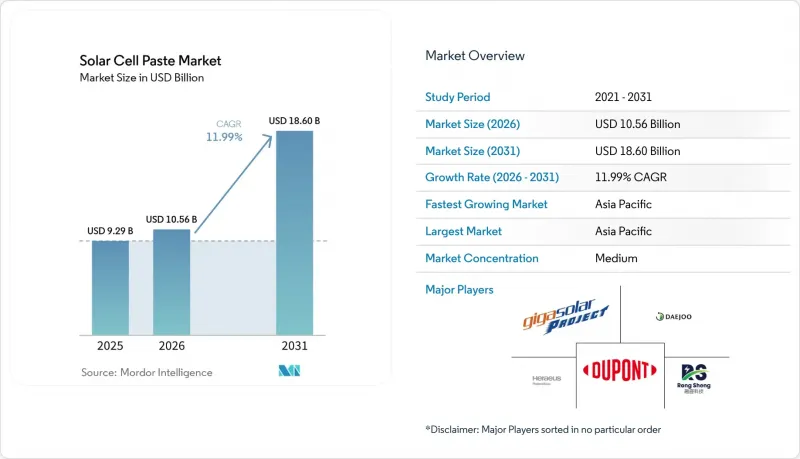
Mordor Intelligence에 의하면, 태양전지용 페이스트 시장 규모는 2025년에 92억 9,000만 달러로 평가되었습니다. 2026년에 105억 6,000만 달러에 달하고, 2031년까지 186억 달러에 이를 것으로 예측됩니다.
2026년부터 2031년까지 연평균 성장률(CAGR) 11.99%를 나타낼 것으로 전망됩니다.
본 보고서는 유형(은 페이스트, 알루미늄 페이스트 등), 용도(단결정 셀, 다결정 셀, 박막 셀 등), 최종 사용자(주거용, 상업 및 산업용, 유틸리티 규모, Off-grid/마이크로그리드), 지역(북미, 아시아태평양, 유럽, 남미, 중동 및 아프리카)별로 분류되어 있습니다. 시장 전망은 금액(달러) 기준으로 제시되어 있습니다.
세계의 태양전지용 페이스트 시장 동향 및 분석
중국, 인도, 미국의 태양광 발전 설비 용량이 꾸준히 증가함에 따라 페이스트 수요가 증가
중국에서만 2024년부터 2025년에 걸쳐 280GW 규모의 신규 셀 생산 능력이 추가되었으며, 누적 생산 능력은 800GW를 넘어섰고, 고정비를 상각하기 위해 생산 라인 가동률이 상승함에 따라 페이스트 소비량도 증가하고 있습니다. 24억 달러 규모의 인도의 생산 연계형 인센티브 제도는 국내에서 페이스트를 조달하도록 의무화하고 있으며, 현지 셀 제조업체와 한국 공급업체 간의 합작 투자를 촉진하고 있습니다. 미국에서는 IRA(인플레이션 억제법)에 따른 45배의 세액 공제 덕분에 2027년까지 연간 셀 생산량이 50GW에 달할 것으로 예상되며, 공급업체들이 지역별로 블렌딩 공장을 가동함에 따라 페이스트 납기 기간이 30일로 단축되었습니다. 지역화를 통해 재고로 묶여 있던 운전자금이 최대 20% 절감되어, 향후 공정 업그레이드를 위한 자금을 확보할 수 있습니다. 이러한 요인의 영향은 2028년까지 뚜렷하게 지속될 것이며, 와트당 페이스트 사용량이 감소하는 상황에서도 기준선 수요를 뒷받침할 것으로 보입니다.
PERC, TOPCon, HJT 셀로의 급속한 전환에 따라 고성능 페이스트에 대한 수요가 증가하고 있습니다.
2025년 말까지 분기별 생산 능력 확충에서 TOPCon이 PERC를 앞지르며, 24.5% 이상의 모듈 효율을 달성했습니다. 이에 따라 2층 메탈라이제이션 및 선택적 이미터 구조의 채택이 정당화되며, 그 결과 접촉 저항률 1.5 mΩ·cm² 미만, 선폭 25µm 미만을 달성할 수 있는 프론트사이드 페이스트가 필요합니다. HJT 셀의 경우, 비정질 실리콘 층을 보호하기 위해 200°C 미만에서 소결이 가능한 저온 은 배합이 필요합니다. REC Solar와 Huasun은 2026년 말까지 총 10GW 규모의 HJT 생산 능력을 가동할 전망입니다. 이러한 엄격한 사양으로 인해, 인증 공급업체는 전 세계적으로 10개 미만으로 제한되며, Heraeus, DuPont, Giga Solar를 중심으로 조달처가 통합될 것입니다. 제조업체들이 사업 전환을 모색하는 가운데, 유변학 제어 및 나노 은 분산 기술에 투자하는 페이스트 공급업체들은 프리미엄 가격과 장기 계약을 확보함으로써 은 가격 변동으로 인한 이익률 압박을 완화하고 있습니다.
은 가격 변동이 셀 제조업체의 비용 리스크를 확대
은 가격은 2025년 1월부터 2026년 1월까지 76% 급등했으나, 이후 2026년 3월까지 1g당 2.65-2.90달러로 반락했으며, 톤웨이, 롱지, JA 솔라는 헤지되지 않은 은 노출과 관련하여 2026년 1분기에 총 11억 달러의 손실을 기록할 수밖에 없었습니다. 현재 페이스트 공급업체들은 3개월 선물 가격에 연동된 고정 가격 계약을 제공하고 있으나, 이로 인해 상품 리스크가 업스트림로 전가되면서 공급업체의 매출총이익률은 최대 200베이시스포인트까지 축소되고 있습니다. 이에 대응하기 위해 2023년부터 2025년에 걸쳐 스크린 메쉬의 미세화를 통해 웨이퍼 1장당 평균 은 소비량이 110mg에서 92mg으로 감소했습니다. 따라서 가격 변동은 수익의 예측 가능성을 낮추고, 자원 절약 기술의 도입을 가속화하게 됩니다.
부문별 분석
은 페이스트는 뛰어난 전도성과 PERC, TOPCon, HJT에 대한 폭넓은 호환성 덕분에 2025년에는 태양전지용 페이스트 시장 점유율의 70.1%를 차지했습니다. 이 부문의 경쟁력은 단기적인 수익을 보호하고 있지만, 은 가격의 변동과 규제상의 역풍으로 인해 상승 여력은 제한적입니다. 무연 다금속 페이스트 시장은 EU의 REACH 규정 및 중국의 GB/T 38597 규격 요건을 배경으로 연평균 성장률(CAGR) 14.1%를 나타낼 것으로 전망됩니다. Sn-Ag-Cu 혼합물은 제조 비용을 약 10% 증가시키지만, 규정 준수 위험을 제거합니다. 알루미늄 페이스트는 유틸리티 규모의 프로젝트에서 Al-BSF 셀에 있어 여전히 중요하지만, TOPCon의 보급에 따라 시장 점유율은 줄어들고 있습니다. 구리 및 은 도금 구리 페이스트는 접착력과 마이그레이션 문제가 해결된다면 높은 성장 잠재력을 지니고 있습니다.
각 공급업체들은 이에 따라 제품 포트폴리오를 조정하고 있습니다. 헤라에우스(Heraeus)와 듀폰(DuPont)은 20-25%의 가격 프리미엄을 활용하여 HJT용 저온 나노은 분산액에 대한 연구 개발(R&D)에 주력하고 있습니다. 기가솔라(Giga Solar)와 같은 중국 경쟁사들은 가격에 민감한 기가와트급 태양광 발전소를 목표로, 알루미늄 및 기존 은 페이스트에 대한 투자를 강화하고 있습니다. 무연 블렌드의 조기 인증은 유럽의 규제 강화가 진행되는 상황에서 선점 우위를 가져다주는 반면, 은도금 구리 페이스트의 시범 프로젝트는 향후 발생할 수 있는 비용 충격에 대비한 대안으로 기능합니다. 따라서 경쟁 우위는 고효율과 비용 최적화라는 두 가지 요소에 대한 병행 투자에 달려 있으며, 소결 보조제 및 습윤제에 관한 지적 재산권이 중요한 경쟁 우위를 형성하고 있습니다.
지역별 분석
아시아태평양은 2025년에 태양전지용 페이스트 시장 점유율의 62.7%를 차지했으며, 2030년까지 500GW의 태양광 발전 설비 확충을 목표로 하는 중국의 계획과, 280GW를 목표로 하는 인도의 ‘국가 태양광 미션’에 힘입어 2031년까지 연평균 성장률(CAGR) 13.4%로 확대되고 있습니다. 장쑤성, 절강성, 안후이성에는 전 세계 셀 생산 능력의 60% 이상이 집중되어 있어, 페이스트 수요가 집중되고 규모의 경제가 실현되고 있습니다. 인도의 국내 조달 의무(DCR)에 따라, 이미 대주전자재료(Daejoo Electronic Materials)와 기가 솔라(Giga Solar)가 구자라트주 및 타밀나두주에서 합작 사업에 참여하고 있으며, 물류 리드타임이 90일에서 30일로 단축되었습니다. 한국과 일본은 생산량은 적지만, 반도체 소재에 관한 풍부한 전문 지식을 바탕으로 저온 HJT 페이스트 분야의 혁신을 주도하고 있습니다.
북미 시장 점유율은 2028년까지 급속히 확대될 전망입니다. IRA(인플레이션 억제법)에 따른 45배의 세액 공제로 인해, 미국의 셀 생산 능력은 2023년 8GW에서 2027년에는 50GW에 달할 것으로 예상되며, 이에 따라 현지에서도 페이스트 수요가 발생할 것입니다. 듀폰의 노스캐롤라이나주 생산 라인과 헤라에우스의 오하이오주 기술 센터는 이 부활하고 있는 시장에서 선구자적 우위를 보여주고 있습니다. REPowerEU 계획에 따라 연간 30GW를 목표로 하는 유럽은 생산 능력 부족에 직면해 있습니다. 따라서 현지 페이스트 소비량은 마이어-버거와 에넬 그린 파워가 주도하는 EU 내 셀 프로젝트의 성패에 달려 있습니다. 그럼에도 불구하고, 무연 합금 사용을 장려하는 규제 정책에 힘입어 유럽의 공장들은 Sn-Ag-Cu(주석·은·구리) 합금 도입에 있어 최전선에 서 있습니다.
중동 및 아프리카는 신흥 성장 지역입니다. 사우디아라비아의 ‘비전 2030’은 태양광 발전 20GW를 목표로 하고 있으며, 이에 따라 헤라에우스는 2026년에 리야드에 서비스 거점을 개설할 예정입니다. UAE의 5GW 규모 알 다프라 풍력 발전단지와 남아프리카공화국의 조달 라운드에 힘입어, 이 지역의 페이스트 수입은 증가할 전망이지만, 국내 생산은 여전히 초기 단계에 머물러 있습니다. 브라질과 칠레가 주도하는 남미는 셀의 대부분을 수입에 의존하고 있지만, 현지 조달 규제가 강화될 경우 향후 블렌딩 시설 건설이 촉진될 가능성이 있습니다. 이러한 지역들은 전반적으로 수익원의 다각화에 기여하지만, 적어도 2031년까지는 아시아태평양이 태양전지용 페이스트 시장의 핵심으로 남아 있을 것입니다.
기타 혜택 :
- 엑셀 형식 시장 예측(ME) 시트
- 3개월간의 애널리스트 지원
자주 묻는 질문
목차
제1장 서론
제2장 조사 방법
제3장 주요 요약
제4장 시장 구도
제5장 시장 규모 및 성장 예측
제6장 경쟁 구도
제7장 시장 기회 및 향후 전망
KTH 26.06.22According to Mordor Intelligence, the solar cell paste market size is projected to be USD 9.29 billion in 2025, USD 10.56 billion in 2026, and reach USD 18.60 billion by 2031, growing at a CAGR of 11.99% from 2026 to 2031.
This report is Segmented by Type (Silver Paste, Aluminum Paste, and More), Application (Monocrystalline Cells, Polycrystalline Cells, Thin-Film Cells, and More), End-User (Residential, Commercial and Industrial, Utility-Scale, and Off-Grid/Micro-grid) and Geography (North America, Asia-Pacific, Europe, South America, and Middle East and Africa). The Market Forecasts are Provided in Terms of Value (USD).
Global Solar Cell Paste Market Trends and Insights
Relentless PV Capacity Additions in China, India & US Boosting Paste Demand
China alone added 280 GW of new cell capacity during 2024-2025, pushing cumulative capability beyond 800 GW and lifting past consumption as lines run at higher utilization to amortize fixed costs. India's USD 2.4 billion Production-Linked Incentive mandates domestic paste sourcing, catalyzing joint ventures between local cell makers and Korean suppliers. In the United States, the IRA's 45X credit is underwriting a projected climb to 50 GW of annual cell output by 2027, trimming lead times for paste deliveries to 30 days as suppliers commission regional blending plants. Regionalization reduces working capital tied up in inventory by up to 20%, freeing cash for further process upgrades. The driver's impact stays pronounced through 2028, underpinning baseline demand even as per-watt paste loadings decline.
Rapid Shift to PERC, TOPCon & HJT Cells Requiring Higher-Performance Pastes
TOPCon overtook PERC in quarterly capacity additions by late 2025, delivering module efficiencies above 24.5% that justify dual-layer metallization and selective-emitter architectures, which in turn require front-side pastes that achieve contact resistivity under 1.5 mΩ*cm2 and line widths under 25 µm. HJT cells demand low-temperature silver formulations that fire below 200 °C to preserve amorphous-silicon layers; REC Solar and Huasun expect 10 GW of combined HJT capacity online by end-2026. These tighter specs limit qualified suppliers to fewer than 10 globally, consolidating purchasing around Heraeus, DuPont, and Giga Solar. As manufacturers pivot, paste vendors investing in rheology control and nano-silver dispersion secure premium pricing and longer-term contracts, cushioning margin pressure from silver volatility.
Silver Price Volatility Enlarging Cost Risk for Cell Makers
Silver rallied 76% from January 2025 to January 2026, then retraced to USD 2.65-2.90 per g by March 2026, forcing Tongwei, LONGi, and JA Solar to book USD 1.1 billion in combined Q1 2026 losses tied to unhedged silver exposure. Paste suppliers now offer fixed-price contracts indexed to three-month forwards, but these shift commodity risk upstream, compressing supplier gross margins by up to 200 bps. To cope, average silver consumption dropped from 110 mg to 92 mg per wafer between 2023 and 2025 through finer screen meshes. Volatility, therefore, reduces revenue predictability and accelerates the uptake of thrifting technologies.
Other drivers and restraints analyzed in the detailed report include:
- IRA, REPowerEU & Localization Schemes Spurring New Paste Lines Outside Asia
- Cost-Down Race Driving Silver-Coated-Copper & Low-Temp Pastes Uptake
- Accelerated Silver-Thrifting & Copper Plating Threaten Paste Volumes
For complete list of drivers and restraints, kindly check the Table Of Contents.
Segment Analysis
Silver Paste captured 70.1% of the solar cell paste market share in 2025, underpinned by its high conductivity and broad qualification across PERC, TOPCon, and HJT. The segment's dominance shields near-term revenues, yet silver volatility and regulatory headwinds limit upside. Lead-Free Multi-Metal Paste is forecast to post a 14.1% CAGR, benefiting from EU REACH and China's GB/T 38597 mandates; Sn-Ag-Cu blends add roughly 10% to production cost but remove compliance risk. Aluminum Paste remains relevant for Al-BSF cells in utility-scale projects, though share erodes as TOPCon spreads. Copper and silver-coated copper pastes present high upside if adhesion and migration challenges are solved.
Suppliers are aligning portfolios accordingly. Heraeus and DuPont funnel R&D into low-temperature nano-silver dispersions for HJT, leveraging 20-25% price premiums. Chinese contenders like Giga Solar double down on aluminum and conventional silver pastes aimed at price-sensitive gigawatt farms. Early certification of lead-free blends offers first-mover advantage in Europe's tightening policy environment, while silver-coated-copper pilots act as an option on future cost shocks. Competitive positioning, therefore, hinges on parallel bets across premium-efficiency and cost-optimized formulations, with IP around sintering additives and wetting agents forming key moats.
Geography Analysis
Asia-Pacific controlled 62.7% of the solar cell paste market share in 2025 and is expanding at a 13.4% CAGR to 2031, fueled by China's plan for 500 GW of additional PV by 2030 and India's National Solar Mission target of 280 GW. Jiangsu, Zhejiang, and Anhui house over 60% of global cell capacity, concentrating paste demand and enabling economies of scale. India's domestic-content rules have already lured Daejoo Electronic Materials and Giga Solar into Gujarat and Tamil Nadu joint ventures, trimming logistics lead times from 90 days to 30 days. South Korea and Japan, though smaller in volume, drive innovation in low-temperature HJT pastes, supported by extensive semiconductor materials expertise.
North America's share is set to rise rapidly through 2028 as the IRA's 45X credit propels U.S. cell capacity from 8 GW in 2023 to a forecast 50 GW by 2027, bringing with it localized paste demand. DuPont's North Carolina line and Heraeus's Ohio tech center illustrate first-mover capture of this resurgent market. Europe, targeting 30 GW per annum under REPowerEU, faces a manufacturing gap; local paste consumption therefore hinges on the success of intra-EU cell projects led by Meyer Burger and Enel Green Power. Still, the regulatory push for lead-free formulations positions European plants at the forefront of Sn-Ag-Cu adoption.
The Middle East and Africa are emerging growth zones. Saudi Arabia's Vision 2030 aims for 20 GW of solar, prompting Heraeus to open a Riyadh service hub in 2026. The UAE's 5 GW Al Dhafra farm and South Africa's procurement rounds will lift regional paste imports, though domestic manufacturing remains nascent. South America, led by Brazil and Chile, imports most cells but could catalyze future blending facilities if local content rules tighten. Collectively, these geographies diversify revenue streams, but Asia-Pacific will remain the anchor of the solar cell paste market through at least 2031.
- Heraeus Photovoltaics
- DuPont Microcircuit Materials
- Giga Solar Materials
- Rutech
- Daejoo Electronic Materials
- Samsung SDI
- Alpha Assembly (MacDermid Alpha)
- Dongjin Semichem
- InkTec
- Toyo Aluminium K.K.
- Monocrystal
- Ferro Corporation
- Targray
- Henkel AG & Co. KGaA
- Heraeus Noblelight (infra-red sintering)
- Pastetech GmbH
- Xi'an Hongxing Electronic Paste
- Jiangsu Hoyi Technology
- Hunan LEED Advanced Material
- Heraeus ShenZhen (local JV)
Additional Benefits:
- The market estimate (ME) sheet in Excel format
- 3 months of analyst support
TABLE OF CONTENTS
1 Introduction
- 1.1 Study Assumptions & Market Definition
- 1.2 Scope of the Study
2 Research Methodology
3 Executive Summary
4 Market Landscape
- 4.1 Market Overview
- 4.2 Market Drivers
- 4.2.1 Relentless PV capacity additions in China, India & US boosting paste demand
- 4.2.2 Rapid shift to PERC, TOPCon & HJT cells that require higher-performance front & rear pastes
- 4.2.3 IRA, REPowerEU & similar localisation schemes spurring new paste lines outside Asia
- 4.2.4 Cost-down race driving silver-coated-copper & low-temp pastes uptake
- 4.2.5 Surge in perovskite-tandem R&D demanding screen-printable conductive inks
- 4.3 Market Restraints
- 4.3.1 Silver price volatility enlarging cost risk for cell makers
- 4.3.2 Accelerated silver-thrifting & copper plating threaten paste volumes
- 4.3.3 Tighter lead-based frit regulations raising reformulation costs
- 4.3.4 High supplier concentration limits buyers' bargaining power
- 4.4 Supply-Chain Analysis
- 4.5 Regulatory Landscape
- 4.6 Technological Outlook
- 4.7 Porter's Five Forces
- 4.7.1 Bargaining Power of Suppliers
- 4.7.2 Bargaining Power of Buyers
- 4.7.3 Threat of New Entrants
- 4.7.4 Threat of Substitutes
- 4.7.5 Competitive Rivalry
5 Market Size & Growth Forecasts
- 5.1 By Type
- 5.1.1 Silver Paste
- 5.1.2 Aluminum Paste
- 5.1.3 Copper Paste
- 5.1.4 Silver-Coated-Copper Paste
- 5.1.5 Lead-Free Multi-Metal Paste
- 5.2 By Application
- 5.2.1 Monocrystalline Cells
- 5.2.2 Polycrystalline Cells
- 5.2.3 Thin-Film Cells
- 5.2.4 Heterojunction (HJT) Cells
- 5.2.5 Perovskite and Tandem Cells
- 5.3 By End-User
- 5.3.1 Residential
- 5.3.2 Commercial and Industrial
- 5.3.3 Utility-Scale
- 5.3.4 Off-Grid/Micro-grid
- 5.4 By Geography
- 5.4.1 North America
- 5.4.1.1 United States
- 5.4.1.2 Canada
- 5.4.1.3 Mexico
- 5.4.2 Europe
- 5.4.2.1 Germany
- 5.4.2.2 United Kingdom
- 5.4.2.3 France
- 5.4.2.4 Italy
- 5.4.2.5 NORDIC Countries
- 5.4.2.6 Russia
- 5.4.2.7 Rest of Europe
- 5.4.3 Asia-Pacific
- 5.4.3.1 China
- 5.4.3.2 India
- 5.4.3.3 Japan
- 5.4.3.4 South Korea
- 5.4.3.5 ASEAN Countries
- 5.4.3.6 Rest of Asia-Pacific
- 5.4.4 South America
- 5.4.4.1 Brazil
- 5.4.4.2 Argentina
- 5.4.4.3 Rest of South America
- 5.4.5 Middle East and Africa
- 5.4.5.1 Saudi Arabia
- 5.4.5.2 United Arab Emirates
- 5.4.5.3 South Africa
- 5.4.5.4 Egypt
- 5.4.5.5 Rest of Middle East and Africa
- 5.4.1 North America
6 Competitive Landscape
- 6.1 Market Concentration
- 6.2 Strategic Moves (M&A, Partnerships, PPAs)
- 6.3 Market Share Analysis (Market Rank/Share for key companies)
- 6.4 Company Profiles (includes Global level Overview, Market level overview, Core Segments, Financials as available, Strategic Information, Products & Services, and Recent Developments)
- 6.4.1 Heraeus Photovoltaics
- 6.4.2 DuPont Microcircuit Materials
- 6.4.3 Giga Solar Materials
- 6.4.4 Rutech
- 6.4.5 Daejoo Electronic Materials
- 6.4.6 Samsung SDI
- 6.4.7 Alpha Assembly (MacDermid Alpha)
- 6.4.8 Dongjin Semichem
- 6.4.9 InkTec
- 6.4.10 Toyo Aluminium K.K.
- 6.4.11 Monocrystal
- 6.4.12 Ferro Corporation
- 6.4.13 Targray
- 6.4.14 Henkel AG & Co. KGaA
- 6.4.15 Heraeus Noblelight (infra-red sintering)
- 6.4.16 Pastetech GmbH
- 6.4.17 Xi'an Hongxing Electronic Paste
- 6.4.18 Jiangsu Hoyi Technology
- 6.4.19 Hunan LEED Advanced Material
- 6.4.20 Heraeus ShenZhen (local JV)
7 Market Opportunities & Future Outlook
- 7.1 White-Space & Unmet-Need Assessment