|
시장보고서
상품코드
2063268
온디맨드 트럭 운송 : 시장 점유율 분석, 업계 동향 및 통계, 성장 예측(2026-2031년)On-demand Trucking - Market Share Analysis, Industry Trends & Statistics, Growth Forecasts (2026 - 2031) |
||||||
 Mordor Intelligence
Mordor Intelligence에 의하면, 온디맨드 트럭 운송 시장 규모는 2025년 793억 5,000만 달러로 평가되었습니다. 2026년 929억 9,000만 달러에서 2031년까지 1,967억 2,000만 달러로 확대되고 2026년부터 2031년에 걸쳐 CAGR은 16.17%를 나타낼 것으로 예측됩니다.
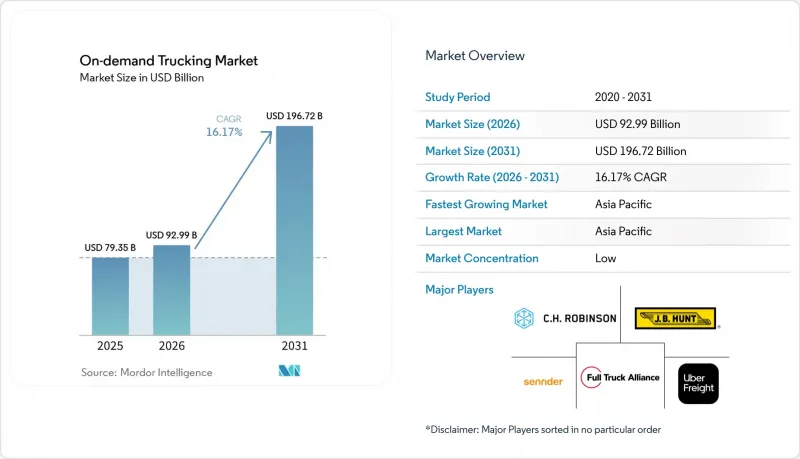
라이드셰어링을 통해 대두된 실시간 견적 수요로 인해, 화물 운송의 의사결정 주기가 며칠이 걸리던 RFP에서 1분 미만의 API 호출로 단축되었으며, 통합된 통관 워크플로가 선전부터 시카고에 이르는 전자상거래 회랑을 개척하고 있습니다. 본 보고서는 서비스 유형(FTL, LTL), 차량 유형(소형 트럭, 중형 트럭, 대형 트럭), 최종 사용자(전자상거래·소매, 소비재, 식품 및 음료 등) 및 지역(북미, 남미, 아시아태평양, 유럽, 중동 및 아프리카)별로 분류되어 있습니다. 시장 전망은 금액(달러) 기준으로 제시되어 있습니다.
세계의 온디맨드 트럭 운송 시장 동향 및 인사이트
연료 가격 변동이 화주들로 하여금 온디맨드 운송을 통해 운송 능력을 헤지하도록 만들고 있습니다.
2025년 디젤 연료 가격은 갤런당 평균 2.50-4.20달러를 기록하며, 고정 요금 계약을 맺은 운송업체들의 이익률을 압박했습니다. 온디맨드 트럭 운송 시장에서는 연료 리스크가 화물 단위 가격 책정으로 전환되기 때문에 화주는 현물 가격이 급등한 경우에만 투명한 추가 요금을 지불하면 됩니다. 연료비가 운영 비용의 24-38%를 차지하는 장거리 노선에서는 조달 팀이 디지털 화물 플랫폼을 실시간 헤지 도구로 활용하고 있어, 도입이 가장 빠르게 진행되고 있습니다. 기존의 연료 가격 연동 조항에 대해 협상력을 갖추지 못한 중견 수출업체와 농업협동조합이 가장 큰 혜택을 보고 있습니다. 한편, 플랫폼 측은 변동 시세를 수익화하기 위해 변동하는 에너지 지수를 견적 엔진에 직접 반영하고, 불확실성이 높은 기간에는 스프레드를 확대하면서도 서비스 수준을 유지하고 있습니다.
스코프 3 배출량 보고 의무가 알고리즘을 통한 백홀 풀링을 촉진
SEC 및 EU의 규정에 따라, 상장 기업은 2027년도부터 업스트림 및 하류 화물 운송 배출량을 공개해야 합니다. 이에 따라 온디맨드 트럭 운송 시장에는 GHG 프로토콜의 스코프 3 카테고리 4 및 9에 부합하는 탄소 배출량 계산 기능이 통합되어 있습니다. 빈 차로 귀가하는 주행 거리를 35%에서 15% 미만으로 줄이는 알고리즘은 화주의 배출 강도를 낮추는 동시에 화물당 비용을 절감합니다. 이 플랫폼은 제3자 검증 기관의 감사를 거친 노선별 인증서를 발급하고 있으며, 이를 통해 수출업체는 투자자의 ESG 심사 요건을 충족할 수 있게 됩니다. 가전 및 의류 업계의 조기 도입 기업들은 이미 과잉 운송량의 40%를 검증 가능한 배출량 대시보드를 제공하는 업체를 통해서만 조달하고 있으며, 이는 입찰 평가에서 지속가능성 지표가 가격이나 서비스와 동등하게 중요하게 여겨지게 되었음을 보여줍니다.
만성적인 운전기사 부족과 노동력의 고령화가 서비스의 신뢰성을 위협하고 있습니다.
전미트럭운송협회(ATA)는 2031년까지 16만 명의 운전기사 부족이 발생할 것으로 예측하고 있으며, 이는 2024년 부족 인원의 2배에 해당합니다. 운전자의 연령 중앙값은 현재 46세이며, 사업자의 54%가 45세 이상인 것으로 나타나, 장거리 노선에서 이직률이 악화되고 있습니다. 공석 수가 늘어남에 따라, 플랫폼은 성수기에 화물 수주 거절이 증가하면서 ‘주문형 운송 능력’이라는 약속이 훼손되고 있습니다. 일부 시장 선도 기업들은 젊은 운전자들을 유치하기 위해 주 단위 최소 적재량 보장이나 주차비 선불과 같은 조치를 취하고 있습니다. 그럼에도 불구하고, 운송 능력 부족이 지방 노선이나 온도 관리가 필요한 노선의 성장을 저해하고 있어, 본래라면 견조한 성장세를 보일 온디맨드 트럭 운송 시장의 확대에 제동을 걸고 있습니다.
부문별 분석
소량 화물(LTL) 서비스는 시장 규모는 작지만, 2031년까지 연평균 성장률(CAGR) 17.23%를 나타낼 전망입니다. 이는 온디맨드 트럭 운송 시장에서 65.52%의 점유율을 차지하는 풀 트럭 로드(FTL)를 앞지르는 속도입니다. 실시간 집하 도구를 통해 여러 화주의 화물을 공유 트레일러에 통합함으로써, 단위당 운임 비용을 30-45% 절감할 수 있기 때문입니다. 온디맨드 트럭 운송 시장 규모라는 맥락에서 알고리즘을 활용한 LTL(소량 화물) 용도는 이미 연간 180억 달러 규모의 화물량을 관리하고 있으며, 기존 허브 앤 스포크 방식의 운송업체들 시장 점유율을 서서히 잠식하고 있습니다. AI 엔진은 체류 시간, 창고 가동 시간 및 운전자의 근무 시간대를 고려하여 환적에 따른 지연을 방지함으로써, 깨지기 쉬운 가전제품이라도 동적인 LTL 운송이 가능해졌습니다. 이전에는 화물 파손을 우려하던 화주들도, 플랫폼이 포장 사양을 심사하고 트레일러 내의 안전한 위치를 배정해 주게 되면서 혼재 운송을 수용하게 되었습니다.
단일 화물의 무결성이 최우선으로 고려되는 벌크 상품, 농산물, 위험물의 경우, FTL(전체 트럭 적재)은 여전히 필수적입니다. 그러나 FTL 분야에서도 플랫폼을 통한 현물 운임 예약이 증가하고 있으며, 2025년에는 미국 장거리 운송 물동량의 28%를 차지했습니다. 현재, 많은 포춘 100대 기업 제조업체들은 연료 가격 변동과 운송량 예측 불가능성에 모두 대비하기 위해 연간 운송 계약의 75%를 계약 기반으로, 25%를 디지털 현물 거래로 나누고 있습니다. 이 하이브리드 모델은 FTL 시장 점유율을 높은 수준으로 유지하면서도 계약 조건을 재정의하여, 전용 계약을 완전히 대체하지 않고도 예산 주기 전반에 걸쳐 온디맨드 트럭 운송 시장의 지속적인 이용을 보장하고 있습니다.
지역별 분석
아시아태평양은 2025년에 전 세계 화물량의 41.25%를 차지했으며, 2031년까지 연평균 성장률(CAGR) 18.34%를 나타낼 것으로 전망됩니다. 이는 아세안 국가들로의 트럭 운송을 위해 팔레트를 혼적하는 중국의 보세 창고형 전자상거래 모델에 힘입은 것입니다. 인도의 국가 물류 정책은 세관 전자 신고와 화물 플랫폼을 연계하여 국경을 넘는 통관 절차를 며칠에서 몇 시간으로 단축하고, 인도 대륙 전역에서 온디맨드 트럭 운송 시장을 더욱 확대되고 있습니다. 자카르타, 방콕, 마닐라의 도심 교통 체증은 소형 차량의 도입을 촉진하고 있는 반면, 전기차 밴에 대한 정부의 인센티브는 플랫폼 연계형 리스 풀에 선점자 기회를 창출하고 있습니다.
유럽에서는 기업 지속가능성 보고 지침(CSRD)에 따라 탄소 집약도 기준이 상향 조정되었으며, 알고리즘을 활용한 풀 운송만이 이 기준을 충족할 수 있기 때문에 시장이 15% 중반대의 성장률을 기록하며 확대되고 있습니다. 독일, 프랑스, 북유럽 국가들에서는 공회전 거리를 줄이고, 소매업체가 소포 1개당 CO2 배출량을 줄여 보고할 수 있도록 지원하는 백홀 마켓플레이스가 널리 보급되고 있습니다. 그렇긴 하지만, 고용에 관한 의무적인 규제가 비용 요인으로 작용하여 스타트업 기업의 성장을 저해하고 있습니다. 브렉시트로 인한 복잡한 상황이 추가적인 호재로 작용하고 있습니다. 종단 간 통관 자동화 서비스를 제공하는 플랫폼은 특히 상품 구색이 풍부한 패션 상품 분야에서 영국과 EU 간 운송 노선 점유율을 확대되고 있습니다.
북미는 ERP에 통합된 화물 예약 분야에서 디지털 분야의 주도권을 유지하고 있습니다. SAP 및 Oracle의 TMS 제품군에 통합된 기성 API를 통해 하루 3만 건 이상의 화물이 플랫폼의 스팟 보드로 직접 전송되고 있습니다. 그러나 이 지역에서는 운전기사 부족 문제가 가장 심각하여 마일당 운임이 상승하고 있으며, 온디맨드 트럭 운송 시장은 I-10 및 I-40 회랑에서 자율주행 시범 사업으로 방향을 전환하고 있습니다. 미국의 화주들은 또한 소규모 차량 그룹을 대상으로 이용 기반 화물 보험을 제공하는 핀테크 기업을 활용하고 있으며, 이로 인해 운송업체의 선택 폭은 넓어졌지만, 화물을 인수할 때 보험의 유효성을 확인해야 하는 규정 준수상의 부담도 발생하고 있습니다. 캐나다와 멕시코 역시 니어쇼어링이 국경을 넘는 물류 흐름을 재편하는 과정에서 유사한 모델을 도입하고 있지만, 로키 산맥 일대의 주와 온타리오주 북부에서는 지방 지역의 광대역 환경 격차가 여전히 실시간 가시성을 저해하고 있습니다.
기타 혜택 :
- 엑셀 형식 시장 예측(ME) 시트
- 3개월간의 애널리스트 지원
자주 묻는 질문
목차
제1장 서론
제2장 조사 방법
제3장 주요 요약
제4장 시장 구도
제5장 시장 규모 및 성장 예측
제6장 경쟁 구도
제7장 시장 기회 및 향후 전망
KTH 26.06.22According to Mordor Intelligence, the on-demand trucking market size is projected to expand from USD 79.35 billion in 2025 and USD 92.99 billion in 2026 to USD 196.72 billion by 2031, registering a CAGR of 16.17% between 2026 and 2031.
Instant quote expectations born in ride-hailing push freight decision cycles from multi-day RFPs to sub-minute API calls, while embedded customs workflows unlock e-commerce corridors stretching from Shenzhen to Chicago. This report is Segmented by Service Type (FTL, LTL), by Vehicle Type (Light-Duty Trucks, Medium-Duty Trucks Class, Heavy-Duty Trucks Class), by End User (E-Commerce and Retail, Consumer Packaged Goods, Food and Beverage, and More), and by Geography (North America, South America, Asia Pacific, Europe, Middle East and Africa). The Market Forecasts are Provided in Terms of Value (USD).
Global On-demand Trucking Market Trends and Insights
Fuel-price Volatility Steering Shippers Toward On-demand Capacity Hedging
Diesel averaged USD 2.50 to USD 4.20 per gallon during 2025, compressing carrier margins in fixed-rate contracts. The on-demand trucking market converts fuel risk into load-level pricing, allowing shippers to pay a transparent surcharge only when spot prices spike. Long-haul lanes, where fuel is 24-38% of operating cost, show the steepest adoption as procurement teams treat digital freight platforms as a real-time hedging tool. Mid-market exporters and agricultural co-ops without leverage for traditional fuel-escalator clauses gain the most relief. Platforms, for their part, monetize volatility by embedding rolling energy indices directly into quote engines, widening spreads during high-uncertainty windows while maintaining service levels.
Scope-3 Emission Reporting Mandates Boosting Algorithmic Back-haul Pooling
SEC and EU rules compel listed firms to disclose upstream and downstream freight emissions beginning fiscal 2027. The on-demand trucking market thus embeds carbon calculators aligned to GHG Protocol Scope-3 categories 4 and 9. Algorithms that cut empty-return miles from 35% to under 15% lower shippers' emissions intensity while trimming cost per load. Platforms issue lane-level certificates audited by third-party verifiers, enabling exporters to satisfy investor ESG screens. Early adopters in consumer electronics and apparel already route 40% of overflow volume only through providers offering verifiable emission dashboards, signaling a shift where sustainability metrics now sit beside price and service in bid evaluations.
Chronic Driver Shortage & Aging Workforce Pressuring Service Reliability
The American Trucking Associations expects a 160,000-driver gap by 2031, double the 2024 shortfall. Median driver age now sits at 46, with 54% of operators older than 45, worsening attrition for long-haul lanes. As vacancies rise, platforms experience higher load rejections during seasonal peaks, eroding the "capacity-on-tap" promise. Some market leaders counter by offering guaranteed weekly minimums and prepaid parking to attract younger drivers. Nevertheless, capacity scarcity caps growth in rural and temperature-controlled corridors, tempering otherwise robust on-demand trucking market expansion.
Other drivers and restraints analyzed in the detailed report include:
- Explosive Cross-border E-commerce Growth Demanding Customs-ready Flexible Trucking
- Instant Freight-quote Expectations Accelerating Platform Adoption
- Worker-classification Laws Inflating Gig-fleet Costs
For complete list of drivers and restraints, kindly check the Table Of Contents.
Segment Analysis
Less-than-Truckload services, while representing a smaller base, are on course for 17.23% CAGR through 2031. That outpaces Full Truckload's 65.52% dominance in the on-demand trucking market as real-time consolidation tools pool multi-shipper parcels onto shared trailers, cutting unit freight costs 30-45%. Within the on-demand trucking market size context, algorithmic LTL applications already manage USD 18 billion of annual volume, chipping away at traditional hub-and-spoke carriers. AI engines factor dwell times, warehouse operating hours, and driver Hours-of-Service windows to avoid trans-shipment delays, making dynamic LTL viable even for fragile consumer electronics. Shippers previously wary of damage now accept consolidated moves because platforms audit packaging specs and assign secure positions inside trailers.
FTL remains indispensable for bulk commodities, agricultural products, and hazardous materials where single-load integrity is paramount. Yet even in FTL, spot-rate bookings via platforms are climbing, comprising 28% of long-haul loads in the United States during 2025. Many Fortune 100 manufacturers now split annual freight commitments 75% contracted, 25% digital spot to hedge both fuel volatility and volume unpredictability. That hybrid model keeps FTL share high but redefines engagement terms, ensuring repeated references to the on-demand trucking market continue across budgeting cycles without replacing dedicated contracts entirely.
Geography Analysis
Asia Pacific captured 41.25% of global volume in 2025 and is projected to grow 18.34% CAGR through 2031, underpinned by China's bonded-warehouse e-commerce model that packs consolidated pallets for truck crossings into ASEAN. India's National Logistics Policy synchronizes customs e-filing with freight platforms, shaving trans-border clearance from days to hours and further expanding the on-demand trucking market across the subcontinent. Urban congestion in Jakarta, Bangkok, and Manila incentivizes light-duty adoption, while government incentives for EV vans create early mover opportunities for platform-linked leasing pools.
Europe advances at mid-teens percentage growth as the Corporate Sustainability Reporting Directive elevates carbon-intensity thresholds that only algorithmic pooling can meet. Germany, France, and the Nordics embrace back-haul marketplaces that cut empty kilometers and help retailers report lower grams-CO2 per parcel. Nonetheless, mandatory employment rules add cost layers that slow startup proliferation. Brexit complexities add another catalyst: platforms offering end-to-end customs automation secure an increasing United Kingdom-EU lane share, especially for high-mix fashion goods.
North America maintains digital leadership in ERP-embedded freight booking. Pre-built APIs inside SAP and Oracle TMS suites route more than 30,000 loads per day directly to platform spot boards. Yet the region feels the sharpest driver deficit, raising per-mile prices and pushing the on-demand trucking market toward autonomous pilots on I-10 and I-40 corridors. United States shippers also adopt usage-based cargo insurance fintechs for micro-fleets, expanding carrier pools but adding compliance overhead to validate insurance at load tender. Canada and Mexico court similar models as near-shoring reshapes cross-border freight flows, while rural broadband gaps still hamper real-time visibility in the Rocky Mountain states and northern Ontario.
- Uber Freight
- C.H. Robinson
- Full Truck Alliance (Manbang)
- DHL Supply Chain & Freight
- Sennder
- GoShare
- Loadsmart
- NEXT Trucking
- Ontruck
- Lalamove
- GoGoX
- BlackBuck
- Flock Freight
- Shipwell
- J.B. Hunt 360
- Schneider FreightPower
- Doft
- DAT (DAT Freight & Analytics)
- CloudTrucks
- Delhivery
- Cargomatic
Additional Benefits:
- The market estimate (ME) sheet in Excel format
- 3 months of analyst support
TABLE OF CONTENTS
1 Introduction
- 1.1 Study Assumptions and Market Definition
- 1.2 Scope of the Study
2 Research Methodology
3 Executive Summary
4 Market Landscape
- 4.1 Market Overview
- 4.2 Market Drivers
- 4.2.1 Fuel-price volatility steering shippers toward on-demand capacity hedging
- 4.2.2 Scope-3 emission reporting mandates boosting algorithmic back-haul pooling
- 4.2.3 Explosive cross-border e-commerce growth demanding customs-ready flexible trucking
- 4.2.4 Instant freight-quote expectations accelerating platform adoption
- 4.2.5 ERP/TMS "Instant Truck Book" APIs slashing integration friction
- 4.2.6 Usage-based cargo-insurance fintechs enabling micro-fleet participation
- 4.3 Market Restraints
- 4.3.1 Chronic driver-shortage & aging workforce pressuring service reliability
- 4.3.2 Worker-classification laws (e.g., AB 5, EU Platform Work Directive) inflating gig-fleet costs
- 4.3.3 Data-privacy regulations limiting monetization of telematics & location streams
- 4.3.4 Sparse satellite fail-over connectivity causing rural SLA breaches
- 4.4 Porter's Five Forces
- 4.4.1 Threat of New Entrants
- 4.4.2 Bargaining Power of Buyers
- 4.4.3 Bargaining Power of Suppliers
- 4.4.4 Threat of Substitutes
- 4.4.5 Competitive Rivalry
- 4.5 Value / Supply-Chain Analysis
- 4.6 Technological Innovations in the Industry
- 4.7 Government Regulations and Policies
- 4.8 Impact of Geopolitical Events on the Market
5 Market Size and Growth Forecasts (Value)
- 5.1 By Service Type
- 5.1.1 Full Truckload (FTL)
- 5.1.2 Less-than-Truckload (LTL)
- 5.2 By Vehicle Type
- 5.2.1 Light-Duty Trucks (Class 1-3)
- 5.2.2 Medium-Duty Trucks (Class 4-6)
- 5.2.3 Heavy-Duty Trucks (Class 7-8)
- 5.3 By End User
- 5.3.1 E-commerce and Retail
- 5.3.2 Consumer Packaged Goods
- 5.3.3 Food and Beverage (incl. Cold-chain)
- 5.3.4 Healthcare and Pharma
- 5.3.5 Industrial and Manufacturing
- 5.3.6 Others
- 5.4 By Geography
- 5.4.1 North America
- 5.4.1.1 United States
- 5.4.1.2 Canada
- 5.4.1.3 Mexico
- 5.4.2 South America
- 5.4.2.1 Brazil
- 5.4.2.2 Peru
- 5.4.2.3 Chile
- 5.4.2.4 Argentina
- 5.4.2.5 Rest of South America
- 5.4.3 Asia-Pacific
- 5.4.3.1 India
- 5.4.3.2 China
- 5.4.3.3 Japan
- 5.4.3.4 Australia
- 5.4.3.5 South Korea
- 5.4.3.6 Southeast Asia (Singapore, Malaysia, Thailand, Indonesia, Vietnam, and Philippines)
- 5.4.3.7 Rest of Asia-Pacific
- 5.4.4 Europe
- 5.4.4.1 United Kingdom
- 5.4.4.2 Germany
- 5.4.4.3 France
- 5.4.4.4 Spain
- 5.4.4.5 Italy
- 5.4.4.6 BENELUX (Belgium, Netherlands, and Luxembourg)
- 5.4.4.7 NORDICS (Denmark, Finland, Iceland, Norway, and Sweden)
- 5.4.4.8 Rest of Europe
- 5.4.5 Middle East and Africa
- 5.4.5.1 United Arab Emirates
- 5.4.5.2 Saudi Arabia
- 5.4.5.3 South Africa
- 5.4.5.4 Nigeria
- 5.4.5.5 Rest of Middle East and Africa
- 5.4.1 North America
6 Competitive Landscape
- 6.1 Market Concentration
- 6.2 Strategic Moves
- 6.3 Market Share Analysis
- 6.4 Company Profiles (includes Global level Overview, Market level overview, Core Segments, Financials as available, Strategic Information, Market Rank/Share for key companies, Products and Services, and Recent Developments)
- 6.4.1 Uber Freight
- 6.4.2 C.H. Robinson
- 6.4.3 Full Truck Alliance (Manbang)
- 6.4.4 DHL Supply Chain & Freight
- 6.4.5 Sennder
- 6.4.6 GoShare
- 6.4.7 Loadsmart
- 6.4.8 NEXT Trucking
- 6.4.9 Ontruck
- 6.4.10 Lalamove
- 6.4.11 GoGoX
- 6.4.12 BlackBuck
- 6.4.13 Flock Freight
- 6.4.14 Shipwell
- 6.4.15 J.B. Hunt 360
- 6.4.16 Schneider FreightPower
- 6.4.17 Doft
- 6.4.18 DAT (DAT Freight & Analytics)
- 6.4.19 CloudTrucks
- 6.4.20 Delhivery
- 6.4.21 Cargomatic