

|
시장보고서
상품코드
2063270
온디맨드 화물 운송 시장 : 시장 점유율 분석, 업계 동향 및 통계, 성장 예측(2026-2031년)On-demand Freight Transportation - Market Share Analysis, Industry Trends & Statistics, Growth Forecasts (2026 - 2031) |
||||||
 Mordor Intelligence
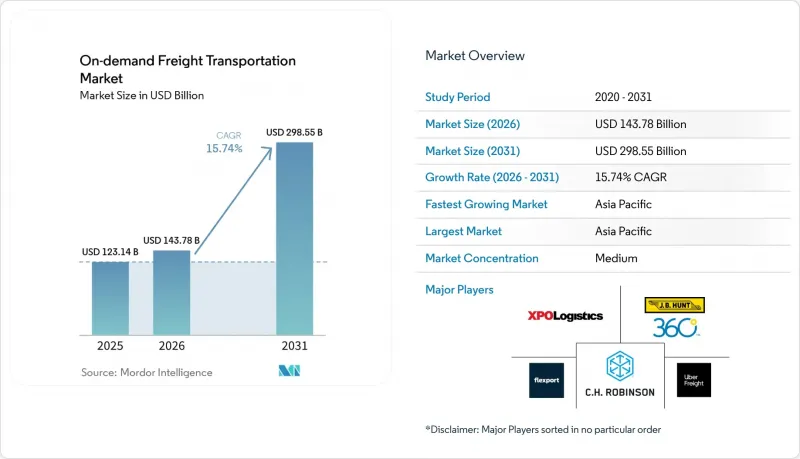
Mordor Intelligence에 의하면, 온디맨드 화물 운송 시장 규모는 2025년 1,231억 4,000만 달러로 평가되었고, 2026년에는 1,437억 8,000만 달러로 추정되고, 2031년까지 2,985억 5,000만 달러에 이를 것으로 예측되며, 2026-2031년 CAGR 15.74%로 성장할 전망입니다.
리쇼어링의 기세가 거세지면서 공급망이 지리적으로 압축됨에 따라, 화주들은 몇 주가 아닌 몇 시간 내에 조달할 수 있는 유연한 운송 능력을 선호하게 되었습니다. 본 보고서는 서비스 유형별(디지털 화물 중개 및 매칭 등), 운송 수단별(육상, 항공 등), 배송 속도별(당일, 익일 등), 최종 사용자 산업별(전자상거래 및 소매, 소비재 등) 및 지역별(북미, 남미, 아시아태평양 등)로 세분화되어 있습니다. 시장 전망은 금액(달러) 기준으로 제시되어 있습니다.
세계 온디맨드 화물 운송 시장 동향 및 인사이트
제조업의 니어쇼어링이 단거리 및 국경을 넘는 트럭 운송 수요를 끌어올리고 있습니다.
미국의 멕시코산 상품 수입이 20년 만에 중국을 앞지르면서, 주문형 디지털 매칭에 적합한 300-800마일 구간의 밀집된 운송 노선이 활성화되고 있습니다. 텍사스주와 누에보레온주에 걸쳐 위치한 자동차 및 전자기기 공장에서는 프리미엄 요금이 적용되는 당일 또는 익일 배송 트럭 운송 서비스가 요구되고 있습니다. 베트남, 태국, 인도네시아로의 이와 같은 생산 이전으로 인해 아세안(ASEAN) 지역 내 화물 운송량은 증가하고 있지만, 구매관리자지수(PMI)는 여전히 회복력의 기준점인 50 근처에서 등락을 거듭하고 있습니다. 디지털 플랫폼은 국경을 넘는 통관 절차, 배송 확인 및 운송 능력의 균형 조정을 자동화함으로써, 이러한 예측 가능하고 빈도가 높은 운송 수요를 활용하고 있습니다.
B2B 화물 조달 플랫폼 : 스팟 운송 슬롯 이용의 대중화
주요 화주들은 현재 수동 전화 입찰을 대체하는 실시간 디지털 경매를 활용하여, 계약 운송과 스팟 운송을 통합된 워크플로에 포함시키고 있습니다. 월마트는 자사 전용 차량만으로 연간 수천만 건의 배송을 처리하며, 연간 10억 마일 가까이 주행하고 있는데, 이는 확장 가능한 API가 장기적인 운송업체 계약과 공존할 수 있음을 보여줍니다. 그 결과 확보된 투명성 덕분에 중개인의 수수료 차익은 한 자릿수 수준으로 줄어들었으며, 물류 비용 절감이 가능해졌습니다. 개방형 마켓플레이스가 성수기 운송 능력 확보에 있어 공정한 경쟁 환경을 조성함으로써, 중견 기업들도 그 혜택을 누리고 있습니다. 이러한 변화들이 맞물리면서 온디맨드 화물 운송 시장 전체의 가격 형성과 힘의 균형이 재편되고 있습니다.
배터리식 전기 트럭의 주행 거리 제한과 충전 대기 시간이 도시 지역 도입을 가로막고 있습니다.
클래스 8 전기 트럭은 한 번 충전으로 보통 150-250마일밖에 주행할 수 없지만, 디젤 차량은 1,000마일을 주행할 수 있습니다. 따라서 전기 트럭은 단거리 운송이나 도심 내 셔틀 운행에 한정되어 있습니다. 350kW 충전기를 사용하더라도 80%까지 충전하는 데 1시간이 걸려, 하루 가동률을 10-15% 낮추고 있습니다. 50억 달러 규모의 미국 NEVI 프로그램은 경차에 우선순위를 두고 있어, 대형 차량의 주요 노선에서는 여전히 충전 인프라가 부족합니다. 메가와트급 충전 설비와 더 고밀도인 충전소 네트워크가 구축될 때까지는 사업자들이 전기 트럭 도입을 주저할 수밖에 없어, 온디맨드 화물 운송 시장의 지속가능성이라는 강점이 훼손되고 있습니다.
부문별 분석
2025년에는 온디맨드 라스트마일 화물 운송이 온디맨드 화물 운송 시장 점유율의 45.59%를 차지했습니다. 그러나 자산을 보유하지 않고 TMS(운송 관리 시스템)와 직접 연동되는 혜택을 누리는 디지털 중개 플랫폼은 해당 부문 내에서 가장 높은 연평균 성장률(CAGR) 19.91%를 나타낼 것으로 전망됩니다. 중개 마켓플레이스는 기업의 화물과 운송업체를 단 몇 초 만에 연결하여 공차 주행을 줄이고 관리 비용을 절감합니다. 크라우드소싱형 택배 네트워크는 고용 관련 규정 준수 비용 증가에 직면해 있으며, 그 비용 경쟁력은 점차 줄어들고 있습니다. 또한, API를 지원하는 중개 사업은 국제 운송 노선 개척을 가능하게 하고, 화주와 국경 간 운송업체를 직접 연결함으로써 네트워크 효과를 강화하고 있습니다.
플랫폼 사업자는 자본 집약적인 차량 보유가 아닌 8-12%의 거래 수수료를 통해 수익을 창출하기 때문에 운송량 증가가 신속하게 이익으로 이어집니다. 그러나 Convoy의 최근 철수 사례가 보여주듯이, 유동성만으로는 부족하며, 운송업체와의 견고한 관계와 엄격한 화물 인수 심사가 여전히 결정적인 요소로 작용합니다. 차별화를 꾀하기 위해, 살아남은 플랫폼들은 임베디드 결제 서비스, 화물 게시판과 보험을 결합한 상품, 예상 도착 시간(ETA) 등의 서비스를 제공하며 화주들의 업무 흐름 내에서 입지를 공고히 하고 있습니다. 이러한 서비스가 성숙해짐에 따라, 중개 업무와 연계된 온디맨드 화물 운송 시장 규모는 2020년대 초반에는 라스트 마일 매출을 넘어설 것으로 예측됩니다.
2025년 수익의 64.25%를 육상 운송이 차지했으며, 이는 곳곳에서 나타나는 전차 적재(FTL) 및 소량 화물(LTL) 수요에 힘입은 결과입니다. 이 하위 부문의 세분화된 출발지-도착지 조합은 이용률을 높이고 리드 타임을 단축하는 알고리즘 기반 매칭에 적합합니다. 그럼에도 불구하고, 항공 화물은 2031년까지 연평균 18.42%의 성장률을 기록하며 다른 모든 운송 수단을 앞지를 것으로 전망됩니다. 의약품 바이오의약품, 반도체 칩, 고급 전자기기는 시간 지정 배송에 대한 의존도가 높아지고 있으며, 온디맨드 포털이 항공사, 통합 물류업체, 전세 항공편 네트워크 전반에 걸쳐 화물 공간을 확보하고 있습니다.
화물칸의 수송 능력 부족이 지속되고 있어 화물기 운항사의 가격 결정력은 유지되고 있으며, Kg당 항공 운임은 여전히 해상 운임의 12배 이상입니다. 이에 반해, 디지털 화물 마켓플레이스는 즉시 예약, 동적 가격 책정, 그리고 업무 처리의 번거로움을 줄여주는 자동 항공운송장 기능을 제공함으로써 이에 대응하고 있습니다. 또한, 육상-항공-육상 복합 운송을 조정하여 공항 내 운송 및 통관 절차를 단일 거래로 통합함으로써, 온디맨드 화물 운송 시장을 더욱 활성화하고 있습니다.
지역별 분석
아시아태평양은 2025년에 전 세계 매출의 41.74%를 차지한 것으로 평가되었으며, 2031년까지 연평균 18.15%의 성장률을 유지할 것으로 전망되어, 온디맨드 화물 운송 시장에서 운송량과 성장의 원동력으로서의 입지를 확고히 하고 있습니다. 중국 연안 지역에서 베트남, 인도네시아, 인도로 공장이 이전됨에 따라, 디지털 플랫폼이 통관 사전 절차와 수요 집약을 관리하는 긴밀한 역내 회랑이 형성되고 있습니다. '일대일로' 철도망은 동남아시아와 중국 내륙 지역의 생산 클러스터를 더욱 통합하고, 운송 시간을 단축하는 동시에, 국경 간 전자상거래 사업자를 위한 가용 운송 능력을 확대되고 있습니다.
북미는 시장 점유율 면에서는 뒤처져 있지만, 멕시코와 미국 간의 니어쇼어링을 통해 비례하지 않을 정도로 큰 혜택을 누리고 있습니다. 전자기기 및 자동차 OEM 제조업체들이 최종 소비지로부터 500마일 반경 내에 조립 공장과 부품 공장을 함께 설립함에 따라, 국경을 넘는 트럭 운송 물량이 급격히 증가했습니다. '인프라 투자 및 고용법'은 스마트 주차, 주행 중 중량 측정, 텔레매틱스 회랑에 자금을 지원하며, 이는 자산의 생산성을 높이고 플랫폼 도입을 촉진합니다. 또한, 미국의 플랫폼은 블록체인을 활용한 실시간 결제의 선구자이기도 하며, 만성적인 운전기사 부족 속에서 독립적인 개인 사업자 운전기사들을 유치하는 데 일조하고 있습니다.
유럽에서는 지속가능성과 모달 시프트가 중요하게 여겨지고 있습니다. '유럽 연결 인프라(CEF)'의 283억 8,000만 달러 규모의 교통 예산에는 국경을 넘나드는 원활한 화물 운송 노선을 위한 자금이 포함되어 있으며, 이 플랫폼은 이를 복합 운송 방식의 문앞에서 문앞까지 운송 서비스로 전환하고 있습니다. 탄소 규제 및 도시 지역의 저배출 구역은 화주들이 친환경 운송 수단을 선택하도록 유도하고 있으며, 현재 주행 거리 제한이 있음에도 불구하고 운송업체들이 도시 구간에서 예측 가능한 배터리식 전기 트럭의 시범 도입을 추진하도록 장려하고 있습니다. 인증된 저탄소 운송 옵션을 제공할 수 있는 플랫폼은 주요 소매업체들이 과학에 기반한 배출 감축 목표를 제시함에 따라 운송 물량을 확대되고 있습니다.
기타 혜택 :
- 엑셀 형식 시장 예측(ME) 시트
- 3개월간의 애널리스트 지원
자주 묻는 질문
목차
제1장 서론
제2장 조사 방법
제3장 주요 요약
제4장 시장 구도
제5장 시장 규모 및 성장 예측
제6장 경쟁 구도
제7장 시장 기회 및 향후 전망
AJY 26.06.22According to Mordor Intelligence, the on-demand freight transportation market size is expected to increase from USD 123.14 billion in 2025 to USD 143.78 billion in 2026 and reach USD 298.55 billion by 2031, growing at a CAGR of 15.74% over 2026-2031.
Strong reshoring momentum compresses supply chains geographically, prompting shippers to favor flexible capacity they can activate in hours rather than weeks. This report is Segmented by Service Type (Digital Freight Brokerage/Matching, and More), by Mode of Transport (Road, Air, and More), by Delivery Speed (Same-Day, Next-Day, and More), by End-User Industry (E-Commerce and Retail, Consumer Packaged Goods, and More), and by Geography (North America, South America, Asia-Pacific, and More). The Market Forecasts are Provided in Terms of Value (USD).
Global On-demand Freight Transportation Market Trends and Insights
Nearshoring of Manufacturing Boosting Short-haul and Cross-border Truckload Demand
The United States goods imports from Mexico are eclipsing China for the first time in over two decades and spurring dense 300-800-mile lanes that favor on-demand digital matching. Automotive and electronics plants straddling the Texas-Nuevo Leon corridor require same-day or next-day trucking that commands premium rates. Similar relocation to Vietnam, Thailand, and Indonesia grows intra-ASEAN freight, although Purchasing Managers' Index values still hover around the 50 resilience threshold. Digital platforms capitalize on this predictable, high-frequency traffic by automating customs, proof-of-delivery, and capacity balancing across borders.
B2B Freight-procurement Platforms Mainstreaming Spot Capacity Access
Large shippers now blend contract and spot freight in unified workflows, using real-time digital auctions that eliminate manual phone bids. Walmart processes tens of millions of annual shipments with its private fleet alone driving nearly 1 billion miles a year showing that scalable APIs can coexist with long-term carrier commitments. The resulting transparency pushes broker spreads into single digits, unlocking logistics savings. Mid-size firms also benefit as open marketplaces level the playing field for capacity during crunch periods. Together these shifts recast price discovery and power dynamics across the on-demand freight transportation market.
Battery-electric Truck Range Limits and Charging Dwell Time Constraining Urban Roll-outs
Class-8 electric rigs typically run 150-250 miles per charge compared with 1,000 miles for diesel, restricting them to drayage and metro shuttle work. Even with 350 kW chargers, 80% top-ups can take an hour, slicing 10-15% off daily utilization. The USD 5 billion United States NEVI program prioritizes light vehicles, so heavy-duty corridors still lack consistent charging. Until megawatt charging and denser station networks arrive, operators limit electric adoption, tempering the on-demand freight transportation market's sustainability edge.
Other drivers and restraints analyzed in the detailed report include:
- Exploding Demand for Temperature-controlled Pharma and Fresh Food On-demand Services
- Government-backed Supply-chain Resilience Funds Expanding Digital Freight Corridors
- Lack of Interoperable Data Standards Hindering Multi-platform Visibility
For complete list of drivers and restraints, kindly check the Table Of Contents.
Segment Analysis
On-demand last-mile freight dominated with 45.59% of the on-demand freight transportation market share in 2025. Yet digital brokerage platforms, benefiting from zero-asset scaling and direct TMS integrations, are forecast to post a 19.91% CAGR, the fastest within the segment. Broker marketplaces match enterprise loads to carriers in seconds, cutting empty miles and lowering administrative overhead. Crowd-sourced courier networks face rising employment compliance costs, narrowing their cost advantage. API-enabled brokerage also unlocks international corridors, linking shippers directly with cross-border carriers and reinforcing network effects.
Platform operators monetize via 8-12% transaction fees rather than capital-intensive vehicle fleets, so incremental volume drops quickly to profit. However, Convoy's recent exit illustrated that liquidity alone is insufficient; dense carrier relationships and disciplined freight underwriting remain decisive. To differentiate, surviving platforms roll out embedded payment products, load-board-plus insurance bundles, and predictive ETAs, deepening stickiness inside shipper workflows. As these services mature, the on-demand freight transportation market size tied to brokerage is expected to overtake last-mile turnover early in the next decade.
Road transport captured 64.25% of 2025 revenue, underpinned by ubiquitous full-truckload (FTL) and less-than-truckload (LTL) demand. The sub-segment's granular origin-destination pairs suit algorithmic matching that lifts utilization and compresses lead times. Nevertheless, air freight is projected to expand 18.42% annually to 2031, outstripping all other modes. Pharmaceutical biologics, semiconductor dies, and luxury electronics increasingly rely on time-definite flights, where on-demand portals secure space across airline, integrator, and charter networks.
Sustained belly-hold capacity deficits preserve pricing power for freighter operators, with air rates still more than 12 times ocean levels on a per-kilogram basis. Digital cargo marketplaces respond by enabling instant booking, dynamic pricing, and automated airway bills that reduce clerical touchpoints. Road-air-road multimodal orchestration further boosts the on-demand freight transportation market by bundling airport drayage and customs clearance into a single transaction.
Geography Analysis
Asia-Pacific held 41.74% of global revenue in 2025 and is forecast to compound at 18.15% through 2031, cementing its role as the volume and growth engine for the on-demand freight transportation market. Factory relocations from coastal China into Vietnam, Indonesia, and India create dense intra-regional corridors where digital platforms manage customs pre-clearance and demand pooling. Belt and Road rail links further integrate Southeast Asia with inland Chinese production clusters, cutting transit times and expanding available capacity for cross-border e-commerce sellers.
North America trails in market share yet benefits disproportionately from nearshoring between Mexico and the United States. Cross-border truckload totals have surged significantly as electronics and automotive OEMs colocate assembly and component plants within 500 miles of final demand. The Infrastructure Investment and Jobs Act funds smart parking, weigh-in-motion, and telematics corridors that amplify asset productivity and encourage platform adoption. United States platforms also pioneer blockchain-driven instant payments, helping them attract independent owner-operators during persistent driver shortages.
Europe emphasizes sustainability and modal shift. The Connecting Europe Facility's USD 28.38 billion transport budget includes funding that targets seamless cross-border freight paths, which platforms convert into intermodal door-to-door offers. Carbon regulations and urban low-emission zones push shippers toward green capacity, prompting carriers to trial battery-electric trucks on predictable urban legs despite current range limits. Platforms that can surface certified low-carbon options gain volume as large retailers commit to science-based emission targets.
- Uber Freight
- C.H. Robinson Worldwide
- J.B. Hunt 360
- Flexport Inc.
- XPO Logistics
- DAT Freight & Analytics
- Full Truck Alliance
- Loadsmart
- GoShare
- Sennder GmbH
- Flock Freight
- Kuehne + Nagel Digital Freight
- DHL Freight / Saloodo!
- Freightos
- Bringg
- BlackBuck
- Delhivery Ltd.
- Freight Tiger
- Lalamove
- Cargomatic
Additional Benefits:
- The market estimate (ME) sheet in Excel format
- 3 months of analyst support
TABLE OF CONTENTS
1 Introduction
- 1.1 Study Assumptions and Market Definition
- 1.2 Scope of the Study
2 Research Methodology
3 Executive Summary
4 Market Landscape
- 4.1 Market Overview
- 4.2 Market Drivers
- 4.2.1 B2B Freight-Procurement Platforms Mainstreaming Spot Capacity Access
- 4.2.2 Nearshoring of Manufacturing Boosting Short-Haul & Cross-Border Truckload Demand
- 4.2.3 Government-Backed Supply-Chain Resilience Funds Expanding Digital Freight Corridors
- 4.2.4 Exploding Demand for Temperature-Controlled Pharma & Fresh Food On-Demand Services
- 4.2.5 Blockchain-Enabled Smart Contracts Shrinking Carrier Payment Cycles
- 4.2.6 Quantum-Inspired Route Optimization Lifting Trailer Utilisation by More Than 8 %
- 4.3 Market Restraints
- 4.3.1 Battery-Electric Truck Range Limits and Charging Dwell Time Constraining Urban Roll-Outs
- 4.3.2 Escalating Cargo-Theft Incidents Driving Up Security Overheads for Operators
- 4.3.3 Lack of Interoperable Data Standards Hindering Multi-Platform Visibility
- 4.3.4 AI-Driven Risk Scoring Inflating Insurance Premiums for Owner-Operators
- 4.4 Porter's Five Forces
- 4.4.1 Threat of New Entrants
- 4.4.2 Bargaining Power of Buyers
- 4.4.3 Bargaining Power of Suppliers
- 4.4.4 Threat of Substitutes
- 4.4.5 Competitive Rivalry
- 4.5 Value / Supply-Chain Analysis
- 4.6 Technological Innovations in the Industry
- 4.7 Government Regulations and Policies
- 4.8 Impact of Geopolitical Events on the Market
5 Market Size and Growth Forecasts (Value in USD)
- 5.1 By Service Type
- 5.1.1 Digital Freight Brokerage / Matching
- 5.1.2 On-demand Last-mile Freight
- 5.1.3 Crowd-sourced Delivery Platforms
- 5.1.4 Others
- 5.2 By Mode of Transport
- 5.2.1 Road
- 5.2.1.1 Full-Truckload (FTL)
- 5.2.1.2 Less-than-Truckload (LTL)
- 5.2.2 Air
- 5.2.3 Other Mode of Transportation
- 5.2.1 Road
- 5.3 By Delivery Speed
- 5.3.1 Same-day (less than 24 h)
- 5.3.2 Next-day (24-48 h)
- 5.3.3 Standard (3-5 days)
- 5.3.4 Economy (more than 5 days)
- 5.3.5 Others
- 5.4 By End-user Industry
- 5.4.1 E-commerce and Retail
- 5.4.2 Consumer Packaged Goods
- 5.4.3 Food and Beverage (incl. Cold-chain)
- 5.4.4 Healthcare and Pharma
- 5.4.5 Industrial and Manufacturing
- 5.4.6 Others
- 5.5 By Geography
- 5.5.1 North America
- 5.5.1.1 United States
- 5.5.1.2 Canada
- 5.5.1.3 Mexico
- 5.5.2 South America
- 5.5.2.1 Brazil
- 5.5.2.2 Peru
- 5.5.2.3 Chile
- 5.5.2.4 Argentina
- 5.5.2.5 Rest of South America
- 5.5.3 Asia-Pacific
- 5.5.3.1 India
- 5.5.3.2 China
- 5.5.3.3 Japan
- 5.5.3.4 Australia
- 5.5.3.5 South Korea
- 5.5.3.6 Southeast Asia (Singapore, Malaysia, Thailand, Indonesia, Vietnam, and Philippines)
- 5.5.3.7 Rest of Asia-Pacific
- 5.5.4 Europe
- 5.5.4.1 United Kingdom
- 5.5.4.2 Germany
- 5.5.4.3 France
- 5.5.4.4 Spain
- 5.5.4.5 Italy
- 5.5.4.6 BENELUX (Belgium, Netherlands, and Luxembourg)
- 5.5.4.7 NORDICS (Denmark, Finland, Iceland, Norway, and Sweden)
- 5.5.4.8 Rest of Europe
- 5.5.5 Middle East And Africa
- 5.5.5.1 United Arab Emirates
- 5.5.5.2 Saudi Arabia
- 5.5.5.3 South Africa
- 5.5.5.4 Nigeria
- 5.5.5.5 Rest of Middle East And Africa
- 5.5.1 North America
6 Competitive Landscape
- 6.1 Market Concentration
- 6.2 Strategic Moves
- 6.3 Market Share Analysis
- 6.4 Company Profiles (includes Global level Overview, Market level overview, Core Segments, Financials as available, Strategic Information, Market Rank/Share for key companies, Products and Services, and Recent Developments)
- 6.4.1 Uber Freight
- 6.4.2 C.H. Robinson Worldwide
- 6.4.3 J.B. Hunt 360
- 6.4.4 Flexport Inc.
- 6.4.5 XPO Logistics
- 6.4.6 DAT Freight & Analytics
- 6.4.7 Full Truck Alliance
- 6.4.8 Loadsmart
- 6.4.9 GoShare
- 6.4.10 Sennder GmbH
- 6.4.11 Flock Freight
- 6.4.12 Kuehne + Nagel Digital Freight
- 6.4.13 DHL Freight / Saloodo!
- 6.4.14 Freightos
- 6.4.15 Bringg
- 6.4.16 BlackBuck
- 6.4.17 Delhivery Ltd.
- 6.4.18 Freight Tiger
- 6.4.19 Lalamove
- 6.4.20 Cargomatic


