|
시장보고서
상품코드
2063286
3D 시큐어 결제 인증 : 시장 점유율 분석, 업계 동향 및 통계, 성장 예측(2026-2031년)3D Secure Pay Authentication - Market Share Analysis, Industry Trends & Statistics, Growth Forecasts (2026 - 2031) |
||||||
 Mordor Intelligence
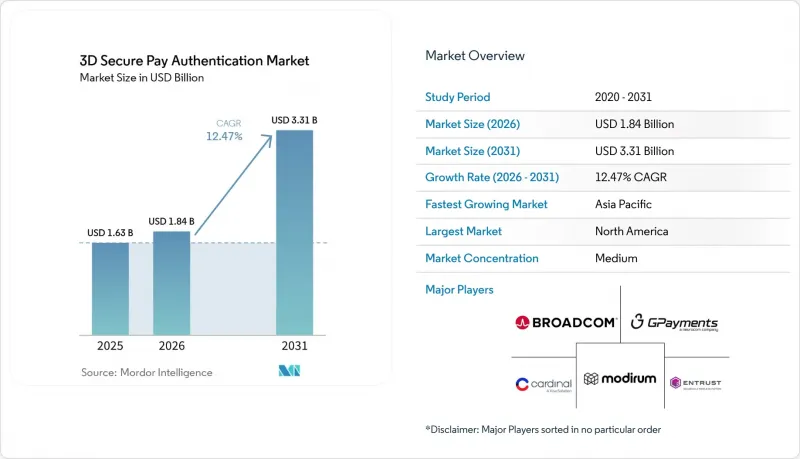
Mordor Intelligence에 의하면, 3D 시큐어 결제 인증 시장 규모는 2025년 16억 3,000만 달러로 평가되었습니다. 2026년 18억 4,000만 달러로 확대되고 2026년부터 2031년에 걸쳐 CAGR은 12.47%를 나타내, 2031년에는 33억 1,000만 달러에 이를 것으로 예측됩니다.
본 보고서는 구성 요소(접근 제어 서버, 3-D Secure 서버 및 가맹점 플러그인 등), 도입 형태(On-Premise, 클라우드 기반, 하이브리드), 인증 흐름의 유형(마찰 없는 흐름 등), 최종 사용자(은행 및 발급사, 가맹점 및 결제 게이트웨이, 결제 서비스 제공업체 등), 그리고 지역별로 분류되어 있습니다. 시장 전망은 금액(달러) 기준으로 제시되어 있습니다.
세계의 3D 시큐어 결제 인증 시장 동향과 인사이트
전자상거래의 급증과 카드 비대면 부정 사용 증가
2025년 전자상거래 사기 피해액은 사상 최고치인 480억 달러에 달했으며, 비대면 카드 거래의 부정 사용이 전체 카드 사기의 73%를 차지하게 되었습니다. 이에 따라 강력한 고객 인증이 손실 방지의 주요 수단이 되고 있습니다. 2026년 차지백으로 인한 사기 피해액은 281억 달러로 예측되며, 상품 대금, 배송비, 수수료를 포함하면 현재 부정 사용으로 인한 1달러의 피해당 미국 가맹점은 4.61달러의 비용을 부담하게 됩니다. EMV 3-D Secure의 책임 전가 규칙에 따라 인증이 거부될 경우, 차지백에 대한 책임은 발급사에 귀속되며, 이에 따라 은행은 챌린지 비율을 높일 것을 권고받고 있습니다. 인증 결제 방식은 부정 거래를 이유로 한 차지백을 60-80% 줄여주며, 이 효과로 인해 건당 0.05-0.15달러의 수수료를 상쇄할 수 있습니다. 따라서, 부정거래 증가는 3D 시큐어 결제 인증 시장의 제공업체들에게 거래량 확대를 촉진하는 한편, 보안과 스트레스 없는 사용자 경험 간의 균형을 맞추도록 요구하고 있습니다.
규제 요건으로 인해 규정 준수 일정이 단축됨
‘결제 서비스 지침 2(PSD2)’는 유럽에서 약 200억 유로(223억 달러) 규모의 부정 사용을 방지했으나, 적용 제외 범위가 축소되고 저위험 요청에 대해 발급사가 거절함에 따라 현재 인증이 의무화되는 거래량이 증가하고 있습니다. 인도의 2025년 9월 지침에 따르면, 2026년 4월 이후 모든 국내 거래에서 최소 한 가지의 동적 인증 요소가 의무화되며, 발행사는 규정 위반으로 인한 손실에 대해 고객에게 배상해야 합니다. 브라질의 제506호 결의안에 따르면, Pix 송금 및 단말기 등록 시 생체 인증이 의무화되어 있으며, 이에 따라 현지 금융기관의 인프라 투자가 증가하고 있습니다. Visa는 2025년 10월부터 인증률이 네트워크 기준치를 밑돌 경우, 아퀴어러에 대해 벌금을 부과하기 시작했습니다. 이에 따라 2026년 1월 이후 미국 내 인증 건수가 증가하고 있습니다. 여러 지역의 규제 도입으로 인해 자연 발생적인 수요의 하한선이 되는 준수 기준이 설정됨에 따라, 그동안 가맹점의 도입이 선택 사항이었던 지역에서도 3D 시큐어 결제 인증 시장의 확대가 가속화되고 있습니다.
통합 비용과 복잡성 때문에 중견·중소규모 가맹점들이 주저하게 됩니다.
결제 건당 수수료는 적게 보일 수 있지만, 소규모 가맹점의 경우 제한된 자원을 압박하는 일회성 통합 프로젝트, 단말기 테스트, 그리고 지속적인 클레임 처리에 직면하게 됩니다. EnterSekt사의 Orkestrate는 도입 속도를 85% 단축하고 98%의 마찰 없는 로그인을 보장하지만, 도입은 여전히 대형 은행에 집중되어 있습니다. 규제 요건에 따라 소액 거래조차도 강력한 고객 인증이 의무화되어 있으며, 일부 판매자들은 부정 방지 효과를 약화시킬 수 있는 위험 기반 면제를 요구하며 로비 활동을 펼치고 있습니다. 평균 거래액이 높을 경우 비용 대비 효과의 격차는 줄어들지만, 많은 소규모 사업자들은 여전히 고객 이탈을 초래할 위험을 감수하기보다는 차지백을 감수하는 쪽을 선택하고 있습니다. 따라서 3D 시큐어 결제 인증 시장에 대한 제동 효과는 세분화된 롱테일 부문에서 가장 심각합니다.
부문별 분석
발행사가 모바일 앱에 생체 인증 및 패스키 절차를 네이티브 방식으로 통합함에 따라, SDK 및 통합 서비스는 3D 시큐어 결제 인증 시장의 매출에서 점유율을 확대할 것으로 전망됩니다. ‘3D Secure 서버 및 가맹점 플러그인’ 카테고리는 기존 도입 실적을 반영하여 2025년 시점에서 42.53%의 점유율을 유지했으나, 기기 연동을 신속하게 처리하고 유지보수 부담을 줄여주는 모듈형 소프트웨어 키트로의 전환이 진행되고 있습니다. Visa의 Payment Passkey Service와 Noon Payments의 세계 확장은 카드 네트워크가 매니지드 서비스를 통해 플러그 앤 플레이 방식의 FIDO2를 제공하려는 의도를 보여주고 있으며, 이것이 SDK 지출의 예상 연평균 성장률(CAGR) 12.91%를 뒷받침하고 있습니다. 디렉터리 서버는 라우팅 구성 요소로서의 중요성을 유지하고 있지만, 대부분은 단독으로 판매되는 것이 아니라 보다 광범위한 오케스트레이션 플랫폼에 번들로 제공됩니다. 또한, 통합 예산은 위임 인증 기능으로도 확장되고 있으며, 이를 통해 가맹점은 사전에 위험을 평가하고, 필요한 경우에만 발행자의 접근 제어 서버를 호출할 수 있게 됩니다.
클라우드 제공 모델은 지속적인 성장을 가속하고 있습니다. IBM Cloud상의 Utimaco의 ‘Payment HSM as a Service’는 자본 집약적인 하드웨어에서 탄력적인 암호화 기능으로의 전환을 보여주는 좋은 사례입니다. 마스터카드의 토큰 서비스는 현재 인증 메타데이터를 추가하고 있으며, 이로 인해 별도의 서버 호출 필요성이 줄어들고, 토큰화 구성 요소와 인증 구성 요소 간의 경계가 모호해지고 있습니다. 인도 등 모바일 우선 시장에서는 생체 인증이나 패스키를 통해 성공률이 2-3포인트 향상될 것으로 예상되며, 핀테크 및 ‘Buy Now Pay Later(후불)’ 플랫폼 전반에 걸쳐 SDK에 대한 수요가 증가하고 있습니다. 그 결과, SDK와 오케스트레이션 도구는 결제 과정의 번거로움을 가중시키지 않으면서 3D Secure Pay 인증 시장의 성장세를 뒷받침하고 있습니다.
2025년 기준으로 클라우드 기반 도입은 3D 시큐어 결제 인증 시장 규모의 51.18%를 차지했으며, 2031년까지 연평균 12.83%의 성장률을 보일 것으로 전망됩니다. IBM Cloud의 Utimaco Payment HSM이나 Microsoft Azure Payment HSM과 같은 관리형 서비스를 통해 물리적 키 관리 하드웨어가 더 이상 필요하지 않게 되어, 중견 발급 기관에도 엔터프라이즈급 보안이 제공될 수 있게 됩니다. 리스크 점수를 산출하는 실시간 머신러닝 모델은 현재 클라우드 환경에서 지속적으로 업데이트되고 있으며, 이는 고정형 On-Premise 어플라이언스에서는 실현하기 어려운 성과입니다. 2026년 3월 유럽에서 출시된 Visa의 Intelligent Authorization 플랫폼은 99.999%의 가동률과 96.3%의 승인 정확도를 보장하며, 이러한 지표들은 클라우드의 복원력을 보여줍니다.
데이터 소재 요건으로 인해 로컬에서 처리가 필요한 경우, 특히 남미 및 아시아태평양의 규제 대상 은행에서는 여전히 On-Premise 시스템이 사용되고 있습니다. 하이브리드 아키텍처는 이벤트 스트림 분석을 클라우드에 배치하면서도 키 저장소를 로컬에 유지함으로써, 규정 준수 요건을 충족할 수 있는 가교 역할을 제공합니다. 변동 가격 체계 역시 클라우드를 더욱 유리하게 만들고 있습니다. 인증 1회당 0.05-0.15달러의 종량제 요금제는 하드웨어 감가상각을 5년에 걸쳐 처리하는 것보다 더 간단합니다. 미국 금융기관에 최대 350억 달러의 손실을 초래하고 있는 부정 사용의 급증과 합성 신분증의 위협은 확장 가능한 분석의 필요성을 더욱 부각시키고 있으며, 3D 시큐어 결제 인증 시장에서 클라우드의 주도적 입지를 공고히 하고 있습니다.
지역별 분석
2025년, 북미는 40.55%의 점유율을 유지하며 매출 면에서 1위를 차지했습니다. 이는 Visa 및 Mastercard의 인터체인지 수수료 최적화뿐만 아니라, 2025년 10월 시행될 성과 기반 페널티로 인해 발행사가 전자상거래 트래픽의 더 높은 비율을 인증하게 된 데 기인합니다. 이 지역의 탄탄한 클라우드 인프라 덕분에, 아퀴어러는 리스크 스코어링을 신속하게 도입할 수 있었으며, 네트워크 토큰의 보급률은 세계 그 어느 지역보다 높습니다.
아시아태평양은 성장의 원동력이며, 2031년까지의 연평균 성장률(CAGR)은 13.11%로 전망됩니다. 2026년 4월 인도에서 동적 2단계 인증이 의무화되고, 중국에서 국경 간 전자상거래 수요가 급증함에 따라, 발급사는 EMV 3-D Secure 2.x를 대규모로 도입할 수밖에 없는 상황에 처해 있습니다. 2026년에는 전 세계적으로 126억 개 이상의 네트워크 토큰이 운영되고 있으며, 일상적인 거래에서 모바일 지갑이 차지하는 비중이 높기 때문에 아시아태평양이 그 대부분을 차지하고 있습니다. 그러나 인증 성공률에는 여전히 격차가 나타나고 있습니다. 2026년 인증 성공률은 영국이 95%인 반면, 인도는 72%, 브라질은 36%에 그치고 있어, 공급업체들이 해소해야 할 준비 상황의 격차가 뚜렷이 드러나고 있습니다.
유럽에서는 PSD2 도입이 성숙 단계에 이르러 전 세계에서 가장 높은 인증 성공률을 자랑하고 있으며, 영국에서는 95%, 이탈리아에서는 93%, 네덜란드에서는 92%로 성장을 지속하고, 있습니다. 거래 리스크 분석 면제 요건이 계속해서 강화되고 있기 때문에 포화 상태에 이른 시장이라 할지라도 거래량은 높은 수준을 유지하고 있습니다. 중동 및 아프리카 및 남미는 절대액 기준으로는 뒤처져 있지만, 아랍에미리트와 사우디아라비아가 카드 네트워크 기준에 규정을 맞추고 있으며, 브라질에서는 생체 인증을 필수로 하는 Pix의 요건이 지출을 끌어올리고 있어 비약적인 보급이 이루어지고 있습니다. 따라서 발행사의 역량에 따른 지역 간 격차가 3D Secure Pay 인증 시장의 다양한 성장 경로를 형성하고 있습니다.
기타 혜택 :
- 엑셀 형식 시장 예측(ME) 시트
- 3개월간의 애널리스트 지원
자주 묻는 질문
목차
제1장 서론
제2장 조사 방법
제3장 주요 요약
제4장 시장 구도
제5장 시장 규모 및 성장 예측
제6장 경쟁 구도
제7장 시장 기회 및 향후 전망
KTH 26.06.22According to Mordor Intelligence, the 3D secure pay authentication market size is expected to grow from USD 1.63 billion in 2025 to USD 1.84 billion in 2026 and is forecast to reach USD 3.31 billion by 2031 at 12.47% CAGR over 2026-2031.
This report is Segmented by Component (Access Control Server, 3-D Secure Server and Merchant Plug-In, and More), Deployment Mode (On-Premises, Cloud-Based, and Hybrid), Authentication Flow Type (Frictionless Flow, and More), End User (Banks and Issuers, Merchants and Payment Gateways, Payment Service Providers, and More), and Geography. The Market Forecasts are Provided in Terms of Value (USD).
Global 3D Secure Pay Authentication Market Trends and Insights
Surge in E-Commerce and Card-Not-Present Fraud
Record USD 48 billion in e-commerce fraud during 2025 pushed card-not-present abuse to 73% of total card fraud, making strong customer authentication the primary loss-prevention lever. Chargeback fraud losses are projected at USD 28.1 billion during 2026, and every fraudulent dollar now costs U.S. merchants USD 4.61 when merchandise, shipping, and fees are included. EMV 3-D Secure liability shift rules place chargeback responsibility on issuers once authentication is declined, encouraging banks to raise challenge rates. Authenticated checkouts cut fraud-coded chargebacks by 60-80%, a return that offsets per-call fees of USD 0.05-0.15. Fraud escalation, therefore, fuels volume growth for 3D Secure Pay Authentication market providers while forcing them to balance security with friction-free experiences.
Regulatory Mandates Compress Compliance Timelines
Payment Services Directive 2 prevented an estimated EUR 20 billion (USD 22.3 billion) in European fraud, but narrower exemptions and issuer denial of low-risk requests now drive mandatory authentication volumes. India's September 2025 directions require at least one dynamic factor for every domestic transaction from April 2026, and issuers must reimburse customers for non-compliance losses. Brazil's Resolution 506 requires biometric confirmation for Pix transfers and device registration, increasing infrastructure spending among local institutions. Visa began penalizing acquirers in October 2025 when authentication rates fell below network thresholds, lifting U.S. authentication volume from January 2026 onward. Rules in multiple regions create a compliance floor beneath organic demand, accelerating the 3D Secure Pay Authentication market even where merchant adoption was previously discretionary.
Integration Cost and Complexity Deter Mid-Market Merchants
Per-authentication fees appear modest, yet small merchants face one-time integration projects, device testing, and ongoing dispute management that strain limited resources. Entersekt's Orkestrate promises 85% faster deployment and 98% frictionless logins, but adoption remains skewed toward tier-one banks. Regulatory mandates force even low-value transactions into strong customer authentication, pushing some sellers to lobby for risk-based exemptions that dilute fraud benefits. The cost-benefit gap narrows where average ticket values are high, yet many micro-merchants still choose to absorb chargebacks rather than risk abandonment. The drag on the 3D Secure Pay Authentication market is therefore most acute in fragmented long-tail segments.
Other drivers and restraints analyzed in the detailed report include:
- Migration to EMV 3-D Secure 2.x Unlocks Frictionless and Delegated Flows
- Mobile-Wallet and In-App Payment Boom Expands Authentication Surface
- Checkout Friction in Non-Mandate Regions Caps Voluntary Uptake
For complete list of drivers and restraints, kindly check the Table Of Contents.
Segment Analysis
SDK and Integration Services are set to capture a growing share of the 3D Secure Pay Authentication market revenue as issuers embed biometric and passkey flows natively in mobile apps. The 3D Secure Server and Merchant Plug-in category kept a 42.53% share in 2025, reflecting legacy installs, yet the preference is shifting toward modular software kits that speed device binding and reduce maintenance. Visa's Payment Passkey Service and Noon Payments' global launch illustrate the card network's intention to deliver plug-and-play FIDO2 through managed services, which supports the 12.91% forecast CAGR for SDK spend. Directory Servers retain their importance as routing components, yet most are bundled into broader orchestration platforms rather than sold standalone. Integration budgets are also flowing toward delegated authentication capability, letting merchants pre-score risk and call issuer Access Control Servers only when needed.
Cloud delivery models further catalyze growth. Utimaco's Payment HSM as a Service on IBM Cloud exemplifies a move away from capital-intensive hardware toward elastic cryptography functions. Mastercard token services now append authentication metadata, reducing the need for separate server calls and blurring the lines between tokenization and authentication components. As mobile-first markets such as India expect biometrics and passkeys to lift success rates 2-3 percentage points, SDK demand intensifies across fintech and Buy Now Pay Later platforms. Consequently, SDKs and orchestration tools reinforce the 3D Secure Pay Authentication market's momentum without adding checkout friction.
Cloud-based deployment accounted for 51.18% of the 3D Secure Pay Authentication market size in 2025 and will grow at 12.83% through 2031. Managed services such as Utimaco Payment HSM on IBM Cloud and Microsoft Azure Payment HSM remove the need for physical key-management hardware, opening enterprise-grade security to mid-tier issuers. Real-time machine learning models that calculate risk scores now update continuously in cloud environments, a feat hard to match on fixed on-premises appliances. Visa's Intelligent Authorization platform, launched in Europe during March 2026, pledges 99.999% uptime and 96.3% approval accuracy, metrics that showcase cloud resilience.
On-premises systems persist where data residency mandates require local processing, especially among regulated banks in South America and the Asia-Pacific. Hybrid architectures place event-stream analytics in the cloud while retaining key stores locally, offering a compliance bridge. Variable pricing further favors cloud: paying USD 0.05-0.15 per authentication on a usage basis is simpler than depreciating capital hardware over five years. Fraud surge and synthetic identity threats costing U.S. institutions up to USD 35 billion reinforce the need for scalable analytics, anchoring the cloud's leadership within the 3D Secure Pay Authentication market.
Geography Analysis
North America remained the revenue leader in 2025 with 40.55% share, as Visa and Mastercard interchange optimization, plus October 2025 performance penalties, drove issuers to authenticate a higher portion of e-commerce traffic. The region's abundant cloud infrastructure lets acquirers implement risk scoring quickly, and network token penetration exceeds any other global zone.
Asia-Pacific is the growth engine, with a 13.11% CAGR projected through 2031. India's April 2026 mandate for dynamic two-factor checks and China's booming cross-border e-commerce demand compel issuers to deploy EMV 3-D Secure 2.x at scale. More than 12.6 billion network tokens were active worldwide in 2026, with Asia-Pacific accounting for a disproportionate slice because mobile wallets dominate daily transactions. Authentication success gaps persist, however: India reached only 72% and Brazil 36% in 2026 compared with the United Kingdom's 95%, highlighting readiness disparities that vendors must bridge.
Europe enjoys the world's highest authentication success due to mature PSD2 rollouts, registering 95% in the United Kingdom, 93% in Italy, and 92% in the Netherlands. Continued tightening of transaction-risk analysis exemptions keeps volume elevated even in saturated markets. The Middle East and Africa and South America trail on absolute dollars but post step-change adoption as the United Arab Emirates and Saudi Arabia align rules with card-network standards, and Brazil's biometric Pix requirements escalate spend. Geographic divergence in issuer capabilities therefore shapes a multi-speed expansion path for the 3D Secure Pay Authentication market.
- GPayments Pty Ltd.
- CardinalCommerce Corporation
- Modirum Oy
- Broadcom Inc.
- Entrust Corporation
- RSA Security LLC
- Fiserv, Inc.
- Decta Limited
- Marqeta, Inc.
- Bluefin Payment Systems LLC
- Entersekt (Pty) Ltd.
- Thales Group
- Netcetera AG
- Worldline SA
- Adyen N.V.
- ACI Worldwide Inc.
- Mastercard Incorporated
- Visa Inc.
- American Express Company
- JCB Co., Ltd.
- Discover Financial Services
Additional Benefits:
- The market estimate (ME) sheet in Excel format
- 3 months of analyst support
TABLE OF CONTENTS
1 INTRODUCTION
- 1.1 Study Assumptions and Market Definition
- 1.2 Scope of the Study
2 RESEARCH METHODOLOGY
3 EXECUTIVE SUMMARY
4 MARKET LANDSCAPE
- 4.1 Market Overview
- 4.2 Impact of Macroeconomic Factors on the Market
- 4.3 Market Drivers
- 4.3.1 Surge In E-Commerce and Card-Not-Present Fraud
- 4.3.2 Regulatory Mandates (PSD2 SCA, India RBI, Brazil BCB)
- 4.3.3 Migration to EMV 3-D Secure 2. X Protocols
- 4.3.4 Mobile-Wallet and In-App Payment Boom
- 4.3.5 Webauthn and Passkey Integration
- 4.3.6 Cloud HSM-Powered Real-Time Risk Scoring
- 4.4 Market Restraints
- 4.4.1 Integration cost and complexity
- 4.4.2 Checkout friction in non-mandate regions
- 4.4.3 Inconsistent issuer readiness in EMs
- 4.4.4 Privacy rules limiting data-sharing (RbA)
- 4.5 Industry Value-Chain Analysis
- 4.6 Regulatory Landscape
- 4.7 Technological Outlook
- 4.8 Porter's Five Forces Analysis
- 4.8.1 Buyer Power
- 4.8.2 Supplier Power
- 4.8.3 Threat of Substitutes
- 4.8.4 Threat of New Entrants
- 4.8.5 Competitive Rivalry
5 MARKET SIZE AND GROWTH FORECASTS (VALUE)
- 5.1 By Component
- 5.1.1 Access Control Server (ACS)
- 5.1.2 3-D Secure Server / Merchant Plug-in
- 5.1.3 Directory Server
- 5.1.4 SDK and Integration Services
- 5.1.5 Other Component
- 5.2 By Deployment Mode
- 5.2.1 On-premises
- 5.2.2 Cloud-based
- 5.2.3 Hybrid
- 5.3 By Authentication Flow Type
- 5.3.1 Frictionless Flow
- 5.3.2 Challenge Flow
- 5.3.3 Out-of-Band / Decoupled Flow
- 5.3.4 Delegated Authentication
- 5.4 By End User
- 5.4.1 Banks / Issuers
- 5.4.2 Merchants and Payment Gateways
- 5.4.3 Payment Service Providers (PSPs)
- 5.4.4 FinTechs and BNPL Platforms
- 5.4.5 Other End User
- 5.5 By Geography
- 5.5.1 North America
- 5.5.1.1 United States
- 5.5.1.2 Canada
- 5.5.1.3 Mexico
- 5.5.2 Europe
- 5.5.2.1 Germany
- 5.5.2.2 United Kingdom
- 5.5.2.3 France
- 5.5.2.4 Italy
- 5.5.2.5 Rest of Europe
- 5.5.3 Asia-Pacific
- 5.5.3.1 China
- 5.5.3.2 Japan
- 5.5.3.3 India
- 5.5.3.4 South Korea
- 5.5.3.5 Australia
- 5.5.3.6 Rest of Asia-Pacific
- 5.5.4 South America
- 5.5.5 Middle East and Africa
- 5.5.1 North America
6 COMPETITIVE LANDSCAPE
- 6.1 Market Concentration
- 6.2 Strategic Moves
- 6.3 Market Share Analysis
- 6.4 Company Profiles (includes Global Level Overview, Market Level Overview, Core Segments, Financials as available, Strategic Information, Market Rank/Share, Products and Services, Recent Developments)
- 6.4.1 GPayments Pty Ltd.
- 6.4.2 CardinalCommerce Corporation
- 6.4.3 Modirum Oy
- 6.4.4 Broadcom Inc.
- 6.4.5 Entrust Corporation
- 6.4.6 RSA Security LLC
- 6.4.7 Fiserv, Inc.
- 6.4.8 Decta Limited
- 6.4.9 Marqeta, Inc.
- 6.4.10 Bluefin Payment Systems LLC
- 6.4.11 Entersekt (Pty) Ltd.
- 6.4.12 Thales Group
- 6.4.13 Netcetera AG
- 6.4.14 Worldline SA
- 6.4.15 Adyen N.V.
- 6.4.16 ACI Worldwide Inc.
- 6.4.17 Mastercard Incorporated
- 6.4.18 Visa Inc.
- 6.4.19 American Express Company
- 6.4.20 JCB Co., Ltd.
- 6.4.21 Discover Financial Services
7 MARKET OPPORTUNITIES AND FUTURE OUTLOOK
- 7.1 White-space and Unmet-need Assessment