

|
시장보고서
상품코드
2063368
바이오 살선충제 : 시장 점유율 분석, 업계 동향 및 통계, 성장 예측(2026-2031년)Bionematicides - Market Share Analysis, Industry Trends & Statistics, Growth Forecasts (2026 - 2031) |
||||||
 Mordor Intelligence
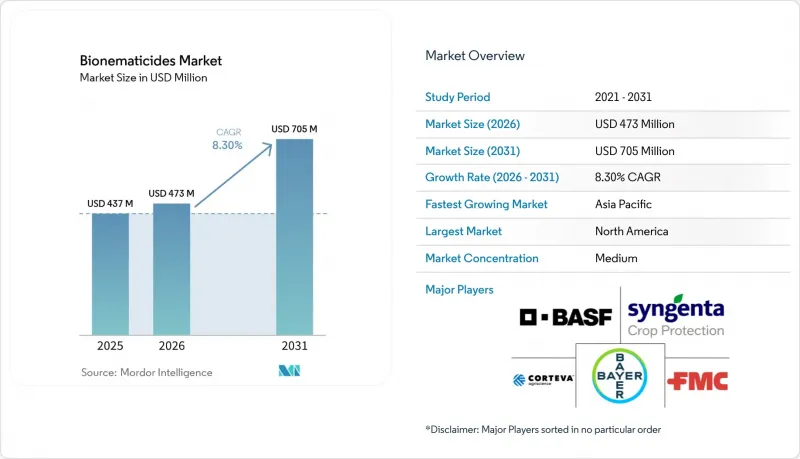
Mordor Intelligence에 의하면, 바이오 살선충제 시장 규모는 2025년에 4억 3,700만 달러로 평가되었습니다. 2026년 4억 7,300만 달러에서 2031년까지 7억 500만 달러로 확대되어 2026-2031년에 걸쳐 CAGR은 8.3%를 나타낼 것으로 예측됩니다.
본 보고서는 제품 유형별(미생물 제제, 생화학 제제, 기타), 시용 방법별(토양, 종자, 기타), 작물(과일 및 채소, 곡물, 기타), 제제 형태(액체, 건조 과립), 피해 유형(뿌리혹선충, 낭선충, 기타), 지역(북미, 남미, 아시아태평양, 기타)별로 분류되어 있습니다. 시장 전망치는 금액(달러)으로 표시되어 있습니다.
세계의 바이오 살선충제 시장 동향 및 분석
유기농 인증 농지의 확대
FiBL과 IFOAM Organics International(2026년)에 따르면, 전 세계 유기농 인증 농지 면적은 2022년 9,600만 헥타르에서 2024년에는 약 9,900만 헥타르로 확대되었습니다. 이는 유기농업 분야에서 꾸준하지만 점차 둔화되고 있는 성장을 반영하고 있습니다. 유기농 기준에 따라 합성 훈증제의 사용이 금지되어 있기 때문에 생산자들은 생물학적 선충 방제 방법을 채택하고 있습니다. 캘리포니아주의 유기농 채소 부문에서는 뿌리혹병 방제를 위해 Bacillus firmus 및 Purpureocillium lilacinum 제품이 표준 방식으로 사용되고 있습니다. 유럽연합(EU)에서도 비슷한 추세가 나타났으며, 2024년에는 EU 내 유기농 경작지가 1,810만 헥타르에 달하고, 전체 농지 면적의 11.1%를 차지했습니다. 유기농지의 확대 속도는 둔화되고 있지만, 여전히 상당한 규모를 유지하고 있습니다. 잔류물이 없는 농산물에 대한 고가의 수출 수요가 브라질의 커피 산지와 인도의 향신료 산지에서 이러한 방식의 도입을 촉진하고 있습니다.
독성이 강한 화학계 선충 구제제의 전 세계적 단계적 폐지
규제 당국은 유기인계 및 카르바메이트계 생물학적 선충 살충제를 시장에서 차근차근 철수시키고 있습니다. 미국 환경보호청(EPA)은 2026년에 바이오 살선충제의 유효 성분 등록을 취소하지는 않았으나, FIFRA(연방 살충제·살균제·살서제법)에 따른 등록 심사, 제품 회수, 규정 준수 비용 증가로 인해 미국 내 토양 살포형 바이오 살선충제 제품군은 점차 축소되고 있습니다. 유럽 집행위원회는 구형 훈증제의 재등록을 막기 위해 엄격한 위험성 기준을 유지하고 있습니다. 2024년과 2025년에 중국은 고독성 농약의 단계적 폐지를 추진하여, 오메토에이트, 카르보플란, 메토밀, 알디카르브를 2025년 12월까지 금지했습니다. 2026년에 예정된 포레이트와 이소펜호스메틸의 사용 금지는 미생물 살선충제 및 바이오 농약으로의 전환을 촉진하고 있습니다. 이를 지원하기 위해 MARA는 2025년 말에 5종의 새로운 바이오 농약을 승인하여 친환경 농업의 발전을 촉진했습니다. 이러한 일련의 움직임은 생물학적 대체제로의 지속적인 전환을 촉진하고 있습니다.
짧은 보관 기간과 제제의 안정성
많은 생미생물 제품은 10℃ 이하에서 냉장 보관이 필요하며, 유효기간이 12개월 이내로 만료되기 때문에 열대 지역에서의 유통이 복잡해지고 있습니다. 건조 과립은 수명을 연장하지만, 대부분의 경우 현장에서의 즉각적인 효과를 희생하게 됩니다. 나노캡슐화 기술에 대한 연구 결과, 곤충 병원성 선충의 생존 기간이 실온에서 최대 18개월까지 연장되었으나, 상업적 활용은 여전히 제한적입니다. 제조업체들은 냉장 시설이 부족한 아시아·태평양 지역과 아프리카에서 높은 부패율에 직면해 있습니다. 대중 시장에 성공적으로 진출하기 위해서는 안정성 측면에서 획기적인 진전이 필수적입니다.
부문별 분석
미생물 제제가 가장 큰 점유율을 차지하며, 2025년 생물성 살선충제 시장의 62%를 차지했습니다. 이는 바실러스, 트리코데르마, 푸르푸레오실리움 균주가 토양에 광범위하게 정착하고 뿌리 주변에서 활성을 발휘하기 때문입니다. 아자지락틴 및 테르페노이드를 함유한 생화학제품은 내성 관리 목표와 보관 기간의 장점 덕분에 2026년부터 2031년까지 연평균 성장률(CAGR) 9.4%라는 가장 높은 성장률을 기록하며 시장 규모가 확대되고 있습니다. 미생물과 생화학을 결합한 복합 제품은 사계절 내내 방제를 위해 생산자가 높은 단가를 수용하는 고급 과일 및 채소 시장에서 점유율을 확대되고 있습니다. TYMIRIUM 등의 RNAi 플랫폼은 아직 상용화의 초기 단계에 있지만, 합성 비용의 감소로 인해 2027년 이후에는 대폭적인 보급이 예상됩니다. 미생물 및 생화학 물질을 통합한 제품인 생물학적 선충 살충제 시장 규모는 예측 기간 동안 두 자릿수 성장률을 기록하며 확대될 것으로 전망됩니다.
2세대 미생물 제제는 대사 산물의 공동 생산을 중시하고 있습니다. 그 예로, BASF SE가 조만간 출시할 예정인 ‘Votivo Prime’을 들 수 있습니다. 이는 바실러스 펌스(Bacillus firmus)와 독자적인 대사 산물을 결합하여 병반선충을 억제하기 위한 것입니다. 현장 시험에서 나노 복합 테르페노이드를 사용함으로써, 알의 부화 억제 측면에서 플루오피람을 능가하는 유의미한 효과가 입증되었습니다. 또한, 생화학제품은 점적 관개 시스템과의 호환성도 향상시켰습니다. 점적 관개에서는 입자의 침전으로 인해 생세포의 현탁이 방해되기 때문입니다. RNAi의 정밀성은 잔류물에 대한 규제가 엄격한 수출 경로에 적합합니다. 이는 유전자 침묵화 화합물이 무해한 뉴클레오티드로 분해되기 때문입니다. 전반적으로, 혁신에 힘입어 생물학적 선충 살충제 시장은 다중 작용 방식, 상온 보관이 가능하며 종 특이적인 제품군으로 발전하고 있습니다.
토양 처리는 가장 큰 점유율을 차지하고 있으며, 2025년 생물성 살선충제 시장 규모의 48%를 차지했습니다. 이는 심각한 피해를 입은 작물에 대한 전면 살포와 띠 모양 살포에 의한 것입니다. 종자 처리 시장은 2026년부터 2031년에 걸쳐 연평균 성장률(CAGR) 10.1%라는 가장 빠른 속도로 성장하고 있습니다. 이는 다국적 기업이 선충, 곰팡이, 해충에 대한 방제 효과를 단 한 번의 처리로 제공하는 독자적인 코팅 기술에 생물 제제를 접목했기 때문입니다. Corteva Agriscience LLC의 ‘Lumialza’와 UPL의 ‘NIMAXXA’는 시용 책임을 종자 공급업체로 전가하는 이러한 번들링 전략의 대표적인 사례입니다. 엽면 시비는 관상용 식물 및 보호 재배 분야에서는 여전히 틈새 시장으로 남아 있지만, 점적 관개 주입 방식은 온실 및 하이 터널에서 채소를 재배하는 농가들로부터 지지를 받고 있습니다. 대두, 옥수수, 면화 재배 시스템에서의 도입이 가속화됨에 따라, 종자 처리용 생물학적 선충 살충제 시장은 2030년까지 토양 처리용 제품 시장을 추월할 것으로 예측됩니다.
종자 코팅은 투여량의 편차를 줄이고 초기 뿌리 정착을 촉진함으로써, 밭에서의 균일성을 높이고 농업 종사자들의 신뢰를 강화합니다. 무경운 재배 시스템에서 종자 처리는 토양 혼합의 제약을 피할 수 있어, 보전 농업의 실천과 부합합니다. 캘리포니아주와 스페인에서 시행되는 생물학적 선충 방제제의 점적 주입은 뿌리 주변을 표적으로 하기 때문에 전면 살포보다 효과적입니다. 점적 관개 시스템은 Purpureocillium lilacinum과 같은 균주의 생육에 적합한 습윤 환경을 제공하며, 포장 시험에서 56%에서 77%의 선충 방제율을 달성했습니다. 장비와의 호환성 및 인력 절감도 종자 처리로의 전환을 더욱 촉진하고 있습니다. 독자적인 배합을 적용한 복합 제제가 보급되는 가운데, 독립 제제 제조업체는 대형 종자 회사와 제휴하지 않는 한 시장 진입이 제한될 가능성이 있습니다.
지역별 분석
북미는 2025년 전 세계 매출의 약 40%를 차지하며, 미국이 주도했습니다. 미국에서는 환경보호청(EPA)의 바이오 농약 심사 절차가 신속화되고, 대규모 유기농 채소 재배 사업이 도입을 뒷받침하고 있습니다. 캘리포니아주에서는 1만 2,000-1만 5,000헥타르 규모의 유기농 토마토와 1만 헥타르 규모의 유기농 상추가 재배되고 있습니다. Purpureocillium lilacinum은 저항성 품종 및 윤작을 결합한 종합 해충 관리(IPM) 전략의 일환으로, 뿌리혹선충(Meloidogyne spp.) 방제에 널리 사용되고 있습니다. 캐나다에서는 지속가능 농업 지원금 제도를 통해 감자와 온실 채소에 대한 바이오 농약 도입을 확대하고 있는 반면, 멕시코에서는 보호재배 클러스터가 피망과 오이를 대상으로 점적 관개를 이용한 미생물 제제의 검사를 실시했습니다. 이 지역의 생물학적 선충 살충제 시장은 미국·멕시코·캐나다 협정(USMCA)에 따른 잔류 기준 조화의 혜택을 받고 있으며, 이로 인해 국경을 넘는 등록 절차상의 마찰이 완화되고 있습니다. 그러나 화학 훈증제가 여전히 합법적이고 저렴한 중서부 일부의 연작 재배 시스템에서는 농업 종사자들의 회의적인 시각이 계속되고 있습니다.
아시아태평양에서는 중국과 인도가 수출 대상국의 구매자가 요구하는 잔류 기준을 충족하기 위해 생물 유래 자재에 대한 보조금을 확대하고 있으며, 연평균 성장률(CAGR) 8.5%의 성장 궤도에 올라 있습니다. 중국은 2025년에 5가지 유형의 화학계 선충 구제제를 규제 대상 목록에 추가하고, 데이터 요건이 비교적 완화된 바실러스계 제품으로의 전환을 생산자들에게 권장하고 있습니다. 인도는 2024년 11월에 출범한 ‘자연농법 국가 미션(NMNF)’을 통해 생물학적 해충 관리를 추진하고 있으며, 2025-26 회계연도에는 248억 1,000만 루피(2억 9,500만 달러)의 예산이 편성되어 있습니다. 이 프로젝트는 1,000만 명의 농업 종사자와 1만 곳의 ‘바이오 투입 자원 센터’를 대상으로 하며, 지역에 뿌리를 둔 저비용 생물학적 자재의 제공을 목표로 하고 있습니다. 일본에서는 홋카이도와 규슈에서 유기농 채소의 재배 면적이 해마다 급속히 증가하고 있으며, 이는 일본 농산물 규격(JAS)을 충족하는 생물학적 살선충제를 포함한 생물 제제에 대한 수요를 견인하고 있습니다. 호주에서는 사탕수수와 감자 재배를 위해 파스투렐리아속과 트리코데르마속의 용액을 검사 및 도입하고 있지만, 가뭄 조건에서는 그 효과가 일정하지 않습니다.
남미에서는 브라질의 대두 및 사탕수수 재배자들이 무경운 재배 시스템에 생물학적 선충 방제 방법을 도입함으로써 급속한 성장을 보이고 있습니다. 유럽연합(EU)의 수입 허용 기준에 힘입어, 2025년에는 브라질의 4,500만 헥타르에 달하는 대두 재배 면적 중 상당 부분에서 생물학적 방제 방법이 채택되었습니다. 아르헨티나의 밀 및 옥수수 생산자들은 기존의 종자 처리 인프라를 활용하여 바실러스균을 이용한 종자 코팅 상태를 검사하고 있으며, 고랑 내 투입 비용 절감을 목표로 하고 있습니다. 유럽연합(EU)에서는 ‘농장에서 식탁까지(Farm-to-Fork)’라는 농약 감축 정책에 따라 연평균 성장률(CAGR)이 급격히 상승할 것으로 전망됩니다. 독일, 프랑스, 스페인은 채소 및 과일에 이를 활용하는 데 있어 선구적인 역할을 하고 있습니다. 중동 및 아프리카에서는 온실 채소 및 수출용 원예 작물 부문에서 현저한 성장이 나타나고 있습니다. 이러한 부문에서는 잔류 기준에 부합하는 해충 방제가 요구되고 있지만, 높은 가격과 콜드체인의 취약성으로 인해 더 광범위한 보급이 저해되고 있습니다.
기타 혜택
- 엑셀 형식 시장 예측(ME) 시트
- 3개월간의 애널리스트 지원
자주 묻는 질문
목차
제1장 서론
제2장 조사 방법
제3장 주요 요약
제4장 시장 구도
제5장 시장 규모 및 성장 예측
제6장 경쟁 구도
제7장 시장 기회 및 향후 전망
KTH 26.06.24According to Mordor Intelligence, the bionematicides market size is valued at USD 437 million in 2025 and is anticipated to grow from USD 473 million in 2026 to USD 705 million by 2031, growing at a CAGR of 8.3% over 2026-2031.
This report is Segmented by Product Type (Microbials, Biochemicals, and More), by Mode of Application (Soil, Seed, and More), by Crop (Fruits and Vegetables, Cereals and Grains, and More), by Formulation (Liquid and Dry Granules), by Infestation Type (Root-Knot, Cyst, and More), and by Geography (North America, South America, Asia-Pacific, and More). Market Forecasts are Provided in Value (USD).
Global Bionematicides Market Trends and Insights
Growth in Certified-Organic Farmland
Global certified organic farmland grew from 96 million hectares in 2022 to nearly 99 million hectares in 2024, reflecting steady but slowing growth in organic agriculture, as per FiBL & IFOAM Organics International (2026). Organic standards prohibit synthetic fumigants, prompting growers to adopt biological nematode control. In California's organic vegetable sector, Bacillus firmus and Purpureocillium lilacinum products are standard practice for root-knot suppression. Similar momentum is evident in the European Union, where in 2024, organically farmed land in the European Union reached 18.1 million hectares, accounting for 11.1% of total agricultural land. Organic area expansion has moderated but remains significant. Premium export pricing for residue-free produce is stimulating uptake in Brazil's coffee and India's spice belts.
Global Phase-Out of Highly Toxic Chemical Nematicides
Regulators are steadily withdrawing organophosphate and carbamate nematicides. While the EPA did not cancel nematicide active ingredients in 2026, registration reviews, product withdrawals, and rising compliance costs under FIFRA are gradually limiting the U.S. soil-applied nematicide portfolio. The European Commission maintains strict hazard-based cutoffs that deter re-registration of older fumigants. In 2024 and 2025, China progressed in phasing out high-toxicity pesticides, banning omethoate, carbofuran, methomyl, and aldicarb, effective by December 2025. Planned 2026 bans on phorate and isofenphos-methyl are driving a shift toward microbial nematicides and biopesticides. To support this, MARA approved five new biopesticides in late 2025, promoting green agricultural development. These concurrent moves underpin lasting substitution toward biological alternatives.
Limited Shelf Life and Formulation Stability
Many live microbial products require refrigeration below 10 °C and expire within 12 months, complicating distribution in tropical regions. Dry granules extend viability yet often sacrifice rapid field efficacy. Nano-encapsulation research has extended the viability of entomopathogenic nematodes to 18 months at ambient temperature, but commercial deployment remains limited. Manufacturers face higher spoilage rates in the Asia-Pacific and Africa, where cold storage is scarce. Stability breakthroughs are essential to unlock mass-market penetration.
Other drivers and restraints analyzed in the detailed report include:
- Lower Research and Registration Cost for Biologicals
- RNA-Interference Nematicides Enabling Species-Specific Control
- Farmer Skepticism Over Field-Level Efficacy
For complete list of drivers and restraints, kindly check the Table Of Contents.
Segment Analysis
Microbials accounted for the largest share, representing 62% of the 2025 bionematicides market, as Bacillus, Trichoderma, and Purpureocillium strains deliver broad soil colonization and rhizosphere activity. Biochemicals, including azadirachtin and terpenoids, are growing at a fastest 9.4% CAGR through 2026-2031, driven by resistance management goals and shelf-life advantages. Combined microbial-biochemical products are gaining share in premium fruit and vegetable markets where growers accept higher unit costs for season-long control. RNAi platforms such as TYMIRIUM are in early commercial phases, yet declining synthesis expenses should unlock meaningful uptake after 2027. The bionematicides market size for integrated microbial-biochemical products is projected to expand at double-digit rates through the forecast horizon.
Second-generation microbials emphasize metabolite co-production, as illustrated by BASF SE's forthcoming Votivo Prime that couples Bacillus firmus with proprietary metabolites for lesion-nematode suppression. Field trials demonstrated a significant share of egg-hatch inhibition using nano-formulated terpenoids, surpassing fluopyram's. Biochemicals also improve compatibility with drip irrigation systems, where particulate settling hinders the suspension of live cells. RNAi's precision aligns with residue-sensitive export channels because gene silencing compounds degrade into benign nucleotides. Collectively, innovation is steering the bionematicides market toward multi-mode, shelf-stable, and species-specific portfolios.
Soil treatments accounted for the largest share, with 48% of the 2025 bionematicides market size, driven by broadcast and banded applications in heavily infested row crops. Seed treatment is advancing at a fastest 10.1% CAGR through 2026-2031, as multinationals embed biologicals into proprietary coatings that deliver nematode, fungal, and insect protection in one pass. Corteva Agriscience LLC's Lumialza and UPL's NIMAXXA exemplify this bundling strategy that shifts application responsibility to seed providers. Foliar sprays remain niche for ornamentals and protected horticulture, whereas drip-irrigation injection appeals to greenhouse and high-tunnel vegetable producers. The bionematicides market for seed-treatment products is forecast to overtake soil-treatment products by 2030 as adoption accelerates in soybean, corn, and cotton systems.
Seed coating reduces dosage variability and enhances early-root colonization, boosting field consistency and farmer confidence. In no-till systems, seed treatments avoid soil-incorporation constraints and align with conservation farming practices. Drip injection of biological nematicides in California and Spain is more effective than broadcast sprays because it targets the rhizosphere. Drip systems provide a moist environment supporting strains like Purpureocillium lilacinum, achieving nematode reduction rates of 56% to 77% in field trials. Equipment compatibility and labor savings further incentivize the shift toward on-seed delivery. As proprietary stacks proliferate, independent formulators may face restricted market access unless they partner with major seed companies.
Geography Analysis
North America generated roughly 40% of 2025 global revenue, led by the United States, where expedited Environmental Protection Agency biopesticide reviews and large organic vegetable operations underpin adoption. In California, 12,000-15,000 hectares of organic tomatoes and 10,000 hectares of organic lettuce are grown. Purpureocillium lilacinum is widely used to control root-knot nematodes (Meloidogyne spp.) as part of an Integrated Pest Management (IPM) strategy with resistant varieties and crop rotation. Canada is scaling biologicals in potatoes and greenhouse vegetables under sustainable-agriculture grants, while Mexico's protected-agriculture clusters are trialing drip-injected microbials for peppers and cucumbers. The bionematicides market in the region benefits from harmonized residue standards under the United States-Mexico-Canada Agreement, which lowers cross-border registration friction. However, farmer skepticism persists in some Midwestern row-crop systems where chemical fumigants remain legal and inexpensive.
Asia-Pacific is on track for an 8.5% CAGR as China and India expand subsidies for bio-inputs to satisfy export buyers' residue limits. China placed five chemical nematicides on restricted schedules in 2025, nudging growers toward Bacillus-based options with lighter data packages. India promotes biological pest management through the National Mission on Natural Farming (NMNF), launched in November 2024 with an outlay of INR 24.81 billion (USD 295 million) for 2025-26. The mission targets 1 crore farmers and 10,000 Bio-input Resource Centers for localized, low-cost biological inputs. Japan's organic vegetable acreage is rising rapidly each year in Hokkaido and Kyushu, driving demand for biologicals including bionematicides that meet Japanese Agricultural Standards. Australia is piloting Pasteuria and Trichoderma solutions for sugarcane and potatoes, but performance is inconsistent under drought conditions.
South America has recorded a rapid growth as Brazilian soybean and sugarcane growers integrate biological nematode management into no-till systems. Biological adoption covered a significant share of Brazil's 45-million-hectare soybean area in 2025, driven by European Union import tolerances. Argentina's wheat and corn producers leverage existing seed-treatment infrastructure to test Bacillus seed coatings, aiming to reduce in-furrow input costs. The European Union is projected to post a rapid CAGR under the Farm-to-Fork pesticide-reduction agenda. Germany, France, and Spain are front-runners in the use of vegetables and fruits. The Middle East and Africa are seeing significant growth in greenhouse vegetable and export horticulture, where residue-compliant pest control is in demand, though high prices and weak cold chains are tempering broader uptake.
- BASF SE
- Bayer AG
- Syngenta Crop Protection AG
- Corteva Agriscience LLC
- FMC Corporation
- UPL Limited
- Valent BioSciences LLC
- Certis Biologicals LLC
- Pro Farm Group Inc.
- Koppert B.V.
- Nufarm Limited
- Isagro S.p.A.
- STK Bio-AG Technologies Ltd.
- Novonesis A/S
- Lallemand Inc.
Additional Benefits:
- The market estimate (ME) sheet in Excel format
- 3 months of analyst support
TABLE OF CONTENTS
1 Introduction
- 1.1 Study Assumptions and Market Definition
- 1.2 Scope of the Study
2 Research Methodology
3 Executive Summary
4 Market Landscape
- 4.1 Market Overview
- 4.2 Market Drivers
- 4.2.1 Growth in certified-organic farmland
- 4.2.2 Global phase-out of highly toxic chemical nematicides
- 4.2.3 Lower research and registration cost for biologicals
- 4.2.4 RNA-interference nematicides enabling species-specific control
- 4.2.5 Bundling of bionematicides in commercial seed-treatment stacks
- 4.2.6 Soil-microbiome diagnostics optimizing application timing
- 4.3 Market Restraints
- 4.3.1 Limited shelf life and formulation stability
- 4.3.2 Farmer skepticism over field-level efficacy
- 4.3.3 Patent thickets around key microbial strains
- 4.3.4 Lack of harmonized import-tolerance standards for residues
- 4.4 Regulatory Landscape
- 4.5 Technological Outlook
- 4.6 Porter's Five Forces Analysis
- 4.6.1 Threat of New Entrants
- 4.6.2 Bargaining Power of Suppliers
- 4.6.3 Bargaining Power of Buyers
- 4.6.4 Threat of Substitutes
- 4.6.5 Intensity of Competitive Rivalry
5 Market Size and Growth Forecasts (Value)
- 5.1 By Product Type
- 5.1.1 Microbials
- 5.1.2 Biochemicals
- 5.1.3 Integrated/Combined
- 5.1.4 Next-Generation RNAi Formulations
- 5.2 By Mode of Application
- 5.2.1 Soil Treatment
- 5.2.2 Seed Treatment
- 5.2.3 Foliar Spray
- 5.2.4 Drip-Irrigation Injection
- 5.3 By Crop
- 5.3.1 Fruits and Vegetables
- 5.3.2 Cereals and Grains
- 5.3.3 Oilseeds and Pulses
- 5.3.4 Turf, Ornamentals and Forage
- 5.4 By Formulation
- 5.4.1 Liquid Suspensions
- 5.4.2 Dry Granules and Wettable Powders
- 5.5 By Infestation Type
- 5.5.1 Root-knot Nematodes
- 5.5.2 Cyst Nematodes
- 5.5.3 Lesion Nematodes
- 5.5.4 Others (Stubby-root, Reniform)
- 5.6 By Geography
- 5.6.1 North America
- 5.6.1.1 United States
- 5.6.1.2 Canada
- 5.6.1.3 Mexico
- 5.6.1.4 Rest of North America
- 5.6.2 South America
- 5.6.2.1 Brazil
- 5.6.2.2 Argentina
- 5.6.2.3 Rest of South America
- 5.6.3 Europe
- 5.6.3.1 Germany
- 5.6.3.2 France
- 5.6.3.3 United Kingdom
- 5.6.3.4 Italy
- 5.6.3.5 Spain
- 5.6.3.6 Russia
- 5.6.3.7 Rest of Europe
- 5.6.4 Asia-Pacific
- 5.6.4.1 China
- 5.6.4.2 India
- 5.6.4.3 Japan
- 5.6.4.4 Australia
- 5.6.4.5 Rest of Asia-Pacific
- 5.6.5 Middle East
- 5.6.5.1 Saudi Arabia
- 5.6.5.2 United Arab Emirates
- 5.6.5.3 Rest of Middle East
- 5.6.6 Africa
- 5.6.6.1 South Africa
- 5.6.6.2 Kenya
- 5.6.6.3 Rest of Africa
- 5.6.1 North America
6 Competitive Landscape
- 6.1 Market Concentration
- 6.2 Strategic Moves
- 6.3 Market Share Analysis
- 6.4 Company Profiles (Includes Global-level Overview, Market-level Overview, Core Segments, Financials as available, Strategic Information, Market Rank/Share, Products and Services, and Recent Developments)
- 6.4.1 BASF SE
- 6.4.2 Bayer AG
- 6.4.3 Syngenta Crop Protection AG
- 6.4.4 Corteva Agriscience LLC
- 6.4.5 FMC Corporation
- 6.4.6 UPL Limited
- 6.4.7 Valent BioSciences LLC
- 6.4.8 Certis Biologicals LLC
- 6.4.9 Pro Farm Group Inc.
- 6.4.10 Koppert B.V.
- 6.4.11 Nufarm Limited
- 6.4.12 Isagro S.p.A.
- 6.4.13 STK Bio-AG Technologies Ltd.
- 6.4.14 Novonesis A/S
- 6.4.15 Lallemand Inc.


