
|
시장보고서
상품코드
2063382
섬유 : 시장 점유율 분석, 업계 동향 및 통계, 성장 예측(2026-2031년)Textile - Market Share Analysis, Industry Trends & Statistics, Growth Forecasts (2026 - 2031) |
||||||
 Mordor Intelligence
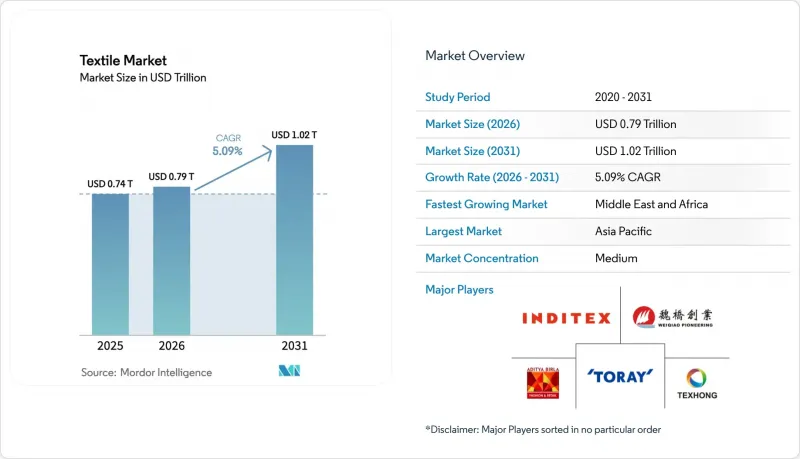
Mordor Intelligence에 의하면, 섬유 시장 규모는 2025년 7,400억 달러로 평가되었습니다. 2026년 7,900억 달러에서 2031년까지 1조 200억 달러로 확대되어 2026-2031년까지 연평균 복합 성장률(CAGR)은 5.09%를 나타낼 것으로 예측됩니다.
본 보고서는 용도별(패션 의류, 산업용·기술용 섬유, 가정용·홈텍스타일, 기타), 원료별(천연섬유(면, 양모, 기타), 합성 섬유(폴리에스터, 나일론, 기타), 기타), 제조 공정 기술(직물, 편물, 부직포, 기타), 지역(북미, 아시아태평양, 기타)별로 분류되어 있습니다. 시장 전망은 금액(달러) 기준으로 제시되어 있습니다.
세계의 섬유 시장 동향 및 인사이트
EU의 디지털 제품 여권이 추적성 기술에 대한 투자를 가속화
EU의 디지털 제품 여권 제도에 따르면, 2027년까지 EU 내에서 판매되는 모든 섬유 제품에 원산지, 구성, 폐기 시 처리 경로에 관한 기계 판독 가능 데이터를 기재해야 할 의무가 부과되어 있으며, 이에 따라 유럽 섬유 제조업체의 소프트웨어 및 하드웨어 총 지출은 14억 5,000만 달러에 달할 것으로 예측됩니다. 방글라데시와 베트남의 수출업체들도 EU 시장 진출을 유지하기 위해 이와 유사한 개선을 진행하고 있으며, 사실상 이 기준이 세계 표준으로 자리 잡아가고 있습니다. 기업 소프트웨어 공급업체 간의 상호 운용성 격차는 소규모 방적 공장의 전환 비용을 높이며, 소규모 사업자들 간의 통합을 초래할 가능성이 있습니다. 또한, 검증된 조성 데이터는 2차 원료 시장을 개척하고 재활용의 경제성을 높여줍니다. 파일럿 프로젝트가 성숙해짐에 따라, 각 브랜드사는 공급업체 감사 주기가 20% 단축될 것으로 예상하고 있으며, 이를 통해 디자인 및 마케팅에 투입할 운전자금을 확보하게 될 것입니다.
위구르 강제노동방지법(UFLPA)이 인증된 비신장산 면화로의 조달 전환을 촉진
UFLPA의 적극적인 시행으로 인해 2022년부터 2025년에 걸쳐 중국산 미국 수출용 면제품 수입이 20% 감소했습니다. 이로 인해 주문이 인도와 베트남으로 이동하고 있습니다. 안정 동위원소 분석은 빠르게 보급되어, 2024년에는 실험실에서 1만 건 이상의 시료를 처리하며 신뢰성 높은 원산지 증명을 뒷받침했습니다. 인도의 방적업체들은 2024년에 미국으로부터의 수주가 35% 증가했으며, 이는 규정 준수 요건이 전 세계 유통 구조를 어떻게 변화시키고 있는지를 보여주고 있습니다. 소매업체들은 현재 입고 가격의 2%-4%를 서류 작성 비용으로 예산에 반영하고 있으며, 이러한 이익 압박이 디지털 추적 시스템 도입을 가속화하고 있습니다. 계약 경로의 변경은 대체 조달국의 농촌 지역 소득을 안정시키고, 인증받은 지속가능한 면화에 대한 장기적인 수요를 공고히 하고 있습니다.
홍해 항로의 혼란으로 인해 아시아에서 EU로 향하는 무역 노선의 운임이 상승하고 있습니다.
희망봉을 우회하는 경로 변경으로 인해 운송 기간이 10-14일 연장되며, 25 FEU당 주문 시 최대 10만 달러의 추가 비용이 발생합니다. 운전자본 회수 주기가 길어지면서 발주 시기를 앞당길 수밖에 없게 되어, 패스트 패션의 신속한 대응 능력이 저하되고 있습니다. 단기 운임은 2025년 중반에 완화되었지만, 포워더들은 여전히 가격에 리스크 프리미엄을 가산하고 있습니다. 니어쇼어링이 기세를 더하고 있습니다. 1주일 이내에 납품할 수 있는 튀르키예나 모로코의 공장들은 FOB 가격이 10% 이상 상승하더라도 시장 점유율을 확대되고 있습니다. 각 브랜드사는 FOB 조건을 재검토하며, 공급망 리스크를 헤지하기 위한 이중 조달 전략을 모색하고 있습니다.
부문별 분석
2025년 수요 중 패션 의류가 56.06%를 차지하며, 섬유 산업에서 소비자가 주도적인 위치를 차지하고 있음을 여실히 보여주었습니다. 그러나 자동차, 의료, 건설 프로젝트에서 성능 기준이 미적 요소를 능가함에 따라, 산업용 테크니컬 텍스타일 시장은 연평균 성장률(CAGR) 6.15%를 기록하며 성장하고 있으며, 이는 모든 용도 중 가장 빠른 성장 속도입니다. 자동차용 에어백, 안전벨트, 실내 트림용 원단은 전기차의 경량화 목표에 힘입어 현재 30%의 가격 프리미엄이 붙고 있습니다. 의료용 일회용 제품은 고령화와 확립된 감염 관리 기준에 힘입어 두 자릿수 성장세를 유지하고 있습니다. 에너지 및 유틸리티 부문에서 더욱 엄격해진 난연성 기준으로 인해 보호 작업복의 매출이 증가하고 있는 반면, 스포츠용 원단 분야의 혁신 기업은 상변화 소재를 통합함으로써 의류 한 벌당 10달러의 프리미엄 가격을 실현하고 있습니다.
자동차 경량화로 인해 고강도 폴리에스터 실의 섬유 산업 내 점유율이 확대되고 있으며, 병원에서 수요가 부직포 가운 및 드레이프의 생산량을 뒷받침하고 있습니다. 가정용·홈텍스타일 시장은 교체 주기가 성숙기에 접어들면서 3%-4%의 완만한 성장에 그치고 있습니다. 스포츠 퍼포먼스 부문의 틈새 시장에서는 흡습·발산성과 체온 조절 기능을 활용하여 프리미엄 가격을 유지하고 있습니다. 지속가능성에 대한 압박이 커지는 가운데, 각 브랜드는 미적 매력과 인증된 기능을 융합하여 테크니컬 부문을 섬유 산업의 구조적 성장 동력으로 확고히 자리매김하고 있습니다.
지역별 분석
아시아태평양은 리드 타임을 단축하는 중국의 통합 클러스터와 방글라데시의 낮은 인건비에 힘입어 2025년 생산량의 54.06%를 차지했습니다. 베트남은 UFLPA(미국 섬유 수입 제한법)에 따라 미국으로부터의 수주를 확보하며, 2025년 상반기에는 전년 동기 대비 18%의 수출 증가를 기록했습니다. 한편, 인도의 생산 연계형 인센티브 제도는 섬유 제품의 출하량을 9% 끌어올려 ‘중국 플러스 원’으로서의 매력을 높였습니다. 중동 및 아프리카는 이집트의 EU와의 무역 우대 조치와, 석유화학 밸류체인을 섬유 부문으로 확대하기 위한 사우디아라비아의 13억 2,000만 달러 규모의 폴리에스터 투자에 힘입어 연평균 성장률(CAGR) 5.80%로 가장 빠르게 성장하고 있는 지역입니다.
수요의 5분의 1 가까이를 차지하는 유럽에서는 탄소국경조정메커니즘(CBAM)으로 인해 탄소 배출량이 많은 아시아 제품의 수입 비용이 상승하는 가운데, 고부가가치 테크니컬 텍스타일로의 전환이 진행되고 있습니다. 독일과 이탈리아의 방적 제조업체들은 의료용 및 자동차용 원단에 연구 개발(R&D)을 집중하고 있으며, 대중 의류 생산 거점이 이전되는 상황 속에서도 견실한 이익률을 유지하고 있습니다. 북미에서는 부직포 및 기능성 섬유 분야에서 리쇼어링의 흐름에 편승하고 있으며, 미국 남동부에서는 공급망의 회복탄력성을 최우선으로 한 4억 달러 규모의 생산 능력 확충 프로젝트가 유치되고 있습니다. 브라질과 페루가 주도하는 남미는 3-4%의 꾸준한 성장세를 보이고 있지만, 물류 병목 현상으로 인해 배송 비용이 증가하고 있는 점이 여전히 걸림돌이 되고 있습니다.
튀르키예와 모로코는 홍해 항로의 혼란을 기회로 삼아, 유럽의 물류 센터까지 5-7일 이내의 배송 기간을 실현하고 있습니다. 남아프리카의 섬유 제조업체들은 아프리카 대륙 자유무역협정(AfCFTA)을 활용해 나이지리아와 케냐에 제품을 판매하며, 10년 동안 이어져 온 수입 의존의 흐름을 뒤집고 있습니다. 에너지 비용 격차와 EU의 추적성 규정과의 규제 조화는 2031년까지 섬유 산업의 지역 구도를 지속적으로 재편할 것으로 보입니다.
기타 혜택
- 엑셀 형식 시장 예측(ME) 시트
- 3개월간의 애널리스트 지원
자주 묻는 질문
목차
제1장 서론
제2장 조사 방법
제3장 주요 요약
제4장 시장 구도
제5장 시장 규모 및 성장 예측
제6장 경쟁 구도
제7장 시장 기회 및 향후 전망
KTH 26.06.26According to Mordor Intelligence, the textile market size is projected to expand from USD 0.74 trillion in 2025 and USD 0.79 trillion in 2026 to USD 1.02 trillion by 2031, registering a CAGR of 5.09% between 2026 to 2031.
This report is Segmented by Application (Fashion and Apparel, Industrial/Technical Textiles, Household and Home Textiles and More), Raw Material (Natural Fibers (Cotton, Wool, and More), Synthetic Fibers (Polyester, Nylon, and More), and More), Process/Technology (Woven, Knitted, Non-Woven, and More), and Geography (North America, Asia-Pacific, and More). The Market Forecasts are Provided in Terms of Value (USD).
Global Textile Market Trends and Insights
EU Digital Product Passport Accelerating Traceability Technology Investments
The EU Digital Product Passport requires every textile sold in the bloc to carry machine-readable data on origin, composition, and end-of-life pathways by 2027, spurring USD 1.45 billion in combined software and hardware spend among European mills. Bangladeshi and Vietnamese exporters are mirroring the upgrades to keep EU access, effectively globalizing the standard. Interoperability gaps between enterprise software vendors raise switching costs for small mills and could trigger consolidation among sub-scale operators. Verified composition data also unlocks secondary-raw-material marketplaces, bolstering recycling economics. As pilot projects mature, brands anticipate 20% faster supplier-auditing cycles, freeing working capital for design and marketing.
Uyghur Forced Labor Prevention Act Shifting Sourcing Toward Certified Non-Xinjiang Cotton
Aggressive enforcement of the UFLPA led to a 20% drop in U.S. cotton-apparel imports from China between 2022 and 2025, diverting orders to India and Vietnam. Stable-isotope testing has scaled quickly, with laboratories processing more than 10,000 samples in 2024, underpinning credible provenance claims. Indian spinners handled a 35% hike in U.S. orders during 2024, demonstrating how compliance mandates reshape global flows. Retailers now budget 2% - 4% of landed cost for documentation, a margin drag that accelerates digital-traceability adoption. The re-routing of contracts stabilizes rural incomes in alternative sourcing nations and cements long-run demand for certified sustainable cotton.
Red Sea Shipping Disruptions Inflating Freight Costs for Asia-to-EU Trade Lanes
Rerouting around the Cape of Good Hope adds 10-14 days transit and up to USD 100,000 per 25-FEU order. Working-capital cycles lengthen, forcing earlier order placement and eroding fast-fashion responsiveness. Spot rates eased mid-2025, but forwarders price a persistent risk premium. Near-shoring gains momentum; Turkish and Moroccan mills that deliver within a week pick up share, even at 10%-plus higher FOB prices. Brands re-evaluate free-on-board terms, seeking dual-source strategies to hedge corridor risk.
Other drivers and restraints analyzed in the detailed report include:
- AI-driven on-demand manufacturing reducing inventory waste
- Carbon-Credit Monetization Programs Boosting Recycled-Fiber Profitability
- Escalating Renewable-Energy Surcharges Raising Electricity Costs
For complete list of drivers and restraints, kindly check the Table Of Contents.
Segment Analysis
Fashion & Apparel commanded 56.06% of the 2025 demand, underscoring consumer dominance within the textile industry. Yet Industrial/Technical Textiles are growing at a 6.15% CAGR, the fastest pace across applications, as performance criteria in automotive, medical, and construction projects trump aesthetic drivers. Automotive airbag, seatbelt, and interior-trim fabrics now fetch 30% price premiums, supported by electric-vehicle lightweighting targets. Medical disposables maintain double-digit growth, buoyed by aging populations and entrenched infection-control standards. Protective workwear sales rise on stricter flame-resistance codes in energy and utilities, while sports fabric innovators integrate phase-change materials to command USD 10 premiums per garment.
Automotive lightweighting extends the textile industry share for high-tenacity polyester yarns, and hospital demand anchors volumes in non-woven gowns and drapes. Household & Home textiles grow modestly at 3%-4%, limited by mature replacement cycles. Sports-performance niches exploit moisture management and thermoregulation to sustain premium pricing. As sustainability pressure mounts, brands blend aesthetic appeal with certified functionality, solidifying technical segments as a structural growth engine for the textile industry.
Geography Analysis
Asia-Pacific retained 54.06% of 2025 output, anchored by integrated Chinese clusters that compress lead times and by Bangladesh's low labor costs. Vietnam captured diverted U.S. orders under the UFLPA, posting 18% year-on-year export growth in H1 2025, while India's Production-Linked Incentive scheme drove a 9% climb in textile shipments, reinforcing its China-plus-one appeal. The Middle East & Africa is the fastest-growing region at a 5.80% CAGR, propelled by Egypt's EU trade perks and Saudi Arabia's USD 1.32 billion polyester investments that extend petrochemical value chains into fiber.
Europe, representing almost one-fifth of demand, pivots to high-value technical textiles as the Carbon Border Adjustment Mechanism raises import costs for carbon-heavy Asian products. German and Italian mills channel R&D into medical and automotive fabrics, capturing resilient margins even as mass-market apparel relocates. North America rides a reshoring wave in non-wovens and technical fabrics, with southeastern U.S. states attracting USD 400 million in capacity expansions that prioritize supply-chain resilience. South America, led by Brazil and Peru, posts steady 3%-4% gains but remains hindered by logistics bottlenecks that inflate delivered costs.
Turkey and Morocco benefit from Red Sea shipping disruptions, offering 5-to-7-day delivery windows into European DCs. South African mills leverage the AfCFTA to sell into Nigeria and Kenya, reversing a decade-long import tide. Energy-cost differentials and regulatory alignment with EU traceability rules will continue to re-order the geography of the textile industry through 2031.
- Toray Industries Inc.
- Weiqiao Pioneering Group Co. Ltd.
- Texhong Textile Group Ltd.
- Inditex S.A.
- Aditya Birla Fashion & Retail Ltd.
- Hyosung TNC Corp.
- Far Eastern New Century Corp.
- PVH Corp.
- Nisshinbo Holdings Inc.
- Arvind Ltd.
- Chori Co. Ltd.
- DuPont de Nemours Inc.
- Freudenberg Group
- Berry Global Group Inc.
- Lenzing AG
- Reliance Industries Ltd. (RIL)
- Shandong Ruyi Technology Group
- Low & Bonar PLC
- Kimberly-Clark Corp.
Additional Benefits:
- The market estimate (ME) sheet in Excel format
- 3 months of analyst support
TABLE OF CONTENTS
1 INTRODUCTION
- 1.1 Study Assumptions & Market Definition
- 1.2 Scope of the Study
2 RESEARCH METHODOLOGY
3 EXECUTIVE SUMMARY
4 MARKET LANDSCAPE
- 4.1 Market Overview
- 4.2 Market Drivers
- 4.2.1 EU Digital Product Passport accelerating traceability technology investments
- 4.2.2 Uyghur Forced Labor Prevention Act (UFLPA) shifting sourcing toward certified non-Xinjiang cotton
- 4.2.3 Bio-based PEF polyester scaling from European pilot to commercial plants
- 4.2.4 Carbon-credit monetization programs boosting recycled-fibre profitability
- 4.2.5 AI-driven on-demand manufacturing reducing inventory waste and enabling micro-batch runs
- 4.2.6 Protective & antiviral textiles demand surge for pathogen-resilient indoor environments
- 4.3 Market Restraints
- 4.3.1 Escalating renewable-energy surcharges raising electricity costs for energy-intensive spinning mills
- 4.3.2 Tightening micro-plastic shedding regulations increasing R&D and compliance spend for synthetics
- 4.3.3 Red Sea shipping disruptions inflating freight costs for Asia-to-EU textile trade lanes
- 4.3.4 PFAS "forever-chemicals" bans forcing costly reformulation of performance finishes
- 4.4 Industry Value Chain Analysis
- 4.5 Regulatory Outlook
- 4.6 Technological Outlook
- 4.7 Porter's Five Forces Analysis
- 4.7.1 Bargaining Power of Buyers
- 4.7.2 Bargaining Power of Suppliers
- 4.7.3 Threat of New Entrants
- 4.7.4 Threat of Substitutes
- 4.7.5 Competitive Rivalry
- 4.8 Impact of Geopolitics on Textile Market
5 MARKET SIZE AND GROWTH FORECASTS (VALUE)
- 5.1 By Application
- 5.1.1 Fashion and Apparel
- 5.1.2 Industrial/Technical Textiles
- 5.1.3 Household and Home Textiles
- 5.1.4 Medical and Healthcare Textiles
- 5.1.5 Automotive and Transport Textiles
- 5.1.6 Other Applications (Protective, Sports Textiles, etc.)
- 5.2 By Raw Material
- 5.2.1 Natural Fibers
- 5.2.1.1 Cotton
- 5.2.1.2 Wool
- 5.2.1.3 Silk
- 5.2.2 Synthetic Fibers
- 5.2.2.1 Polyester
- 5.2.2.2 Nylon
- 5.2.2.3 Rayon / Viscose
- 5.2.2.4 Acrylic
- 5.2.2.5 Polypropylene
- 5.2.3 Recycled Fibers
- 5.2.4 Other Raw Materials (Speciality High-Performance Fibers (Aramid, Carbon, UHMWPE))
- 5.2.1 Natural Fibers
- 5.3 By Process / Technology
- 5.3.1 Woven
- 5.3.2 Knitted
- 5.3.3 Non-woven
- 5.3.3.1 Spunlaid (Spunbond / Melt-blown)
- 5.3.3.2 Dry-laid Hydro-entangled
- 5.3.3.3 Wet-Laid
- 5.3.3.4 Needle-punched
- 5.3.4 3-D Weaving and Spacer Fabrics
- 5.4 By Geography
- 5.4.1 North America
- 5.4.1.1 United States
- 5.4.1.2 Canada
- 5.4.1.3 Mexico
- 5.4.2 South America
- 5.4.2.1 Brazil
- 5.4.2.2 Argentina
- 5.4.2.3 Peru
- 5.4.2.4 Rest of South America
- 5.4.3 Europe
- 5.4.3.1 United Kingdom
- 5.4.3.2 Germany
- 5.4.3.3 France
- 5.4.3.4 Italy
- 5.4.3.5 Spain
- 5.4.3.6 BENELUX (Belgium, Netherlands, and Luxembourg)
- 5.4.3.7 NORDICS (Denmark, Finland, Iceland, Norway, and Sweden)
- 5.4.3.8 Rest of Europe
- 5.4.4 Asia-Pacific
- 5.4.4.1 China
- 5.4.4.2 India
- 5.4.4.3 Japan
- 5.4.4.4 Australia
- 5.4.4.5 South Korea
- 5.4.4.6 ASEAN (Indonesia, Thailand, Philippines, Malaysia, Vietnam)
- 5.4.4.7 Rest of Asia-Pacific
- 5.4.5 Middle East and Africa
- 5.4.5.1 Saudi Arabia
- 5.4.5.2 United Arab Emirates
- 5.4.5.3 Qatar
- 5.4.5.4 Kuwait
- 5.4.5.5 Turkey
- 5.4.5.6 Egypt
- 5.4.5.7 South Africa
- 5.4.5.8 Nigeria
- 5.4.5.9 Rest of Middle East and Africa
- 5.4.1 North America
6 COMPETITIVE LANDSCAPE
- 6.1 Market Concentration
- 6.2 Strategic Moves
- 6.3 Market Share Analysis
- 6.4 Company Profiles {(includes Global level Overview, Market level overview, Core Segments, Financials as available, Strategic Information, Products & Services, and Recent Developments)}
- 6.4.1 Toray Industries Inc.
- 6.4.2 Weiqiao Pioneering Group Co. Ltd.
- 6.4.3 Texhong Textile Group Ltd.
- 6.4.4 Inditex S.A.
- 6.4.5 Aditya Birla Fashion & Retail Ltd.
- 6.4.6 Hyosung TNC Corp.
- 6.4.7 Far Eastern New Century Corp.
- 6.4.8 PVH Corp.
- 6.4.9 Nisshinbo Holdings Inc.
- 6.4.10 Arvind Ltd.
- 6.4.11 Chori Co. Ltd.
- 6.4.12 DuPont de Nemours Inc.
- 6.4.13 Freudenberg Group
- 6.4.14 Berry Global Group Inc.
- 6.4.15 Lenzing AG
- 6.4.16 Reliance Industries Ltd. (RIL)
- 6.4.17 Shandong Ruyi Technology Group
- 6.4.18 Low & Bonar PLC
- 6.4.19 Kimberly-Clark Corp.
7 MARKET OPPORTUNITIES and FUTURE OUTLOOK
- 7.1 White-space & Unmet-Need Assessment