
|
시장보고서
상품코드
2063389
슬릿 램프 시장 : 시장 점유율 분석, 업계 동향 및 통계, 성장 예측(2026-2031년)Slit Lamps - Market Share Analysis, Industry Trends & Statistics, Growth Forecasts (2026 - 2031) |
||||||
 Mordor Intelligence
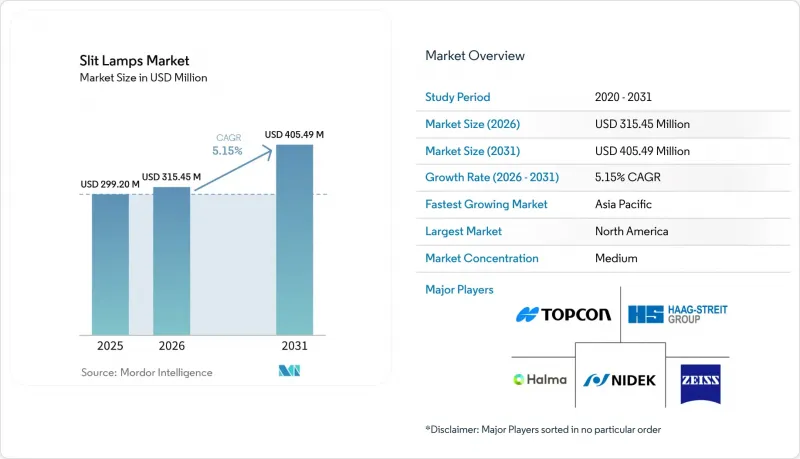
Mordor Intelligence에 의하면, 슬릿 램프 시장 규모는 2025년 2억 9,920만 달러로 평가되었고, 2026년에는 3억 1,545만 달러로 추정되고, 2026-2031년 CAGR 5.15%로 성장을 지속하여, 2031년에는 4억 549만 달러에 이를 것으로 예측됩니다.
본 보고서는 모달리티별(탁상형, 휴대용 등), 광원별(LED, 할로겐, 크세논, 기타), 기술별(기존 및 아날로그, 디지털 이미징 지원 등), 용도별(백내장, 녹내장, 안구건조증 및 마이보그래피, 기타), 최종 사용자별(병원, 클리닉, 기타), 지역별(북미, 유럽, 아시아태평양, 기타)로 분류되어 있습니다. 시장 전망은 금액(달러)으로 제시되어 있습니다.
세계의 슬릿 램프 시장 동향 및 분석
노화에 따른 안과 질환의 급증
현재 전 세계적으로 22억 명이 시력 장애로 고통받고 있으며, 미국의 65세 이상 인구는 2030년까지 7,310만 명에 달할 것으로 예측됩니다. 평균 수명의 연장에 따라 백내장 및 녹내장 환자 수가 증가하고 있어, 의료기관은 시설을 증설하지 않고도 진단 역량을 확대할 수밖에 없는 상황입니다. 연 1회 실시하는 안압 측정 및 시신경 검사에는 생체현미경 검사가 필요하기 때문에 환자 1인당 슬릿 램프 이용률이 증가하고 있습니다. 인도는 그 규모가 얼마나 큰지를 보여주고 있습니다. 2024년에는 700만 건의 백내장 수술이 시행되었으며, 1,000개 이상의 지역 병원에서 각각 수술 전 세극등 현미경 영상 진단이 필요했습니다. 진료 보수가 기록된 영상 진단에 의존하고 있는 경우, 장비 교체를 미루면 진료 효율이 저하될 위험이 있습니다.
전 세계의 LED 조명 시스템으로의 전환
LED 모듈은 45만 룩스의 조도를 구현하며, 할로겐에 비해 전력 소비를 40% 절감하고 수명도 500시간에서 5만 시간으로 늘어났습니다. 안정적인 5,500K 색온도로 진단의 일관성이 확보되며, 발열량 감소로 환자의 쾌적함도 향상됩니다. 주요 공급업체들은 더 이상 할로겐 모델을 제공하지 않지만, 중국 제조업체들은 ISO 15004-2 안전 기준을 충족하는 가격 경쟁력 있는 LED 장비를 공급하고 있습니다. 현재 남아 있는 할로겐 장비는 여전히 초기 비용을 중시하는 자금난에 시달리는 공립 병원에 집중되어 있습니다.
디지털 모델의 높은 초기 비용 및 유지비
영상 진단 기능과 AI 기능을 갖춘 디지털 유닛은 1만 5,000달러를 초과하며, 서비스 계약에 따라 연간 10-15%의 추가 비용이 발생합니다. 가격에 민감한 시장의 진료소에서는 영상 진단 기능을 제외한 6,950달러짜리 아날로그 LED 장비로 전환하고 있습니다. 일본이나 서유럽에서는 리스 계약을 통해 예산 부담이 줄어들지만, 기타 지역에서는 여전히 드문 임베디드니다.
부문별 분석
2025년 매출의 71.55%를 차지한 벤치탑형 유닛은 안압 측정과 안저 촬영을 통합한 검사 라인의 핵심을 이루고 있습니다. 이 데이터는 백내장 수술 계획을 수립하는 데 있어 외과 의사가 필요로 하는 내구성이 뛰어난 광학 시스템과 입체 시야 깊이를 반영한 것입니다. 한편, 휴대용 기기는 이동성이 필수적인 지방의 선별 검사 프로그램과 동물병원을 주축으로 2031년까지 연평균 성장률(CAGR) 8.25%를 나타낼 것으로 전망됩니다. 하이브리드형 이동식 카트 솔루션은 바퀴가 달린 탁상용 광학 시스템을 제공하지만, 여전히 가격이 비싸기 때문에 보급에는 한계가 있습니다. 휴대용 모델은 소아과나 응급의료 현장에서 활용되고 있지만, 상세한 매핑을 수행하기에는 배율이 부족합니다. 이러한 양분된 상황은 워크플로우 내 우선순위의 차이가 두 방식 모두의 중요성을 유지하고 있음을 보여줍니다.
휴대용 기기의 보급 현황은 처리 능력의 우위만으로는 모든 이용 사례를 아우를 수 없음을 보여줍니다. 지방의 의료 종사자들은 배터리 구동 방식이나 태블릿 연동을 선호하는 반면, 병원 네트워크에서는 환자 수가 많기 때문에 고정 설치형에 의존하고 있습니다. 유지보수 기준도 다릅니다. 탁상형 광학 기기는 매년 정밀한 조정이 필요하지만, 휴대용 기기는 현장에서의 내구성을 중시하여 설계되었습니다. 주로 유럽에서 볼 수 있는 리스 옵션은 소규모 클리닉이 고급 탁상형 장비를 도입할 수 있도록 지원하지만, 신흥 시장의 구매자 대다수는 여전히 기본 사양의 아날로그 LED 모델을 선택하고 있습니다. 장래에는 AI 모듈이 성능 격차를 해소함으로써 휴대용 기기에서도 고정식 시스템에 버금가는 분류 정확도를 구현할 수 있게 될지도 모르지만, 외과 의사가 고위험 사례를 계획할 때는 여전히 벤치탑 기기의 안정성이 요구될 것입니다.
LED는 2025년 매출의 59.53%를 차지했으며, 연평균 성장률(CAGR) 7.55%로 성장하고 있습니다. 이는 하나의 장수명 모듈이 기기의 수명 기간 동안 100개의 할로겐 전구를 대체하기 때문입니다. 의료기관은 전구 교체로 인한 가동 중단 시간을 피할 수 있으며, 5,500K의 안정적인 조명을 통해 미세한 각막 부종을 더 잘 관찰할 수 있습니다. 할로겐 조명이 차지하는 나머지 시장 점유율은 예산이 부족한 병원이나 전력 공급이 불안정한 지역에 집중되어 있으며, 이러한 곳에서는 사용자들이 성능보다 편의성을 더 중요하게 여깁니다. 크세논은 초고휘도가 필요한 조사 용도에서만 여전히 사용되고 있습니다.
수명 주기 경제성 측면에서 특히 에너지 가격 상승에 따라 LED 유닛은 3년 이내에 확실한 투자 회수가 기대됩니다. 중국의 국내 공급업체들은 낮은 생산 비용을 활용해 안전 기준을 충족하면서도 수입품보다 30-40% 저렴한 가격을 책정함으로써, 지역 병원의 LED 보급을 가속화하고 있습니다. 정부 입찰에서는 공공 프로그램 전체의 운영 비용을 최소화하기 위해 LED를 지정하는 사례가 늘고 있습니다. 2031년 이후 레이저 기반 조명 기술이 성숙되면, 슬릿 램프 시장은 기술적으로 더욱 큰 도약을 이룰 가능성이 있지만, 현재 연구실 단계에 있는 프로토타입이 실용화되기까지는 아직 수년이 더 걸릴 것으로 보입니다.
지역별 분석
북미는 LED의 조기 도입, ASC(외래수술센터(ASC)) 네트워크의 밀집, 그리고 촬영된 영상 진단에 대해 보상을 제공하는 환급 인센티브 덕분에 2025년에는 34.55%의 점유율로 매출을 주도했습니다. 도입 기반이 성숙해져 있기 때문에 성장은 눈부시다기보다는 꾸준한 임베디드니다. 구매의 대부분은 노후화된 아날로그 시스템을 디지털 제품으로 교체하는 것입니다. 사이버 보안 규제와 지불 기관의 감사가 디지털 전환을 더욱 가속화하고 있습니다.
아시아태평양은 2031년까지 연평균 성장률(CAGR) 7.51%를 기록할 전망이며, 지역별로는 가장 빠른 성장세를 보일 것으로 전망됩니다. 이는 인도에서 연간 700만 건의 백내장 수술이 이루어지고 있다는 점과, 중국에서 국내 공급업체들이 가격 경쟁력을 높이는 데 도움이 되는 NMPA(국가약품감독관리국)의 간소화된 승인 절차에 힘입은 결과입니다. 일본에서는 급속한 고령화로 인해 선별 검사 수요가 증가하고 있는 반면, 호주와 한국에서는 외딴 지역에서의 의료 서비스 제공을 목적으로 휴대용 AI 기기가 도입되고 있습니다. 가격에 대한 민감성 때문에 아날로그 기기의 판매는 여전히 이어지고 있지만, 정부의 일괄 입찰에서는 운영 비용을 최소화하기 위해 LED 모듈의 채택이 의무화되고 있습니다.
유럽에서는 의료기기 규정(MDR) 준수로 인해 승인 절차가 장기화되고 있어, 견고한 품질 관리 시스템을 갖춘 기존 기업들이 유리한 입장에 서게 되면서 시장은 완만한 성장에 그치고 있습니다. 독일과 영국에서는 전국적인 전자건강기록(EHR) 플랫폼과의 연동을 목적으로 고가 디지털 기기가 도입되고 있지만, 남유럽 및 동유럽 회원국에서는 여전히 초기 비용 절감이 우선시되고 있습니다. 중동 및 아프리카 및 남미는 특히 자선 안과 의료 활동을 통해 지방 진료소에 휴대용 기기를 도입하고 있는 지역에서 전반적으로 판매 대수가 크게 증가하고 있습니다. 전반적으로, 지역 간 격차는 소득 수준과 규제의 엄격성을 반영하고 있습니다. 선진국 시장에서는 디지털 통합이 요구되는 반면, 신흥국 시장에서는 저가형 LED 및 아날로그 기기를 활용한 광범위한 접근성이 우선시되고 있습니다.
기타 혜택 :
- 엑셀 형식 시장 예측(ME) 시트
- 3개월간의 애널리스트 지원
자주 묻는 질문
목차
제1장 서론
제2장 조사 방법
제3장 주요 요약
제4장 시장 구도
제5장 시장 규모 및 성장 예측
제6장 경쟁 구도
제7장 시장 기회 및 향후 전망
AJY 26.06.22According to Mordor Intelligence, the slit lamps market size is expected to grow from USD 299.20 million in 2025 to USD 315.45 million in 2026 and is forecast to reach USD 405.49 million by 2031 at 5.15% CAGR over 2026-2031.
This report is Segmented by Modality (Table-top/Benchtop, Portable, and More), Light Source (LED, Halogen, Xenon, Other), Technology (Conventional/Analog, Digital Imaging-Ready, and More), Application (Cataract, Glaucoma, Dry-Eye & Meibography, and More), End User (Hospitals, Clinics, and More), and Geography (North America, Europe, Asia-Pacific, and More). Market Forecasts are Provided in Value (USD).
Global Slit Lamps Market Trends and Insights
Rapid Rise in Age-Related Ocular Diseases
Global vision-impairment now affects 2.2 billion people, and the U.S. population aged 65 plus will reach 73.1 million by 2030. Greater longevity inflates cataract and glaucoma caseloads, obliging clinics to expand diagnostic capacity without adding real estate. Slit lamp utilization per patient has increased because annual intraocular pressure checks and optic nerve exams require biomicroscopy. India illustrates scale effects: 7 million cataract surgeries in 2024 each demanded pre-operative slit lamp imaging across more than 1,000 district hospitals. Practices that delay upgrading risk throughput losses when reimbursement depends on documented imaging.
Global Shift Toward LED-Illuminated Systems
LED modules deliver 450,000 lux while consuming 40% less power than halogen and lasting 50,000 hours instead of 500. Stable 5,500 K color temperature ensures diagnostic consistency, and lower heat output improves patient comfort. Top vendors no longer offer halogen models, while Chinese manufacturers supply cost-competitive LED devices that meet ISO 15004-2 safety rules. Remaining halogen units cluster in cash-constrained public hospitals where upfront cost still prevails.
High Capital and Maintenance Costs of Digital Models
Digital units with imaging and AI functions exceed USD 15,000, while service contracts add 10-15% per year. Practices in price-sensitive markets turn to USD 6,950 analog LED devices that forgo imaging. Leasing eases budgets in Japan and Western Europe yet remains rare elsewhere.
Other drivers and restraints analyzed in the detailed report include:
- Accelerating Demand for Portable Point-of-Care Units
- Digitally Integrated Imaging and EHR Connectivity
- Regulatory Approval Complexity Across Regions
For complete list of drivers and restraints, kindly check the Table Of Contents.
Segment Analysis
Benchtop units represented 71.55% of 2025 revenue, anchoring examination lanes that integrate tonometry and fundus imaging. This share reflects durable optics and stereoscopic depth that surgeons need for cataract planning. Portable devices, however, are forecast to post an 8.25% CAGR to 2031, driven by rural screening programs and veterinary clinics where mobility is essential. Hybrid mobile-cart solutions offer benchtop optics on wheels yet remain expensive, limiting adoption. Handheld models serve pediatric and emergency settings but lack the magnification for detailed mapping. The split shows how differing workflow priorities keep both modalities relevant.
Portable gains demonstrate that throughput advantages alone cannot offset all use cases. Rural health workers prefer battery operation and tablet pairing, while hospital networks rely on fixed lanes for high patient volume. Maintenance standards also diverge; benchtop optics need precise alignment each year, whereas portable devices are designed for field robustness. Leasing options, mainly in Europe, help smaller clinics afford premium benchtops, yet most emerging-market buyers still choose base-spec analog LED models. Over time, AI modules may bridge the capability gap, letting portable units deliver triage accuracy closer to fixed systems, yet surgeons will still require the stability of bench equipment when planning high-risk cases.
LED commanded 59.53% of 2025 sales and is growing at a 7.55% CAGR because one long-life module replaces a hundred halogen bulbs over the device lifespan. Clinics avoid downtime tied to bulb swaps and enjoy consistent 5,500 K illumination that enhances visualization of subtle corneal edema. Halogen's remaining share centers on low-budget hospitals and locations with unreliable power where users value simplicity over performance. Xenon survives only in research scenarios needing ultra-high intensity.
Lifecycle economics give LED units a clear payback inside three years, particularly as energy prices rise. China's domestic suppliers leverage lower production cost to undercut imports by 30-40% while still meeting safety norms, speeding LED penetration in community hospitals. Government tenders increasingly specify LED to minimize operating expense across public programs. If laser-based illumination matures post-2031, the slit lamps market may see another technology leap, yet current lab prototypes remain years from commercialization.
Geography Analysis
North America led revenue with a 34.55% share in 2025 due to early LED uptake, dense ASC networks, and reimbursement incentives that reward documented imaging. Growth is steady rather than spectacular because the installed base is mature; most purchases replace aging analog systems with digital equivalents. Cybersecurity rules and payer audits further accelerate digital upgrades.
Asia-Pacific is forecast to post a 7.51% CAGR through 2031, the fastest regional pace, propelled by India's 7 million annual cataract surgeries and China's streamlined NMPA pathway that helps local vendors compete on price. Japan's rapidly aging society deepens screening demand, while Australia and South Korea adopt portable AI devices for outreach in remote areas. Price sensitivity keeps analog sales alive, yet bulk government tenders now specify LED modules to minimize running costs.
Europe shows moderate expansion as Medical Device Regulation compliance lengthens approval cycles, favoring incumbents with robust quality systems. Germany and the United Kingdom buy premium digital units to integrate with nationwide EHR platforms, but southern and eastern member states still prioritize upfront savings. Middle East and Africa plus South America collectively add meaningful volume, especially where charitable eye-care missions deploy portable units in rural clinics. Overall, regional divergence reflects income levels and regulatory stringency: developed markets seek digital integration, while emerging markets prioritize broad access using lower-price LED or analog devices.
- 66 Vision Tech Co., Ltd.
- Appasamy Associates
- Canon
- Carl Zeiss
- CSO Srl
- Ellex Medical Pty Ltd.
- Haag-Streit AG
- HEINE Optotechnik
- Huvitz Co., Ltd.
- Keeler Ltd. (Halma plc)
- Kowa Company, Ltd.
- Luneau Technology Group (Visionix)
- MediWorks Precision Instruments
- Nidek
- OCULUS Optikgerate GmbH
- Optopol Technology Sp. z o.o.
- Reichert Technologies (AMETEK)
- Shin Nippon (Rexxam Co., Ltd.)
- Suzhou KangJie Medical Instruments
- Takagi Seiko Co., Ltd.
- Topcon
Additional Benefits:
- The market estimate (ME) sheet in Excel format
- 3 months of analyst support
TABLE OF CONTENTS
1 Introduction
- 1.1 Study Assumptions & Market Definition
- 1.2 Scope of the Study
2 Research Methodology
3 Executive Summary
4 Market Landscape
- 4.1 Market Overview
- 4.2 Market Drivers
- 4.2.1 Rapid rise in age-related ocular diseases
- 4.2.2 Global shift toward LED-illuminated systems
- 4.2.3 Accelerating demand for portable point-of-care units
- 4.2.4 Digitally integrated imaging & EHR connectivity
- 4.2.5 AI-assisted anterior-segment screening in primary care
- 4.2.6 Growing uptake in veterinary ophthalmology
- 4.3 Market Restraints
- 4.3.1 High capital & maintenance costs of digital models
- 4.3.2 Regulatory approval complexity across regions
- 4.3.3 Cyber-security risk for networked slit lamps
- 4.3.4 Smartphone-based imaging cannibalisation
- 4.4 Supply-Chain Analysis
- 4.5 Regulatory Landscape
- 4.6 Technological Outlook
- 4.7 Porter's Five Forces
- 4.7.1 Threat of New Entrants
- 4.7.2 Bargaining Power of Suppliers
- 4.7.3 Bargaining Power of Buyers
- 4.7.4 Threat of Substitutes
- 4.7.5 Competitive Rivalry
5 Market Size & Growth Forecasts (Value, USD)
- 5.1 By Modality
- 5.1.1 Table-top / Benchtop Slit Lamps
- 5.1.2 Portable Slit Lamps
- 5.1.3 Hand-held Slit Lamps
- 5.1.4 Hybrid / Mobile-cart Systems
- 5.2 By Light Source
- 5.2.1 LED
- 5.2.2 Halogen
- 5.2.3 Xenon
- 5.2.4 Other Emerging Sources
- 5.3 By Technology
- 5.3.1 Conventional / Analog
- 5.3.2 Digital Imaging-ready
- 5.3.3 AI-enabled Digital
- 5.3.4 Confocal / Laser Slit Lamps
- 5.4 By Application
- 5.4.1 Cataract Examination
- 5.4.2 Glaucoma Screening
- 5.4.3 Dry-eye & Meibography
- 5.4.4 Macular Degeneration & Retinal Pathology
- 5.4.5 Other Applications
- 5.5 By End User
- 5.5.1 Hospitals & Tertiary Eye Centres
- 5.5.2 Ophthalmology Clinics
- 5.5.3 Ambulatory Surgical Centres
- 5.5.4 Other End Users
- 5.6 By Geography
- 5.6.1 North America
- 5.6.1.1 United States
- 5.6.1.2 Canada
- 5.6.1.3 Mexico
- 5.6.2 Europe
- 5.6.2.1 Germany
- 5.6.2.2 United Kingdom
- 5.6.2.3 France
- 5.6.2.4 Italy
- 5.6.2.5 Spain
- 5.6.2.6 Rest of Europe
- 5.6.3 Asia-Pacific
- 5.6.3.1 China
- 5.6.3.2 India
- 5.6.3.3 Japan
- 5.6.3.4 Australia
- 5.6.3.5 South Korea
- 5.6.3.6 Rest of Asia-Pacific
- 5.6.4 Middle East and Africa
- 5.6.4.1 GCC
- 5.6.4.2 South Africa
- 5.6.4.3 Rest of Middle East and Africa
- 5.6.5 South America
- 5.6.5.1 Brazil
- 5.6.5.2 Argentina
- 5.6.5.3 Rest of South America
- 5.6.1 North America
6 Competitive Landscape
- 6.1 Market Concentration
- 6.2 Market Share Analysis
- 6.3 Company Profiles (includes Global level Overview, Market level overview, Core Segments, Financials as available, Strategic Information, Market Rank/Share for key companies, Products & Services, and Recent Developments)
- 6.3.1 66 Vision Tech Co., Ltd.
- 6.3.2 Appasamy Associates
- 6.3.3 Canon Medical Systems Corp.
- 6.3.4 Carl Zeiss Meditec AG
- 6.3.5 CSO Srl
- 6.3.6 Ellex Medical Pty Ltd.
- 6.3.7 Haag-Streit AG
- 6.3.8 Heine Optotechnik GmbH & Co. KG
- 6.3.9 Huvitz Co., Ltd.
- 6.3.10 Keeler Ltd. (Halma plc)
- 6.3.11 Kowa Company, Ltd.
- 6.3.12 Luneau Technology Group (Visionix)
- 6.3.13 MediWorks Precision Instruments
- 6.3.14 NIDEK Co., Ltd.
- 6.3.15 OCULUS Optikgerate GmbH
- 6.3.16 Optopol Technology Sp. z o.o.
- 6.3.17 Reichert Technologies (AMETEK)
- 6.3.18 Shin Nippon (Rexxam Co., Ltd.)
- 6.3.19 Suzhou KangJie Medical Instruments
- 6.3.20 Takagi Seiko Co., Ltd.
- 6.3.21 Topcon Corporation
7 Market Opportunities & Future Outlook
- 7.1 White-space & Unmet-need Assessment