|
시장보고서
상품코드
2063420
인간-AI 협업 시스템 : 시장 점유율 분석, 업계 동향 및 통계, 성장 예측(2026-2031년)Human-AI Collaborative Work Systems - Market Share Analysis, Industry Trends & Statistics, Growth Forecasts (2026 - 2031) |
||||||
 Mordor Intelligence
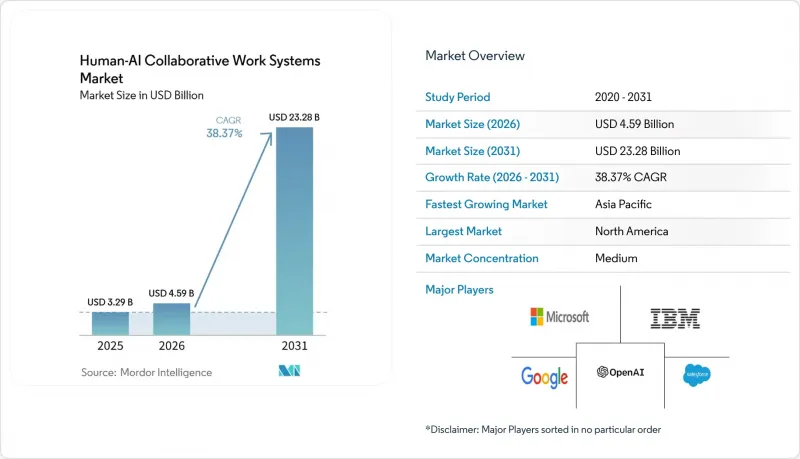
Mordor Intelligence에 의하면, 인간-AI 협업 시스템 시장 규모는 2025년에 32억 9,000만 달러로 평가되었습니다. 2026년에 45억 9,000만 달러에 달하고, 2031년까지 232억 8,000만 달러에 이를 것으로 예측됩니다.
2026년부터 2031년까지 연평균 성장률(CAGR) 38.37%를 나타낼 것으로 전망됩니다.
본 보고서는 도입 형태(On-Premise, 클라우드, 하이브리드), 구성 요소(소프트웨어, 서비스), 최종 사용자 산업(IT 및 통신, 헬스케어 및 생명과학, 제조, 은행, 금융서비스 및 보험(BFSI), 소매 및 전자상거래, 교육, 기타), 조직 규모(대기업, 중소기업) 및 지역별로 분류되어 있습니다. 시장 전망은 금액(달러) 기준으로 제시되어 있습니다.
세계의 인간-AI 협업 시스템 시장 동향 및 인사이트
기업 내 생성형 AI 어시스턴트 도입 확대
이 조직은 어시스턴트를 단순히 생산성 향상을 위한 부가 기능으로 취급하지 않고, 의사결정 워크플로우에 직접 통합하고 있습니다. 마이크로소프트는 2025년 말까지 6만 5,000개 이상의 기업이 Azure OpenAI Service를 이용했으며, 이는 2024년 초 수치에 비해 거의 4배 증가한 것이라고 발표했습니다. 한편, Microsoft 365용 Copilot의 유료 라이선스 수는 1,500만 개를 돌파했으나, 이는 Office 설치 기반의 4% 미만에 그치고 있어 여전히 성장 여지가 크다는 것을 보여주고 있습니다. Agentforce를 이용 중인 Salesforce 고객들은 2025년 말 릴리스 이후 케이스 해결 시간이 30-50% 단축되었다고 보고하고 있습니다. IBM은 27만 명의 직원을 대상으로 사내에서 Watsonx를 도입하고 있으며, 2027년까지 누적 45억 달러의 생산성 향상을 목표로 하고 있어 ROI의 효과를 입증하고 있습니다. 이러한 사례들은 얼리 어답터들이 모든 지식 근로자로의 확대를 추진하기 전에 경제적 효과를 검증하고 있음을 강조하고 있습니다.
협업을 강화하는 다중 모달 대규모 언어 모델의 발전
텍스트, 이미지, 음성, 동영상을 이해하는 멀티모달 모델은 디자인, 임상 진단, 산업 유지보수 분야에서 협업의 새로운 가능성을 열어가고 있습니다. 구글의 제미니는 2025년 12월 월간 활성 사용자 수 7억 5,000만 명을 달성했으나, 규제 산업의 많은 고객들은 데이터 거주 규정을 준수하기 위해 On-Premise 도입을 선택하고 있습니다. 어도비는 Firefly를 Creative Cloud에 통합하여, 마케터들이 별도의 디자이너를 고용하지 않고도 맞춤형 시각 자료를 생성할 수 있도록 했습니다. 의료 분야에서는 FDA가 2024년까지 950건 이상의 AI 탑재 의료기기를 승인했으며, 그중 상당수는 방사선 영상 진단을 효율화하는 비전 및 언어 모델을 기반으로 하고 있습니다. 엣지 추론으로의 전환은 소매점의 계산대나 자율형 로봇 시나리오에서 요구되는 저지연 요건을 충족하기 위한 것입니다.
표준화된 인간과 AI 간의 대화 프로토콜 부재
에이전트가 지시를 받고, 확인을 위한 질문을 하거나, 사람에게 에스컬레이션하는 방법을 규정하는 공통된 프로토콜은 존재하지 않습니다. ISO/IEC 42001은 경영 시스템의 개요를 제시하고 있으나, 기술적 인계에 관한 세부 사항에 대해서는 정의하고 있지 않습니다. IEEE의 P7001 투명성 표준은 여전히 선택적 표준이며, 2027년까지는 최종 확정되지 않을 것입니다. 해당 기업에 따르면, 통합 시간의 40% 가까이가 공급업체 간 인증 체계, 피드백 루프, 감사 로그를 일치시키는 데 소요되고 있다고 합니다. 이러한 단편화는 다중 에이전트의 도입을 지연시키고 전환 비용을 증가시키고 있습니다. 특히, 모든 의사결정 과정을 문서화해야 하는 규제가 엄격한 금융 및 의료 분야에서는 이러한 경향이 두드러집니다.
부문별 분석
하이브리드 모델이 성장을 주도할 것으로 예상되며, 2026년부터 2031년까지 연평균 성장률(CAGR) 38.97%로 확대될 것으로 전망됩니다. 이는 규제가 엄격한 분야가 기밀 데이터를 On-Premise에서 처리하는 동시에, 중요도가 낮은 추론 처리를 클라우드로 오프로드하기 위함입니다. Azure Stack이나 Google Distributed Cloud를 이용하는 금융 기관들은 고객의 개인 식별 정보(PII)를 관할 구역 내에 보관하면서, 리스크 스코어링에는 최신 트랜스포머 모델을 활용하고 있습니다. 제조 공장에서는 에지 노드가 저지연 품질 검사를 수행하고, 중앙 집중형 서버가 모델을 미세 조정함으로써, 하이브리드 아키텍처가 데이터 주권과 밀리초 단위의 응답 요구 사항이라는 두 가지 과제를 모두 해결하는 방법을 보여줍니다.
그럼에도 불구하고, 2025년 인간과 AI의 협업 업무 시스템 시장에서 클라우드 도입은 47.22%라는 최대 점유율을 유지했습니다. 이는 순수한 SaaS가 초기 투자를 최소화하고 가치 입증(PoV)을 가속화하기 위함입니다. On-Premise 환경은 에어갭 방식의 보안이 필요한 국방 기관이나 공공 부문 기관에 있어 여전히 중요합니다. 각 벤더사는 현재 여러 환경을 아우르는 단일 제어 플레인을 통합하여 가시성과 비용 관리를 용이하게 하고 있습니다. 이러한 아키텍처의 유연성 덕분에, 성능을 희생하지 않으면서도 규정 준수를 추구하는 ‘레이트 메이저리티’ 도입자가 늘어남에 따라, 인간-AI 협업 시스템 시장은 확대되고 있습니다.
2025년에는 소프트웨어가 매출의 63.49%를 차지한 반면, 기업들이 통합, 맞춤형 워크플로우 설계 및 정기적인 모델 재조정을 요구함에 따라 서비스 부문은 연평균 성장률(CAGR) 40.37%로 더욱 빠르게 성장할 전망입니다. EU AI법 및 미국의 산업별 규정에 명시된 지속적인 감사 의무에 따라, 조직은 모델의 각 반복마다 공정성 및 편향성에 관한 보고서를 갱신해야 하며, 이러한 업무는 시스템 통합 업체에 위탁되는 경우가 많아지고 있습니다. 2026년 초까지 액센츄어는 급증하는 수요에 대응하기 위해 4만 명 이상의 컨설턴트를 대상으로 생성형 AI 교육을 실시했습니다.
매니지드 서비스를 위한 인간-AI 협업 시스템 시장은 사내에 데이터 사이언스자를 보유하지 않은 중소기업 사이에서 가장 빠르게 성장하고 있습니다. monday.com이나 ClickUp이 제공하는 턴키 방식의 구독 번들은 플랫폼 이용권과 지원 서비스를 한 세트로 묶어 제공하기 때문에 진입 장벽을 낮추고 있습니다. 일부 공급업체는 전문 서비스를 성과 기반 가격 책정과 연계하여, 시간 단위 청구 대신 생산성 향상에 인센티브를 부여하고 있기 때문에 이러한 추세는 인간-AI 협업 시스템 업계 전반의 계약 관행을 혁신적으로 변화시킬 것으로 예측됩니다.
지역별 분석
북미는 2025년에 매출의 34.57%를 차지했으며, 하이퍼스케일러의 설비 투자와 소프트웨어, 통신, 전문 서비스 분야의 초기 단계 실험이 성장의 견인차 역할을 했습니다. 마이크로소프트는 현재 Azure OpenAI Service를 지원하는 AI 최적화 데이터센터에 375억 달러를 투자했습니다. 한편, 세일즈포스에서는 Agentforce 시범 도입의 70%가 미국 고객에 의한 것으로, 이는 신속한 기술 테스트를 수행하는 문화를 반영하고 있습니다. 그러나 HIPAA 및 GLBA에 근거한 소송으로 인해 리스크 담당자들이 데이터 흐름을 면밀히 검토하고 있어, 의료 및 은행 업계에서의 도입 일정이 지연되고 있습니다.
아시아태평양은 가장 역동적인 지역이 될 것으로 예상되며, 연평균 성장률(CAGR)은 39.57%에 달할 전망입니다. 1조 위안(약 1,389억 달러) 규모의 중국 국가 AI 프로그램은 바이두, 알리바바, 텐센트가 개발하는 국내 모델에 자금을 지원하고 있으며, 중국어에 대한 유창성과 현지 도메인에 대한 적응력을 중시하고 있습니다. 활기를 띠고 있는 인도의 IT 서비스 업계에서는 정부의 보조금과 방대한 영어 구사자 인재 풀을 바탕으로, AI를 도입해 업무 효율을 높이고 있습니다. 일본과 한국은 고령화와 세계 공급망의 변화를 보완하기 위해 제조 및 반도체 설계에 주력하고 있습니다. 그러나 엄격한 데이터 주권법으로 인해 다국적 기업들은 병행 시스템을 유지할 수밖에 없어 운영 비용이 증가하고 있습니다.
유럽은 혁신과 엄격한 규정 준수의 균형을 유지하고 있습니다. EU AI법이 요구하는 투명성 요건은 조달 주기를 장기화하는 한편, 거버넌스 전문가들에게 기회를 창출하고 있습니다. 독일은 산업 분야에서의 도입을 주도하고 있으며, 특히 자동차의 예측 유지보수 분야에서 두드러집니다. 한편, 영국은 AI 안전 연구소를 활용하여 도입 전 테스트를 통해 기업 이사회에 안도감을 주고 있습니다. 브라질, 아랍에미리트, 남아프리카공화국에서 클라우드 리전의 구축은 라틴아메리카, 중동 및 아프리카를 인간-AI 협업 시스템 시장으로 서서히 끌어들이고 있지만, 지출은 여전히 다국적 기업의 자회사에 집중되고 있습니다.
기타 혜택 :
- 엑셀 형식 시장 예측(ME) 시트
- 3개월간의 애널리스트 지원
자주 묻는 질문
목차
제1장 서론
제2장 조사 방법
제3장 주요 요약
제4장 시장 구도
제5장 시장 규모 및 성장 예측
제6장 경쟁 구도
제7장 시장 기회 및 향후 전망
KTH 26.06.22According to Mordor Intelligence, the human-AI collaborative work systems market size is projected to be USD 3.29 billion in 2025, USD 4.59 billion in 2026, and reach USD 23.28 billion by 2031, growing at a CAGR of 38.37% from 2026 to 2031.
This report is Segmented by Deployment Mode (On-Premise, Cloud, and Hybrid), Component (Software, and Services), End-User Industry (IT and Telecom, Healthcare and Life Sciences, Manufacturing, BFSI, Retail and E-Commerce, Education, and More), Organization Size (Large Enterprises, and Small and Medium Enterprises), and Geography. The Market Forecasts are Provided in Terms of Value (USD).
Global Human-AI Collaborative Work Systems Market Trends and Insights
Escalating Enterprise Adoption of Generative AI Assistants
Organizations are embedding assistants directly into decision workflows rather than treating them as separate productivity add-ons. Microsoft disclosed that more than 65,000 enterprises consumed Azure OpenAI Service by late 2025, almost quadrupling its early-2024 count, while Copilot for Microsoft 365 surpassed 15 million paid seats, yet still touched less than 4% of the Office installed base, showing substantial headroom. Salesforce customers using Agentforce reported 30-50% reductions in case-resolution time after its late-2025 launch. IBM's internal roll-out of watsonx across 270,000 employees targets USD 4.5 billion in cumulative productivity gains by 2027, reinforcing the ROI narrative. These examples underscore how early adopters validate economic impact before extending deployment across all knowledge workers.
Advances in Multimodal Large Language Models Enhancing Collaboration
Multimodal models that understand text, images, audio, and video are opening new collaboration frontiers in design, clinical diagnostics, and industrial maintenance. Google's Gemini hit 750 million monthly active users in December 2025, with many regulated-industry customers opting for on-premises deployments to comply with data-residency rules. Adobe embedded Firefly into Creative Cloud, enabling marketers to generate personalized visual assets without hiring extra designers. In healthcare, the FDA approved more than 950 AI-enabled medical devices through 2024, many of which are powered by vision-language models that streamline radiology reads. The move toward edge inference addresses low-latency requirements in retail checkout and autonomous robotics scenarios.
Lack of Standardized Human-AI Interaction Protocols
No common protocol governs how agents receive instructions, ask clarifying questions, or escalate to humans. ISO/IEC 42001 outlines management systems but leaves technical hand-off details undefined. IEEE's P7001 transparency standard remains voluntary and will not be finalized until 2027. Enterprises report that close to 40% of integration time is spent harmonizing authentication schemes, feedback loops, and audit logs across vendors. This fragmentation slows multi-agent adoption and increases switching costs, particularly inside regulated finance and healthcare environments that must document every decision path.
Other drivers and restraints analyzed in the detailed report include:
- Rising Demand for Hybrid-Work Orchestration Platforms
- Integration of RPA Bots With Conversational Agents
- Data-Privacy Concerns Limiting Cross-Team Data Sharing
For complete list of drivers and restraints, kindly check the Table Of Contents.
Segment Analysis
Hybrid models are forecast to lead growth, advancing at a 38.97% CAGR from 2026-2031, as heavily regulated sectors process sensitive data on-premise while offloading non-critical inference to the cloud. Financial institutions using Azure Stack or Google Distributed Cloud keep customer PII within local jurisdiction while still using the latest transformer models for risk scoring. In manufacturing plants, edge nodes execute low-latency quality inspections while centralized servers refine models, demonstrating how a hybrid architecture solves both data sovereignty and millisecond response constraints.
Cloud deployments nonetheless sustained the largest 47.22% share of the human-AI collaborative work systems market in 2025 because pure SaaS minimizes upfront capital outlays and accelerates proof of value. On-premises remains relevant for defense and public-sector agencies that require air-gapped security. Vendors now bundle a single control plane spanning environments, easing observability and cost governance. The architectural flexibility widens the market for human-AI collaborative work systems, as late-majority adopters demand compliance without sacrificing performance.
While software captured 63.49% revenue in 2025, services will expand more quickly at a 40.37% CAGR as enterprises seek integration, custom workflow design, and periodic model re-tuning. Continuous audit obligations outlined in the EU AI Act and sectoral U.S. rules oblige organizations to refresh fairness and bias reports for each model iteration, a task often outsourced to systems integrators. By early 2026, Accenture had trained more than 40,000 consultants in generative AI to meet surging demand.
The human-AI collaborative work systems market for managed services is growing fastest among small and medium enterprises that lack in-house data scientists. Turnkey subscription bundles from monday.com or ClickUp wrap platform access with support, lowering entry barriers. Some vendors tie professional services to outcome-based pricing, aligning incentives around productivity lifts rather than hourly billing, a trend expected to reshape contracting norms across the human-AI collaborative work systems industry.
Geography Analysis
North America retained 34.57% revenue in 2025, anchored by hyperscaler capex and early experimentation across software, telecom, and professional services. Microsoft invested USD 37.5 billion in AI-optimized data centers that now underpin Azure OpenAI Service, while Salesforce saw 70% of Agentforce pilots originate from U.S. customers, reflecting a culture of rapid technology trials. Nonetheless, litigation under HIPAA and GLBA prolongs deployment timelines in healthcare and banking as risk officers scrutinize data flow.
Asia-Pacific is projected to be the most dynamic region, registering a 39.57% CAGR. China's CNY 1 trillion (USD 138.9 billion approximately) national AI program funds domestic model development by Baidu, Alibaba, and Tencent, emphasizing Mandarin fluency and local domain adaptation. India's thriving IT services sector embeds AI to raise billable efficiency, supported by government subsidies and a vast English-speaking talent pool. Japan and South Korea focus on manufacturing and semiconductor design to offset aging demographics and global supply-chain shifts. However, stringent data-sovereignty laws force multinational companies to maintain parallel instances, inflating operating costs.
Europe balances innovation with strict compliance. The EU AI Act's transparency mandates lengthen procurement cycles yet create opportunities for governance specialists. Germany leads industrial adoption, particularly in automotive predictive maintenance, whereas the United Kingdom leverages its AI Safety Institute for pre-deployment testing that reassures corporate boards. Cloud region build-outs in Brazil, the United Arab Emirates, and South Africa are gradually pulling Latin America and the Middle East, and Africa into the human-AI collaborative work systems market, though spending remains concentrated in multinational subsidiaries.
- Microsoft Corporation
- Google LLC
- IBM Corporation
- OpenAI, L.L.C.
- Salesforce, Inc.
- Adobe Inc.
- Atlassian Corporation
- ServiceNow, Inc.
- UiPath, Inc.
- Automation Anywhere, Inc.
- Zoho Corporation Pvt. Ltd.
- monday.com Ltd.
- Slack Technologies, L.L.C.
- Notion Labs, Inc.
- GitHub, Inc.
- Figma, Inc.
- Zoom Video Communications, Inc.
- ClickUp Technologies Inc.
- Airtable, Inc.
- Workday, Inc.
Additional Benefits:
- The market estimate (ME) sheet in Excel format
- 3 months of analyst support
TABLE OF CONTENTS
1 INTRODUCTION
- 1.1 Study Assumptions and Market Definition
- 1.2 Scope of the Study
2 RESEARCH METHODOLOGY
3 EXECUTIVE SUMMARY
4 MARKET LANDSCAPE
- 4.1 Market Overview
- 4.2 Market Drivers
- 4.2.1 Escalating Enterprise Adoption of Generative AI Assistants
- 4.2.2 Advances in Multimodal Large Language Models Enhancing Collaboration
- 4.2.3 Rising Demand for Hybrid-Work Orchestration Platforms
- 4.2.4 Integration of RPA Bots with Conversational Agents
- 4.2.5 Availability of Low-Code and No-Code AI Development Tools
- 4.2.6 Growing Compliance Mandates for AI Auditability and Transparency
- 4.3 Market Restraints
- 4.3.1 Lack of Standardized Human-AI Interaction Protocols
- 4.3.2 Data-Privacy Concerns Limiting Cross-Team Data Sharing
- 4.3.3 High Upfront Integration and Training Costs
- 4.3.4 Workforce Resistance Due to Job-Displacement Anxiety
- 4.4 Impact of Macroeconomic Factors on the Market
- 4.5 Industry Value Chain Analysis
- 4.6 Regulatory Landscape
- 4.7 Technological Outlook
- 4.8 Porter's Five Forces Analysis
- 4.8.1 Bargaining Power of Suppliers
- 4.8.2 Bargaining Power of Buyers
- 4.8.3 Threat of New Entrants
- 4.8.4 Threat of Substitutes
- 4.8.5 Intensity of Competitive Rivalry
5 MARKET SIZE AND GROWTH FORECASTS (VALUE)
- 5.1 By Deployment Mode
- 5.1.1 On-Premise
- 5.1.2 Cloud
- 5.1.3 Hybrid
- 5.2 By Component
- 5.2.1 Software
- 5.2.2 Services
- 5.3 By End-User Industry
- 5.3.1 IT and Telecom
- 5.3.2 Healthcare and Life Sciences
- 5.3.3 Manufacturing
- 5.3.4 BFSI
- 5.3.5 Retail and E-commerce
- 5.3.6 Education
- 5.3.7 Government and Public Sector
- 5.3.8 Other End-user Industries
- 5.4 By Organization Size
- 5.4.1 Large Enterprises
- 5.4.2 Small and Medium Enterprises
- 5.5 By Geography
- 5.5.1 North America
- 5.5.1.1 United States
- 5.5.1.2 Canada
- 5.5.1.3 Mexico
- 5.5.2 South America
- 5.5.2.1 Brazil
- 5.5.2.2 Argentina
- 5.5.2.3 Rest of South America
- 5.5.3 Europe
- 5.5.3.1 United Kingdom
- 5.5.3.2 Germany
- 5.5.3.3 France
- 5.5.3.4 Italy
- 5.5.3.5 Spain
- 5.5.3.6 Rest of Europe
- 5.5.4 Asia-Pacific
- 5.5.4.1 China
- 5.5.4.2 Japan
- 5.5.4.3 India
- 5.5.4.4 South Korea
- 5.5.4.5 Rest of Asia-Pacific
- 5.5.5 Middle East and Africa
- 5.5.5.1 Middle East
- 5.5.5.1.1 United Arab Emirates
- 5.5.5.1.2 Saudi Arabia
- 5.5.5.1.3 Rest of Middle East
- 5.5.5.2 Africa
- 5.5.5.2.1 South Africa
- 5.5.5.2.2 Egypt
- 5.5.5.2.3 Rest of Africa
- 5.5.5.1 Middle East
- 5.5.1 North America
6 COMPETITIVE LANDSCAPE
- 6.1 Market Concentration
- 6.2 Strategic Moves
- 6.3 Market Share Analysis
- 6.4 Company Profiles (includes Global Level Overview, Market Level Overview, Core Segments, Financials as available, Strategic Information, Market Rank/Share, Products and Services, Recent Developments)
- 6.4.1 Microsoft Corporation
- 6.4.2 Google LLC
- 6.4.3 IBM Corporation
- 6.4.4 OpenAI, L.L.C.
- 6.4.5 Salesforce, Inc.
- 6.4.6 Adobe Inc.
- 6.4.7 Atlassian Corporation
- 6.4.8 ServiceNow, Inc.
- 6.4.9 UiPath, Inc.
- 6.4.10 Automation Anywhere, Inc.
- 6.4.11 Zoho Corporation Pvt. Ltd.
- 6.4.12 monday.com Ltd.
- 6.4.13 Slack Technologies, L.L.C.
- 6.4.14 Notion Labs, Inc.
- 6.4.15 GitHub, Inc.
- 6.4.16 Figma, Inc.
- 6.4.17 Zoom Video Communications, Inc.
- 6.4.18 ClickUp Technologies Inc.
- 6.4.19 Airtable, Inc.
- 6.4.20 Workday, Inc.
7 MARKET OPPORTUNITIES AND FUTURE OUTLOOK
- 7.1 White-Space and Unmet-Need Assessment