|
시장보고서
상품코드
2063444
생물제제 부형제 시장 : 점유율 분석, 업계 동향과 통계, 성장 예측(2026-2031년)Biologic Excipients - Market Share Analysis, Industry Trends & Statistics, Growth Forecasts (2026 - 2031) |
||||||
 Mordor Intelligence
Mordor Intelligence에 의하면, 생물제제 부형제 시장 규모는 2025년 53억 달러, 2026년 57억 달러에서 2031년까지 87억 달러로 확대되어 2026년부터 2031년까지 연평균 복합 성장률(CAGR)은 8.61%를 나타낼 것으로 예측됩니다.
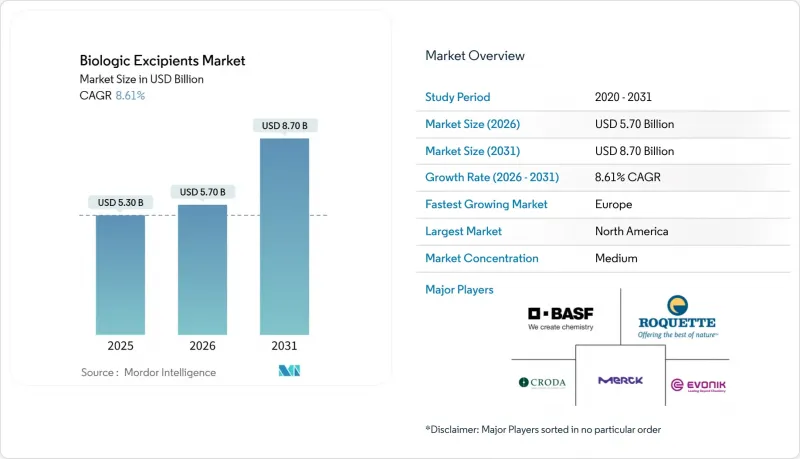
본 보고서는 제품 카테고리(용해제·계면활성제, 탄수화물 등), 제형(비경구, 동결건조 등), 치료법(단일클론항체, 백신, 세포 및 유전자 치료 등), 최종 사용자(바이오의약품 기업, CMO/CDMO 등), 지역(북미, 유럽, 아시아태평양, 중동 및 아프리카, 남미)에 따라 분류되어 있습니다. 시장 전망은 금액(달러) 기준으로 제시되어 있습니다.
세계 바이오로직 부형제 시장 동향 및 인사이트
바이오의약품 파이프라인 확대와 승인이 주사용 등급 부형제에 대한 수요를 가속화하고 있습니다.
2024년, 전 세계 규제 당국은 55개의 신약을 승인했으며, 그중 바이오의약품이 큰 비중을 차지했습니다. 각 바이오로직에는 일반적으로 4-8종의 개별 부형제가 사용되기 때문에 승인될 때마다 완충제, 안정제, 계면활성제, 삼투압 조절제의 소비량이 증가합니다. 현재 시장에 출시되는 단일클론 항체 중 피하 투여 제제의 비중이 크게 증가하고 있으며, 국소 반응을 방지하기 위해 순도 기준이 더욱 엄격해지고 있습니다. EMA는 2025년에 12개의 바이오시밀러를 승인하고, 각 개발 기업에 대해 첨가제 선택에 있어 기존 제품과의 동등성을 입증하거나, 그 선택 이유를 설명할 것을 의무화했습니다. 이로 인해 주사제용 등급 원료에 대한 수요가 두 배로 증가하고 있습니다. 그 결과, 오리지널 의약품 제조업체와 바이오시밀러 제조업체는 제한된 공급량의 초고순도 안정제를 놓고 경쟁하게 되었습니다.
비경구 투여 경로의 주류화로 인해 고순도 안정제, 완충제, 계면활성제 수요가 증가하고 있습니다.
비경구 제제에는 ICH Q3D에 근거한 내독소 한도(<=0.5 EU/mg) 및 원소 불순물 관리가 적용됩니다. USP는 2024년에 프리필드 주사기의 입자 허용 한도를 더욱 엄격히 규정하고, 공급업체에 클린룸에서의 충전을 의무화했습니다. 고농도 단일클론 항체 제제는 점도를 낮추기 위해 50-200 mM의 염산아르기닌 또는 프로린에 의존하고 있습니다. 과산화물 함량이 5 ppm 미만인 크로다의 2025년판 ‘슈퍼 리파인드’ 폴리솔베이트 80은 고농도 단백질 용액에서 발생하는 산화 현상에 대응하도록 설계된 부형제로의 전환을 보여줍니다.
독립적인 세계적 부형제 승인 절차가 마련되어 있지 않아, 새로운 부형제의 도입이 지연되고 있습니다.
부형제는 각 의약품 신청 서류 내에서 승인되기 때문에 공급업체는 바이오의약품 파트너에 의존할 수밖에 없으며, 이로 인해 혁신을 저해하는 악순환이 발생하고 있습니다. FDA 데이터베이스에는 비경구용 바이오의약품에 허용된 부형제가 42유형밖에 기재되어 있지 않으며, 2022년 이후로 변경된 바가 없습니다. 신흥국에서는 현지에서 시험을 실시해야 하는 의무가 있으며, 이로 인해 최대 18개월의 기간이 소요되어 중소 혁신 기업들의 활동을 위축시키고 있습니다.
부문별 분석
2025년 생물제제 부형제 시장 규모에서 폴리머가 매출의 41.68%를 차지하고 있으며, 이는 서방형 주사제용 PEG 및 HPMC가 주도하고 있습니다. 그러나 특수 등급 및 공동 처리 등급은 연평균 성장률(CAGR) 8.80%로 성장할 전망이며, 완충 작용과 점도 제어를 하나의 입자에 통합한 공급업체에 혜택을 가져다주고 있습니다. 로켓사의 만니톨-자당 혼합물은 동결건조 주기를 20% 단축시켰으며, 이는 제제 개발자들이 단일 기능 충전재에서 설계된 복합 소재로 전환하고 있는 이유를 보여줍니다. 트레할로스 등의 탄수화물은 동결건조 과정에서 단백질의 3차 구조를 보호하는 반면, 염산아르기닌 등의 아미노산은 현재 피하 투여용 mAb 제제의 대부분에 사용되고 있습니다.
계면활성제 수요는 여전히 폴리솔베이트 20과 80이 주류를 이루고 있지만, 산화 문제로 인해 폴록사머와 재조합 알부민 수요가 증가하고 있습니다. 무기염은 삼투압을 유지하는 역할을 하며, mAb에는 여전히 인산염이 선호되고 있습니다. 바이오의약품용 부형제 시장에서는 초저 엔도톡신 및 과산화물 프로파일을 입증할 수 있는 공급업체가 계속해서 우위를 점하고 있으며, 이러한 추세는 예측 기간 동안 프리미엄 가격대의 정착으로 이어질 것입니다.
비경구 제제는 2025년 매출의 58.93%를 차지해, 경구 생체이용률 문제가 지속되는 가운데 2031년까지 바이오의약품 부형제 시장에서 1위 점유율을 유지할 것으로 전망됩니다. 동결건조 바이알은 보관 기간을 연장하고 콜드체인 물류를 불필요하게 만들 수 있기 때문에 가장 빠르게 성장하고 있는 하위 부문입니다. 2024년에 승인된 트라스투주맙 바이오시밀러는 실온에서 36개월간 보관할 수 있음을 입증했습니다. 고순도 당류 및 증량용 폴리올은 이러한 동결건조 공정에 필수적이며, 설비 비용이 여전히 높은 상황에서도 부형제에 대한 수요는 견조한 추세를 보이고 있습니다.
경구용 세마글루티드 등 경구용 펩타이드의 유형은 점차 다양해지고 있지만, 그 생산량은 주사제에 비하면 미미한 수준입니다. 외용 바이오의약품은 여전히 틈새 시장에 머물러 있습니다. 그 결과, 공급업체들은 주사제용 완충액 생산을 위한 클린룸의 생산 능력을 지속적으로 확대하고 있으며, 비경구 제제의 요구 사항이 더 광범위한 바이오의약품 부형제 시장 전체의 품질 기준을 결정짓는 선순환이 강화되고 있습니다.
지역별 분석
북미는 부형제의 적합성 평가 기간을 2년 단축한 FDA 지침에 힘입어 2025년 매출의 43.87%를 차지했습니다. 세계 상위 20개 바이오의약품 제조업체 중 12곳이 미국에 거점을 두고 있으며, 2025년 제제 연구개발비는 80억 달러를 넘어섰습니다. 캐나다의 22억 캐나다 달러 규모의 바이오 제조 계획은 가동 개시 후 폴리솔베이트와 트레할로스를 생산할 3개의 신규 공장에 자금을 지원할 예정입니다. 멕시코에서의 니어쇼어링도 추가적인 수요를 창출하고 있으며, 그 예로 2025년에 확장된 화이자사의 5억 달러 규모의 톨카 주사기 생산 라인을 들 수 있습니다.
유럽은 2031년까지 8.78%라는 지역별 최고 연평균 성장률(CAGR)을 보일 것으로 전망됩니다. 독일의 CDMO는 2024년 이후 18만 리터의 생산 능력을 확충하고 있으며, 프랑스에서는 사노피가 10억 유로를 투자해 설비를 현대화함으로써 고농도 단일클론 항체 전용 제조 구역이 마련되었습니다. 또한, 영국 의약품규제청(MHRA)이 2025년에 유럽의약품청(EMA)의 기준에 부합하는 체계를 재구축함에 따라, 영국 내 규제 투명성이 회복되었습니다. 이탈리아와 스페인은 EU의 모노그래프 요건을 충족하면서도 저비용 거점으로 부상하고 있으며, 바이오시밀러 계약을 유치하고 있습니다.
아시아태평양에서는 2024년부터 2025년까지 68억 달러 규모의 생산 능력에 대한 투자가 이루어졌으며, 현지 바이오의약품 생산량은 200만 리터를 넘어섰습니다. 중국 우시 및 헝리제약의 거점, 인도의 바이오시밀러 생산 확대, 그리고 한국의 삼성생물제제의 초대형 공장이 맞물리면서, 제제 연구소와 부형제 공급업체 간의 협력이 강화되고 있습니다. 일본의 NOF 코퍼레이션은 현재 국내 시장에 주사용 폴리솔베이트를 공급하고 있으며, 리드타임을 4주로 단축했습니다. 호주 및 아세안 시장은 여전히 규모는 작지만, TGA(호주 의약품 관리청)와 EMA(유럽의약품청)의 첨가물 규제가 조화를 이루는 데 따른 혜택을 누리고 있습니다.
중동 및 아프리카은 개발도상국이지만, 전략적으로 중요한 시장입니다. 사우디아라비아는 2030년까지 의약품 수요의 약 3분의 1을 현지에서 조달하는 것을 목표로 하고 있으며, 남아프리카공화국의 바이오백 인스티튜트는 mRNA 백신 생산 능력을 확충하고 있습니다. 남미에서의 활동은 브라질의 3억 달러 규모 리우 시설과 아르헨티나의 mAbxience를 통한 확장이 주를 이루지만, 두 곳 모두 현지 정제 능력이 성숙해질 때까지는 해당 지역에서 트레할로스 및 완충액을 수입하는 데 의존하게 될 것입니다.
기타 혜택:
- 엑셀 형식 시장 예측(ME) 시트
- 3개월간의 애널리스트 지원
자주 묻는 질문
목차
제1장 서론
제2장 조사 방법
제3장 주요 요약
제4장 시장 구도
제5장 시장 규모와 성장 예측
제6장 경쟁 구도
제7장 시장 기회와 향후 전망
JHS 26.06.23According to Mordor Intelligence, the biologic excipients market size is projected to expand from USD 5.30 billion in 2025 and USD 5.70 billion in 2026 to USD 8.70 billion by 2031, registering a CAGR of 8.61% between 2026 to 2031.
This report is Segmented by Product Category (Solubilizers & Surfactants, Carbohydrates, and More), Dosage Form (Parenteral, Lyophilized, and More), Therapeutic Modality (Monoclonal Antibodies, Vaccines, Cell & Gene Therapies, and More), End User (Biopharma, CMOs/CDMOs, and More), and Geography (North America, Europe, Asia-Pacific, MEA, South America). Market Forecasts are Provided in Terms of Value (USD).
Global Biologic Excipients Market Trends and Insights
Biologics Pipeline Expansion and Approvals Accelerate Demand for Injectable-Grade Excipients
Global regulators cleared 55 novel drugs in 2024, and biologics accounted for a significant share of them. Each biologic typically employs four-to-eight discrete excipients, so every approval magnifies consumption of buffers, stabilizers, surfactants, and tonicity agents. The subcutaneous share of monoclonal antibody launches now has a significant share in the market, which pushes purity specifications even tighter to avoid local reactions. EMA cleared 12 biosimilars in 2025, obliging each developer to match or justify every excipient choice, thereby multiplying demand for injectable-grade ingredients. Innovators and biosimilar manufacturers consequently compete for the same finite pool of ultra-pure stabilizers.
Dominance of Parenteral Routes Increases Need for High-Purity Stabilizers, Buffers, and Surfactants
Parenteral products impose endotoxin limits of ≤ 0.5 EU / mg and elemental impurity controls under ICH Q3D. USP tightened particulate limits for prefilled syringes in 2024, compelling suppliers to adopt cleanroom packaging. High-concentration monoclonal antibody formats rely on arginine hydrochloride or proline at 50-200 mM to suppress viscosity. Croda's 2025 "Super Refined" polysorbate 80, with peroxide below 5 ppm, illustrates the pivot toward engineered excipients that address oxidation in dense protein solutions.
Lack of Independent Global Excipient Approval Pathways Delays Novel Excipient Uptake
Because excipients are approved within each drug dossier, suppliers must piggyback on biopharma partners, creating a circular risk that stalls innovation. The FDA's database lists only 42 excipients permitted for parenteral biologics, unchanged since 2022. Emerging economies also impose local studies, adding up to 18 months, and discouraging smaller innovators.
Other drivers and restraints analyzed in the detailed report include:
- Monoclonal Antibodies and High-Concentration Formulations Require Viscosity-Reducing / Stabilizing Excipients
- APAC Biomanufacturing and CDMO Expansion Boosts Excipient Consumption
- High Cost and Supply Complexity for Parenteral-Grade Excipients vs Oral Grades
For complete list of drivers and restraints, kindly check the Table Of Contents.
Segment Analysis
Polymers commanded 41.68% of 2025 revenue within the biologic excipients market size, anchored by PEG and HPMC for sustained-release syringes. Specialty and co-processed grades, however, are on track for an 8.80% CAGR, benefiting suppliers that combine buffering and viscosity control in one particle. Roquette's mannitol-sucrose blend trims lyophilization cycles by 20%, demonstrating why formulators are migrating from single-function fillers to engineered composites. Carbohydrates such as trehalose safeguard protein tertiary structure during freeze-dry, while amino acids like arginine hydrochloride now appear in the majority of subcutaneous mAb recipes.
Surfactant demand remains dominated by polysorbate 20 and 80, yet oxidation has accelerated the search for poloxamers and recombinant albumin. Inorganic salts preserve tonicity, with phosphate still preferred for mAbs. The biologic excipients market continues to reward suppliers that document ultra-low endotoxin and peroxide profiles, a trend likely to cement premium-tier pricing over the forecast window.
Parenteral formats delivered 58.93% of 2025 revenue and are projected to hold the biologic excipients market share lead through 2031 as oral bioavailability hurdles persist. Lyophilized vials are the fastest-growing sub-segment because they extend shelf life and can eliminate cold-chain logistics; a trastuzumab biosimilar approved in 2024 validated room-temperature storage for 36 months. High-purity sugars and bulking polyols are essential for these freeze-dry cycles, keeping excipient demand strong even as equipment costs remain high.
Oral peptides such as oral semaglutide showcase gradual diversification, but volumes are dwarfed by injectables. Topical biologics stay niche. Consequently, suppliers continue to expand cleanroom capacity for injectable-grade buffers, reinforcing a virtuous cycle in which parenteral requirements dictate quality benchmarks for the wider biologic excipients market.
Geography Analysis
North America contributed 43.87% of 2025 revenue, buoyed by FDA guidance that cut excipient qualification timelines by two years. Twelve of the world's 20 largest biologic producers call the United States home, and their 2025 formulation R&D outlays exceeded USD 8 billion. Canada's CAD 2.2 billion biomanufacturing plan funds three new plants that will absorb polysorbate and trehalose once operational. Mexican near-shoring adds further pull, exemplified by Pfizer's USD 500 million Toluca syringe line expanded in 2025.
Europe is projected to log the fastest regional CAGR at 8.78% through 2031. German CDMOs have added 180,000 L since 2024, and France's EUR 1 billion Sanofi upgrade embeds dedicated suites for high-concentration mAbs. The MHRA's 2025 realignment with EMA standards restored regulatory clarity in the United Kingdom. Italy and Spain are emerging low-cost hubs that nevertheless meet EU monograph requirements, attracting biosimilar contracts.
Asia-Pacific saw USD 6.8 billion in 2024-2025 capacity investments, pushing local biologic output above 2 million L. China's Wuxi and Henlius sites, India's biosimilar expansions, and South Korea's Samsung Biologics mega-plant collectively tighten the loop between formulation labs and excipient suppliers. Japan's NOF Corporation now supplies injectable polysorbate domestically, trimming lead times to four weeks. Australia and ASEAN markets remain smaller but benefit from harmonized TGA and EMA excipient rules.
The Middle East and Africa segment is nascent but strategic. Saudi Arabia aims to cover nearly one third of its pharmaceutical needs locally by 2030, and South Africa's Biovac Institute is retrofitting capacity for mRNA vaccines. South America's activity centers on Brazil's USD 300 million Rio facility and Argentina's mAbxience expansion, both of which will depend on regional trehalose and buffer imports until local purification capacity matures.
- Actylis
- Ashland
- Avantor
- BASF
- BioSpectra
- Clariant
- Colorcon
- Croda International
- DFE Pharma
- Dow
- Evonik Industries
- Gattefosse
- InVitria
- JRS Pharma
- Kerry Group
- Kirsch Pharma
- Lubrizol Life Science
- MEGGLE
- Merck
- NOF Corporation
- Pfanstiehl
- Roquette Freres
- Spectrum Chemical
- Wacker Chemie
Additional Benefits:
- The market estimate (ME) sheet in Excel format
- 3 months of analyst support
TABLE OF CONTENTS
1 Introduction
- 1.1 Study Assumptions & Market Definition
- 1.2 Scope of the Study
2 Research Methodology
3 Executive Summary
4 Market Landscape
- 4.1 Market Overview
- 4.2 Market Drivers
- 4.2.1 Biologics Pipeline Expansion and Approvals Accelerate Demand For Injectable-Grade Excipients
- 4.2.2 Dominance Of Parenteral Routes Increases Need for High-Purity Stabilizers, Buffers, Surfactants
- 4.2.3 Monoclonal Antibodies and High-Concentration Formulations Require Viscosity-Reducing/Stabilizing Excipients
- 4.2.4 APAC Biomanufacturing And CDMO Expansion Boosts Excipient Consumption
- 4.2.5 FDA/USP Initiatives Lower Uncertainty for Novel Excipients Adoption In Biologics
- 4.2.6 Shift To Ultra-Pure/Engineered Excipients (E.G., Super-Refined Surfactants, Chelators) To Mitigate Degradation
- 4.3 Market Restraints
- 4.3.1 Lack of Independent Global Excipient Approval Pathways Delays Novel Excipient Uptake
- 4.3.2 High Cost and Supply Complexity for Parenteral-Grade Excipients Vs Oral Grades
- 4.3.3 Stringent Endotoxin/Elemental Impurity Controls Complicate Supplier Changes and Documentation
- 4.3.4 Polysorbate Degradation Risks (Oxidation/Enzymatic) Raise QC Burden And Reformulation Cycles
- 4.4 Supply-Chain Analysis
- 4.5 Regulatory Landscape
- 4.6 Technological Outlook
- 4.7 Porter's Five Forces
- 4.7.1 Threat of New Entrants
- 4.7.2 Bargaining Power of Suppliers
- 4.7.3 Bargaining Power of Buyers
- 4.7.4 Threat of Substitutes
- 4.7.5 Industry Rivalry
5 Market Size & Growth Forecasts (Value, USD)
- 5.1 By Product Category
- 5.1.1 Solubilizers & Surfactants/Emulsifiers
- 5.1.2 Carbohydrates (Sugars)
- 5.1.3 Polyols
- 5.1.4 Polymers
- 5.1.5 Amino Acids
- 5.1.6 Inorganic Salts
- 5.1.7 Specialty / Co-processed Excipients
- 5.1.8 Others
- 5.2 By Dosage Form
- 5.2.1 Parenteral (Injectables)
- 5.2.2 Lyophilized (Freeze-dried)
- 5.2.3 Oral
- 5.2.4 Topical
- 5.3 By Therapeutic Modality
- 5.3.1 Monoclonal Antibodies
- 5.3.2 Vaccines
- 5.3.3 Cell & Gene Therapies (incl. mRNA)
- 5.3.4 Recombinant Proteins/Enzymes
- 5.3.5 Insulins & Analogs
- 5.3.6 ADCs & Long-acting Injectables
- 5.4 By End User
- 5.4.1 Biopharma & Biotech Companies (Drug Developers)
- 5.4.2 CMOs/CDMOs
- 5.4.3 Academic/Research & Others
- 5.5 By Geography
- 5.5.1 North America
- 5.5.1.1 United States
- 5.5.1.2 Canada
- 5.5.1.3 Mexico
- 5.5.2 Europe
- 5.5.2.1 Germany
- 5.5.2.2 United Kingdom
- 5.5.2.3 France
- 5.5.2.4 Italy
- 5.5.2.5 Spain
- 5.5.2.6 Rest of Europe
- 5.5.3 Asia-Pacific
- 5.5.3.1 China
- 5.5.3.2 India
- 5.5.3.3 Japan
- 5.5.3.4 South Korea
- 5.5.3.5 Australia
- 5.5.3.6 Rest of Asia-Pacific
- 5.5.4 Middle East and Africa
- 5.5.4.1 GCC
- 5.5.4.2 South Africa
- 5.5.4.3 Rest of Middle East and Africa
- 5.5.5 South America
- 5.5.5.1 Brazil
- 5.5.5.2 Argentina
- 5.5.5.3 Rest of South America
- 5.5.1 North America
6 Competitive Landscape
- 6.1 Market Concentration
- 6.2 Market Share Analysis
- 6.3 Company Profiles {(includes Global level Overview, Market level overview, Core Segments, Financials as available, Strategic Information, Market Rank/Share for key companies, Products & Services, and Recent Developments)}
- 6.3.1 Actylis
- 6.3.2 Ashland
- 6.3.3 Avantor
- 6.3.4 BASF SE
- 6.3.5 BioSpectra
- 6.3.6 Clariant
- 6.3.7 Colorcon
- 6.3.8 Croda International
- 6.3.9 DFE Pharma
- 6.3.10 Dow
- 6.3.11 Evonik Industries
- 6.3.12 Gattefosse
- 6.3.13 InVitria
- 6.3.14 JRS Pharma
- 6.3.15 Kerry Group
- 6.3.16 Kirsch Pharma
- 6.3.17 Lubrizol Life Science
- 6.3.18 MEGGLE
- 6.3.19 Merck KGaA
- 6.3.20 NOF Corporation
- 6.3.21 Pfanstiehl
- 6.3.22 Roquette Freres
- 6.3.23 Spectrum Chemical
- 6.3.24 Wacker Chemie
7 Market Opportunities & Future Outlook
- 7.1 White-space & Unmet-need Assessment