|
시장보고서
상품코드
2063459
피브린 실란트 시장 : 시장 점유율 분석, 업계 동향 및 통계, 성장 예측(2026-2031년)Fibrin Sealants - Market Share Analysis, Industry Trends & Statistics, Growth Forecasts (2026 - 2031) |
||||||
 Mordor Intelligence
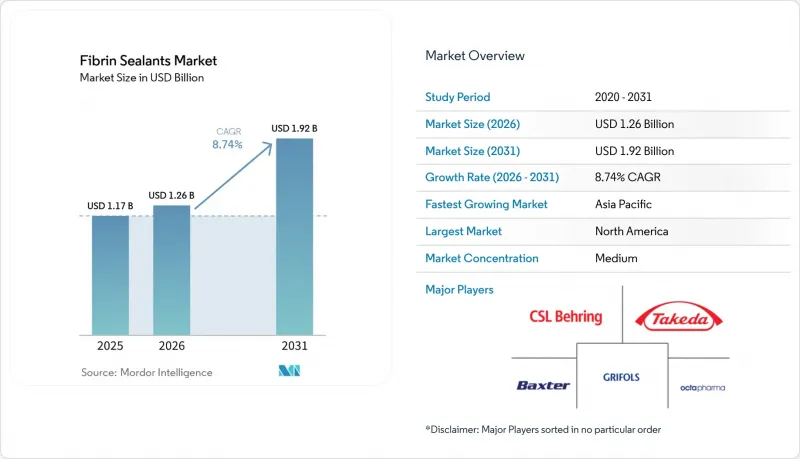
Mordor Intelligence에 의하면, 피브린 실란트 시장 규모는 2025년 11억 7,000만 달러로 평가되었고, 2026년에는 12억 6,000만 달러로 추정되고, 2026-2031년 CAGR 8.74%로 성장을 지속할 전망이며, 2031년까지 19억 2,000만 달러에 이를 것으로 예측됩니다.
본 보고서는 제품별(액체 2액형 키트, 흡수성 피브린 실란트 패치), 원료별(인간 유래, 기타), 용도별(심장혈관외과, 일반외과, 뇌신경외과, 정형외과, 비뇨기과, 기타), 최종 사용자별(병원, 기타), 지역별(북미, 유럽, 아시아태평양, 중동 및 아프리카, 남미)로 분류되어 있습니다. 시장 전망은 금액(달러) 기준으로 제시되어 있습니다.
세계의 피브린 실란트 시장 동향 및 분석
심혈관외과 및 일반외과에서의 수술 건수 증가
심혈관외과 및 일반외과는 광범위한 문합 부위에서 신속하고 광범위한 지혈이 필요하기 때문에 1건당 피브린 실란트 소비량이 가장 많습니다. 영국은 2035년까지 연간 50만 건의 로봇 수술을 시행하는 것을 목표로 하고 있으며, 이러한 정책으로 인해 출혈량이 많은 수술에서 실런트 수요가 증가하고 있습니다. 미국에서는 경피적 판막 교체술의 보급으로 인해 개흉 수술 건수의 감소 추세가 안정적으로 유지되고 있습니다. 다만, 경피적 판막 교체술에서도 국소 보조제는 여전히 필요합니다. 일반외과는 2025년 매출의 34.55%를 차지했으며, 조기 퇴원을 중시하는 비만외과, 간담췌외과, 대장외과 사례로부터 계속해서 혜택을 보고 있습니다. 실란탄의 사용은 이러한 조기 퇴원이라는 치료 성과 향상에 기여하고 있습니다. 미국 국립의학도서관의 2025년 보고서에 따르면, 피브린 실란트는 현장 중합, 높은 접착력, 생체 적합성, 생분해성, 생물학적 활성 등 뛰어난 특성 덕분에 이미 널리 사용되고 있습니다. 피브린 실란트는 일반외과, 뇌신경외과, 혈관외과 및 신장 단위 보존 수술, 외상학 및 정형외과, 안과 수술, 재건성형외과 등 외과 분야의 거의 모든 분야에서 수요가 높습니다. 전반적으로 볼 때, 수술 건수 증가는 피브린 실란트 시장에 있어 확실한 수요 하한선을 형성하고 있습니다.
저침습 수술 및 로봇 수술의 보급 확대
인튜이티브 서지컬은 2024년에 240만 건의 다빈치 수술을 기록하여 전년 대비 17% 증가했습니다. 그중 일반외과가 로봇 보조 수술 전체의 절반을 차지하고 있습니다. 현재 실란트 제제 제조업체들은 5mm 및 8mm 포트용 카테터를 개발 중이며, 패치 공급업체들은 로봇용 글라스판에 맞도록 매트릭스를 미리 절단하고 있습니다. 유럽의약품청(EMA)이 가압 가스와 색전증의 연관성을 지적한 권고에 따라, 스프레이형 도포기는 역풍을 맞고 있습니다. 따라서 각 제조업체는 기계식 분무 방식을 활용한 무가스 장치의 상품화를 추진하고 있습니다. 상환 제도 또한 보급을 뒷받침하고 있습니다. 미국이 외래수술센터(ASC)에서의 인공 슬관절 전치환술을 보험 적용 대상으로 결정함에 따라, 외래에서의 정형외과 수술이 가속화되고 있으며, 이러한 환경에서는 피브린 실란트를 이용한 신속하고 위생적인 지혈이 필수적입니다. 이러한 요인들이 복합적으로 작용하여, 피브린 실란트 시장의 적용 가능한 적응증 범위가 확대되고 있습니다.
스프레이 도포의 안전상의 제약으로 인해 교육이 필요하며, 사용이 제한됩니다.
현재 외과의사는 규정된 압력과 거리에서 기기를 사용해야 하며, 많은 의료기관에서는 공식적인 자격증을 요구하고 있습니다. 실제로 수술실 직원들은 여러 전문 분야를 겸임하는 경우가 많아, 특정 기기에 필요한 기술을 유지하기 어렵기 때문에 이러한 규정들이 기기 사용의 분산을 초래하고 있습니다. 따라서 스프레이 사용이 현실적으로 어렵거나 금기 사항으로 간주되는 복강경 수술, 흉부 수술, 신경외과 수술의 경우, 흡수성 패치 시장 점유율이 확대되고 있습니다. 각 제조업체들은 가스리스 시스템이나 프리필드 주사기로 대응하고 있지만, 규제 당국의 심사 절차에 시간이 걸리기 때문에 단기적인 시장 침투는 제한적입니다.
부문별 분석
2액형 키트는 2025년 매출의 62.4%를 차지했으며, 피브린 실란트 시장 점유율에서 가장 큰 단일 부문으로 자리매김하고 있습니다. 수술 중 혼합을 통해 투여 직전까지 트롬빈 활성을 유지하여 응고 강도를 극대화할 수 있으므로, 심혈관 및 간담췌 외과 수술에 탁월합니다. 또한, 이 부문은 투여의 유연성이라는 장점도 가지고 있습니다. 듀얼 시린지 건은 점적, 분사 또는 제트 분사가 가능하여, 외과의가 넓고 불규칙한 표면을 코팅할 수 있게 해줍니다. 그러나 콜드체인을 통한 보관, 해동 절차 및 준비 시간은 인력이 제한적인 외래수술센터(ASC)에 있어 과제가 되고 있습니다. 흡수성 패치 및 스펀지는 연평균 성장률(CAGR) 8.94%를 나타낼 것으로 예측되며, 이는 해당 제품 카테고리 내에서 가장 높은 성장률입니다. 5mm 포트는 스프레이 건의 조작에 제약을 주기 때문에 패치는 로봇 수술의 흐름에 편승하고 있습니다. 피브린과 산화 셀룰로오스를 결합한 에시콘(Esicon)사의 ‘EVARREST’는 가스 주입으로 인한 위험을 피할 수 있으며, 상온 보관이 가능하고 즉시 사용 가능한 제품에 대한 의료진의 높은 수요를 입증하고 있습니다.
장기적으로는 제조업체들이 피브린에 성장 인자나 항균제를 결합하여 감염 위험이 높은 환자를 위한 다기능 매트릭스를 개발함으로써, 패치 하위 카테고리가 피브린 실런트 시장 내 점유율을 확대할 가능성이 있습니다. 그러나 키트 제조업체들은 EMA의 안전 지침을 충족하는 무가스 주입기를 출시하거나, 5mm 트로카용 노즐을 소형화하는 등 기존 입지를 지키기 위해 노력하고 있습니다. 대규모 심장 센터에서 나온 증거는 광범위한 피복 면적에서 패치보다 우수한 성능을 보이는 액체 키트가 재개흉술에 여전히 적합하다는 점을 뒷받침하고 있습니다. 그 결과, 시장에서 제품이 전면적으로 대체되지는 않을 것이며, 오히려 실용적인 시술별 분업이 진행될 것으로 보입니다. 즉, 개흉 수술이나 광범위한 수술에는 액상 제제가, 내시경 수술이나 로봇 수술에는 패치가 사용되는 방식입니다.
2025년에는 자가혈 유래 제제가 원료 기준 매출의 58.39%를 차지한 것으로 평가되었으며, 이는 바이러스 감염 위험이 전혀 없고 면역학적 적합성을 우선시하는 병원의 요구와 부합합니다. Vivostat사의 플랫폼은 환자의 혈액 120ml를 처리하여 피브리노겐 함량이 안정된 5ml의 실란트를 생성함으로써, 기증자 풀에 대한 노출을 차단합니다. 특히 정형외과 재수술이나 여호와의 증인 신자 환자가 받는 심장 수술에서 그 도입이 두드러집니다. 자체 유래 부문은 준비 시간을 20분 미만으로 단축하는 새로운 소형 원심분리기의 등장으로 힘을 얻어 연평균 성장률(CAGR) 8.96%를 나타낼 것으로 예측됩니다.
수직 통합형 대기업인 그리폴스, CSL 베링, 다케다 제약, 옥타파마가 기증자 풀과 분획 공장을 장악하고 있기 때문에 인간 혈장 유래 제품은 여전히 전 세계 공급의 기반을 이루고 있습니다. 엄격한 용매 및 계면활성제 처리, 나노 여과, 그리고 저온 살균 공정은 EMA(유럽의약품청)의 플라즈마 마스터 파일 기준을 충족하여 임상의들의 신뢰를 얻고 있습니다. 면역글로불린 수요가 연간 8-9% 증가함에 따라, 동일한 혈장 공급원을 두고 경쟁하게 되어 가격 압박이 커지고 있습니다. 말이나 소에서 유래한 단백질은 면역원성에 대한 우려가 있어, 동물성 제품은 여전히 틈새 시장 수준에 머물러 있습니다. 따라서 박스터사의 콜라겐 제제인 '타코실'은 주로 인간 혈장을 확보하기 어려운 상황에서 사용되고 있습니다.
지역별 분석
북미는 2025년 전 세계 매출의 45.87%를 차지한 것으로 평가되었으며, 이는 해당 지역의 다빈치 시스템 도입 대수 9,539대와 수혈 관련 합병증에 대해 불이익을 부과하는 종합적 지불 모델에 힘입은 결과입니다. 2024년 VISTASEAL의 소아용 FDA 승인과 2025년 박스터(Baxter)사의 신생아용 적응증 갱신에 따라, 고도의 치료가 필요한 소아 병원에 대한 상업적 판매가 가능해졌습니다. 캐나다와 멕시코는 절대 수치상으로는 뒤처져 있지만, 고령화에 따라 심혈관 질환 환자 수가 증가하고 있어 그 격차를 점차 좁혀가고 있습니다.
유럽은 더 세분화되어 있습니다. 독일에서는 심장 질환 DRG에서 실란트가 별도로 보상되지만, 영국에서는 중앙 조달 체제 하에 가격 상한선이 설정되어 있습니다. 만성적인 혈장 부족. 옥타파마가 빈에서 진행한 2억 유로 규모의 확장 사업과 국내 혈장 처리와 관련된 NHS와의 계약은 공급 충격을 완화하기 위한 전략적 조치라고 할 수 있습니다. 2035년까지 연간 50만 건의 로봇 수술을 실현하겠다는 국민보건서비스(NHS)의 목표는 내시경 포트에 대응하는 실런트 시장에 장기적인 호재가 될 것입니다.
아시아태평양은 연평균 성장률(CAGR) 9.98%를 기록하며 가장 빠르게 성장하고 있는 지역입니다. 이 지역의 의료비는 2020년 3조 2,000억 달러에서 2024년에는 4조 2,000억 달러로 급증했으며, 2030년까지 5조 7,000억 달러에 달할 것으로 예측됩니다. 중국과 인도는 3차 의료시설에 공적 자금을 투입하고 있으며, 상하이 RAAS나 광저우 Bioseal과 같은 현지 기업들이 제품 라인을 확대되고 있습니다. 일본과 한국은 로봇 수술 보급률이 높아, 미국에서 나타나는 이용 양상을 반영하고 있습니다. 한편, 중동 및 아프리카 및 남미의 경우 전체 시장 점유율은 작지만, 걸프협력회의(GCC)의 의료 관광 투자와 브라질의 비전염성 질환 관리 추진에 힘입어 해당 시장은 점차 확대되고 있습니다. 콜드체인의 미비나 보험 급여 제한으로 인해 도입은 여전히 사립 병원에 집중되어 있지만, 교통사고로 인한 외상 환자 수 증가는 피브린 실런트가 충족시킬 수 있는 미충족 수요를 창출하고 있습니다.
기타 혜택 :
- 엑셀 형식 시장 예측(ME) 시트
- 3개월간의 애널리스트 지원
자주 묻는 질문
목차
제1장 서론
제2장 조사 방법
제3장 주요 요약
제4장 시장 구도
제5장 시장 규모 및 성장 예측
제6장 경쟁 구도
제7장 시장 기회 및 향후 전망
AJY 26.06.22According to Mordor Intelligence, the fibrin sealants market size is expected to grow from USD 1.17 billion in 2025 to USD 1.26 billion in 2026 and is forecast to reach USD 1.92 billion by 2031 at 8.74% CAGR over 2026-2031.
This report is Segmented by Product (Liquid Two-Component Kit, Absorbable Fibrin Sealant Patch), Source (Human, and More), Application (Cardiovascular Surgery, General Surgery, Neurosurgery, Orthopedic Surgery, Urology, Others), End-User (Hospitals, and More), and Geography (North America, Europe, Asia-Pacific, Middle East and Africa, South America). The Market Forecasts are Provided in Terms of Value (USD).
Global Fibrin Sealants Market Trends and Insights
Rising Surgical Volumes in Cardiovascular and General Surgery
Cardiovascular and general surgery together drive the highest per-case consumption of fibrin sealants because large anastomotic areas require rapid, diffuse hemostasis. The United Kingdom aims to perform 500,000 robotic surgeries annually by 2035, a policy that increases sealant demand in high-bleed procedures. In the United States, the decline in open-heart volumes has stabilized, thanks to transcatheter valve replacements that still require topical adjuncts. General surgery retained 34.55% of 2025 revenue and continues to benefit from bariatric, hepatobiliary, and colorectal cases that prioritize early discharge, an outcome improved by sealant use. According to a 2025 report by the National Library of Medicine, fibrin sealants are already widely used due to their advantageous properties, such as in situ polymerization, high adhesion, biocompatibility, biodegradability, and biological activity. Fibrin sealants are in high demand in almost all areas of surgery: general surgery, neurosurgery, vascular and nephron-sparing surgery, traumatology and orthopedics, ophthalmic surgery, and reconstructive plastic surgery. Collectively, rising procedure counts provide a dependable volume floor for the Fibrin sealants market.
Wider Adoption in Minimally Invasive and Robotic Procedures
Intuitive Surgical logged 2.4 million da Vinci procedures in 2024, up 17% year over year, with general surgery representing half of all robot-assisted cases . Sealant formulators now engineer catheters sized for 5 mm and 8 mm ports, while patch suppliers pre-cut matrices to fit robotic graspers. Spray applicators face headwinds after European Medicines Agency advisories linked pressurized gas to embolism; manufacturers are therefore commercializing gasless devices that use mechanical atomization. Reimbursement also boosts uptake: the U.S. decision to cover total-knee arthroplasty in ambulatory surgical centers accelerates outpatient orthopedic work, a setting that depends on fast, clean hemostasis delivered by fibrin sealants. These forces collectively enlarge the addressable case mix for the Fibrin sealants market.
Spray Application Safety Constraints Require Training and Limit Use
Surgeons must now use devices at defined pressures and distances, and many centers demand formal credentialing. In practice, these stipulations fragment usage because operating-room staff often rotate between multiple specialties and cannot maintain device-specific competencies. Absorbable patches have therefore gained share in laparoscopic, thoracic, and neuro cases where spray is either impractical or contraindicated. Manufacturers are countering with gasless systems and pre-filled syringes, but regulatory review adds time, limiting near-term market penetration.
Other drivers and restraints analyzed in the detailed report include:
- Hospital Protocols Favoring Blood Conservation and Hemostasis Adjuncts
- Product Approvals Expanding Indications and Pediatric Use
- High Product Cost and Reimbursement Variability Versus Alternatives
For complete list of drivers and restraints, kindly check the Table Of Contents.
Segment Analysis
Liquid two-component kits accounted for 62.4% of 2025 revenue, giving them the largest single slice of the Fibrin sealants market share. They excel in cardiovascular and hepatobiliary surgery because intraoperative mixing preserves thrombin activity until the moment of application, maximizing clot strength. The segment also benefits from delivery flexibility: dual-syringe guns can drip, spray, or stream, enabling surgeons to coat large, irregular surfaces. Yet cold-chain storage, thawing protocols, and setup time challenge ambulatory centers with lean staff. Absorbable patches and sponges are forecast to log a 8.94% CAGR, the fastest within the product category. Patches ride the robotic-surgery wave because 5 mm ports restrict spray-gun maneuvering. Ethicon's EVARREST, which couples fibrin with oxidized cellulose, underscores physicians' appetite for shelf-stable, ready-to-use products that avoid gas-propulsion risks.
Longer term, the patch subcategory may raise its Fibrin sealants market size share as manufacturers pair fibrin with growth factors or antimicrobials, creating multifunctional matrices for infection-prone patients. However, kit manufacturers defend incumbency by rolling out gasless applicators that meet EMA safety guidance and by miniaturizing nozzles for 5 mm trocars. Evidence from large cardiac centers continues to favor liquid kits in redo sternotomies where broad coverage outperforms patches. Consequently, the market is unlikely to witness wholesale substitution, but rather a pragmatic procedural split: liquids for open and large-field surgery, patches for endoscopic and robotic cases.
Autologous formulations captured 58.39% of source-based revenue in 2025, aligning with hospitals that prioritize zero viral-transmission risk and immunologic compatibility. Vivostat's platform processes 120 ml of the patient's blood to yield 5 ml of sealant with stable fibrinogen content, eliminating donor-pool exposure. Adoption is particularly strong in orthopedic revisions and cardiac cases involving Jehovah's Witness patients. The autologous segment is expected to post a 8.96% CAGR, bolstered by new compact centrifuges that cut prep time below 20 minutes.
Human plasma-derived products still underpin global supply because vertically integrated giants Grifols, CSL Behring, Takeda, Octapharma control donor pools and fractionation plants. Rigorous solvent-detergent, nanofiltration, and pasteurization regimes meet EMA Plasma Master File standards, sustaining clinician trust. Pricing pressure looms as immunoglobulin demand rises 8-9% annually, competing for the same plasma pool. Animal-derived offerings remain niche because equine or bovine proteins raise immunogenicity flags; Baxter's collagen-based TachoSil, therefore, finds use mainly in situations where human plasma access is constrained.
Geography Analysis
North America retained 45.87% of global revenue in 2025, underwritten by the region's 9,539-unit da Vinci installed base and bundled-payment models that penalize transfusion-related complications. FDA pediatric approval for VISTASEAL in 2024 and Baxter's neonatal label update in 2025 have opened high-acuity children's hospitals to commercial sales. Canada and Mexico trail in absolute volumes but are catching up as aging populations swell cardiovascular caseloads.
Europe is more fragmented. Germany reimburses sealants separately in cardiac DRGs, but the U.K. imposes price ceilings under centralized procurement. Chronic plasma deficits. Octapharma's EUR 200 million expansion in Vienna and its NHS contract to process domestic plasma mark strategic moves to buffer supply shocks. The National Health Service's aim of 500,000 robotic surgeries per year by 2035 furnishes a long-term tailwind for sealants compatible with endoscopic ports.
Asia-Pacific is the fastest-growing region with a projected 9.98% CAGR. Regional healthcare expenditure jumped from USD 3.2 trillion in 2020 to USD 4.2 trillion in 2024 and is on pace for USD 5.7 trillion by 2030. China and India direct public funds into tertiary surgical centers, and local players like Shanghai RAAS and Guangzhou Bioseal are broadening product lines. Japan and South Korea boast high robotic-surgery density, mirroring utilization patterns seen in the United States. While the Middle East, Africa, and South America collectively hold smaller shares, Gulf Cooperation Council investments in medical tourism and Brazil's push to manage non-communicable diseases are slowly enlarging the addressable base. Cold-chain gaps and reimbursement limitations keep adoption concentrated in private hospitals, but rising trauma volumes linked to road-traffic injuries provide an unserved need that fibrin sealants meet.
- Asahi Kasei
- Baxter
- Corza Medical
- CSL Behring
- GC Biopharma
- Grifols
- Guangzhou Bioseal Biotechnology Co., Ltd.
- Hemarus
- Instituto Grifols, S.A.
- Johnson & Johnson
- Kedrion Biopharma
- KM Biologics Co., Ltd.
- LFB S.A.
- Octapharma
- Pfizer
- Shanghai RAAS Blood Products Co., Ltd.
- Stryker
- Takeda Pharmaceuticals
- Vivostat
Additional Benefits:
- The market estimate (ME) sheet in Excel format
- 3 months of analyst support
TABLE OF CONTENTS
1 Introduction
- 1.1 Study Assumptions & Market Definition
- 1.2 Scope of the Study
2 Research Methodology
3 Executive Summary
4 Market Landscape
- 4.1 Market Overview
- 4.2 Market Drivers
- 4.2.1 Rising Surgical Volumes in Cardiovascular and General Surgery
- 4.2.2 Wider Adoption of Minimally Invasive and Robotic Procedures
- 4.2.3 Hospital Protocols Favoring Blood Conservation and Hemostasis Adjuncts
- 4.2.4 Product Approvals Expanding Indications, and Pediatric Use
- 4.2.5 Shift Toward Autologous Fibrin Systems in Centers Prioritizing Pathogen-Risk Mitigation
- 4.2.6 Optimized Delivery Systems for Endoscopic/Robotic Ports and Gasless Spray Applicators
- 4.3 Market Restraints
- 4.3.1 Spray Application Safety Constraints (Air/Gas Embolism Risk) Require Training and Limit Use
- 4.3.2 High Product Cost and Reimbursement Variability Versus Alternatives
- 4.3.3 Plasma-Derived Input Constraints and Stringent Viral-Inactivation/Testing Steps
- 4.3.4 Mixed Clinical Benefit Across Certain Indications Limits Routine Use
- 4.4 Supply-Chain Analysis
- 4.5 Regulatory Landscape
- 4.6 Technological Outlook
- 4.7 Porter's Five Forces
- 4.7.1 Threat of New Entrants
- 4.7.2 Bargaining Power of Suppliers
- 4.7.3 Bargaining Power of Buyers
- 4.7.4 Threat of Substitutes
- 4.7.5 Competitive Rivalry
5 Market Size & Growth Forecasts (Value, USD)
- 5.1 By Product
- 5.1.1 Liquid (two-component kit)
- 5.1.2 Absorbable fibrin sealant patch
- 5.2 By Source
- 5.2.1 Human
- 5.2.2 Autologous
- 5.2.3 Animal-derived
- 5.3 By Application (Surgery)
- 5.3.1 Cardiovascular surgery
- 5.3.2 General surgery
- 5.3.3 Neurosurgery
- 5.3.4 Orthopedic surgery
- 5.3.5 Urology
- 5.3.6 Others
- 5.4 By End-User
- 5.4.1 Hospitals
- 5.4.2 Ambulatory Surgical Centers (ASCs)
- 5.4.3 Specialty Clinics
- 5.5 By Geography
- 5.5.1 North America
- 5.5.1.1 United States
- 5.5.1.2 Canada
- 5.5.1.3 Mexico
- 5.5.2 Europe
- 5.5.2.1 Germany
- 5.5.2.2 United Kingdom
- 5.5.2.3 France
- 5.5.2.4 Italy
- 5.5.2.5 Spain
- 5.5.2.6 Rest of Europe
- 5.5.3 Asia-Pacific
- 5.5.3.1 China
- 5.5.3.2 India
- 5.5.3.3 Japan
- 5.5.3.4 South Korea
- 5.5.3.5 Australia
- 5.5.3.6 Rest of Asia-Pacific
- 5.5.4 Middle East and Africa
- 5.5.4.1 GCC
- 5.5.4.2 South Africa
- 5.5.4.3 Rest of Middle East and Africa
- 5.5.5 South America
- 5.5.5.1 Brazil
- 5.5.5.2 Argentina
- 5.5.5.3 Rest of South America
- 5.5.1 North America
6 Competitive Landscape
- 6.1 Market Concentration
- 6.2 Market Share Analysis
- 6.3 Company Profiles (includes Global level Overview, Market level overview, Core Segments, Financials as available, Strategic Information, Market Rank/Share for key companies, Products & Services, and Recent Developments)
- 6.3.1 Asahi Kasei Corporation
- 6.3.2 Baxter International Inc.
- 6.3.3 Corza Medical
- 6.3.4 CSL Behring
- 6.3.5 GC Biopharma
- 6.3.6 Grifols, S.A.
- 6.3.7 Guangzhou Bioseal Biotechnology Co., Ltd.
- 6.3.8 Hemarus
- 6.3.9 Instituto Grifols, S.A.
- 6.3.10 Johnson & Johnson
- 6.3.11 Kedrion S.p.A.
- 6.3.12 KM Biologics Co., Ltd.
- 6.3.13 LFB S.A.
- 6.3.14 Octapharma AG
- 6.3.15 Pfizer Inc.
- 6.3.16 Shanghai RAAS Blood Products Co., Ltd.
- 6.3.17 Stryker
- 6.3.18 Takeda Pharmaceutical Company
- 6.3.19 Vivostat A/S
7 Market Opportunities & Future Outlook
- 7.1 White-space & unmet-need assessment