|
시장보고서
상품코드
2063510
조직 처리 시스템 : 시장 점유율 분석, 업계 동향 및 통계, 성장 예측(2026-2031년)Tissue Processing Systems - Market Share Analysis, Industry Trends & Statistics, Growth Forecasts (2026 - 2031) |
||||||
 Mordor Intelligence
Mordor Intelligence에 의하면, 조직 처리 시스템 시장 규모는 2025년 3억 8,700만 달러로 평가되었습니다. 2026년에는 4억 1,820만 달러로 확대되어 2031년까지 6억 2,390만 달러에 이를 것으로 예측되며, 2026-2031년 CAGR은 8.33%를 나타낼 전망입니다.
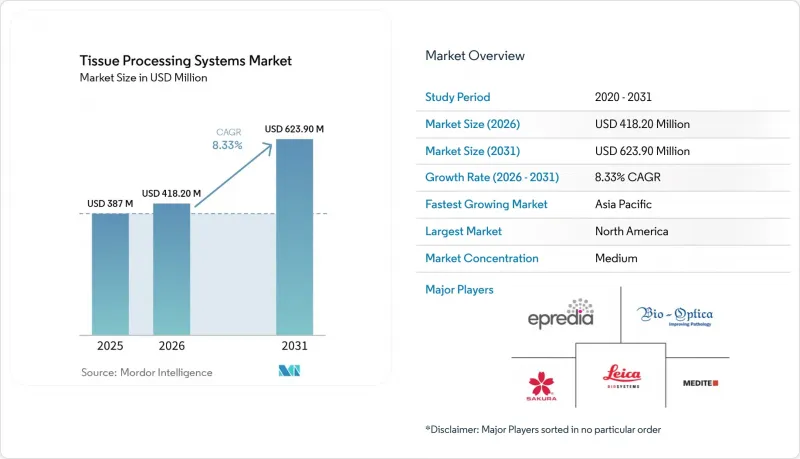
본 보고서는 기술별(진공/레토르트식 조직 처리 장치 등), 제품별(전자동, 반자동, 수동), 설치 형태별(스탠드얼론/플로어 스탠드형, 벤치탑형), 최종 사용자별(병원, 연구·학술 기관 등), 지역별(북미, 유럽, 아시아태평양, 중동 및 아프리카, 남미)로 분류되어 있습니다. 시장 전망은 금액(달러) 기준으로 제시되어 있습니다.
세계의 조직 처리 시스템 시장 동향 및 인사이트
암 및 만성 질환의 부담 증가로 인해 생검 건수와 조직 검사 업무량이 증가
세계 질병 부담 연구(Global Burden of Disease Study)에 따르면, 2023년 전 세계 암 발생 건수는 1,850만 건이었으며, 2050년까지 65% 증가해 3,050만 건에 달할 것으로 예측됩니다. 이로 인해 병리 검사실의 카세트 처리량이 직접적으로 증가하게 됩니다. 현재 정밀 종양학 프로토콜에 따르면, PD-L1이나 HER2 등의 바이오마커 패널의 경우 환자 1명당 3-5개의 블록이 필요하며, 헤마톡실린-에오신 염색만 수행하는 일반적인 절차에 비해 사례당 작업량이 3배로 늘어났습니다. 중국의 임상시험 생태계에서는 2024년에 종양학 연구가 전년 대비 22% 증가했으며, 각 임상시험에서 50-200건의 생검이 이루어지게 됨에 따라, 베이징과 상하이의 시설에서는 8시간 교대 근무당 300-400개의 카세트를 처리할 수 있는 듀얼 레토르트 프로세서의 도입이 활발히 진행되고 있습니다. OECD 시장 전체를 보면, 2030년까지 65세 이상 인구가 전체 인구의 25%를 차지할 것으로 예상되며, 이 연령대는 이미 암 진단 건수의 60%를 차지하고 있어 조직 검사 처리 능력에 부담을 주고 있습니다. 염증성 장 질환 및 자가면역성 간 질환에 대한 연속 생검 모니터링으로 인해 2025년에는 1,200만 건의 사례가 추가되었으며, 많은 검사실의 가동률이 85%를 넘어섰습니다.
핵심 조직학 분야의 처리 능력과 품질을 향상시키기 위한 검사실 자동화 및 LIS/디지털 통합 추진
최신 검사 정보 시스템(LIS)은 검체의 전 과정을 통합적으로 관리합니다. 조직 처리 장치는 현재 HL7 FHIR을 통해 체온 및 시약 소비량 데이터를 실시간으로 전송하여, 유지보수 시기를 예측하거나 시약의 적시 보충을 촉진하는 대시보드에 정보를 제공합니다. 2025년, 애지런트(Agilent)는 자사의 처리 장치를 디지털 병리 파트너와 연동하여 메이요 클리닉의 200만 슬라이드 규모 업무에서 오판율을 40% 줄였습니다. CMS 지침 QSO-25-10은 전자 감사 추적을 의무화하고 있으며, 메디케어 청구를 하는 모든 검사실에 대해 연결 기능이 없는 독립형 수동 처리 장치의 폐지를 의무화하고 있습니다. 2025년에 도입된 FlexLIS는 카세트를 가동률이 낮은 장비로 분배하고, 포매 전에 이상을 감지함으로써 파일럿 사이트에서 전체 처리 시간을 30% 단축했습니다.
높은 초기 투자 비용과 수명 주기 비용이 도입을 저해하고 있습니다.
최신 듀얼 레토르트식 처리 장치의 정가는 15만-25만 달러이며, 연간 유지보수 비용으로 그 15%에 해당하는 금액이 추가됩니다. 중규모 지역 병원의 경우 투자 회수 기간이 3-5년이 소요되지만, 조직병리학 진료 보수는 2020년 이후로 정체된 상태입니다. 리퍼브 제품은 초기 비용을 절감할 수 있지만, 가동 중단 위험이 높아집니다. 왜냐하면, 출시된 지 7년이 지난 플랫폼의 부품 조달에는 6주가 소요될 수 있으며, 프로세서를 단 1대만 보유하고 있는 시설의 경우 이는 용납할 수 없는 지연이 되기 때문입니다. 시약의 락인 현상이 비용을 더욱 끌어올립니다. 주요 공급업체의 크실렌 무함유 시약은 대량 크실렌보다 25% 비싸며, 경쟁사의 장비와 호환되지 않기 때문에 경쟁 입찰을 통한 가격 협상 여지가 사라집니다. 웨일스의 NHS는 2025년 3,440만 파운드 규모의 관리형 서비스 패키지에서 처리업체를 제외했는데, 이는 바로 시약 가격의 급등을 막기 위함이었습니다.
부문별 분석
진공식 또는 레토르트식 처리 장치는 자일렌 방식과의 동등성이 입증된 점과 24시간 가동 체제의 신뢰성을 강점으로 삼아, 2025년 매출의 55.80%를 차지했습니다. 이 부문의 조직 처리 시스템 시장 규모는 재생 제품이 소규모 병원으로 보급됨에 따라 꾸준한 속도로 확대되고 있습니다. 마이크로파 시스템은 연평균 성장률(CAGR) 8.87%로 성장을 지속하고, 있는데, 이는 응급 의료 부문에서 당일 결과를 요구하고 있으며, 학술 기관들이 냉동 절편의 처리 지연을 해소하기 위해 신속 검사실을 구축하고 있기 때문입니다. 검증 조사 결과, 마이크로파 처리 후 바이오마커의 완전성이 95% 유지되는 것으로 확인되어, 에피토프 손실에 대한 기존의 우려가 해소되었습니다.
연속 흐름 방식의 듀얼 레토르트 구조를 통해 대기 시간을 단축하고 시약 교체를 자동화할 수 있게 되었으며, 진공 시스템은 여전히 중요한 위치를 차지하고 있습니다. Milestone사의 EVO 플랫폼은 1교대당 400개의 카세트를 처리하며, 크실렌을 사용하지 않는 화학 처리를 지원함으로써 마이크로파 방식의 대체 장비와의 기능적 격차를 좁히고 있습니다. Sakura사의 VIP 6 AI는 점도 모니터링 기능을 추가하여 재처리율을 대폭 줄여줍니다. 미국의 많은 시장에서 조직 기술자의 시간당 초과근무 수당이 50달러를 초과하고 있기 때문에 마이크로파식 장비에 대한 설비 투자 비용은 인건비 절감을 통해 2년 이내에 회수할 수 있습니다.
2025년 매출액 중 완전 자동 처리 장치가 53.80%를 차지했습니다. 조직 처리 시스템 시장 점유율 우위는 통합된 바코드 추적, 예측 유지보수, 그리고 한 명의 기술자가 여러 처리 공정을 감독할 수 있는 클라우드 대시보드 덕분입니다. CMS가 발주한 QSO-25-10은 메디케어 검사실에 감사 추적 기능 도입을 의무화함으로써 이러한 전환을 가속화하고 있습니다. 반자동 장비는 중규모 병원에서 일정한 입지를 유지하고 있지만, 중고 시장의 자동 시스템이 비슷한 가격대에 도달함에 따라 시장 점유율 감소에 직면해 있습니다. 수동 장치는 여전히 수의학 분야나 소규모 연구실에서 사용되고 있습니다.
Epredia사의 E1000 Dx는 하루에 1,500개의 검체를 처리하며, RFID 기반의 시약 관리 시스템을 채택하고 있습니다. 이를 통해 2일 분량의 재고가 남으면 자동으로 소모품을 발주하게 되므로, 처리량이 많은 검사 위탁 기관의 현금 흐름이 원활해집니다. 아시아태평양에서는 의료 관광 인증 획득을 위해 시설을 정비하는 병원 체인들이 미국병리학회(CAP)의 기준을 충족하기 위해 완전 자동화 라인을 도입하고 있으며, 이는 이 지역의 성장률이 전 세계 평균을 상회하는 요인 중 하나가 되고 있습니다. 사쿠라의 ‘SmartConnect’와 같은 로봇 로더는 수작업량을 80% 줄여줍니다. 이는 공실률이 20%에 달하는 지역에서 매우 중요한 요소입니다.
지역별 분석
2025년 시장 규모에서 북미는 38.19%를 차지하며, 그중 미국이 5분의 4에 가까운 비중을 차지했습니다. 2025년 5월 Labcorp가 Incyte의 진단 사업 자산을 인수한 사례에서 볼 수 있듯이, 이 지역의 통합 추세는 프로토콜의 통일과 시약 대량 구매를 통한 할인 협상을 촉진하고 있습니다. CMS CLIA 지침 QSO-25-10은 완벽한 디지털 추적성을 의무화하고 있으며, 단순한 처리 능력 향상보다 자동화에 대한 투자를 가속화하고 있습니다. 라이카는 2025년에 히스토파이와 제휴하여 HistoCore PEGASUS Plus에 예측형 품질 관리(QC) 기능을 탑재함으로써, 이 지역에서 AI 기반 분석에 대한 수요가 높음을 보여주었습니다. 캐나다와 멕시코는 1인당 지출이 적고, 학술 기관 이외의 분야에서의 도입이 제한적이기 때문에 뒤처져 있습니다. 기술 인력의 결원율이 15-20% 수준을 유지하고 있는 만큼, 자동화는 여전히 최우선 과제로 남아 있습니다.
아시아태평양은 2031년까지 연평균 성장률(CAGR) 8.59%를 기록하며, 다른 모든 지역을 앞지를 것으로 전망됩니다. 중국은 고처리량의 듀얼 레토르트 시스템이 필요한 종양학 임상시험이 연간 22% 증가하고 있어 선도적인 입지를 차지하고 있습니다. 인도의 민간 병원 체인은 해외 환자를 유치하고 미국병리학회(CAP)의 인증을 획득하기 위해 자동화 라인을 도입하고 있지만, 인력 부족으로 인해 프로토콜 검증 작업이 지연되고 있습니다. 일본에서는 2030년까지 65세 이상 인구의 비율이 35%에 달하고, 수요가 증가할 것으로 예상되지만, 상환 한도로 인해 설비 투자 예산은 억제되고 있습니다. 호주와 한국은 조달 체계에서 환경 기준에 15%의 비중을 두고 있기 때문에 크실렌이 함유되지 않은 화학 물질을 조기에 도입한 국가들입니다.
유럽은 다양한 중견적 위치를 차지하고 있습니다. 영국 NHS의 병리학 자동화 프레임워크(8년간 4,000만 파운드 규모)가 잉글랜드와 웨일스 전역에 걸친 대규모 설비 현대화의 기반이 되고 있습니다. 독일과 프랑스는 대학 병원에 대한 투자로 이에 뒤를 잇고 있으며, 동유럽에서는 2025년 루마니아에서 MedLife사가 개설한 210만 달러 규모의 자동화 검사실과 같이 새로운 처리 능력이 생겨나고 있습니다. 중동 및 아프리카는 사우디아라비아의 킹 파이살 전문병원과 같은 뛰어난 의료 거점을 중심으로 사업을 전개하고 있습니다. 이 병원은 2024년에 5,000만 달러를 투자해 구축한 AI 기반 검사실을 공개했습니다. 남미는 여전히 발전 도상 단계에 있습니다. 브라질이나 아르헨티나의 검사실에서는 연간 5,000 카세트를 초과하는 경우가 드물어 자동화의 투자 대비 효과(ROI)가 제한되고 있지만, 에티오피아와 걸프협력회의(GCC) 국가들의 기부 자금 지원 프로젝트를 통해 일부 현대식 장비가 공립 검사실에 도입되고 있습니다.
기타 혜택 :
- 엑셀 형식 시장 예측(ME) 시트
- 3개월간의 애널리스트 지원
자주 묻는 질문
목차
제1장 서론
제2장 조사 방법
제3장 주요 요약
제4장 시장 구도
제5장 시장 규모 및 성장 예측
제6장 경쟁 구도
제7장 시장 기회 및 향후 전망
KTH 26.06.24According to Mordor Intelligence, the tissue processing systems market size is expected to increase from USD 387 million in 2025 to USD 418.20 million in 2026 and reach USD 623.90 million by 2031, growing at a CAGR of 8.33% over 2026-2031.
This report is Segmented by Technology (Vacuum/Retort Tissue Processors and More), Product (Fully Automated, Semi-Automated, Manual), Modality (Stand-alone/Floor-standing, Bench-Top), End User (Hospitals, Research & Academic Institutes, and More), and Geography (North America, Europe, Asia-Pacific, Middle East & Africa, South America). Market Forecasts are Provided in Terms of Value (USD).
Global Tissue Processing Systems Market Trends and Insights
Rising Cancer and Chronic Disease Burden Elevates Biopsy Volumes and Histology Workloads
The Global Burden of Disease Study estimated worldwide cancer incidence at 18.5 million cases in 2023 and projects a 65% increase to 30.5 million by 2050, thereby directly increasing cassette throughput in pathology laboratories . Precision oncology protocols now demand three to five blocks per patient for biomarker panels such as PD-L1 or HER2, tripling work per case compared with hematoxylin-and-eosin-only routines. China's clinical-trial ecosystem logged a 22% annual rise in oncology studies in 2024, with each trial generating 50-200 biopsies, prompting Beijing and Shanghai centers to install dual-retort processors that handle 300-400 cassettes per eight-hour shift. Across OECD markets, people older than 65 will account for 25% of the population by 2030, and this cohort already represents 60% of cancer diagnoses, stretching histology capacity. Serial-biopsy monitoring of inflammatory bowel and autoimmune liver disease added 12 million cases in 2025, raising utilization above 85% at many labs.
Push for Lab Automation and LIS/Digital Integration to Lift Throughput and Quality in Core Histology
Modern laboratory information systems orchestrate end-to-end specimen flow. Tissue processors now stream real-time temperature and reagent-consumption data via HL7 FHIR, feeding dashboards that predict maintenance windows and prompt just-in-time reagent restocks. In 2025, Agilent bundled its processors with digital pathology partners, cutting ID errors by 40% at Mayo Clinic's two-million-slide operation. CMS order QSO-25-10 enforces electronic audit trails, obliging any Medicare-billing lab to retire isolated manual processors that lack connectivity. FlexLIS, launched in 2025, reroutes cassettes to under-used instruments and flags anomalies before embedding, slashing overall turnaround 30% at pilot sites.
High Capital and Lifecycle Costs Constrain Adoption
A modern dual-retort processor lists at USD 150,000-250,000, and annual service can add 15% of that figure. Medium-sized community hospitals face a 3- to 5-year payback period, while reimbursement for histopathology has remained flat since 2020. Refurbished units cut upfront costs but increase downtime risk because parts for seven-year-old platforms may take 6 weeks to source, an unacceptable delay for single-processor sites. Reagent lock-in deepens the bill: xylene-free chemistries from leading vendors cost 25% more than bulk xylene and cannot be cross-used on rival machines, removing competitive-bidding leverage. The NHS in Wales excluded processors from a GBP 34.4 million managed-service package in 2025, precisely to avoid volatile reagent escalations.
Other drivers and restraints analyzed in the detailed report include:
- Faster Turnaround Time Mandates Accelerate Rapid or Microwave Processor Adoption
- Shift to Xylene-Free or Formalin-Reduced Workflows to Meet Occupational-Health and Sustainability Targets
- Shortage of Skilled Histotechnologists Limits Complex Protocol Uptake
For complete list of drivers and restraints, kindly check the Table Of Contents.
Segment Analysis
Vacuum or retort processors delivered 55.80% of 2025 revenue, anchored by proven parity with xylene methods and overnight reliability. The tissue processing systems market size for this segment is advancing at a steady pace as refurb units cascade into smaller hospitals. Microwave systems are tracking an 8.87% CAGR because emergency departments want same-day answers and academic centers build rapid suites to cut frozen-section backlogs. Validation research confirmed 95% biomarker integrity after microwave cycles, easing earlier doubts about epitope loss.
Continuous-flow dual-retort architectures help vacuum systems stay relevant by shaving queue times and automating reagent swaps. Milestone's EVO platform processes 400 cassettes per shift and supports xylene-free chemistries, narrowing the functional gap with microwave alternatives. Sakura's VIP 6 AI adds viscosity monitoring, cutting reprocess rates by significantly. With histotechnologist overtime surpassing USD 50 per hour in many U.S. markets, the capital premium for microwave units can be offset within two years through labor savings.
Fully automated processors captured 53.80% of 2025 sales. The tissue processing systems market share advantage stems from integrated barcode tracking, predictive maintenance, and cloud dashboards that enable a single technologist to supervise multiple runs. CMS order QSO-25-10 accelerates that shift by forcing audit-trail capability for Medicare labs. Semi-automated units retain a foothold among mid-tier hospitals yet face erosion as secondary-market automated systems hit similar price points. Manual devices linger in veterinary and small research labs.
Epredia's E1000 Dx processes 1,500 samples a day and uses RFID-based reagent management that automatically orders supplies when a 2-day supply is available, smoothing cash flow for high-volume reference labs. In Asia-Pacific, hospital chains equipping for medical-tourism accreditation install fully automated lines to satisfy College of American Pathologists benchmarks, helping the region outpace global growth. Robotic loaders, such as Sakura's SmartConnect, reduce manual handling by 80%, which is vital in geographies with 20% vacancy rates.
Geography Analysis
North America accounted for 38.19% of the 2025 value, with the United States accounting for nearly four-fifths. The region's consolidation wave, typified by Labcorp's May 2025 acquisition of Incyte diagnostics assets, is harmonizing protocols and negotiating reagent bulk discounts. CMS CLIA order QSO-25-10 forces full digital traceability, vaulting automation investment ahead of simple capacity gains. Leica partnered with Histofy in 2025 to embed predictive QC into HistoCore PEGASUS Plus, showing the region's appetite for AI-driven analytics. Canada and Mexico lag because of lower per-capita spend and limited adoption outside academic centers. Persistent 15-20% technologist vacancies keep automation on the front burner.
Asia-Pacific is forecast to post an 8.59% CAGR to 2031, outpacing all other regions. China leads due to a 22% annual rise in oncology trials that demand high-throughput dual-retort systems. India's private hospital chains install automated lines to attract international patients and secure College of American Pathologists stamps, yet staffing shortfalls slow protocol validation. Japan's over-65 share will hit 35% by 2030, spurring demand, though reimbursement caps temper capital budgets. Australia and South Korea act as early adopters of xylene-free chemistries because procurement frameworks award 15% weight to environmental criteria.
Europe holds a diversified mid-tier position. The U.K. NHS Anatomical Pathology Automation framework, worth GBP 40 million over eight years, anchors large upgrades across England and Wales. Germany and France follow with university hospital investments, while Eastern Europe sees fresh capacity, as in MedLife's USD 2.1 million automated lab opened in Romania in 2025. The Middle East and Africa cluster around centers of excellence such as Saudi Arabia's King Faisal Specialist Hospital, which unveiled a USD 50 million AI-enabled lab in 2024. South America remains nascent; Brazilian and Argentine labs rarely surpass 5,000 cassettes a year, limiting automation ROI, though donor-funded projects in Ethiopia and the Gulf Cooperation Council bring select modern units to public labs.
- Amos Scientific Pty Ltd
- Bioevopeak
- Bio-Optica Milano S.p.A.
- Dakewe Medical
- Diapath S.p.A.
- Epredia (PHC Holdings)
- General Data Healthcare (RTP Series)
- Histo-Line Laboratories
- Infitek Co., Ltd.
- Jinhua YIDI Medical Appliance
- JOKOH Co., Ltd.
- Kalstein
- Leica Biosystems (Danaher)
- MEDITE Medical GmbH
- Milestone Medical
- PathnSitu Biotechnologies
- Sakura Finetek USA, Inc
- Servicebio (Wuhan Servicebio Technology)
- Shenyang Roundfin Technology (Roundfin)
- SLEE medical GmbH
Additional Benefits:
- The market estimate (ME) sheet in Excel format
- 3 months of analyst support
TABLE OF CONTENTS
1 Introduction
- 1.1 Study Assumptions & Market Definition
- 1.2 Scope of the Study
2 Research Methodology
3 Executive Summary
4 Market Landscape
- 4.1 Market Overview
- 4.2 Market Drivers
- 4.2.1 Rising Cancer and Chronic Disease Burden Elevates Biopsy Volumes and Histology Workloads
- 4.2.2 Push For Lab Automation And LIS/Digital Integration to Lift Throughput and Quality in Core Histology
- 4.2.3 Faster Turnaround Time Mandates (STAT/Same-Day) Accelerate Rapid/Microwave Processor Adoption
- 4.2.4 Shift To Xylene-Free/Formalin-Reduced Workflows to Meet OH&S And Sustainability Targets
- 4.2.5 Dual-Retort/Parallel Processing Architectures Enable Lean, Continuous-Flow High-Mix Labs
- 4.2.6 Consolidation Of Multi-Site Networks and Tenders Standardizes Installed Bases to A Few Platforms
- 4.3 Market Restraints
- 4.3.1 High Capital and Lifecycle Costs (Service, Reagents, Downtime Risk) Constrain Adoption
- 4.3.2 Shortage of Skilled Histotechnologists Limits Complex Protocol Utilization at Scale
- 4.3.3 Regulatory and Chemical-Safety Compliance Adds Validation/Documentation Burden
- 4.3.4 Protocol Validation Hurdles for Rapid/Microwave on Sensitive Tissues/Biomarkers
- 4.4 Supply Chain Analysis
- 4.5 Regulatory Landscape
- 4.6 Technological Outlook
- 4.7 Porter's Five Forces
- 4.7.1 Threat of New Entrants
- 4.7.2 Bargaining Power of Suppliers
- 4.7.3 Bargaining Power of Buyers
- 4.7.4 Threat of Substitutes
- 4.7.5 Industry Rivalry
5 Market Size & Growth Forecasts (Value, USD)
- 5.1 By Technology
- 5.1.1 Vacuum/Retort Tissue Processors
- 5.1.2 Microwave/Rapid Tissue Processors
- 5.1.3 Other
- 5.2 By Product
- 5.2.1 Fully Automated
- 5.2.2 Semi-automated
- 5.2.3 Manual
- 5.3 By Modality
- 5.3.1 Stand-alone / Floor-standing
- 5.3.2 Bench-top
- 5.4 By End User
- 5.4.1 Hospitals
- 5.4.2 Diagnostic Laboratories
- 5.4.3 Research & Academic Institutes
- 5.4.4 Pharma/Biotech & CRO
- 5.5 By Geography
- 5.5.1 North America
- 5.5.1.1 United States
- 5.5.1.2 Canada
- 5.5.1.3 Mexico
- 5.5.2 Europe
- 5.5.2.1 Germany
- 5.5.2.2 United Kingdom
- 5.5.2.3 France
- 5.5.2.4 Italy
- 5.5.2.5 Spain
- 5.5.2.6 Rest of Europe
- 5.5.3 Asia-Pacific
- 5.5.3.1 China
- 5.5.3.2 India
- 5.5.3.3 Japan
- 5.5.3.4 South Korea
- 5.5.3.5 Australia
- 5.5.3.6 Rest of Asia-Pacific
- 5.5.4 Middle East and Africa
- 5.5.4.1 GCC
- 5.5.4.2 South Africa
- 5.5.4.3 Rest of Middle East and Africa
- 5.5.5 South America
- 5.5.5.1 Brazil
- 5.5.5.2 Argentina
- 5.5.5.3 Rest of South America
- 5.5.1 North America
6 Competitive Landscape
- 6.1 Market Concentration
- 6.2 Market Share Analysis
- 6.3 Company Profiles {(includes Global level Overview, Market level overview, Core Segments, Financials as available, Strategic Information, Market Rank/Share for key companies, Products & Services, and Recent Developments)}
- 6.3.1 Amos Scientific Pty Ltd
- 6.3.2 Bioevopeak
- 6.3.3 Bio-Optica Milano S.p.A.
- 6.3.4 Dakewe Medical
- 6.3.5 Diapath S.p.A.
- 6.3.6 Epredia (PHC Holdings)
- 6.3.7 General Data Healthcare (RTP Series)
- 6.3.8 Histo-Line Laboratories
- 6.3.9 Infitek Co., Ltd.
- 6.3.10 Jinhua YIDI Medical Appliance
- 6.3.11 JOKOH Co., Ltd.
- 6.3.12 Kalstein
- 6.3.13 Leica Biosystems (Danaher)
- 6.3.14 MEDITE Medical GmbH
- 6.3.15 Milestone Medical
- 6.3.16 PathnSitu Biotechnologies
- 6.3.17 Sakura Finetek USA, Inc
- 6.3.18 Servicebio (Wuhan Servicebio Technology)
- 6.3.19 Shenyang Roundfin Technology (Roundfin)
- 6.3.20 SLEE medical GmbH
7 Market Opportunities & Future Outlook
- 7.1 White-space & unmet-need assessment