|
시장보고서
상품코드
2063514
주사형 피임약 시장 : 점유율 분석, 업계 동향과 통계, 성장 예측(2026-2031년)Injectable Contraceptives - Market Share Analysis, Industry Trends & Statistics, Growth Forecasts (2026 - 2031) |
||||||
 Mordor Intelligence
Mordor Intelligence에 의하면, 주사형 피임약 시장 규모는 2025년 3억 3,600만 달러, 2026년 3억 4,780만 달러에서 2031년까지 4억 1,410만 달러로 확대되어 2026년부터 2031년까지 사이에 CAGR 3.55%를 나타낼 것으로 예측됩니다.
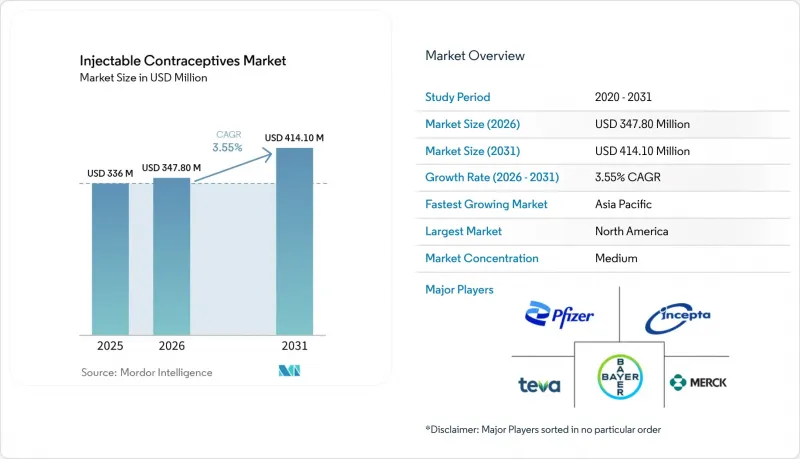
본 보고서는 호르몬 조성(복합제제 및 프로게스틴 단독제제), 투여 일정(월 1회, 3개월, 6개월의 장기 작용형), 유통 채널(병원 및 전문 클리닉 내 약국, 소매 약국 및 드럭스토어 등), 최종 사용자(15-24세 여성, 기타), 지역(북미, 유럽, 기타)에 따라 분류되어 있습니다. 시장 전망은 금액(달러) 기준으로 제시되어 있습니다.
세계 주사형 피임약 시장 동향 및 인사이트
저·중소득 국가에서 장시간 작용형 가역적 피임법에 대한 미충족 수요가 증가하고 있습니다.
피임 수요가 충족되지 않은 2억 1,800만 명의 여성 중 대다수는 저·중소득 국가에 거주하고 있지만, 이들 시장의 피임법 구성 비율에서 장기 작용형 주사제가 차지하는 비중은 극히 미미하여 여전히 큰 수요 격차가 남아 있습니다. 조달 기관들은 더 대규모의 기본 계약을 통해 이러한 격차를 메우기 시작하고 있습니다. PATH는 2020년부터 2024년까지 14개국에서 170만 건의 자가 주사 치료를 기록했으며, 12개월 시점의 지속률은 65-72%를 달성했습니다. 이는 진료소에서 주사 투여 시 일반적으로 나타나는 55-60%를 크게 웃도는 수치입니다. 장거리 이동이나 대기 시간을 없애면, 여성들은 진료 1회당 최대 2일분의 농업 소득 손실을 피할 수 있어, 자가 주사 프로그램의 경제적 이점이 더욱 커집니다. 나이지리아에서공급 차질은 재고 부족이 얼마나 신속하게 치료 중단이나 예상치 못한 임신으로 이어질 수 있는지를 보여주고 있으며, 공급처 다각화의 필요성을 한층 더 시급하게 만들고 있습니다. 저·중소득국(LMIC)을 대상으로 하는 공급량의 70%는 상업적 거래가 아닌 유엔 경로를 통해 유통되고 있으므로, WHO의 사전 인증을 획득한 제조업체가 공급 확대에 가장 적합한 입장에 있습니다.
정부의 가족 계획 정책과 기부 자금의 호황
FP2030 중점 대상국 69개국에서 가족 계획 예산은 2019년부터 2024년 사이에 57% 증가했습니다. 이로 인해 2025년 초 미국의 양자 간 자금이 41% 감소했음에도 불구하고 자금 조달의 안정성이 유지되고 있습니다. 2025년, 콩고민주공화국, 잠비아, 짐바브웨에서는 국내 예산 배분이 대폭 증가하여, 원조국에 대한 의존도를 낮추고 자립을 향해 전환하고 있음을 시사하고 있습니다. UNFPA의 2026-2030년 계획에서는 상품 바스켓의 35%를 주사제 및 이식형 피임법에 할당하고 있으며(기존에는 28%), 추가 지출을 데포 제제에 배정하고 있습니다. 인도나 남아프리카공화국 등 재정 기반이 탄탄한 국가들에서는 연간 판매량이 눈에 띄게 증가하고 있는 반면, 니제르와 같이 원조 의존도가 높은 시장에서는 대체 자금원이 등장할 때까지 정체 상태가 이어지고 있습니다. 공공 및 민간 채널 양쪽에서 사업을 전개하는 공급업체는 자금원의 재분배에 따라 타사를 압도할 정도의 이익을 얻을 것으로 전망됩니다.
중단률을 좌우하는 부작용 프로파일
데포 제제 사용자의 최대 70%가 비정상적인 출혈을 경험한 바 있으며, FDA는 2004년 이후 골밀도와 관련된 경고 문구 표기를 의무화하고 있습니다. 이로 인해, 본래는 이상적인 적응자여야 할 사춘기 여성들 사이에서 심리적 장벽이 생겨나고 있습니다. 2024년 프랑스의 검토 결과, 장기 사용과 뇌수막종 간의 연관성이 지적되어 새로운 금기 사항이 추가된 데다, 소셜 미디어를 통한 확산까지 겹치면서 첫해 사용 중단률이 35-40%에 달했습니다. 투여 중단 후 3년 이내에 골밀도는 회복되지만, 블랙박스 경고는 여전히 사용에 걸림돌이 되고 있습니다. 각 제약사는 출혈을 줄이도록 설계된 이중 작용기전의 약물을 시험 중이지만, 2028년 이전에 시장에 출시될 수 있는 대안은 없으므로, 단기적으로는 이러한 제약 요인이 지속될 것으로 보입니다.
부문별 분석
프로게스틴 단독 제제는 2025년에 69.32%의 시장 점유율을 기록한 데 힘입어, 에스트로겐·프로게스틴 복합 제제에 대한 우위를 더욱 확대되고 있습니다. 그 매력은 수유 중에도 사용할 수 있다는 점, 폭넓은 연령층에서 사용할 수 있다는 점, 그리고 에스트로겐과 관련된 위험이 없습니다는 점에 있습니다. 이러한 위험으로 인해, 복합 제제는 생식 연령의 여성 중 약 3분의 1에게만 사용할 수 있습니다. 2025년에 개정된 WHO의 ‘의학적 적응 기준’에 따르면, 프로게스틴 단독 제제는 수유 중인 여성 및 심혈관 위험이 있는 사용자에 대해 카테고리 1로 분류된 반면, 복합형 주사제는 35세 이상의 흡연자, 고혈압 환자, 또는 정맥혈전색전증의 병력이 있는 여성에 대해서는 카테고리 3-4로 평가되었습니다. 이 지침에 따라, 특히 심혈관 검진이 미흡한 저·중소득 국가에서 신규 사용자의 대다수가 메드록시프로게스테론 아세테이트 저장제나 이와 유사한 제제로 전환하게 되었습니다.
나머지 시장 점유율은 복합 제제가 차지하고 있으며, 주로 프로게스틴 단독 제제 사용자의 절반 이상이 1년 이내에 경험하는 무월경보다는 예측 가능한 월경을 더 중요하게 여기는 젊고 비흡연인 여성을 대상으로 하고 있습니다. 이러한 성장 전망은 비만 증가와 인구 고령화로 인해 제약을 받고 있습니다. 이러한 요인들로 인해 미국 산부인과 학회(ACOG) 등의 단체는 혈전 위험을 이유로 체질량 지수(BMI)가 35 kg/m²를 초과하는 여성에게 에스트로겐 함유 제제의 사용을 자제하도록 권고하고 있습니다.
3개월 지속형 제제는 DMPA의 역사적 배경으로 인해 2025년에는 49.54%의 시장 점유율을 차지했으나, 진료비에 대한 지불 측의 반발로 인해 내원 횟수를 절반으로 줄여주는 장기 투여 간격에 대한 관심이 높아지고 있습니다. 가족 계획 관련 1회 진료 시 공적 의료 제도에서 15-25달러의 비용이 발생하기 때문에 6개월 지속형 주사제는 연간 서비스 지출을 약 20-25% 절감할 수 있어, 특히 자금 부족에 시달리는 프로그램에 매력적인 선택지입니다.
6개월형 제품의 파이프라인은 3상 임상시험의 순조로운 성공과 2028년까지의 WHO 사전 인증을 전제로 연평균 성장률(CAGR) 5.54%로 확대될 것으로 전망됩니다. 한때는 자연스러운 월경 주기를 모방할 수 있다는 이유로 선호되었던월1회 주사제는 자가 투여가 가능한 3개월형 데포 제제가 이미 유사한 출혈 패턴을 제공하며 외래 방문이 필요하지 않기 때문에 연평균 성장률(CAGR) -1--1.5%로 축소 추세를 보이고 있습니다. 주사형 피임약 시장 규모는 한쪽 끝에서는 자가 주사 방식의 3개월 투여, 다른 쪽 끝에서는 의료진이 투여하는 6개월 투여라는 양극단적인 형태로 이동함에 따라, 중간 주기의 제품 형태가 압박을 받을 가능성이 있습니다. 가격 전략이 중요합니다. 만약 제조업체가 6개월 분량의 도매 가격을 3개월 분량 바이알 가격의 2배 미만으로 책정한다면, 지불 주체는 비용 절감을 위해 신속하게 장기 투여로 전환할 가능성이 있습니다. 규제 당국은 이미 투여 간격 연장에 대응하기 위해 첨부 문서의 지침을 업데이트했으며, 유효성 기준이 충족되면 시장 출시의 길이 열리게 됩니다.
지역별 분석
북미는 상환 제도와 높은 1인당 지출에 힘입어 2025년에는 세계 시장의 42.43%를 차지했으나, 시장 포화와 5년형 임플란트와의 경쟁으로 인해 성장이 둔화될 것으로 예측됩니다. 원격의료 채널을 통해 처방량이 늘어나고 있는 반면, 소셜 미디어상에서 안전성에 대한 논의가 신규 사용자 확보를 더욱 저해하고 있습니다. 자가 투여 방식의 채택이 증가하고 있음에도 불구하고, 기존 방식에서 전환하는 사례가 신규 도입을 초과할 경우, 해당 지역의 주사형 피임약 시장 규모는 정체될 가능성이 있습니다.
아시아태평양은 보조 간호사 및 조산사에 의한 저장형 제제 투여를 허용하는 정책 개혁을 배경으로, 연평균 성장률(CAGR) 5.76%를 기록하며 성장을 주도할 것으로 전망됩니다. 이로 인해 인도와 인도네시아의 농촌 지역에서 의료 제공업체의 밀도가 실질적으로 3배로 늘어납니다. 인구 증가와 도시 지역의 소득 향상도 민간 부문의 채용을 뒷받침하는 한편, 기부자 프로그램은 필리핀과 베트남 전역의 접근이 어려운 주에 초점을 맞추었습니다. 2031년까지 이 지역은 북미와의 금액 기준 격차를 절반까지 줄일 가능성이 있으며, 이는 주사형 피임약 시장의 판매량과 구성 변화 모두를 반영한 것입니다.
유럽은 큰 시장 점유율을 차지하고 있지만, 저출산과 높은 피임 보급률로 인해 성장 여지가 제한적이어서 정체된 추세를 보이고 있습니다. 중동 및 아프리카는 뚜렷한 시장 점유율을 유지하고 있으나, 기부금에 의한 조달 체제가 유지된다면 높은 연평균 성장률(CAGR)이 예상됩니다. 남미 시장 점유율은 다소 낮은 편이지만, 특히 브라질과 우루과이에서 원격의료에 대한 규제 장벽이 완화되고 지역 보건 종사자 프로그램이 확산됨에 따라 시장이 확대될 것으로 전망됩니다.
기타 혜택:
- 엑셀 형식 시장 예측(ME) 시트
- 3개월간의 애널리스트 지원
자주 묻는 질문
목차
제1장 서론
제2장 조사 방법
제3장 주요 요약
제4장 시장 구도
제5장 시장 규모와 성장 예측
제6장 경쟁 구도
제7장 시장 기회와 향후 전망
JHS 26.06.23According to Mordor Intelligence, the injectable contraceptives market size is projected to expand from USD 336 million in 2025 and USD 347.80 million in 2026 to USD 414.10 million by 2031, registering a CAGR of 3.55% between 2026 to 2031.
This report is Segmented by Hormonal Composition (Combined Formulation, and Progestin-Only), Dosage Schedule (Monthly, 3-Month, 6-Month Long-Acting), Distribution Channel (Hospital & Specialty-Clinic Pharmacies, Retail Pharmacies & Drug Stores and More), End User (Women 15-24, and More), and Geography (North America, Europe, and More). The Market Forecasts are Provided in Terms of Value (USD).
Global Injectable Contraceptives Market Trends and Insights
Rising Unmet Need for Long-Acting Reversible Contraception in LMICs
Low- and middle-income countries account for the majority of the 218 million women with unmet contraceptive need, yet depot injectables make up only a modest portion of the method mix in these markets, leaving a sizable demand gap that procurement agencies are beginning to close through larger framework agreements. PATH documented 1.7 million self-injection visits across 14 countries between 2020 and 2024, achieving 65-72% continuation at 12 months, well above the 55-60% typical for clinic-administered injections. Eliminating long travel and wait times helps women avoid losing up to two days of agricultural wages per visit, reinforcing the economic case for self-injection programs . Supply disruptions in Nigeria illustrated how stock-outs quickly translate to discontinuation and unintended pregnancies, adding urgency to diversifying suppliers. Manufacturers holding WHO prequalification are best placed to scale because 70% of LMIC volumes flow through UN channels rather than commercial trade.
Favorable Government Family-Planning Initiatives & Donor Funding
Family-planning budgets in 69 FP2030 focus countries climbed 57% between 2019 and 2024, underpinning procurement stability even as U.S. bilateral funding fell 41% in early 2025. Domestic allocations rose significantly in the Democratic Republic of Congo, Zambia, and Zimbabwe during 2025, signaling a pivot toward self-reliance that reduces donor exposure. UNFPA's 2026-2030 plan dedicates 35% of its commodity basket to injectables and implants versus 28% previously, directing incremental spend toward depot formulations. Countries with stronger fiscal capacity, such as India and South Africa, maintain notable annual volume growth, whereas donor-heavy markets like Niger remain flat until alternate funding emerges. Suppliers diversified across public and private channels stand to capture outsized gains as funding sources rebalance.
Side-Effect Profile Driving Discontinuation Rates
Up to 70% of depot users experience irregular bleeding, and the FDA has required a bone-density warning since 2004, creating a perception hurdle among adolescents who are otherwise ideal candidates. A 2024 French review linked long-term use to meningioma, prompting new contraindications and sparking social-media amplification that drives a 35-40% first-year drop-out. Although bone density rebounds within three years of stopping, the black-box labeling remains a deterrent. Manufacturers are testing dual-mechanism agents designed to reduce bleeding, but no option will reach the market before 2028, keeping the restraint in place in the short term.
Other drivers and restraints analyzed in the detailed report include:
- Higher Adherence & Cost-Effectiveness Versus Daily Oral Pills
- Sub-Cutaneous Products Enabling Task-Shifting to Community Health Workers
- Competition from Implants & Intra-Uterine Devices
For complete list of drivers and restraints, kindly check the Table Of Contents.
Segment Analysis
Progestin-only injectables are expanding their lead over combined estrogen-progestin alternatives, building on the 69.32% share they commanded in 2025. Their appeal comes from breastfeeding compatibility, broad use across age groups, and the absence of estrogen-linked risks that limit combined products to roughly one-third of women of reproductive age. The 2025 update to WHO's Medical Eligibility Criteria classified progestin-only methods as Category 1 for lactating women and for users with cardiovascular risk, while combined injectables received Category 3-4 ratings for women older than 35 who smoke, those with hypertension, or anyone with a history of venous thromboembolism. This guidance now channels about the majority of new adopters toward depot medroxyprogesterone acetate and similar formulations, especially in low- and middle-income countries where cardiovascular screening is scarce.
Combined formulations hold the remaining share and cater mainly to younger, non-smoking women who value predictable bleeding over the amenorrhea that affects more than half of progestin-only users within a year. Their growth outlook is constrained by rising obesity and population aging, factors that prompt groups such as the American College of Obstetricians and Gynecologists to steer women with a body-mass index above 35 kg/m2 away from estrogen-containing methods because of clotting risk.
Three-month depots held 49.54% share in 2025 thanks to the legacy of DMPA, yet payer push-back over visit costs fuels interest in extended intervals that halve clinic traffic. A single family-planning encounter costs public systems USD 15-25, so six-month injectables cut annual service expenditure by roughly 20-25%, appealing especially to under-funded programs.
The six-month pipeline is forecast to grow at 5.54% CAGR, contingent on timely Phase III success and WHO prequalification by 2028. Monthly injectables, once favored for mimicking natural cycles, are receding at -1 to -1.5% CAGR because self-administered three-month depots already deliver similar bleeding patterns without clinic visits. The injectable contraceptives market size could shift toward a barbell distribution, with self-injected quarterly doses on one end and six-month provider-administered shots on the other, squeezing mid-frequency formats. Pricing strategies will matter: if manufacturers peg six-month wholesale prices at less than double three-month vials, payers may transition rapidly to longer intervals for cost savings. Regulators have already updated labeling guidance to accommodate extended intervals, clearing a path for commercialization once efficacy thresholds are met.
Geography Analysis
North America generated 42.43% of global value in 2025, buoyed by reimbursement and high per-capita spending, but growth is expected to soften as market saturation meets competition from five-year implants. Social-media safety debates further temper new-user acquisition even as telemedicine channels expand prescription volume. The injectable contraceptives market size in the region may plateau if switching outpaces new initiations, despite rising self-administration adoption.
Asia-Pacific is forecast to lead growth at 5.76% CAGR on the back of policy reforms that authorize auxiliary nurse midwives to give depots, effectively trebling provider density in rural India and Indonesia. Population momentum and urban income gains also lift private-sector uptake, while donor programs focus on hard-to-reach provinces across the Philippines and Vietnam. By 2031, the region could close half the dollar-value gap with North America, reflecting both volume and mix shifts in the injectable contraceptives market.
Europe captures a significant share but trends sideways because of low fertility rates and high contraceptive prevalence that offer limited headroom for expansion. The Middle East and Africa hold a notable share yet promise a high CAGR, provided donor-funded procurement remains intact. South America, at modest share, is projected to advance as regulatory barriers to telemedicine ease and community health worker programs proliferate, particularly in Brazil and Uruguay.
- Abbvie
- Bayer
- Cipla
- Dongkook Pharmaceutical Co., Ltd.
- Eve Pharmaceuticals
- Famy Care Ltd.
- Gedeon Richter Plc
- HLL Lifecare
- Incepta Pharmaceuticals Ltd.
- Johnson & Johnson
- Lupin
- Merck
- Organon
- Pfizer
- Sandoz Group
- Serum Institute of India Pvt Ltd.
- Shanghai HPGC Huayao Pharma Co.
- Teva Pharmaceutical Industries
- TherapeuticsMD
- Viatris
Additional Benefits:
- The market estimate (ME) sheet in Excel format
- 3 months of analyst support
TABLE OF CONTENTS
1 Introduction
- 1.1 Study Assumptions & Market Definition
- 1.2 Scope of the Study
2 Research Methodology
3 Executive Summary
4 Market Landscape
- 4.1 Market Overview
- 4.2 Market Drivers
- 4.2.1 Rising Unmet Need for Long-Acting Reversible Contraception in LMICs
- 4.2.2 Favorable Government Family-Planning Initiatives & Donor Funding
- 4.2.3 Higher Adherence & Cost-Effectiveness Versus Daily Oral Pills
- 4.2.4 Sub-Cutaneous Products Enabling Task-Shifting to Community Health Workers
- 4.2.5 Pipeline Of Heat-Stable Depot Injectables for Ambient Distribution
- 4.2.6 Telemedicine-Driven Prescription Fulfillment for Self-Injection
- 4.3 Market Restraints
- 4.3.1 Side-Effect Profile Driving Discontinuation Rates
- 4.3.2 Competition From Implants & Intra-Uterine Devices
- 4.3.3 API Shortages Disrupting Medroxyprogesterone Supply Chain
- 4.3.4 Social-Media Misinformation on Hormonal Safety
- 4.4 Supply-Chain Analysis
- 4.5 Regulatory Landscape
- 4.6 Technological Outlook
- 4.7 Porter's Five Forces Analysis
- 4.7.1 Bargaining Power of Suppliers
- 4.7.2 Bargaining Power of Buyers
- 4.7.3 Threat of New Entrants
- 4.7.4 Threat of Substitutes
- 4.7.5 Competitive Rivalry
5 Market Size & Growth Forecasts (Value, USD)
- 5.1 By Hormonal Composition
- 5.1.1 Combined Formulation
- 5.1.2 Progestin-Only
- 5.2 By Dosage Schedule
- 5.2.1 Monthly Injectable
- 5.2.2 3-Month Injectable
- 5.2.3 6-Month Long-Acting Injectable
- 5.3 By Distribution Channel
- 5.3.1 Hospital & Specialty-Clinic Pharmacies
- 5.3.2 Retail Pharmacies
- 5.3.3 Online Platforms
- 5.3.4 NGO & Public-Health Facilities
- 5.4 By End User
- 5.4.1 Women 15-24 Years
- 5.4.2 Women 25-34 Years
- 5.4.3 Women 35-44 Years
- 5.4.4 Women 45+ Years
- 5.5 By Geography
- 5.5.1 North America
- 5.5.1.1 United States
- 5.5.1.2 Canada
- 5.5.1.3 Mexico
- 5.5.2 Europe
- 5.5.2.1 Germany
- 5.5.2.2 United Kingdom
- 5.5.2.3 France
- 5.5.2.4 Italy
- 5.5.2.5 Spain
- 5.5.2.6 Rest of Europe
- 5.5.3 Asia-Pacific
- 5.5.3.1 China
- 5.5.3.2 India
- 5.5.3.3 Japan
- 5.5.3.4 South Korea
- 5.5.3.5 Australia
- 5.5.3.6 Rest of Asia-Pacific
- 5.5.4 Middle East and Africa
- 5.5.4.1 GCC
- 5.5.4.2 South Africa
- 5.5.4.3 Rest of Middle East and Africa
- 5.5.5 South America
- 5.5.5.1 Brazil
- 5.5.5.2 Argentina
- 5.5.5.3 Rest of South America
- 5.5.1 North America
6 Competitive Landscape
- 6.1 Market Concentration
- 6.2 Market Share Analysis
- 6.3 Company Profiles (includes Global level Overview, Market Level Overview, Core Segments, Financials as Available, Strategic Information, Market Rank/Share for Key Companies, Products & Services, and Recent Developments)
- 6.3.1 AbbVie Inc.
- 6.3.2 Bayer AG
- 6.3.3 Cipla Limited
- 6.3.4 Dongkook Pharmaceutical Co., Ltd.
- 6.3.5 Eve Pharmaceuticals
- 6.3.6 Famy Care Ltd.
- 6.3.7 Gedeon Richter Plc
- 6.3.8 HLL Lifecare Limited
- 6.3.9 Incepta Pharmaceuticals Ltd.
- 6.3.10 Johnson & Johnson
- 6.3.11 Lupin Pharmaceuticals Inc.
- 6.3.12 Merck & Co., Inc.
- 6.3.13 Organon & Co.
- 6.3.14 Pfizer Inc.
- 6.3.15 Sandoz International GmbH
- 6.3.16 Serum Institute of India Pvt Ltd.
- 6.3.17 Shanghai HPGC Huayao Pharma Co.
- 6.3.18 Teva Pharmaceutical Industries Ltd.
- 6.3.19 TherapeuticsMD Inc.
- 6.3.20 Viatris Inc.
7 Market Opportunities & Future Outlook
- 7.1 White-space & Unmet-Need Assessment