|
시장보고서
상품코드
2063519
호흡기 바이러스 감염 치료제 : 시장 점유율 분석, 업계 동향 및 통계, 성장 예측(2026-2031년)Respiratory Virus Infection Drugs - Market Share Analysis, Industry Trends & Statistics, Growth Forecasts (2026 - 2031) |
||||||
 Mordor Intelligence
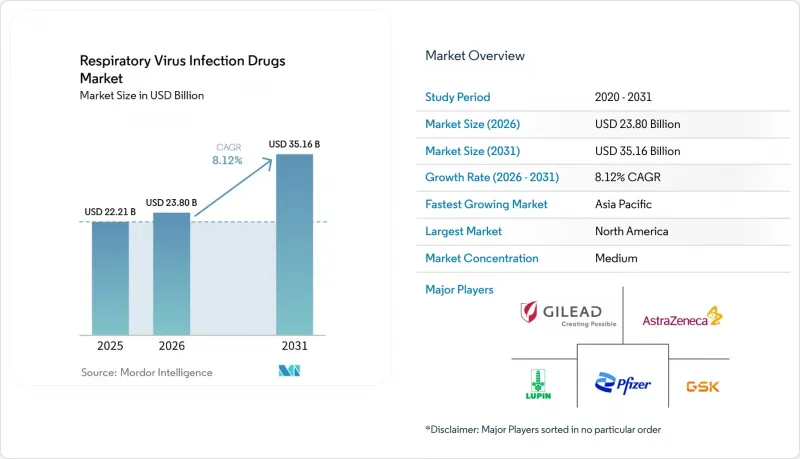
Mordor Intelligence에 의하면, 호흡기 바이러스 감염 치료제 시장 규모는 2025년에 222억 1,000만 달러로 평가되었습니다. 2026년에 238억 달러에서 2031년까지 351억 6,000만 달러에 이를 것으로 예측되며, 2026-2031년 CAGR은 8.12%를 나타낼 전망입니다.
본 보고서는 병원체(SARS-CoV-2, 인플루엔자 A/B, RSV, HMPV 등), 치료 방식(저분자 항바이러스제, 단일클론 항체 등), 투여 경로(경구, 정맥 내, 근육 내/피하, 흡입), 의료 제공 환경(외래, 입원, 장기 요양), 지역(북미, 남미, 유럽, 아시아태평양, 중동 및 아프리카)별로 분류되어 있습니다. 시장 전망은 금액(달러) 기준으로 제시되어 있습니다.
세계의 호흡기 바이러스 감염 치료제 시장 동향 및 인사이트
고령자 및 영유아에게서 RSV와 인플루엔자가 초래하는 부담이 크다는 점이 항바이러스제 수요를 뒷받침하고 있습니다.
미국에서는 고령자의 RSV로 인한 입원 건수가 연간 최대 12만 건에 달하는 반면, 생후 6개월 미만의 영아는 1인당 RSV 감염 위험이 가장 높습니다. 닐세비맙은 2024년 시즌에 호주 영아에서 88.2%, 2024-2025년 시즌에 스페인에서 89.8%의 유효성을 보였습니다. 일본에서 바로사비르의 내성률은 전체적으로 1.7%로 낮은 수준을 유지했으나, 2025년까지의 H3N2 사례에서는 3.6%로 상승했습니다. 고령자 및 소아 코호트에 대한 실세계 데이터가 증가하고 있는 것이 안정적인 수요를 뒷받침하는 두 가지 축이 되고 있습니다. 유럽의 의료 제도가 예방용 바이오의약품을 지지함에 따라, GSK와 사노피는 2024년에 미국을 제외한 닐세비맙 매출로 총 12억 달러를 기록했습니다.
경구용 항바이러스제로 외래 진료에서 신속한 치료가 가능해졌습니다.
치료 시작 시기가 매우 중요하기 때문에 주사실 과정을 거치지 않는 알약 기반 치료법에 대한 관심이 높아지고 있습니다. 적격 환자임에도 불구하고, 2024년에는 미국 환자의 69%가 COVID-19 항바이러스제 투여를 받지 못했습니다. 그 이유로 처방 의사의 주저함이나 리토나비르 증강제와 관련된 약물 상호작용에 대한 우려가 꼽히고 있습니다. 2026년 6월 FDA 승인 심사 중인 엔시트렐비르는 위약에 비해 바이러스 제거 속도가 82% 더 빠르며, 리토나비르가 필요하지 않아 다제 병용 치료 환자에 대한 적응성이 향상되었습니다. 미국에서는 약사가 검사를 실시하고 당일에 항바이러스제를 처방하는 것이 허용되어 있어, 치료 시작까지 걸리는 시간을 단축하고 있습니다. 일본의 발록사비르 과립은 알약을 삼키기 어려운 소아 환자의 복약 순응도 문제를 해결했으나, 치료를 받은 소아 환자 중 9.7%에서 138종의 변이가 확인되었습니다. 중국에서는 2026년 3월, 경구용 제제인 심노트렐비르·리토나비르 및 VV-116이 승인되어, 내성 발생 위험이 낮은 재택 치료 옵션이 추가되었습니다.
코로나19로 인한 입원 환자 수 감소와 공공 조달 규모 축소가 판매량을 끌어내리고 있습니다.
미국의 입원 환자 수는 2024년에 2023년 대비 18% 감소했으며, 2022년 1월 정점 대비 92% 감소함에 따라, 렘데시비르에 대한 입원 환자 수요가 급감했습니다. 화이자의 팍스로비드 매출액은 정부 비축 물량이 고갈되고 1회 치료당 소매 가격이 1,390달러로 인상됨에 따라, 2022년 125억 달러에서 2024년에는 15억 달러로 감소했습니다. 영국은 2025년 5월, 유효기간이 만료된 팍스로비드에 대해 17억 파운드(21억 달러)를 상각했습니다. 각국 정부는 자금을 RSV 및 인플루엔자 대비에 재배정하고 있으며, 그 결과 코로나19용 항바이러스제 구매가 일시적으로 주춤하고 있습니다.
부문별 분석
SARS-CoV-2 관련 제품은 2025년 매출의 57.28%를 차지했으나, 단일클론 항체가 소아용 접종 일정에 포함됨에 따라 RSV 치료제는 2031년까지 연평균 8.87%의 성장률을 기록하고 있습니다. RSV 분야의 발전은 호흡기 바이러스 감염 치료제 시장 전망을 뒷받침하고 있으며, 팬데믹으로 인한 변동으로부터의 영향을 완화하는 역할을 하고 있습니다. 인플루엔자 항바이러스제는 계절적 안정성을 유지하고 있으며, 일본에서는 발록사비르 과립의 경우 내성 감시를 신중하게 실시하면서 소아에 대한 적용 범위를 확대되고 있습니다. 이 모든 요소를 종합해 보면, COVID-19 이외의 병원체가 현재 시장 가치의 상당 부분을 차지하고 있으며, 그 비중은 꾸준히 증가하고 있습니다.
실제 데이터에 따르면, 닐세비맙은 88%-90%의 유효성을 보이고 있으며, 크레스로비맙공급 범위가 확대됨에 따라 RSV 예방 분야의 호흡기 바이러스 감염 치료제 시장 점유율 확대세가 더욱 가속화되고 있습니다. COVID-19에 대한 수요는 풍토병 수준에서 정체되어 있지만, 엔시트렐비르의 노출 후 치료 적응증 확대 가능성은 가정 내 이용 사례를 늘리고, 프로테아제 억제제 포트폴리오를 다각화하며, 제품 수명 주기 수익을 연장할 가능성이 있습니다.
2025년에도 저분자 의약품이 매출의 67.34%를 차지했지만, 항체 분야의 연평균 성장률(CAGR) 9.21%는 수동적 예방 솔루션으로의 전환을 시사하고 있습니다. 단일클론 항체를 이용한 호흡기 바이러스 감염 치료제 시장은 1회 투여의 편의성과 콜드체인 폐기물 감축을 배경으로, 고위험군인 영유아 및 고령자 부문에서 가장 빠르게 성장할 것으로 전망됩니다.
리토나비르와의 상호작용으로 인해, 다제 병용군에서 닐마트레빌의 사용이 제한되고 있으며, 처방 의사는 리토나비르가 포함되지 않은 약물이나 생물학적 제제를 선택해야 하는 상황에 처해 있습니다. 아스트라제네카와 GSK는 2024년에 닐세비맙으로 총 22억 달러의 매출을 기록하며, 이 약물의 상업적 실현 가능성을 입증했습니다. 병용 요법은 여전히 제한적이지만, 내성 임계치를 높이는 것을 목표로 한 연구 개발 투자가 집중되고 있습니다.
지역별 분석
북미는 2025년에도 매출 점유율 47.29%를 유지했으나, 코로나19 비축 의약품의 사용이 감소하고 있으며, 환급이 소매 채널로 전환됨에 따라 성장이 정체되고 있습니다. 미국 약사들이 주도하는 ‘검사 후 즉시 치료(test-to-treat)’ 체계는 신속성이라는 장점을 제공하고 있으며, 캐나다에서는 주 차원의 시범 사업이 성공을 거둔 데 힘입어 전국적인 확대를 목표로 하고 있습니다. 멕시코에서는 보험 적용 범위에 차이가 있어 도입에 걸림돌이 되고 있지만, 공립 클리닉에서는 제네릭 오셀타미비르와 모르누피라빌을 처방약 목록에 추가하고 있습니다.
유럽에서는 동향에 차이가 나타나고 있습니다. 독일과 영국에서는 약사에 의한 처방전 발급이 가속화되고 있지만, 프랑스공급 차질로 인해 RSV 생물학적 제제의 콜드체인에 존재하는 취약점이 드러났습니다. 남유럽에서는 상환 주기가 길어, 새로운 항바이러스제의 도입이 지연되고 있습니다. 동유럽 시장은 여전히 가격에 민감하여, 고가의 단일클론 항체보다는 제네릭 의약품이 선호되고 있습니다.
아시아태평양은 연평균 성장률(CAGR) 8.88%를 기록하며 성장률 1위를 차지하고 있습니다. 중국에서 심노트렐빌과 VV-116의 승인, 그리고 원격의료의 보급에 힘입어 지방 도시로의 확산이 진행되고 있습니다. 일본의 소아용 발록사비르 및 한국의 RSV 백신 접종 확대가 두 자릿수 성장을 뒷받침하고 있습니다. 인도의 방대한 제조거점이 해당 지역에 비용 면에서 우위를 제공하고 있지만, 신약에 대한 현지 추가 임상시험으로 인해 시장 출시까지의 기간이 길어지고 있습니다. 호주에서 니르세비맙이 88.2%의 유효성을 보인 것이 오세아니아 전역에서의 도입을 뒷받침하고 있습니다.
기타 혜택 :
- 엑셀 형식 시장 예측(ME) 시트
- 3개월간의 애널리스트 지원
자주 묻는 질문
목차
제1장 서론
제2장 조사 방법
제3장 주요 요약
제4장 시장 구도
제5장 시장 규모 및 성장 예측
제6장 경쟁 구도
제7장 시장 기회 및 향후 전망
KTH 26.06.24According to Mordor Intelligence, the respiratory virus infection drugs market size is projected to be USD 22.21 billion in 2025, USD 23.80 billion in 2026, and reach USD 35.16 billion by 2031, growing at a CAGR of 8.12% from 2026 to 2031.
This report is Segmented by Pathogen (SARS-CoV-2, Influenza A/B, RSV, HMPV, and More), Modality (Small-Molecule Antivirals, Monoclonal Antibodies, and More), Route of Administration (Oral, IV, IM/SC, Inhaled), Setting of Care (Outpatient, Hospital, Long-Term Care), and Geography (North America, South America, Europe, APAC, MEA). Market Forecasts are Provided in Terms of Value (USD).
Global Respiratory Virus Infection Drugs Market Trends and Insights
High Elderly and Infant RSV and Influenza Burden Sustains Antiviral Demand
Older adults account for up to 120,000 RSV hospitalizations annually in the United States, while infants under six months face the highest per-capita RSV load . Nirsevimab showed 88.2% effectiveness in Australian infants during the 2024 season and 89.8% in Spain's 2024-2025 season. Baloxavir resistance stayed low at 1.7% overall but rose to 3.6% in H3N2 cases in Japan through 2025. Growing real-world evidence across geriatric and pediatric cohorts is creating dual pillars of steady demand. GSK and Sanofi together booked USD 1.2 billion in 2024 ex-U.S. nirsevimab sales as European health systems backed preventive biologics.
Oral Antivirals Enable Faster Outpatient Access
Time-critical initiation drives interest in pill-based regimens that bypass infusion suites. Despite eligibility, 69% of U.S. patients missed COVID-19 antivirals in 2024, citing prescriber hesitancy and drug interaction fears with ritonavir-boosted products. Ensitrelvir, under FDA review for June 2026, cleared the virus 82% faster than placebo and avoids ritonavir, improving suitability for polypharmacy patients . Forty-two U.S. states allow pharmacists to test and prescribe antivirals the same day, compressing treatment windows. Japan's baloxavir granules broke adherence barriers for children unable to swallow tablets, although 138 mutations were observed in 9.7% of treated pediatric cases. China's March 2026 approvals of oral simnotrelvir-ritonavir and VV-116 added home-use options with higher resistance barriers.
COVID-19 Hospitalization Decline and Lower Public Procurement Depress Volumes
U.S. hospitalizations fell 18% in 2024 versus 2023 and 92% from the January 2022 peak, slashing inpatient demand for remdesivir. Pfizer's Paxlovid sales shrank to USD 1.5 billion in 2024 from USD 12.5 billion in 2022 as public stockpiles depleted and retail pricing rose to USD 1,390 per course. The United Kingdom wrote off GBP 1.7 billion (USD 2.1 billion) in expired Paxlovid during May 2025 . Governments are shifting funds toward RSV and influenza preparedness, leading to a temporary lull in COVID-19 antiviral purchases.
Other drivers and restraints analyzed in the detailed report include:
- Asia-Pacific Healthcare Expansion Boosts Antiviral Utilization
- Long-Acting RSV Monoclonal Antibodies Scale Across Immunization Programs
- Antiviral Resistance and Variant Escape Events
For complete list of drivers and restraints, kindly check the Table Of Contents.
Segment Analysis
SARS-CoV-2 products delivered 57.28% of 2025 revenue, but RSV therapies are expanding at 8.87% annually through 2031 as monoclonal antibodies enter pediatric schedules. RSV advances underpin the outlook for the respiratory virus infection drugs market, offering insulation from pandemic volatility. Influenza antivirals remain seasonally stable, with Japan's baloxavir granules widening pediatric reach amid careful resistance monitoring. Combined, non-COVID pathogens contribute over significant share of the current value, and their share is rising steadily.
Real-world data show nirsevimab reaching 88%-90% effectiveness and clesrovimab adding supply depth, reinforcing the respiratory virus infection drugs market share momentum for RSV prophylaxis. COVID-19 demand is flattening at endemic levels, yet ensitrelvir's potential post-exposure label could expand household use cases, diversifying the portfolio and extending lifecycle revenues for protease inhibitors.
Small molecules retained 67.34% revenue dominance in 2025, but the 9.21% CAGR for antibodies signals a shift toward passive prophylaxis solutions. The respiratory virus infection drugs market for monoclonal antibodies is projected to expand fastest in high-risk infant and elderly segments, driven by single-dose convenience and reduced cold-chain waste.
Ritonavir interactions limit nirmatrelvir use in polypharmacy groups, nudging prescribers toward ritonavir-free or biologic options. AstraZeneca and GSK logged combined revenue of USD 2.2 billion from nirsevimab in 2024, demonstrating commercial viability. Combination therapy remains marginal but attracts R&D investment aimed at raising resistance thresholds.
Geography Analysis
North America maintained a 47.29% revenue share in 2025, but growth is plateauing as COVID-19 stockpile use wanes and reimbursement shifts to retail channels. U.S. pharmacist test-to-treat frameworks supply speed advantages, while Canada eyes nationwide expansion after successful provincial pilots. Mexico's adoption is hampered by uneven insurance coverage, although public clinics are adding generic oseltamivir and molnupiravir to formularies.
Europe demonstrates mixed momentum. Germany and the United Kingdom accelerate pharmacist prescribing, yet supply hiccups in France exposed cold-chain weaknesses for RSV biologics. Southern Europe faces slower reimbursement cycles, delaying the introduction of new antivirals. Eastern European markets remain price-sensitive, favoring generics over premium monoclonals.
Asia-Pacific tops the growth chart at an 8.88% CAGR. China's approvals of simnotrelvir and VV-116, plus telemedicine penetration, expand reach into lower-tier cities. Japan's pediatric baloxavir and South Korea's RSV immunization roll-outs support double-digit gains. India's vast manufacturing base gives the region a cost edge, though additional local trials for novel agents prolong time-to-market. Australia's 88.2% nirsevimab effectiveness is catalyzing take-up across Oceania.
- AstraZeneca
- Aurobindo Pharma
- BioCryst Pharmaceuticals
- Cipla
- Roche
- Fujifilm Toyama Chemical
- Genentech (US)
- Gilead Sciences
- GlaxoSmithKline
- Hetero Healthcare
- Invivyd
- Lupin
- Merck
- Pfizer
- Sanofi
- Sawai Pharmaceutical
- Shionogi & Co., Ltd.
- Swedish Orphan Biovitrum
- Teva Pharmaceutical Industries
- Zydus Lifesciences
Additional Benefits:
- The market estimate (ME) sheet in Excel format
- 3 months of analyst support
TABLE OF CONTENTS
1 Introduction
- 1.1 Study Assumptions & Market Definition
- 1.2 Scope of the Study
2 Research Methodology
3 Executive Summary
4 Market Landscape
- 4.1 Market Overview
- 4.2 Market Drivers
- 4.2.1 High Elderly and Infant RSV/Influenza Burden Sustains Antiviral and Mab Demand
- 4.2.2 Oral Antivirals Enable Outpatient Treatment and Faster Access
- 4.2.3 APAC Healthcare Expansion and Surveillance Lift Antiviral Utilization
- 4.2.4 Long-Acting RSV Mab Single-Dose Immunization Scales Across Countries
- 4.2.5 Pharmacist-Prescribed Test-To-Treat Broadens Same-Day Antiviral Initiation
- 4.2.6 China-Led Uptake of Baloxavir and New Antivirals Accelerates Growth
- 4.3 Market Restraints
- 4.3.1 COVID-19 Hospitalization Declines and Waning Public Procurement Depress Volumes
- 4.3.2 Antiviral Resistance and Variant Escape
- 4.3.3 Seasonal Supply and Cold-Chain Limits for RSV mAbs Constrain Coverage
- 4.3.4 Underuse Of Antivirals Among High-Risk Outpatients Reduces Penetration
- 4.4 Supply-Chain Analysis
- 4.5 Regulatory Landscape
- 4.6 Technological Outlook
- 4.7 Porter's Five Forces Analysis
- 4.7.1 Threat of New Entrants
- 4.7.2 Bargaining Power of Suppliers
- 4.7.3 Bargaining Power of Buyers
- 4.7.4 Threat of Substitutes
- 4.7.5 Competitive Rivalry
5 Market Size & Growth Forecasts (Value, USD)
- 5.1 By Pathogen
- 5.1.1 SARS-CoV-2 (COVID-19)
- 5.1.2 Influenza A/B
- 5.1.3 Respiratory Syncytial Virus (RSV)
- 5.1.4 Human Metapneumovirus (hMPV)
- 5.1.5 Parainfluenza Viruses (PIV 1-4)
- 5.1.6 Adenovirus (respiratory types)
- 5.2 By Modality
- 5.2.1 Small-Molecule Antivirals
- 5.2.2 Monoclonal Antibodies
- 5.2.3 Combination/Adjunctive Regimens
- 5.3 By Route of Administration
- 5.3.1 Oral
- 5.3.2 Intravenous
- 5.3.3 Intramuscular/Subcutaneous
- 5.3.4 Inhaled/Intranasal
- 5.4 By Setting of Care
- 5.4.1 Outpatient/Community
- 5.4.2 Hospital/Acute care
- 5.4.3 Long-term care/Skilled nursing
- 5.5 By Geography
- 5.5.1 North America
- 5.5.1.1 United States
- 5.5.1.2 Canada
- 5.5.1.3 Mexico
- 5.5.2 Europe
- 5.5.2.1 Germany
- 5.5.2.2 United Kingdom
- 5.5.2.3 France
- 5.5.2.4 Italy
- 5.5.2.5 Spain
- 5.5.2.6 Rest of Europe
- 5.5.3 Asia-Pacific
- 5.5.3.1 China
- 5.5.3.2 India
- 5.5.3.3 Japan
- 5.5.3.4 South Korea
- 5.5.3.5 Australia
- 5.5.3.6 Rest of Asia Pacific
- 5.5.4 Middle East & Africa
- 5.5.4.1 GCC
- 5.5.4.2 South Africa
- 5.5.4.3 Rest of MEA
- 5.5.5 South America
- 5.5.5.1 Brazil
- 5.5.5.2 Argentina
- 5.5.5.3 Rest of South America
- 5.5.1 North America
6 Competitive Landscape
- 6.1 Market Concentration
- 6.2 Market Share Analysis
- 6.3 Company Profiles (includes Global level Overview, Market Level Overview, Core Segments, Financials as Available, Strategic Information, Market Rank/Share for Key Companies, Products & Services, and Recent Developments)
- 6.3.1 AstraZeneca Plc
- 6.3.2 Aurobindo Pharma USA
- 6.3.3 BioCryst Pharmaceuticals
- 6.3.4 Cipla Limited
- 6.3.5 F. Hoffmann-La Roche
- 6.3.6 Fujifilm Toyama Chemical
- 6.3.7 Genentech (US)
- 6.3.8 Gilead Sciences, Inc
- 6.3.9 GSK plc
- 6.3.10 Hetero Healthcare
- 6.3.11 Invivyd
- 6.3.12 Lupin Pharmaceuticals
- 6.3.13 Merck & Co.
- 6.3.14 Pfizer Inc
- 6.3.15 Sanofi
- 6.3.16 Sawai Pharmaceutical
- 6.3.17 Shionogi & Co., Ltd.
- 6.3.18 Swedish Orphan Biovitrum
- 6.3.19 Teva Pharmaceutical Industries
- 6.3.20 Zydus Lifesciences
7 Market Opportunities & Future Outlook
- 7.1 White-space & unmet-need assessment