

|
시장보고서
상품코드
2063520
코 세척 : 시장 점유율 분석, 업계 동향 및 통계, 성장 예측(2026-2031년)Nasal Irrigation - Market Share Analysis, Industry Trends & Statistics, Growth Forecasts (2026 - 2031) |
||||||
 Mordor Intelligence
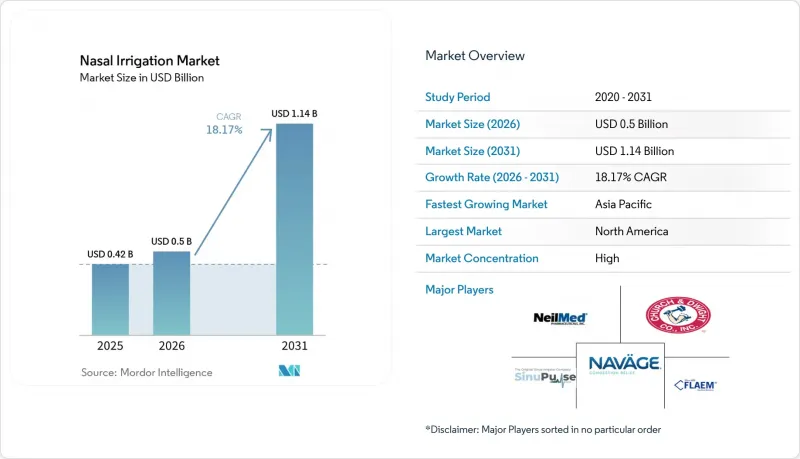
에 의하면, 코 세척 시장 규모는 2025년 4억 2,000만 달러로 평가되었습니다. 2026년 5억 달러에서 2031년까지 11억 4,000만 달러로 확대되어 2026-2031년 CAGR은 18.17%를 나타낼 것으로 예측됩니다.

본 보고서는 제품 유형(네티팟 등), 기술(수동식 등), 용액 유형(등장액 등), 적응증(만성 부비동염 등), 최종 사용자(재택 간호 등), 유통 채널(소매 약국 및 드럭스토어 등) 및 지역(북미, 유럽, 아시아태평양 등)별로 분류되어 있습니다. 시장 전망은 금액(달러) 기준으로 제시되어 있습니다.
세계의 코 세척 시장 동향 및 인사이트
알레르기성 비염 및 만성 부비동염 유병률 상승이 구조적 수요를 견인
알레르기성 비염 및 만성 부비동염은 전신적인 부작용을 동반하지 않는 증상 완화를 원하는 환자들이 존재하기 때문에 일상적 또는 계절적인 세척에 대한 수요의 기반이 되고 있습니다. 2026년 임상 현장에서는 특히 수술 후 만성 부비동염의 경우, 대량 세척이 점막 부종을 완화하고 증상 관리를 돕는다는 인식이 널리 퍼지고 있습니다. 메타분석을 통한 증거에 따르면, 부데소니드를 이용한 코 세척은 코르티솔 수치와 안압을 안전한 범위 내로 유지하면서 질환 특이적인 환자 보고 결과를 개선하는 것으로 나타났으며, 이는 임상의들의 신뢰를 더욱 높이고 있습니다.
환자들의 지식 수준에는 여전히 차이가 있습니다. 2026년 중국에서 실시된 횡단 연구에 따르면, 비부비동염 환자들 사이에서 코 세척의 현재 이용률은 높은 편이지만, 독립적인 질환 관리 전략으로서의 코 세척에 대한 신뢰도는 제한적인 것으로 보고되었으며, 이는 공급업체들이 해소하고자 하는 교육상의 격차를 여실히 드러내고 있습니다. 교육과 체계적인 사후 관리를 병행하면, 부비동염 발병 초기 1주일 동안은 치료 순응도가 향상되지만, 지속적인 관리가 이루어지지 않으면 2주 차에는 떨어질 가능성이 있습니다. 이러한 추세로 인해, 코 세척 시장 전반에서 계절성 및 만성 질환 치료 계획의 일환으로 소모품과 전동 시스템 모두에 대한 수요가 유지되고 있습니다.
재택 자가 관리로의 전환이 유통과 기기 설계를 재정의하고 있습니다.
환자들이 시중에서 판매되는 위생 관리 습관을 점차 도입함에 따라, 코 세척 시장은 재택 관리로의 뚜렷한 전환으로 인해 혜택을 보고 있습니다. 설명서, 동영상 링크, 그리고 항생제 투여를 지연시키는 전략을 통해 제공된 복약 순응도 지원은 대조군 연구에서 1주차 순응도를 향상시켰으나, 2주차로 이어지기 위해서는 디지털 구독 서비스를 통해 제공될 수 있는 지속적인 피드백 루프가 필요했습니다.
재택 간호 이용자들은 처음에는 이 처치를 불편하게 느끼는 경우가 많지만, 편의성과 사생활 보호를 중요하게 여기고 있으며, 이러한 점이 인체공학에 기반한 조작성과 신속하게 세척할 수 있는 부품 등 제품 설계의 방향성을 형성하고 있습니다. 소매 약국의 약사들은 생리식염수의 조제, 온도, 소아 안전에 대해 지속적으로 계몽 활동을 펼치고 있는 반면, 온라인 채널은 자동 보충 기능과 최근 임상 조사에서 드러난 지식 부족을 해소하기 위한 교육 컨텐츠를 통해 그 규모를 확대되고 있습니다. 각 업체는 알레르기나 감염증의 주기에 맞추어 주 단위의 루틴을 유지할 수 있도록 패키지와 앱의 알림을 조정하고 있으며, 이로 인해 코 세척 시장은 계절적 수요가 정점에 달하는 시기뿐만 아니라 일상적인 지속적인 사용 측면에서도 활기를 띠고 있습니다.
부적절한 수질과 장비 오염 위험이 안전 대책의 의무화를 초래합니다.
2023년 뉴멕시코주에서 발생한, 전자식 비강 세정기에 수돗물을 사용한 것과 관련된 아칸타모에바 뇌염 사망 사례는 위험에 대한 인식을 높이고, 비강 세정 시 수질 안전에 대한 재조명을 촉발했습니다. 2025년에 개정된 CDC 지침에 따르면, 사용자는 증류수, 멸균수 또는 끓여서 식힌 물을 선택하거나, 세척 전에 특정 소독 절차를 거쳐야 한다고 명시되어 있습니다. 이와 유사한 미생물 위험 평가 체계는 네그렐리아 푸렐리에도 적용됩니다. 수돗물이 비강으로 들어가 중추신경계에 도달할 경우, 이 미생물에 의한 치사율은 매우 높아집니다.
공중보건 지침에 따라 준비 절차가 추가됨에 따라 일부 사용자의 단기적인 준수율이 떨어질 가능성이 있으므로, 기기 제조업체들은 포장이나 앱 내에 명확한 지침과 주의 사항을 포함하도록 권고받고 있습니다. 2025년에 면봉 등 관련 코 관리 제품에서 발생한 리콜은 점막과 접촉하는 부품에 대한 엄격한 제조 관리와 검증된 세척 절차의 필요성을 더욱 부각시켰습니다.
부문별 분석
2025년, 스퀴즈 병은 20.16%의 시장 점유율을 차지했습니다. 이는 합리적인 가격, 소매점에서 쉽게 구할 수 있다는 점, 그리고 스타터 키트에 대해 의료진이 이미 익숙하다는 점이 반영된 결과입니다. 구매자들은 심플한 인체공학적 설계와 미리 조제된 생리식염수 팩 및 가정에서 조제한 등장성 용액과의 폭넓은 호환성을 중요하게 여기고 있으며, 이로 인해 코 세척 시장 전체에서 신규 사용자의 진입 장벽이 낮게 유지되고 있습니다. 일상적인 위생 관리에서는 여전히 직접 조제하는 등장액이 일반적이지만, pH나 삼투압을 일정하게 유지하고 싶은 가정에서는 미리 혼합된 소포장 제품이 조제 실수를 줄이는 데 도움이 되고 있습니다. 수동식 병의 설계에서는 불편함을 우려하는 초보 사용자의 학습 곡선을 완화하기 위해, 잡기 편한지, 밸브의 신뢰성, 한 손으로 조작할 수 있는지에 중점을 두고 있습니다. 압축기식 코 세척기와 같은 특수 제품은 이비인후과 전문의나 외래 진료소에서 내구성이 뛰어난 의료기기가 인기 있는 유럽의 약국에서 틈새 시장을 차지하고 있습니다.
전동식 및 펄스식 시스템은 보다 정교한 맞춤형 기능, 압력 제어, 통합된 위생 기능을 통해 사용자층을 세분화하고 있어, 2031년까지 연평균 성장률(CAGR) 21.19%를 나타낼 것으로 전망됩니다. 주요 모델은 분당 1,200 사이클의 펄스 기능, 가변 속도, 그리고 교차 오염을 억제하고 사용 시 부담을 줄이도록 설계된 ‘세척 + 흡입’ 방식을 특징으로 합니다. 현재 설계에는 항균 하우징과 자가 세척 기능이 통합되어 있어, 오염 및 세척 절차에 대한 신뢰성을 높이고 주요 우려 사항 중 하나를 해결하고 있습니다. 안전성 혁신의 일환으로, 코피나 기압 외상의 위험을 최소화하도록 설정된 수준까지 출력을 제한하는 압력 방출 밸브가 있어, 가장 많이 지적되는 내약성 우려 중 하나에 대응하고 있습니다. 무선, 접이식, IPX 규격 지원 기기는 여행이나 직장에서의 사용을 가능하게 하여 월간 활성 사용 일수를 늘리고, 생리식염수 팩의 보충 빈도를 높여줍니다.
2025년에는 수동식 기술이 65.23%의 시장 점유율을 차지했는데, 이는 저렴한 비용, 거의 모든 생리식염수와 호환되는 점, 그리고 소매 약국 및 진료소에 널리 보급된 점을 반영한 것입니다. 수동식 시스템은 사용법을 익히기 쉽고 가격이 저렴하며, 특히 알레르기 성수기 정점 시기에는 효과가 눈에 띄기 때문에 도입 초기 단계에서는 여전히 인기가 높습니다. 의료진이 온도와 머리 위치에 대해 안내해 줌으로써, 많은 사용자들이 초기에 느꼈던 불편함을 해소하고, 꽃가루가 가장 많이 날리는 시기나 추운 계절에도 계속 사용하고 있습니다. 병에는 분리 가능하고 식기세척기 사용이 가능한 부품이 채택되는 경우가 늘어나고 있으며, 이를 통해 사용을 시작한 지 2주 만에 사용을 중단하게 될 수 있는 일상적인 세척 부담이 줄어들고 있습니다.
전동 및 배터리 구동식 시스템은 리튬 폴리머 배터리, USB-C를 통한 공통 충전, 마이크로프로세서 제어 압력 프로파일 등에 힘입어 2031년까지 연평균 성장률(CAGR) 20.15%를 나타낼 것으로 전망됩니다. 최신 기기에서는 다양한 해부학적 구조와 민감도에 대응하는 여러 강도 수준은 물론, 용량과 휴대성의 균형을 맞춘 부속 저장 탱크가 특징으로 내세워지고 있습니다. '세척·흡입' 기능은 철저한 세척을 원하는 바쁜 사용자에게 한 번 사용에 소요되는 시간을 단축시켜 주는 독창적인 경험을 제공합니다. 7 kPa라는 저압 설정은 중이와 민감한 점막을 보호하기 위한 것으로, 이는 코 세척 업계의 신흥 프리미엄 부문에서 ‘안전 제일’이라는 접근 방식을 강조하는 것입니다. 이러한 기능이 중가대 제품군에도 확산됨에 따라, 선진국과 급성장 지역 모두에서 코 세척 시장 내 전동식 제품의 비중이 지속적으로 증가할 것으로 전망됩니다.
지역별 분석
북미는 2025년에 38.17%의 점유율을 차지했습니다. 이는 알레르기 질환 환자 수가 많고, 급성기 및 만성기 모두에서 의사와 약사가 세척 요법에 폭넓게 관여하고 있다는 점이 배경에 있습니다. FESS(전두상비인두 수술) 후의 정기 세척 프로토콜은 전문 의료 현장에 정착되어 있으며, 이는 병원, 클리닉, 재택 간호로 확대됨에 따라 기기 및 소모품 수요를 뒷받침하고 있습니다. 이 지역은 가처분 소득이 높고 임상 지도를 받기 쉬운 환경 덕분에 다른 지역에 비해 전동 기기 도입률이 높으며, 펄스 기능이나 자동 세척 사이클과 같은 프리미엄 기능이 선호되고 있습니다. 물의 안전성에 관한 지침은 중요하게 여겨지고 있으며, 현재는 기기 설명서나 웹 페이지에도 널리 게재되어 있습니다. 이를 통해 사용자의 행동이 형성되며, 멸균수나 끓인 후 식힌 물에 대한 관심이 지속되고 있습니다.
아시아태평양에서는 도시화와 대기질 악화로 인해 건강상의 부담이 커지고, 소비자들이 일상적인 위생 습관을 더욱 중요하게 여기게 됨에 따라, 2031년까지 연평균 성장률(CAGR) 20.14%로 시장이 확대될 것으로 전망됩니다. 중산층의 구매력이 향상됨에 따라, 현지에서 조립된 중저가형 전기 세척기는 수압 제어 및 항균 기능을 희생하지 않으면서도 접근성을 높이고 있습니다. 약국과 온라인 채널은 처음 사용하는 사용자를 대상으로 사용법 관련 컨텐츠나 리필 구독 서비스를 통해 적극적으로 안내하고 있으며, 이를 통해 초기 체험 후 습관적인 사용이 촉진되고 있습니다. 특정 시장의 문화적 위생 관행은 기기 보급을 위한 수용 기반을 형성하고 있으며, 이비인후과(ENT) 센터에서의 임상 교육을 통해 코 세척 시장의 모범 사례가 지역 사회로 확산되고 있습니다.
유럽에서는 이비인후과학회 및 병원의 프로토콜에 따라 수술 후나 만성 질환 치료 시 고유량 세척이 표준화되어 꾸준히 성장세를 이어가고 있습니다. 압축기식 코 세정기는 내구성이 뛰어난 기기를 선호하는 기존 약국 유통망을 통해 서유럽 일부 지역에서 틈새 시장을 차지하고 있지만, 가정용 짜는 방식의 병이나 새롭게 등장한 전동 기기가 소비자의 선택 폭을 넓혀주고 있습니다. 2024년 및 2025년의 임상 문헌은 유효성과 내약성의 균형을 고려한 세척액 선택을 뒷받침하고 있으며, 이는 환자 상담의 지침이 되어 코 세척 시장에서 치료 순응도를 유지하는 데 기여하고 있습니다.
기타 혜택 :
- 엑셀 형식 시장 예측(ME) 시트
- 3개월간의 애널리스트 지원
자주 묻는 질문
목차
제1장 서론
제2장 조사 방법
제3장 주요 요약
제4장 시장 구도
제5장 시장 규모 및 성장 예측
제6장 경쟁 구도
제7장 시장 기회 및 향후 전망
KTH 26.06.24According to Mordor Intelligence, the nasal irrigation market size is projected to expand from USD 0.42 billion in 2025 and USD 0.5 billion in 2026 to USD 1.14 billion by 2031, registering a CAGR of 18.17% between 2026 to 2031.
This report is Segmented by Product Type (Neti Pots, and More), Technology (Manual, and More), Solution Type (Isotonic, and More), Indication (Chronic Rhinosinusitis, and More), End User (Homecare, and More), Distribution Channel (Retail Pharmacies/Drugstores, and More), and Geography (North America, Europe, Asia-Pacific, and More). The Market Forecasts are Provided in Terms of Value (USD).
Global Nasal Irrigation Market Trends and Insights
Rising Prevalence of Allergic Rhinitis and Chronic Rhinosinusitis Fuels Structural Demand
Allergic rhinitis and chronic rhinosinusitis continue to anchor need for daily or seasonal lavage because patients want relief without systemic side effects. Clinical practice in 2026 reflects growing consensus that high-volume irrigation reduces mucosal edema and supports symptom control, especially in chronic rhinosinusitis after surgery. Meta-analytic evidence shows that budesonide nasal irrigation improves disease-specific patient-reported outcomes while maintaining cortisol levels and intraocular pressure within safe ranges, which supports broader clinician confidence.
Patient knowledge remains uneven, as a 2026 cross-sectional study in China reported high current usage of nasal irrigation among rhinosinusitis patients but limited belief in irrigation as an independent disease control strategy, which highlights an education gap that vendors aim to close. When education is combined with structured follow-up, adherence rises during the first week of a sinusitis episode, although it can taper in week two without ongoing engagement. These patterns sustain demand for both consumables and powered systems as part of seasonal and chronic regimens across the nasal irrigation market.
Home-Based Self-Care Migration Redefines Distribution and Device Design
The nasal irrigation market benefits from a clear migration to home-based care as patients adopt OTC hygiene routines. Adherence support delivered through instructions, video links, and delayed-antibiotic strategies improved week-one compliance in controlled trials, although retention in week two required ongoing feedback loops that digital subscriptions can provide.
Homecare users prize convenience and privacy for a procedure that many initially find unpleasant, which shapes product design toward ergonomic controls and quick-clean components. Retail pharmacists continue to educate on saline mixture, temperature, and pediatric safety, yet online channels expand through automated replenishment and instructional content that address known knowledge deficits documented in recent clinical surveys. Companies adapt packaging and app prompts to sustain weekly routines that align with allergy and infection cycles, which keeps the nasal irrigation market active through both seasonal spikes and chronic daily use.
Improper Water Quality and Device Contamination Risks Trigger Safety Mandates
A 2023 fatality in New Mexico due to Acanthamoeba encephalitis linked to tap-water use in an electronic nasal irrigator heightened risk awareness, which prompted renewed emphasis on water safety for sinus rinsing. CDC guidance updated in 2025 states that users should choose distilled, sterile, or boiled-then-cooled water or apply specific disinfection steps before irrigation. The same organism risk framework extends to Naegleria fowleri, which has a very high case-fatality rate when tap water enters nasal passages and accesses the central nervous system.
Public-health instructions add preparation steps that may reduce short-term adherence among some users, which motivates device makers to include clear instructions and reminders inside packaging and apps. Recalls in related nasal-care products such as cotton swabs in 2025 further underscored the need for stringent manufacturing controls and validated cleaning protocols for components that contact mucosa.
Other drivers and restraints analyzed in the detailed report include:
- Product Innovation in Powered and Pulsatile Irrigation Systems
- Expanding Use of Medicated and Antiseptic Irrigation
- Tolerability Issues Limit Adherence Despite Clinical Efficacy
For complete list of drivers and restraints, kindly check the Table Of Contents.
Segment Analysis
Squeeze bottles captured a 20.16% share in 2025, reflecting affordability, wide retail availability, and clinician familiarity in starter kits. Buyers value simple ergonomics and universal compatibility with premixed saline packets or home-mixed isotonic blends, which keeps entry barriers low for new users across the nasal irrigation market. Self-prepared isotonic solutions remain common for everyday hygiene, and premixed sachets reduce mixing errors in households that want predictable pH and tonicity. Manual bottle design has focused on grip, valve reliability, and one-handed operation to reduce learning curves for first-time users who may be apprehensive about discomfort. Specialty products like compressor-assisted nasal showers occupy a niche in European pharmacies where durable medical equipment is popular with ENT prescribers and outpatient clinics.
Electric and pulsatile systems are forecast to grow at a 21.19% CAGR through 2031 as they segment the user base with more personalization, pressure control, and integrated hygiene features. Flagship models advertise pulsation at 1,200 cycles per minute, variable speeds, and rinse-plus-suction flows designed to limit cross-pass contamination and reduce perceived effort. Designs now incorporate antimicrobial housings and self-clean cycles to reinforce confidence around contamination and cleaning routines, which addresses a central restraint. Safety innovation includes pressure-release valves that cap output to levels set to minimize epistaxis and barotrauma risk, answering one of the most cited tolerability concerns. Cordless, foldable, and IPX-rated devices expand usage into travel and work settings, which increases monthly active use days and supports replenishment cadence for saline packets.
Manual technology held a 65.23% share in 2025, reflecting low device cost, near-universal saline compatibility, and broad placement across retail pharmacies and physician offices. Manual systems remain popular in early adoption because the learning curve is short, the price point is low, and results are visible, particularly during peak allergy seasons. As clinicians coach on temperature and head position, many users resolve early discomfort and continue use through pollen surges and cold seasons. Bottles increasingly feature removable, dishwasher-safe parts, which reduces routine cleaning barriers that can lead to drop-off in week two of new use.
Electric and battery-powered systems are projected to expand at a 20.15% CAGR through 2031, driven by lithium-polymer batteries, USB-C common charging, and microprocessor-controlled pressure profiles. Modern devices advertise multiple intensity levels for varied anatomy and sensitivity, alongside attached reservoirs that balance volume with portability. Rinse-and-suction functionality provides a differentiated experience that reduces time per session for busy users who still want thorough clearance. Pressure caps as low as 7 kPa aim to protect the middle ear and fragile mucosa, which underscores a safety-first approach in the emerging premium tier of the nasal irrigation industry. As these capabilities filter into mid-tier prices, the nasal irrigation market will see continued mix-shift toward electric platforms in both developed and fast-growing regions.
Geography Analysis
North America held a 38.17% share in 2025, underpinned by a large burden of allergic disease and widespread clinician and pharmacist engagement with irrigation across acute and chronic use. Routine post-FESS irrigation protocols are entrenched in specialty care, which sustains device and consumables demand across hospitals, clinics, and home transitions. The region supports higher adoption of powered devices relative to other geographies due to disposable income and access to clinical coaching, which favors premium features like pulsation and self-clean cycles. Water-safety guidance is prominent and now common in device leaflets and web pages, which shapes behavior and maintains focus on sterile or boiled-then-cooled water.
Asia-Pacific is projected to expand at a 20.14% CAGR through 2031 as urbanization and air-quality factors increase symptom burdens that point users to daily hygiene routines. As middle-class purchasing power rises, mid-tier powered irrigators assembled locally increase accessibility without sacrificing pressure controls or antimicrobial features. Pharmacy and online channels are both active in educating first-time users with how-to content and refill subscriptions, which supports habitual use after initial trials. Cultural hygiene practices in select markets create a receptive base for device adoption, and clinical training in ENT centers spreads best practices into community settings in the nasal irrigation market.
Europe maintains steady growth as ENT societies and hospital protocols standardize high-volume irrigation after surgery and in chronic care. Compressor-assisted nasal showers hold niche positions in parts of Western Europe through established pharmacy channels that favor durable equipment, while home-based squeeze bottles and emerging electric devices broaden consumer choice. Clinical literature in 2024 and 2025 supports solution selection by balancing efficacy and tolerability, which guides patient counseling and sustains adherence for the nasal irrigation market.
- Church & Dwight
- ENT Technologies Pty Ltd
- Flaem Nuova S.p.A.
- Health Solutions Medical Products Corp. (SinuPulse)
- Himalayan Chandra
- hydraSense
- Medisana GmbH
- NeilMed Pharmaceuticals, Inc.
- RhinoSystems, Inc. (Navage)
- SQuiP Inc.
- The Alkalol Company
- Waterpulse
- Xlear, Inc.
Additional Benefits:
- The market estimate (ME) sheet in Excel format
- 3 months of analyst support
TABLE OF CONTENTS
1 Introduction
- 1.1 Study Assumptions & Market Definition
- 1.2 Scope of the Study
2 Research Methodology
3 Executive Summary
4 Market Landscape
- 4.1 Market Overview
- 4.2 Market Drivers
- 4.2.1 Rising prevalence of allergic rhinitis and chronic rhinosinusitis
- 4.2.2 Shift to home-based self-care and OTC nasal hygiene
- 4.2.3 Product innovation in powered and pulsatile irrigation systems
- 4.2.4 Expanding use of medicated and antiseptic irrigation (e.g., PVP-iodine, HOCl, xylitol)
- 4.2.5 ENT postoperative protocols standardizing high-volume irrigation
- 4.2.6 Guideline endorsements and antibiotic stewardship elevating saline nasal irrigation as first-line adjunct in rhinosinusitis
- 4.3 Market Restraints
- 4.3.1 Improper water quality and device contamination risks
- 4.3.2 Tolerability issues (irritation, epistaxis) limiting adherence
- 4.3.3 Availability of alternative intranasal therapies (steroids, antihistamines, decongestants)
- 4.3.4 Cleaning/maintenance burden reducing long-term adherence
- 4.4 Supply-Chain Analysis
- 4.5 Regulatory Landscape
- 4.6 Technological Outlook
- 4.7 Porter's Five Forces
- 4.7.1 Threat of New Entrants
- 4.7.2 Bargaining Power of Suppliers
- 4.7.3 Bargaining Power of Buyers
- 4.7.4 Threat of Substitutes
- 4.7.5 Competitive Rivalry
5 Market Size & Growth Forecasts (Value, USD)
- 5.1 By Product Type
- 5.1.1 Neti Pots
- 5.1.2 Squeeze Bottles (positive-pressure LVLP)
- 5.1.3 Syringes/Bulb Syringes
- 5.1.4 Powered/Pulsatile/Electric Systems
- 5.1.5 Nasal Douches/Showers (compressor-assisted)
- 5.2 By Technology
- 5.2.1 Manual
- 5.2.2 Electric/Battery-Powered
- 5.3 By Solution Type
- 5.3.1 Isotonic Saline
- 5.3.2 Hypertonic Saline
- 5.3.3 Additive-enhanced (e.g., xylitol, povidone-iodine, HOCl, corticosteroid admixture per Rx)
- 5.4 By Indication
- 5.4.1 Chronic Rhinosinusitis (with/without polyps)
- 5.4.2 Allergic Rhinitis
- 5.4.3 Upper Respiratory Infection/Cold & Flu
- 5.4.4 Post-operative ENT Care (post-FESS/septoplasty)
- 5.5 By End User
- 5.5.1 Homecare
- 5.5.2 Hospitals
- 5.5.3 ENT/Allergy Clinics
- 5.6 By Distribution Channel
- 5.6.1 Retail Pharmacies/Drugstores
- 5.6.2 E-commerce/Direct-to-Consumer
- 5.6.3 Hospital/Clinic Pharmacies & B2B
- 5.7 By Geography
- 5.7.1 North America
- 5.7.1.1 United States
- 5.7.1.2 Canada
- 5.7.1.3 Mexico
- 5.7.2 Europe
- 5.7.2.1 Germany
- 5.7.2.2 United Kingdom
- 5.7.2.3 France
- 5.7.2.4 Italy
- 5.7.2.5 Spain
- 5.7.2.6 Rest of Europe
- 5.7.3 Asia-Pacific
- 5.7.3.1 China
- 5.7.3.2 Japan
- 5.7.3.3 India
- 5.7.3.4 Australia
- 5.7.3.5 South Korea
- 5.7.3.6 Rest of Asia-Pacific
- 5.7.4 Middle East and Africa
- 5.7.4.1 GCC
- 5.7.4.2 South Africa
- 5.7.4.3 Rest of Middle East and Africa
- 5.7.5 South America
- 5.7.5.1 Brazil
- 5.7.5.2 Argentina
- 5.7.5.3 Rest of South America
- 5.7.1 North America
6 Competitive Landscape
- 6.1 Market Concentration
- 6.2 Market Share Analysis
- 6.3 Company Profiles {(includes Global level Overview, Market level overview, Core Segments, Financials as available, Strategic Information, Market Rank/Share for key companies, Products & Services, and Recent Developments)}
- 6.3.1 Church & Dwight Co., Inc.
- 6.3.2 ENT Technologies Pty Ltd
- 6.3.3 Flaem Nuova S.p.A.
- 6.3.4 Health Solutions Medical Products Corp. (SinuPulse)
- 6.3.5 Himalayan Chandra
- 6.3.6 hydraSense
- 6.3.7 Medisana GmbH
- 6.3.8 NeilMed Pharmaceuticals, Inc.
- 6.3.9 RhinoSystems, Inc. (Navage)
- 6.3.10 SQuiP Inc.
- 6.3.11 The Alkalol Company
- 6.3.12 Waterpulse
- 6.3.13 Xlear, Inc.
7 Market Opportunities & Future Outlook
- 7.1 White-space & unmet-need assessment


