

|
시장보고서
상품코드
2063523
베타 차단제 : 시장 점유율 분석, 업계 동향 및 통계, 성장 예측(2026-2031년)Beta Blockers - Market Share Analysis, Industry Trends & Statistics, Growth Forecasts (2026 - 2031) |
||||||
 Mordor Intelligence
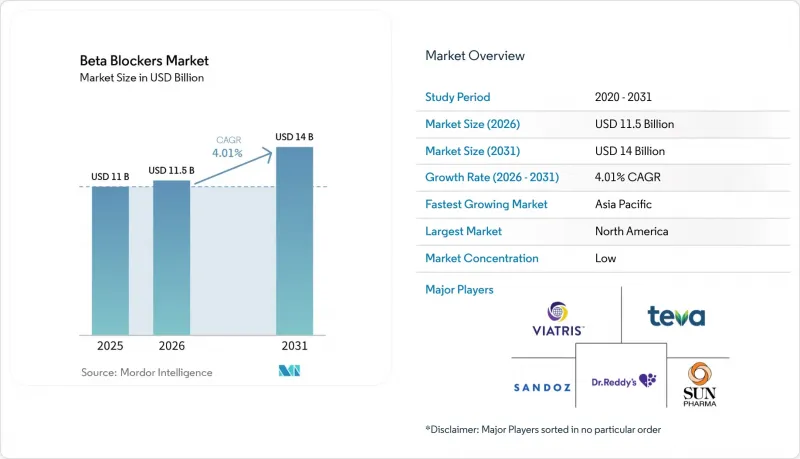
Mordor Intelligence에 의하면, 베타 차단제 시장 규모는 2025년에 110억 달러로 평가되었습니다. 2026년에 115억 달러에서 2031년까지 140억 달러에 이를 것으로 예측되며, 2026-2031년 CAGR은 4.01%를 나타낼 전망입니다.
본 보고서는 약물 분류(β-1 선택적 등), 분자(메토프로롤, 비소프로롤, 아테놀롤 등), 투여 경로(경구, 정맥 내, 점안), 적응증(고혈압, 심부전, 부정맥 등), 유통 채널(병원, 소매, 온라인), 지역(북미, 유럽, 아시아태평양 등)에 따라 분류되어 있습니다. 시장 전망은 금액(달러) 기준으로 제공됩니다.
세계의 베타 차단제 시장 동향 및 분석
심부전 및 심근경색 후 관리에서 수행하는 기초적인 역할이 장기적인 수요를 뒷받침하고 있습니다.
2025년 일본순환기학회 지침에서는 레닌-안지오텐신계 억제제 및 나트륨-포도당 공동수송체 2(SGLT2) 억제제와 함께 베타 차단제에 대한 1등급 권고가 유지되었으며, 4제 병용 요법에 대한 보편적인 적용이 강화되었습니다. MERIT-HF와 같은 획기적인 임상시험은 북미 및 유럽에서 병원에 대한 지급액을 베타 차단제 처방률과 연계하는 보험급여 감사 근거로 계속해서 활용되고 있습니다. 유럽심장학회(ESC)의 2024년 심방세동 지침에 따르면, 좌심실 기능 장애 환자의 심박수 조절에 있어 베타 차단제가 여전히 칼슘 채널 차단제보다 우선적으로 권장되고 있습니다. 급성 관상동맥 증후군 후 사망률을 낮추는 효과는 여전히 확고하며, 응급의료 현장에서의 처방 우선순위를 유지하고 있습니다. 그 결과, 심부전 및 심근경색 후 환자의 장기 투여량은 합병증이 없는 고혈압으로 인한 감소분을 여전히 상회하고 있습니다.
지침이 변경되었음에도 불구하고, 심혈관 질환의 부담이 만성적인 처방을 지속시키고 있습니다.
세계보건기구(WHO)의 통계에 따르면, 2022년 전 세계 심혈관 질환으로 인한 사망자 수는 1,980만 명이었으며, 그 주요 원인으로 고혈압과 관상동맥 질환이 꼽혔습니다. 미국심장협회(AHA)의 2025년판 개정 지침에 따르면, 미국에서 고혈압을 앓고 있는 성인은 1억 2,240만 명으로 추산되며, 이 집단에서는 베타 차단제가 여전히 권장되는 추가 요법 또는 확고한 적응증이 있는 경우의 1차 선택 약물로 자리 잡고 있습니다. 인도의 실제 진료 기록에 따르면, 주요 심혈관 질환으로 입원한 환자 중 베타 차단제 처방률이 75% 이상의 것으로 나타났으며, 이는 현지 지침이 서유럽의 개정판에 뒤처져 있는 상황에서도 의사들이 여전히 베타 차단제에 의존하고 있는 실태를 뒷받침하고 있습니다. 이러한 유병률 동향, 특히 아시아·태평양 지역 및 중동 및 아프리카의 상황은 지속적인 기본 수요를 뒷받침하는 한편, 고혈압 초기 처방의 점진적인 감소를 상쇄하고 있습니다.
지침 개정에 따라 고혈압 치료의 1차 선택 약제로서의 사용이 제한됩니다.
2024년 유럽심장학회(ESC) 고혈압 지침에서는 명확한 심장 관련 적응증이 없는 환자에 대한 표준 1차 치료법에서 베타 차단제가 제외되었습니다. 2025년 미국심장협회(AHA)의 개정판 역시, 메타분석을 통해 레닌-안지오텐신계 억제제 및 칼슘채널 차단제가 뇌졸중 예방 효과 면에서 더 우수하다는 사실이 밝혀진 점을 반영하여, 이 방침을 그대로 따랐습니다. 서유럽의 임상 의사결정 지원 플랫폼은 몇 달 이내에 이러한 변경 사항을 반영했으며, 이는 1차 진료 현장의 처방 행태에 즉각적인 영향을 미쳤습니다. 아시아태평양 및 중동 및 아프리카(MEA) 국가들에서는 아직 현지 알고리즘이 업데이트되지 않았지만, 다국적 기업들에 따르면 성숙 시장에서 고혈압 단독 치료제의 신규 처방률이 감소하고 있어 베타 차단제 시장의 단기적인 성장을 억제하고 있습니다.
부문별 분석
메토프로롤, 비소프로롤, 네비보롤 등의 심장 선택성 분자는 2025년 매출의 62.18%를 차지했으며, 베타 차단제 시장에서 이 점유율은 2031년까지 연평균 성장률(CAGR) 4.35%로 확대될 것으로 예측됩니다. 심장 선택성 덕분에 반응성 기도 질환이 있는 환자의 기관지 경련 위험이 감소함에 따라, 그 결과 심부전 및 심근경색 후 환자에 대한 적응증이 확대되고 있습니다. 네비보롤의 산화질소 자극 작용은 말초 저항을 감소시켜, 동종 약물군 내에서 가장 빠르게 성장하고 있는 분자로서의 입지를 확고히 하고 있습니다. 비선택적 약물은 문맥압 상승증의 예방이나 안과 분야에서 여전히 중요한 역할을 하고 있지만, 카르베지롤과 라베타롤은 각각 심부전과 응급 고혈압 위기의 치료에 사용되고 있습니다.
의사가 심장 선택적 치료법을 선정하는 데에는 기관지 경련과 관련된 재입원율을 지표로 삼는 보험자의 품질 평가 기준도 영향을 미칩니다. 유럽의 제한적 환급 목록에서는 CIBIS-II 임상시험의 사망률 데이터를 근거로 비소프로롤에 대해 소폭의 가격 우대가 인정되고 있습니다. 한편, 북미의 처방집에서는 상호 대체성이 중시되고 있어, 제네릭 의약품으로의 높은 대체율이 촉진되고 있습니다. 성과 기반 상환 제도가 신흥국으로 확대됨에 따라, 심장 선택성 약물의 성능적 우위가 베타 차단제 시장에서 꾸준한 성장을 뒷받침할 것으로 예측됩니다.
2025년 처방전 중 경구용 정제가 78.19%를 차지하며, 만성 질환 치료용 베타 차단제 시장에서 가장 큰 점유율을 기록했습니다. 하루 1회 투여하는 서방형 제제는 혈중 농도의 최고치와 최저치 변동을 줄여, 내약성과 복약 순응도를 향상시킵니다. 정주 제제는 수술 전·수술 후 및 집중 치료 시 신속한 혈역학적 조절(온·오프)에 대한 수요에 힘입어 연평균 성장률(CAGR) 4.21%로 성장을 지속하고, 있습니다. 병원에서는 경카테터 치료 중 심박수 관리에 있어, 그 초단시간 작용 특성을 이유로 란지올롤을 선호하는 경향이 강해지고 있습니다.
점안제는 단독제로서의 사용은 감소하는 추세이지만, 고정 용량의 프로스타글란딘 복합제의 일부로 여전히 사용되고 있습니다. 정주제나 복합제에 대해서는 생물학적 동등성 시험을 통해 전신으로의 즉각적인 이동 및 상가적 효능을 확인해야 하기 때문에 규제상의 장벽이 비교적 높습니다. 이러한 승인 절차를 성공적으로 통과할 수 있는 제약사는 베타 차단제 시장의 차별화된 고수익 하위 부문에서 우위를 점하게 됩니다.
지역별 분석
북미는 메디케어 파트 D의 적용, 심부전 품질 지표, 그리고 서방형 제제의 높은 보급률에 힘입어 2025년 매출의 33.18%를 차지했습니다. 메디케어·메디케이드 서비스 센터(CMS)는 베타 차단제 처방 기준을 충족한 병원에 금전적 인센티브를 제공하고 있으며, 이를 통해 의료기관으로부터의 안정적인 수요가 확보되고 있습니다. 캐나다의 주별 의약품 목록에서는 제네릭 의약품의 보험 급여가 우선시되기 때문에 브랜드 의약품의 가격 프리미엄이 축소되고 있습니다.
아시아태평양은 연평균 성장률(CAGR) 4.30%를 기록하며 가장 빠르게 성장하고 있는 지역입니다. 인도의 ROBUST 레지스트리에 따르면, 심혈관 질환으로 퇴원한 환자의 4분의 3 이상에게 메토프로롤이 투여된 것으로 기록되어 있으며, 중국의 대량 구매 목록에는 메토프로롤이 1정당 0.05달러 미만의 가격으로 등재되어 있어, 이는 수직 통합형 기업에 유리한 환경을 조성하고 있습니다. 일본과 한국에서는 심부전 유병률이 증가하는 추세이지만, 녹내장 치료 분야에서 프로스타글란딘 유사제가 국소용 베타 차단제의 매출을 잠식하고 있습니다.
유럽 시장은 병행수입과 적극적인 입찰로 인해 성숙기에 접어들어 가격에 민감하지만, 각국의 심부전 대책 덕분에 판매량은 견조한 추세를 보이고 있습니다. 독일의 의사들은 콘코르(비소프로롤)에 대한 충성심을 유지하고 있는 반면, 영국의 국민보건서비스(NHS)는 제네릭 의약품으로의 전환을 의무화하고 있습니다. 남유럽 국가들에서는 긴축 재정 정책이 계속되고 있으며, 처방전은 여전히 최저가 공급업체로 향하고 있습니다. 중동 및 아프리카 및 남미는 시장 점유율 면에서는 뒤처져 있지만, 민관 협력을 통한 보험 적용 범위 확대에 따라 잠재적인 성장이 기대됩니다.
기타 혜택 :
- 엑셀 형식 시장 예측(ME) 시트
- 3개월간의 애널리스트 지원
자주 묻는 질문
목차
제1장 서론
제2장 조사 방법
제3장 주요 요약
제4장 시장 구도
제5장 시장 규모 및 성장 예측
제6장 경쟁 구도
제7장 시장 기회 및 향후 전망
KTH 26.06.24According to Mordor Intelligence, the beta blockers market size is projected to be USD 11 billion in 2025, USD 11.5 billion in 2026, and reach USD 14 billion by 2031, growing at a CAGR of 4.01% from 2026 to 2031.
This report is Segmented by Drug Class (Beta-1 Selective, and More), Molecule (Metoprolol, Bisoprolol, Atenolol, and More), Route of Administration (Oral, Intravenous, Ophthalmic), Indication (Hypertension, Heart Failure, Arrhythmias, and More), Distribution Channel (Hospital, Retail, Online), and Geography (North America, Europe, Asia-Pacific, and More). Market Forecasts are Provided in Terms of Value (USD).
Global Beta Blockers Market Trends and Insights
Foundational Role in Heart Failure and Post-Infarction Care Anchors Long-Term Demand
Guidelines from the Japanese Circulation Society in 2025 maintained Class I recommendations for beta blockers alongside renin-angiotensin and sodium-glucose cotransporter-2 inhibitors, reinforcing universal inclusion in quadruple therapy . Landmark trials such as MERIT-HF continue to inform reimbursement audits that link hospital payments to beta-blocker prescription rates in North America and Europe. The European Society of Cardiology's 2024 atrial-fibrillation guideline still positions beta blockers ahead of calcium-channel blockers for rate control in impaired left-ventricular function. Mortality benefits after acute coronary syndrome remain robust, sustaining formulary preference in emergency pathways. As a result, long-term utilization in heart-failure and post-myocardial-infarction patients continues to outweigh the volume lost from uncomplicated hypertension.
Cardiovascular Disease Burden Sustains Chronic Prescribing Despite Guideline Shifts
World Health Organization statistics place global cardiovascular deaths at 19.8 million in 2022, with hypertension and coronary disease leading the etiology. The American Heart Association 2025 update cited 122.4 million U.S. adults with hypertension, populations in which beta blockers remain either preferred add-ons or first-line for compelling indications. Real-world registries from India show beta-blocker penetration exceeding 75% across major cardiovascular admissions, validating continued physician reliance even where local guidelines lag European and U.S. revisions. These prevalence dynamics, especially in Asia-Pacific and MEA, underpin sustained baseline demand and compensate for the gradual pullback in initial hypertension prescriptions
Guideline Revisions Narrow First-Line Hypertension Use
The 2024 European Society of Cardiology hypertension guideline removed beta blockers from standard first-line therapy in patients without compelling cardiac indications . The 2025 American Heart Association update echoed this stance after meta-analyses showed superior stroke prevention with renin-angiotensin and calcium-channel inhibitors. Clinical-decision-support platforms across Europe and the United States implemented the change within months, immediately influencing prescribing behavior in primary care settings. Although Asia-Pacific and MEA countries have not yet updated local algorithms, multinational companies report lower hypertension-only initiation rates in mature markets, trimming near-term growth in the beta blockers market.
Other drivers and restraints analyzed in the detailed report include:
- Ultra-Short-Acting Intravenous Formulations Expand Critical-Care Utility
- Extended-Release Formulations and Fixed-Dose Combinations Lift Adherence Metrics
- Prostaglandin Analogs Capture First-Line Glaucoma Share
For complete list of drivers and restraints, kindly check the Table Of Contents.
Segment Analysis
Cardioselective molecules such as metoprolol, bisoprolol, and nebivolol captured 62.18% of 2025 revenue, and this share of the beta blockers market is projected to expand at a 4.35% CAGR through 2031. Cardioselectivity mitigates the risk of bronchospasm in patients with reactive airway disease, thereby widening the eligible heart-failure and post-infarction populations. Nebivolol's nitric-oxide stimulation lowers peripheral resistance, driving its status as the fastest-rising molecule within the class. Nonselective agents retain relevance in portal hypertension prophylaxis and ophthalmology, while carvedilol and labetalol serve heart failure and emergent hypertensive crises, respectively.
Physician preference for cardioselective therapy is also guided by payer quality metrics that benchmark bronchospasm-related readmissions. European narrow-spectrum reimbursement lists grant small price premiums for bisoprolol based on the CIBIS-II mortality record, whereas North American formularies emphasize interchangeability, reinforcing high generic substitution rates. As outcome-based reimbursement spreads to emerging economies, the performance edge of cardioselective drugs is expected to secure steady expansion in the beta blockers market.
Oral tablets accounted for 78.19% of 2025 prescriptions, representing the largest share of the beta blocker market in chronic therapy. Once-daily extended-release designs reduce peak-to-trough variability, enhancing tolerability and adherence. Intravenous formulations are recording a 4.21% CAGR, driven by the perioperative and intensive-care requirements for rapid on-off hemodynamic control. Hospitals increasingly favor landiolol for its ultra-short profile when managing heart rate during transcatheter interventions.
Topical ophthalmic solutions are declining in stand-alone use but remain part of fixed-dose prostaglandin combinations. Regulatory barriers are comparatively higher for IV and combination products, as bioequivalence studies must confirm immediate systemic availability or additive efficacy. Manufacturers that can navigate these pathways hold an advantage in differentiated, higher-margin sub-segments of the beta blockers market.
Geography Analysis
North America generated 33.18% of 2025 revenue, aided by Medicare Part D coverage, heart-failure quality metrics, and high penetration of extended-release formulations. The Centers for Medicare & Medicaid Services financially reward hospitals that meet beta-blocker prescription benchmarks, ensuring stable institutional demand. Canada's provincial formularies preferentially reimburse generics, compressing brand premiums.
Asia-Pacific is the fastest-growing region, with a 4.30% CAGR. India's ROBUST registry recorded metoprolol use in over three-quarters of cardiovascular discharges, and China's volume-based procurement lists metoprolol at prices below USD 0.05 per tablet, an environment favoring vertically integrated firms. Japan and South Korea show rising heart-failure prevalence, but prostaglandin analogs are cannibalizing topical beta-blocker sales in glaucoma.
Europe's market is mature and price-sensitive due to parallel trade and aggressive tendering, yet volumes remain resilient thanks to national heart-failure initiatives. German physicians retain loyalty to Concor bisoprolol, while the United Kingdom's National Health Service mandates generic substitution. Southern European austerity continues to channel prescriptions toward the lowest-cost suppliers. Middle East & Africa and South America lag in share but show potential as insurance coverage widens through public-private partnerships.
- Abbvie
- Accord Healthcare
- Alcon
- ANI Pharmaceuticals
- AOP Orphan Pharmaceuticals GmbH
- Apotex
- Aurobindo Pharma
- Bausch Health
- Baxter
- Cipla
- Dr. Reddy's Laboratories Ltd.
- Fresenius
- Glenmark Pharmaceuticals
- Hikma Pharmaceuticals
- Lupin
- Menarini Industrie Farmaceutiche Riunite S.R.L.
- Merck
- Sandoz Group
- Santen Pharmaceuticals
- Sun Pharmaceuticals Industries
- Teva Pharmaceutical Industries
- Torrent Pharmaceuticals Limited
- Viatris
- Zydus Lifesciences Limited
Additional Benefits:
- The market estimate (ME) sheet in Excel format
- 3 months of analyst support
TABLE OF CONTENTS
1 Introduction
- 1.1 Study Assumptions & Market Definition
- 1.2 Scope of the Study
2 Research Methodology
3 Executive Summary
4 Market Landscape
- 4.1 Market Overview
- 4.2 Market Drivers
- 4.2.1 Foundational Role in HFrEF, AF Rate Control, And Post-MI Care Maintained in Leading Guidelines
- 4.2.2 Hypertension And Ischemic Heart Disease Prevalence Sustaining Chronic Beta-Blocker Prescriptions
- 4.2.3 Growing Glaucoma and Ocular Hypertension Pool Supporting Ophthalmic Beta-Blocker Demand
- 4.2.4 Expansion Of Ultra-Short-Acting IV Beta-1 Blockers (Esmolol, Landiolol) In ICU/Perioperative Settings
- 4.2.5 ER/CR And Fixed-Dose Combinations Improving Adherence and Persistence
- 4.2.6 Portal Hypertension Prophylaxis Broadening Noncardiac Use of Nonselective Beta Blockers
- 4.3 Market Restraints
- 4.3.1 Deprioritization As First-Line in Uncomplicated Hypertension in Updated Guidelines
- 4.3.2 Prostaglandin Analogs Favored as First-Line in Glaucoma, Lowering Beta-Blocker Initiation
- 4.3.3 Global Generic Price Erosion and Tendering Pressure Compress Margins
- 4.3.4 Sterile Injectable Shortages and API Supply Risks Constrain Hospital Availability
- 4.4 Supply Chain Analysis
- 4.5 Regulatory Landscape
- 4.6 Technological Outlook
- 4.7 Porter's Five Forces Analysis
- 4.7.1 Threat of New Entrants
- 4.7.2 Bargaining Power of Suppliers
- 4.7.3 Bargaining Power of Buyers
- 4.7.4 Threat of Substitutes
- 4.7.5 Competitive Rivalry
5 Market Size & Growth Forecasts (Value, USD)
- 5.1 By Drug Class
- 5.1.1 Beta-1 Selective
- 5.1.2 Nonselective
- 5.1.3 Combined Alpha/Beta
- 5.2 By Molecule
- 5.2.1 Metoprolol
- 5.2.2 Bisoprolol
- 5.2.3 Atenolol
- 5.2.4 Nebivolol
- 5.2.5 Carvedilol
- 5.2.6 Others
- 5.3 By Route of Administration
- 5.3.1 Oral
- 5.3.2 Intravenous
- 5.3.3 Ophthalmic (topical)
- 5.4 By Indication
- 5.4.1 Hypertension
- 5.4.2 Heart failure (HFrEF)
- 5.4.3 Arrhythmias (AF/SVT Rate Control)
- 5.4.4 Angina & Ischemic Heart Disease
- 5.4.5 Other Indications
- 5.5 By Distribution Channel
- 5.5.1 Hospital pharmacies
- 5.5.2 Retail Pharmacies and Drug Stores
- 5.5.3 Online / E-pharmacies
- 5.6 By Geography
- 5.6.1 North America
- 5.6.1.1 United States
- 5.6.1.2 Canada
- 5.6.1.3 Mexico
- 5.6.2 Europe
- 5.6.2.1 Germany
- 5.6.2.2 United Kingdom
- 5.6.2.3 France
- 5.6.2.4 Italy
- 5.6.2.5 Spain
- 5.6.2.6 Rest of Europe
- 5.6.3 Asia-Pacific
- 5.6.3.1 China
- 5.6.3.2 India
- 5.6.3.3 Japan
- 5.6.3.4 South Korea
- 5.6.3.5 Australia
- 5.6.3.6 Rest of APAC
- 5.6.4 Middle East & Africa
- 5.6.4.1 GCC
- 5.6.4.2 South Africa
- 5.6.4.3 Rest of MEA
- 5.6.5 South America
- 5.6.5.1 Brazil
- 5.6.5.2 Argentina
- 5.6.5.3 Rest of South America
- 5.6.1 North America
6 Competitive Landscape
- 6.1 Market Concentration
- 6.2 Market Share Analysis
- 6.3 Company Profiles (includes Global level Overview, Market Level Overview, Core Segments, Financials as Available, Strategic Information, Market Rank/Share for Key Companies, Products & Services, and Recent Developments)
- 6.3.1 AbbVie Inc.
- 6.3.2 Accord Healthcare
- 6.3.3 Alcon Inc
- 6.3.4 ANI Pharmaceuticals, Inc.
- 6.3.5 AOP Orphan Pharmaceuticals GmbH
- 6.3.6 Apotex Inc.
- 6.3.7 Aurobindo Pharma Limited
- 6.3.8 Bausch & Lomb
- 6.3.9 Baxter International Inc.
- 6.3.10 Cipla Inc.
- 6.3.11 Dr. Reddy's Laboratories Ltd.
- 6.3.12 Fresenius Kabi AG
- 6.3.13 Glenmark Pharmaceuticals
- 6.3.14 Hikma Pharmaceuticals
- 6.3.15 Lupin Limited
- 6.3.16 Menarini Industrie Farmaceutiche Riunite S.R.L.
- 6.3.17 Merck KGaA
- 6.3.18 Sandoz AG
- 6.3.19 Santen Pharmaceutical Co., Ltd.
- 6.3.20 Sun Pharmaceutical Industries
- 6.3.21 Teva Pharmaceutical Industries
- 6.3.22 Torrent Pharmaceuticals Limited
- 6.3.23 Viatris Inc.
- 6.3.24 Zydus Lifesciences Limited
7 Market Opportunities & Future Outlook
- 7.1 White-space & unmet-need assessment


