|
시장보고서
상품코드
2063552
헬스케어 계약 연구 아웃소싱 시장 : 점유율 분석, 업계 동향과 통계, 성장 예측(2026-2031년)Healthcare Contract Research Outsourcing - Market Share Analysis, Industry Trends & Statistics, Growth Forecasts (2026 - 2031) |
||||||
 Mordor Intelligence
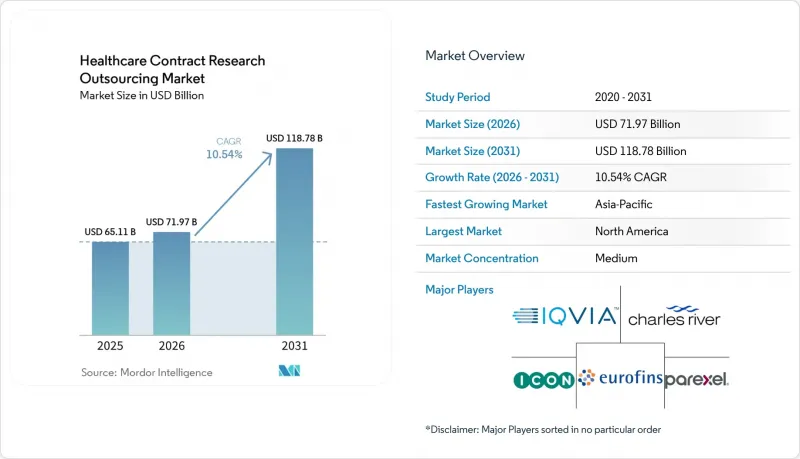
Mordor Intelligence에 의하면, 헬스케어 계약 연구 아웃소싱 시장 규모는 2025년 651억 1,000만 달러에서 2026년에는 719억 7,000만 달러로 확대되어 2031년까지 1,187억 8,000만 달러에 이를 것으로 예측되며, 2026년부터 2031년까지 CAGR 10.54%로 성장할 전망입니다.
헬스케어 계약 연구 아웃소싱 시장은 서비스 유형(임상시험 서비스(1-4상), 규제 관련 서비스, 임상 데이터 관리 등), 유형(신약 개발, 전임상 연구, 임상 연구), 최종 사용자(제약 회사, 생명공학 기업 등) 및 지역(북미, 유럽, 아시아태평양 등)으로 분류됩니다. 시장 규모 및 전망은 금액(달러) 기준으로 산출되었습니다.
전 세계 헬스케어 계약 연구 아웃소싱 시장 동향 및 인사이트
바이오의약품 분야의 연구개발 투자 증가와 파이프라인 확충
2025년 주요 규제 당국의 신약 승인 현황은 임상적 복잡성과 규제 당국의 철저한 심사로 인해 강력한 개발 파트너가 필요한 전문적인 적응증에 대해, 스폰서들이 계속해서 주력하고 있음을 뒷받침하고 있습니다. 연간 승인 건수에서 희귀질환 치료제로 지정된 요법의 비중이 증가하고 있는 것은 특정 환자 집단에 대한 집중적인 노력이 지속되고 있음을 나타내며, 이에 따라 피험자 1인당 데이터 수율을 극대화하는 프로토콜 설계의 필요성이 높아지면서, 생물통계학 및 임상시험 기관 운영에 대한 아웃소싱 수요가 가속화되고 있습니다. 종양학 및 기타 복잡한 분야에서 진행되는 지속적인 플랫폼형 임상시험의 경우, 단일 프로토콜에 기반한 개별 계약보다는 다군 프레임워크 전반에 걸쳐 거버넌스 체계와 적응형 분석을 구축할 수 있는 CRO 파트너가 유리합니다. 스폰서들은 하위 집단의 세분화, 엔드포인트에 대한 규제 당국의 기대치 충족, 그리고 신청 절차의 효율화를 도모하기 위해 사내에 구축된 통계 및 데이터 사이언스 역량에 대한 의존도를 높이고 있으며, 이로 인해 프로그램 차원의 아웃소싱 관계가 강화되고 있습니다. 주요 서비스 제공업체들이 실제 데이터와 기술 역량을 연구 솔루션에 통합함에 따라, 지원 범위는 초기 증거 개발 단계에서 후기 단계의 결과 연구에 이르기까지 확대되고 있으며, 자산 수명 주기 전반에 걸친 아웃소싱의 가치 제안이 강화되고 있습니다.
비용 압박과 시장 출시 속도가 외부 위탁을 촉진하고 있습니다.
예산 제약에 직면한 스폰서들은 데이터 확보에 소요되는 시간과 예측 가능한 자원 배분 간의 균형을 맞추려 하고 있으며, 그 결과 많은 스폰서들이 제공 품질에 대한 설명 책임을 유지하면서 스폰서 조직 내에 팀을 임베디드하는 기능형 서비스 제공업체 모델을 확대되고 있습니다. 대기업에서 백로그의 가시화와 단기적인 전환 동향을 살펴보면, 단계적인 약속과 유연한 계약이 포트폴리오 리스크를 관리하고 지출을 마일스톤 달성 상황에 맞추기 위한 표준적인 접근 방식이 되고 있음을 보여줍니다. AI를 활용한 계약 및 임상시험 개시 도구는 문서의 불일치를 조기에 감지하고 대조 과정을 단축함으로써, 첫 번째 피험자 등록을 지연시키는 경향이 있는 임상시험 개시 일정을 단축합니다. 사이트 인텔리전스 플랫폼은 현재 수십 개국에 걸쳐 있는 수십만 개의 기관과 수백만 개의 임상시험 기관을 색인화하고 있으며, 이를 통해 실현 가능성의 정확도가 향상되고, 후원사가 속도를 우선시할 때 피험자 등록 성과가 개선됩니다. 이러한 업무상의 이점으로 인해, 스폰서는 의사결정 과정을 단축하고 가장 유망한 프로그램에 투자를 집중할 수 있게 되었으며, 일정이 단축되고 데이터 포인트당 비용이 개선됨에 따라 헬스케어 계약 연구 아웃소싱 시장에 선순환이 형성되고 있습니다.
지역 간 규제 차이와 CTR/GCP의 강화
GCP 지침의 발전에 따라, 위험 기반의 품질 관리와 지속적인 품질 개선이 더욱 중요시되고 있습니다. 이에 따라 CRO 및 의뢰사는 SOP를 갱신하고, 팀원 재교육을 실시하며, 집중형 분석 및 위험 판단에 대한 명확한 추적 가능성을 반영한 모니터링 모델로 전환해야 합니다. 후원사는 적용된 근거 및 기준치를 포함하여 특정 위험이 왜, 어떻게 우선순위로 선정되었는지를 입증해야 하며, 이로 인해 프로토콜 팀과 공급업체 감독 그룹의 문서 작성 업무가 증가하게 됩니다. 각 기능 팀은 원격 모니터링, eConsent 및 센서에서 수집된 데이터가 항상 감사 대응이 가능한 상태를 유지할 수 있도록 데이터 흐름과 감사 추적을 재조정해야 합니다. 이로 인해 다자간 시험 실시 기간 중 이행 기간이 장기화될 가능성이 있습니다. 이에 대응하기 위해 많은 후원사는 CRO와의 협력을 강화하고, 규제 정보 관리 및 교육 프로그램을 CRO에 위탁함으로써 전 세계 임상시험을 일관된 품질 기준에 따라 유지하고 있습니다. 이러한 조정은 단기적으로는 부담이 되겠지만, 표준화된 분석, 문서화 및 RBQM(위험 기반 품질 관리) 플랫폼이 구축되면 장기적인 효율성으로 이어져, 다양한 임상시험 포트폴리오 전반에 걸쳐 규정 준수를 안정화시킬 수 있을 것입니다.
부문별 분석
2025년 현재, 임상시험 서비스(1-4상)는 헬스케어 계약 연구 아웃소싱 시장의 62.34%를 차지하고 있지만, 실시간 데이터 수집과 통합 분석이 표준 관행으로 자리 잡음에 따라, 임상 데이터 관리는 2031년까지 연평균 성장률(CAGR) 12.56%로 가장 빠르게 성장할 것으로 전망됩니다. 데이터 큐레이션, 편집 검토, 이상 감지에 특화된 기능 팀이 워크플로우의 초기 단계에 통합되어, 위험 기반의 품질 관리를 지원하는 동시에, 지속적으로 발전하는 GCP 지침에 따라 예측 가능한 데이터베이스 잠금 구현을 추진하고 있습니다. 사이트 인텔리전스 플랫폼을 보유한 제공업체는 원격의료, ePRO, 영상 진단 및 심혈관학 분야의 엔드포인트에서 실적이 입증된 인프라를 갖춘 시설을 대상으로 삼음으로써, 후원사가 선별 및 피험자 등록 과정을 개선할 수 있도록 지원하며, 이를 통해 선별 실패를 줄이고 마일스톤 달성을 가속화합니다. AI를 통한 지원이 실현 가능성 평가에서 메디컬 라이팅 및 데이터 정제 분야로 확대됨에 따라, 대규모 서비스 제공업체는 프로토콜에 대한 요구가 높아지더라도 안정적인 수익률을 유지할 수 있게 되며, 이를 통해 연구 수행 부문의 분석 역량에 대한 투자가 지속될 것입니다. 임상시험의 시작 단계 역시 주목받는 분야로, 계약 및 예산의 자동화를 통해 초기 환자 등록을 지연시켜 후원사에 비용 위험을 초래하는 경우가 많은 관리상의 지연을 줄일 수 있습니다.
스폰서가 분산형 구성 요소, 영상 진단, 전문 검사실에 걸친 데이터 흐름을 표준화함에 따라 임상 데이터 관리의 중요성이 커지고 있으며, 이에 따라 통합된 용어집, 재사용 가능한 편집 점검, 실시간 대시보드의 필요성이 높아지고 있습니다. 벤더들은 이러한 요구에 부응하기 위해 생체 인식 및 프로그래밍 허브를 확대되고 있습니다. 이러한 발전은 통계 프로그래밍 및 임상 데이터 운영을 다국적 임상시험의 수행 거점에 한층 더 가깝게 만드는 지역적 역량 강화 투자에서 확인할 수 있습니다. 리얼 월드 에비던스 및 후기 단계 업무가 임상 업무와 점점 더 가까워짐에 따라, 스폰서들은 관찰 코호트, 레지스트리, 안전성 추적 조사를 단일 거버넌스 체계 하에서 관리하는 통합 솔루션을 점점 더 많이 요구하고 있습니다. 그 결과, 1-4단계의 대규모 업무가 수요의 기반을 이루는 한편, RBQM, 분산형 요소, 엔드포인트의 복잡성 증가를 배경으로 데이터 중심 기능이 현저한 성장을 이루는 서비스 구성이 형성되고 있습니다.
지역별 분석
2025년, 북미는 헬스케어 계약 연구 아웃소싱 시장의 37.23%를 차지했습니다. 이는 광범위한 임상시험 책임의사 네트워크, 성숙한 임상시험 시설 인프라, 그리고 다수의 후원사 기반에 힘입은 결과입니다. 미국 내 공급업체의 강력한 입지는 풀서비스 및 FSP(기능별 서비스 제공) 모델에 대한 접근을 보장할 뿐만 아니라, 문서화 및 집중 모니터링과 관련된 최신 GCP(임상시험 수행 기준)의 요구 사항을 충족하는 첨단 데이터 플랫폼을 제공합니다. AI를 활용한 점검 기능 덕분에 임상시험 기관 및 벤더와의 계약 과정에서 발생하는 마찰이 줄어들어, 임상시험 개시 및 계약 최적화 역량이 이 지역 전체의 실행 속도를 더욱 높이고 있습니다. 주요 제약사들이 비만, 심혈관 대사 질환 및 실제 임상 데이터(RWE)에 관한 공동 연구를 연구 서비스에 통합함에 따라, 이 분야는 3상 임상시험은 물론 후기 단계 임상시험 및 결과 연구를 지원하는 대규모 인프라의 혜택을 누리고 있습니다. 이러한 특징 덕분에, 스폰서들이 전 세계적으로 임상시험의 진행 방식을 다각화하고 있는 상황에서도 북미는 헬스케어 계약 연구 아웃소싱 시장에서 핵심적인 역할을 유지하고 있습니다.
아시아태평양은 2031년까지 연평균 성장률(CAGR)이 15.83%를 나타낼 것으로 예측되는 가장 빠르게 성장하는 지역으로, 이는 임상 인프라의 급속한 확충과 초기 단계의 역량을 확대하기 위한 전략적 제휴를 반영한 것입니다. 대학의 의료 시스템과 전 세계 CRO의 역량을 결합하는 파트너십을 통해, 의뢰사는 첫 인체 임상시험이나 용량 설정 시험에 필수적인 대규모 환자 기반 및 통합된 임상 생태계에 효율적으로 접근할 수 있게 됩니다. 각 지역의 플랫폼 및 치료법 전문 기업들은 바이오의약품 및 복합 치료법 분야의 역량을 지속적으로 확대하고 있으며, 이에 따라 고품질의 분석 역량과 제조 통합을 바탕으로 아시아태평양 환자들에게 치료 기회를 제공하고자 하는 후원사들에게 아웃소싱 선택지가 늘어나고 있습니다. 해당 지역에서 신약 개발부터 제조에 이르는 통합 파이프라인이 성숙해짐에 따라, 의뢰사는 전임상 및 임상 공급망을 시험 일정에 맞추어 조정할 수 있게 되어 프로그램의 신속한 진행을 지원할 뿐만 아니라, 아시아태평양의 헬스케어 계약 연구 아웃소싱 시장을 강화하게 될 것입니다.
CRO를 통한 유럽 내 사업 확대로 인해 초기 단계 및 생체측정 분야에 대한 전문적인 접근성이 확대되고 있으며, 이를 통해 의뢰사는 유럽 전역의 규제 요건과 운영상의 요구 사항 간의 균형을 보다 쉽게 맞출 수 있게 되었습니다. FSP(풀서비스 제공업체) 기능을 갖춘 종양학 전문 제공업체는 정밀의료 분야에서 지역의 강점을 지속적으로 강화하고 있습니다. 이 분야에서는 복잡한 마스터 프로토콜이나 바이오마커 주도형 코호트 연구에 대해 강력한 거버넌스와 분석 능력이 요구되고 있습니다. 유럽의 사업 운영에서 집중형 모니터링 및 RBQM(위험 기반 품질 관리)에 기반한 감독 체제가 표준화됨에 따라, 검증된 프로세스와 교육 프로그램을 갖춘 공급업체는 선정 과정에서 우위를 점하며, 헬스케어 계약 연구 아웃소싱 시장에 대한 기여도를 높이고 있습니다.
기타 혜택:
- 엑셀 형식 시장 예측(ME) 시트
- 3개월간의 애널리스트 지원
자주 묻는 질문
목차
제1장 서론
제2장 조사 방법
제3장 주요 요약
제4장 시장 구도
제5장 시장 규모와 성장 예측
제6장 경쟁 구도
제7장 시장 기회와 향후 전망
JHS 26.06.23According to Mordor Intelligence, the healthcare contract research outsourcing market size is expected to increase from USD 65.11 billion in 2025 to USD 71.97 billion in 2026 and reach USD 118.78 billion by 2031, growing at a CAGR of 10.54% over 2026-2031.
The Healthcare Contract Research Outsourcing Market is Service Type (Clinical Trial Services (Phase I-IV), Regulatory Services, Clinical Data Management, and More), Type (Drug Discovery, Pre-Clinical Research, and Clinical Research), End User (Pharmaceutical Companies, Biotechnology Companies, and More), and Geography (North America, Europe, Asia-Pacific, and More). The Market and Forecasted in Terms of Value (USD).
Global Healthcare Contract Research Outsourcing Market Trends and Insights
Rising Biopharma R&D Investments and Pipeline Intensity
Novel drug approvals across leading regulators in 2025 confirm continued sponsor focus on specialized indications where clinical complexity and regulatory scrutiny require strong development partners. A higher share of orphan-designated therapies within the annual approval mix points to sustained emphasis on targeted patient populations, which raises the need for protocol designs that maximize data yield per subject and accelerate demand for outsourced biostatistics and site operations. Continuous platform-style studies in oncology and other complex areas favor CRO partners that can stand up governance structures and adaptive analytics across multi-arm frameworks rather than isolated single-protocol engagements. Sponsors increasingly rely on embedded statistical and data science capacity to segment subpopulations, align endpoints to regulatory expectations, and streamline submission pathways, which strengthens program-level outsourcing relationships. As larger providers integrate real-world data and technology capabilities into research solutions, they extend support from early evidence development to late-phase outcomes research, reinforcing the outsourcing value proposition across the asset lifecycle.
Cost Pressure and Speed-To-Market Imperatives Drive Externalization
Sponsors under budget constraints balance time-to-data with predictable resourcing, leading many to expand functional service provider models that embed teams within sponsor systems while preserving accountability for delivery quality. Backlog visibility and near-term conversion at large players indicate that staged commitments and flexible contracting are now a standard approach to manage portfolio risk and to match spend to milestone attainment.AI-enabled contracting and study start-up tools flag document misalignments early and reduce reconciliation cycles, shrinking activation timelines that often impede first patient. Site intelligence platforms now index hundreds of thousands of institutions and millions of study sites across dozens of countries, which strengthens feasibility accuracy and lifts enrollment performance when sponsors prioritize speed. These operational gains help sponsors compress decision gates and direct investment to the most promising programs, creating a reinforcing cycle for the healthcare contract research outsourcing market as timelines and cost per data point improve.
Regulatory Divergence and CTR/GCP Tightening Across Regions
Evolving GCP guidance places stronger emphasis on risk-based quality management and continuous quality improvement, which requires CROs and sponsors to upgrade SOPs, retrain teams, and adapt monitoring models to centralized analytics and clear traceability of risk decisions. Sponsors are expected to demonstrate why and how particular risks were prioritized, including the evidence and thresholds applied, which increases documentation workloads for protocol teams and vendor oversight groups. Functional teams must realign data flows and audit trails to ensure that remote monitoring, eConsent, and sensor-derived data remain inspection-ready, which can extend transition timelines during multi-country study execution. To address this, many sponsors strengthen embedded partnerships where CROs manage regulatory intelligence and training programs that keep global studies on a consistent quality baseline. These adjustments create near-term drag but support longer-term efficiency gains once standardized analytics, documentation, and RBQM platforms are in place, which steadies compliance across a diversified study portfolio.
Other drivers and restraints analyzed in the detailed report include:
- Increasing Clinical Trial Complexity
- Preference for Specialized Full-Service and FSP Models
- Data Security, IP Protection, and Vendor Governance Risks
For complete list of drivers and restraints, kindly check the Table Of Contents.
Segment Analysis
Clinical trial services (Phase I-IV) captured 62.34% of the healthcare contract research outsourcing market in 2025, while clinical data management is set to grow fastest at a 12.56% CAGR through 2031 as real-time capture and centralized analytics become standard practice. Functional teams focused on data curation, edit checks, and anomaly detection are embedded earlier in the workflow to support risk-based quality management and drive predictable database lock performance under evolving GCP guidance. Providers with site intelligence platforms help sponsors improve screening and enrollment by targeting institutions with proven infrastructure for telehealth, ePRO, imaging, and cardiology endpoints, which reduces screen failure and accelerates milestone attainment. As AI support extends from feasibility to medical writing and data cleaning, large providers maintain margin stability even as protocol demands rise, which sustains investment in analytics capabilities within research delivery units. Study start-up is another focal area, with contract and budget automation reducing administrative latency that often slows first patient in and creates cost risk for sponsors.
Clinical data management gains momentum as sponsors standardize data flows across decentralized components, imaging, and specialty labs, which increases the need for harmonized dictionaries, reusable edit checks, and real-time dashboards. Vendors expand biometrics and programming hubs to address these needs; this evolution is visible in regional capacity investments that bring statistical programming and clinical data operations closer to multinational study footprints. As real-world evidence and late-phase work move closer to clinical operations, sponsors increasingly look for integrated solutions that manage observational cohorts, registries, and safety follow-up under one governance umbrella. The cumulative effect is a service mix where high-volume Phase I-IV activity anchors demand, while data-centric functions command premium growth on the back of RBQM, decentralized elements, and expanding endpoint complexity.
Geography Analysis
North America accounted for 37.23% of the healthcare contract research outsourcing market in 2025, supported by extensive investigator networks, mature site infrastructure, and a large base of sponsors. Strong vendor presence in the United States ensures access to full-service and FSP models along with advanced data platforms that align to updated GCP expectations on documentation and centralized monitoring. Study start-up and contract optimization capabilities further enhance execution speed across this region, as AI-powered checks reduce friction in agreements with sites and vendors. As large providers integrate obesity, cardiometabolic, and real-world evidence collaborations into research offerings, the region benefits from scaled infrastructure that supports late-phase and outcomes studies alongside pivotal trials. These features sustain North America's anchor role in the healthcare contract research outsourcing market even as sponsors diversify trial footprints globally.
Asia-Pacific is the fastest-growing region with a projected 15.83% CAGR through 2031, reflecting the rapid buildout of clinical infrastructure and strategic collaborations that expand early-phase capacity. Partnerships that link university health systems with global CRO capabilities give sponsors efficient access to large patient bases and integrated clinical ecosystems, which are vital for first-in-human and dose-ranging studies. Regional platform and modality specialists continue to scale capabilities in biologics and complex modalities, which increases outsourcing options for sponsors seeking APAC patient access with high-quality analytics and manufacturing integration. As integrated discovery-to-manufacturing pipelines mature in the region, sponsors can align pre-clinical and clinical supply chains with study timelines, supporting faster program progression and reinforcing the healthcare contract research outsourcing market in APAC.
European expansions by CROs increase access to specialized early-phase and biometrics capabilities, which helps sponsors balance regulatory and operational needs across the continent. Oncology-focused providers with embedded FSP capacity continue to build on regional strengths in precision medicine, where complex master protocols and biomarker-driven cohorts demand strong governance and analytics. As centralized monitoring and RBQM-based oversight are standardized in European operations, vendors with validated processes and training programs gain selection advantages, strengthening contributions to the healthcare contract research outsourcing market.
- Allucent Inc.
- Caidya Inc.
- Charles River
- CMIC Holdings Co., Ltd.
- CTI Clinical Trial & Consulting Services, Inc.
- EPS Holdings, Inc.
- Eurofins
- Fortrea Holdings Inc.
- Hangzhou Tigermed Consulting Co., Ltd.
- ICON
- IQVIA
- Linical Co., Ltd.
- Medpace Holdings, Inc.
- Novotech
- Parexel International
- Pharmaron Beijing Co., Ltd.
- Premier Research International LLC
- PSI CRO
- SGS Life Sciences
- Syneos Health
- Thermo Fisher Scientific (PPD Clinical Research)
- Worldwide Clinical Trials, LLC
- WuXi AppTec Co., Ltd.
Additional Benefits:
- The market estimate (ME) sheet in Excel format
- 3 months of analyst support
TABLE OF CONTENTS
1 Introduction
- 1.1 Study Assumptions & Market Definition
- 1.2 Scope of the Study
2 Research Methodology
3 Executive Summary
4 Market Landscape
- 4.1 Market Overview
- 4.2 Market Drivers
- 4.2.1 Rising Biopharma R&D Investments and Pipeline Intensity
- 4.2.2 Cost Pressure and Speed-To-Market Imperatives Drive Externalization
- 4.2.3 Increasing Clinical Trial Complexity
- 4.2.4 Preference for Specialized Full-Service and FSP Models
- 4.2.5 Expansion of Platform/Master Protocols Elevates Program-Level CRO Demand
- 4.2.6 AI-Enabled Protocol, Site, and RBQM Optimization Expands Data/Tech-Led CRO Revenue
- 4.3 Market Restraints
- 4.3.1 Regulatory Divergence and CTR/GCP Tightening Across Regions
- 4.3.2 Data Security, IP Protection, and Vendor Governance Risks
- 4.3.3 Geopolitical/Biosecurity Scrutiny Reshapes China-Linked Vendor Risk
- 4.3.4 Site Workforce Shortages and Investigator Burnout Extend Timelines
- 4.4 Value / Supply-Chain Analysis
- 4.5 Regulatory Landscape
- 4.6 Technological Outlook
- 4.7 Porters Five Forces Analysis
- 4.7.1 Threat of New Entrants
- 4.7.2 Bargaining Power of Buyers
- 4.7.3 Bargaining Power of Suppliers
- 4.7.4 Threat of Substitutes
- 4.7.5 Competitive Rivalry
5 Market Size & Growth Forecasts (Value, USD)
- 5.1 By Service Type
- 5.1.1 Clinical Trial Services (Phase I-IV)
- 5.1.2 Regulatory Services
- 5.1.3 Clinical Data Management
- 5.1.4 Pharmacovigilance
- 5.1.5 Site Management & Monitoring
- 5.1.6 Central Lab & Bioanalytical Services
- 5.1.7 Real World Evidence & Late Phase
- 5.1.8 Others
- 5.2 By Type
- 5.2.1 Drug Discovery
- 5.2.2 Pre-clinical Research
- 5.2.3 Clinical Research
- 5.3 By End User
- 5.3.1 Pharmaceutical Companies
- 5.3.2 Biotechnology Companies
- 5.3.3 Medical Device Companies
- 5.3.4 Academic & Research Institutes
- 5.4 By Geography
- 5.4.1 North America
- 5.4.1.1 United States
- 5.4.1.2 Canada
- 5.4.1.3 Mexico
- 5.4.2 Europe
- 5.4.2.1 Germany
- 5.4.2.2 United Kingdom
- 5.4.2.3 France
- 5.4.2.4 Italy
- 5.4.2.5 Spain
- 5.4.2.6 Rest of Europe
- 5.4.3 Asia-Pacific
- 5.4.3.1 China
- 5.4.3.2 India
- 5.4.3.3 Japan
- 5.4.3.4 Australia
- 5.4.3.5 South Korea
- 5.4.3.6 Rest of Asia-Pacific
- 5.4.4 Middle East and Africa
- 5.4.4.1 GCC
- 5.4.4.2 South Africa
- 5.4.4.3 Rest of Middle East and Africa
- 5.4.5 South America
- 5.4.5.1 Brazil
- 5.4.5.2 Argentina
- 5.4.5.3 Rest of South America
- 5.4.1 North America
6 Competitive Landscape
- 6.1 Market Concentration
- 6.2 Market Share Analysis
- 6.3 Company Profiles (includes Global level Overview, Market level overview, Core Segments, Financials as available, Strategic Information, Market Rank/Share for key companies, Products & Services, and Recent Developments)
- 6.3.1 Allucent Inc.
- 6.3.2 Caidya Inc.
- 6.3.3 Charles River Laboratories International, Inc.
- 6.3.4 CMIC Holdings Co., Ltd.
- 6.3.5 CTI Clinical Trial & Consulting Services, Inc.
- 6.3.6 EPS Holdings, Inc.
- 6.3.7 Eurofins Scientific
- 6.3.8 Fortrea Holdings Inc.
- 6.3.9 Hangzhou Tigermed Consulting Co., Ltd.
- 6.3.10 ICON plc
- 6.3.11 IQVIA Holdings Inc.
- 6.3.12 Linical Co., Ltd.
- 6.3.13 Medpace Holdings, Inc.
- 6.3.14 Novotech
- 6.3.15 Parexel International Corporation
- 6.3.16 Pharmaron Beijing Co., Ltd.
- 6.3.17 Premier Research International LLC
- 6.3.18 PSI CRO AG
- 6.3.19 SGS Life Sciences
- 6.3.20 Syneos Health, Inc.
- 6.3.21 Thermo Fisher Scientific (PPD Clinical Research)
- 6.3.22 Worldwide Clinical Trials, LLC
- 6.3.23 WuXi AppTec Co., Ltd.
7 Market Opportunities & Future Outlook
- 7.1 White-space & Unmet-need Assessment