

|
시장보고서
상품코드
2063556
이중 에너지 X선 흡수 측정법(DXA) : 시장 점유율 분석, 업계 동향 및 통계, 성장 예측(2026-2031년)Dual-energy X-ray Absorptiometry (DEXA) - Market Share Analysis, Industry Trends & Statistics, Growth Forecasts (2026 - 2031) |
||||||
 Mordor Intelligence
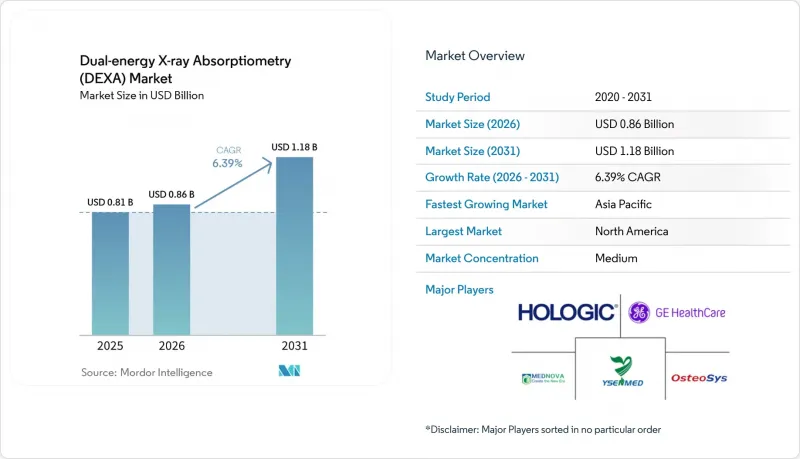
Mordor Intelligence에 의하면, 이중 에너지 X선 흡수 측정법(DXA) 시장 규모는 2025년 8억 1,000만 달러로 평가되었습니다. 2026년 8억 6,000만 달러에서 2031년까지 11억 8,000만 달러로 확대되어 2026년부터 2031년까지 연평균 복합 성장률(CAGR)은 6.39%를 나타낼 것으로 예측됩니다.
본 보고서는 제품 유형(중앙/축방향 DEXA 등), 기술(팬 빔, 펜슬 빔), 용도(골다공증 진단 등), 최종 사용자(병원, 진단·영상진단센터, 전문 클리닉), 지역(북미, 유럽, 아시아태평양, 중동 및 아프리카, 남미)별로 분류되어 있습니다. 시장 전망은 금액(달러) 기준으로 제시되어 있습니다.
세계의 이중 에너지 X선 흡수 측정법(DXA) 시장 동향 및 인사이트
고령화와 취약성 골절로 인한 부담 증가
65세 이상 고령 인구는 2024년에 7억 6,100만 명에 달했고, 2030년까지 9억 9,400만 명에 육박할 것으로 전망되고 있으며, 동아시아와 남유럽에서 고령화가 가장 빠르게 진행되고 있습니다. 일본에서는 이미 연간 18만 건의 고관절 골절이 기록되고 있으며, 이로 인한 직접 의료비만 1조 2,000억 엔(81억 달러)에 달할 전망입니다. 한국에서는 2020년부터 2024년 사이에 70세 이상 여성의 골절 발생률이 14% 증가했습니다. 세계보건기구(WHO)는 고소득 국가에서 60세 이상 여성의 경우, 취약성 골절이 장애 조정 생명년(DALY) 손실의 가장 큰 원인이라고 지적하고 있습니다. 이러한 인구 동향의 흐름은 이중 에너지 X선 흡수 측정법(DXA)을 이용한 기준선 및 추적 검사에 대한 시장 수요의 지속적인 기반을 공고히 하고 있습니다.
지침에 따른 선별 검사와 보험 적용 확대로 인해 검사 대상 인구가 확대되었습니다.
2025년 USPSTF(미국 예방의학 작업반)의 개정안에 따라, FRAX 점수가 높은 50-64세 미국 여성 1,200만 명이 선별 검사 대상에 추가되었습니다. CMS(미국 의료보험센터)는 2025년 1회당 스캔에 대한 전국적인 지급액을 127.42달러로 동결하여 수익의 안정성을 확보했습니다. 중국 국가위생건강위원회는 2025년부터 65세 이상의 도시 지역 여성을 대상으로 하는 ‘기본 공중보건 서비스’에 골밀도 검진을 포함시켜, 2028년까지 4,000만 명의 수혜자를 확보하는 것을 목표로 하고 있습니다. 호주 역시 2024년에 과거에 골절 이력이 있는 고령 남성을 수급 대상에 포함시켰습니다. 이러한 정책 덕분에 DEXA 검사는 선택적 검사에서 프로토콜에 기반한 검사로 전환되었으며, 검사 건수 증가를 확고히 하고 있습니다.
상환액의 편차와 진료소에서의 시행률 저하가 이용을 억제
2025년 메디케어 요금표에 따르면, 의료기관 외 지출이 3.2% 감소했으며, 진료소의 총이익률은 2020년 대비 11% 하락했습니다. 민간 보험사들의 대응은 제각각입니다. Cigna는 메디케어 네트워크 내에서는 110%를 지급하지만, 네트워크 외에서는 85%만 지급하기 때문에 지역별 이용 가능성에 편중 현상이 발생하고 있습니다. 블루크로스 NC는 2024년에 사전 승인 요건을 강화하여 6개월 동안 지역 내 검사 건수를 7% 줄였습니다. 병원 시설 이용료의 인상으로 인해, 고액 본인부담형 보험 플랜 가입자의 비용 부담이 환자에게 전가되면서 선택적 검사가 억제되고 있습니다. 처리 능력이 제한적인 지방 시설에서는 8만-15만 달러 규모의 설비에 대한 투자 회수에 어려움을 겪고 있어, 설비 교체 속도가 둔화되고 있습니다.
부문별 분석
중앙 플랫폼은 2025년 매출의 61.30%를 차지했으며, 고관절 및 척추 분야의 진단 기준으로서 확고한 위치를 유지함에 따라 2031년까지 연평균 성장률(CAGR) 7.95%를 나타낼 전망입니다. 이 부문은 이중 에너지 X선 흡수 측정법(DXA) 시장 규모를 지탱하는 기반이 되고 있습니다. 그 이유는 보험사가 중앙 장치를 통한 스캔에 대해 127.42달러를 보상하고 있는데, 이는 주변 장치의 약 3배에 달하는 금액일 뿐만 아니라, AI를 활용한 척추체 골절 평가 및 TBS 분석이 중앙 장치의 하드웨어에서만 이용 가능하기 때문입니다. 라이프사이클 서비스, 소프트웨어 구독, 팬텀, 서비스 계약은 매출의 4분의 1을 추가로 차지하며, 총투자수익률(ROI)을 높이고 있습니다.
주변 기기는 지방에서의 선별 검사 및 산업 보건 분야에서 틈새 시장을 차지하고 있습니다. 2만 5,000달러 미만의 장비는 소규모 진료소에서 인기가 높지만, 메디케어의 CPT 77081에 따른 37.26달러의 지급액은 수익성을 제한하고 있습니다. 치료 방침을 결정할 때, 임상 지침에서는 여전히 중앙 장비를 통한 영상 진단 확인이 권장되고 있으며, 트리아지 프로그램 이외의 분야에서 주변 기기의 보급은 제한적입니다. 종합적인 평가 및 체성분 분석에 대한 보험 급여가 우대되므로, 이중 에너지 X선 흡수 측정법(DEXA) 시장 점유율 대부분은 중앙 시스템이 차지하게 될 것입니다.
팬빔 시스템은 2025년 매출의 65.98%를 차지했으며, 2031년까지 연평균 성장률(CAGR) 8.16%를 기록하며 듀얼 에너지 X선 흡수 측정법(DXA) 시장 전체를 상회하는 성장이 예상됩니다. 2분 미만의 스캔 시간은 환자 처리 능력을 향상시키고 움직임으로 인한 아티팩트를 줄여주기 때문에 소아 및 비만 환자 집단에게 매우 중요합니다. 현재 협각 팬 빔은 전신 검사 1회당 고작 0.4μSv의 방사선 피폭량을 기록하고 있으며, 이는 규제 기준치를 크게 밑돌고 있습니다.
설비 투자 예산이 제한적인 지역에서는 여전히 펜슬 빔 기술이 채택되고 있습니다. 라틴아메리카와 동남아시아에서는 5만 달러 미만의 시스템이 여전히 일반적이지만, 그 큰 화소 크기는 척추 형태 측정 및 VFA 분석에 걸림돌이 되고 있습니다. 국제임상골밀도학회(ISCD)는 펜슬 빔과 팬 빔 데이터 간에 호환성이 없습니다고 경고하고 있으며, 이에 따라 통합 네트워크는 팬 빔 플랫폼으로의 장비 표준화를 추진하고 있습니다.
지역별 분석
2025년 매출액 중 북미가 42.17%를 차지했습니다. 2025년 USPSTF(미국 예방 서비스 태스크포스)의 확대와 CMS(미국 의료보험 서비스 센터)의 안정적인 보상률 덕분에 검사 건수는 유지되고 있지만, 진료소에서의 보상액은 전년 대비 3.2% 감소하여 의료 제공업체들이 병원 외래 진료부로 이동하고 있습니다. 캐나다에서는 주 전체에서 고령자에게 보상이 지급되고 있지만, 이용률은 지침의 목표치에 미치지 못하고 있으며, 멕시코에서는 대도시권 이외의 지역에서 보험 적용 범위가 여전히 제한적입니다.
아시아태평양은 2031년까지 8.44%의 성장률을 보일 것으로 예측되며, 지역별로는 가장 높은 연평균 성장률(CAGR)을 보일 전망입니다. 중국의 2025년 공중보건 정책에 따라, 2028년까지 약 3,000대의 중앙 장비가 추가로 도입될 예정입니다. 일본은 연간 1조 2,000억 엔에 달하는 골절 관련 비용을 절감하기 위해, 도도부현이 실시하는 선별 검사에 보조금을 지급하고 있습니다. 인도에서는 충족되지 않은 수요가 막대하고 보급률이 낮기 때문에 장비 단가가 4만 달러 미만으로 떨어지면 성장 여지가 있습니다. 유럽에서는 성숙도가 제각각입니다. 영국에서는 62%의 트러스트(의료법인)에서 골절 연계 서비스를 운영하고 있지만, 65세 이상 여성 1,000명당 28명만이 선별 검사를 받고 있습니다. 독일의 2025년 지침 개정에 따라, 해당 여성 인구가 250만 명 증가할 가능성이 있습니다. 프랑스는 현재 TBS 비용을 상환하고 있으며, 이는 조기 도입국으로서의 조치입니다. 예산 제약으로 인해 이탈리아와 스페인의 판매는 주춤하고 있지만, GCC 국가들에서는 고령 여성을 대상으로 한 검진이 의무화되어 있어, 이로 인해 판매량이 증가하고 있습니다.
기타 혜택 :
- 엑셀 형식 시장 예측(ME) 시트
- 3개월간의 애널리스트 지원
자주 묻는 질문
목차
제1장 서론
제2장 조사 방법
제3장 주요 요약
제4장 시장 구도
제5장 시장 규모 및 성장 예측
제6장 경쟁 구도
제7장 시장 기회 및 향후 전망
KTH 26.06.26According to Mordor Intelligence, the dual-energy x-ray absorptiometry market size is projected to expand from USD 0.81 billion in 2025 and USD 0.86 billion in 2026 to USD 1.18 billion by 2031, registering a CAGR of 6.39% between 2026 to 2031.
This report is Segmented by Product Type (Central/Axial DEXA, and More), Technology (Fan-Beam, Pencil-Beam), Application (Osteoporosis Diagnosis, and More), End User (Hospitals, Diagnostic/Imaging Centers, Specialty Clinics), and Geography (North America, Europe, Asia-Pacific, Middle East & Africa, South America). The Market Forecasts are Provided in Terms of Value (USD).
Global Dual-energy X-ray Absorptiometry (DEXA) Market Trends and Insights
Aging Population and Rising Fragility-Fracture Burden
People aged 65+ climbed to 761 million in 2024 and will approach 994 million by 2030, with East Asia and Southern Europe aging the fastest . Japan already records 180,000 hip fractures a year, costing JPY 1.2 trillion (USD 8.1 billion) in direct care. South Korea saw a 14% fracture rise in fractures among women 70+ between 2020 and 2024. The WHO lists fragility fractures as the top cause of disability-adjusted life-years lost for women over 60 in high-income countries. This demographic wave ensures a persistent baseline for baseline and follow-up Dual-energy X-ray Absorptiometry market demand.
Guideline-Backed Screening and Payer Coverage Expand Testable Populations
The 2025 USPSTF update added 12 million U.S. women aged 50-64 with elevated FRAX scores to screening eligibility . CMS kept national payment at USD 127.42 per central scan in 2025, protecting revenue stability. China's National Health Commission bundled bone-density screening into its Essential Public Health Services for urban women 65+ in 2025, targeting 40 million beneficiaries by 2028. Australia similarly extended rebates to older men with prior fractures in 2024. These policies shift DEXA from optional to protocol-driven imaging, anchoring volume growth.
Reimbursement Variability and Declining In-Office Rates Depress Utilization
The 2025 Medicare schedule cut non-facility payment 3.2%, dragging aggregate office margins 11% below 2020 levels. Private payers diverge: Cigna pays 110% of Medicare in-network but only 85% out-of-network, skewing geographic access. Blue Cross NC tightened prior authorization in 2024, slicing local scan volume 7% in six months. Higher hospital facility fees shift the cost burden to patients on high-deductible plans, curbing elective tests. Rural centers with limited throughput struggle to recover capital on USD 80,000-150,000 units, slowing fleet renewal.
Other drivers and restraints analyzed in the detailed report include:
- DEXA As Clinical Gold Standard With Add-On TBS And AI Analytics
- GLP-1 Weight-Loss Programs Spur DXA Body-Composition Monitoring
- Persistent Post-Fracture Care Gap and Low Screening Adherence
For complete list of drivers and restraints, kindly check the Table Of Contents.
Segment Analysis
Central platforms generated 61.30% of 2025 revenue and are poised for a 7.95% CAGR through 2031, underpinned by hip and spine metrics that remain the diagnostic gold standard. This segment undergirds the Dual-energy X-ray Absorptiometry market size because payers reimburse central scans at USD 127.42, roughly triple peripheral rates, and because AI-driven vertebral-fracture assessment and TBS analytics are available only on central hardware. Lifecycle services, software subscriptions, phantoms, and service contracts, contribute another quarter of revenue, raising total return on investment.
Peripheral devices occupy value niches in rural screening and occupational health. Units priced under USD 25,000 attract small clinics, but Medicare's USD 37.26 payment under CPT 77081 constrains profitability. Clinical guidelines continue to advise confirmatory central imaging for treatment decisions, limiting peripheral uptake beyond triage programs. As reimbursement favors comprehensive assessment and body-composition analytics, central systems will retain the bulk of the Dual-energy X-ray Absorptiometry market share.
Fan-beam systems held 65.98% of 2025 revenue and are expected to outpace the overall Dual-energy X-ray Absorptiometry market at an 8.16% CAGR to 2031. Scan times under two minutes boost patient throughput and cut motion artifacts, critical for pediatric and bariatric cohorts. Narrow-angle fan beams now deliver radiation doses of just 0.4 μSv per whole-body exam, well below regulatory thresholds.
Pencil-beam technology persists where capital budgets are tight. Systems costing below USD 50,000 remain common in Latin America and Southeast Asia, yet their larger pixel size hampers vertebral morphometry and VFA analytics. The International Society for Clinical Densitometry cautions that pencil-beam and fan-beam data are not interchangeable, driving integrated networks toward fleet standardization on fan-beam platforms.
Geography Analysis
North America accounted for 42.17% of 2025 revenue. The 2025 USPSTF expansion and steady CMS rates maintain scan volume, yet office reimbursements dropped 3.2% year on year, pushing providers to hospital outpatient departments. Canada reimburses seniors province-wide, but utilization lags guideline targets, and Mexico's coverage outside metros remains sparse.
Asia-Pacific is forecast to grow 8.44% through 2031, the fastest regional CAGR. China's 2025 public-health mandate will install roughly 3,000 additional central units by 2028. Japan subsidizes prefectural screening to contain JPY 1.2 trillion annual fracture costs. India's vast unmet need and low penetration represent upside once unit pricing falls below USD 40,000. Europe shows mixed maturity. The U.K. operates fracture liaison services in 62% of trusts, yet still scans only 28 women per 1,000 over 65 years old. Germany's 2025 guideline update could add 2.5 million eligible women. France now reimburses TBS, an early adopter move. Budget limits restrain Italy and Spain, while GCC states mandate screening for older women, bolstering unit sales.
- DMS Imaging
- FUJIFILM
- GE Healthcare
- Guangzhou Yueshen
- Mednova
- Hologic
- MEDIKORS Co., Ltd.
- Medilink (France)
- Medonica Co., Ltd.
- Osteometer Meditech A/S
- OsteoSys Co., Ltd.
- Pinyuan Medical (Jiangsu) Co., Ltd.
- Shenzhen XRAY Electric Co., Ltd.
- Swissray International (Norland)
- XinGaoyi Medical Equipment Co., Ltd.
Additional Benefits:
- The market estimate (ME) sheet in Excel format
- 3 months of analyst support
TABLE OF CONTENTS
1 Introduction
- 1.1 Study Assumptions & Market Definition
- 1.2 Scope of the Study
2 Research Methodology
3 Executive Summary
4 Market Landscape
- 4.1 Market Overview
- 4.2 Market Drivers
- 4.2.1 Aging Population and Rising Fragility-Fracture Burden
- 4.2.2 Guideline-Backed Screening and Payer Coverage Expand Testable Populations
- 4.2.3 DEXA as The Clinical Gold Standard with Add-On TBS And AI Analytics
- 4.2.4 GLP-1 Weight-Loss Programs Spur DXA Body-Composition Monitoring
- 4.2.5 Opportunistic CT Case-Finding Channels Referrals to Confirmatory DEXA
- 4.3 Market Restraints
- 4.3.1 Reimbursement Variability and Declining In-Office Rates Depress Utilization
- 4.3.2 Persistent Post-Fracture Care Gap and Low Screening Adherence
- 4.3.3 Substitution Risk from Opportunistic CT/QCT And QUS In Select Settings
- 4.3.4 Cross-Vendor Standardization Issues and Capital/Space Constraints
- 4.4 Supply Chain Analysis
- 4.5 Regulatory Landscape
- 4.6 Technological Outlook
- 4.7 Porter's Five Forces Analysis
- 4.7.1 Threat of New Entrants
- 4.7.2 Bargaining Power of Suppliers
- 4.7.3 Bargaining Power of Buyers
- 4.7.4 Threat of Substitutes
- 4.7.5 Competitive Rivalry
5 Market Size & Growth Forecasts (Value, USD)
- 5.1 By Product Type
- 5.1.1 Central/Axial DEXA
- 5.1.2 Peripheral DEXA
- 5.2 By Technology
- 5.2.1 Fan-beam
- 5.2.2 Pencil-beam
- 5.3 By Application
- 5.3.1 Osteoporosis diagnosis
- 5.3.2 Body composition analysis
- 5.3.3 Vertebral fracture assessment (VFA)
- 5.4 By End User
- 5.4.1 Hospitals
- 5.4.2 Diagnostic/Imaging Centers
- 5.4.3 Specialty Clinics (Orthopedics/Endocrinology/Rheumatology)
- 5.5 By Geography
- 5.5.1 North America
- 5.5.1.1 United States
- 5.5.1.2 Canada
- 5.5.1.3 Mexico
- 5.5.2 Europe
- 5.5.2.1 Germany
- 5.5.2.2 United Kingdom
- 5.5.2.3 France
- 5.5.2.4 Italy
- 5.5.2.5 Spain
- 5.5.2.6 Rest of Europe
- 5.5.3 Asia-Pacific
- 5.5.3.1 China
- 5.5.3.2 India
- 5.5.3.3 Japan
- 5.5.3.4 South Korea
- 5.5.3.5 Australia
- 5.5.3.6 Rest of Asia-Pacific
- 5.5.4 Middle East and Africa
- 5.5.4.1 GCC
- 5.5.4.2 South Africa
- 5.5.4.3 Rest of Middle East and Africa
- 5.5.5 South America
- 5.5.5.1 Brazil
- 5.5.5.2 Argentina
- 5.5.5.3 Rest of South America
- 5.5.1 North America
6 Competitive Landscape
- 6.1 Market Concentration
- 6.2 Market Share Analysis
- 6.3 Company Profiles
- 6.3.1 DMS Imaging
- 6.3.2 Fujifilm Healthcare
- 6.3.3 GE HealthCare
- 6.3.4 Guangzhou Yueshen
- 6.3.5 Mednova
- 6.3.6 Hologic, Inc.
- 6.3.7 MEDIKORS Co., Ltd.
- 6.3.8 Medilink (France)
- 6.3.9 Medonica Co., Ltd.
- 6.3.10 Osteometer Meditech A/S
- 6.3.11 OsteoSys Co., Ltd.
- 6.3.12 Pinyuan Medical (Jiangsu) Co., Ltd.
- 6.3.13 Shenzhen XRAY Electric Co., Ltd.
- 6.3.14 Swissray International (Norland)
- 6.3.15 XinGaoyi Medical Equipment Co., Ltd.
7 Market Opportunities & Future Outlook
- 7.1 White-space & unmet-need assessment


