
|
시장보고서
상품코드
2063561
체외 전사 템플릿 : 시장 점유율 분석, 업계 동향 및 통계, 성장 예측(2026-2031년)In-vitro Transcription Templates - Market Share Analysis, Industry Trends & Statistics, Growth Forecasts (2026 - 2031) |
||||||
 Mordor Intelligence
Mordor Intelligence에 의하면, 체외 전사 템플릿 시장 규모는 2025년 5억 4,000만 달러로 평가되었습니다. 2026년에는 6억 5,000만 달러로 확대되어 2026년부터 2031년에 걸쳐 CAGR 19.80%로 성장을 지속하여, 2031년까지 16억 달러에 이를 것으로 예측됩니다.
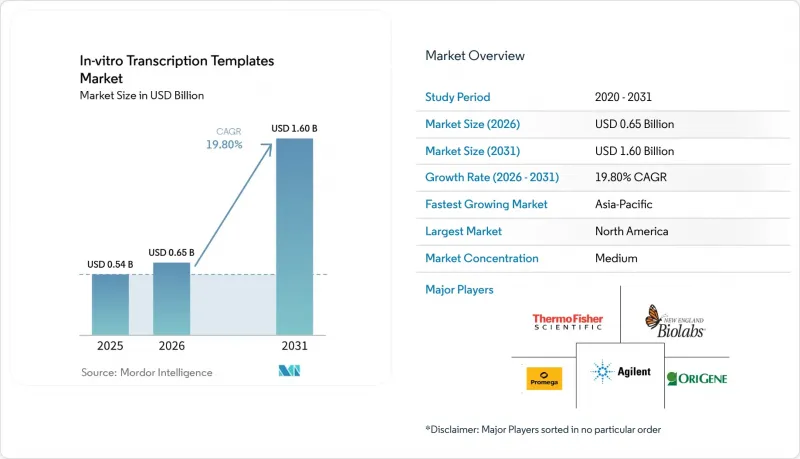
본 보고서는 템플릿 유형(선형화 플라스미드 DNA, 합성 유전자 단편, PCR 증폭 산물, 올리고뉴클레오티드, 기타), 용도(mRNA 치료제·백신 등), 최종 사용자(바이오의약품 기업, CRO·CMO, 학술 기관, 임상 실험실), 지역(북미, 유럽, 아시아태평양, 중동 및 아프리카, 남미)별로 분류되어 있습니다. 시장 전망치는 금액(달러)으로 표시되어 있습니다.
세계의 체외 전사 템플릿 시장 동향 및 인사이트
mRNA 백신 생산이 급속히 확대되고 있습니다.
팬데믹 기간 동안 수요가 안정화되는 가운데, 계절성 독감 대책 및 종양학 분야의 파이프라인에 힘입어 체외 전사 템플릿 시장은 성장을 이어가고 있습니다. 2024년, 모더나(Moderna)는 매사추세츠주 노우드에 위치한 시설을 20만 제곱피트 확장하여 다양한 mRNA 제품의 생산 능력을 강화했습니다. 2024년 6월, FDA는 후원사에게 1회 투여량당 잔류 숙주 세포 DNA 수준을 10 ng 미만으로 유지할 것을 요구하는 새로운 기준을 도입했습니다. 템플릿 공급업체는 로트 출하에 차세대 염기서열 분석 기술을 도입하고 있으며, 이로 인해 단위당 비용은 증가하지만, 후공정 전사 수율은 최대 25% 향상됩니다. 2025년에는 신속 대응형 백신 플랫폼을 위한 합성 DNA 템플릿 개발 가속화 노력에 힘입어 고순도 템플릿에 대한 수요가 더욱 증가했습니다.
CRISPR 가이드 RNA 합성 서비스의 도입이 확대되고 있습니다.
임상 프로그램이 ex vivo 편집에서 in vivo 투여로 전환됨에 따라, 환자 1인당 필요한 가이드 RNA의 양이 증가할 뿐만 아니라, 템플릿의 품질에 대한 기준도 높아지고 있습니다. 2025년까지 cGMP 기준을 준수하는 가이드 RNA 배치가 대량으로 생산되어, 여러 임상시험용 의약품 신청을 뒷받침하게 되었습니다. 고급 클라우드 설계 엔진은 오프타겟 예측과 IVT 템플릿 최적화를 통합하여, 전사 효율을 40% 저하시킬 가능성이 있는 T7 프로모터 내의 이차 구조를 식별할 수 있게 되었습니다. FDA는 2024년에 유전자 치료에 대한 규제 체계를 개편했으나, 유럽의약품청(EMA)은 순도 기준을 완전히 일치시키지 않았기 때문에 전 세계의 후원사들은 이중 규제 기준을 준수해야 합니다.
T7 폴리메라제 수율의 로트 간 변동
야생형 T7 중합효소의 로트 간에는 활성에 20%에서 40%의 변동이 관찰되며, 그 결과 번역 효율을 저하시키는 이중가닥 RNA(dsRNA) 불순물이 생성됩니다. 2024년 연구에 따르면, G47A+884G 돌연변이 효소가 dsRNA 형성을 85% 감소시킨다는 사실이 입증되었습니다. 그러나 발효를 통한 생산량은 야생형에 비해 30% 낮기 때문에 생산 규모 확대는 여전히 과제로 남아 있습니다. 활성도가 낮은 로트가 발생할 위험을 줄이기 위해, 후원사는 종종 과잉 효소를 조달하고 있으며, 이로 인해 원가가 10%에서 15% 증가하고 있습니다. 또한, 실시간 활성 분석법의 도입으로 인해 납기가 2-3주 연장되어, 체외 전사 템플릿 시장에서 일정 지연이 발생할 가능성이 있습니다.
부문별 분석
2025년, 직선화 플라스미드 DNA 템플릿은 체외 전사 템플릿 시장의 47.8%를 차지했습니다. 이는 오랜 기간에 걸친 규제 당국의 승인 및 확립된 mRNA 워크플로우와의 호환성을 반영한 것입니다. 그러나 합성 유전자 단편 시장은 20.45%라는 높은 연평균 성장률(CAGR)을 기록하며 크게 성장할 것으로 전망됩니다. 2025년에 주목할 만한 발전으로는 ENFINIA IVT-Ready DNA의 상용화가 꼽힙니다. 이를 통해 7일 이내에 납품이 가능해지며, 기존 플라스미드 클로닝에 소요되던 4-6주라는 기간을 대폭 단축합니다. 검증을 거친 단편은 발효 공정을 생략하고, 내독소 제거의 필요성을 없애며, 숙주 세포 DNA에 의한 오염 위험을 줄임으로써 공정을 효율화합니다.
지역별 분석
2025년, 북미는 39.61%의 시장 점유율을 차지했습니다. 이는 전 세계 순도 기준을 정하는 FDA의 지침과, 확고한 입지를 다진 업계 주요 기업들의 강력한 존재감에 힘입은 결과입니다. 그러나 아시아태평양은 상당한 성장이 예상되며, 2031년까지의 체외 전사 템플릿 시장에서 연평균 성장률(CAGR) 21.34%를 나타낼 것으로 전망됩니다. 해당 지역의 주요 투자 사례로는 첨단 세포 및 유전자 치료 및 mRNA 시설을 갖춘 대규모 바이오 캠퍼스가 있습니다. 2026년까지 전 세계 생산 능력의 대부분을 자동화하겠다는 계획은 해당 지역의 경쟁 우위를 한층 더 강화하고 있습니다. 유럽에서는 규제 지침에 따른 유해 폐기물 처리 비용으로 인해 성장이 저해되고 있으며, 비용이 높음에도 불구하고 폐쇄형 바이오리액터의 도입이 진행되고 있습니다.
신흥 지역 시장 점유율은 여전히 10% 미만입니다. 인도는 2026년에 대규모 바이오의약품 CDMO 시설 건설을 발표하며 밸류체인에서 한 걸음 더 나아가고 있으며, 이 분야에서의 경쟁 의지를 보여주고 있습니다. 기업들이 북미 및 유럽의 규제 확실성과 아시아태평양의 비용 효율성 사이에서 균형을 모색함에 따라, 듀얼 소싱 전략이 점점 더 보편화되고 있습니다.
기타 혜택 :
- 엑셀 형식 시장 예측(ME) 시트
- 3개월간의 애널리스트 지원
자주 묻는 질문
목차
제1장 서론
제2장 조사 방법
제3장 주요 요약
제4장 시장 구도
제5장 시장 규모 및 성장 예측
제6장 경쟁 구도
제7장 시장 기회 및 향후 전망
KTH 26.06.26According to Mordor Intelligence, the in-vitro transcription templates market size is expected to grow from USD 0.54 billion in 2025 to USD 0.65 billion in 2026 and is forecast to reach USD 1.60 billion by 2031 at 19.80% CAGR over 2026-2031.
This report is Segmented by Template Type (Linearised Plasmid DNA, Synthetic Gene Fragments, PCR Amplicons, Oligonucleotides, Others), Application (mRNA Therapeutics & Vaccines, and More), End User (Biopharma, Cros & CMOs, Academic Institutes, Clinical Labs), and Geography (North America, Europe, Asia-Pacific, MEA, South America). Market Forecasts are in Value (USD).
Global In-vitro Transcription Templates Market Trends and Insights
mRNA Vaccine Manufacturing Expands Rapidly
As pandemic-era demand stabilizes, the In-vitro Transcription Templates market continues to grow, driven by seasonal influenza initiatives and oncology pipelines. In 2024, Moderna expanded its Norwood, Massachusetts, facility by 200,000 square feet to enhance its multi-product mRNA production capacity. In June 2024, the FDA introduced a new benchmark requiring sponsors to maintain residual host-cell DNA levels below 10 ng per dose. Template suppliers are adopting next-generation sequencing for lot release, which, while increasing per-unit costs, improves downstream transcription yields by up to 25%. In 2025, efforts to accelerate synthetic DNA template development for rapid-response vaccine platforms further reinforced the demand for high-purity templates.
CRISPR Guide-RNA Synthesis Services See Rising Adoption
As clinical programs transition from ex vivo edits to in vivo delivery, the demand for guide-RNA volumes per patient is increasing, along with higher standards for template quality. By 2025, significant production of cGMP guide-RNA batches supported multiple investigational new-drug applications. Advanced cloud design engines now integrate off-target prediction with IVT template optimization, identifying secondary structures in the T7 promoter that can reduce transcription efficiency by 40%. While the FDA modernized its gene-therapy framework in 2024, the European Medicines Agency has yet to align its purity specifications fully, requiring global sponsors to comply with dual regulatory standards.
Batch-to-Batch Variability in T7 Polymerase Yields
Wild-type T7 polymerase lots experience activity variations of 20% to 40%, resulting in the generation of double-stranded RNA contaminants that reduce translation efficiency. A 2024 study demonstrated that a G47A+884G mutant enzyme decreased dsRNA formation by 85%. However, scaling up production remains a challenge, as fermentation titers are 30% lower compared to the wild type. To mitigate the risk of low-activity lots, sponsors often procure excess enzyme, increasing the cost of goods by 10% to 15%. Additionally, implementing real-time activity assays extends delivery timelines by 2 to 3 weeks, exposing the In-vitro Transcription Templates market to potential scheduling delays.
Other drivers and restraints analyzed in the detailed report include:
- Surge in Investments for Cell & Gene Therapy CDMOs
- Synthetic Biology Foundries Revolutionize IVT Workflows
- Limited Availability of GMP-Compliant Nucleotide Raw Materials
For complete list of drivers and restraints, kindly check the Table Of Contents.
Segment Analysis
In 2025, linearised plasmid DNA templates accounted for 47.8% of the In-vitro Transcription Templates market, reflecting their longstanding regulatory acceptance and compatibility with established mRNA workflows. However, the market for synthetic gene fragments is projected to grow significantly, with a strong 20.45% CAGR. A notable development in 2025 was the commercialization of ENFINIA IVT-Ready DNA, which offers delivery in under seven days, significantly faster than the traditional 4-6 week plasmid cloning timeline. Sequence-verified fragments streamline processes by bypassing fermentation, eliminating endotoxin remediation, and reducing the risk of host-cell DNA contamination.
Geography Analysis
In 2025, North America held a 39.61% market share, supported by FDA guidance that sets global purity standards and the strong presence of established industry players. However, the Asia-Pacific region is expected to grow significantly, with a projected 21.34% CAGR in the In-vitro Transcription Templates market through 2031. Major investments in the region include a large-scale biocampus featuring advanced cell-gene therapy and mRNA suites. Plans to automate a significant portion of global capacity by 2026 further enhance the region's competitive edge. In Europe, growth is moderated by hazardous-waste fees under regulatory directives, prompting the adoption of closed-loop bioreactors despite their high costs.
Emerging regions remain below a 10% market share. India is advancing in the value chain with the announcement of a significant biologics CDMO facility in 2026, signaling its ambition to compete in this space. Dual-sourcing strategies are becoming increasingly common as companies balance regulatory certainty in North America and Europe with cost efficiencies in the Asia-Pacific region.
- Agilent Technologies
- Aldevron LLC (Danaher)
- Bioneer
- Bio-Rad Laboratories
- Bio-Synthesis
- Cytiva
- Eurofins
- GeneDesign Inc.
- Genscript
- Integrated DNA Technologies (IDT)
- Jena Bioscience
- Lucigen Corporation (LGC Biosearch)
- Maravai LifeSciences (TriLink BioTechnologies)
- Merck KGaA (MilliporeSigma)
- New England Biolabs
- OriGene Technologies
- Promega
- QIAGEN
- Roche
- Synbio Technologies
- Takara Bio
- Thermo Fisher Scientific
Additional Benefits:
- The market estimate (ME) sheet in Excel format
- 3 months of analyst support
TABLE OF CONTENTS
1 Introduction
- 1.1 Study Assumptions & Market Definition
- 1.2 Scope of the Study
2 Research Methodology
3 Executive Summary
4 Market Landscape
- 4.1 Market Overview
- 4.2 Market Drivers
- 4.2.1 Rapid Scale-Up of Mrna Vaccine Manufacturing
- 4.2.2 Growing Adoption of CRISPR Guide-RNA Synthesis Services
- 4.2.3 Rising Investments in Cell & Gene Therapy Cdmos
- 4.2.4 Advent of Synthetic Biology Foundries Standardising IVT Workflows
- 4.2.5 Biopharma Demand for GMP-Grade Linearised Plasmid Templates
- 4.2.6 Cloud-Based Automation of Template Design & Error-Checking
- 4.3 Market Restraints
- 4.3.1 Batch-To-Batch Variability in T7 Polymerase Yields
- 4.3.2 Limited Availability Of GMP-Compliant Nucleotide Raw Materials
- 4.3.3 IP Cross-Licensing Disputes on Promoter Sequences
- 4.3.4 Environmental Regulations on Plasmid-Prep Waste Streams
- 4.4 Value / Supply-Chain Analysis
- 4.5 Regulatory Landscape
- 4.6 Technological Outlook
- 4.7 Porter's Five Forces Analysis
- 4.7.1 Bargaining Power of Suppliers
- 4.7.2 Bargaining Power of Buyers
- 4.7.3 Threat of New Entrants
- 4.7.4 Threat of Substitutes
- 4.7.5 Competitive Rivalry
5 Market Size & Growth Forecasts (Value, USD)
- 5.1 By Template Type
- 5.1.1 Linearised Plasmid DNA Templates
- 5.1.2 Synthetic Gene Fragments
- 5.1.3 PCR Amplicon Templates
- 5.1.4 Oligonucleotide Templates
- 5.1.5 Others
- 5.2 By Application
- 5.2.1 mRNA Therapeutics & Vaccines
- 5.2.2 Cell & Gene Therapy (CRISPR gRNA, siRNA)
- 5.2.3 Diagnostic Probes
- 5.2.4 RNA Structural Studies
- 5.2.5 Synthetic Biology & Protein Engineering
- 5.3 By End User
- 5.3.1 Biopharmaceutical & Biotechnology Companies
- 5.3.2 Contract Research & Manufacturing Organisations (CROs & CMOs)
- 5.3.3 Academic & Research Institutes
- 5.3.4 Clinical & Diagnostic Laboratories
- 5.4 By Geography
- 5.4.1 North America
- 5.4.1.1 United States
- 5.4.1.2 Canada
- 5.4.1.3 Mexico
- 5.4.2 Europe
- 5.4.2.1 Germany
- 5.4.2.2 United Kingdom
- 5.4.2.3 France
- 5.4.2.4 Italy
- 5.4.2.5 Spain
- 5.4.2.6 Rest of Europe
- 5.4.3 Asia-Pacific
- 5.4.3.1 China
- 5.4.3.2 India
- 5.4.3.3 Japan
- 5.4.3.4 South Korea
- 5.4.3.5 Australia
- 5.4.3.6 Rest of Asia-Pacific
- 5.4.4 Middle East and Africa
- 5.4.4.1 GCC
- 5.4.4.2 South Africa
- 5.4.4.3 Rest of Middle East and Africa
- 5.4.5 South America
- 5.4.5.1 Brazil
- 5.4.5.2 Argentina
- 5.4.5.3 Rest of South America
- 5.4.1 North America
6 Competitive Landscape
- 6.1 Market Concentration
- 6.2 Market Share Analysis
- 6.3 Company Profiles (includes Global level Overview, Market-level Overview, Core Segments, Financials, Strategic Information, Market Rank/Share, Products & Services, Recent Developments)
- 6.3.1 Agilent Technologies Inc.
- 6.3.2 Aldevron LLC (Danaher)
- 6.3.3 Bioneer Corporation
- 6.3.4 Bio-Rad Laboratories Inc.
- 6.3.5 Bio-Synthesis Inc.
- 6.3.6 Cytiva (Danaher)
- 6.3.7 Eurofins Genomics
- 6.3.8 GeneDesign Inc.
- 6.3.9 GenScript Biotech Corporation
- 6.3.10 Integrated DNA Technologies (IDT)
- 6.3.11 Jena Bioscience GmbH
- 6.3.12 Lucigen Corporation (LGC Biosearch)
- 6.3.13 Maravai LifeSciences (TriLink BioTechnologies)
- 6.3.14 Merck KGaA (MilliporeSigma)
- 6.3.15 New England Biolabs Inc.
- 6.3.16 OriGene Technologies
- 6.3.17 Promega Corporation
- 6.3.18 QIAGEN N.V.
- 6.3.19 F. Hoffmann-La Roche Ltd
- 6.3.20 Synbio Technologies
- 6.3.21 Takara Bio Inc.
- 6.3.22 Thermo Fisher Scientific Inc.
7 Market Opportunities & Future Outlook
- 7.1 White-space & unmet-need assessment