

|
시장보고서
상품코드
2063572
항균 성분 시장 : 점유율 분석, 업계 동향과 통계, 성장 예측(2026-2031년)Antimicrobial Ingredients - Market Share Analysis, Industry Trends & Statistics, Growth Forecasts (2026 - 2031) |
||||||
 Mordor Intelligence
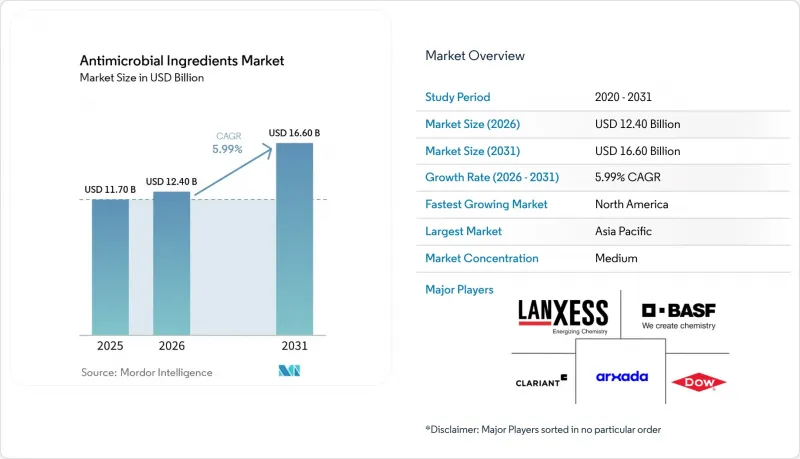
Mordor Intelligence에 의하면, 항균 성분 시장 규모는 2025년 117억 달러에서 2026년에는 124억 달러로 확대되어 2031년까지 166억 달러에 이를 것으로 예상되고 있어 2026년부터 2031년까지 CAGR 5.99%로 성장할 전망입니다.
본 보고서는 성분 유형(무기/금속계, 합성 유기물, 유기산 및 염, 기타), 용도(의료기기, 표면 처리, 상처 관리, 섬유, 소독제, 제약 제조, 기타), 형태(분말, 액체, 젤, 마스터배치, 캡슐화 시스템), 지역(북미, 유럽, 아시아태평양, 중동 및 아프리카, 남미)별로 분류되어 있습니다. 시장 전망치는 금액(달러)으로 표시되어 있습니다.
세계 항균 성분 시장 동향 및 인사이트
증가하는 의료 관련 감염증
의료 관련 감염증은 미국 병원에 연간 280억-450억 달러의 비용을 초래하고 있으며, 여전히 매일 약 31명 중 1명의 환자에게 영향을 미치고 있습니다. 2023년부터 2024년까지 혈류 감염 및 요로 감염의 발생률은 소폭 감소했으나, 절대적인 발생 건수는 여전히 높은 수준을 유지하고 있어, 이에 따라 의료시설 관리자들은 은 및 4급 암모늄 화합물이 함침된 카테터, 인공호흡기 튜브 및 침구류를 도입하는 방향으로 나아가고 있습니다. 또한, ‘병원 내 감염 감소 프로그램(HACRP)’에 따른 메디케어 지급 감액 조치 역시 이 제도의 도입을 더욱 촉진하고 있습니다. 동·은이 함유된 섬유 제품은 동료 심사를 거친 연구에 따르면, 50회의 세탁 주기를 거친 후에도 ESKAPE 병원체에 대해 99.9%의 효능을 유지하는 것으로 나타났으며, 이는 비용 대비 효과에 대한 주장을 뒷받침하고 있습니다.
엄격한 감염 관리 규정
FDA의 2024년 지침에 따르면, 감염 예방 효과를 내세워 판매되는 모든 의료기기에 대해 ISO 22196 또는 ASTM E2180에 기반한 임상적 유효성 입증이 요구됩니다. EU에서는 살생물제 규정에 따라, 승인까지 5년이 소요되는 나노 물질 고유의 신청 서류 제출이 의무화되어 있습니다. 이러한 장벽은 시장 진입 비용을 높이지만, 여러 관할 구역에 걸친 규제 대응 서류를 종합적으로 제공하는 공급업체에게는 이점을 가져다줍니다. 안전성과 유효성이라는 두 가지 목표를 모두 달성하기 위해, 제조업체는 세포 독성의 최고치를 억제하면서도 안정적인 항균 수준을 유지하는 서방형 캡슐을 채택하고 있습니다. 2023년 동합금 접촉면의 EPA 등록은 재료의 발전과 신청 서류의 상세함이 어떻게 연결되는지를 보여주는 좋은 사례입니다.
규제 및 안전성 문제
나노 소재와 관련된 EU 신청 서류는 유효 성분 1개당 100만 유로의 비용이 소요되며, 시판까지의 기간을 5년으로 연장할 가능성이 있습니다. FDA 지침에 따르면, 항균 효과를 내세우는 복합 제품에 대해서는 신속 심사를 허용하지 않으며, 완전한 510(k) 또는 PMA 신청을 의무화하고 있습니다. 따라서 병원 측은 수십 년에 걸친 독성 데이터가 있는 기존의 알코올이나 염소계 제품에 의존하는 경향이 있습니다. 또한, 세포 독성의 임계값에 따라 상처 덮개재의 은 함유량은 10ppm으로 제한되어 있어, 유효성 범위가 좁아짐에 따라 일부 구매자들은 더 저렴한 일회용 거즈를 계속 사용해야만 하는 상황에 처해 있습니다.
부문별 분석
2025년, 무기 및 금속계 화학물질이 매출의 38.10%를 차지했습니다. 이는 은과 구리가 신속한 내성 획득을 유발하지 않으면서도 광범위한 살균 효과를 발휘했기 때문입니다. 구리 합금은 2시간 이내에 MRSA를 4로그 감소시키는 효과가 있어, 침대 난간이나 호출 버튼에 이를 적용하는 것을 장려하고 있습니다. 4급 암모늄 화합물 등의 합성 유기 화합물은 여전히 스프레이와 물티슈의 주력 제품으로 자리 잡고 있지만, 생태 독성에 대한 면밀한 검토에 직면해 있습니다. 천연 및 바이오 제품들은 지속가능성에 대한 요구와 저독성 병실을 선호하는 환자들의 선호에 힘입어 연평균 성장률(CAGR) 7.89%로 성장하고 있습니다. 에센셜 오일은 저위험 영역에서 널리 사용되고 있으며, 키토산은 지혈 작용과 항균 작용이 필요한 상처 피복재로 활용되고 있습니다. 펩타이드 가격 상승으로 인해 그 용도는 고급 임플란트로 한정되어 있지만, 청어 등의 GRAS(일반적으로 안전하다고 인정되는) 성분에 대한 규제상 신속 승인으로 인해 2028년까지 비용 장벽이 해소될 가능성이 있습니다.
연구개발비의 급증은 부유 세포를 죽이는 것이 아니라 생물막을 파괴하는 효소 개발로 이어지고 있으며, 이를 통해 내성 발생 압력을 낮추고 있습니다. DSM-Firmenich사는 카테터용 Delvo Nis 펩타이드 코팅에 대한 시범 시험을 진행 중이며, 식품 용도에서 해당 분자에 대한 FDA의 이해가 의료기기 승인 절차를 원활하게 할 것으로 기대하고 있습니다.
지역별 분석
2025년에는 아시아·태평양 지역이 매출의 35.18%를 차지했으며, 중국의 의료기기 공장 및 인도의 병원 건설 확대가 이를 뒷받침했습니다. 베이징의 ‘제14차 5개년 계획’에 따라 각 성의 시설에 1,700억 달러가 투입되었으며, 각 시설에는 항균성 에폭시 수지 바닥재와 구리 합금 손잡이가 지정되었습니다. 일본에서는 공립 병원의 시설에 항균 코팅이 의무화되어 있어, 인구 증가율은 둔화되고 있음에도 불구하고 고부가가치의 틈새 시장으로 자리 잡고 있습니다. 한국에서는 JIS Z 2801에 따른 시험이 의무화되어 있지만, 소규모 공급업체의 경우 이에 대응할 역량이 부족한 경우가 많아 기존 기업들에게 우위를 점하게 하고 있습니다.
북미는 연평균 성장률(CAGR) 7.67%를 기록하며 가장 빠르게 성장하고 있는 지역입니다. 이는 CMS(미국 의료보험 및 의료보조 서비스 센터)가 감염병 점수와 보험금 지급을 연계하고 있기 때문입니다. 미국의 병원들은 SARS-CoV-2에 대한 효능이 입증된 소독제에 대해 기꺼이 리스트 N 할증 요금을 지불하고 있습니다. 의료기기 제조업체들 역시 코팅된 카테터의 510(k) 승인을 획득하기 위해 항균성 마스터배치에 의존하고 있습니다. 캐나다가 USMCA(미국·멕시코·캐나다 협정)를 준수함에 따라 신청 서류의 중복이 줄어들었고, 중규모 배합 제조업체의 사업 확장이 촉진되고 있습니다. 판매량은 아시아에 미치지 못하지만, 평균 판매 가격이 높기 때문에 이익률이 매우 높아, 항균 성분 시장에서 이 지역의 중요성이 더욱 커지고 있습니다.
기타 지역은 유럽, 중동, 남미가 차지하고 있습니다. EU의 BPR(생물제품규정)에 따른 일정은 시장 출시 주기를 길게 만들고 있지만, 독일, 프랑스, 영국은 여전히 혁신의 중심지로서 데이터가 풍부한 신청 서류를 요구하고 있습니다. '비전 2030'에 기반한 중동의 병상 증설 계획에서는 ISO 14644를 준수하는 클린존이 의무화되어 있으며, 이는 항균성 HVAC 코팅에 호재가 될 것입니다. 남미는 예산 제약으로 인해 뒤처져 있지만, 메르코수르(Mercosur)의 살생물제 규정 통합을 위한 노력 덕분에 승인까지 걸리는 기간이 단축되어, 2031년까지 브라질과 아르헨티나에서 수요가 창출될 가능성이 있습니다.
기타 혜택:
- 엑셀 형식 시장 예측(ME) 시트
- 3개월간의 애널리스트 지원
자주 묻는 질문
목차
제1장 서론
제2장 조사 방법
제3장 주요 요약
제4장 시장 구도
제5장 시장 규모와 성장 예측
제6장 경쟁 구도
제7장 시장 기회와 향후 전망
JHS 26.06.23According to Mordor Intelligence, the antimicrobial ingredients market size is expected to increase from USD 11.70 billion in 2025 to USD 12.40 billion in 2026 and reach USD 16.60 billion by 2031, growing at a CAGR of 5.99% over 2026-2031.
This report is Segmented by Ingredient Type (Inorganic/Metal-based, Synthetic Organics, Organic Acids & Salts, and More), Application (Medical Devices, Surfaces, Wound Care, Textiles, Disinfectants, Pharma Manufacturing, Others), Form (Powder, Liquid, Gel, Masterbatch, Encapsulated Systems), and Geography (North America, Europe, Asia-Pacific, MEA, South America). Market Forecasts are in Value (USD).
Global Antimicrobial Ingredients Market Trends and Insights
Rising Healthcare-Associated Infections
Healthcare-associated infections impose USD 28 billion to USD 45 billion in annual costs on U.S. hospitals and still affect roughly 1 in 31 patients on any given day. Although bloodstream and urinary-tract infection rates declined modestly between 2023 and 2024, absolute incidence remains high, steering administrators toward catheters, ventilator tubing, and bed linens impregnated with silver and quaternary ammonium compounds. Medicare payment penalties under the Hospital-Acquired Condition Reduction Program further motivate adoption. Peer-reviewed studies show copper-silver textiles retain 99.9% efficacy against ESKAPE pathogens after 50 wash cycles, reinforcing return-on-investment arguments.
Stringent Infection Control Regulations
The FDA's 2024 guidance requires any device marketed with an infection-prevention claim to demonstrate clinical efficacy under ISO 22196 or ASTM E2180. In the EU, the Biocidal Products Regulation demands nanomaterial-specific dossiers that can take five years to clear. These hurdles raise the cost of market entry but also reward suppliers that offer turnkey regulatory files across multiple jurisdictions. To meet both safety and efficacy targets, manufacturers turn to controlled-release capsules that deliver steady antimicrobial levels while limiting cytotoxic peaks. EPA registration of copper-alloy touch surfaces in 2023 exemplifies how material advances and dossier depth intersect.
Regulatory and Safety Concerns
EU dossiers for nanomaterials can cost EUR 1 million per active substance and extend launch cycles to five years. FDA guidance denies accelerated reviews for combination products that claim antimicrobial benefits, forcing full 510(k) or PMA submissions. Hospitals, therefore, hedge with legacy alcohols and chlorine because decades of toxicology data exist. Cytotoxic thresholds also cap silver loading in wound dressings at 10 ppm, limiting efficacy windows and prompting some buyers to stick with cheaper single-use gauze.
Other drivers and restraints analyzed in the detailed report include:
- Growth in Medical Device and Implant Usage
- Expansion of Hospital Infrastructure
- Risk of Antimicrobial Resistance
For complete list of drivers and restraints, kindly check the Table Of Contents.
Segment Analysis
In 2025, inorganic and metal chemistries captured 38.10% revenue as silver and copper delivered broad-spectrum kill without fostering quick resistance. Copper alloys achieve a 4-log reduction of MRSA within two hours, driving uptake on bed rails and call buttons. Synthetic organics such as quaternary ammonium compounds remain workhorses in sprays and wipes but face eco-toxicity scrutiny. Natural and bio-based options are growing at 7.89% CAGR, supported by sustainability mandates and patient preference for low-toxicity rooms. Essential oils appeal in low-risk zones, while chitosan serves wound dressings needing hemostasis and antimicrobial action. High peptide prices confine their use to premium implants, yet regulatory fast-tracks for GRAS ingredients like nisin could offset cost barriers by 2028.
Surging R&D dollars are steering toward enzymes that disrupt biofilms rather than kill planktonic cells, reducing resistance pressure. DSM-Firmenich is piloting Delvo Nis peptide coatings for catheters, betting that FDA familiarity with the molecule in food applications will streamline device approval.
Geography Analysis
Asia Pacific accounted for 35.18% revenue in 2025, underpinned by China's device factories and India's hospital build-out. Beijing's 14th Five-Year Plan channeled USD 170 billion into provincial facilities, each specifying antimicrobial epoxy floors and copper-alloy handles. Japan obliges antimicrobial coatings on public hospital fixtures, making it a high-value niche despite slower population growth. South Korea enforces JIS Z 2801 testing, which smaller suppliers often lack, giving incumbents an edge.
North America is the quickest-growing geography at 7.67% CAGR because CMS links reimbursement to infection scores. U.S. hospitals willingly pay List N premiums for disinfectants that guarantee SARS-CoV-2 efficacy. Device makers also rely on antimicrobial masterbatch to secure 510(k) clearance for coated catheters. Canada's alignment under USMCA reduces dossier duplication, helping mid-sized formulators expand. Though volumes lag Asia, higher average selling prices deliver outsized profit, reinforcing regional importance to the antimicrobial ingredients market.
Europe, the Middle East, and South America fill the remainder. EU BPR timelines stretch launch cycles, but Germany, France, and the U.K. remain innovation hubs demanding data-rich dossiers. Middle-East bed growth under Vision 2030 stipulates ISO 14644 clean zones, a tailwind for antimicrobial HVAC coatings. South America lags because of budget constraints, yet Mercosur's work on unified biocide rules could shorten approval windows and unlock demand in Brazil and Argentina before 2031.
- Arxada
- Ashland
- Avient Corporation
- BASF
- BioCote Limited
- Celanese
- Clariant AG
- Corbion
- Croda International
- Dow Inc.
- DSM-Firmenich
- Evonik Industries
- International Flavors & Fragrances (IFF)
- Kerry Group
- Lanxess AG
- Microban International
- Milliken & Company
- Novonesis
- RTP Company
- Sanitized AG
- Schulke & Mayr GmbH
- Sharon Laboratories
- Symrise
- THOR Group
Additional Benefits:
- The market estimate (ME) sheet in Excel format
- 3 months of analyst support
TABLE OF CONTENTS
1 Introduction
- 1.1 Study Assumptions & Market Definition
- 1.2 Scope of the Study
2 Research Methodology
3 Executive Summary
4 Market Landscape
- 4.1 Market Overview
- 4.2 Market Drivers
- 4.2.1 Rising Healthcare-Associated Infections (HAIs)
- 4.2.2 Stringent Infection Control Regulations
- 4.2.3 Growth in Medical Device and Implant Usage
- 4.2.4 Expansion of Hospital Infrastructure and Healthcare Access
- 4.2.5 Increased Focus on Surface Hygiene Post-Pandemic
- 4.2.6 Advancements in Antimicrobial Technologies
- 4.3 Market Restraints
- 4.3.1 Regulatory and Safety Concerns
- 4.3.2 Risk of Antimicrobial Resistance (AMR)
- 4.3.3 High Cost of Advanced Antimicrobial Materials
- 4.3.4 Limited Long-Term Efficacy and Durability Concerns
- 4.4 Supply Chain Analysis
- 4.5 Regulatory Landscape
- 4.6 Technological Outlook
- 4.7 Porter's Five Forces Analysis
- 4.7.1 Threat of New Entrants
- 4.7.2 Bargaining Power of Suppliers
- 4.7.3 Bargaining Power of Buyers
- 4.7.4 Threat of Substitutes
- 4.7.5 Competitive Rivalry
5 Market Size & Growth Forecasts (Value, USD)
- 5.1 By Ingredient Type
- 5.1.1 Inorganic/metal-based
- 5.1.2 Synthetic organics
- 5.1.3 Organic acids & salts
- 5.1.4 Natural/bio-based
- 5.1.5 Enzymatic & antimicrobial peptides
- 5.2 By Application
- 5.2.1 Medical Devices & Implants
- 5.2.2 Healthcare Surfaces & Coatings
- 5.2.3 Wound Care Products
- 5.2.4 Healthcare Textiles
- 5.2.5 Hospital Hygiene & Disinfectants
- 5.2.6 Pharmaceutical & Biotechnology Manufacturing
- 5.2.7 Others
- 5.3 By Form
- 5.3.1 Dry / Powder
- 5.3.2 Liquid
- 5.3.3 Gel / Foam
- 5.3.4 Masterbatch / Carrier for polymers
- 5.3.5 Encapsulated / Controlled-release systems
- 5.4 By Geography
- 5.4.1 North America
- 5.4.1.1 United States
- 5.4.1.2 Canada
- 5.4.1.3 Mexico
- 5.4.2 Europe
- 5.4.2.1 Germany
- 5.4.2.2 United Kingdom
- 5.4.2.3 France
- 5.4.2.4 Italy
- 5.4.2.5 Spain
- 5.4.2.6 Rest of Europe
- 5.4.3 Asia-Pacific
- 5.4.3.1 China
- 5.4.3.2 India
- 5.4.3.3 Japan
- 5.4.3.4 South Korea
- 5.4.3.5 Australia
- 5.4.3.6 Rest of Asia-Pacific
- 5.4.4 Middle East and Africa
- 5.4.4.1 GCC
- 5.4.4.2 South Africa
- 5.4.4.3 Rest of Middle East and Africa
- 5.4.5 South America
- 5.4.5.1 Brazil
- 5.4.5.2 Argentina
- 5.4.5.3 Rest of South America
- 5.4.1 North America
6 Competitive Landscape
- 6.1 Market Concentration
- 6.2 Market Share Analysis
- 6.3 Company Profiles
- 6.3.1 Arxada
- 6.3.2 Ashland
- 6.3.3 Avient Corporation
- 6.3.4 BASF SE
- 6.3.5 BioCote Limited
- 6.3.6 Celanese
- 6.3.7 Clariant AG
- 6.3.8 Corbion
- 6.3.9 Croda International
- 6.3.10 Dow Inc.
- 6.3.11 DSM-Firmenich
- 6.3.12 Evonik Industries
- 6.3.13 International Flavors & Fragrances (IFF)
- 6.3.14 Kerry Group
- 6.3.15 Lanxess AG
- 6.3.16 Microban International
- 6.3.17 Milliken & Company
- 6.3.18 Novonesis
- 6.3.19 RTP Company
- 6.3.20 Sanitized AG
- 6.3.21 Schulke & Mayr GmbH
- 6.3.22 Sharon Laboratories
- 6.3.23 Symrise
- 6.3.24 THOR Group
7 Market Opportunities & Future Outlook
- 7.1 White-space & unmet-need assessment


