|
시장보고서
상품코드
2063578
조산 진단 키트 시장 : 점유율 분석, 업계 동향과 통계, 성장 예측(2026-2031년)Preterm Birth Diagnostic Test Kits - Market Share Analysis, Industry Trends & Statistics, Growth Forecasts (2026 - 2031) |
||||||
 Mordor Intelligence
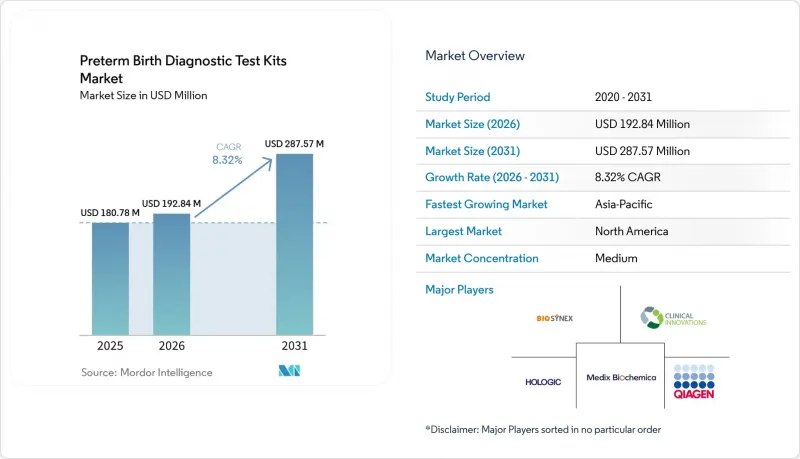
Mordor Intelligence에 의하면, 조산 진단 키트 시장 규모는 2025년에 1억 8,078만 달러, 2026년에 1억 9,284만 달러, 2031년까지 2억 8,757만 달러에 이를 것으로 예측됩니다.
2026년부터 2031년까지 연평균 성장률(CAGR) 8.32%로 성장할 것으로 전망됩니다.
본 보고서는 제품 유형(태아 피브로넥틴 등), 검체(질·자궁경부 면봉, 혈액), 최종 사용자(병원·산과 센터, 진단 검사 기관, 출산 센터·산부인과 외래 클리닉, 기타), 지역(북미, 유럽, 아시아태평양, 중동 및 아프리카, 남미)별로 분류되어 있습니다. 시장 전망은 금액(달러) 기준으로 제시되어 있습니다.
전 세계 조산 진단 키트 시장 동향 및 인사이트
전 세계 조산 발생률과 부담 증가
조산은 전 세계적으로 여전히 신생아의 발병률 및 사망률의 주요 원인이며, 이에 따라 더 조기적이고 정확한 위험 평가에 대한 임상적 수요가 높아지고 있습니다. 병원 측은 불필요한 전원 이송을 제한하고, 위험이 확실하며 출산이 임박한 경우에만 적시에 코르티코스테로이드를 사용할 수 있도록 지원하기 위해 트리아지 절차를 표준화하고 있습니다. 자원이 부족한 환경에서 지속되는 부담은 수요와 접근성 사이의 격차를 드러내고 있으며, 이로 인해 보다 간편한 검사법의 사용이 지속되고, 정교한 바이오마커 검사의 도입이 지연되고 있습니다. 의료 시스템은 임박한 분만을 신속하게 배제할 수 있는 검사의 운영적 가치를 중시하고 있으며, 이를 통해 피할 수 있는 입원을 방지하고 3차 의료기관에 가해지는 부담을 줄이고 있습니다. 이러한 상황으로 인해 조산 진단 키트 시장은 현장에서의 의사결정을 강화하기 위해 결과의 신속성과 명확성에 중점을 두고 있습니다.
임상 경로에 바이오마커 기반 분류 체계 통합(fFN, PAMG-1, IGFBP-1)
북미 및 유럽의 많은 의료기관에서는 임신 24주부터 34주 사이에 증상을 보이는 환자를 대상으로 한 표준화된 프로토콜에 바이오마커 기반 선별 검사를 포함시켜, 명확한 음성 결과가 나왔을 때 불필요한 입원을 줄이고 있습니다. 정량적 태아 피브로넥틴 카세트의 판매 중단에 따라, 2024년에는 대체 플랫폼으로의 전환을 요구하는 국가 지침이 수립되었으며, 이에 따라 조달 체계가 재구축됨과 동시에 IGFBP-1 및 PAMG-1에 대한 보다 광범위한 평가가 촉진되었습니다. 양막 파열(ROM)의 진단은 치료 경로의 일부로서 여전히 중요한 역할을 하고 있습니다. 이는 양막의 상태가 조산 위험이나 임상적 경과 관찰의 선택에 직접적인 영향을 미치기 때문입니다. 프로토콜에 기반한 트리아지는 임상의들 간의 대응 차이를 줄이고, 예방적 경과 관찰이 아닌 측정 가능한 위험이 있는 사례에 자원을 집중시킵니다. 전문가들의 지침과 의료 기관 위원회는 도입 방식을 지속적으로 정립해 나가고 있으며, 조산 진단 키트 시장을 몇 분 이내에 이분법적이거나 거의 이분법적인 명확한 결과를 제공하는 검사로 자리매김시키고 있습니다.
일부 바이오마커 및 용도에 대한 혼합적/조건부 지침 권고
지역별 지침의 차이는 표준화된 도입을 지연시키고, 국내 및 국가 간 검사 관행의 불일치를 초래하고 있습니다. 전문가들의 문서에서는 특정 브랜드명이 아닌 바이오마커의 분류가 주로 언급되는 경우가 많으며, 그 결과 조달 팀은 가격, 입수 가능성 및 현지 인지도에 근거하여 결정을 내리게 됩니다. 무증상 선별검사 등의 이용 사례에 대한 권고 사항의 일관성 부족은 3차 의료기관 이외의 곳에서 도입이 고르지 않게 되는 원인 중 하나입니다. 또한, 임상의들은 특정 상황에서 어떤 검사가 보험 적용 대상이 되는지에 대해 보험사마다 다른 규정에 직면하고 있으며, 이로 인해 일상적인 검사 의뢰 과정에서 마찰이 발생하고 있습니다. 이러한 요인들로 인해, 조산 진단 키트 시장이 시범 운영 단계에서 프로토콜에 기반한 안정적인 도입 단계로 전환되는 속도가 둔화되고 있습니다.
부문별 분석
2025년 기준으로 태아 피브로넥틴은 조산 진단 키트 시장 규모의 43.89%를 차지하고 있으며, 이는 공급 구조의 변화가 검사 의뢰 행태를 바꾸기 전의 기존 시장 상황을 반영하고 있습니다. 2024년 정량 fFN 카세트의 생산 중단으로 인해, 많은 병원의 진료 흐름에서 정량 기준이 정성 검사 및 대체 바이오마커로 대체되었습니다. PAMG-1 플랫폼은 증상이 있는 임산부의 분류 판단을 효율화하는 이진식 제외 기준을 병원이 도입함에 따라, 2031년까지 연평균 성장률(CAGR) 9.67%를 나타낼 것으로 예측됩니다. 양막의 상태를 확인하는 것이 근기적 위험 관리에 큰 영향을 미치기 때문에 ROM(양수 파열) 진단은 진료 흐름에서 여전히 보완적인 축으로 자리 잡고 있습니다. 조산 진단 키트 시장에서도 ‘시기’에 대한 재정의가 진행되고 있습니다. PreTRM으로 대표되는 단백질체학 혈액 검사는 임신 18-20주 시점의 위험 요소에 초점을 맞추어, 프로게스테론, 아스피린 및 강화된 케어 네비게이션을 중심으로 한 예방 전략을 수립하고 있습니다. 2026년에 보고된 무작위 대조 시험 결과에 따르면, PreTRM 선별 검사와 표적 중재를 병행함으로써 극초기 조산의 감소 및 신생아 합병증의 감소가 확인되었습니다. 이러한 변화로 인해, 중점 사항이 24-34주 차의 위기 관리에서 고액의 의료비가 수반되는 사태를 미연에 방지할 가능성이 있는 조기 위험군 분류로 전환되고 있습니다. 병원 측은 전원(다른 병원으로의 이송)을 피하기 위한 실용적인 음성 예측치를 여전히 중시하는 반면, 검사 기관 측은 복잡한 검사를 위한 중앙 집중화된 업무 흐름을 중시하고 있습니다. 이러한 제품 동향들이 복합적으로 작용하여, 신속 검사 키트가 급성기 분류 작업을 뒷받침하고, 혈액 단백질체학가 예방 의학 분야로 확대되는 등 양극화된 시장 구조가 유지되고 있습니다.
이 제품 구성은 구매자의 선호도를 형성하는 명확한 운영상의 상충 관계를 반영하고 있습니다. 몇 분 이내에 결과를 확인할 수 있는 현장 진단용 면봉은 배제 진단을 위해 즉각적인 명확성이 필요한 응급실이나 관찰 병동에 적합합니다. PAMG-1과 IGFBP-1은 fFN 공급 차질로 인해 조달 팀이 신뢰할 수 있는 공급처를 모색하는 가운데, 가격, 입수 가능성 및 지역 지침 준수 측면에서 경쟁하고 있습니다. 혈액 기반 단백질체학 검사는 집중적인 처리가 필요하지만, 기존의 위험 지표에 해당하지 않는 많은 자연 조기 분만 사례를 대상으로 하는 새로운 예방 전략을 개척합니다. 따라서 조산 진단 키트 시장에서는 제품이 임상적 시기에 맞추어 배치되어 있으며, 증상이 있는 환자의 선별 검사는 래터럴 플로우 키트가 담당하고, 무증상 고위험군에 대해서는 증상이 나타나기 몇 주 전부터 관리 계획에 영향을 미치는 단백질체학 검사가 대응하고 있습니다. 이러한 보완적인 포지셔닝을 통해 공급업체는 검사를 치료 성과나 예산에 미치는 영향과 연계함으로써, 가격만을 쟁점으로 삼는 경쟁사들에 대항할 수 있게 됩니다.
지역별 분석
북미는 2025년 매출의 43.64%를 차지하며, 분만 및 산과 병동에서 바이오마커 활용을 반영한 프로토콜을 통해 조산 진단 키트 시장의 기반을 다지고 있습니다. 2024년 정량 fFN의 폐지는 대체 바이오마커로의 전환을 가속화시켰으며, 진료 실무를 형성하는 데 있어 국가 지침의 중요성을 재확인하는 결과를 낳았습니다. 캐나다와 멕시코에서는 주마다 조달 및 보험 적용 규칙과 지급 주체의 구성이 다르기 때문에 미국에 비해 도입이 늦어지고 있습니다. 현재 미국의 확대 조치에는 민간 보험 플랜 및 메디케이드(Medicaid)를 통한 무증상 선별 검사의 시범 사업이 포함되어 있으며, 이에 따라 도입 방향이 위기 상황의 분류에서 예방으로 전환되고 있습니다. 북미의 조산 진단 키트 시장에서는 신속한 면봉 검사의 활용과 측정 가능한 성과를 입증할 수 있는 새로운 단백질체학 워크플로우 간의 균형을 계속해서 모색하고 있습니다.
아시아태평양에서는 중국, 인도, 한국의 검사실 규모 확대와 공공 시범 사업을 통한 신규 검사법의 보험 적용 검토가 진행됨에 따라, 2031년까지 연평균 성장률(CAGR) 9.45%로 성장할 것으로 전망됩니다. 공공 의료 네트워크에서의 면봉 검사 도입에는 국내 생산 및 가격 중심의 입찰이 영향을 미치고 있는 반면, 민간 병원 체인은 도시 지역에서 PAMG-1 및 IGFBP-1에 주력하고 있습니다. 일본에서는 저출산과 산과 의료 종사자 부족으로 인해 수요 증가가 억제되고 있지만, 3차 의료기관에서는 대상 범위를 좁혀 도입이 계속되고 있습니다. 호주에서는 임상 그룹이 fFN 공급 변동이 지방으로의 이송 업무에 미치는 영향을 모니터링하고, 트리아지의 신뢰성을 유지하기 위한 안정적인 대안을 모색했습니다. 동남아시아 전역에서는 콜드체인 부족과 규제 경로의 파편화로 인해 새로운 바이오마커의 보급이 지연되고 있으며, 조산 진단 키트 시장은 여전히 합리적인 가격에 신뢰성이 높은 제품에 의존하는 상황이 지속되고 있습니다.
유럽에서는 의료기관들이 IVD 규정 준수를 위한 규제 요건의 변화와 기한 준수에 대응해 나가는 가운데, 시장 점유율을 유지했습니다. 독일, 프랑스, 영국에서는 바이오마커 검사가 산과 진료 과정에 포함되어 있지만, 예산 평가에 따라 국가 보험 적용 대상에 포함되는 시기가 늦어질 수 있습니다. 영국에서는 2024년 fFN 생산 중단에 따라 대체 선별 검사로의 전환이 진행되면서, 공공 부문의 높은 비용 효율성 의식과 국가 지침의 핵심적인 역할이 부각되었습니다. 남유럽 및 동유럽에서는 지역별 의료 행정 체계와 1인당 의료비가 낮은 탓에 도입 현황에 차이가 나타납니다. 그 때문에 일부 의료 현장에서는 여전히 임상적 판단이나 구식 검사에 의존하는 상황이 계속되고 있습니다. 유럽의 조산 진단 키트 시장에서는 공급 중단 없이 문서화 및 시판 후 요건을 충족할 수 있는 공급업체가 점점 더 높이 평가받고 있습니다.
중동 및 아프리카에서는 걸프 지역의 사립 병원이 서유럽의 바이오마커 플랫폼을 도입하고, 남아프리카의 3차 의료기관이 진단 검사를 선별적으로 도입하는 등 성장의 조짐이 보이고 있습니다. 사하라 이남 아프리카는 조산으로 인한 부담이 크지만, 인프라의 제약으로 인해 검사 이용은 도시 지역의 거점으로 한정되어 있습니다. 자간전증 등의 관련 합병증을 대상으로 한 체계적인 노력이 계속되고 있으며, 개발 중인 새로운 신속 검사법은 자원이 부족한 환경에서도 접근성을 높이는 것을 목표로 하고 있습니다. 남미에서는 브라질과 아르헨티나의 민간 부문이 도시 지역의 진료소에 이 시스템을 도입하는 것을 지원하고 있지만, 공공 의료 시스템은 예산 부족으로 인해 도입 규모가 제한적입니다. 이러한 지역적 요인으로 인해, 조산 진단 키트 시장의 성장은 조달 체계의 성숙도, 검사실의 역량, 그리고 검사 결과를 측정 가능한 성과로 연결하려는 지불 주체의 의지에 좌우되는 상황이 지속되고 있습니다.
기타 혜택:
- 엑셀 형식 시장 예측(ME) 시트
- 3개월간의 애널리스트 지원
자주 묻는 질문
목차
제1장 서론
제2장 조사 방법
제3장 주요 요약
제4장 시장 구도
제5장 시장 규모와 성장 예측
제6장 경쟁 구도
제7장 시장 기회와 향후 전망
JHS 26.06.23According to Mordor Intelligence, the preterm birth diagnostic test kits market size is projected to be USD 180.78 million in 2025, USD 192.84 million in 2026, and reach USD 287.57 million by 2031, growing at a CAGR of 8.32% from 2026 to 2031.
This report is Segmented by Product Type (Fetal Fibronectin, and More), Material (Vaginal/Cervical Swab, Blood), End User (Hospitals & Maternity Centers, Diagnostic Laboratories, Birthing Centers/Outpatient OB-GYN Clinics, Others), and Geography (North America, Europe, Asia-Pacific, Middle East and Africa, South America). The Market Forecasts are Provided in Terms of Value (USD).
Global Preterm Birth Diagnostic Test Kits Market Trends and Insights
Rising Global Incidence and Burden of Preterm Births
Preterm birth remains a leading cause of neonatal morbidity and mortality worldwide, which sustains clinical demand for earlier and more accurate risk assessment. Hospitals seek to standardize triage to limit unnecessary transfers and to support timely corticosteroid use only when risk is credible and near term. Persistent burden in low-resource settings exposes a gap between need and access, which sustains use of simpler tests and delays adoption of advanced biomarker assays. Health systems weigh the operational value of tests that can quickly rule out imminent delivery, preventing avoidable hospital stays and reducing strain on tertiary units. These dynamics keep the preterm birth diagnostic test kits market focused on speed and clarity of result to strengthen frontline decisions.
Integration of Biomarker-Based Triage in Clinical Pathways (fFN, PAMG-1, IGFBP-1)
Many institutions in North America and Europe have integrated biomarker-based triage into standardized protocols for patients with symptoms between 24 and 34 weeks, reducing unwarranted admissions when a clear negative result is returned. The discontinuation of quantitative fetal fibronectin cassettes prompted national guidance in 2024 to transition to alternative platforms, which reshaped procurement and encouraged broader evaluation of IGFBP-1 and PAMG-1 options. The role of ROM diagnostics persists as part of the care pathway, since membrane status directly influences near-term labor risk and clinical surveillance choices. Protocol-driven triage limits variation among clinicians and channels resources to cases with measurable risk rather than precautionary observation. Professional guidance and institutional committees continue to shape uptake, anchoring the preterm birth diagnostic test kits market to tests that deliver binary or near-binary clarity within minutes.
Mixed/Conditional Guideline Endorsements for Some Biomarkers and Uses
Guideline variability across regions slows standardized adoption and sustains a patchwork of testing practices within and across countries. Professional documents often reference biomarker classes rather than specific brands, which leaves procurement teams to decide based on price, availability, and local familiarity. Inconsistent endorsement for use cases such as asymptomatic screening contributes to uneven uptake outside tertiary centers. Clinicians also face divergent payer rules on which tests are reimbursed in specific scenarios, which adds friction to routine ordering. These factors temper the pace at which the preterm birth diagnostic test kits market can move from pilot usage to stable, protocol-driven deployment.
Other drivers and restraints analyzed in the detailed report include:
- Rapid, Point-of-Care Lateral-Flow Kits Enabling Fast Rule-Out Decisions in Maternity Triage
- Hospital-Protocol and Reimbursement Support for Targeted Testing in High-Risk/Symptomatic Cases
- EU IVDR Elevates Clinical Evidence, Cost, and Time-to-Market for IVDs
For complete list of drivers and restraints, kindly check the Table Of Contents.
Segment Analysis
Fetal fibronectin accounted for 43.89% share of the preterm birth diagnostic test kits market size in 2025, reflecting legacy entrenchment before a supply shift changed ordering behavior. The discontinuation of quantitative fFN cassettes in 2024 replaced the quantitative standard with qualitative and alternative biomarkers within many hospital pathways. PAMG-1 platforms are projected to grow at a 9.67% CAGR through 2031 as hospitals adopt binary rule-out formats that streamline triage decisions for symptomatic women. ROM diagnostics remain a complementary pillar in the pathway because confirming membrane status substantially influences near-term risk management. The preterm birth diagnostic test kits market is also redefining timing as proteomic blood tests, led by PreTRM, focus on risk at 18 to 20 weeks with a prevention strategy built around progesterone, aspirin, and intensified care navigation. Randomized evidence reported in 2026 showed a reduction in very early preterm births and fewer newborn complications when PreTRM screening was paired with targeted interventions. These shifts move the center of gravity upstream from crisis management at 24 to 34 weeks to earlier risk stratification that may avert high-cost episodes. Hospitals still value actionable negative predictive value to avoid transfers, while laboratories emphasize centralized workflows for complex assays. Together, these product dynamics sustain a two-speed market in which rapid swab kits support acute triage and blood proteomics expands into preventive care.
The product mix reflects clear operational trade-offs that shape buyer preferences. Point-of-care swabs that return results within minutes fit emergency and observation units that need immediate clarity for rule-out decisions. PAMG-1 and IGFBP-1 options compete on price, availability, and local guideline familiarity as procurement teams seek reliable supply after fFN disruptions. Blood-based proteomic assays require centralized processing but open a new prevention play that targets the many spontaneous preterm births that lack traditional risk flags. The preterm birth diagnostic test kits market, therefore, aligns products to clinical timing, with symptomatic triage anchored by lateral-flow kits and asymptomatic risk addressed by proteomic tests that influence care plans weeks before symptoms appear. This complementary positioning helps vendors defend against price-only competition by linking tests to outcomes and budget impact.
Geography Analysis
North America held 43.64% of 2025 revenue and anchors the preterm birth diagnostic test kits market with protocols that embed biomarker use in labor and delivery units. The 2024 discontinuation of quantitative fFN drove expedited transitions to alternative biomarkers and reinforced the weight of national guidance in shaping practice. Canada and Mexico trail U.S. adoption as procurement and coverage rules vary across provinces and payer mixes. U.S. growth now includes asymptomatic screening pilots under commercial plans and Medicaid, which nudges adoption beyond crisis triage toward prevention. The preterm birth diagnostic test kits market in North America continues to balance rapid swab usage with emerging proteomic workflows that can demonstrate measurable outcomes.
Asia-Pacific is projected to grow at a 9.45% CAGR through 2031 as laboratories scale in China, India, and South Korea and as public pilots examine coverage for newer assays. Domestic manufacturing and price-sensitive tenders influence swab adoption in public networks, while private hospital chains concentrate on PAMG-1 and IGFBP-1 in urban centers. Japan's declining birth rate and a constrained obstetric workforce temper demand growth, yet targeted adoption persists in tertiary centers. In Australia, clinical groups monitored implications of fFN supply changes on rural transfer practices and sought consistent alternatives to preserve triage confidence. Across Southeast Asia, limited cold-chain and fragmented regulatory pathways slow uptake of novel biomarkers, which keeps the preterm birth diagnostic test kits market anchored to affordable and robust options.
Europe maintained share as institutions navigated evolving regulatory expectations and deadlines for IVD compliance. Germany, France, and the United Kingdom embed biomarker testing in maternity pathways, though budget evaluations can slow inclusion on national reimbursement schedules. The 2024 shift in the United Kingdom toward alternative triage tests after the fFN discontinuation highlighted public-sector cost sensitivity and the central role of national guidance. Southern and Eastern Europe exhibit uneven adoption due to regionalized health administration and lower per-capita spend, which sustains reliance on clinical judgment and older tests in some settings. The preterm birth diagnostic test kits market in Europe increasingly rewards vendors that can meet documentation and post-market needs without interrupting supply.
The Middle East and Africa show nascent growth with private hospitals in the Gulf importing Western biomarker platforms and tertiary centers in South Africa using diagnostics selectively. Sub-Saharan Africa bears a high preterm burden but faces infrastructure constraints that limit test usage to urban hubs. Programmatic efforts continue to target related complications such as preeclampsia, where new rapid tests under development seek to broaden access in lower-resource settings. South America's private sectors in Brazil and Argentina support adoption in urban clinics, while public systems face budget pressures that moderate scale. These regional factors keep the preterm birth diagnostic test kits market growth tied to procurement sophistication, laboratory capacity, and payer willingness to link tests to measurable outcomes.
- BIOSYNEX S.A.
- CiTest Diagnostics
- Healgen Scientific LLC
- Hologic
- Laborie Medical Technologies (Clinical Innovations)
- Medix Biochemica (Actim)
- Nanjing Liming Bio
- NX Prenatal Inc.
- Pro-Lab Diagnostics
- QIAGEN
- Sera Prognostics, Inc.
- Vitrosens Biotechnology
Additional Benefits:
- The market estimate (ME) sheet in Excel format
- 3 months of analyst support
TABLE OF CONTENTS
1 Introduction
- 1.1 Study Assumptions & Market Definition
- 1.2 Scope of the Study
2 Research Methodology
3 Executive Summary
4 Market Landscape
- 4.1 Market Overview
- 4.2 Market Drivers
- 4.2.1 Rising global incidence and burden of preterm births
- 4.2.2 Integration of biomarker-based triage in clinical pathways (fFN, PAMG-1, IGFBP-1)
- 4.2.3 Rapid, point-of-care lateral-flow kits enabling fast rule-out decisions in maternity triage
- 4.2.4 Hospital-protocol and reimbursement support for targeted testing in high-risk/symptomatic cases
- 4.2.5 Expansion of blood-based proteomic risk tests informing earlier care pathways
- 4.2.6 Digital decision tools combining quantitative biomarkers with cervical length
- 4.3 Market Restraints
- 4.3.1 Mixed/conditional guideline endorsements for some biomarkers and uses
- 4.3.2 Modest PPV/false positives necessitating confirmatory assessment
- 4.3.3 Operational sampling constraints (timing, co-interference) limit universal deployment
- 4.3.4 EU IVDR elevates clinical evidence, cost, and time-to-market for IVDs
- 4.4 Supply-Chain Analysis
- 4.5 Regulatory Landscape
- 4.6 Technological Outlook
- 4.7 Porter's Five Forces
- 4.7.1 Threat of New Entrants
- 4.7.2 Bargaining Power of Suppliers
- 4.7.3 Bargaining Power of Buyers
- 4.7.4 Threat of Substitutes
- 4.7.5 Industry Rivalry
5 Market Size & Growth Forecasts (Value, USD)
- 5.1 By Product Type
- 5.1.1 Fetal Fibronectin
- 5.1.2 PAMG-1-based
- 5.1.3 IGFBP-1-based
- 5.1.4 Dual-marker ROM tests
- 5.1.5 Blood-based proteomic risk tests
- 5.2 By Material
- 5.2.1 Vaginal/Cervical swab
- 5.2.2 Blood
- 5.3 By End User
- 5.3.1 Hospitals & Maternity Centers
- 5.3.2 Diagnostic Laboratories
- 5.3.3 Birthing Centers / Outpatient OB-GYN Clinics
- 5.3.4 Others
- 5.4 By Geography
- 5.4.1 North America
- 5.4.1.1 United States
- 5.4.1.2 Canada
- 5.4.1.3 Mexico
- 5.4.2 Europe
- 5.4.2.1 Germany
- 5.4.2.2 United Kingdom
- 5.4.2.3 France
- 5.4.2.4 Italy
- 5.4.2.5 Spain
- 5.4.2.6 Rest of Europe
- 5.4.3 Asia-Pacific
- 5.4.3.1 China
- 5.4.3.2 Japan
- 5.4.3.3 India
- 5.4.3.4 Australia
- 5.4.3.5 South Korea
- 5.4.3.6 Rest of Asia-Pacific
- 5.4.4 Middle East and Africa
- 5.4.4.1 GCC
- 5.4.4.2 South Africa
- 5.4.4.3 Rest of Middle East and Africa
- 5.4.5 South America
- 5.4.5.1 Brazil
- 5.4.5.2 Argentina
- 5.4.5.3 Rest of South America
- 5.4.1 North America
6 Competitive Landscape
- 6.1 Market Concentration
- 6.2 Market Share Analysis
- 6.3 Company Profiles {(includes Global level Overview, Market level overview, Core Segments, Financials as available, Strategic Information, Market Rank/Share for key companies, Products & Services, and Recent Developments)}
- 6.3.1 BIOSYNEX S.A.
- 6.3.2 CiTest Diagnostics
- 6.3.3 Healgen Scientific LLC
- 6.3.4 Hologic, Inc.
- 6.3.5 Laborie Medical Technologies (Clinical Innovations)
- 6.3.6 Medix Biochemica (Actim)
- 6.3.7 Nanjing Liming Bio
- 6.3.8 NX Prenatal Inc.
- 6.3.9 Pro-Lab Diagnostics
- 6.3.10 QIAGEN N.V.
- 6.3.11 Sera Prognostics, Inc.
- 6.3.12 Vitrosens Biotechnology
7 Market Opportunities & Future Outlook
- 7.1 White-space & unmet-need assessment