|
시장보고서
상품코드
2063595
신생항원 표적치료 : 시장 점유율 분석, 업계 동향 및 통계, 성장 예측(2026-2031년)Neoantigen Targeted Therapies - Market Share Analysis, Industry Trends & Statistics, Growth Forecasts (2026 - 2031) |
||||||
 Mordor Intelligence
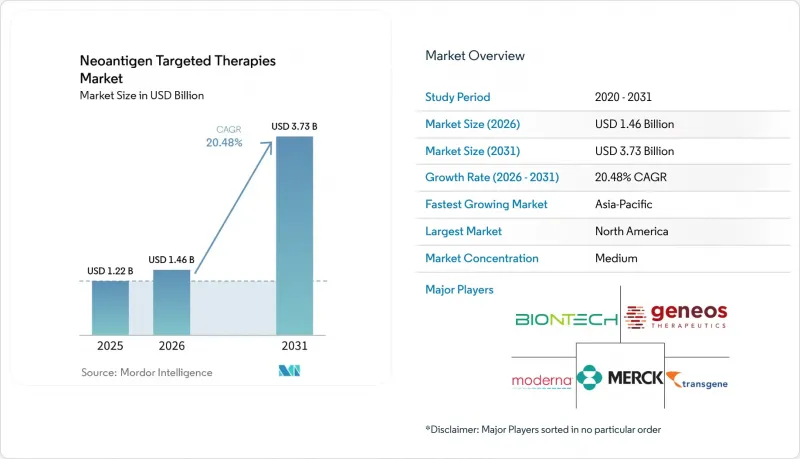
신생항원 표적치료 시장 규모는 2025년에 12억 2,000만 달러로 평가되었습니다. 2026년에 14억 6,000만 달러에서 2031년까지 37억 3,000만 달러에 이를 것으로 예측되며, 2026년부터 2031년에 걸쳐 CAGR 20.48%로 성장할 전망입니다.
본 보고서는 치료법 유형(단일 요법 및 병용 요법), 암 적응증(흑색종, 비소세포폐암 등), 전달 플랫폼(mRNA 기반 백신, 펩타이드 기반 백신 등), 최종 사용자(학술·연구 기관 등), 투여 경로(근육 내, 피하 등), 지역별로 분류되어 있습니다. 시장 규모 및 전망은 금액(달러) 기준으로 표시되어 있습니다.
세계의 신생항원 표적치료 시장 동향 및 인사이트
전 세계 암 발병률 증가
세계 암 발병률은 계속 증가하는 추세이며, 아시아가 전체 환자 수의 대부분과 사망자의 상당 부분을 차지하고 있기 때문에 지속적인 통제를 가능하게 할 새로운 치료법의 개발이 시급한 과제로 대두되고 있습니다. 2022년 신규 진단 사례 중 폐암, 유방암, 대장암이 가장 큰 비중을 차지했으며, 폐암과 간암은 여전히 암 사망의 주요 원인으로 남아 있어, 이로 인해 새로운 보조 요법 및 유지 요법에 대한 수요가 계속해서 증가하고 있습니다. 저선량 CT 프로그램 덕분에 대상 집단에서 조기 발견 사례가 증가하고 있으며, 이에 따라 거대한 종양이 아닌 미세 잔존 병변을 표적으로 하는 보조 백신 요법의 임상적 적용 기간이 확대되고 있습니다. 흑색종이나 흡연 관련 비소세포폐암(NSCLC)과 같이 돌연변이 부하가 높은 종양은 치료 가능한 신항원의 풍부한 공급원이 되며, 1차 상용화 과정에서 계속해서 주목받고 있습니다. 소아암이나 변이 부하가 낮은 육종은 표적이 적기 때문에 현재 투자는 표적 밀도와 면역학적 가시성이 높으며 지속적인 T세포 반응이 기대되는 성인 상피성 악성 종양에 집중되고 있습니다.
고속 시퀀싱과 생물정보학의 발전
HLA-펩타이드 결합 예측의 검증 정확도는 향상되고 있으며, 최신 도구는 실험적 분석법과 높은 일치율을 보여, 신뢰성 높은 에피토프 선정을 가능하게 하고 있습니다. RNA 시퀀싱을 통해 예측된 신항원의 대부분이 실제로 발현되는 것으로 확인되었으며, 이를 통해 위양성이 감소하고 전사량이 낮은 표적을 제외함으로써 제조 효율이 향상됩니다. 생물정보학 분야의 품질 관리는 규제 당국의 주요 관심사로 대두되고 있으며, 미국 및 유럽의 지침에서는 감사 추적, 버전 관리, 그리고 머신러닝 기반 파이프라인에 대한 철저한 검증이 요구되고 있습니다.
연구용 파이프라인에서 신청 준비가 완료되어 감사 가능한 엔진으로의 전환은 시퀀싱의 규모와 검증된 인실리코 예측 및 전사 산물의 확인을 결합함으로써, IND 신청 서류의 효율화를 도모하는 스폰서에게 유리하게 작용합니다. 플랫폼 검증 체계가 강화됨에 따라, 신생항원 표적치료제 시장은 설계부터 임상까지의 주기가 단축되고, 제조된 배치에서 의도된 면역 반응을 유도할 확률이 높아지는 이점을 누리고 있습니다. 네오항원 표적
제조 과정의 복잡성, 소요 시간 및 환자 1인당 비용
맞춤형 백신 제조에는 생검 채취, 종양 및 정상 조직의 염기서열 분석, 에피토프 선정, GMP 제조 등 상호 의존적인 일련의 단계가 필요하며, 이로 인해 일정상의 압박과 비용에 대한 민감성이 발생합니다. 지역 간 분산형 GMP 생산 능력의 격차가 여전히 존재하고 있으며, 이로 인해 규모 확대가 지연되고, 택배망이나 냉장 보관 인프라가 제한적인 지역에서 공평한 접근이 어려워지고 있습니다. 로트별 편차와 개별화된 품질 관리는 대규모의 균일한 로트에서는 비용을 분산할 수 없는 추가적인 시험 공정을 필요로 하며, 이는 기존 백신의 경제성과는 다릅니다. 스폰서가 생물정보학을 통해 선정 과정을 효율화하고 출시 시험을 표준화함으로써 처리 능력의 향상이 기대되지만, 생산 능력의 분포는 단기적인 지역 확장에 있어 여전히 중요한 제약 요인으로 남아 있습니다. 이러한 운영상의 제약으로 인해, 더 많은 거점과 훈련을 받은 인력, 그리고 조율된 프로토콜을 통해 일관되고 시기적절한 공급이 확대될 때까지는 신생항원 표적치료제 시장의 단기적인 보급 곡선이 억제될 것입니다.
부문별 분석
2025년 매출액 중 58.42%를 병용 요법이 차지했습니다. 이는 많은 고형암에서 체크포인트 억제제 단독 요법의 반응률 상한선을 초과하기 때문에 임상의들이 네오항원 백신을 PD-1 또는 PD-L1 억제제와 병용 투여했기 때문입니다. 단일제 요법은 종양 부하가 제한적이고 검증된 바이오마커가 존재하며, 백신 주도의 조절이 유리한 보조 요법에서의 사용에 힘입어 2031년까지 연평균 성장률(CAGR) 22.56%로 가장 빠르게 성장할 것으로 예측됩니다. 신생항원 표적치료 시장에서는 플랫폼이 장기 지속성 있는 기억 면역 반응을 목표로 페이로드 설계 및 투여 일정을 개선하는 한편, 임상적 이점을 확보하기 위해 병용 요법의 기반이 활용되고 있습니다. 절제된 흑색종 환자에서 맞춤형 mRNA 백신과 PD-1 요법의 병용 요법은 체크포인트 억제제 단독 요법에 비해 재발 또는 사망 위험을 감소시켰습니다. 이를 통해 병용 요법의 유효성이 입증됨에 따라, 다른 고위험군 환자를 대상으로 한 임상시험 활동이 활발해지고 있습니다. 데이터가 축적됨에 따라 임상시험 수행 기관은 유효성과 면역 관련 이상반응 간의 균형을 맞추기 위해 투여 순서와 시기를 평가하고 있으며, 안전성과 유효성이 일관되게 나타나는 경우 동시 투여 요법이 지지를 얻고 있습니다.
지속적인 T세포 기억에 관한 증거가 축적됨에 따라, 한정된 횟수의 보조 백신 접종이 지지되는 반면, 전이성 질환의 구제 요법이나 면역 억제가 현저한 종양의 경우, 체크포인트 억제제가 여전히 중심적인 역할을 수행하고 있습니다. 페이로드 공학의 발전에 따라, 바이오마커 양성 코호트에서 체크포인트 관련 독성 증가 없이 강력한 무재발 생존율이 확인될 경우, 단일 요법이 특정 보조 요법의 기반이 될 가능성이 있습니다. 또한, 각 후원사는 항원 제시를 확대하고 T세포의 프라이밍을 개선하기 위해 투여 경로의 최적화를 추진하고 있으며, 이는 초기 질환 단계에서 단일 요법의 상대적 역할에 영향을 미칠 가능성이 있습니다.
2025년 매출액 중 31.57%를 흑색종이 차지했습니다. 이는 높은 종양 돌연변이 부하(TMB)와 진행성 보조 요법 프로그램에 대한 강력한 임상적 관심에 힘입은 것입니다. 비소세포폐암(NSCLC) 시장은 2031년까지 연평균 성장률(CAGR) 23.61%로 확대될 것으로 예측됩니다. 이는 신규 환자 수가 많다는 점과, 백신 도입을 위한 치료 경로를 마련하기 위해 면역종양학을 도입한 데 따른 성장세에 힘입은 것입니다. 흑색종 및 흡연 관련 폐암에서 높은 TMB(종양 돌연변이 부하)가 지닌 생물학적 특성은 풍부한 네오에피토프를 제공하며, 이는 항원 회피를 방지하도록 설계된 다중 에피토프 페이로드와 일치합니다. 중추신경계(CNS) 종양 및 기타 면역 억제 환경에서는 전달과 관련된 과제가 남아 있지만, 보조적 전략이나 수송 능력의 개선을 통해 특정 프로그램에서 생존 기간의 연장이 확인되었습니다. 적응증에 관계없이, 보조 요법이나 MRD(잔존 병변)에 기반한 접근법이 주를 이룹니다. 이는 질환이 T세포에 의한 제거에 가장 취약한 시기에 면역계를 활성화하기 위함입니다.
수지상 세포 백신 및 종양 용해물 백신에서 얻은 증거는 교모세포종과 같이 치료가 어려운 환경에서도 생존 기간의 개선을 입증하고 있으며, 전달상의 장벽이 해결된다면 항원 지향적 프라이밍의 잠재적 가능성이 더욱 강화될 것입니다. 신세포암 및 기타 면역원성을 지닌 고형 종양의 경우, 초기 임상시험에서 강력한 항원 특이적 반응이 확인되었으며, 백신 주도 보조 요법 분야의 혁신을 이끄는 핵심 요소로 계속해서 주목받고 있습니다. 바이오마커로 정의된 하위 그룹이 임상시험 설계에서 표준화됨에 따라, 신생항원 표적치료제 시장은 흑색종 중심의 수익 구조에서 더 규모가 큰 폐암 및 대장암 시장으로 다각화될 것입니다. 데이터 세트가 확대됨에 따라, 검증된 ctDNA를 통한 계층화 및 충분히 특성화된 신항원 지형을 갖춘 적응증이 백신을 일상적인 치료 경로에 도입하는 첫 번째 대상이 될 것입니다.
지역별 분석
북미는 임상시험의 밀도, 시퀀싱 인프라의 집중, 그리고 보조 백신의 통합을 수용할 수 있는 확립된 면역종양학 치료 경로를 바탕으로 2025년 매출의 35.23%를 차지했습니다. 해당 지역에서는 흑색종 및 폐암을 대상으로 한 제3상 임상시험이 지속적으로 진행되고 있으며, 주요 후원사 측에서는 추적 관찰 기간 연장 및 기타 종양 유형으로의 확대가 보고되고 있습니다. 북미의 신생항원 표적치료 시장은 생태계 구축이 진전되고 있는 혜택을 누리고 있지만, 보다 광범위한 접근성은 성숙한 무재발 생존 기간 데이터에 따라 결정되는 보험 적용 여부에 좌우될 것입니다. 병원 네트워크가 세포 치료의 워크플로우를 백신 물류에 적용함에 따라, 수술 후 첫 투여까지의 기간이 단축될 것으로 예상되며, 보조 요법의 적용 기간 활용도도 개선될 것입니다.
유럽은 EU 차원의 일관된 촉진 메커니즘과 우선 대상국에서의 국가 차원 지원 프로그램에 힘입어, 견고한 수익 기반과 충실한 인프라를 유지하고 있습니다. 영국 국민보건서비스(NHS) 프로그램은 환자 등록 및 다기관 서비스 제공을 조정하기 위한 체계적인 경로를 제공함으로써, 학술 연구센터 이외의 기관에서도 운영 역량이 확대되고 있습니다. 유럽의 신생항원 표적치료 시장은 보조 요법 적응증에서 환자 수가 증가함에 따라, 조정된 임상시험 네트워크와 실세계 데이터 수집의 혜택을 받을 것으로 전망됩니다. 검증된 바이오마커와 방법론의 투명성에 대한 지속적인 노력은 지역별 도입 동향을 형성하는 의료 기술 평가 및 가격 책정에 관한 논의를 뒷받침할 것입니다.
아시아태평양은 유전체 인프라에 대한 투자와 수술 후 치료에 대한 강력한 수요를 유발하는 암 발병률 증가에 힘입어 연평균 성장률(CAGR) 25.72%로 가장 빠른 성장세를 기록할 것으로 전망됩니다. 주요 시장에서 활발하게 진행되는 학술 프로그램과 확대되는 임상시험 역량은 대규모 생산과 신속한 처리 시간을 위한 기반을 마련하고 있습니다. 특정 국가들의 HLA 집단 분포는 공유 네오항원 전략을 뒷받침하고 있으며, 이를 통해 예방 및 보조 요법 분야에서 단위당 경제성이 향상될 가능성이 있습니다. 아시아태평양 이외의 지역에서는 라틴아메리카에서 표적 치료와 관련하여 병원체 관련 악성 종양에 초점을 맞춘 초기 단계의 노력이 진행되고 있으며, 이를 통해 해당 지역의 면역 치료 포트폴리오가 확대되고 있습니다. 모든 지역을 통틀어, 신생항원 표적치료제 시장 점유율 분포는 바이오마커 도입 속도, 보험 급여 제도의 명확화, 그리고 학술 기관에서 전국 병원 시스템으로의 분산형 GMP 역량 확산과 계속해서 연동될 것입니다.
기타 혜택 :
- 엑셀 형식 시장 예측(ME) 시트
- 3개월간의 애널리스트 지원
자주 묻는 질문
목차
제1장 서론
제2장 조사 방법
제3장 주요 요약
제4장 시장 구도
제5장 시장 규모 및 성장 예측
제6장 경쟁 구도
제7장 시장 기회 및 향후 전망
KTH 26.06.26According to Mordor Intelligence, the neoantigen targeted therapies market size is projected to be USD 1.22 billion in 2025, USD 1.46 billion in 2026, and reach USD 3.73 billion by 2031, growing at a CAGR of 20.48% from 2026 to 2031.
This report is Segmented by Therapy Type (Monotherapy and Combination Therapy), Cancer Indication (Melanoma, Non-Small Cell Lung Cancer, and More), Delivery Platform (mRNA-Based Vaccines, Peptide-Based Vaccines, and More), End User (Academic & Research Institutes, and More), Route of Administration (Intramuscular, Subcutaneous, and More), and Geography. The Market and Forecasted in Terms of Value (USD).
Global Neoantigen Targeted Therapies Market Trends and Insights
Rising Global Cancer Incidence
Global cancer incidence continues to grow, with Asia bearing a majority of cases and a large share of mortality, which elevates the urgency for new modalities that deliver lasting control. Lung, breast, and colorectal cancers accounted for the largest portions of new diagnoses in 2022, and lung and liver cancers have remained leading contributors to cancer mortality, which continues to pull demand toward new adjuvant and maintenance options. Low-dose CT programs are increasing early-stage detection in eligible populations, which widens the clinical window for adjuvant vaccination that targets minimal residual disease rather than bulky tumors. Tumors with high mutational burdens like melanoma and smoking-related NSCLC offer richer pools of actionable neoantigens and remain focal points for first-wave commercialization. Pediatric cancers and low-mutational-burden sarcomas yield fewer targets, so current investment is concentrated in adult epithelial malignancies where target density and immune visibility support durable T-cell responses.
Advances in High-Throughput Sequencing and Bioinformatics
Validation of HLA-peptide binding predictions is improving, with modern tools demonstrating high concordance against experimental assays and enabling higher-confidence epitope selection. RNA sequencing corroborates the expression of a large share of predicted neoantigens, which reduces false positives and improves manufacturing utilization by filtering out low-transcript targets. Quality management in bioinformatics has become a regulatory focal point, with U.S. and European guidance pushing for audit trails, version control, and robust validation of machine-learning-based pipelines.
The shift from research-grade pipelines to submission-ready, auditable engines favors sponsors that combine sequencing scale with validated in silico prediction and transcript confirmation to streamline IND dossiers. As platform validation strengthens, the neoantigen targeted therapies market benefits from shortened design-to-clinic cycles and a higher probability that manufactured batches induce the intended immune response. neoantigen-targeted
Manufacturing Complexity, Turnaround Time, and Cost per Patient
Personalized vaccine production requires a series of interdependent steps that include biopsy procurement, tumor-normal sequencing, epitope selection, and GMP manufacturing, which creates schedule pressure and cost sensitivity. Decentralized GMP capacity remains uneven across regions, which slows scale-up and complicates equitable access where courier chains or cold storage infrastructure are limited. Batch-by-batch variability and individualized quality control add layers of testing that do not amortize across large uniform lots, which is unlike conventional vaccine economics. As sponsors streamline bioinformatics selection and standardize release testing, throughput is expected to improve, yet capacity distribution remains a gating factor in near-term regional rollouts. These operational constraints temper near-term adoption curves in the neoantigen targeted therapies market until more hubs, trained personnel, and harmonized protocols expand consistent, timely delivery.
Other drivers and restraints analyzed in the detailed report include:
- Positive Late-Stage Clinical Readouts in Personalized Neoantigen Immunotherapies
- Regulatory and Investor Support for Individualized Oncology
- Clinical and Logistical Challenges Across Biopsy-Sequencing-Manufacturing Chain
For complete list of drivers and restraints, kindly check the Table Of Contents.
Segment Analysis
Combination therapy accounted for 58.42% of 2025 revenue as clinicians layered neoantigen vaccines with PD-1 or PD-L1 inhibitors to push beyond the response ceilings of checkpoint monotherapy in many solid tumors. Monotherapy is projected to grow fastest at a 22.56% CAGR through 2031, helped by adjuvant use where limited tumor burden and validated biomarkers favor vaccine-led control. The neoantigen targeted therapies market is using combination backbones to lock in clinical benefit while platforms refine payload design and dosing schedules that aim for long-lived memory responses. In resected melanoma, a personalized mRNA vaccine plus PD-1 therapy reduced the risk of recurrence or death over checkpoint monotherapy, which validated the combination thesis and increased trial activity across other high-risk settings. As datasets accrue, sponsors are evaluating sequence and timing to balance efficacy with immune-related adverse events, with concurrent regimens gaining traction where safety and benefit are consistent.
Growing evidence for durable T-cell memory supports finite-course adjuvant vaccination, while checkpoint agents remain central for metastatic salvage or in tumors where immune suppression is substantial. As payload engineering improves, monotherapy may anchor select adjuvant regimens where biomarker-enriched cohorts show strong recurrence-free survival without added checkpoint toxicity. Sponsors are also optimizing delivery routes to broaden antigen presentation and improve T-cell priming, which can influence the relative role of monotherapy in early-stage disease.
Melanoma contributed 31.57% of 2025 revenue, supported by high tumor mutational burden and strong clinical visibility from advanced adjuvant programs. NSCLC is expected to expand at a 23.61% CAGR to 2031, helped by large incident populations and momentum from immuno-oncology adoption that primes the care pathway for vaccine integration. High TMB biology in melanoma and smoking-related lung cancer provides abundant neoepitopes, which align with multi-epitope payloads designed to prevent antigen escape. In CNS tumors and other immune-cold settings, delivery challenges remain, though adjunctive strategies and improved trafficking have shown survival gains in select programs. Across indications, adjuvant and MRD-guided approaches are central because they engage the immune system when disease is most vulnerable to T-cell-mediated clearance.
Evidence from dendritic cell and tumor lysate vaccines has demonstrated survival improvements in difficult settings like glioblastoma, reinforcing the potential of antigen-directed priming when delivery barriers are addressed. Renal cell carcinoma and other solid tumors with immunogenic features have shown robust antigen-specific responses in early trials, which keeps them in focus for vaccine-led adjuvant innovation. The neoantigen targeted therapies market will likely diversify from melanoma-led revenue toward larger lung and colorectal opportunities as biomarker-defined subgroups become standard in trial designs. As datasets scale, indications with validated ctDNA stratification and well-characterized neoantigen landscapes should be first to embed vaccines into routine care pathways.
Geography Analysis
North America held 35.23% of 2025 revenue due to clinical trial density, concentration of sequencing infrastructure, and established immuno-oncology care pathways that can absorb adjuvant vaccine integration. The region continues to run pivotal studies in melanoma and lung cancer, with leading sponsors reporting extended follow-up and expansion into additional tumor types. The neoantigen targeted therapies market in North America benefits from ecosystem readiness, yet broader access will track with coverage decisions that hinge on mature recurrence-free survival data. As hospital networks adapt cell therapy workflows to vaccine logistics, time-to-first-dose post-surgery is expected to shorten, improving utilization of adjuvant windows.
Europe maintains a substantial revenue base and infrastructure depth, supported by cohesive facilitation mechanisms at the EU level and national delivery programs in priority countries. NHS England's program provides a structured channel for enrolling patients and coordinating multi-site delivery, which broadens operational capacity beyond academic centers. The neoantigen targeted therapies market in Europe is set to benefit from coordinated trial networks and real-world data collection as patient numbers rise across adjuvant indications. Sustained focus on validated biomarkers and method transparency will support health technology assessments and pricing dialogues that shape regional uptake trajectories.
Asia-Pacific is projected to post the fastest growth at a 25.72% CAGR, supported by investment in genomic infrastructure and a rising incident cancer burden that creates strong demand for post-surgical interventions. Active academic programs and expanding trial capacity in large markets are laying the groundwork for scaled manufacturing and faster turnaround times. Population HLA distributions in select countries support shared-neoantigen strategies, which can improve unit economics in prevention or adjuvant niches. Outside APAC, targeted activity in Latin America includes early-phase initiatives focused on pathogen-linked malignancies that broaden regional immunotherapy portfolios. Across regions, the neoantigen targeted therapies market share distribution will continue to track the pace of biomarker adoption, reimbursement clarity, and the diffusion of decentralized GMP capacity from academic nodes into national hospital systems.
- Achilles Therapeutics plc
- BioNTech
- CureVac N.V.
- Elicio Therapeutics, Inc.
- Evaxion Biotech A/S
- Genentech
- Geneos Therapeutics, Inc.
- Gritstone bio, Inc.
- Immatics N.V.
- Merck
- Moderna
- Nouscom AG
- Nykode Therapeutics ASA
- Transgene
Additional Benefits:
- The market estimate (ME) sheet in Excel format
- 3 months of analyst support
TABLE OF CONTENTS
1 Introduction
- 1.1 Study Assumptions & Market Definition
- 1.2 Scope of the Study
2 Research Methodology
3 Executive Summary
4 Market Landscape
- 4.1 Market Overview
- 4.2 Market Drivers
- 4.2.1 Rising Global Cancer Incidence
- 4.2.2 Advances in High-Throughput Sequencing and Bioinformatics
- 4.2.3 Positive Late-Stage Clinical Readouts in Personalized Neoantigen Immunotherapies
- 4.2.4 Regulatory and Investor Support for Individualized Oncology
- 4.2.5 Shift to Adjuvant or MRD-Guided Use Enabled by ctDNA-Based Patient Selection
- 4.2.6 Emergence of Shared Frameshift Neoantigen Products Expanding Treatable Populations
- 4.3 Market Restraints
- 4.3.1 Manufacturing Complexity, Turnaround Time, and Cost per Patient
- 4.3.2 Clinical and Logistical Challenges Across Biopsy to Sequencing to Manufacturing Chain
- 4.3.3 Uncertain Reimbursement Models for Individualized Therapies
- 4.3.4 Tumor Heterogeneity and Antigen Escape Limiting Durability
- 4.4 Value / Supply-Chain Analysis
- 4.5 Regulatory Landscape
- 4.6 Technological Outlook
- 4.7 Porters Five Forces Analysis
- 4.7.1 Threat of New Entrants
- 4.7.2 Bargaining Power of Buyers
- 4.7.3 Bargaining Power of Suppliers
- 4.7.4 Threat of Substitutes
- 4.7.5 Competitive Rivalry
5 Market Size & Growth Forecasts (Value, USD)
- 5.1 By Therapy Type
- 5.1.1 Monotherapy
- 5.1.2 Combination Therapy
- 5.2 By Cancer Indication
- 5.2.1 Melanoma
- 5.2.2 Non-small Cell Lung Cancer (NSCLC)
- 5.2.3 Colorectal Cancer (MSI-H/dMMR)
- 5.2.4 Pancreatic Ductal Adenocarcinoma (PDAC)
- 5.2.5 Ovarian Cancer
- 5.2.6 Others
- 5.3 By Delivery Platform
- 5.3.1 mRNA-based Vaccines
- 5.3.2 Peptide-based Vaccines
- 5.3.3 DNA-based Vaccines
- 5.3.4 Others
- 5.4 By End User
- 5.4.1 Academic & Research Institutes
- 5.4.2 Tertiary Care Hospitals
- 5.4.3 Specialty Oncology Centers/Infusion Clinics
- 5.5 By Route of Administration
- 5.5.1 Intramuscular
- 5.5.2 Subcutaneous
- 5.5.3 Intradermal
- 5.5.4 Others
- 5.6 By Geography
- 5.6.1 North America
- 5.6.1.1 United States
- 5.6.1.2 Canada
- 5.6.1.3 Mexico
- 5.6.2 Europe
- 5.6.2.1 Germany
- 5.6.2.2 United Kingdom
- 5.6.2.3 France
- 5.6.2.4 Italy
- 5.6.2.5 Spain
- 5.6.2.6 Rest of Europe
- 5.6.3 Asia-Pacific
- 5.6.3.1 China
- 5.6.3.2 India
- 5.6.3.3 Japan
- 5.6.3.4 Australia
- 5.6.3.5 South Korea
- 5.6.3.6 Rest of Asia-Pacific
- 5.6.4 Middle East and Africa
- 5.6.4.1 GCC
- 5.6.4.2 South Africa
- 5.6.4.3 Rest of Middle East and Africa
- 5.6.5 South America
- 5.6.5.1 Brazil
- 5.6.5.2 Argentina
- 5.6.5.3 Rest of South America
- 5.6.1 North America
6 Competitive Landscape
- 6.1 Market Concentration
- 6.2 Market Share Analysis
- 6.3 Company Profiles (includes Global Level Overview, Market Level overview, Core Segments, Financials as Available, Strategic Information, Market Rank/Share for Key Companies, Products & Services, and Recent Developments)
- 6.3.1 Achilles Therapeutics plc
- 6.3.2 BioNTech SE
- 6.3.3 CureVac N.V.
- 6.3.4 Elicio Therapeutics, Inc.
- 6.3.5 Evaxion Biotech A/S
- 6.3.6 Genentech, Inc.
- 6.3.7 Geneos Therapeutics, Inc.
- 6.3.8 Gritstone bio, Inc.
- 6.3.9 Immatics N.V.
- 6.3.10 Merck & Co., Inc.
- 6.3.11 Moderna, Inc.
- 6.3.12 Nouscom AG
- 6.3.13 Nykode Therapeutics ASA
- 6.3.14 Transgene SA
7 Market Opportunities & Future Outlook
- 7.1 White-space & Unmet-need Assessment