
|
시장보고서
상품코드
2063600
HER2 검사 시장 : 점유율 분석, 업계 동향과 통계, 성장 예측(2026-2031년)HER2 Testing - Market Share Analysis, Industry Trends & Statistics, Growth Forecasts (2026 - 2031) |
||||||
 Mordor Intelligence
Mordor Intelligence에 의하면, HER2 검사 시장 규모는 2025년에 2억 1,746만 달러로 평가되었고 2026년 2억 3,482만 달러에서 2031년까지 3억 4,686만 달러에 이를 것으로 예측되며, 예측 기간(2026-2031년) CAGR은 8.09%를 나타낼 전망입니다.
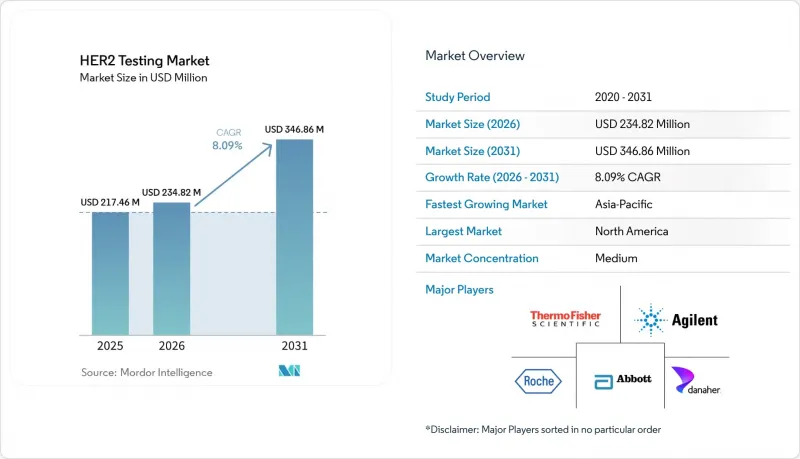
본 보고서는 검사법(IHC, ISH, PCR/DPCR, NGS/CGP), 검체 유형(조직/FFPE, 체액 생검), 암 유형(유방암, 위암/위식도 접합부암, 비소세포폐암, 대장암, 담도·췌장암), 최종 사용자(병원·학술 연구소, 참조 실험실, 조사 기관·CRO), 지역(북미, 남미, 유럽, 아시아태평양, 중동 및 아프리카)별로 분류되어 있습니다. 시장 전망은 금액(달러) 단위로 제시되어 있습니다.
전 세계 HER2 검사 시장 동향 및 인사이트
HER2 저발현 적응증 확대로 인해 검사 대상 인구가 증가
2025년 1월, FDA는 로슈사의 PATHWAY HER2(4B5) 토끼 단일클론 항체를 승인함으로써, HER2 초저발현을 확인하는 것이 가능해졌습니다. 이러한 중요한 진전을 통해 트라스투주맙 델쿠스테칸의 적응증이 기존에 HER2 음성으로 분류되었던 환자까지 확대되었습니다. 현재 검사실에서는 IHC 0과 1+를 구분해야 할 필요가 있으며, 이로 인해 슬라이드 처리량이 증가하고 외부 정확도 관리 프로그램에 대한 수요가 높아지고 있습니다. 2024년 연구에 따르면, HER2 저발현 평가에서 병리 의사 간의 일치율이 불과 60-75%에 불과한 것으로 밝혀졌으며, 판독의 표준화를 도모하기 위해 전체 슬라이드 이미징 및 AI 도입이 추진되었습니다. 재검사율의 상승으로 인해 시약 소비량이 증가하고 품질 관리 실시 빈도도 높아지고 있으며, 이는 HER2 검사 시장의 꾸준한 성장에 기여하고 있습니다.
종양 유형에 관계없이 HER2 양성 승인으로 검사 대상이 확대됨
2026년 3월, 일본은 트라스투주맙-델쿠스테칸에 대해 종양 유형과 무관한 승인을 부여하고, 병리학자에게 거의 모든 고형암에 대한 HER2 수준 평가를 의무화했습니다. 이번 결정은 2024년 4월 FDA가 내린 조직 비의존적 승인을 반영한 것으로, 이에 따라 미국의 종양 센터에서는 대장암, 폐암, 담도암, 췌장암 치료 프로토콜에 HER2 면역염색이 포함되게 되었습니다. 2025년 7월에 실시된 65,000건의 종양 사례를 대상으로 한 분석 결과, 방광암 및 자궁내막암의 약 10%에서 치료 대상이 되는 HER2 양성이 확인되어, 활용되지 않은 검체 수가 부각되었습니다. 이러한 검사 요건의 확대는 독립 검사 기관, 특히 HER2를 KRAS, BRAF, MSI 마커와 결합한 종합적인 패널을 제공하는 기관에 상당한 수익 성장을 가져다주며, HER2 검사 시장을 더욱 공고히 하고 있습니다.
저발현 영역(0 대 1+)에서 IHC의 재현성 문제
IHC 0과 1+ 사이의 미세한 막 염색 차이는 판정 결과의 편차를 초래하여, 적격 환자에게 치료 기회를 놓치게 할 가능성이 있습니다. 2024년 스웨덴에서 실시된 조사에 따르면, 저발현 검체에 대한 정확도 기준을 충족한 검사실은 절반에 불과했습니다. 이러한 편차는 저온 허혈, 고정 불량, 항체 선택 등의 요인에 기인하며, 외부 품질 평가 프로그램 및 디지털 영상 분석에 대한 수요를 높이고 있습니다. 이러한 지속적인 불일치는 의사의 신뢰를 떨어뜨리고, 특히 자원이 제한된 지역에서 HER2 검사 시장의 성장을 저해하고 있습니다.
부문별 분석
조직 내 단백질 시각화를 권장하는 지침에 따라, 면역조직화학법은 2025년 HER2 검사 시장 매출의 48.19%를 차지할 것으로 전망됩니다. 2031년까지 연평균 9.56%의 성장이 예상되는 차세대 염기서열 분석(NGS)은 ERBB2의 복제 수 및 변이 분석을 위한 실험실의 종합 패널에 점차 포함되고 있습니다. NGS(차세대 염기서열 분석) 기반의 HER2 검사 시장은 자니다타맙 및 종겔티닙의 동반진단제 승인과 함께 확대될 전망입니다. 인 시투 하이브리다이제이션은 IHC 2+ 판정이 모호한 사례에서 주로 사용되는 확인 방법이지만, AI를 활용한 IHC를 통해 초기 판정의 정확도가 향상됨에 따라 그 비중은 감소하고 있습니다.
FFPE 조직은 조직병리학 분야에서 오랫동안 수행해 온 역할 덕분에, 2025년 HER2 검사 시장의 검사 건수 중 85.19%를 차지하는 압도적인 점유율을 기록하고 있습니다. 조직 검체는 단백질 및 유전자 평가 분야에서 골드 스탠다드로 인정받고 있어, 안정적인 보험 급여 지원을 받고 있습니다. HER2 검사 분야의 액체 생검 시장 규모는 아직 작지만 빠르게 확대되고 있으며, 2031년까지 연평균 성장률(CAGR) 10.56%로 성장할 것으로 전망됩니다. 혈장 기반 검사법은 접근이 어려운 전이 병변에 대해 매우 유용함이 입증되었으며, 새로운 생검 없이도 지속적인 모니터링을 가능하게 합니다.
지역별 분석
2025년, 북미는 광범위한 보험 적용과 디지털 병리학의 급속한 확산에 힘입어 HER2 검사 시장 매출의 43.12%를 차지했습니다. 미국에서는 FDA가 동반진단제를 지속적으로 승인하고 있으며, HER2 평가가 치료 과정에 포함되어 있습니다. 한편, 캐나다에서는 공적 자금을 바탕으로 한 의료 제도의 지원과 미국 지침 준수를 통해 안정적인 검사 건수가 확보되고 있습니다.
아시아태평양은 중국과 일본의 규제 당국이 트라스츠주마브-델쿠스테칸의 적응증을 확대함에 따라, 2031년까지 연평균 성장률(CAGR) 10.43%를 달성할 것으로 전망됩니다. 2026년 3월 중국에서 승인된 유방암 수술 전 치료(네오아쥬반트 요법)는 HER2 검사를 더 초기 병기로 확대함으로써 환자 1인당 필요한 슬라이드 수를 증가시킵니다. 2024년, 인도의 타타 메모리얼 센터는 허브 앤 스포크 방식의 디지털 병리 모델을 도입하여 지역 병원들이 중앙 집중화된 전문가들의 판독 서비스를 이용할 수 있도록 했습니다. 한국의 K-MASTER 플랫폼은 HER2 검사를 국가 차원의 정밀의료 이니셔티브에 포함시켜 보험 급여를 확보하는 한편, 표준화를 추진하고 있습니다.
유럽에서는 일관된 ESMO 지침과 ISO 품질 기준에 따라 운영되고 있지만, 보험 급여 정책의 차이로 인한 가격 편차를 겪고 있으며, 이로 인해 프리미엄 NGS 패널의 도입이 지연되고 있습니다. 독일, 프랑스, 영국은 검사 건수 면에서 선도적인 위치를 차지하고 있으며, 이는 검사 결과 보고 기간을 단축하는 로슈사의 CE 마크를 획득한 영상 분석 시스템 ‘navify’에 힘입은 바 큽니다. 한편, 라틴아메리카와 중동은 인프라 측면에서 과제에 직면해 있지만, 튀르키예, 사우디아라비아, 브라질에서의 전략적 투자를 통해 새로운 검사실이 설립되면서 HER2 검사 시장이 확대되고 있습니다.
기타 혜택:
- 엑셀 형식 시장 예측(ME) 시트
- 3개월간의 애널리스트 지원
자주 묻는 질문
목차
제1장 서론
제2장 조사 방법
제3장 주요 요약
제4장 시장 구도
제5장 시장 규모와 성장 예측
제6장 경쟁 구도
제7장 시장 기회와 향후 전망
JHS 26.06.23According to Mordor Intelligence, the hER2 testing market size was valued at USD 217.46 million in 2025 and is estimated to grow from USD 234.82 million in 2026 to reach USD 346.86 million by 2031, at a CAGR of 8.09% during the forecast period (2026-2031).
This report is Segmented by Test Modality (IHC, ISH, PCR/DPCR, NGS/CGP), Sample Type (Tissue/FFPE, Liquid Biopsy), Cancer Type (Breast, Gastric/GEJ, NSCLC, Colorectal, Biliary/Pancreatic), End User (Hospital/Academic Labs, Reference Labs, Research/CROs), and Geography (North America, South America, Europe, APAC, MEA). Market Forecasts are Provided in Value (USD).
Global HER2 Testing Market Trends and Insights
HER2-Low Eligibility Expands Tested Population
In January 2025, the FDA approved Roche's PATHWAY HER2 (4B5) rabbit monoclonal antibody, enabling the identification of HER2-ultralow expression. This significant development expanded the eligibility for trastuzumab deruxtecan to patients previously classified as HER2-negative. Laboratories are now required to differentiate between IHC 0 and 1+, a process that increases slide volumes and drives demand for external proficiency programs. Studies in 2024 revealed only 60-75% agreement among pathologists in HER2-low scoring, prompting the adoption of whole-slide imaging and AI to standardize readings. The rise in retest rates has led to higher reagent consumption and more frequent quality-control runs, contributing to the steady growth of the HER2 testing market.
Tumor-Agnostic HER2-Positive Approvals Widen Testing Across Tumor Types
In March 2026, Japan granted a tumor-agnostic authorization for trastuzumab deruxtecan, requiring pathologists to evaluate HER2 levels across nearly all solid tumors. This decision mirrored an FDA tissue-agnostic approval in April 2024, which prompted U.S. oncology centers to incorporate HER2 immunostaining into protocols for colorectal, lung, biliary, and pancreatic cancers. A July 2025 analysis of 65,000 tumors identified actionable HER2 positivity in nearly 10% of bladder and endometrial cancers, highlighting untapped sample volumes. This expanded testing requirement has driven significant revenue growth for independent reference laboratories, particularly those bundling HER2 with KRAS, BRAF, and MSI markers in comprehensive panels, further strengthening the HER2 testing market.
Low-End (0 vs 1+) IHC Reproducibility Challenges
Subtle membrane-staining differences between IHC 0 and 1+ result in variable readings, potentially withholding therapy from eligible patients. A 2024 survey in Sweden indicated that only half of laboratories met proficiency benchmarks on low-expression samples. Variation arises from factors such as cold ischemia, under-fixation, and antibody selection, driving the demand for external quality assessment programs and digital image analysis. These ongoing inconsistencies reduce physician confidence and limit the growth of the HER2 testing market, particularly in resource-constrained regions.
Other drivers and restraints analyzed in the detailed report include:
- Guideline-Mandated Testing in Breast and Gastric/GEJ Cancers
- Hospital and Lab Infrastructure Upgrades, Automation
- IHC-ISH Discordance and Pre-Analytical Variability
For complete list of drivers and restraints, kindly check the Table Of Contents.
Segment Analysis
Guidelines favoring protein visualization on tissue helped immunohistochemistry secure 48.19% of the HER2 testing market's 2025 revenue. Next-generation sequencing, projected to grow at an annual rate of 9.56% through 2031, is being integrated into laboratories' comprehensive panels for ERBB2 copy-number and mutation analysis. The market for NGS-based HER2 testing is set to rise alongside companion-diagnostic labels for zanidatamab and zongertinib. While in situ hybridization is the go-to confirmatory method for ambiguous IHC 2+ cases, its share is declining as AI-enhanced IHC improves first-pass accuracy.
FFPE tissue accounted for a dominant 85.19% of the HER2 testing market's 2025 volume, thanks to its longstanding role in histopathology. Tissue, being the gold standard for protein and gene assessment, enjoys robust reimbursement support. While the market size for liquid biopsy in HER2 testing is smaller, it is on a rapid ascent, projected to grow at a 10.56% CAGR through 2031. Plasma-based assays are proving invaluable for inaccessible metastatic lesions and enable serial monitoring without the need for new biopsies.
Geography Analysis
In 2025, North America accounted for 43.12% of the HER2 testing market revenue, driven by extensive insurance coverage and rapid adoption of digital pathology. The U.S. benefits from a consistent pipeline of FDA companion-diagnostic approvals, integrating HER2 assessments into treatment pathways. Meanwhile, Canada's adherence to U.S. guidelines, supported by its publicly funded healthcare system, ensures stable testing volumes.
Asia-Pacific is projected to achieve a 10.43% CAGR through 2031, as regulators in China and Japan expand indications for trastuzumab deruxtecan. China's approval in March 2026 for neoadjuvant breast cancer advances HER2 testing to earlier disease stages, increasing the number of slides required per patient. In 2024, Tata Memorial Centre in India implemented a hub-and-spoke digital pathology model, enabling regional hospitals to access centralized expert readings. South Korea's K-MASTER platform incorporates HER2 testing into a national precision medicine initiative, ensuring reimbursement and promoting standardization.
Europe, guided by consistent ESMO guidelines and ISO quality standards, faces price variability due to differing reimbursement policies, which slows the adoption of premium NGS panels. Germany, France, and the U.K. lead in volume, supported by Roche's CE-marked navify image analysis, which accelerates turnaround times. While Latin America and the Middle East encounter infrastructure challenges, strategic investments in Turkey, Saudi Arabia, and Brazil are establishing new laboratories and expanding the HER2 testing market's reach.
- Abbott Laboratories
- Agilent Technologies
- ARUP Laboratories
- Bio SB, Inc.
- Biocare Medical
- Caris Life Sciences, Inc.
- Danaher
- Roche
- Guardant Health
- Ibex Medical Analytics Ltd.
- Illumina
- LabCorp
- NeoGenomics Laboratories
- PathAI, Inc.
- Quest Diagnostics
- Sysmex
- Tempus Labs Inc.
- Thermo Fisher Scientific
- Visiopharm
- ZytoVision GmbH
Additional Benefits:
- The market estimate (ME) sheet in Excel format
- 3 months of analyst support
TABLE OF CONTENTS
1 Introduction
- 1.1 Study Assumptions & Market Definition
- 1.2 Scope of the Study
2 Research Methodology
3 Executive Summary
4 Market Landscape
- 4.1 Market Overview
- 4.2 Market Drivers
- 4.2.1 HER2-Low Eligibility Expands Tested Population
- 4.2.2 Tumor-Agnostic HER2-Positive Approvals Widen Testing Across Tumor Types
- 4.2.3 Guideline-Mandated Testing in Breast and Gastric/GEJ Cancers
- 4.2.4 Hospital and Lab Infrastructure Upgrades, Automation
- 4.2.5 Digital Pathology and AI Adoption Improves HER2 Scoring Throughput
- 4.2.6 Liquid Biopsy and CGP Panels Broaden Access to ERBB2 Assessment
- 4.3 Market Restraints
- 4.3.1 Low-End (0 Vs 1+) IHC Reproducibility Challenges
- 4.3.2 IHC-ISH Discordance and Pre-Analytical Variability
- 4.3.3 Skilled Personnel and QC Burden for Consistent HER2 Reads
- 4.3.4 Limited Validation of Ctdna for HER2-Low/Ultralow
- 4.4 Value Chain Analysis
- 4.5 Regulatory Landscape
- 4.6 Technological Outlook
- 4.7 Porter's Five Forces Analysis
5 Market Size & Growth Forecasts (Value, USD)
- 5.1 By Test Modality
- 5.1.1 Immunohistochemistry (IHC)
- 5.1.2 In Situ Hybridization (FISH, CISH, SISH)
- 5.1.3 PCR/dPCR
- 5.1.4 Next-Generation Sequencing (NGS/CGP)
- 5.2 By Sample Type
- 5.2.1 Tissue/FFPE Biopsy
- 5.2.2 Liquid Biopsy (Plasma ctDNA)
- 5.3 By Cancer Type / Application
- 5.3.1 Breast Cancer (incl. HER2-low)
- 5.3.2 Gastric & Gastroesophageal Junction Adenocarcinoma
- 5.3.3 Non-Small Cell Lung Cancer (HER2-altered)
- 5.3.4 Colorectal Cancer (HER2-amplified subset)
- 5.3.5 Biliary Tract & Pancreatic Cancers (HER2-positive subset)
- 5.4 By End User
- 5.4.1 Hospital & Academic Pathology Laboratories
- 5.4.2 Independent Reference/Central Laboratories
- 5.4.3 Research Institutes & CROs (clinical trials, translational)
- 5.5 By Geography
- 5.5.1 North America
- 5.5.1.1 United States
- 5.5.1.2 Canada
- 5.5.1.3 Mexico
- 5.5.2 Europe
- 5.5.2.1 Germany
- 5.5.2.2 United Kingdom
- 5.5.2.3 France
- 5.5.2.4 Italy
- 5.5.2.5 Spain
- 5.5.2.6 Rest of Europe
- 5.5.3 Asia-Pacific
- 5.5.3.1 China
- 5.5.3.2 India
- 5.5.3.3 Japan
- 5.5.3.4 South Korea
- 5.5.3.5 Australia
- 5.5.3.6 Rest of Asia-Pacific
- 5.5.4 Middle East and Africa
- 5.5.4.1 GCC
- 5.5.4.2 South Africa
- 5.5.4.3 Rest of Middle East and Africa
- 5.5.5 South America
- 5.5.5.1 Brazil
- 5.5.5.2 Argentina
- 5.5.5.3 Rest of South America
- 5.5.1 North America
6 Competitive Landscape
- 6.1 Market Concentration
- 6.2 Market Share Analysis
- 6.3 Company Profiles (includes Global level Overview, Market-level Overview, Core Segments, Financials, Strategic Information, Market Rank/Share, Products & Services, Recent Developments)
- 6.3.1 Abbott Laboratories
- 6.3.2 Agilent Technologies Inc.
- 6.3.3 ARUP Laboratories
- 6.3.4 Bio SB, Inc.
- 6.3.5 Biocare Medical, LLC
- 6.3.6 Caris Life Sciences, Inc.
- 6.3.7 Danaher Corporation
- 6.3.8 F. Hoffmann-La Roche AG
- 6.3.9 Guardant Health Inc.
- 6.3.10 Ibex Medical Analytics Ltd.
- 6.3.11 Illumina Inc.
- 6.3.12 Laboratory Corporation of America Holdings
- 6.3.13 NeoGenomics Laboratories, Inc.
- 6.3.14 PathAI, Inc.
- 6.3.15 Quest Diagnostics Incorporated
- 6.3.16 Sysmex Corporation
- 6.3.17 Tempus Labs Inc.
- 6.3.18 Thermo Fisher Scientific Inc.
- 6.3.19 Visiopharm A/S
- 6.3.20 ZytoVision GmbH
7 Market Opportunities & Future Outlook
- 7.1 White-space & unmet-need assessment