|
시장보고서
상품코드
2063620
임신중 약제 시장 : 점유율 분석, 업계 동향과 통계, 성장 예측(2026-2031년)Pregnancy Medication - Market Share Analysis, Industry Trends & Statistics, Growth Forecasts (2026 - 2031) |
||||||
 Mordor Intelligence
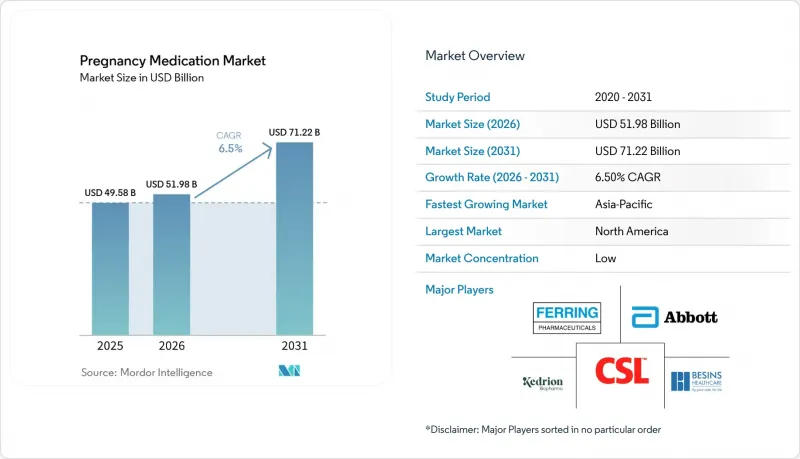
Mordor Intelligence에 의하면, 임신중 약제 시장 규모는 2025년에 495억 8,000만 달러로 평가되었고 2026년 519억 8,000만 달러에서 2031년까지 712억 2,000만 달러에 이를 것으로 예측되며, 예측 기간(2026-2031년) CAGR은 6.5%를 나타낼 전망입니다.
본 보고서는 약물 분류별(구토 억제제, 항고혈압제, 항당뇨병제 등), 적응증별(임신 초기 구토, 임신성 고혈압 증후군, Rh 면역 예방 등), 투여 경로별(경구 등), 유통 채널별(병원 약국 등) 및 지역별(북미 등)로 분류되어 있습니다. 시장 전망은 금액(달러) 기준으로 제시되어 있습니다.
세계 임신중 약제 시장 동향과 인사이트
임신 초기 구토 증상의 높은 유병률
임산부의 70%에서 80%가 입덧을 경험하며, 그중 일부는 입원 치료가 필요한 중증 입덧으로 진행됩니다. 독실라민 타르트레이트와 피리독신 염산염의 복합제에 대해서는 매우 대규모의 피험자 집단에서 기형 유발 징후가 관찰되지 않았다는 광범위한 안전성 데이터가 있으며, 이는 지침 개정 과정에서 이 약제가 1차 선택 약제로서의 역할을 뒷받침하고 있습니다. 캐나다 보건부가 아포텍스사의 서방형 독사민·피리독신 10mg/10mg 제제를 승인한 것을 비롯해, 이미 승인된 제네릭 의약품 시장 진입은 가격 경쟁을 유발하고, 비용에 민감한 환경에서 의약품 접근성을 확대하는 데 기여합니다. 몇 시간 후에 최고 농도에 도달하는 서방형 약동학 프로파일 덕분에 저녁에 투여할 수 있게 되어, 주로 아침에 나타나는 증상의 발생 시기와 더 적절하게 일치하므로, 외래 진료에서 복약 순응도 향상에 기여합니다. 이러한 요인들로 인해, 구토 억제제는 여전히 1차 치료의 핵심적인 위치를 차지하며, 임신 중 약물 시장의 기반을 계속 지탱하고 있습니다.
조산으로 인한 전 세계적 부담의 지속과 자궁 수축 억제 및 출생 전 코르티코스테로이드 투여의 필요성
조산은 여전히 신생아의 발병률 및 사망률의 주요 원인이며, 전 세계적인 기준은 출생 전 코르티코스테로이드 투여와 산모를 더 수준 높은 의료시설로 이송하기 위한 48시간의 유예 기간을 두는 기간 제한적인 진통 억제 요법으로 수렴되고 있습니다. WHO 지침에 따르면, 7일 이내에 조산이 예상되는 임신 24-34주 임산부에게 증거에 기반한 스테로이드 투여법으로 베타메타손 12mg을 24시간 간격으로 2회 근육 주사하거나, 또는 덱사메타손 6mg을 12시간 간격으로 4회 근육 내 투여하도록 규정하고 있습니다. 분만 중 자궁 수축 억제 요법은 신생아에게 주는 이점이 제한적이며, 산모의 위험이 높기 때문에 권장되지 않습니다. 따라서 외래 환경에서의 만성적인 자궁 수축 억제제 사용은 자제되며, 신생아에게 명확한 이점이 기대되는 기간으로만 사용이 제한되고 있습니다. 2023년 미국에서 17-하이드록시프로게스테론 카프로에이트가 시장에서 철수함에 따라, 재발성 조산 위험을 줄이기 위해 이전에 승인되었던 선택지가 사라지게 되었고, 적응증 외 사용이 허용된 대체 약물로 전환하거나 보다 면밀한 경과 관찰을 실시하는 방향으로 진료 방침이 바뀌었습니다. 급성기의 자궁 수축 억제 요법은 대부분의 경우, 기간이 정해진 프로토콜에 따라 니페디핀 또는 인도메타신을 단기간 투여하는 것을 중심으로 이루어지며, 이를 통해 신생아의 예후에 최대의 효과를 가져다주는 입원 기간에 맞추어 약물 조달이 조정됩니다.
FDA가 17-OHPC(마케나)의 승인을 취소함에 따라, 재발성 조산 예방을 위한 프로게스테론 사용이 제한됩니다.
미국 식품의약국(FDA)은 2023년 4월, 마케나(17-하이드록시프로게스테론 카프로에이트) 및 해당 의약품의 제네릭 의약품 판매 중단을 최종 결정했습니다. 이로 인해 과거에 자연 조산 이력이 있고 현재 단태 임신을 하고 있는 여성의 재발성 조산 위험을 줄이기 위해 미국에서 승인되었던 유일한 약물이 시장에서 사라지게 되었습니다. 이 결정으로 인해 임신중 약제 시장에서 확립되어 있던 하위 범주가 사라지게 되었으며, 임상의들은 고위험 환자에게 적응증 외 사용이 가능한 대체 약물을 처방하거나 더욱 면밀한 경과 관찰에 의존할 수밖에 없게 되었습니다. 또한, 이러한 변경 사항은 대체 평가 지표를 바탕으로 승인된 임신중 약제이 규제 당국의 지속적인 심사를 받고 있으며, 확인 시험에서 임상적 유효성이 입증되지 않을 경우 승인 후 취소로 이어질 수 있음을 시사하고 있으며, 이는 향후 개발 및 보험사의 심사에 영향을 미칠 가능성이 있습니다. 그 결과, 적응증 외 사용 중인 프로게스테론 제제에 대한 보험 적용 여부가 불투명해지고, 대규모 대체 사용이 제한됨에 따라 재발성 조산 위험 감소에 있어 치료상의 공백이 발생하고 있습니다. 의료 제도가 점차 정착됨에 따라, 이용 현황은 기간이 정해진 토코리시스 치료나 조산이 임박한 경우의 분만 전 코르티코스테로이드 투여 등, 근거에 기반한 급성기 프로토콜로 전환되고 있으며, 이로 인해 임신중 약제 시장에서 장기 투여용 프로게스테론 제제의 영역이 제한되고 있습니다.
부문별 분석
2025년 기준으로 구토 억제제는 임신중 약제 시장의 22.45%를 차지했으나, 당뇨병 치료제는 2031년까지 연평균 성장률(CAGR) 9.03%를 나타낼 것으로 예측되며, 산모의 고령화 및 비만에 따른 대사성 합병증 증가에 따라 임신중 약제 시장 전체를 상회하는 성장이 예상됩니다. 카이저 퍼머넌트의 2025년 6월 지침에서는 인슐린 그랄긴이 권장 기저 인슐린으로 지정되었으며, 메트포르민은 1일 2회 투여하는 서방형 제제로의 전환이 추진되었습니다. 이를 통해 복약 순응도가 향상되었으며, 통합 의료 시스템 내 처방집 변경 사항과도 일치합니다. 글리브리드를 1차 선택 약물로 권장하지 않는다는 전문가들의 권고에 따라, 치료는 인슐린과 메트포르민을 중심으로 통합되었으며, 임신중 약제 시장에서의 채택 추이를 더욱 예측하기 쉬워졌습니다. 혈압강하제는 라베타롤과 니페디핀을 주축으로 하는 꾸준히 성장하고 성숙한 분야로 자리매김하고 있습니다. 자간전증의 유병률이 증가하고, 입원 환경에서의 관리 기준이 엄격해짐에 따라, 임신 후기에서의 사용이 증가하고 있습니다. 반면, 자궁 수축 억제제는 WHO 지침에 따라 사용 기간이 48시간으로 제한되어 있어 적응증이 제한적입니다. 이로 인해 유지 요법이 줄어들면서, 신생아에게 효과가 입증된 기간에 사용이 집중되는 양상을 보이고 있습니다.
프로게스테론 시장은 2023년 미국에서 하이드록시프로게스테론 카프로에이트가 시장에서 철수한 이후 급격히 위축되었습니다. 이로 인해 적응증 외 사용에 대한 대체 약물에 대한 보험 적용을 일관되게 받을 수 없게 되었으며, 임신중 약제 업계에서 대규모 대체 처방이 감소했습니다. 면역글로불린, 특히 항-D 제제는 기증자의 인구 동향과 제조 거점의 집중으로 인해 공급 부족이 지속되고 있으며, 불필요한 투여를 피하기 위해 비침습적 태아 RhD 유전자형 판정을 활용한 표적 예방 전략이 가속화되고 있습니다. 베타메타손이나 덱사메타손과 같은 태아용 코르티코스테로이드는 조산 위험 추이와 지속적으로 연동되고 있으며, 특정 조건 하에서 1회 재투여를 허용하는 WHO 프로토콜에 따라 사용되고 있기 때문에 3차 의료기관에서 수요는 안정적인 상태를 유지하고 있습니다. 항응고제 및 항감염제는 특정 위험군에 초점을 맞추고 있어 안정적인 기본 수요를 창출하고는 있지만, 현재 주기에서 임신중 약제 시장의 전반적인 성장 추세를 바꾸지는 못합니다.
임신 구토는 2025년 임신중 약제 시장 규모의 24.32%를 차지하고 있으며, 이는 그 광범위한 유병률과 외래 진료에서 구토 억제제가 확립된 1차 선택 약제로서의 역할을 반영한 것입니다. 임신성 당뇨병 관리 시장은 임산부의 BMI 상승과 출산 연령의 고령화를 배경으로 2031년까지 연평균 성장률(CAGR) 8.53%로 확대될 것으로 예상되며, 인슐린 그랄긴과 서방형 메트포르민을 중심으로 한 명확한 치료 선택 경향이 이를 뒷받침하고 있습니다. 호주 및 뉴질랜드 임신성 당뇨병 학회(Australasian Diabetes in Pregnancy Society)의 2025년 합의문에서는 과잉 진단을 피하면서 동시에 사례 식별을 개선하기 위해 선별 검사 및 진단 기준이 세분화되었으나, 고위험군에서의 유병률 추세는 치료 건수에 대한 상승 압력을 지속하고 있습니다. 임신성 고혈압 증후군은 여전히 약물 치료 분야에서 큰 관심을 받고 있으며, 유럽의 일부 의료 시스템에서는 바이오마커를 통합한 선별 진단을 통해 항고혈압제나 황산마그네슘을 이용한 예방 치료의 혜택을 받을 수 있는 환자를 조기에 파악할 수 있게 되었습니다.
Rh 면역 예방은 동종 면역화를 방지하기 위해 여전히 필수적이지만, 현재 유럽의 몇몇 국가에서는 비침습적 태아 RhD 유전자형 검사를 통해 그 사용이 최적화되고 있으며, 이를 통해 불필요한 주사가 줄어들고 혈액 공급 관리에도 기여하고 있습니다. 조산 관리는 자궁 수축 억제제 및 태아기 코르티코스테로이드에 대한 근거에 기반한 보다 엄격한 처방을 중심으로 이루어지고 있으며, 이를 통해 신생아에게 가장 큰 이점이 있는 시기로 노출 시기가 이동하고, 유지 요법의 사용이 억제되고 있습니다. B군 연쇄상구균 예방 등 감염증 관련 관리 업무는 확립된 프로토콜에 따라 이루어지고 있으며, 이는 변동성이 적고 안정적인 기준선 이용 현황에 기여하고 있습니다. 유산 위험이나 정맥혈전색전증과 같은 보다 제한적인 적응증은 특정 위험군을 대상으로 하며, 임상적으로는 중요하지만, 임신중 약제 시장 전체의 동향에 미치는 영향은 제한적입니다.
지역별 분석
북미는 1인당 의약품 지출액이 높고, 종합적인 산전 검사가 이루어지며, 임신중 약제 시장에서 지침에 기반한 치료에 대한 광범위한 접근성이 보장되는 점을 배경으로, 2025년 매출의 32.45%를 차지했습니다. 유럽의 의료 시스템에서는 자간전증에 대한 바이오마커 기반 분류 체계가 지속적으로 도입되고 있으며, 이를 통해 조기 표적 치료가 가능해짐에 따라 환자 수가 많은 의료기관에서의 불필요한 입원이 감소하고 있습니다. 유럽에서 혈장 유래 항-D 항체의 기증자 부족은 우선순위 결정 지침의 수립을 촉진하고 있으며, 산과 의료 분야에서 장기적인 공급 탄력성을 구축하기 위한 재조합 대체제에 대한 새로운 관심을 높이고 있습니다. 미국의 의료 제공업체 네트워크에서는 고혈압의 신속한 관리 프로토콜과 황산마그네슘을 이용한 예방 요법이 중시되고 있으며, 이는 병원 약국에 대한 수요를 유지하는 동시에 산모 안전에 관한 더욱 엄격해진 목표와도 부합합니다. 두 지역의 소매 유통 채널은 외래 환자를 위한 구토 억제제, 항고혈압제, 당뇨병 치료제의 주요 공급원으로 자리매김하고 있으며, 임신중 약제 시장에서 가장 큰 유통 점유율을 유지하고 있습니다.
아시아태평양은 임신성 당뇨병 유병률 증가, 산모 의료 인프라의 개선, 그리고 첨단 진단 및 치료법의 적용 범위 확대를 주요 동력으로 삼아 2031년까지 연평균 성장률(CAGR) 7.69%로 성장할 것으로 전망됩니다. 비침습적 산전 검사 및 임산부 선별 검사를 지원하는 국가 정책은 고위험 임신에 대한 조기 발견과 표적 약물 치료의 기반을 마련하고 있으며, 이는 임신중 약제 시장의 꾸준한 성장을 뒷받침하고 있습니다. 호주에서 공적 자금을 통해 태아의 RhD 유전자형 검사를 지원하는 것은 산모 및 태아 의학에 대한 정밀한 접근 방식을 보여주는 것이며, 유사한 지불 구조를 가진 국가들의 자원 관리 모델이 되고 있습니다. 동남아시아의 의료 시스템에서는 외래 진료소 및 3차 의료기관에서 당뇨병 및 고혈압 관리 체계가 확충되고 있으며, 이에 따라 항당뇨병제, 항고혈압제 및 진단약에 대한 수요가 증가하고 있습니다. 보험 적용 범위 확대와 진료 프로토콜의 표준화에 따라, 해당 지역의 임신중 약제 시장은 2031년까지 시장 동향을 상회하는 성장세를 유지할 것으로 전망됩니다.
중동에서는 기준선 위험 증가가 명확히 인식됨에 따라 임신성 당뇨병 치료의 이용이 급속히 확대되고 있지만, 보험 급여 제도나 처방약 목록의 구조는 국가나 지급 주체의 구성에 따라 다릅니다. 남미에서는 1순위로 선택되는 산과용 의약품의 도입이 진행되고 있지만, 환율 변동이 수입 생물학적 제제의 조달을 어렵게 만들고 있어, 필수 경구 치료제의 현지 생산을 지원하는 체제로의 전환을 촉진하고 있습니다. 사하라 이남 아프리카는 조산으로 인한 부담이 가장 크며, WHO 지침에서는 실질적인 효과를 확보하기 위해 정확한 임신 주수 판정과 신생아 지원이 가능한 경우에 한해 출생 전 코르티코스테로이드를 사용해야 한다고 강조하고 있습니다. 인프라와 의료 종사자 교육이 개선됨에 따라, 지역 내 의뢰 의료기관에서 시간적 제약이 있는 임산부용 의약품 및 모니터링에 대한 수요가 증가할 것으로 예상되며, 임신중 약제 시장에서 근거 기반 진료 프로세스가 강화될 것입니다.
기타 혜택:
- 엑셀 형식 시장 예측(ME) 시트
- 3개월간의 애널리스트 지원
자주 묻는 질문
목차
제1장 서론
제2장 조사 방법
제3장 주요 요약
제4장 시장 구도
제5장 시장 규모와 성장 예측
제6장 경쟁 구도
제7장 시장 기회와 향후 전망
JHS 26.06.23According to Mordor Intelligence, the pregnancy medication market size was valued at USD 49.58 billion in 2025 and is estimated to grow from USD 51.98 billion in 2026 to reach USD 71.22 billion by 2031, at a CAGR of 6.5% during the forecast period (2026-2031).
This report is Segmented by Drug Class (Antiemetics, Antihypertensives, Antidiabetics, and More), Indication (Nausea & Vomiting of Pregnancy, Hypertensive Disorders of Pregnancy, Rh Immunoprophylaxis, and More), Route of Administration (Oral, and More), Distribution Channel (Hospital Pharmacies, and More), and Geography (North America, and More). The Market Forecasts are Provided in Terms of Value (USD).
Global Pregnancy Medication Market Trends and Insights
High Prevalence Of Nausea And Vomiting Of Pregnancy
Between 70% and 80% of pregnant women experience nausea and vomiting of pregnancy, with a smaller subset progressing to hyperemesis gravidarum that requires hospital care. Doxylamine succinate combined with pyridoxine hydrochloride has extensive safety data without a teratogenic signal across very large exposed cohorts, which supports its first-line role in guidance updates. The entry of approved generics, including the Health Canada authorization of delayed-release doxylamine-pyridoxine 10 mg/10 mg by Apotex, adds price competition and can expand access in cost-sensitive settings. The delayed-release pharmacokinetic profile that peaks after several hours enables evening dosing and better alignment with morning-predominant symptoms, which helps adherence in outpatient care. These factors keep antiemetics central to first-line management and sustain the foundation of the pregnancy medication market.
Persistent Global Burden Of Preterm Birth And Need For Tocolysis And Antenatal Corticosteroids
Preterm birth remains a leading driver of neonatal morbidity and mortality, and global standards have converged on time-limited tocolysis that creates a 48-hour window to administer antenatal corticosteroids and transfer mothers to higher-acuity centers. WHO guidance specifies evidence-backed steroid regimens, including betamethasone 12 mg intramuscularly in two doses 24 hours apart or dexamethasone 6 mg intramuscularly in four doses 12 hours apart, for women between 24 and 34 weeks when preterm delivery appears likely within seven days. Maintenance tocolysis is discouraged due to limited neonatal benefit and higher maternal risk, which restrains chronic tocolytic use in outpatient settings and focuses utilization on periods of clear neonatal benefit. The United States withdrawal of 17-hydroxyprogesterone caproate in 2023 removed the previously approved option for recurrent preterm birth risk reduction and shifted practice toward off-label alternatives or closer surveillance. Acute tocolysis often centers on short courses of nifedipine or indomethacin consistent with time-limited protocols, which aligns procurement with the inpatient windows that deliver the greatest impact on neonatal outcomes.
FDA Withdrawal Of 17-OHPC (Makena) Curtails Progesterone Use For Recurrent PTB Prevention
The U.S. Food and Drug Administration finalized the withdrawal of Makena (17-hydroxyprogesterone caproate) and its generics in April 2023, which removed the only drug that had been approved in the United States for reducing the risk of recurrent preterm birth in women with a prior spontaneous preterm birth and a current singleton pregnancy. This decision erased a mature subcategory within the pregnancy medication market and led clinicians to rely on off-label alternatives or closer surveillance for high-risk patients. The change also signaled that pregnancy medications cleared on surrogate endpoints face ongoing regulatory scrutiny that can result in post-approval reversal if confirmatory evidence does not show clinical benefit, which may influence future development and payer reviews. The resulting coverage uncertainty for off-label progesterone formulations has limited scaled substitution, which leaves a therapeutic gap for recurrent preterm birth risk reduction. As health systems adapt, utilization has shifted toward evidence-supported acute protocols like time-limited tocolysis and antenatal corticosteroids for imminent preterm delivery, which constrains the longer-duration progesterone corridor within the pregnancy medication market.
Other drivers and restraints analyzed in the detailed report include:
- Rising Hyperglycemia In Pregnancy Driving Insulin And Antidiabetic Use
- Guideline-Backed Low-Dose Aspirin Prophylaxis In High-Risk Pregnancies
- Rh(D) Immune Globulin Shortages Constrain Prophylaxis Availability
For complete list of drivers and restraints, kindly check the Table Of Contents.
Segment Analysis
Antiemetics held 22.45% of the pregnancy medication market share in 2025, while antidiabetics are projected to grow at a 9.03% CAGR to 2031, outpacing the overall pregnancy medication market as metabolic complications rise with maternal age and obesity. Kaiser Permanente's June 2025 guidance designated insulin glargine as the preferred basal insulin and moved metformin toward extended-release dosing twice daily, which improves adherence and aligns with formulary shifts in integrated health systems. Professional recommendations that advise against glyburide as first line have consolidated treatment around insulin and metformin, creating a more predictable uptake trajectory within the pregnancy medication market. Antihypertensives remain a durable and mature corridor anchored by labetalol and nifedipine, with use rising in the third trimester as preeclampsia prevalence increases and as targets tighten in inpatient settings. Tocolytics, in contrast, face restricted indications due to WHO guidance limiting use to a 48-hour window, which curbs maintenance therapy and aligns utilization with the periods of proven neonatal benefit.
The progesterone corridor contracted sharply after the 2023 United States withdrawal of hydroxyprogesterone caproate, which left off-label alternatives without consistent payer coverage and reduced scaled substitution in the pregnancy medication industry. Immunoglobulins, especially anti-D products, remain under supply strain due to donor demographics and concentrated manufacturing, which has accelerated targeted prophylaxis strategies using non-invasive fetal RhD genotyping to avoid unnecessary administration. Antenatal corticosteroids such as betamethasone and dexamethasone continue to track preterm birth exposures and are guided by WHO protocols that permit a single repeat course under specific conditions, which keeps demand stable in tertiary centers. Anticoagulants and anti-infectives focus on defined risk cohorts, and while they contribute steady baseline demand, they do not alter the aggregate growth profile of the pregnancy medication market in the current cycle.
Nausea and vomiting of pregnancy accounted for a 24.32% share of the pregnancy medication market size in 2025, which reflects widespread prevalence and the entrenched first-line role of antiemetics in outpatient care. Gestational diabetes management is advancing at an 8.53% projected CAGR to 2031 on rising maternal BMI and delayed childbearing, and it benefits from clearer preferences that center on insulin glargine and extended-release metformin. The Australasian Diabetes in Pregnancy Society's 2025 consensus refined screening and diagnostic thresholds to improve case identification while seeking to avoid overdiagnosis, but the prevalence trends in high-risk populations maintain upward pressure on treatment volumes. Hypertensive disorders of pregnancy continue to command significant pharmacologic attention, with biomarker-integrated triage in several European systems enabling earlier identification of cases that will benefit from antihypertensives and magnesium sulfate prophylaxis.
Rh immunoprophylaxis remains essential to prevent alloimmunization, but use is now being targeted through non-invasive fetal RhD genotyping in several European countries, which cuts unnecessary injections and helps steward supply. Preterm labor management revolves around tighter, evidence-based prescribing of tocolytics and antenatal corticosteroids, which shifts exposure into windows of highest neonatal benefit and contains maintenance use. Infection-related care such as Group B Streptococcus prophylaxis follows stable protocols and contributes steady baseline utilization with low volatility. Smaller indications such as threatened miscarriage and venous thromboembolism address focused risk cohorts, and while clinically important, they hold limited influence on the overall trajectory of the pregnancy medication market.
Geography Analysis
North America captured 32.45% of 2025 revenues on the strength of high per-capita pharmaceutical spending, comprehensive prenatal screening, and broad access to guideline-based therapies within the pregnancy medication market. European systems continue to integrate biomarker-led triage for preeclampsia, which supports earlier targeted treatment and reduces unnecessary admissions in high-volume centers. Donor constraints for plasma-derived anti-D in Europe have driven prioritization guidance and a fresh interest in recombinant alternatives to build long-run supply resilience for obstetric care. Provider networks in the United States emphasize rapid-control hypertension protocols and magnesium sulfate prophylaxis, which sustain hospital pharmacy demand and align with tightened targets for maternal safety. Retail channels in both regions continue to anchor outpatient antiemetics, antihypertensives, and antidiabetics and maintain the largest distribution share in the pregnancy medication market.
Asia-Pacific is projected to expand at a 7.69% CAGR to 2031, led by rising gestational diabetes prevalence, improved maternal health infrastructure, and broader coverage for advanced diagnostics and therapies. National policies that back non-invasive prenatal testing and maternal screening build a foundation for earlier identification and targeted pharmacology in high-risk pregnancies, which supports steady class growth in the pregnancy medication market. Australia's support for publicly funded fetal RhD genotyping illustrates a precision approach to maternal-fetal medicine and provides a model for resource stewardship in countries with similar payer structures. Southeast Asian health systems are adding diabetes and hypertension management capacity in ambulatory clinics and tertiary centers, which expands demand for antidiabetics, antihypertensives, and diagnostics. As coverage expands and clinical pathways standardize, the pregnancy medication market in the region is likely to sustain above-trend growth through 2031.
The Middle East is experiencing faster utilization growth in gestational diabetes therapy with clear recognition of elevated baseline risk, though reimbursement and formulary structures vary by country and payer mix. South America continues to adopt first-line obstetric pharmacology, while currency volatility challenges imported biologics procurement and nudges systems to support local manufacturing of essential oral therapies. Sub-Saharan Africa carries the highest preterm birth burden, and WHO guidance emphasizes that antenatal corticosteroids should be used where accurate gestational age dating and neonatal support are available to ensure net benefit. As infrastructure and workforce training improve, demand for time-sensitive maternal medications and monitoring is expected to grow in regional referral centers, reinforcing evidence-based pathways within the pregnancy medication market.
- Abbott Laboratories
- Bayer
- Besins Healthcare Monaco S.A.M
- Biocon
- CSL Behring
- Duchesnay USA
- Exeltis UK ltd.
- Ferring
- Fresenius
- Galen Limited.
- Grifols
- Hikma Pharmaceuticals
- Kedrion
- Eli Lilly and Company
- Marlex Pharmaceuticals, Inc.
- Novo Nordisk
- Pfizer
- Sanofi
- Teva Pharmaceutical Industries
Additional Benefits:
- The market estimate (ME) sheet in Excel format
- 3 months of analyst support
TABLE OF CONTENTS
1 Introduction
- 1.1 Study Assumptions & Market Definition
- 1.2 Scope of the Study
2 Research Methodology
3 Executive Summary
4 Market Landscape
- 4.1 Market Overview
- 4.2 Market Drivers
- 4.2.1 High Prevalence of Nausea and Vomiting of Pregnancy
- 4.2.2 Persistent Global Burden of Preterm Birth and Need For Tocolysis and Antenatal Corticosteroids
- 4.2.3 Rising Hyperglycaemia in Pregnancy Driving Insulin and Antidiabetic Use
- 4.2.4 Guideline-Backed Low-Dose Aspirin Prophylaxis in High-Risk Pregnancies
- 4.2.5 Growing Use of Antihypertensives in Hypertensive Disorders of Pregnancy
- 4.2.6 Biomarker-Led Triage Enabling Earlier Pharmacologic Intervention
- 4.3 Market Restraints
- 4.3.1 FDA Withdrawal of 17-OHPC (Makena) Curtails Progesterone Use for Recurrent PTB Prevention
- 4.3.2 Rh(D) Immune Globulin Shortages Constrain Prophylaxis Availability
- 4.3.3 Non-Invasive Fetal RhD Genotyping Reducing Unnecessary Anti-D Administration
- 4.3.4 Who Limits On Maintenance Tocolysis and Restricted Indications Temper Utilization
- 4.4 Supply-Chain Analysis
- 4.5 Regulatory Landscape
- 4.6 Technological Outlook
- 4.7 Porters Five Forces
- 4.7.1 Threat of New Entrants
- 4.7.2 Bargaining Power of Suppliers
- 4.7.3 Bargaining Power of Buyers
- 4.7.4 Threat of Substitutes
- 4.7.5 Industry Rivalry
5 Market Size & Growth Forecasts (Value, USD)
- 5.1 By Drug Class
- 5.1.1 Antiemetics
- 5.1.2 Antihypertensives
- 5.1.3 Antidiabetics
- 5.1.4 Anticoagulants
- 5.1.5 Tocolytics
- 5.1.6 Progesterone therapies
- 5.1.7 Immunoglobulins
- 5.1.8 Corticosteroids
- 5.1.9 Others (Anti-infectives, Hematological Agents)
- 5.2 By Indication
- 5.2.1 Nausea & Vomiting of Pregnancy (NVP)
- 5.2.2 Hypertensive Disorders of Pregnancy
- 5.2.3 Rh Immunoprophylaxis (Anti-D)
- 5.2.4 Preterm Labor Management
- 5.2.5 Gestational Diabetes Management
- 5.2.6 Infection Management
- 5.2.7 Others (Threatened Miscarriage, Venous Thromboembolism)
- 5.3 By Route of Administration
- 5.3.1 Oral
- 5.3.2 Parenteral (IV/IM/Subcutaneous)
- 5.3.3 Vaginal
- 5.3.4 Other Route of Administrations
- 5.4 By Distribution Channel
- 5.4.1 Hospital Pharmacies
- 5.4.2 Retail Pharmacies
- 5.4.3 Online Pharmacies
- 5.5 By Geography
- 5.5.1 North America
- 5.5.1.1 United States
- 5.5.1.2 Canada
- 5.5.1.3 Mexico
- 5.5.2 Europe
- 5.5.2.1 Germany
- 5.5.2.2 United Kingdom
- 5.5.2.3 France
- 5.5.2.4 Italy
- 5.5.2.5 Spain
- 5.5.2.6 Rest of Europe
- 5.5.3 Asia-Pacific
- 5.5.3.1 China
- 5.5.3.2 India
- 5.5.3.3 Japan
- 5.5.3.4 Australia
- 5.5.3.5 South Korea
- 5.5.3.6 Rest of Asia-Pacific
- 5.5.4 Middle East and Africa
- 5.5.4.1 GCC
- 5.5.4.2 South Africa
- 5.5.4.3 Rest of Middle East and Africa
- 5.5.5 South America
- 5.5.5.1 Brazil
- 5.5.5.2 Argentina
- 5.5.5.3 Rest of South America
- 5.5.1 North America
6 Competitive Landscape
- 6.1 Market Concentration
- 6.2 Market Share Analysis
- 6.3 Company Profiles {(includes Global level Overview, Market level overview, Core Segments, Financials as available, Strategic Information, Market Rank/Share for key companies, Products & Services, and Recent Developments)}
- 6.3.1 Abbott Laboratories
- 6.3.2 Bayer AG
- 6.3.3 Besins Healthcare Monaco S.A.M
- 6.3.4 Biocon
- 6.3.5 CSL
- 6.3.6 Duchesnay USA
- 6.3.7 Exeltis UK ltd.
- 6.3.8 Ferring
- 6.3.9 Fresenius Kabi AG
- 6.3.10 Galen Limited.
- 6.3.11 Grifols, S.A.
- 6.3.12 Hikma Pharmaceuticals PLC
- 6.3.13 Kedrion
- 6.3.14 Lilly
- 6.3.15 Marlex Pharmaceuticals, Inc.
- 6.3.16 Novo Nordisk A/S
- 6.3.17 Pfizer Inc.,
- 6.3.18 Sanofi
- 6.3.19 Teva Pharmaceutical Industries Ltd.
7 Market Opportunities & Future Outlook
- 7.1 White-space & unmet-need assessment