

|
시장보고서
상품코드
2063622
우르소데옥시콜산 시장 : 점유율 분석, 업계 동향과 통계, 성장 예측(2026-2031년)Ursodeoxycholic Acid - Market Share Analysis, Industry Trends & Statistics, Growth Forecasts (2026 - 2031) |
||||||
 Mordor Intelligence
Mordor Intelligence에 의하면, 우르소데옥시콜산 시장 규모는 2025년에 6억 2,010만 달러로 평가되었고 2026년 6억 6,040만 달러에서 2031년까지 9억 8,690만 달러에 이를 것으로 예측되며, 예측 기간 CAGR은 7.74%입니다(2026-2031년).
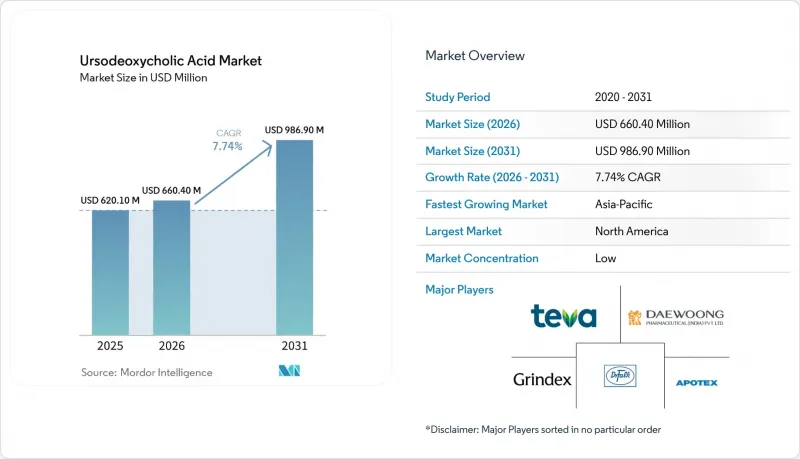
본 보고서는 적응증(원발성 담관염, 담석 용해 및 예방, 담즙 정체성 간질환(비-PBC) 등), 제형(정제, 캡슐, 경구 현탁액), 유통 채널(병원 약국, 소매 약국 및 드럭스토어, 온라인 약국), 지역(북미 등)별로 분류되어 있습니다. 시장 전망은 금액(달러) 기준으로 제시되어 있습니다.
세계 우르소데옥시콜산 시장 동향 및 분석
AASLD/EASL에서 PBC의 1차 치료법으로서의 위상
UDCA는 1일 13-15 mg/kg의 용량으로 PBC의 권장 1차 치료제로 계속 사용되고 있으며, 이를 통해 일관된 치료 용량이 확보되어 주요 지역 전반에 걸쳐 우르소데옥시콜산 시장의 견고한 기반이 되고 있습니다. 수년간의 임상적 근거에 따르면, 질환 경과의 초기 단계에서 UDCA 치료를 시작하면 간 기능 검사 수치가 개선되고 이식이 필요 없는 생존율이 향상되는 것으로 나타났으며, 이는 의사의 신뢰와 지침 준수를 뒷받침하고 있습니다. 2024년에 승인된 세라델파르와 엘라피브라놀은 모두 UDCA의 대체제가 아니라, UDCA 단독 요법으로는 충분한 효과를 얻지 못하는 환자에 대한 병용 요법으로 사용되므로, 표준 치료법을 변경하는 것이 아니라 UDCA의 핵심적인 역할을 더욱 공고히 하고 있습니다. 2025년 미국에서 오베티콜산이 시장에서 철수함에 따라, 2차 치료제로 사용되던 경쟁 제품이 시장에서 사라지면서 치료 범위를 점진적으로 확대하는 방향이 UDCA에 PPAR 작용제를 추가하는 쪽으로 전환되었고, 이로 인해 UDCA 시장 입지가 더욱 공고해졌습니다. 그 결과, 우르소데옥시콜산 시장은 지침에 근거한 사용에 힘입어 성장하고 있으며, 부분적인 반응을 보이는 환자를 대상으로 한 추가 치료 전략에 의해 그 효과가 더욱 강화되고 있습니다. 이 지침과 적응증 포지셔닝의 조합이 예측 기간 동안 UDCA의 핵심 수요를 안정시키는 데 기여하고 있습니다.
PBC 및 담즙 정체성 간 질환의 진단 유병률 증가
인지도 향상과 혈청학적 검사의 보급으로 인해 PBC의 진단 유병률이 증가하고 있으며, 이에 따라 UDCA의 적용 대상 환자층이 꾸준히 확대되고 있습니다. 임상의들은 PBC에서 UDCA를 평생 치료법으로 권장하는 확립된 지침 체계에 의존하고 있으며, 이에 따라 더 많은 사례가 초기 단계에서 발견됨에 따라 처방 기반이 지속적으로 유지되고 있습니다. 상당수의 환자가 UDCA 단독 요법으로는 생화학적 완전 반응을 보이지 않기 때문에 치료 요법에서 UDCA를 유지하면서 해당 환자군을 대상으로 한 병용 요법에 초점이 맞추어져 있습니다. 그 밖의 담즙 정체성 질환의 경우에도, 특히 임상 지침에서 담즙 정체 지표 개선을 위해 UDCA 사용을 권장하는 경우, 전문의 진료 시 처방량에 기여하고 있습니다.
진단의 조기화와 치료 기간의 장기화라는 추세는 치료 대상 환자 수 증가와 함께 우르소데옥시콜산 시장의 성장을 뒷받침하고 있습니다. 이러한 경향은 선별 검사 체계와 전문의 진료 접근성이 잘 갖춰진 의료 시스템에서 가장 두드러지게 나타납니다.
제네릭 의약품으로 인한 가격 압박이 심화되면서, 브랜드 의약품의 이익률이 위축되고 있습니다.
제네릭 의약품 시장 진입이 확대됨에 따라 가격 경쟁의 초점이 브랜드 가치에서 밸류체인의 효율성으로 이동하고 있으며, 이로 인해 제제 제조업체의 이익률이 압박받고 있습니다. 이러한 환경 하에서 수익성의 중심은 비용 경쟁력과 안정적인 원료 공급을 갖춘 원료의약품(API) 제조업체로 업스트림 쪽으로 이동하는 경향이 있는 반면, 제제 제조업체는 유통 체계를 철저히 구축함으로써 차별화를 꾀하고 있습니다. 제형이나 용량을 불문하고 성숙한 표시가 제네릭 의약품의 높은 접근성을 보여주고 있어, 약국 유통 채널에서 지속적인 가격 프리미엄을 유지하기는 어려워지고 있습니다. 우르소데옥시콜산 시장에서 이러한 압박으로 인해 처방 건수가 증가하고 있음에도 불구하고 평균 판매 가격은 정체될 가능성이 있습니다. 그 결과, 많은 지역에서 매출 증가가 가격 인상보다는 판매 수량에 더 크게 좌우되는 경향이 강해지고 있습니다. 공적 상환이나 입찰 제도가 있는 지역에서는 조달 시 최저 입찰가가 우선시되므로, 이러한 억제 효과는 더욱 두드러집니다.
부문별 분석
2025년 기준으로, PBC(원발성 담즙성 담관염)는 우르소데옥시콜산 시장의 59.23%를 차지하고 있으며, 이는 확고한 1차 치료제로서의 지위와 장기 치료를 안정화시키는 지침의 지속성을 반영하고 있습니다. 부분 반응 사례에서 병용 요법은 UDCA의 투여 기간을 연장하고 환자 기반을 유지하는 한편, 추가 요법은 보다 야심찬 생화학적 평가 지표를 목표로 하고 있으며, 이것이 간내과 주요 진료 분야에서의 우르소데옥시콜산 시장을 뒷받침하고 있습니다. 담석 용해 및 예방 분야는 2026년부터 2031년까지 연평균 성장률(CAGR) 9.54%를 나타낼 것으로 예측되며, 이는 전체 시장의 성장 추이를 상회하는 수치로, 이 분야가 보다 역동적인 2차 활용 사례임을 시사합니다. 비만 치료 프로그램의 확대와, UDCA가 담석 형성을 유의미하게 감소시키는 것으로 밝혀진 고위험 수술 후 기간에 대한 예방 프로토콜의 표준화가 진행됨에 따라, 우르소데옥시콜산 시장은 그 혜택을 누리게 될 것입니다. 원발성 담즙정체성 간질환(PBC)을 제외한 담즙정체성 간질환의 경우, 검사 수치의 개선 효과가 임상적으로 입증되었으며, 장기 사용 시의 안전성이 충분히 확립되어 있어 안정적인 수요가 예상됩니다. 원발성 경화성 담관염(PSC)의 경우, 최근의 총설에서 질환 진행의 종결점에 미치는 영향이 확인되지 않았기 때문에 UDCA의 사용은 제한적이며, 주로 특정 생화학적 관리 전략에 국한되어 있습니다.
담석 예방 분야에서 우르소데옥시콜산 시장 규모는 비만 치료 프로그램의 성장과 밀접한 관련이 있습니다. 이는 수술 후 결석 형성 위험이 수술 후 1년 차에 가장 높아지기 때문이며, 또한 임상 지침이 특정 환자 집단에서의 예방적 사용을 권장하고 있기 때문입니다. 기능하는 담낭 내의 작고 콜레스테롤이 풍부한 결석의 경우, 수술이 연기되거나 금기인 환자들에게 약물 요법은 여전히 주요 치료 옵션이며, 이러한 사용법은 외과적 치료 과정 전반에 걸쳐 일관성을 유지합니다.
원발성 담관염(PBC)의 경우, 안정적인 장기 처방을 통해 1차 진료부터 전문 의료에 이르기까지 기본적인 처방량이 확보되어 있으며, 이것이 우르소데옥시콜산 시장의 안정성을 지탱하는 핵심 요소가 되고 있습니다. 전체 적응증에 걸쳐, PBC(원발성 담즙정체성 간질환)의 2차 치료에 대한 추가 적응증은 우르소데옥시콜산(UDCA)의 역할을 대체하는 것이 아니라 유지함으로써, 대체 위험을 줄이고 공급망의 장기적인 계획 수립을 뒷받침하고 있습니다. 이러한 추세로 인해 PBC가 여전히 가장 큰 기여 요인으로 남아 있는 한편, 담석 예방 및 특정 담즙 정체성 질환에 대한 적응증이 더 높은 증분 성장을 가져오고 있습니다. 이러한 균형이 포트폴리오 효과를 창출하며, 2031년까지 우르소데옥시콜산 시장의 견실한 수익을 뒷받침하는 기반이 되고 있습니다.
지역별 분석
2025년, 북미는 우르소데옥시콜산 시장의 41.32%를 차지했습니다. 이는 PBC에 대한 지침에 따라 1차 치료제로서의 사용이 확고하게 자리 잡았으며, 장기 치료를 지원하는 보험 적용 방침을 시행하고 있는 미국이 주도한 것입니다. 2025년 미국에서 오베티콜산이 시장에서 철수함에 따라, 2차 치료제의 선택지가 사라졌고, 치료 효과가 충분하지 않은 환자에 대한 UDCA와 PPAR 작용제의 병용 요법이 확대되었습니다. 이로 인해 UDCA의 판매량은 증량 단계에서도 유지되었습니다. 캐나다와 멕시코에서는 비용 대비 효과가 높은 제네릭 의약품을 우선적으로 채택하는 경향이 있는 공적·민간 보험 제도를 통해 추가 수요가 창출되고 있으며, 간 질환 센터가 치료를 조정하는 지역에서는 UDCA의 사용이 안정적으로 유지되고 있습니다. 전문의 네트워크와 이식 프로그램 역시 정해진 프로토콜에 따른 UDCA 사용을 지원하고 있는 반면, 비만 수술 프로그램은 고위험군에 대한 예방적 사용을 통해 수요를 늘리고 있습니다. 북미 전체의 상황을 보면, 시장 점유율은 성숙 단계에 접어들었으나 장기 치료 추세에 힘입어 수요량은 견조한 추세를 보이고 있습니다.
유럽은 EASL(유럽간학회) 지침의 준수와 주요 시장의 견고한 보험 급여 제도에 힘입어, 지역별로는 2위의 규모를 차지하고 있습니다. 독일, 영국, 프랑스, 이탈리아, 스페인 등 각국의 의료 제도에서는 UDCA에 대한 접근 경로가 확립되어 있으며, 기준을 충족하는 경우 2차 치료로 단계적으로 전환하는 절차도 정해져 있습니다. 의사들이 장기적인 안전성에 대한 이해를 바탕으로 투여량을 일관되게 유지함으로써 안정적인 수요가 뒷받침되고 있는 한편, 인구 고령화에 따라 만성 질환 치료를 받고 있는 환자의 비율이 증가하고 있습니다. 유럽연합(EU)의 입찰 구조와 공공 조달은 저비용 제네릭 의약품 쪽으로 기울어져 있으며, 이는 우르소데옥시콜산 시장의 판매량 측면에서는 긍정적이지만, 가격 결정력을 제한하는 요인이 되고 있습니다. 또한, 유럽 각국에서 체중 감량 수술의 보급률에 차이가 있는 점도 담석 예방약 시장의 성장 속도에 영향을 미치고 있습니다. 전반적으로 유럽 시장은 임상적 지속성과 지불 주체의 지원에 힘입어 꾸준한 성장세를 보이고 있습니다.
아시아태평양은 2031년까지 연평균 성장률(CAGR) 10.45%를 나타낼 것으로 예측되며, 우르소데옥시콜산 시장에서 가장 빠르게 성장하는 원동력이 될 것입니다. 일부 국가에서 B형 간염 유병률이 증가하고, 대사성 간 질환의 부담이 커지며, 비만 수술 프로그램이 급속히 확대됨에 따라 수요가 증가하고 있습니다. 인도 현지에서의 원료의약품(API) 생산 확대와 중국의 견고한 제조 생태계는 공급 안정성을 높이고 가격 적정화를 뒷받침하고 있으며, 이를 통해 우르소데옥시콜산(UDCA)에 대한 접근성이 확대되고 있습니다. 일본과 호주에서는 확립된 진료 경로를 바탕으로 안정적인 수요가 예상되는 반면, 중국과 인도에서는 그 규모가 크고 보험 적용 범위가 확대됨에 따라 가장 큰 수요 증가가 예상됩니다. 동남아시아에서는 바이러스성 간염 선별 검사 및 대사성 질환 관리를 개선하기 위한 정책 조치에 힘입어, 진단 유병률과 치료 시작률이 상승할 것으로 전망됩니다. 따라서 아시아·태평양 지역의 우르소데옥시콜산 시장 규모는 예측 기간 동안 임상 인프라 및 보험사의 정책에 따라 확대될 것으로 전망됩니다.
기타 혜택:
- 엑셀 형식 시장 예측(ME) 시트
- 3개월간의 애널리스트 지원
자주 묻는 질문
목차
제1장 서론
제2장 조사 방법
제3장 주요 요약
제4장 시장 구도
제5장 시장 규모와 성장 예측
제6장 경쟁 구도
제7장 시장 기회와 향후 전망
JHS 26.06.23According to Mordor Intelligence, the ursodeoxycholic acid market size was valued at USD 620.10 million in 2025 and is estimated to grow from USD 660.40 million in 2026 to reach USD 986.90 million by 2031, at a CAGR of 7.74% during the forecast period (2026-2031).
This report is Segmented by Indication (Primary Biliary Cholangitis, Gallstone Dissolution and Prophylaxis, Cholestatic Liver Diseases (non-PBC), and More), Dosage Form (Tablets, Capsules, Oral Suspension), Distribution Channel (Hospital Pharmacies, Retail Pharmacies & Drug Stores, and Online Pharmacies), and Geography (North America and More). The Market Forecasts are Provided in Terms of Value (USD).
Global Ursodeoxycholic Acid Market Trends and Insights
First-line Therapy Status in PBC Under AASLD/EASL
UDCA remains the recommended first-line therapy for PBC at 13-15 mg/kg/day, which locks in consistent treatment volumes and provides a durable base for the ursodeoxycholic acid market across major regions. Longstanding clinical evidence shows that UDCA improves liver biochemistry and transplant-free survival when initiated early in the disease course, which sustains physician confidence and adherence to guidelines. The 2024 approvals of seladelpar and elafibranor did not alter the standard of care because both are used alongside UDCA for inadequate responders rather than as replacements, reinforcing UDCA's backbone role. The 2025 U.S. withdrawal of obeticholic acid further strengthened UDCA positioning since a second-line competitor exited the market, which redirected escalation pathways toward PPAR agonists added to UDCA. As a result, the ursodeoxycholic acid market is anchored by guideline-backed use and reinforced by add-on strategies for partial responders. This combination of guidelines and label positioning helps stabilize core demand for UDCA through the forecast period.
Rising Diagnosed Prevalence of PBC and Cholestatic Liver Diseases
Better awareness and serologic testing have increased diagnosed PBC prevalence, which steadily expands the patient pool eligible for UDCA. Clinicians rely on established guideline frameworks that endorse UDCA as lifelong therapy in PBC, which supports a sustained prescription base as more cases are detected at earlier stages. A considerable share of patients do not fully respond biochemically to UDCA alone, which concentrates add-on use for that cohort while preserving UDCA in the regimen. Additional cholestatic conditions also contribute to volumes in specialist practice, particularly where clinical guidance supports UDCA use to improve cholestatic parameters.
The direction of travel favors earlier diagnosis and sustained therapy durations, which underpins growth in the ursodeoxycholic acid market as treated prevalence rises. These patterns are most visible in health systems with screening infrastructure and specialist access in place.
Generic Pricing Pressure Compressing Branded Margins
Broader generic participation shifts price competition from brand value to supply chain efficiency, which compresses margins for finished-dose manufacturers. In this environment, the locus of profitability often moves upstream to API producers with cost advantages and secure feedstock, while finished-dose players differentiate through distribution execution. Mature labeling across presentations and strengths evidences the depth of generic availability, which makes sustained price premiums difficult to defend in pharmacy channels. For the ursodeoxycholic acid market, this pressure can flatten average selling prices even as total prescriptions rise. The net effect is top-line growth that relies more on volumes than on price realization in many geographies. In regions with public reimbursement and tendering, this restraint is more pronounced as procurement favors lowest bids.
Other drivers and restraints analyzed in the detailed report include:
- Increasing Gallstone Disease and Non-surgical Management Cohorts
- Expansion of Generics and API Capacity Improving Affordability
- Limited Efficacy/Non-response in Subsets
For complete list of drivers and restraints, kindly check the Table Of Contents.
Segment Analysis
PBC captured 59.23% of the ursodeoxycholic acid market share in 2025, reflecting entrenched first-line use and guideline continuity that stabilizes long-term therapy. Combination regimens in partial responders extend UDCA duration and keep the base in place while add-on agents target more ambitious biochemical endpoints, which supports the ursodeoxycholic acid market in core hepatology practices. Gallstone dissolution and prophylaxis are projected to grow at 9.54% CAGR between 2026 and 2031, which is higher than the overall trajectory and signals a more dynamic secondary use case. The ursodeoxycholic acid market benefits as bariatric programs scale and as clinicians standardize prevention protocols for high-risk postoperative periods, where UDCA has shown meaningful reductions in gallstone formation. Cholestatic liver diseases outside PBC contribute steady volumes where laboratory improvements are clinically valued, and safety is well characterized in long-term use. In PSC, adoption is limited by a lack of impact on progression endpoints in recent overviews, which restricts UDCA mainly to selected biochemical management strategies.
The ursodeoxycholic acid market size for gallstone prevention is aligned with bariatric program growth because the risk of postoperative stone formation is highest in the first postoperative year, and clinical guidance supports prophylactic use in defined cohorts. For small, cholesterol-rich stones in functioning gallbladders, medical management remains a targeted option in patients where surgery is delayed or contraindicated, and this use preserves continuity across surgical pathways.
In PBC, stable long-term prescribing anchors base volumes that extend across primary and specialty care, which is central to the consistency of the ursodeoxycholic acid market. Across indications, add-on labels for second-line PBC therapies sustain UDCA's role rather than displacing it, which lowers substitution risk and supports long-range planning for supply chains. These patterns keep PBC as the largest contributor, while gallstone prevention and selected cholestatic uses provide higher incremental growth. The balance yields a portfolio effect that underpins resilient revenue for the ursodeoxycholic acid market through 2031.
Geography Analysis
North America held 41.32% of the ursodeoxycholic acid market share in 2025, led by the United States, where guideline-backed first-line use in PBC is firmly established, and coverage policies support long-term therapy. The U.S. withdrawal of obeticholic acid in 2025 removed a second-line option and reinforced the pairing of UDCA with PPAR agonists for inadequate responders, which kept UDCA volumes intact at escalation. Canada and Mexico contribute additional volumes through public and private coverage frameworks that tend to favor cost-effective generics, which stabilizes uptake where hepatology centers coordinate care. Specialist networks and transplant programs also support the use of UDCA in defined protocols, while bariatric surgery programs add demand through preventive use in high-risk cohorts. The overall picture in North America is one of maturity in share but resilient volume based on long-term therapy behaviors.
Europe accounts for the second-largest regional base, driven by adherence to EASL-aligned guidance and robust reimbursement across major markets. National health systems in Germany, the United Kingdom, France, Italy, and Spain have established pathways for UDCA access and for escalation to second-line therapies where criteria are met. Physician familiarity with long-term safety and dosing consistency supports stable demand, while demographic aging increases the share of patients under chronic care. Tendering structures and public procurement in the European Union tilt toward low-cost generics, which benefits the ursodeoxycholic acid market in terms of volume but caps pricing power. Variations in bariatric surgery uptake across Europe also influence the pace of growth in gallstone prophylaxis. Overall, Europe shows steady expansion driven by clinical continuity and payer support.
Asia-Pacific is set to grow at 10.45% CAGR through 2031, which positions the region as the fastest-growing engine for the ursodeoxycholic acid market. Rising hepatitis B prevalence in some countries, a growing burden of metabolic liver disease, and fast-expanding bariatric surgery programs drive incremental demand. Local API expansions in India and strong manufacturing ecosystems in China increase supply security and support affordability, which broadens access to UDCA. Japan and Australia provide steady demand based on established care pathways, while China and India produce the largest incremental gains due to scale and improving reimbursement coverage. In Southeast Asia, policy initiatives to improve viral hepatitis screening and metabolic disease management are likely to lift diagnosed prevalence and treatment initiation. The ursodeoxycholic acid market size in Asia-Pacific is therefore set to expand in line with clinical infrastructure and payer policies through the forecast horizon.
- Alkem Laboratories Ltd.
- Apotex
- Aurobindo Pharma
- Cipla
- Daewoong Pharmaceutical (INDIA) Pvt. Ltd.
- Dr. Falk Pharma GmbH
- Epic Pharma
- Glenmark Pharmaceuticals
- Grindeks
- Lannett
- Lupin
- Strides Pharma
- Sun Pharmaceuticals Industries
- Teva Pharmaceutical Industries
- Torrent Pharmaceuticals
- Viatris
- Wockhardt
- Zydus Group
Additional Benefits:
- The market estimate (ME) sheet in Excel format
- 3 months of analyst support
TABLE OF CONTENTS
1 Introduction
- 1.1 Study Assumptions & Market Definition
- 1.2 Scope of the Study
2 Research Methodology
3 Executive Summary
4 Market Landscape
- 4.1 Market Overview
- 4.2 Market Drivers
- 4.2.1 First-line Therapy Status in PBC Under AASLD/EASL
- 4.2.2 Rising Diagnosed Prevalence of PBC and Cholestatic Liver Diseases
- 4.2.3 Increasing Gallstone Disease and Non-surgical Management Cohorts
- 4.2.4 Expansion of Generics and API Capacity Improving Affordability
- 4.2.5 Vertically Integrated Bile-acid Supply Chains Stabilizing UDCA Output
- 4.2.6 Pipeline of Second-line PBC Agents Preserves UDCA as Backbone
- 4.3 Market Restraints
- 4.3.1 Generic Pricing Pressure Compressing Branded Margins
- 4.3.2 Limited Efficacy/Non-response in Subsets (e.g., PSC; ~40% PBC Non-responders)
- 4.3.3 Feedstock Exposure to Cholic-acid/Bovine Bile Supply Risks
- 4.3.4 New PBC Agents Competing for Non-responder Share
- 4.4 Supply-Chain Analysis
- 4.5 Regulatory Landscape
- 4.6 Technological Outlook
- 4.7 Porter's Five Forces
- 4.7.1 Threat of New Entrants
- 4.7.2 Bargaining Power of Suppliers
- 4.7.3 Bargaining Power of Buyers
- 4.7.4 Threat of Substitutes
- 4.7.5 Industry Rivalry
5 Market Size & Growth Forecasts (Value, USD)
- 5.1 By Indication
- 5.1.1 Primary Biliary Cholangitis (PBC)
- 5.1.2 Gallstone Dissolution and Prophylaxis
- 5.1.3 Cholestatic Liver Diseases (non-PBC)
- 5.1.4 Primary Sclerosing Cholangitis (PSC)
- 5.1.5 Other Indications
- 5.2 By Dosage Form
- 5.2.1 Tablets
- 5.2.2 Capsules
- 5.2.3 Oral Suspension
- 5.3 By Distribution Channel
- 5.3.1 Hospital Pharmacies
- 5.3.2 Retail Pharmacies & Drug Stores
- 5.3.3 Online Pharmacies
- 5.4 By Geography
- 5.4.1 North America
- 5.4.1.1 United States
- 5.4.1.2 Canada
- 5.4.1.3 Mexico
- 5.4.2 Europe
- 5.4.2.1 Germany
- 5.4.2.2 United Kingdom
- 5.4.2.3 France
- 5.4.2.4 Italy
- 5.4.2.5 Spain
- 5.4.2.6 Rest of Europe
- 5.4.3 Asia-Pacific
- 5.4.3.1 China
- 5.4.3.2 India
- 5.4.3.3 Japan
- 5.4.3.4 Australia
- 5.4.3.5 South Korea
- 5.4.3.6 Rest of Asia-Pacific
- 5.4.4 Middle East and Africa
- 5.4.4.1 GCC
- 5.4.4.2 South Africa
- 5.4.4.3 Rest of Middle East and Africa
- 5.4.5 South America
- 5.4.5.1 Brazil
- 5.4.5.2 Argentina
- 5.4.5.3 Rest of South America
- 5.4.1 North America
6 Competitive Landscape
- 6.1 Market Concentration
- 6.2 Market Share Analysis
- 6.3 Company Profiles {(includes Global level Overview, Market level overview, Core Segments, Financials as available, Strategic Information, Market Rank/Share for key companies, Products & Services, and Recent Developments)}
- 6.3.1 Alkem Laboratories Ltd.
- 6.3.2 Apotex Inc.
- 6.3.3 Aurobindo Pharma Limited
- 6.3.4 Cipla
- 6.3.5 Daewoong Pharmaceutical (INDIA) Pvt. Ltd.
- 6.3.6 Dr. Falk Pharma GmbH
- 6.3.7 Epic Pharma
- 6.3.8 Glenmark Pharmaceuticals
- 6.3.9 Grindeks
- 6.3.10 Lannett
- 6.3.11 Lupin
- 6.3.12 Strides Pharma
- 6.3.13 Sun Pharmaceutical Industries Ltd.
- 6.3.14 Teva Pharmaceutical Industries Ltd.
- 6.3.15 Torrent Pharmaceuticals Ltd.
- 6.3.16 Viatris Inc.
- 6.3.17 Wockhardt
- 6.3.18 Zydus Group
7 Market Opportunities & Future Outlook
- 7.1 White-space & Unmet-need Assessment


