|
시장보고서
상품코드
2063628
자궁 장액성 암종 시장 : 점유율 분석, 업계 동향과 통계, 성장 예측(2026-2031년)Uterine Serous Carcinoma - Market Share Analysis, Industry Trends & Statistics, Growth Forecasts (2026 - 2031) |
||||||
 Mordor Intelligence
Mordor Intelligence에 의하면, 자궁 장액성 암종 시장 규모는 2025년 34억 4,000만 달러, 2026년 36억 5,000만 달러에서 2031년까지 49억 3,000만 달러로 확대되어 2026년부터 2031년까지 연평균 복합 성장률(CAGR)은 6.20%를 나타낼 것으로 예측됩니다.
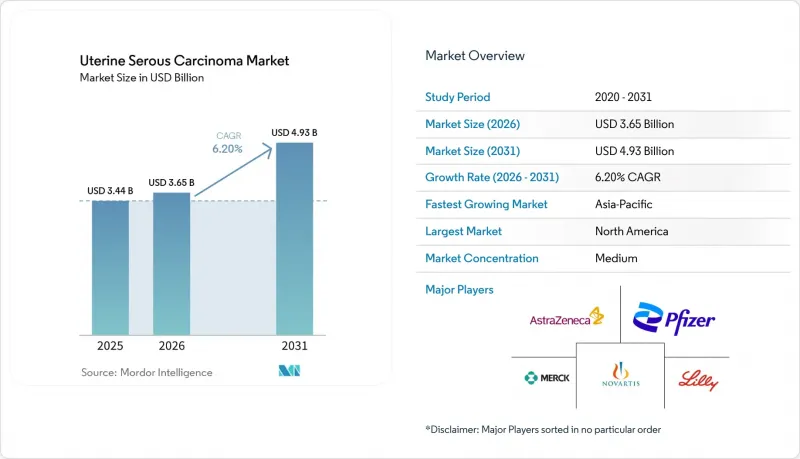
본 보고서는 치료법(수술, 화학요법, 방사선요법, 면역요법, 표적요법), 약물 분류별(면역관문억제제 등), 치료 단계(1차 치료, 2차 치료 및 그 이후), 지역(북미, 유럽, 아시아·태평양, 중동 및 아프리카, 남미)별로 분류되어 있습니다. 시장 전망은 금액(달러) 기준으로 제시되어 있습니다.
세계 자궁 장액성 암종 시장 동향 및 인사이트
고령화와 비만과 관련된 발병률 증가
세계적으로 대사증후군이 증가함에 따라 자궁내막암 진단 건수가 꾸준히 증가하고 있으며, 60세 이상 여성의 경우 장액성 조직형으로의 뚜렷한 전환이 관찰되고 있습니다. 비만과 관련된 염증은 말초 에스트로겐 농도를 상승시키고, 장액성 아형에 전형적인 TP53 돌연변이를 촉진하며, 1기에서 전이성 질환으로 진행되는 기간을 단축시킵니다. 일본, 이탈리아, 한국은 고령화, 초산 연령의 상승, 출산 횟수의 감소라는 삼중의 과제에 직면해 있으며, 이 모든 요인이 평생에 걸친 에스트로겐 노출 기간을 연장시키는 원인이 되고 있습니다. 그 결과, 대상 환자층이 과거 평균보다 빠르게 확대되고 있으며, 2031년에 이르기까지 1차 치료제로 사용되는 면역관문억제제 병용 요법 및 구제 요법으로서의 항체-약물 복합체(ADC)에 대한 지속적인 수요가 발생하고 있습니다. 각국의 보건복지부는 이미 부인과 종양학 분야에 대한 예산 배정을 확대할 의향을 밝혔으며, 제약 기업 입장에서는 판매량 안정성을 뒷받침해 줄 다년 계약 체결이 확정되어 가고 있습니다.
면역종양학 병용 요법에 대한 규제 당국의 승인
2024년 6월, FDA가 새로 진단된 진행성 질환에 대한 펨브롤리주맙과 카보플라틴·파클리탁셀 병용 요법을 신속 승인함에 따라, 통상 4년이 소요되던 ‘연구에서 임상 적용’까지의 기간이 절반으로 단축되었으며, 이는 제약사들이 개발 초기 단계에서 생물학적 제제 병용 요법에 대한 승인을 신청하도록 장려하는 계기가 되었습니다. 그로부터 4개월 후 유럽집행위원회가 조건부 승인을 내림에 따라 EU 전역에서 환급 협상이 가능해졌으며, 이로 인해 일부 국가의 보험사들이 순차적으로 화학요법에 대한 사전 요건 면제를 추진하게 되었습니다. 일본, 한국, 호주의 규제 당국도 유사한 심사 절차를 신속하게 도입하여, 미국과 아시아태평양에서 시장 출시까지 걸리는 시간 차를 1년 미만으로 단축했습니다. 이러한 승인 절차의 동기화를 통해 수익화까지 걸리는 기간이 단축됨에 따라, 제약사들은 자궁 장액성 암종 시장에서의 점유율 확대를 도모하기 위해 개발 초기 단계부터 전 세계적인 3상 임상시험을 시작하도록 권장받고 있습니다.
면역관문억제제의 높은 비용과 보험 급여의 장벽
미국에서는 체크포인트 억제제의 연간 치료비가 환자 1인당 15만-20만 달러에 달하며, 그 결과 사전 승인 요건이 마련되어 치료 시작이 최대 1개월까지 지연될 가능성이 있습니다. 미국의 14개 메디케이드 프로그램에서는 면역요법을 승인하기 전에 화학요법의 실패를 조건으로 하고 있어, 1차 치료제로서의 사용이 제한되고 있습니다. 라틴아메리카에서는 공적 보험사가 30-50%의 비밀 리베이트를 협상하고 있습니다. 그러나 예산 상한선으로 인해, 약품의 입수는 주요 대학병원 등으로 제한되어 있습니다. 걸프협력회의(GCC) 회원국의 민간 보험사들은 바이오마커를 통한 근거를 요구하고 연간 지출 한도를 설정하고 있어, 치료 도중에 중단할 수밖에 없는 사례가 빈번하게 발생하고 있습니다. 이러한 과제들이 복합적으로 작용하여, 자궁 장액성 암종 세계 시장 연평균 성장률(CAGR)이 1% 가까이 하락했습니다.
부문별 분석
2025년 기준으로 면역요법은 자궁 장액성 암종 시장 규모의 38.15%를 차지하고 있으며, 2031년까지 연평균 성장률(CAGR) 7.34%로 성장할 것으로 전망됩니다. 펨브롤리주맙과 카보플라틴·파클리탁셀의 병용 요법은 2024년 6월 FDA 승인을 받아 1차 치료법으로 자리 잡았으며, NCCN 지정 기관에서 화학요법 단독 요법을 빠르게 대체했습니다. 도스타르리맙 단독 요법은 미스매치 복구 기능 결손(MMR-D) 종양에 대한 우선적인 치료 옵션으로 자리 잡고 있으며, 40% 이상의 객관적 반응률을 달성하고 있습니다. 초기 병변의 경우 여전히 수술이 표준 치료법이지만, 수술 전 면역요법을 통해 종양이 큰 제3기 사례에서 종양 부피가 줄어들어 절제 가능성이 높아지고 있습니다. 현재 방사선 치료는 주로 증상을 동반하는 골반 내 재발이나 뇌 전이의 증상 완화에 사용되고 있으며, 이는 전신적 통제로의 전환을 반영하고 있습니다.
지역별 분석
2025년, 북미는 자궁 장액성 암종 시장에서 43.13%라는 압도적인 점유율을 차지하고 있으며, 이는 메디케어의 효율적인 보험금 지급 절차 덕분입니다. 메디케어는 펨브롤리주맙, 도스탈리주맙, 트라스투주맙 델크스테칸 등의 약제에 대해 사전 승인 없이 FDA가 승인한 적응증에 대해 보험 급여를 제공합니다. 2026년 1월부터 ‘인플레이션 억제법’에 따라 메디케어는 항암제 가격 협상을 할 수 있게 됩니다. 이러한 조치를 통해 지출이 가장 많은 의약품의 순비용이 25-40% 절감될 것으로 예측됩니다. 이러한 조치는 환자들이 지속적으로 약을 구할 수 있도록 보장하는 한편, 매출 성장을 억제하는 결과도 낳고 있어, 제약사들은 판매량을 늘리기 위해 아시아 시장에서 사업 기회를 모색하고 있습니다.
아시아태평양은 가장 성장세가 두드러진 지역으로, 연평균 성장률(CAGR)은 6.98%로 성장을 지속하고, 있습니다. 중국에서 MSI-high 종양에 대한 신틸리맙 및 티슬레리맙의 신속 승인, 그리고 일본에서 트라스투주맙 델크스테칸의 신속 심사 지정에 따라, 퍼스트-인-클래스 승인부터 시장 출시까지의 기간이 9개월 미만으로 단축되었습니다. 한국과 호주에서는 체크포인트 억제제가 규제 당국의 승인을 받은 지 60일 이내에 보험 적용 대상이 되기 때문에 이들 국가는 조기에 매출 증대에 기여하고 있습니다.
유럽은 안정적인 시장 점유율을 유지하고 있지만, 지역별로 상황이 제각각입니다. 독일과 프랑스에서는 면역관문억제제의 병용 요법이 신속하게 보험 적용을 받는 반면, 이탈리아와 스페인에서는 예산 상한선이 설정되어 있어 병원 차원에서의 도입이 지연되고 있습니다. 동유럽 국가들에서는 상당한 규모의 리베이트 협상이 이루어지고 있지만, 주로 도시 지역의 3차 의료기관 이용에 국한되어 있습니다. 중동 및 아프리카에서는 전신 요법의 보급률이 여전히 낮은 탓에, 자궁 장액성 암종 시장은 전체 시장 규모의 5% 미만을 차지하는 데 그치고 있습니다. 콜드체인 인프라 부족, 환율 변동, 현지 생물학적 제제 생산 능력 부족과 같은 문제들이 의약품 공급을 저해하고 있어, 국제적인 자금 지원 이니셔티브의 필요성이 강조되고 있습니다.
기타 혜택:
- 엑셀 형식 시장 예측(ME) 시트
- 3개월간의 애널리스트 지원
자주 묻는 질문
목차
제1장 서론
제2장 조사 방법
제3장 주요 요약
제4장 시장 구도
제5장 시장 규모와 성장 예측
제6장 경쟁 구도
제7장 시장 기회와 향후 전망
JHS 26.06.23According to Mordor Intelligence, the uterine serous carcinoma market size is projected to expand from USD 3.44 billion in 2025 and USD 3.65 billion in 2026 to USD 4.93 billion by 2031, registering a CAGR of 6.20% between 2026 to 2031.
This report is Segmented by Treatment Modality (Surgery, Chemotherapy, Radiotherapy, Immunotherapy, Targeted Therapy), Drug Class (Immune Checkpoint Inhibitors, and More), Line of Therapy (First-Line, Second-Line & Later), and Geography (North America, Europe, Asia-Pacific, Middle East & Africa, South America). Market Forecasts are Provided in Terms of Value (USD).
Global Uterine Serous Carcinoma Market Trends and Insights
Rising Incidence Linked to Aging & Obesity
The global rise in metabolic syndrome is driving a steady increase in endometrial cancer diagnoses, with a pronounced shift toward serous histology among women over 60. Obesity-related inflammation elevates peripheral estrogen levels, encouraging TP53 mutations that typify the serous subtype and shorten the interval from stage I to metastatic disease. Japan, Italy, and South Korea face a triple burden of aging populations, delayed first pregnancies, and reduced parity, all of which extend lifetime estrogen exposure. Consequently, the addressable patient pool is expanding faster than historical averages, stimulating sustained demand for first-line immune-checkpoint doublets and salvage antibody-drug conjugates through 2031. Health ministries are already signaling higher budget allocations for gynecologic oncology, locking in multiyear procurement contracts that underpin volume certainty for drug makers.
Regulatory Approvals for Immuno-Oncology Combinations
The FDA's June 2024 accelerated approval of pembrolizumab plus carboplatin-paclitaxel for newly diagnosed advanced disease cut the standard four-year bench-to-bedside interval in half, encouraging sponsors to file combination biologics earlier in development. The European Commission's conditional nod four months later enabled pan-EU reimbursement negotiations and prompted several national payers to waive sequential chemotherapy prerequisites. Regulators in Japan, South Korea, and Australia rapidly adopted comparable review pathways, reducing the lag between U.S. and Asia-Pacific launches to under one year. These synchronized approvals compress time-to-revenue and push manufacturers to initiate global pivotal trials from day one to secure a wider uterine serous carcinoma market footprint.
High Costs & Reimbursement Hurdles for IO Agents
In the United States, checkpoint inhibitors are priced between USD 150,000 and 200,000 annually per patient, resulting in prior-authorization requirements that can delay treatment by up to a month.Fourteen Medicaid programs in the United States mandate chemotherapy failure before approving immunotherapy, restricting its use as a first-line treatment. In Latin America, public insurers negotiate confidential rebates of 30-50%. However, budget caps limit drug availability to major academic centers. Private payers in the Gulf Cooperation Council require biomarker evidence and impose annual spending limits, often causing interruptions to therapy mid-cycle. These challenges collectively reduce the global market's compound annual growth rate for uterine serous carcinoma by nearly one percentage point.
Other drivers and restraints analyzed in the detailed report include:
- Uptake of Molecular Profiling & HER2 Testing
- Companion-Diagnostic Reimbursement Incentives
- Limited Biomarker-Testing in LMICs
For complete list of drivers and restraints, kindly check the Table Of Contents.
Segment Analysis
Immunotherapy accounted for a 38.15% share of the uterine serous carcinoma market size in 2025 and is projected to grow at a 7.34% CAGR through 2031. Pembrolizumab, combined with carboplatin-paclitaxel, advanced to first-line therapy following its FDA approval in June 2024, quickly replacing chemotherapy-only regimens at NCCN-designated centers. Dostarlimab monotherapy has become a preferred option for mismatch-repair-deficient tumors, achieving objective response rates exceeding 40%. Surgery continues to be the standard for early-stage disease, but neoadjuvant immunotherapy is reducing tumor volume in bulky stage III cases, improving resectability. Radiation therapy is now primarily used for palliating symptomatic pelvic relapse or brain metastases, reflecting a shift toward systemic control.
Geography Analysis
In 2025, North America held a dominant 43.13% share of the uterine serous carcinoma market, attributed to Medicare's efficient reimbursement process. Medicare reimburses drugs such as pembrolizumab, dostarlimab, and trastuzumab deruxtecan for FDA-approved indications without requiring prior authorization. Starting January 2026, the Inflation Reduction Act allows Medicare to negotiate prices for oncology drugs. This initiative is expected to reduce net costs by 25-40% for the highest-spending drugs. While this measure ensures continued patient access, it also moderates revenue growth, prompting manufacturers to explore opportunities in Asia to increase volumes.
Asia-Pacific is the fastest-growing region, advancing at a 6.98% CAGR. China's rapid approval of sintilimab and tislelizumab for MSI-high tumors, along with Japan's expedited designation for trastuzumab deruxtecan, has reduced the time-to-launch to less than nine months after first-in-class approvals. In South Korea and Australia, checkpoint inhibitors are reimbursed within 60 days of regulatory approval, making these countries early contributors to revenue.
Europe holds a stable share but displays heterogeneity. Germany and France reimburse immune-checkpoint combinations promptly, whereas Italy and Spain impose budget caps that delay adoption at the hospital level. Eastern European countries negotiate significant rebates but primarily restrict access to urban tertiary centers. In the Middle East and Africa, the uterine serous carcinoma market accounts for less than 5% of the total size due to systemic therapy penetration remaining low. Challenges such as limited cold-chain infrastructure, currency volatility, and insufficient local biologic manufacturing capacity hinder drug availability, emphasizing the need for international funding initiatives.
- AstraZeneca PLc
- Clovis Oncology
- Eisai
- Eli Lilly and Company
- Exelixis
- Roche
- GlaxoSmithKline
- ImmunoGen
- Incyte
- Innovent Biologics, Inc.
- MacroGenics
- Merck
- Mersana Therapeutics
- Myovant Sciences Ltd.
- Novartis
- OncXerna Therapeutics Inc.
- Pfizer
- Regeneron Pharmaceuticals
- Seagen
- Zai Lab Ltd
Additional Benefits:
- The market estimate (ME) sheet in Excel format
- 3 months of analyst support
TABLE OF CONTENTS
1 Introduction
- 1.1 Study Assumptions & Market Definition
- 1.2 Scope of the Study
2 Research Methodology
3 Executive Summary
4 Market Landscape
- 4.1 Market Overview
- 4.2 Market Drivers
- 4.2.1 Rising Incidence Linked to Aging & Obesity
- 4.2.2 Regulatory Approvals for Immuno-Oncology Combinations
- 4.2.3 Uptake of Molecular Profiling & HER2 Testing
- 4.2.4 Expansion of Investigator-Sponsored Trials & EAPS
- 4.2.5 Companion-Diagnostic Reimbursement Incentives (OECD)
- 4.2.6 Fast-Track Synthetic-Lethality Pipeline Inflection
- 4.3 Market Restraints
- 4.3.1 High Cost & Reimbursement Hurdles for IO Agents
- 4.3.2 Low Biomarker-Testing Penetration in LMICs
- 4.3.3 Patient-Pool Limitations Slowing Trial Recruitment
- 4.3.4 Safety Concerns Over TKI + Checkpoint Blockade Combos
- 4.4 Value / Supply-Chain Analysis
- 4.5 Regulatory Landscape
- 4.6 Technological Outlook
- 4.7 Epidemiology Trends & Incidence Analysis
- 4.8 Porter's Five Forces Analysis
- 4.8.1 Threat of New Entrants
- 4.8.2 Bargaining Power of Suppliers
- 4.8.3 Bargaining Power of Buyers
- 4.8.4 Threat of Substitutes
- 4.8.5 Industry Rivalry
5 Market Size & Growth Forecasts (Value, USD)
- 5.1 By Treatment Modality
- 5.1.1 Surgery
- 5.1.2 Chemotherapy
- 5.1.3 Radiotherapy
- 5.1.4 Immunotherapy
- 5.1.5 Targeted Therapy
- 5.2 By Drug Class
- 5.2.1 Immune Checkpoint Inhibitors
- 5.2.2 Tyrosine-Kinase Inhibitors
- 5.2.3 HER2-targeted Monoclonal Antibodies
- 5.2.4 Hormonal Agents
- 5.2.5 Cytotoxic Agents
- 5.3 By Line of Therapy
- 5.3.1 First-Line
- 5.3.2 Second-Line & Later
- 5.4 By Geography
- 5.4.1 North America
- 5.4.1.1 United States
- 5.4.1.2 Canada
- 5.4.1.3 Mexico
- 5.4.2 Europe
- 5.4.2.1 Germany
- 5.4.2.2 United Kingdom
- 5.4.2.3 France
- 5.4.2.4 Italy
- 5.4.2.5 Spain
- 5.4.2.6 Rest of Europe
- 5.4.3 Asia-Pacific
- 5.4.3.1 China
- 5.4.3.2 India
- 5.4.3.3 Japan
- 5.4.3.4 South Korea
- 5.4.3.5 Australia
- 5.4.3.6 Rest of Asia-Pacific
- 5.4.4 Middle East & Africa
- 5.4.4.1 GCC
- 5.4.4.2 South Africa
- 5.4.4.3 Rest of Middle East and Africa
- 5.4.5 South America
- 5.4.5.1 Brazil
- 5.4.5.2 Argentina
- 5.4.5.3 Rest of South America
- 5.4.1 North America
6 Competitive Landscape
- 6.1 Market Concentration
- 6.2 Market Share Analysis
- 6.3 Company Profiles (includes Global level Overview, Market-level Overview, Core Segments, Financials, Strategic Information, Market Rank/Share, Products & Services, Recent Developments)
- 6.3.1 AstraZeneca PLc
- 6.3.2 Clovis Oncology
- 6.3.3 Eisai Co.
- 6.3.4 Eli Lilly & Co.
- 6.3.5 Exelixis Inc.
- 6.3.6 F. Hoffmann-La Roche Ltd
- 6.3.7 GlaxoSmithKline PLC
- 6.3.8 ImmunoGen
- 6.3.9 Incyte Corporation
- 6.3.10 Innovent Biologics, Inc.
- 6.3.11 MacroGenics, Inc.
- 6.3.12 Merck & Co.
- 6.3.13 Mersana Therapeutics
- 6.3.14 Myovant Sciences Ltd.
- 6.3.15 Novartis AG
- 6.3.16 OncXerna Therapeutics Inc.
- 6.3.17 Pfizer Inc.
- 6.3.18 Regeneron Pharmaceuticals, Inc.
- 6.3.19 Seagen Inc.
- 6.3.20 Zai Lab Ltd
7 Market Opportunities & Future Outlook
- 7.1 White-space & Unmet-Need Assessment