

|
시장보고서
상품코드
2063629
특발성 저신장증 : 시장 점유율 분석, 업계 동향 및 통계, 성장 예측(2026-2031년)Idiopathic Short Stature - Market Share Analysis, Industry Trends & Statistics, Growth Forecasts (2026 - 2031) |
||||||
 Mordor Intelligence
에 의하면, 특발성 저신장증 시장 규모는 2025년 17억 3,000만 달러로 평가되었습니다. 2026년에는 18억 7,000만 달러로 확대되어 2026-2031년 CAGR은 8.34%를 나타내, 2031년까지 28억 달러에 이를 것으로 예측됩니다.

본 보고서는 치료법별(브랜드 인간 성장호르몬, 바이오시밀러 인간 성장호르몬 등), 연령대별(사춘기 이전 소아 등), 투여 경로별(매일 피하 주사 등), 최종 사용자별(병원, 내분비 전문 클리닉, 재택치료 시설) 및 지역별(북미, 유럽 등)로 분류되어 있습니다. 시장 전망은 금액(달러) 기준으로 제시되어 있습니다.
세계의 특발성 저신장증 시장 동향 및 인사이트
특발성 저신장증 진단 건수 증가
차세대 염기서열 분석 기술 덕분에 유전자 검사 비용과 소요 시간이 줄어들어, 임상의들은 SHOX 결핍증과 같은 단일 유전자 질환을 배제하고 소아 환자를 특발성 저신장증의 치료 대상군으로 재분류할 수 있게 되었습니다. 2025년 10월 지침에서는 표준편차 -2.5 미만의 모든 소아에게 다중 리가션 의존 프로브 증폭법(MLPA)을 권장하고 있으며, 이를 통해 의뢰 기준이 표준화되었습니다. 아부다비에서는 2011년부터 2022년까지 특발성 저신장증이 전체 rhGH 처방의 34.8%를 차지하여 성장호르몬 결핍증을 앞질렀습니다. 시퀀싱을 통한 진단률은 여전히 14.9%에 그치고 있지만, 선별 검사를 받는 소아의 수가 크게 증가하면서 수요가 늘어나고 있습니다. 전자 성장 곡선을 도입하는 병원이 늘어남에 따라, 기준치에서 벗어난 경우 조기에 전문의에게 의뢰하게 되어 북미 및 걸프만 지역의 처방량이 증가하고 있습니다.
rhGH 바이오시밀러의 보급 확대
가격 경쟁력이 뛰어난 바이오시밀러가 중국과 인도의 특발성 저신장증 시장을 변화시키고 있습니다. 두 국가에서는 국내 제약사가 2026년 1월 국가 보험 약품 목록에 등재됨에 따라 연간 치료비를 50% 이상 절감했습니다. Intas Pharmaceuticals사의 발효부터 충전까지의 생산 공정은 인도의 주 보험 기관이 환급 규정을 확정하면 비용 면에서 우위를 점할 수 있게 됩니다. 라틴아메리카에서는 아르헨티나의 보험 적용 의무화가, 공급을 저해하고 임상 결과에 악영향을 미치는 행정적 병목 현상으로 인해 가로막히고 있습니다. 유럽과 북미에서는 의사들이 오리지널 의약품 브랜드에 대한 충성도를 유지하고 있으며, 면역원성 데이터와 관련된 규제 요건으로 인해 승인까지 걸리는 기간이 길어지면서 도입이 지연되고 있습니다.
엄격한 규제 심사와 고액의 치료비
2007년 유럽의약품청(EMA)이 특발성 저신장증 치료 승인을 거부한 것은 FDA의 승인 결정과는 대조적이며, 유럽의 보험사들이 청구를 거부할 때 윤리적 우려를 이유로 들면서 이중적인 접근 구조가 확립되어 있습니다. 미국에서 연간 치료비가 2만-5만 달러에 달하기 때문에 보험사는 엄격한 사전 승인을 요구받고 있는 반면, 소아내분비학회는 신중한 대응을 권고하고 있어, 이로 인해 보험사의 급여 거부가 부추겨지고 있습니다. 장시간 작용형 아날로그의 경우, 임상시험에서 성장 호르몬에 지속적으로 노출됨에 따라 부종 발생률이 증가한 것으로 나타나, 추가적인 안전성 검증이 요구되고 있습니다. 아르헨티나의 민간 보험사들은 현지에서 승인을 받았음에도 불구하고, 고가의 아날로그 제제에 대한 보험 적용을 체계적으로 미루고 있으며, 높은 비용을 주요 장애물로 꼽고 있습니다.
부문별 분석
2025년 기준으로, 브랜드 제품 rhGH는 62.20%의 시장 점유율을 차지했습니다. 그러나 장시간 작용형 아날로그는 시장 평균을 상회하는 성장이 예상되며, 2031년까지의 연평균 성장률(CAGR)은 9.32%로 전망되어, 특발성 저신장증 시장에서 가장 빠르게 성장하는 부문이 될 것으로 보입니다. 아센디스 파마의 ‘SKYTROFA’는 불과 18개월 만에 미국 시장에서 6.5%라는 놀라운 시장 점유율을 차지했습니다. 이는 특히 복약 순응도의 이점이 명확한 경우, 높은 가격 책정과 지불 주체의 수용이 공존할 수 있음을 보여줍니다. 한편, 중국에서는 바이오시밀러의 승인으로 치료비가 75% 절감되어, 특발성 저신장증 치료 시장에 대한 접근성이 중산층 가정까지 확대되었습니다. 서유럽 기업들이 커넥티드 기기 및 사업 영역 확대를 통해 시장 점유율을 강화하는 한편, 지역 기업들은 정부 입찰을 효과적으로 활용하여 특히 현립 병원에서 대규모 계약을 수주하고 있습니다.
2025년 기준으로, 치료를 받은 환자 중 65.05%가 10세 이하의 소아였습니다. 이 부문은 유전체 스크리닝을 통한 성장 장애의 조기 발견을 배경으로, 2031년까지 연평균 성장률(CAGR) 9.55%라는 견실한 성장이 예상됩니다. 사춘기 전에 치료를 시작하면, 연간 11cm를 넘는 성장 속도를 확보할 수 있는 경우가 많습니다. 사춘기 환자는 여전히 특발성 저신장증 시장의 상당 부분을 차지하고 있지만, 성장판이 닫힌 후에는 치료 효과가 떨어지기 때문에 성장 속도가 둔화됩니다. 현재 건강 증진 캠페인에서는 키 측정 활동을 통해 초등학교를 적극적으로 대상으로 삼고 있으며, 소아내분비과로의 의뢰 절차를 원활하게 하고 있습니다.
지역별 분석
2025년, 북미는 견고한 보험 제도와 높은 1인당 의약품 지출에 힘입어 전 세계 매출의 38.13%를 차지했습니다. 그러나 특발성 저신장증에 대한 사전 승인 신청의 승인률은 고작 15%에 그치고 있어, 비용 대비 효과에 대한 우려가 여전히 존재함을 반영하고 있습니다. 높은 가격 책정에도 불구하고, Skytrofa는 출시 후 18개월 이내에 미국 시장에서 6.5%의 점유율을 확보했으며, 이는 의사들이 주 1회 투여 일정을 선호하고 있음을 보여줍니다. 캐나다에서 치료에 대한 접근성은 주마다 다릅니다. 일부 주에서는 예외적인 의약품 프로그램을 통해 환급을 실시하고 있지만, 다른 주에서는 전통적인 결핍 질환에 대한 지원으로만 자금을 한정하고 있어 전국적인 보급 현황에 차이가 나타나고 있습니다.
아시아태평양은 2031년까지 연평균 성장률(CAGR)이 9.33%를 나타낼 것으로 전망되며, 시장을 주도할 것으로 보입니다. 2026년 1월, 중국 국가기본의약품목록(NRDL)에 등재됨에 따라 환자의 본인 부담금이 절반 이하로 줄어들었고, 이로 인해 도시 지역의 중산층 가구에서 수요가 증가했습니다. Genescience사는 시장을 독점하고 있으며, 중국 rhGH 매출의 70% 이상을 차지하고, 그 규모를 바탕으로 신규 업체 시장 진입을 가로막고 있습니다. 한편, 인도의 바이오시밀러 기업들은 WHO의 사전 인증을 획득하는 대로 동남아시아로의 수출 기회를 노리고 있습니다. 한국과 일본은 혁신적인 장시간 작용형 아날로그 제제를 활용하여 국내 파이프라인을 추진하고 있습니다.
유럽에서는 2007년 유럽의약품청(EMA)의 결정으로 인해 어려움을 겪고 있으며, 많은 환자들이 적응증 외 처방에 의존할 수밖에 없는 상황입니다. 독일에서는 특발성 저신장증에 대한 재정 지원이 유전적 잠재력의 격차 등의 기준에 따라 엄격하게 규제되고 있습니다. 영국의 NHS는 치료법 승인을 거의 하지 않으며, 일반적으로 인도적 사유가 있는 경우에만 승인하고 있습니다. 남유럽 국가들은 지역 보건 당국에 의존하고 있기 때문에 격차가 발생하고 있으며, 이는 특발성 저신장증 시장의 성장을 저해하고 있습니다. 서유럽에서는 콜드체인의 안정성이 충분한 반면, 동유럽에서는 특히 지방 지역에서 여전히 물류상의 과제에 직면해 있습니다.
기타 혜택 :
- 엑셀 형식 시장 예측(ME) 시트
- 3개월간의 애널리스트 지원
자주 묻는 질문
목차
제1장 서론
제2장 조사 방법
제3장 주요 요약
제4장 시장 구도
제5장 시장 규모 및 성장 예측
제6장 경쟁 구도
제7장 시장 기회 및 향후 전망
KTH 26.06.24According to Mordor Intelligence, the idiopathic short stature market size is expected to grow from USD 1.73 billion in 2025 to USD 1.87 billion in 2026 and is forecast to reach USD 2.80 billion by 2031 at 8.34% CAGR over 2026-2031.
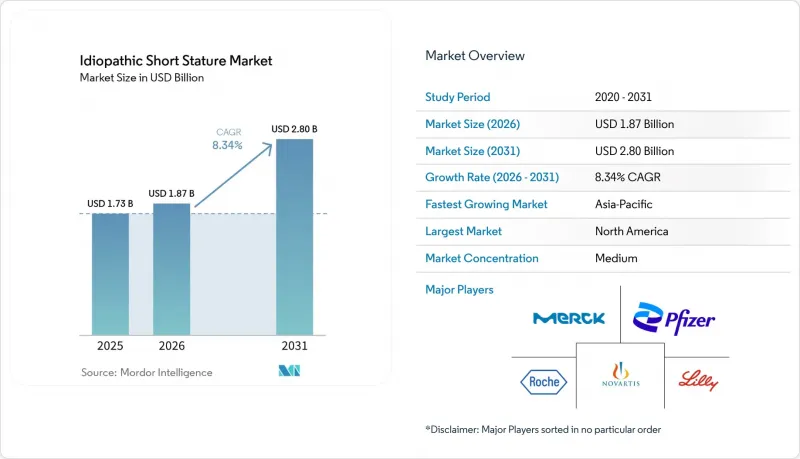
This report is Segmented by Therapy Type (Branded RhGH, Biosimilar RhGH, and More), Age Group (Pre-Pubertal Children, and More), Route of Administration (Daily Subcutaneous Injection, and More), End User (Hospitals, Specialty Endocrine Clinics, Home-Care Settings), and Geography (North America, Europe, and More). The Market Forecasts are Provided in Terms of Value (USD).
Global Idiopathic Short Stature Market Trends and Insights
Rising Prevalence of ISS Diagnosis
Next-generation sequencing has reduced the cost and turnaround time for genetic evaluations, enabling clinicians to exclude monogenic causes such as SHOX deficiency and reclassify children into the idiopathic short stature market treatment pool. An October 2025 guideline recommends multiplex ligation-dependent probe amplification for all children below -2.5 standard deviations, which standardizes referrals. In Abu Dhabi, idiopathic short stature accounted for 34.8% of all rhGH prescriptions from 2011 to 2022, surpassing growth hormone deficiency. Although the diagnostic yield of sequencing remains 14.9%, the significant increase in screened children is driving demand. As more hospitals implement electronic growth charts, deviations prompt earlier specialist referrals, increasing volume in North America and the Gulf.
Growing Adoption of rhGH Biosimilars
Price-competitive biosimilars are transforming the idiopathic short stature market in China and India, where domestic manufacturers obtained National Reimbursement Drug List coverage in January 2026, reducing annual therapy costs by more than 50%. Intas Pharmaceuticals' fermentation-to-fill pipeline provides a cost advantage once Indian state payers finalize reimbursement rules. In Latin America, mandatory coverage in Argentina is hindered by administrative bottlenecks that disrupt supply and negatively impact clinical outcomes. Europe and North America lag behind as physicians remain loyal to originator brands and regulatory requirements for immunogenicity data extend approval timelines.
Stringent Regulatory Scrutiny & High Therapy Cost
The EMA's 2007 refusal to approve idiopathic short stature contrasts with FDA acceptance and establishes a two-tier access structure, as European payers cite ethical concerns when rejecting claims. U.S. annual therapy costs of USD 20,000-50,000 push insurers toward strict prior-authorization, while pediatric endocrine societies advise caution, reinforcing payer denials. Long-acting analogs face additional safety checks because continuous GH exposure increased edema rates in trials. Argentine private insurers systematically defer coverage for premium analogs despite local approval, framing high cost as the primary barrier.
Other drivers and restraints analyzed in the detailed report include:
- Expanded Insurance Reimbursement
- Long-Acting GH Formulations Pipeline
- Low Awareness / Delayed Diagnosis in Low-Income Countries
For complete list of drivers and restraints, kindly check the Table Of Contents.
Segment Analysis
In 2025, branded rhGH held a 62.20% market share. However, long-acting analogs are set to outpace the market, growing at a projected 9.32% CAGR through 2031, making them the fastest-growing segment in the idiopathic short stature market. Ascendis Pharma's SKYTROFA, within just 18 months, secured a notable 6.5% share in the U.S. market. This demonstrates that premium pricing can coexist with payer acceptance, especially when adherence benefits are evident. Conversely, in China, biosimilar approvals reduced therapy costs by 75%, broadening the idiopathic short stature market's accessibility to middle-income families. While Western companies strengthen their market share with connected devices and expanded labels, regional players effectively leverage government tenders to secure volume contracts, particularly in county-level hospitals.
In 2025, children aged 10 and under constituted 65.05% of treated patients. This segment is projected to grow at a robust 9.55% CAGR through 2031, driven by earlier detection of growth deficits through genomic screening. Initiating therapy pre-puberty can secure an annualized growth velocity often surpassing 11 cm. While adolescents still represent a significant portion of the idiopathic short stature market, their growth is tempered due to the diminishing efficacy post growth-plate closure. Health campaigns are now proactively targeting primary schools with height-monitoring initiatives, streamlining referrals to pediatric endocrine clinics.
Geography Analysis
In 2025, North America accounted for 38.13% of global revenue, supported by strong insurance frameworks and high per-capita drug spending. However, only 15% of prior-authorization requests for idiopathic short stature succeed, reflecting ongoing concerns about cost-effectiveness. Despite premium pricing, Skytrofa achieved a 6.5% share in the US market within 18 months, demonstrating physicians' preference for its weekly regimen. Access to treatments in Canada varies by province; some provinces provide reimbursements through exceptional drug programs, while others restrict funding to classical deficiencies, resulting in uneven national uptake.
Asia-Pacific is set to lead with a projected 9.33% CAGR through 2031. In January 2026, China's inclusion in the NRDL reduced patient co-pays by more than half, driving increased demand among urban middle-income families. Genescience dominates the market, holding over 70% of China's rhGH sales and leveraging its scale to deter new entrants. Meanwhile, Indian biosimilar firms are targeting export opportunities in Southeast Asia once the WHO pre-qualification is secured. South Korea and Japan are advancing their domestic pipelines with innovative long-acting analog options.
Europe grapples with the EMA's 2007 decision, leaving many patients reliant on off-label prescriptions. In Germany, funding for idiopathic short stature is tightly regulated, based on criteria such as genetic potential disparity. The UK's NHS rarely approves treatments, typically doing so only on compassionate grounds. Southern European countries rely on regional health authorities, leading to disparities and hindering the market's growth for idiopathic short stature. While Western Europe has adequate cold-chain stability, Eastern Europe continues to face logistical challenges, particularly in rural areas.
- Anhui Anke Biotechnology (Group) Co., Ltd.
- Ascendis Pharma
- BioPartners GmbH
- Bio-Thera Solutions, Ltd.
- Eli Lilly and Company
- Ferring Pharmaceuticals In.
- F-Hoffmann-La Roche Ltd.
- GeneScience Pharmaceutical
- Hanmi Pharmaceutical Co., Ltd.
- Intas Pharmaceutical
- Ipsen Pharma Inc.
- JCR Pharmaceuticals Inc.
- Kyowa Kirin
- LG Chem
- Merck KGaA / EMD Serono
- Novartis
- Novo Nordisk
- Opko Health
- Pfizer
- Teva Pharmaceutical Industries
Additional Benefits:
- The market estimate (ME) sheet in Excel format
- 3 months of analyst support
TABLE OF CONTENTS
1 Introduction
- 1.1 Study Assumptions & Market Definition
- 1.2 Scope of the Study
2 Research Methodology
3 Executive Summary
4 Market Landscape
- 4.1 Market Overview
- 4.2 Market Drivers
- 4.2.1 Rising Prevalence of ISS Diagnosis
- 4.2.2 Growing Adoption of Rhgh Biosimilars
- 4.2.3 Expanded Insurance Reimbursement
- 4.2.4 Long-Acting GH Formulations Pipeline
- 4.2.5 Genomic Screening for Early Detection
- 4.2.6 Medical Tourism for Pediatric Endocrinology
- 4.3 Market Restraints
- 4.3.1 Stringent Regulatory Scrutiny & High Therapy Cost
- 4.3.2 Low Awareness / Delayed Diagnosis in LICs
- 4.3.3 Ethical Concerns Over Non-Medical Height Use
- 4.3.4 Cold-Chain Constraints for Biologics
- 4.4 Value / Supply-Chain Analysis
- 4.5 Regulatory Landscape
- 4.6 Technological Outlook
- 4.7 Porter's Five Forces Analysis
- 4.7.1 Threat of New Entrants
- 4.7.2 Bargaining Power of Suppliers
- 4.7.3 Bargaining Power of Buyers
- 4.7.4 Threat of Substitutes
- 4.7.5 Competitive Rivalry
5 Market Size & Growth Forecasts (Value, USD)
- 5.1 By Therapy Type
- 5.1.1 Branded rhGH
- 5.1.2 Biosimilar rhGH
- 5.1.3 Long-acting GH analogs
- 5.1.4 GH secretagogues (oral, pipeline)
- 5.2 By Age Group
- 5.2.1 Pre-pubertal Children (?10 yrs)
- 5.2.2 Pubertal Adolescents (11-18 yrs)
- 5.3 By Route of Administration
- 5.3.1 Daily sub-cutaneous injection
- 5.3.2 Weekly sub-cutaneous injection
- 5.3.3 Oral formulations (Pipeline)
- 5.4 By End User
- 5.4.1 Hospitals
- 5.4.2 Specialty Endocrine Clinics
- 5.4.3 Home-care Settings
- 5.5 By Geography
- 5.5.1 North America
- 5.5.1.1 United States
- 5.5.1.2 Canada
- 5.5.1.3 Mexico
- 5.5.2 Europe
- 5.5.2.1 Germany
- 5.5.2.2 United Kingdom
- 5.5.2.3 France
- 5.5.2.4 Italy
- 5.5.2.5 Spain
- 5.5.2.6 Rest of Europe
- 5.5.3 Asia-Pacific
- 5.5.3.1 China
- 5.5.3.2 India
- 5.5.3.3 Japan
- 5.5.3.4 South Korea
- 5.5.3.5 Australia
- 5.5.3.6 Rest of Asia-Pacific
- 5.5.4 Middle East & Africa
- 5.5.4.1 GCC
- 5.5.4.2 South Africa
- 5.5.4.3 Rest of Middle East and Africa
- 5.5.5 South America
- 5.5.5.1 Brazil
- 5.5.5.2 Argentina
- 5.5.5.3 Rest of South America
- 5.5.1 North America
6 Competitive Landscape
- 6.1 Market Concentration
- 6.2 Market Share Analysis
- 6.3 Company Profiles (includes Global level Overview, Market-level Overview, Core Segments, Financials, Strategic Information, Market Rank/Share, Products & Services, Recent Developments)
- 6.3.1 Anhui Anke Biotechnology (Group) Co., Ltd.
- 6.3.2 Ascendis Pharma
- 6.3.3 BioPartners GmbH
- 6.3.4 Bio-Thera Solutions, Ltd.
- 6.3.5 Eli Lilly and Company
- 6.3.6 Ferring Pharmaceuticals In.
- 6.3.7 F-Hoffmann-La Roche Ltd.
- 6.3.8 GeneScience Pharmaceutical
- 6.3.9 Hanmi Pharmaceutical Co., Ltd.
- 6.3.10 Intas Pharmaceuticals Ltd.
- 6.3.11 Ipsen Pharma Inc.
- 6.3.12 JCR Pharmaceuticals Inc.
- 6.3.13 Kyowa Kirin Co., Ltd.
- 6.3.14 LG Chem Ltd.
- 6.3.15 Merck KGaA / EMD Serono
- 6.3.16 Novartis AG
- 6.3.17 Novo Nordisk A/S
- 6.3.18 OPKO Health, Inc.
- 6.3.19 Pfizer Inc.
- 6.3.20 Teva Pharmaceutical Industries Ltd.
7 Market Opportunities & Future Outlook
- 7.1 White-space & Unmet-need Assessment

(주말 및 공휴일 제외)


