|
시장보고서
상품코드
2063630
X 연관 망막색소변성증 : 시장 점유율 분석, 업계 동향 및 통계, 성장 예측(2026-2031년)X-linked Retinitis Pigmentosa - Market Share Analysis, Industry Trends & Statistics, Growth Forecasts (2026 - 2031) |
||||||
 Mordor Intelligence
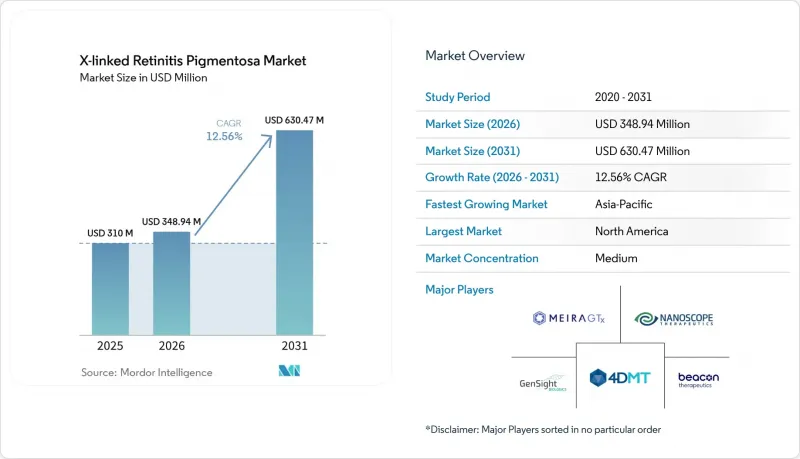
Mordor Intelligence에 의하면, X 연관 망막색소변성증 시장 규모는 2025년 3억 1,000만 달러로 평가되었습니다. 2026년에는 3억 4,894만 달러로 확대되어 2026-2031년 CAGR은 12.56%를 나타내, 2031년까지 6억 3,047만 달러에 이를 것으로 예측됩니다.
본 보고서는 치료법별(유전자 치료 등), 개발 단계별(신약 개발·전임상 단계 등), 투여 경로별(망막하, 유리체 내, 경구·전신 투여 등), 최종 사용자별(병원·안과 의료 체인 등), 지역별(북미, 유럽, 아시아태평양 등)으로 분류되어 있습니다. 시장 전망은 금액(달러) 기준으로 제시되어 있습니다.
세계의 X 연관 망막색소변성증 시장 동향 및 인사이트
AAV를 매개로 하는 RPGR 유전자 치료의 진전
2024년, MeiraGTx사는 보타레치젠 스파로팔보벡을 3상 임상시험 단계로 진행하여 전 세계 12개 기관에서 60명의 피험자를 등록했으며, 2026년 하반기에 중간 데이터를 확보할 것으로 예측됩니다. 이 벡터는 로도프신 키나아제 프로모터 하에서 코돈이 최적화된 RPGR-ORF15를 채택하고 있으며, 유전적으로 확인된 사례의 약 70%에 해당합니다. 얀센의 17억 달러 투자로, 당초 비인간 영장류에서 관찰된 지속성에 대한 기대가 입증되었습니다. 그러나 치료를 받지 않은 소아의 최대 84%에서 높은 기저 AAV8 항체가 확인됨에 따라, 적격 후보자의 수가 크게 감소했습니다. 각 후원사는 야생형 AAV8보다 10배 높은 역가에서의 중화 작용을 극복하기 위해 NAV 등의 플랫폼을 통해 캡시드 변이체를 개발하고 있습니다.
일회성 근치적 치료 가격 모델에 대한 지불자의 수용도
2024년, CMS는 세포 및 유전자 치료 접근 모델을 도입하고, 성과 연계형 메디케이드 계약에 20억 달러를 배정했습니다. 이 계약들에 따르면, 한쪽 눈당 85만-120만 달러로 책정된 치료법에 대해 보험금 지급이 이루어집니다. 조기 도입 주에서는 수급자의 80%가 24개월 시점에 ETDRS 척도에서 15글자의 시력 개선을 달성해야 한다는 요건을 두고 있으며, 이 기준을 충족하지 못할 경우 정가의 최대 40%에 해당하는 리베이트가 발생합니다. 제조업체는 향후 환불 의무를 증권화할 수 있으며, 이를 통해 자본 비용을 절감하고 X 연관 망막색소변성증 시장의 지불 주체들의 신뢰를 높일 수 있습니다. 그러나 조사 대상인 미국 민간 보험사 18곳 중 희귀질환 관련 예산이 5,000만 달러를 넘는 곳은 고작 6곳에 불과하며, 많은 보험사가 엄격한 평생 상한액을 적용하고 있습니다.
망막하 수술 수행 능력의 병목 현상
2024년, 미국 망막 전문의 협회(American Society of Retina Specialists)의 보고에 따르면, 미국에서 활동 중인 유리체망막 외과 의사는 불과 3,000명에 불과했으며, 그중 40%가 55세 이상이었습니다. 망막하 주사 시술에는 고도의 망막 절개 기술이 요구되지만, 이 시술(코드 67036)에 대한 보험 지급액은 2020년 이후 1,200달러로 정체되어 있습니다. 그 결과, 루크스투르나(Luxturna) 출시 후 2년 동안 미국에서 시술을 받을 수 있는 시설은 고작 35곳에 그쳤으며, 6개월 대기 현상이 발생했습니다. MeiraGTx사는 허브 앤 스포크 방식의 교육 네트워크를 시범적으로 도입하고 있으나, 유리체 내 벡터를 이용한 치료법과의 동등성이 확인될 때까지는 각 외과 의사의 일일 시술 건수가 2-3건으로 제한되어 있습니다.
부문별 분석
2025년, X 연관 망막색소변성증 시장에서 유전자 치환 요법은 시장 점유율의 82.34%를 차지했으며, 전체 시장 규모는 약 2억 8,700만 달러에 달할 전망입니다. 3가지 주요 AAV8-RPGR 프로그램은 광수용체의 보존에 중점을 두고 있으며, 이 임상 평가 지표는 기능적 시력의 대체 지표로서 규제 당국으로부터 점점 더 널리 인정받고 있습니다. 옵토제네틱스는 2025년에는 시장 점유율이 작을 것으로 예상되지만, 벡터의 혈청형 매칭이나 손상되지 않은 외절이 필요 없이 FDA 승인을 목표로 하는 MCO-010에 힘입어 연평균 성장률(CAGR) 15.23%로 가장 빠른 성장을 이룰 것으로 전망됩니다.
나노스코프사의 옵신은 주변 빛에 의해 활성화되기 때문에 부피가 큰 고글이 필요 없어, 고령 환자들 사이에서 도입이 확대되고 있습니다. 한편, 진행성 변성 질환을 치료하기 위해 1/2상 임상시험에 진입한 BlueRock사의 iPS 세포 유래 광수용체는 1회 투여당 90만 달러를 초과할 가능성이 있는 제조 비용 문제에 직면해 있습니다. 약리학적 신경 보호 요법은 여전히 2차적인 선택지에 그치고 있으며, 그 효과는 일시적인 데 그치고, 지속적인 투여가 필요하다는 점에서 한계가 있습니다.
2025년 X 연관 망막색소변성증 시장 규모에서 1/2상 자산이 54.06%를 차지하고 있는 것으로 나타나, 새로운 치료법에 대한 기대가 높아지고 있음에도 불구하고 임상 개발이 아직 미성숙한 실태가 드러나고 있습니다. CRISPR 기반 유전자 편집 기술을 바탕으로 한 신약 개발 프로그램은 로열티율 하락과 선도 화합물의 최적화 기간을 단축하는 모듈식 가이드 RNA 설계를 통해 연평균 성장률(CAGR) 14.95%로 발전하고 있습니다.
파이프라인의 불과 12%를 차지하는 3상 임상시험은 특히 소아 대상 투여에서 유효성의 지속성과 안전성에 대한 선례를 제시함으로써 큰 영향력을 발휘하고 있습니다. 첫 번째 승인은 ‘팔로 더 리더(선도자 추종)’ 현상을 촉발할 것으로 예상되며, 지급 기관은 초기 가격 신호를 기준으로 예산에 미치는 영향을 평가하게 될 것입니다. 승인된 치료법은 여전히 극히 드물며, 전 세계적으로 50명 미만의 환자로 구성된 희귀한 RPGR-RPE65 중복 증례에 대한 Luxturna의 적응증 외 사용으로만 제한되어 있습니다.
지역별 분석
2025년, 북미는 X 연관 망막색소변성증 시장의 41.13%를 차지했으며, 19곳의 운영 중인 임상시험 센터와 2개의 CMS 환급 시범 프로그램의 지원을 받고 있습니다. 미국 희귀질환 치료제법(Orphan Drug Act)은 FDA 수수료 320만 달러를 면제하고 7년간의 독점권을 부여함으로써, 후원사의 손익분기점을 낮춥니다. 또한, 14억 캐나다 달러 규모의 캐나다 희귀질환 의약품 전략은 주요 지불 주체의 핵심 역할을 수행하고 있으며, 캐나다 보건부의 ‘조건부 적합 통지(Notice of Compliance with Conditions)’ 요건을 충족하는 유전자 치료에 대해 조건부 보험 적용을 제공합니다.
유럽은 32%의 점유율을 차지하고 있지만, HTA(의료기술평가) 기관에 따라 적용되는 QALY(질 조정 생존년)당 비용 기준치가 다르기 때문에 회원국 간 가격에 3배의 차이가 발생하고 있습니다. 예를 들어, 독일의 IQWiG는 지불 의향액의 상한선을 8만 유로(9만 3,655.60 달러)로 설정하고 있는 반면, 영국의 NHS는 초희귀질환 치료제에 대해 기준치를 조정하고 있습니다. 이러한 조정으로 인해 병행 협상이 발생하여, 출시까지의 기간이 평균 9개월 연장되었습니다. GenSight사의 LUMEVOQ 사례는 이러한 격차를 여실히 보여주고 있습니다. 프랑스와 이탈리아에서는 1년 이내에 상환이 승인되었으나, 스페인에서는 2026년까지도 승인이 지연되고 있습니다.
아시아태평양은 현재 18%의 점유율을 차지하고 있으며, 연평균 성장률(CAGR) 14.58%로 가장 빠르게 성장하고 있는 지역입니다. 이는 중국이 85종의 희귀질환 치료제를 국가 보험 급여 목록에 추가한 것과, 2상 임상시험 데이터를 바탕으로 조건부 승인을 부여하는 일본의 ‘SAKIGAKE’ 제도가 주도하고 있습니다. 한국의 2024년 희귀질환법에서는 환자 수가 2만 명 미만인 질환군에 대해 국민건강보험공단이 치료비의 80%를 환급하도록 의무화해, 향후 출시될 X 연관 망막색소변성증 치료제를 사실상 지원하게 됩니다. 라틴아메리카 및 중동 및 아프리카는 제한된 수술 역량과 단편적인 지불자 제도로 인해 여전히 초기 단계에 머물러 있지만, 2024년에 ANVISA가 3건의 안과용 유전자 치료에 대해 우선 심사를 실시하는 등 규제 측면에서 초기적인 진전이 나타나고 있습니다.
기타 혜택 :
- 엑셀 형식 시장 예측(ME) 시트
- 3개월간의 애널리스트 지원
자주 묻는 질문
목차
제1장 서론
제2장 조사 방법
제3장 주요 요약
제4장 시장 구도
제5장 시장 규모 및 성장 예측
제6장 경쟁 구도
제7장 시장 기회 및 향후 전망
KTH 26.06.24According to Mordor Intelligence, the x-linked retinitis pigmentosa market size is expected to grow from USD 310 million in 2025 to USD 348.94 million in 2026 and is forecast to reach USD 630.47 million by 2031 at 12.56% CAGR over 2026-2031.
This report is Segmented by Therapy Type (Gene Therapy, and More), Stage of Development (Discovery & Preclinical, and More), Route of Administration (Sub-Retinal, Intravitreal, Oral/Systemic, and More), End User (Hospitals & Eye-Care Chains, and More), and Geography (North America, Europe, Asia-Pacific, and More). The Market Forecasts are Provided in Terms of Value (USD).
Global X-linked Retinitis Pigmentosa Market Trends and Insights
Breakthroughs in AAV-Mediated RPGR Gene Therapy
In 2024, MeiraGTx progressed botaretigene sparoparvovec to Phase III, enrolling 60 participants across 12 global sites, with interim data expected in late 2026. The vector employs a codon-optimized RPGR-ORF15 under a rhodopsin-kinase promoter, addressing approximately 70% of genetically confirmed cases. Janssen's investment of USD 1.7 billion highlighted durability expectations initially observed in non-human primates. However, high baseline anti-AAV8 antibodies, present in up to 84% of treatment-naive children, significantly reduced the pool of eligible candidates. Sponsors are developing capsid variants through platforms like NAV to overcome neutralization at titers ten times higher than the wild-type AAV8.
Payer Acceptance of One-Time Curative Pricing Models
In 2024, CMS introduced its cell and gene therapy access model, allocating USD 2 billion for outcomes-based Medicaid contracts. These contracts reimburse therapies priced between USD 850,000 and USD 1.2 million per eye. Early adopter states require 80% of recipients to achieve a 15-letter gain on the ETDRS scale at 24 months, with rebates of up to 40% of the list price triggered if this benchmark is not met. Manufacturers can securitize future rebate obligations, reducing capital costs and enhancing payor confidence in the X-linked retinitis pigmentosa market. However, only six out of 18 surveyed US commercial insurers maintain rare-disease budgets exceeding USD 50 million, and many enforce strict lifetime caps.
Sub-Retinal Surgical Capacity Bottlenecks
In 2024, the American Society of Retina Specialists reported only 3,000 active vitreoretinal surgeons in the U.S., with 40% aged over 55. While sub-retinal injections demand advanced retinotomy skills, reimbursement for the procedure (code 67036) has stagnated at USD 1,200 since 2020.Consequently, only 35 U.S. centers could administer Luxturna in its initial two commercial years, leading to six-month wait times. MeiraGTx is testing a hub-and-spoke training network, but each surgeon's capacity is limited to 2-3 cases daily until intravitreal vectors demonstrate equivalence.
Other drivers and restraints analyzed in the detailed report include:
- Priority-Review Vouchers Accelerating ROI
- Cross-Licensing of CRISPR IP Lowering Barriers
- Uncertain Durability of Vector Expression
For complete list of drivers and restraints, kindly check the Table Of Contents.
Segment Analysis
In 2025, gene replacement accounted for 82.34% of the x-linked retinitis pigmentosa market share, translating to approximately USD 287 million within the broader market size. Three pivotal AAV8-RPGR programs focus on preserving photoreceptors, a clinical endpoint increasingly recognized by regulators as a surrogate for functional vision. Optogenetics, while holding a smaller share in 2025, is projected to achieve the fastest growth at a 15.23% CAGR, driven by MCO-010's pursuit of FDA approval without requiring vector-serotype matching or intact outer segments.
Nanoscope's opsin activates under ambient light, eliminating the need for bulky goggles and increasing adoption among elderly patients. Meanwhile, BlueRock's iPSC-derived photoreceptors, which entered Phase I/II to address late-stage degeneration, face cost-of-goods challenges that could exceed USD 900,000 per dose. Pharmacologic neuroprotection remains a secondary option, limited by its transient efficacy and the need for continuous dosing.
Phase I/II assets formed 54.06% of the X-linked retinitis pigmentosa market size pipeline in 2025, highlighting clinical immaturity despite growing enthusiasm for novel modalities. Discovery programs driven by CRISPR-based editing are advancing at a 14.95% CAGR, supported by declining royalty rates and modular guide-RNA designs that shorten lead-optimization timelines.
Phase III trials, comprising only 12% of the pipeline, exert significant influence by setting precedents for durability and safety, particularly in pediatric dosing. The first approvals are expected to trigger a follow-the-leader dynamic, with payers benchmarking budget impacts against early pricing signals. Approved therapies remain minimal, limited to off-label Luxturna use in the rare RPGR-RPE65 overlap, a cohort of fewer than 50 patients worldwide.
Geography Analysis
In 2025, North America commanded 41.13% of the X-linked retinitis pigmentosa market size, supported by 19 active trial sites and two CMS reimbursement pilots. The U.S. Orphan Drug Act provides a waiver of USD 3.2 million in FDA fees and grants seven years of exclusivity, reducing sponsor breakeven points. Additionally, Canada's CAD 1.4 billion rare-disease drug strategy acts as a significant payer anchor, offering conditional coverage for gene therapies that meet Health Canada's Notice of Compliance with Conditions pathway.
Europe held a 32% share, but pricing varies threefold across member states due to distinct cost-per-QALY thresholds applied by HTA agencies. For example, Germany's IQWiG limits willingness-to-pay at EUR 80,000 (USD 93,655.60), while England's NHS adjusts thresholds for ultra-orphan drugs. These adjustments lead to parallel negotiations, extending launch timelines by an average of nine months. GenSight's LUMEVOQ experience highlights this disparity: reimbursed in France and Italy within a year but still delayed in Spain as of 2026.
Asia-Pacific, currently at 18%, is the fastest-growing region with a 14.58% CAGR, driven by China's inclusion of 85 rare-disease drugs in its National Reimbursement List and Japan's SAKIGAKE pathway, which grants conditional approval after Phase II data. South Korea's 2024 Rare Disease Act requires the National Health Insurance Service to reimburse 80% of therapy costs for patient populations under 20,000, effectively supporting upcoming X-linked retinitis pigmentosa launches. Latin America and the Middle East & Africa remain in early stages, hindered by limited surgical capacity and fragmented payer systems, but early regulatory developments are evident, such as ANVISA's priority review for three ocular gene therapies in 2024.
- 4D Molecular Therapeutics Inc.
- Adverum Biotechnologies, Inc.
- Alkeus Pharmaceuticals
- Beacon Therapeutics Inc.
- Beam Therapeutics Inc.
- Biogen
- CRISPR Therapeutics AG
- Editas Medicine
- GenSight Biologics S.A
- Horama SA
- Johnson & Johnson (Janssen/Beacon)
- MeiraGTx Holdings PLC
- Nanoscope Therapeutics Inc.
- Neurotech Pharmaceuticals, Inc.
- Novartis
- Ocugen
- ProQR Therapeutics Inc.
- Regenxbio Inc.
- RetinalGenix Technologies
- Spark Therapeutics (Roche)
Additional Benefits:
- The market estimate (ME) sheet in Excel format
- 3 months of analyst support
TABLE OF CONTENTS
1 Introduction
- 1.1 Study Assumptions & Market Definition
- 1.2 Scope of the Study
2 Research Methodology
3 Executive Summary
4 Market Landscape
- 4.1 Market Overview
- 4.2 Market Drivers
- 4.2.1 Breakthroughs in AAV-Mediated RPGR Gene Therapy
- 4.2.2 Payer Acceptance of One-Time Curative Pricing Models
- 4.2.3 Priority-Review Vouchers Accelerating ROI
- 4.2.4 Cross-Licensing of CRISPR IP Lowering Barriers
- 4.2.5 Emergence of AI-Guided Retinal Imaging Endpoints
- 4.2.6 Venture Philanthropy De-Risking Early Trials
- 4.3 Market Restraints
- 4.3.1 Sub-Retinal Surgical Capacity Bottlenecks
- 4.3.2 Uncertain Durability of Vector Expression
- 4.3.3 Anti-AAV Neutralising Antibodies in Paediatric Pools
- 4.3.4 Competing Optogenetic Pipelines Crowding Trial Sites
- 4.4 Value / Supply-Chain Analysis
- 4.5 Regulatory Landscape
- 4.6 Technological Outlook
- 4.7 Porter's Five Forces Analysis
- 4.7.1 Threat of New Entrants
- 4.7.2 Bargaining Power of Suppliers
- 4.7.3 Bargaining Power of Buyers
- 4.7.4 Threat of Substitutes
- 4.7.5 Intensity of Competitive Rivalry
5 Market Size & Growth Forecasts (Value, USD)
- 5.1 By Therapy Type
- 5.1.1 Gene Therapy
- 5.1.2 Pharmacological Agents
- 5.1.3 Optogenetics
- 5.1.4 Stem Cell Therapies
- 5.1.5 Others
- 5.2 By Stage of Development
- 5.2.1 Discovery & Preclinical
- 5.2.2 Phase I/II
- 5.2.3 Phase III
- 5.2.4 Approved/Commercial
- 5.3 By Route of Administration
- 5.3.1 Sub-retinal
- 5.3.2 Intravitreal
- 5.3.3 Oral/Systemic
- 5.3.4 Others
- 5.4 By End User
- 5.4.1 Hospitals & Eye-care Chains
- 5.4.2 Academic & Research Institutes
- 5.4.3 Specialty Clinics
- 5.5 By Geography
- 5.5.1 North America
- 5.5.1.1 United States
- 5.5.1.2 Canada
- 5.5.1.3 Mexico
- 5.5.2 Europe
- 5.5.2.1 Germany
- 5.5.2.2 United Kingdom
- 5.5.2.3 France
- 5.5.2.4 Italy
- 5.5.2.5 Spain
- 5.5.2.6 Rest of Europe
- 5.5.3 Asia-Pacific
- 5.5.3.1 China
- 5.5.3.2 India
- 5.5.3.3 Japan
- 5.5.3.4 South Korea
- 5.5.3.5 Australia
- 5.5.3.6 Rest of Asia-Pacific
- 5.5.4 Middle East & Africa
- 5.5.4.1 GCC
- 5.5.4.2 South Africa
- 5.5.4.3 Rest of Middle East and Africa
- 5.5.5 South America
- 5.5.5.1 Brazil
- 5.5.5.2 Argentina
- 5.5.5.3 Rest of South America
- 5.5.1 North America
6 Competitive Landscape
- 6.1 Market Concentration
- 6.2 Market Share Analysis
- 6.3 Company Profiles (includes Global level Overview, Market-level Overview, Core Segments, Financials, Strategic Information, Market Rank/Share, Products & Services, Recent Developments)
- 6.3.1 4D Molecular Therapeutics Inc.
- 6.3.2 Adverum Biotechnologies, Inc.
- 6.3.3 Alkeus Pharmaceuticals
- 6.3.4 Beacon Therapeutics Inc.
- 6.3.5 Beam Therapeutics Inc.
- 6.3.6 Biogen Inc.
- 6.3.7 CRISPR Therapeutics AG
- 6.3.8 Editas Medicine
- 6.3.9 GenSight Biologics S.A
- 6.3.10 Horama SA
- 6.3.11 Johnson & Johnson (Janssen/Beacon)
- 6.3.12 MeiraGTx Holdings PLC
- 6.3.13 Nanoscope Therapeutics Inc.
- 6.3.14 Neurotech Pharmaceuticals, Inc.
- 6.3.15 Novartis AG
- 6.3.16 Ocugen Inc.
- 6.3.17 ProQR Therapeutics Inc.
- 6.3.18 Regenxbio Inc.
- 6.3.19 RetinalGenix Technologies
- 6.3.20 Spark Therapeutics (Roche)
7 Market Opportunities & Future Outlook
- 7.1 White-space & Unmet-need Assessment