|
시장보고서
상품코드
2063631
구획증후군 모니터링 기기 : 시장 점유율 분석, 업계 동향 및 통계, 성장 예측(2026-2031년)Compartment Syndrome Monitoring Devices - Market Share Analysis, Industry Trends & Statistics, Growth Forecasts (2026 - 2031) |
||||||
 Mordor Intelligence
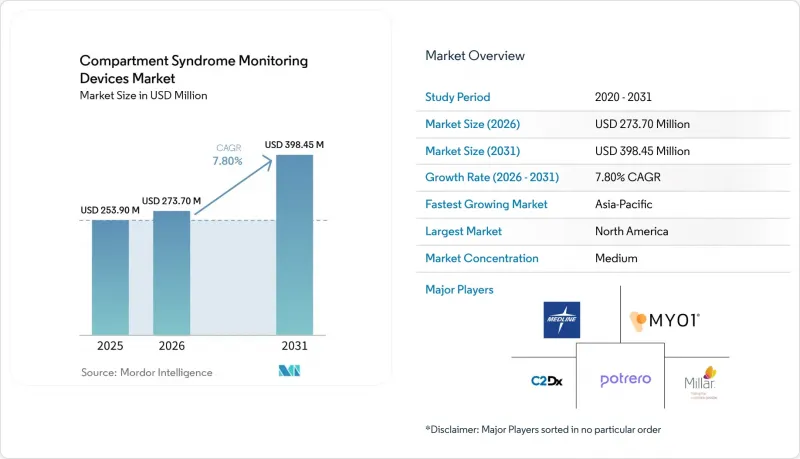
Mordor Intelligence에 의하면, 구획증후군 모니터링 기기 시장 규모는 2025년에 2억 5,390만 달러로 평가되었습니다. 2026년에 2억 7,370만 달러에서 2031년까지 3억 9,845만 달러에 이를 것으로 예측됩니다.
2026년부터 2031년까지 연평균 성장률(CAGR) 7.80%를 나타낼 것으로 전망됩니다.
본 보고서는 제품(장비, 소모품 및 부속품), 기술(침습적 모니터링 기기 등), 증후군 유형(급성 구획증후군 등), 최종 사용자(병원, 외래수술센터(ASC) 등) 및 지역(북미, 유럽 등)별로 분류되어 있습니다. 시장 전망은 금액(달러) 기준으로 제공됩니다.
세계의 구획증후군 모니터링 기기 시장 동향 및 인사이트
외상 관련 부상 발생률 증가
세계의 교통사고, 스포츠로 인한 골절, 그리고 군사적 부상자 증가로 인해 급성 구획증후군(ACS)의 환자 수가 늘어나고 있으며, 신속한 진단이 요구되고 있습니다. 미국 국방부는 ‘Advanced Medical Monitor’ 프로그램에 막대한 자금을 투자하고 있으며, 전장에서의 부상자 분류 과정에서 연속 압력 센서의 중요성을 강조하고 있습니다. 민간 외상 센터도 이러한 수요에 대응하고 있으며, 2024년에 100명의 환자를 대상으로 실시된 다기관 공동 연구에 따르면, 간헐적인 점검에 비해 연속 모니터링을 통해 절단 확률이 0.23으로 감소한 것으로 나타났습니다. 아시아태평양에서 교통사고로 인한 부상자 수가 증가함에 따라, 지역 의료 센터에서 신뢰할 수 있는 모니터링에 대한 수요가 높아지고 있습니다.
조기 진단에 대한 임상의들의 인식 제고
전문의 학회는 고위험 골절에 대한 표준화된 모니터링을 권장하고 있습니다. 조사에 따르면, 증상이 나타난 지 6시간 이내에 근막 절개술을 시행하면 절단 발생률을 3분의 2로 줄일 수 있지만, 주관적인 소견에 근거한 판단으로 인해 수술이 지연되는 경우가 종종 있습니다. 임상의들은 델타 압력을 30 mmHg 미만으로 유지해야 한다는 것과 같은 객관적인 기준치에 점점 더 의존하고 있습니다. 미국에서는 의료과실 보험사들이 기록된 압력 추이를 위험 완화 조치로 간주하고 있으며, 병원들이 필요한 설비 투자를 하도록 독려하고 있습니다. 학술 기관에서의 시뮬레이션 훈련을 통해 숙련도가 향상되었으며, 지속적인 모니터링 시스템이 새로운 표준 치료법으로 자리 잡아가고 있습니다.
장비 및 소모품 비용의 높음
의료기기의 가격은 최대 2만 5,000달러에 달하고, 일회용 카테터는 400달러나 하기 때문에 소규모 병원에는 재정적 부담이 되고 있습니다. 2024년 분석에 따르면, 근막 절개술의 감소와 입원 기간 단축으로 인해 환자 1인당 60일 동안 2,789달러의 순절감 효과가 확인되었습니다. 그러나 이러한 비용 절감 효과는 장비 자금 조달을 담당하는 부서가 아닌 병원의 재무 부서에 환원되기 때문에 예산의 일관성이 무너지는 상황을 초래하고 있습니다. 인도의 2024년 생산 연계형 인센티브 제도는 제조의 현지화를 목적으로 하고 있지만, 그 혜택이 본격적으로 나타나기 시작하는 것은 2027년 이후가 될 것으로 예측됩니다.
부문별 분석
병원들이 감염 관리 준수 및 예측 가능한 비용 구조에 주력함에 따라, 일회용 제품이 기기 시장을 앞지를 것으로 예측됩니다. 일회용 카테터에 대한 선호는 ‘면도기와 면도날’ 모델에 부합하며, 공급업체의 수익성을 높여줍니다. 기기 제조업체들은 라이선싱을 통해 프리미엄 소프트웨어를 활성화하는 모듈식 콘솔을 도입함으로써, 초기 투자 부담을 줄이는 동시에 장기적인 수익원을 확보하고 있습니다. 이러한 전략적 접근 방식 덕분에, 핵심 설비 투자가 포화 상태에 도달한 후에도 구획증후군 모니터링 기기 시장의 성장이 지속될 가능성이 높습니다.
일회용 제품으로의 전환은 외래수술센터(ASC)에서 특히 두드러집니다. 이 경우, 초기 비용이 저렴하다는 점이 1건당 비용 증가에 대한 거부감을 상쇄하고 있습니다. 이러한 시설에서는 진료보수 제도에 따라 카테터 비용을 지불자에게 전가하고 있으며, 이에 따라 2031년까지 소모품의 연평균 성장률(CAGR)은 9.08%를 나타낼 것으로 전망됩니다. 주요 정형외과 기업들은 이미 일회용 모니터링 제품군에서 두 자릿수 성장을 보고하고 있으며, 이는 구획증후군 모니터링 기기 시장 전체에서 소모품이 이익률 확대의 핵심 요소가 될 것임을 시사합니다.
임상의들이 카테터 관련 합병증을 줄이려고 노력하는 가운데, 비침습적 및 저침습적 시스템이 시장 점유율을 확대할 태세를 갖추고 있습니다. 2025년에는 침습적 기기가 54.06%의 점유율을 유지한 반면, 신흥 생체 임피던스 및 근적외선 플랫폼은 9.55%의 성장률을 기록하며 급속히 성장하고 있어, 구획증후군 모니터링 기기 시장 전체의 성장률을 상회하고 있습니다. 조기 도입을 추진하고 있는 외상 센터에서는 이러한 플랫폼의 정확도 검증이 진행 중이며, 생체 임피던스 측정값과 침습적인 골드 스탠다드 간의 연관성을 보여주는 긍정적인 파일럿 데이터를 바탕으로 규제 승인 절차도 점차 명확해지고 있습니다.
지역 병원이나 스포츠 클리닉의 경우, 비침습형 프로브는 사용법을 익히기 쉬우며 인증 절차도 간소화되어 있습니다. 천자 시 발생할 수 있는 위험을 배제할 수 있기 때문에 항응고 요법을 받고 있는 환자나 응고 장애가 있는 환자에게도 적용 범위가 확대되고 있습니다. 생산량이 증가함에 따라 부품 비용은 감소하고, 가격 차이는 줄어들 것으로 예측됩니다. AI 분석과 결합됨에 따라, 비접촉식 모니터링은 결국 주류 접근 방식이 될 것이며, 카테터는 특정 중증 환자 사례로만 제한될 가능성이 있습니다.
지역별 분석
2025년, 북미는 매출 점유율의 41.13%를 차지했습니다. 이는 광범위한 1급 및 2급 외상 센터 네트워크와, 시장 진입을 가속화하는 FDA의 예측 가능한 510(k) 승인 절차에 힘입은 결과입니다. 2025년 10월에 도입된 MY01 회계연도의 ‘Transitional Pass-Through’ 및 ‘New Technology Add-on Payments’를 통해 전용 상환 채널이 구축되었고, 병원 내 도입이 가속화되었으며, 고가 의료기기의 가격 책정이 정당화되었습니다. 미국의 품질 관리 프로그램에서는 현재 구획 내압 모니터링이 벤치마크에 포함되어 있으며, 이를 도입할 경우 경제적 인센티브가 마련되어 있습니다.
아시아태평양은 교통사고로 인한 부상자 증가와 현지 의료기기 조립에 대한 정부의 인센티브에 힘입어 연평균 성장률(CAGR) 8.80%를 달성하며 가장 빠르게 성장하는 지역으로 부상하고 있습니다. 인도의 의료 기술 클러스터에서는 제조 비용을 최대 40% 절감하고, 수입품과 경쟁할 수 있는 국내 생산을 촉진하고 있습니다. 중국의 외상 센터 확충에 더해, 고령화 사회에 대응하는 일본의 프리미엄 시장이 안정적인 수요를 보장하고 있습니다. 그러나 일본의 센서에 대한 미국의 관세 조치로 인해 일부 조립 업무가 동남아시아로 이전되는 움직임이 나타나고 있습니다. 호주의 외상 네트워크는 비교적 소규모이지만, 중요한 영어권 규제 플랫폼으로서 기능하고 있으며, 많은 다국적 기업들이 시범 도입에 이를 활용하고 있습니다.
유럽에서는 EU MDR(의료기기 규정)로 인한 병목 현상에 직면해 있어, 멸균 검증 지연 및 북미에 비해 제품 출시 주기가 길어지는 결과를 초래하고 있습니다. 독일에서는 경제 상황을 일변시킬 가능성이 있는 독자적인 DRG 코드 도입이 검토되고 있지만, 2027년 이전에 시행될 가능성은 낮을 것으로 보입니다. 영국에서는 NHS(국민보건서비스) 예산이 빠듯한 상황에서 비침습적 의료기기에 대한 NICE(국립의료기술평가기구)의 평가가 조달 결정에 중요한 영향을 미치게 됩니다. 남유럽에서는 외상 센터의 밀도가 낮아, 그 결과 도입 곡선이 단절되어 있습니다. 북유럽 시장이 앞서가고 있으며, 남유럽 시장은 3년에서 5년 정도 뒤처져 있습니다.
기타 혜택 :
- 엑셀 형식 시장 예측(ME) 시트
- 3개월간의 애널리스트 지원
자주 묻는 질문
목차
제1장 서론
제2장 조사 방법
제3장 주요 요약
제4장 시장 구도
제5장 시장 규모 및 성장 예측
제6장 경쟁 구도
제7장 시장 기회 및 향후 전망
KTH 26.06.24According to Mordor Intelligence, the compartment syndrome monitoring devices market size is projected to be USD 253.90 million in 2025, USD 273.70 million in 2026, and reach USD 398.45 million by 2031, growing at a CAGR of 7.80% from 2026 to 2031.
This report is Segmented by Product (Equipment, Disposables & Accessories), Technology (Invasive Monitoring Devices, and More), Syndrome Type (Acute Compartment Syndrome, and More), End User (Hospitals, Ambulatory Surgical Centers, and More), and Geography (North America, Europe, and More). The Market Forecasts are Provided in Terms of Value (USD).
Global Compartment Syndrome Monitoring Devices Market Trends and Insights
Rising Incidence of Trauma-Related Injuries
Global road-traffic collisions, sports fractures, and military casualties are driving an increase in acute compartment syndrome (ACS) cases, requiring prompt diagnosis. The U.S. Department of Defense has invested significant funds in its Advanced Medical Monitor program, emphasizing the importance of continuous pressure sensors for battlefield triage. Civilian trauma centers are also addressing this need, with a 2024 multicenter study involving 100 patients showing that continuous monitoring reduced amputation odds to 0.23 compared to intermittent checks. As traffic injury volumes rise in the Asia-Pacific, the demand for reliable monitoring in regional centers is growing.
Growing Clinician Awareness of Early Diagnosis
Professional societies are recommending protocolized monitoring for high-risk fractures. Research shows that performing a fasciotomy within six hours of symptom onset can reduce amputations by two-thirds, but subjective signs often delay surgery. Clinicians are increasingly relying on objective thresholds, such as maintaining a delta pressure below 30 mmHg. In the United States, malpractice insurers consider documented pressure trends as a risk mitigation measure, encouraging hospitals to invest in necessary capital purchases. Simulation training in academic centers is enhancing proficiency, establishing continuous monitoring systems as the emerging standard of care.
High Device & Disposable Costs
Capital units can cost up to USD 25,000, and single-use catheters cost USD 400, putting financial pressure on smaller hospitals. A 2024 analysis identified net 60-day savings of USD 2,789 per patient due to fewer fasciotomies and shorter hospital stays. However, these savings benefit hospital finance teams rather than the departments responsible for funding the equipment, leading to budget misalignment. India's 2024 production linked incentive scheme aims to localize manufacturing, but the benefits are not expected to materialize before 2027.
Other drivers and restraints analyzed in the detailed report include:
- Advances in Continuous & Wireless Monitorin
- AI-Driven Predictive Alert Systems
- Mixed Clinical-Outcome Evidence
For complete list of drivers and restraints, kindly check the Table Of Contents.
Segment Analysis
Disposables are expected to surpass equipment as hospitals focus on infection-control compliance and predictable cost structures. The preference for single-use catheters aligns with the razor-and-blade model, enhancing profitability for suppliers. Equipment manufacturers are introducing modular consoles that activate premium software through licenses, combining capital affordability with long-term annuity streams. This strategic approach is likely to sustain the growth of the compartment syndrome monitoring devices market even after core capital placements reach saturation.
The shift towards disposables is particularly evident in ambulatory surgical centers, where lower upfront costs outweigh resistance to higher per-case fees. These facilities transfer catheter expenses to payers under fee-for-service rules, supporting a 9.08% compound annual growth rate through 2031 for consumables. Leading orthopedic companies are already reporting double-digit growth in single-use monitoring portfolios, indicating that consumables will play a key role in margin expansion across the compartment syndrome monitoring devices market.
Non-invasive and minimally invasive systems are poised to gain market share as clinicians aim to reduce catheter-related complications. While invasive devices maintained a 54.06% lead in 2025, emerging bioimpedance and near-infrared platforms are growing rapidly at a 9.55% rate, outpacing the overall compartment syndrome monitoring devices market growth. Early-adopter trauma centers are validating the accuracy of these platforms, and regulatory pathways are becoming clearer following positive pilot data linking bioimpedance readings to invasive gold standards.
For community hospitals and sports clinics, non-invasive probes offer faster learning curves and simplified credentialing. Eliminating puncture risks also expands their use in anticoagulated or coagulopathic patients. As manufacturing volumes increase, component costs are expected to decline, narrowing price differences. Combined with AI analytics, contactless monitoring could eventually become the primary approach, relegating catheters to niche high-acuity scenarios.
Geography Analysis
In 2025, North America secured 41.13% of the revenue share, supported by its extensive network of Level I and II trauma centers and the FDA's predictable 510(k) pathway, which expedites market entry. The introduction of the October 2025 Transitional Pass-Through and New Technology Add-on Payments for MY01 established a dedicated reimbursement channel, accelerating hospital adoption and validating premium device pricing. US quality programs have now integrated compartment pressure monitoring into their benchmarks, aligning financial incentives with its adoption.
Asia-Pacific emerges as the fastest-growing region, achieving an 8.80% CAGR, driven by road-traffic injuries and government incentives for local device assembly. MedTech clusters in India have reduced manufacturing costs by up to 40%, promoting domestic production that competes with imports. China's expansion of trauma centers, along with Japan's premium market catering to its aging population, ensures consistent demand. However, US tariffs on Japanese sensors have prompted a shift in some assembly operations to Southeast Asia. While Australia's trauma network is relatively smaller, it serves as a crucial English-language regulatory platform, with many multinationals leveraging it for pilot deployments.
Europe grapples with EU MDR bottlenecks, causing delays in sterilization validations and extending launch cycles compared to North America. Germany is considering a distinct DRG code that could transform the economic landscape, but its implementation is unlikely before 2027. The UK's NICE evaluation of non-invasive devices will play a pivotal role in shaping procurement decisions amidst tight NHS budgets. Southern Europe lags in trauma-center density, resulting in a fragmented adoption curve, where northern markets lead and their southern counterparts trail by three to five years.
- B. Braun
- Beckton Dickinson
- Biometrix Ltd. (3i Group)
- Centurion Medical Products
- Convatec
- Critical Care Diagnostics (C2DX), Inc.
- DePuy Synthes
- Gaeltec Devices Ltd.
- Integra LifeSciences
- Medline Industries
- Millar, Inc.
- MY01, Inc.
- Perimed
- Potrero Medical
- Raumedic
- Smiths Group
- Spiegelberg
- Stryker
- Terumo
- Zimmer Biomet
Additional Benefits:
- The market estimate (ME) sheet in Excel format
- 3 months of analyst support
TABLE OF CONTENTS
1 Introduction
- 1.1 Study Assumptions & Market Definition
- 1.2 Scope of the Study
2 Research Methodology
3 Executive Summary
4 Market Landscape
- 4.1 Market Overview
- 4.2 Market Drivers
- 4.2.1 Rising Incidence of Trauma-Related Injuries
- 4.2.2 Growing Clinician Awareness of Early Diagnosis
- 4.2.3 Advances in Continuous & Wireless Monitoring
- 4.2.4 AI-Driven Predictive Alert Systems
- 4.2.5 Reimbursement Code Updates in Key Markets
- 4.2.6 Military Field-Care Procurement Surge
- 4.3 Market Restraints
- 4.3.1 High Device & Disposable Costs
- 4.3.2 Mixed Clinical-Outcome Evidence
- 4.3.3 EU MDR Sterilization Validation Delays
- 4.3.4 Tariff-Driven Component Cost Volatility
- 4.4 Value / Supply-Chain Analysis
- 4.5 Regulatory Landscape
- 4.6 Technological Outlook
- 4.7 Porter's Five Forces Analysis
- 4.7.1 Threat of New Entrants
- 4.7.2 Bargaining Power of Buyers
- 4.7.3 Bargaining Power of Suppliers
- 4.7.4 Threat of Substitutes
- 4.7.5 Industry Rivalry
5 Market Size & Growth Forecasts (Value, USD)
- 5.1 By Product
- 5.1.1 Equipment
- 5.1.2 Disposables & Accessories
- 5.2 By Technology
- 5.2.1 Invasive Monitoring Devices
- 5.2.2 Non-Invasive / Minimally Invasive Devices
- 5.3 By Syndrome Type
- 5.3.1 Acute Compartment Syndrome
- 5.3.2 Chronic/Exertional Compartment Syndrome
- 5.3.3 Abdominal Compartment Syndrome
- 5.4 By End User
- 5.4.1 Hospitals (Level I/II Trauma)
- 5.4.2 Ambulatory Surgical Centers
- 5.4.3 Orthopaedic & Sports Medicine Clinics
- 5.4.4 Military & Emergency Medical Services
- 5.5 By Geography
- 5.5.1 North America
- 5.5.1.1 United States
- 5.5.1.2 Canada
- 5.5.1.3 Mexico
- 5.5.2 Europe
- 5.5.2.1 Germany
- 5.5.2.2 United Kingdom
- 5.5.2.3 France
- 5.5.2.4 Italy
- 5.5.2.5 Spain
- 5.5.2.6 Rest of Europe
- 5.5.3 Asia-Pacific
- 5.5.3.1 China
- 5.5.3.2 India
- 5.5.3.3 Japan
- 5.5.3.4 South Korea
- 5.5.3.5 Australia
- 5.5.3.6 Rest of Asia-Pacific
- 5.5.4 Middle East & Africa
- 5.5.4.1 GCC
- 5.5.4.2 South Africa
- 5.5.4.3 Rest of MEA
- 5.5.5 South America
- 5.5.5.1 Brazil
- 5.5.5.2 Argentina
- 5.5.5.3 Rest of South America
- 5.5.1 North America
6 Competitive Landscape
- 6.1 Market Concentration
- 6.2 Market Share Analysis
- 6.3 Company Profiles (includes Global level Overview, Market-level Overview, Core Segments, Financials, Strategic Information, Market Rank/Share, Products & Services, Recent Developments)
- 6.3.1 B. Braun Melsungen AG
- 6.3.2 Becton, Dickinson and Company (BD)
- 6.3.3 Biometrix Ltd. (3i Group)
- 6.3.4 Centurion Medical Products
- 6.3.5 ConvaTec Group PLC
- 6.3.6 Critical Care Diagnostics (C2DX), Inc.
- 6.3.7 DePuy Synthes
- 6.3.8 Gaeltec Devices Ltd.
- 6.3.9 Integra LifeSciences
- 6.3.10 Medline Industries, Inc.
- 6.3.11 Millar, Inc.
- 6.3.12 MY01, Inc.
- 6.3.13 Perimed AB
- 6.3.14 Potrero Medical
- 6.3.15 Raumedic AG
- 6.3.16 Smith & Nephew plc
- 6.3.17 Spiegelberg GmbH & Co. KG
- 6.3.18 Stryker Corporation
- 6.3.19 Terumo Corporation
- 6.3.20 Zimmer Biomet Holdings, Inc.
7 Market Opportunities & Future Outlook
- 7.1 White-space & Unmet-Need Assessment