|
시장보고서
상품코드
2063642
개인용 얼굴 및 피부 치료 기기 : 시장 점유율 분석, 업계 동향 및 통계, 성장 예측(2026-2031년)Personal Use Facial And Skin Therapy Devices - Market Share Analysis, Industry Trends & Statistics, Growth Forecasts (2026 - 2031) |
||||||
 Mordor Intelligence
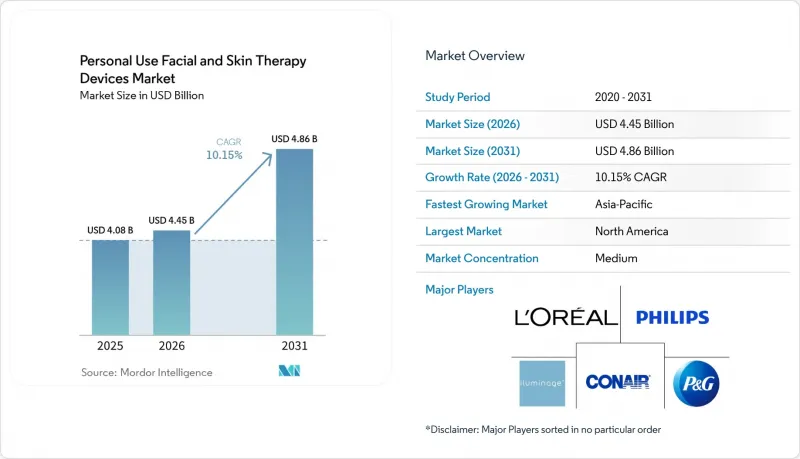
Mordor Intelligence에 의하면, 개인용 얼굴 및 피부 치료 기기 시장 규모는 2025년 40억 8,000만 달러로 평가되었습니다. 2026년에는 44억 5,000만 달러로 확대되어 2031년까지 48억 6,000만 달러에 이를 것으로 예측됩니다.
2026년부터 2031년까지 연평균 성장률(CAGR) 10.15%를 나타낼 것으로 전망됩니다.
본 보고서는 기기 유형(클렌징 브러시, LED 테라피, 미세전류 등), 기술(회전/진동, 초음파, 미세전류/EMS 등), 용도(여드름, 안티에이징 등), 유통 채널(온라인 소매 등) 및 지역(북미, 유럽, 아시아태평양 등)별로 분류되어 있습니다. 시장 규모 및 전망은 금액(달러) 기준으로 표시되어 있습니다.
세계의 개인용 얼굴 및 피부 치료 기기 시장 동향 및 인사이트
가정용 미용 기기의 보급 확대
전문가에게 받는 페이셜 트리트먼트의 연간 누적 구독 비용이 기기 구입 비용을 초과함에 따라, 소비자들은 시술을 클리닉에서 집 욕실로 옮기고 있습니다. 한국 제조업체 APR은 2025년 첫 9개월 동안 200만 대의 Medicube를 출하했으며, 재구매 및 선물 수요에 힘입어 25세에서 45세 사이의 전문직 계층 사이에서 이 기기의 소유가 점차 정착되고 있습니다. 각 브랜드는 현재 지속적인 수익을 확보하기 위해 전도성 젤이나 특정 파장에 대응하는 에센스를 세트로 판매하고 있으며, 이는 ‘면도기와 면도날’ 비즈니스 모델을 연상시킵니다. CES 2026에서 공개된 삼성의 ‘AI 뷰티 미러’는 진단 기능과 맞춤형 코칭을 통해 하드웨어가 어떻게 참여 유도 플랫폼으로 변모할 수 있는지를 보여주고 있습니다. 독자적인 소모품을 보유하지 않은 기업은 기기, 소프트웨어 및 보충품의 시너지 효과를 통합한 생태계에 의해 이익률이 잠식될 위험이 있습니다.
소셜 미디어와 인플루언서가 주도하는 ‘클리닉 수준의 효과’에 대한 수요
짧은 동영상은 인지 단계부터 구매에 이르는 과정을 단축시키며, TikTok 튜토리얼에서는 정지 이미지 광고로는 재현할 수 없는 즉각적인 모공 축소 효과가 소개되고 있습니다. 그러나 노출이 늘어나면 비판적인 시선도 불러일으킵니다. 영국 광고표준청(ASA)은 2025년, 허가받지 않은 의료 효과를 내세웠다는 이유로 LED 마스크 관련 게시물을 삭제했으며, 이에 따라 각 브랜드는 피부과 전문의와의 협력, 동료 심사를 거친 데이터 공개, 인플루언서에 대한 지도 강화를 요구받게 되었습니다. 2025년, 한국에서 미국으로의 미용 기기 수출은 K-뷰티 온라인 매출 전체의 절반 이상을 차지했습니다. 이는 하드웨어를 다층적인 피부 관리의 필수 단계로 자리매김하는 피부과 전문의들이 지지하는 컨텐츠에 힘입은 결과입니다. 검증되지 않은 추천에 의존하는 기업은 규제 당국의 반발이나 신뢰도 하락이라는 위험을 감수하게 됩니다.
안전상의 우려 및 부적절한 사용의 위험
2025년, FDA의 MAUDE 데이터베이스에는 고강도 펄스 광(IPL) 기기로 인한 2도 화상 및 LED에 장시간 노출되어 발생한 망막 손상 사례가 기록되었습니다. 임상의가 피부 반응에 맞추어 조사량을 조절하는 것과는 달리, 가정에서 사용하는 사용자들은 더 빨리 결과를 얻기 위해 설정을 최대로 높여버리는 경우가 종종 있습니다. EU 의료기기 규정(MDR)에 따르면, 현재 일부 LED 및 RF 제품에 클래스 IIa 분류가 적용되어 있으며, 이에 따라 임상 평가 요건 및 시판 후 조사 범위가 확대되었습니다. 각 브랜드는 자동 정지 타이머, 피부 센서, 금기 사항 앱 등의 기능을 통해 이에 대응하고 있지만, 이러한 추가 기능으로 인해 부품 비용이 증가하고 있습니다. 배상책임보험의 보험료는 상승하고 있으며, 리콜은 여전히 큰 위험 요인으로 남아 있습니다.
부문별 분석
2025년에는 클렌징 브러시가 매출의 37.12%를 차지했으나, LED 치료 기기는 2031년까지 연평균 성장률(CAGR) 12.16%로 성장하고 있습니다. 항균 효과와 분기별 앱 업데이트를 특징으로 하는 Foreo의 실리콘 소재 Luna 시리즈는 클렌징 제품 애호가들 사이에서 여전히 높은 점유율을 유지하고 있지만, 630nm의 적색광과 830nm의 근적외선 파장을 제공하는 LED 마스크는 브러시로는 실현할 수 없는 콜라겐 자극 효과를 내세우고 있습니다. LED, 미세 전류, 고주파를 결합한 다기능 헤드셋은 프리미엄 제품으로서의 입지를 확고히 하고 있습니다. 독자적인 다이오드 어레이나 특허를 취득한 전극 레이아웃을 보유하지 않은 브랜드는 OEM 모조품이 전자상거래 채널에 넘쳐나는 상황에서 상품의 일반화 위기에 직면해 있습니다. 동료 심사를 거친 시험을 통해 시너지 효과를 입증한 장치 제조업체는 400달러 이상의 가격 책정을 정당화하고, 매출 총이익률을 유지할 수 있을 것입니다.
2세대 LED 마스크에는 얼굴 윤곽에 밀착되는 유연한 인쇄 회로가 적용되어, 피부에 밀착된 상태를 유지하면서 균일한 광선을 비춥니다. 로레알의 2026년 프로토타입은 재료 과학이 어떻게 편안한 착용감과 핸즈프리 조작을 가능하게 하는지 보여주고 있습니다. 교체 가능한 필터 렌즈, 자동 조광 센서, 앱을 통한 세션 추적 기능을 통합한 제조업체는 교체 주기를 연장하고, 소프트웨어 중심의 추가 판매 경로를 확보하게 될 것입니다.
2025년에는 회전식 및 진동식 모터가 기술 매출의 29.38%를 차지했으나, 포토닉 시스템은 연평균 11.65%의 성장률이 예상됩니다. 피부과 전문의들이 실시한 메타분석을 통해 여드름에는 415nm의 청색광이, 콜라겐 재형성에는 630nm의 적색광이 효과적이라는 사실이 입증됨에 따라, 개인용 페이셜 기기 시장에서 LED 및 레이저 기술의 점유율은 확대될 것으로 보입니다. FDA 제품 코드 NFO에 따라 승인된 미세전류 및 EMS 기기에는 앱을 통한 안내 및 복용 알림 기능이 추가되어 지속적인 사용을 장려하고 있습니다. 24-28kHz 초음파 스크러버는 동아시아에서 각질 제거용으로 여전히 인기를 끌고 있지만, 동료 심사를 거친 검증 연구가 제한적이기 때문에 그 프리미엄 가격의 상한선은 낮게 유지되고 있습니다.
적외선 열 기기는 헤어 케어 분야에서 페이셜 토닝 분야로 전환되고 있으며, 내장된 온도 센서가 과도한 열에 노출되는 것을 방지하고 있습니다. MTG와 아이신의 ‘Hydraid’ 프로젝트와 같은 제휴는 자동차 등급 폴리머가 미용 기기를 강화한다는 점에서 산업 간 혁신의 한 예입니다. 반도체 공급처나 배터리 연구개발 분야의 협력사를 확보하지 못한 브랜드는 스마트폰처럼 빠른 속도로 제품 개선을 거듭하는 포토닉스 분야의 선도 기업들에 뒤처지게 될 것입니다.
지역별 분석
북미는 2025년 시장 규모의 41.83%를 차지하며, 예측 가능한 FDA 승인 절차와 높은 가처분 소득의 혜택을 누렸습니다. 소비자들은 2-3년마다 클렌징 브러시에서 LED 마스크나 미세전류 기기로 교체하기 때문에 성장의 원동력은 신규 구매자보다는 교체 주기에 기인하고 있습니다. 미국의 피부과 의사들은 클리닉에서 RF 마이크로니들링 시술을 받는 동안 집에서 LED 케어를 자주 병행할 것을 권장하고 있으며, 이것이 이 치료법이 주류로 자리 잡는 데 기여하고 있습니다. 캐나다의 소매업체들은 프랑스어권 소비자들의 신뢰를 얻기 위해 이중언어 포장 및 캐나다 보건부의 등록 사실을 강조하고 있는 반면, 멕시코에서는 리드타임을 단축하고 스페인어 앱의 현지화를 도모하기 위해 니어쇼어링 물류를 활용하고 있습니다.
아시아태평양은 연평균 성장률(CAGR) 13.03%로 성장하고 있습니다. 한국에서는 각 브랜드가 팬데믹 이후 ‘집에서 즐기는 럭셔리 경험’에 대한 수요를 포착한 결과, 2025년 상반기 수출이 전년 동기 대비 42% 증가했습니다. 중국의 크로스보더 전자상거래 채널을 통해 소비자들은 ‘대구(代購)’를 통한 그레이 마켓을 피할 수 있게 되었으며, FDA 승인을 받은 레이저 핸드셋의 수입이 촉진되고 있습니다. 일본에서는 고령화가 진행되면서 비침습적인 주름 개선에 대한 수요가 증가하고 있으며, 현지 연구 개발에서는 치밀한 안전 기준이 중시되고 있어 해외 기업 시장 진입 장벽이 높아지고 있습니다. 동남아시아에서는 아직 시장 침투 초기 단계이지만, 인터넷 접속 환경의 개선과 인플루언서 마케팅의 확산에 힘입어 2027년 이후 급속한 성장이 예상됩니다.
유럽에서는 EU 의료기기 규정에 따라 LED 마스크와 RF 롤러가 클래스 IIa로 재분류되면서, 고액의 임상 데이터 파일 및 안전성 모니터링 보고서 제출이 의무화됨에 따라 이익률 압박에 직면해 있습니다. 독일, 프랑스, 이탈리아는 프리미엄 포지셔닝과 강력한 약국 네트워크 덕분에 여전히 견조한 시장 상황을 유지하고 있습니다. 아랍에미리트(UAE)를 필두로 한 중동에서는 고급 기기가 지위의 상징으로 구매되고 있으며, 면세점에서는 자체 브랜드의 스킨케어 제품과 세트로 판매되는 경우가 많습니다. 라틴아메리카는 소규모 시장에서 성장해 왔으며, 브라질과 아르헨티나에서는 할부 결제 계획과 포르투갈어·스페인어로 진행되는 현지 인플루언서 캠페인을 통해 환율 변동의 영향을 상쇄하고 있습니다.
기타 혜택 :
- 엑셀 형식 시장 예측(ME) 시트
- 3개월간의 애널리스트 지원
자주 묻는 질문
목차
제1장 서론
제2장 조사 방법
제3장 주요 요약
제4장 시장 구도
제5장 시장 규모 및 성장 예측
제6장 경쟁 구도
제7장 시장 기회 및 향후 전망
KTH 26.06.24According to Mordor Intelligence, the personal use facial and skin therapy devices market size is expected to increase from USD 4.08 billion in 2025 to USD 4.45 billion in 2026 and reach USD 4.86 billion by 2031, growing at a CAGR of 10.15% over 2026-2031.
This report is Segmented by Device Type (Cleansing Brushes, LED Therapy, Microcurrent, and More), Technology (Rotational/Vibrational, Ultrasonic, Microcurrent/EMS, and More), Application (Acne, Anti-Aging, and More), Distribution (Online Retail, and More), and Geography (North America, Europe, Asia-Pacific, and More). The Market and Forecasted in Terms of Value (USD).
Global Personal Use Facial And Skin Therapy Devices Market Trends and Insights
Growing Adoption of At-Home Beauty Devices
Consumers are moving treatments from clinics into bathrooms because cumulative subscription costs for professional facials exceed one-time hardware outlays over a single year. South Korean manufacturer APR shipped 2 million Medicube units in the first nine months of 2025, with repeat purchases and gifting normalizing device ownership among 25-to-45-year-old professionals. Brands now bundle conductive gels or wavelength-specific serums to capture recurring revenue, mirroring the razor-and-blade model. Samsung's AI Beauty Mirror, introduced at CES 2026, demonstrates how diagnostics and personalized coaching transform hardware into an engagement platform. Companies that lack proprietary consumables risk ceding margin to ecosystems that integrate device, software, and refill synergy.
Social Media and Influencer-Led Demand for Clinic-Like Results
Short-form video has collapsed the awareness-to-purchase funnel, with TikTok tutorials showcasing instant pore-reduction that static ads cannot match. Yet heightened exposure invites scrutiny. The UK Advertising Standards Authority removed LED mask posts in 2025 for unauthorized medical claims, pushing brands to collaborate with dermatologists, publish peer-reviewed data, and tighten influencer guidance. South Korean exports of beauty devices to the United States accounted for more than half of all K-beauty online sales in 2025, propelled by dermatologist-backed content that positions hardware as an essential step in multi-layered skincare. Firms relying on unvetted endorsements risk regulatory backlash and eroded credibility.
Safety Concerns and Risk of Improper Use
FDA MAUDE databases recorded second-degree burns from intense pulsed light units and retinal injuries from prolonged LED exposure during 2025. At-home users often maximize settings for faster results, unlike clinicians who tailor fluence to skin response. The EU's Medical Device Regulation now assigns Class IIa status to several LED and RF products, extending clinical-evaluation requirements and post-market surveillance. Brands have reacted with auto-shutoff timers, skin sensors, and contraindication apps, yet these additions inflate bills of material. Liability insurance is climbing, and recalls remain a headline risk.
Other drivers and restraints analyzed in the detailed report include:
- Integration of Smartphone Connectivity and Personalized Routines
- Miniaturization and High-Density Batteries Enabling Portability
- Counterfeit and Low-Quality Devices Eroding Trust
For complete list of drivers and restraints, kindly check the Table Of Contents.
Segment Analysis
Cleansing brushes held 37.12% of revenue in 2025, yet LED therapy units are advancing at a 12.16% CAGR through 2031. Foreo's silicone Luna line, with antimicrobial credits and quarterly app updates, retains share among cleansing loyalists, but LED masks offering 630 nm red and 830 nm near-infrared wavelengths deliver collagen-stimulation claims that brushes cannot match. Multi-function headsets combining LED, microcurrent, and radiofrequency secure premium positioning. Brands without proprietary diode arrays or patented electrode layouts face commoditization as white-label copies flood e-commerce channels. Device makers that evidence synergistic effects in peer-reviewed trials will justify USD 400-plus price points, safeguarding gross margins.
Second-generation LED masks incorporate flexible printed circuits that conform to facial contours, delivering even irradiance while maintaining skin contact. L'Oreal's 2026 prototype illustrates how material science can unlock comfortable wear and hands-free operation. Manufacturers integrating replaceable filter lenses, auto-dimming sensors, and app-based session tracking will extend replacement cycles and add software-driven upsell routes.
Rotational and vibrational motors controlled 29.38% of technology revenue in 2025, but photonic systems are projected to grow 11.65% per year. The personal use facial devices market share of LED and laser technologies will widen as dermatologists publish meta-analyses affirming 415 nm blue light for acne and 630 nm red light for collagen remodeling. Microcurrent and EMS devices cleared under FDA product code NFO add app coaching and compliance reminders, pushing repeat adherence. Ultrasonic scrubbers at 24-28 kHz remain popular in East Asia for exfoliation, yet limited peer-reviewed validation caps their premium price ceiling.
Infrared heat devices are migrating from hair care into facial toning, with embedded temperature sensors preventing thermal overexposure. Partnerships, such as MTG and Aisin's Hydraid project, illustrate cross-industry innovation where automotive-grade polymers fortify beauty hardware. Brands lacking semiconductor sourcing or battery R&D alliances will lag photonic leaders that iterate at smartphone speed.
Geography Analysis
North America commanded 41.83% of 2025 value, benefiting from predictable FDA clearances and high disposable income. Consumers upgrade from cleansing brushes to LED masks and microcurrent tools every two to three years, so growth stems more from replacement cycles than first-time adopters. U.S. dermatologists frequently recommend at-home LED sessions between in-clinic RF microneedling, reinforcing mainstream acceptance. Canadian retailers promote bilingual packaging and Health Canada registration to assure French-speaking consumers, while Mexico leverages near-shoring logistics to shorten lead times and localize Spanish-language apps.
Asia-Pacific is expanding at a 13.03% CAGR. South Korea's exports rose 42% year on year in the first half of 2025 as brands leveraged post-pandemic appetite for at-home luxury. China's cross-border e-commerce channels let shoppers bypass daigou gray markets, spurring imports of FDA-cleared laser handsets. Japan's aging population fuels demand for non-invasive wrinkle solutions, and local R&D emphasizes meticulous safety standards, raising the bar for foreign entrants. Southeast Asia shows early-stage penetration, but rising internet connectivity and influencer marketing foreshadow rapid upside from 2027.
Europe faces tougher margins as the EU Medical Device Regulation reclassifies LED masks and RF rollers into Class IIa, mandating costly clinical dossiers and vigilance reporting. Germany, France, and Italy remain resilient due to premium positioning and strong pharmacy networks. The Middle East, led by United Arab Emirates, buys luxury devices as status symbols, often bundling them with private-label skincare at duty-free outlets. Latin America grows from a small base, with Brazil and Argentina absorbing currency volatility through installment payment plans and local influencer campaigns in Portuguese and Spanish.
- Amorepacific
- BeautyBio Inc.
- Beurer
- Braun GmbH
- Carol Cole Company
- Conair Corporation
- Foreo AB
- Hitachi
- Home Skinovations Ltd.
- HoMedics Inc.
- Illuminage Beauty Inc.
- Koninklijke Philips
- L'Oreal S.A.
- MTG Co. Ltd.
- Nu Skin Enterprises Inc.
- Panasonic Corporation
- Pollogen Ltd.
- Procter & Gamble
- Shenzhen Leaflife Technology Co., Ltd.
- Shiseido Co., Ltd.
- Spectrum Brands Holdings Inc.
- Tria Beauty Inc.
- Ya-Man Ltd.
Additional Benefits:
- The market estimate (ME) sheet in Excel format
- 3 months of analyst support
TABLE OF CONTENTS
1 Introduction
- 1.1 Study Assumptions & Market Definition
- 1.2 Scope of the Study
2 Research Methodology
3 Executive Summary
4 Market Landscape
- 4.1 Market Overview
- 4.2 Market Drivers
- 4.2.1 Growing Adoption of At-Home Beauty Devices
- 4.2.2 Rising Disposable Income in Emerging Economies
- 4.2.3 Social Media & Influencer-Led Demand for Clinic-Like Results
- 4.2.4 Integration of Smartphone Connectivity & Personalized Routines
- 4.2.5 Regulatory Easing for Low-Energy Devices
- 4.2.6 Miniaturization & High-Density Batteries Enabling Portability
- 4.3 Market Restraints
- 4.3.1 Safety Concerns & Risk of Improper Use
- 4.3.2 Limited Clinical Evidence for Some Modalities
- 4.3.3 Counterfeit & Low-Quality Devices Eroding Trust
- 4.3.4 Fragmented Regulatory Standards Across Regions
- 4.4 Regulatory Landscape
- 4.5 Technological Outlook
- 4.6 Porter's Five Forces Analysis
- 4.6.1 Threat of New Entrants
- 4.6.2 Bargaining Power of Buyers
- 4.6.3 Bargaining Power of Suppliers
- 4.6.4 Threat of Substitutes
- 4.6.5 Competitive Rivalry
5 Market Size & Growth Forecasts
- 5.1 By Device Type
- 5.1.1 Cleansing Brushes
- 5.1.2 LED Therapy Devices
- 5.1.3 Microcurrent Devices
- 5.1.4 Dermal Rollers
- 5.1.5 Ultrasonic Skin Scrubbers
- 5.1.6 Multi-function Devices
- 5.1.7 Others
- 5.2 By Technology
- 5.2.1 Rotational/Vibrational
- 5.2.2 Ultrasonic
- 5.2.3 Microcurrent/EMS
- 5.2.4 LED/Laser Light
- 5.2.5 Thermal/Heat
- 5.2.6 Iontophoresis
- 5.2.7 Plasma & Radiofrequency
- 5.3 By Application
- 5.3.1 Acne Treatment
- 5.3.2 Anti-aging & Wrinkle Reduction
- 5.3.3 Skin Rejuvenation & Brightening
- 5.3.4 Hair Removal
- 5.3.5 Hyperpigmentation & Spot Correction
- 5.3.6 Others
- 5.4 By Distribution Channel
- 5.4.1 Online Retail
- 5.4.2 Specialty Stores
- 5.4.3 Direct Sales
- 5.4.4 Pharmacies & Drugstores
- 5.5 By Geography
- 5.5.1 North America
- 5.5.1.1 United States
- 5.5.1.2 Canada
- 5.5.1.3 Mexico
- 5.5.2 Europe
- 5.5.2.1 Germany
- 5.5.2.2 United Kingdom
- 5.5.2.3 France
- 5.5.2.4 Italy
- 5.5.2.5 Spain
- 5.5.2.6 Rest of Europe
- 5.5.3 Asia-Pacific
- 5.5.3.1 China
- 5.5.3.2 Japan
- 5.5.3.3 India
- 5.5.3.4 Australia
- 5.5.3.5 South Korea
- 5.5.3.6 Rest of Asia-Pacific
- 5.5.4 Middle East & Africa
- 5.5.4.1 GCC
- 5.5.4.2 South Africa
- 5.5.4.3 Rest of Middle East & Africa
- 5.5.5 South America
- 5.5.5.1 Brazil
- 5.5.5.2 Argentina
- 5.5.5.3 Rest of South America
- 5.5.1 North America
6 Competitive Landscape
- 6.1 Market Concentration
- 6.2 Market Share Analysis
- 6.3 Company Profiles (includes Global level Overview, Market-level Overview, Core Segments, Financials, Strategic Information, Market Rank/Share, Products & Services, Recent Developments)
- 6.3.1 Amorepacific Corporation
- 6.3.2 BeautyBio Inc.
- 6.3.3 Beurer GmbH
- 6.3.4 Braun GmbH
- 6.3.5 Carol Cole Company
- 6.3.6 Conair Corporation
- 6.3.7 Foreo AB
- 6.3.8 Hitachi Ltd.
- 6.3.9 Home Skinovations Ltd.
- 6.3.10 HoMedics Inc.
- 6.3.11 Illuminage Beauty Inc.
- 6.3.12 Koninklijke Philips N.V.
- 6.3.13 L'Oreal S.A.
- 6.3.14 MTG Co. Ltd.
- 6.3.15 Nu Skin Enterprises Inc.
- 6.3.16 Panasonic Corporation
- 6.3.17 Pollogen Ltd.
- 6.3.18 Procter & Gamble Co.
- 6.3.19 Shenzhen Leaflife Technology Co., Ltd.
- 6.3.20 Shiseido Co., Ltd.
- 6.3.21 Spectrum Brands Holdings Inc.
- 6.3.22 Tria Beauty Inc.
- 6.3.23 Ya-Man Ltd.
7 Market Opportunities & Future Outlook
- 7.1 White-space & Unmet-need Assessment