

|
시장보고서
상품코드
2063739
남미의 계면활성제 시장 : 점유율 분석, 업계 동향과 통계, 성장 예측(2026-2031년)South America Surfactants - Market Share Analysis, Industry Trends & Statistics, Growth Forecasts (2026 - 2031) |
||||||
 Mordor Intelligence
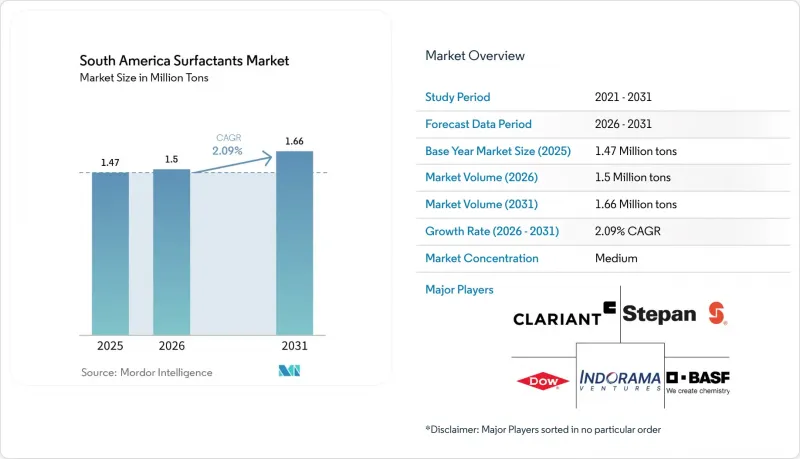
Mordor Intelligence에 의하면, 남미 계면활성제 시장 규모는 2025년에 147만 톤, 2026년에 150만 톤이 되어, 2031년까지 166만 톤에 이를 것으로 예측되며, 2026년부터 2031년까지 CAGR 2.09%로 성장할 전망입니다.
본 보고서는 유형(음이온성 계면활성제, 양이온성 계면활성제 등), 원료(합성 계면활성제 및 바이오 계면활성제), 용도(가정용 비누 및 세제, 퍼스널케어, 상업용·산업용 세정제 등), 그리고 지역(브라질, 아르헨티나, 칠레, 콜롬비아, 페루 및 기타 남미)별로 분류되어 있습니다. 시장 전망은 수량(톤) 단위로 제시되어 있습니다.
남미 계면활성제 시장 동향과 인사이트
퍼스널케어 및 홈 케어 제품 소비 확대 열풍
2024년, 라틴아메리카의 화장품 및 퍼스널케어 제품 매출액은 총 247억 4,000만 달러에 달했으며, 그중 브라질 한 나라만으로도 98억 3,000만 달러를 차지했습니다. 이러한 성장은 기존의 고형 비누에서 액체 바디워시나 샴푸와 같은 프리미엄 제품으로의 전환을 여실히 보여주고 있습니다. 코카미도프로파일베타인과 같은 순한 양성 계면활성제는 범용 LAS(알코올계 계면활성제)에 비해 30-50%의 가격 프리미엄이 있어, 원유 유래 원료 비용이 변동하더라도 가격 안정성을 확보하고 있습니다. 브라질의 액체 세제 소매 매출액은 2024년에 6억 9,781만 달러에 달했습니다. 이는 알코올 에톡실레이트나 알코올 에톡실황산염(AES) 계열 세제를 선호하는 프론트 로드식 세탁기가 도시 지역에서 널리 보급된 데 따른 결과입니다. 아르헨티나에서는 고인플레이션으로 인해 가전제품 교체가 제한되고 있어, 분말 세제가 여전히 주류를 이루고 있습니다. 콜롬비아와 페루에서는 도시 지역과 농촌 지역에 따라 세제의 형태별 보급 상황이 제각각이어서, 유통업체의 재고 관리를 복잡하게 만들고 있습니다.
농약 생산 능력 확대 가속화
브라질의 농약 처리된 경작지는 2023년부터 2024년까지 6.1% 확대되어 8,500만 헥타르에 달했습니다. BRANDT Consolidated사는 대두 및 옥수수 재배용 알코올 에톡실레이트 배합제를 공급하기 위해 론도노폴리스에 위치한 첨가제 공장에 1,500만 달러를 투자했습니다. 아르헨티나의 제제 제조업체들은 신규 투자 지연으로 인해 수입에 의존하고 있지만, 개정된 살포 드리프트 관련 지침에 따라 저발포성이며 고온 안정성이 뛰어난 비이온성 계면활성제에 대한 수요가 증가하고 있습니다. 브라질 규제 당국은 2027년까지 작물 보호 제품에서 알킬페놀 에톡실레이트를 단계적으로 폐지할 계획이며, 이에 따라 수요는 ISO 14001 규격을 준수하는 지방아민 에톡실레이트 및 알코올 에톡실레이트로 전환되고 있습니다.
APEO 및 인 함유 폐수에 대한 규제 강화
브라질 국가환경위원회(CONAMA)는 2024년 제498호 명령에 따라, 2027년 1월부터 산업 폐수 내 알킬페놀 함량을 10µ g/L로 제한하고, 세제 내 노닐페놀 에톡실레이트(NPE)를 질량비 0.1% 이하로 제한합니다. 아르헨티나에서는 PFAS 화합물을 POPs(잔류성 유기 오염 물질) 목록에 추가하고, 2026년 12월까지 소화용 거품제에 포함된 PFAS 함유 계면활성제의 사용을 금지할 예정입니다. 알코올 에톡실레이트 및 아민 옥사이드로의 원료 변경으로 인해 원자재 비용이 8%-12% 증가하게 되어, 입찰 중심의 기관용 유통 채널에 있어서는 과제가 되고 있습니다.
부문별 분석
2025년 판매량 중 음이온성 계면활성제가 46.85%를 차지하며, 분말 세제의 보급으로 인해 LAS가 주류를 이루고 있습니다. AES와 AOS는 액체 세제 및 샴푸 용도를 통해 판매량을 더욱 끌어올렸습니다. 등유에서 추출된 선형 알킬벤젠의 가격 변동에 연동되는 LAS의 가격 변동으로 인해, 브라질 북동부 지역에서는 MES로의 전환이 진행되고 있습니다. 해당 지역에서는 현지에서 생산된 유지 화학 원료 덕분에 LAS와의 비용 차이가 100달러/t 미만으로 좁혀졌습니다. 리튬 부유용 2차 알칸설폰산염이나 초저자극성 세정제용 설포수크신산염과 같은 특수 하위 부문은 틈새 시장이지만 수익성이 높은 기회를 제공합니다.
양성 계면활성제 및 기타 유형은 순한 사용감을 중시하는 퍼스널케어 브랜드와 2027년까지 APEO 함유 계면활성제의 단계적 폐지라는 배경에 힘입어, 2031년까지 연평균 성장률(CAGR) 3.05%를 기록하며 성장할 것으로 전망됩니다. 주로 알코올 에톡실레이트로 구성된 비이온성 계면활성제는 알킬페놀 에톡실레이트에서 브라질 지방화학 산업에서 유래한 직쇄 C12-C14 알코올 에톡실레이트로 점차 전환되고 있습니다. 규제 압력과 프리미엄화 추세에 따라 남미의 계면활성제 시장은 유형별로 서서히 재편되고 있습니다.
기타 혜택:
- 엑셀 형식 시장 예측(ME) 시트
- 3개월간의 애널리스트 지원
자주 묻는 질문
목차
제1장 서론
제2장 조사 방법
제3장 주요 요약
제4장 시장 구도
제5장 시장 규모와 성장 예측
제6장 경쟁 구도
제7장 시장 기회와 향후 전망
JHS 26.06.23According to Mordor Intelligence, the south america surfactants market size is projected to be 1.47 Million tons in 2025, 1.5 Million tons in 2026, and reach 1.66 Million tons by 2031, growing at a CAGR of 2.09% from 2026 to 2031.
This report is Segmented by Type (Anionic Surfactants, Cationic Surfactants, and More), Origin (Synthetic Surfactants and Bio-Based Surfactants), Application (Household Soaps and Detergents, Personal Care, Institutional and Industrial Cleaning, and More), and Geography (Brazil, Argentina, Chile, Colombia, Peru, and Rest of South America). The Market Forecasts are Provided in Volume (Tons).
South America Surfactants Market Trends and Insights
Growing Personal- and Home-Care Consumption Boom
Latin America's cosmetics and personal-care sales totaled USD 24.74 billion in 2024, with Brazil alone contributing USD 9.83 billion. This growth highlights a shift toward premium products, such as liquid body washes and shampoos, over traditional bar soaps. Mild amphoteric surfactants like cocamidopropyl betaine command a 30-50% price premium over commodity LAS, ensuring price stability even amid fluctuations in crude-derived feedstock costs. Brazil's liquid laundry detergent retail value reached USD 697.81 million in 2024, driven by urban adoption of front-loading washing machines that favor alcohol ethoxylate and Alcohol Ethoxy Sulfate (AES) systems. In Argentina, powder detergents remain dominant due to high inflation limiting appliance upgrades. Colombia and Peru exhibit mixed adoption of detergent formats across urban and rural areas, complicating distributor inventory management.
Accelerating Agrochemical Capacity Additions
Brazil's pesticide-treated cropland expanded by 6.1% between 2023 and 2024, reaching 85 million hectares. BRANDT Consolidated invested USD 15 million in an adjuvant plant in Rondonopolis to supply alcohol-ethoxylate blends for soybean and corn crops. Argentine formulators depend on imports due to delayed greenfield investments, but revised spray-drift guidelines are driving demand for low-foam, high-temperature-stable nonionics. Brazilian regulators plan to phase out alkylphenol ethoxylates in crop-protection products by 2027, shifting demand toward fatty-amine ethoxylates and alcohol ethoxylates that meet ISO 14001 standards.
Tightening APEO and Phosphorus Effluent Laws
Brazil's Conselho Nacional do Meio Ambiente (CONAMA), 498/2024 limits industrial effluent alkylphenol content to 10 µg/L and restricts detergent nonylphenol ethoxylate (NPE) to 0.1% by mass starting January 2027. Argentina has added PFAS compounds to its POPs inventory and will ban PFAS-containing surfactants in firefighting foams by December 2026. Reformulating to alcohol ethoxylates and amine oxides increases raw material costs by 8%-12%, a challenge for tender-driven institutional channels.
Other drivers and restraints analyzed in the detailed report include:
- Bio-Based Surfactants Favored by Oleochemical Feedstock Growth
- Lithium-Ore Flotation Chemicals Demand Spike
- Crude-Oil Price Volatility Hitting LAB Feedstock
For complete list of drivers and restraints, kindly check the Table Of Contents.
Segment Analysis
Anionic surfactants accounted for 46.85% of 2025 volume, with LAS dominating due to its prevalence in powder detergents. AES and AOS contributed additional volume through liquid detergent and shampoo applications. LAS price volatility, linked to kerosene-derived linear alkylbenzene, is prompting a shift toward MES in Brazil's Northeast, where localized oleochemical feedstocks narrow cost differences to less than USD 100/t compared to LAS. Specialty sub-segments, such as secondary alkane sulfonates in lithium flotation and sulfosuccinates in ultra-mild cleansers, offer niche but profitable opportunities.
Amphoteric surfactants and other types are projected to grow at a 3.05% CAGR through 2031, driven by personal-care brands emphasizing mildness and the phase-out of APEO co-surfactants by 2027. Nonionics, primarily alcohol ethoxylates, are transitioning from alkylphenol ethoxylates to straight-chain C12-C14 alcohol ethoxylates derived from Brazil's oleochemical industry. Regulatory pressures and premiumization trends are gradually reshaping the South America surfactants market by type.
List of Companies Covered in this Report:
- BASF
- Braskem SA
- Clariant
- Croda International plc
- Deten Quimica S.A.
- Dow
- Evonik Industries AG
- Godrej Industries
- Indorama Ventures Public Company Limited
- Innospec
- Kao Corporation
- Lonza
- Nouryon
- P&G Chemicals
- Sasol
- Solvay
- Stepan Company
- TENSAC
- YPF
Additional Benefits:
- The market estimate (ME) sheet in Excel format
- 3 months of analyst support
TABLE OF CONTENTS
1 Introduction
- 1.1 Study Assumptions and Market Definition
- 1.2 Scope of the Study
2 Research Methodology
3 Executive Summary
4 Market Landscape
- 4.1 Market Overview
- 4.2 Market Drivers
- 4.2.1 Growing personal and home-care consumption boom
- 4.2.2 Accelerating agrochemical capacity additions
- 4.2.3 Bio-based surfactants favoured by oleochemical feedstock growth
- 4.2.4 Lithium-ore flotation chemicals demand spike
- 4.2.5 Brazilian "green-chem" tax incentives
- 4.3 Market Restraints
- 4.3.1 Tightening APEO and phosphorus effluent laws
- 4.3.2 Crude-oil price volatility hitting LAB feedstock
- 4.3.3 Regional macro-economic instability
- 4.4 Value Chain Analysis
- 4.5 Porter's Five Forces
- 4.5.1 Bargaining Power of Suppliers
- 4.5.2 Bargaining Power of Buyers
- 4.5.3 Threat of New Entrants
- 4.5.4 Threat of Substitutes
- 4.5.5 Degree of Rivalry
5 Market Size and Growth Forecasts (Volume)
- 5.1 By Type
- 5.1.1 Anionic Surfactants
- 5.1.1.1 Linear Alkylbenzene Sulfonate (LAS or LABS)
- 5.1.1.2 Alcohol Ethoxy Sulfate (AES)
- 5.1.1.3 Alpha-Olefin Sulfonate (AOS)
- 5.1.1.4 Secondary Alkane Sulfonate (SAS)
- 5.1.1.5 Methyl Ester Sulfonate (MES)
- 5.1.1.6 Sulfosuccinates
- 5.1.1.7 Other Anionic Surfactants
- 5.1.2 Cationic Surfactants
- 5.1.2.1 Quaternary Ammonium Compounds
- 5.1.2.2 Other Cationic Surfactants
- 5.1.3 Non-ionic Surfactants
- 5.1.3.1 Alcohol Ethoxylates
- 5.1.3.2 Ethoxylated Alkyl-phenols
- 5.1.3.3 Fatty Acid Esters
- 5.1.3.4 Other Non-ionic Surfactants
- 5.1.4 Amphoteric and Other Types
- 5.1.1 Anionic Surfactants
- 5.2 By Origin
- 5.2.1 Synthetic Surfactants
- 5.2.2 Bio-based Surfactants
- 5.3 By Application
- 5.3.1 Household Soaps and Detergents
- 5.3.2 Personal Care
- 5.3.3 Institutional and Industrial Cleaning
- 5.3.4 Oilfield Chemicals
- 5.3.5 Lubricants and Fuel Additives
- 5.3.6 Agricultural Chemicals
- 5.3.7 Food Processing
- 5.3.8 Textile Processing
- 5.3.9 Other Applications
- 5.4 By Geography
- 5.4.1 Brazil
- 5.4.2 Argentina
- 5.4.3 Chile
- 5.4.4 Colombia
- 5.4.5 Peru
- 5.4.6 Rest of South America
6 Competitive Landscape
- 6.1 Market Concentration
- 6.2 Strategic Moves
- 6.3 Market Share (%)/Ranking Analysis
- 6.4 Company Profiles (includes Global level Overview, Market level overview, Core Segments, Financials as available, Strategic Information, Products and Services, and Recent Developments)
- 6.4.1 BASF
- 6.4.2 Braskem SA
- 6.4.3 Clariant
- 6.4.4 Croda International plc
- 6.4.5 Deten Quimica S.A.
- 6.4.6 Dow
- 6.4.7 Evonik Industries AG
- 6.4.8 Godrej Industries
- 6.4.9 Indorama Ventures Public Company Limited
- 6.4.10 Innospec
- 6.4.11 Kao Corporation
- 6.4.12 Lonza
- 6.4.13 Nouryon
- 6.4.14 P&G Chemicals
- 6.4.15 Sasol
- 6.4.16 Solvay
- 6.4.17 Stepan Company
- 6.4.18 TENSAC
- 6.4.19 YPF
7 Market Opportunities and Future Outlook
- 7.1 White-space and Unmet-need Assessment


